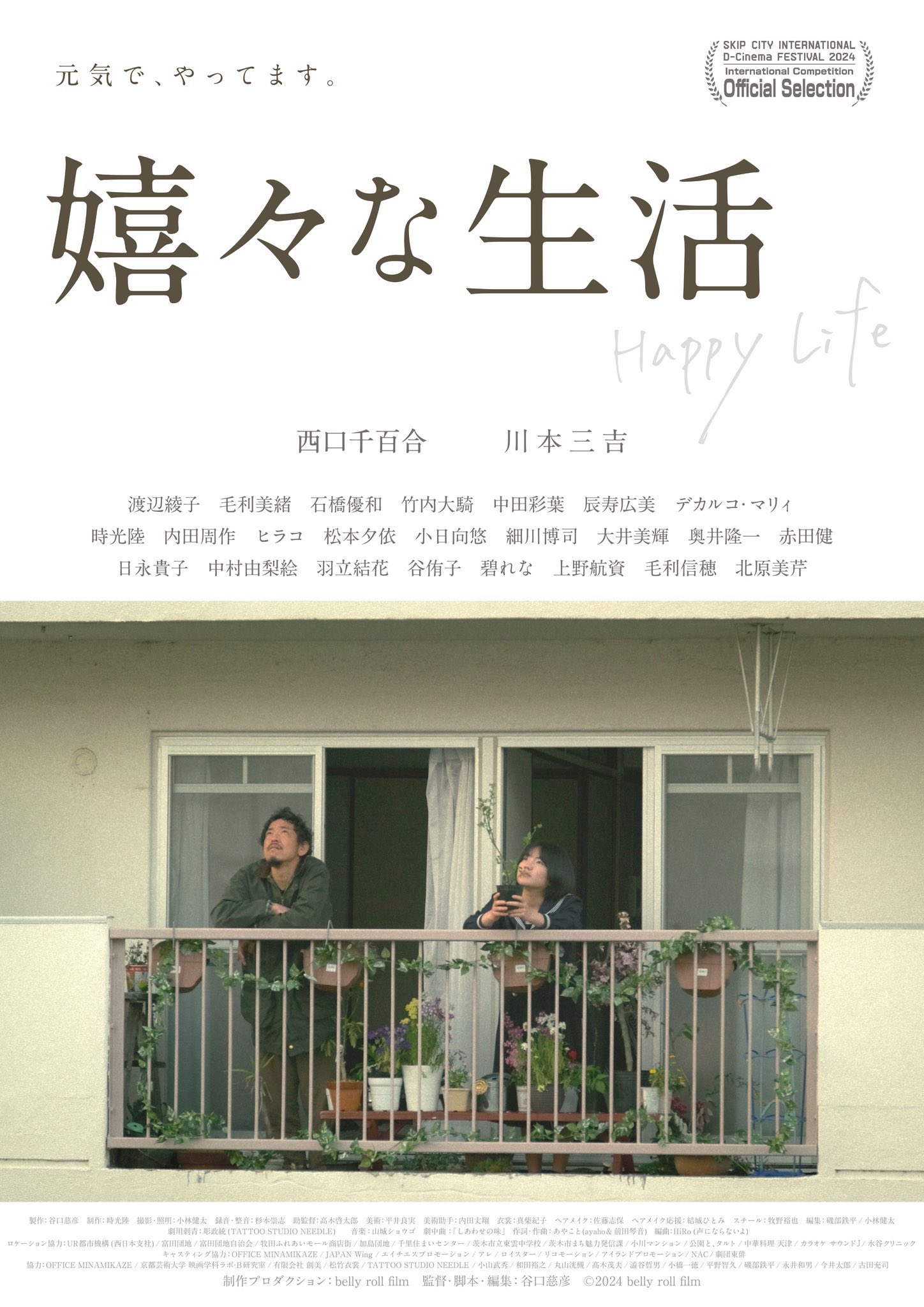
Happy Life (嬉々な生活, Yoshihiko Taniguchi, 2024)

A teenage girl finds herself responsible for her family after her mother’s sudden death and father’s descent into depression in the ironically named Happy Life (嬉々な生活, Kikina Seikatsu). Filmed with gritty realism, Yoshihiko Taniguchi’s indie drama explores life on the margins but also the judgement and stigmatisation of those who are struggling, along with the echoing effects of parental neglect and a wider lack of compassion and understanding in the community.

Kiki once had a happy life but after her parents moved into a larger apartment on a housing estate, it all seemed to go wrong. Her mother died suddenly, and her father Kensuke has become depressed which has left him unable to work and plunged the family into financial insecurity. As the oldest of three siblings, Kiki has had to pick up the strain with the consequence that she has little time to think about her own future. She tells a friend that she doesn’t have any dreams, but it maybe more that she already feels them to be impossible. She’s more or less stopped going to school and is checking out ways to earn a lost of money fast including a few jobs for a dodgy relative of her friend Miyu who keeps trying to talk her into taking up compensated dating or embark on a blackmail plot of their unpleasant head teacher they say is at any rate at least over friendly with pupils. 

Mr. Maehara is also harassing Kiki’s seemingly similarly depressed teacher who has a habit of putting things in his letter box as revenge. Though he chided her for not addressing Kiki’s truancy problem or investigating whether there might be issues at home, Ms. Kozuma does later take an interest in Kiki and her family which does allow her to begin emerging from her own depression after quitting her teaching job. Lifting some of the burden from Kiki, she helps out by cleaning the apartment and cooking for the family while encouraging Kensuke to apply for benefits and seek psychiatric treatment for his declining mental health.

Those on the danchi are supportive in some ways and in others not. Many of the neighbourhood women feel sorry for the children and often give them leftover food, but at the same time they’re wary of Kensuke and have lost both patience with and sympathy for him. The family is now several months behind on the rent and some of the other residents dissapparove of the family being allowed to go on living there while there is no immediate sign that their living standards will continue to rise. A window herself, Mrs Miyake takes Kensuke to task for failing his children but he doesn’t have much of an answer for her, while Ms Kozuma tells her they should be patient because Kensuke ill and can’t simply snap out it to resume a paternal role over his family.

For his own part, he resents Ms Kozuma’s help because it highlights his own failing but is unable to do anything about his situation while lost in dreams of his late wife. Matters come to a head when he inexplicably takes a little girl’s scooter and throws it on the ground which proves the last straw for a community that’s already come to think of him of “scary”. The irate father of the little girl goes so far to suggest that the family should leave because Kensuke makes people “uncomfortable”, even though his own aggression makes him dangerous and unpredictable. Kiki tries to talk back and defend her father, but the other man simply tells Kensuke that he needs to teach his kids some manners because his daughter’s got problems too, signalling the extent to which anyone who doesn’t fit the norm is not really welcome in this society. 

Even so, thanks to the help of Ms Kozuma and means of connecting with her late mother, Kiki gains the courage to dream, too, deciding she will go to high school after all and would like to become a nurse. Though often bleak in its depiction of the family’s mounting disintegration, the film does allow a ray of possibility to leak through suggesting that Kiki will be able to rediscover a happy life sometime in the future even if right now she doesn’t even have the time to imagine in.


Happy Life screens 30th May as part of this year’s Nippon Connection.

Trailer (English subtitles)

The Chrysanthemum and the Guillotine (菊とギロチン 女相撲とアナキスト, Takahisa Zeze, 2018)

Chrysanthemum and the Guillotine poster 1“I see it now, we can’t change anything” a despondent would-be-revolutionary decries in a moment of despair. Almost 100 years later, you might have to concede they have a point when the world finds itself on a tipping point once again and the same old prejudices refuse to disappear. Takahisa Zeze’s The Chrysanthemum and the Guillotine (菊とギロチン 女相撲とアナキスト, Kiku to Guillotine Onna Zumo to Anarchism) casts an unflinching eye back towards the Japan of 1923 caught in the aftermath of a devastating natural disaster which followed on from a chaotic era of rapid social change and bewildering modernisation during which a series of battles were being fought for the future direction of a nation still trying to define itself in world dominated by empires.

When the Great Kanto Earthquake struck claiming mass loss of life and extreme damage to infrastructure, the ensuing chaos gave rise to a vicious rumour that Koreans were taking advantage of the situation to foment the independence movement by poisoning wells and committing arson leading to a pogrom against anyone who failed to prove themselves Japanese enough to satisfy the mob. Meanwhile, the same forces also turned on political opponents whose influence they perceived as destructive to their own aims culminating in the murder of prominent anarchist Sanae Osugi along with his feminist wife Noe Ito and their six-year-old nephew.

We begin, however, with a different band of outsiders in the Tamaiwa itinerant female sumo wrestler troupe many of whom have taken refuge in an isolated world of female solidarity in order to escape abusive relationships. Kiku (Mai Kiryu) is one such woman who found the courage to run away from a violent husband on catching sight of the powerful female wrestlers who made her realise that she too could become strong like them. Having accepted that “weak people can’t change anything”, Kiku has vowed to become “strong” in order to claim her own agency and ensure that she can’t be pushed around ever again.

Meanwhile, an anarchist sect known as the Guillotines are fomenting a more general kind of revolution but have not been very successful and are now on the run from the authorities which is how they end up running into the female wrestlers and more or less bringing them into the struggle. Led by libertine and (as yet) unpublished poet Tetsu Nakahama (Masahiro Higashide), the Guillotines are more romantic bandits with high ideals than serious revolutionaries. They rob the rich to fund their “activism” but spend most of the money on sex and drink while plotting revenge for the murder of Osugi with various schemes which imply that at heart they aren’t so different from that which they hate.

Nevertheless, the forces of darkness are rising and history tells us that, temporally at least, they will win. The vigilante militias which carried out the massacres were largely made-up of farmer soldiers who’d served in Russia and experienced terrible hardship. Unable to bear the idea that their traumatic wartime experiences had been a senseless waste, they doubled down on militarist ideology and insisted on their nationalistic superiority. This led them to hate, to regard anything that lay outside of their code as inferior and dangerous. Though the massacres were condemned by the government and the perpetrators prosecuted for their crimes, the convictions were largely quashed a short time later which is why we see our major villains rewarded by the state and our revolutionary “heroes” imprisoned for their resistance towards state oppression and desire to create a fairer, more equal society.

Ironically enough, Nakahama’s big utopian idea is an overly idealistic vision for a future Manchuria which in hindsight proves extremely uncomfortable but is perhaps an indication of the naivety of the times. Even so, the Guillotines for all their romanticism are essentially progressive in their thinking and in full support of sexual equality, insisting on the necessity of the wrestlers to embrace their physical capabilities in order to defend themselves against an oppressive and patriarchal society fuelled by male violence. Though this in itself might be mildly problematic in implying that in order to become “equal” women must learn to be more like men, it also plays into the film’s subtle sense of irony in which the tools of militarism are being subverted in order to oppose it. The “intellectual” Guillotines find their revolutions failing, while fighting fire with fire may be the only surefire way to win even if it legitimises the problematic act of violence in the process. Then again, as another of the Guillotines puts it, the truly strong are those who have no need of killing. 

In any case, the Tamaiwa stable becomes a tiny enclave of progressive values built on female solidarity though they ultimately discover that solidarity is not quite enough and they cannot protect each other from the ravages of the times without external assistance. Even so, they attempt to hold the line, literally pushing back against the fascist incursion while insisting on their right to resist as human beings with will and agency. The prognosis seems bleak. 100 years later the same battles are still being fought and the same tensions rising in the wake of new disasters yet there are also those who will continue to resist and like the Tamaiwa wrestlers refuse to give in to those who threaten to restrict their freedom.


The Chrysanthemum and the Guillotine was screened as part of the 2019 Nippon Connection Film Festival.

Original trailer (no subtitles)