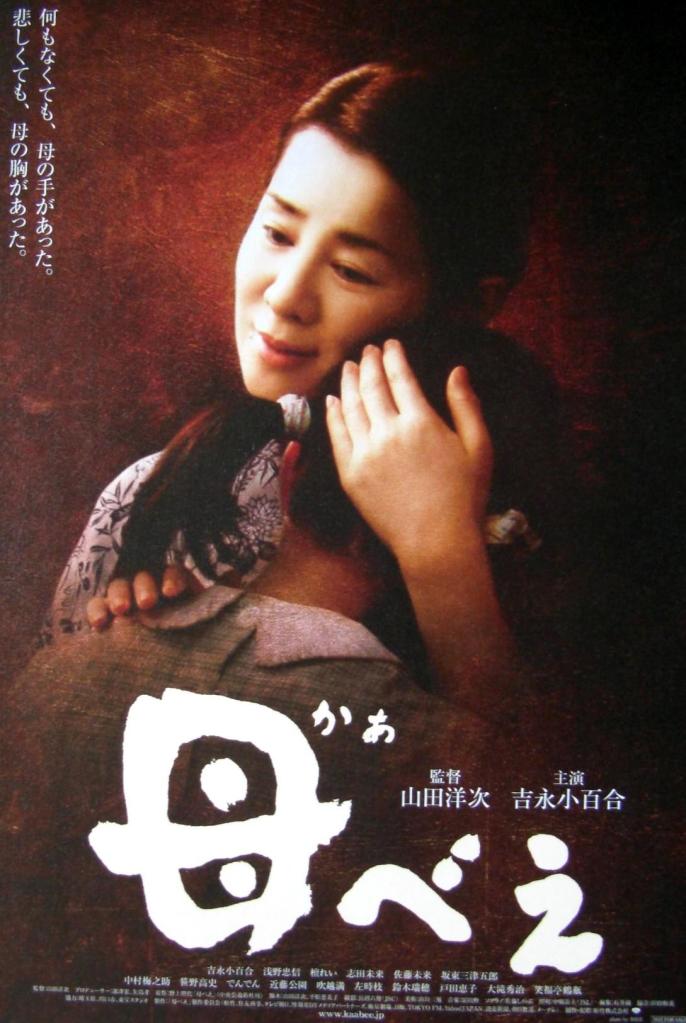
 Yoji Yamada’s films have an almost Pavlovian effect in that they send even the most hard hearted of viewers out for tissues even before the title screen has landed. Kabei (母べえ), based on the real life memoirs of script supervisor and frequent Kurosawa collaborator Teruyo Nogami, is a scathing indictment of war, militarism and the madness of nationalist fervour masquerading as a “hahamono”. As such it is engineered to break the hearts of the world, both in its tale of a self sacrificing mother slowly losing everything through no fault of her own but still doing her best for her daughters, and in the crushing inevitably of its ever increasing tragedy.
Summer, 1940. The Nogamis are a happy family who each refer to each other by adding the cute suffix of “bei” to their names. The father, Tobei (Bando Mitsugoro X), is a writer and an intellectual opposed to Japan’s increasing militarism and consequently has found himself in both political and financial difficulties as his writing is continually rejected by the censors. Eventually, the secret police come for him, dragging him away from his home in front of his terrified wife and daughters. After Tobei is thrown into jail for his “thought crimes”, the mother, Kabei (Sayuri Yoshinaga), is left alone with her two young girls Hatsuko and Teruyo (Hatsubei and Terubei in family parlance).
Though devastated, Kabei does not give up and continues to try and visit her husband, urging his release and defending his reputation but all to no avail. Thankfully, she does receive assistance from some of her neighbours who, at this point at least, are sympathetic to her plight and even help her get a teaching job to support herself and the children in the absence of her husband. She also finds an ally in the bumbling former student, Yamazaki (Tadanobu Asano), as well as her husband’s sister Hisako (Rei Dan), and her brother (Tsurube Shofukutei) who joins them for a brief spell but ultimately proves a little too earthy for the two young middle class daughters of a dissident professor.
The time passes and life goes on. The war intensifies as do the attitudes of Kabei’s friends and neighbours though the family continues its individual struggle, sticking to their principles but also keeping their heads down. By the war’s end, Kabei has lost almost everything but managed to survive whilst also ensuring her children are fed and healthy. A voice over from the older Teryuo calmly announces the end of the conflict to us in such a matter of fact way that it’s impossible not wonder what all of this was for? All of this suffering, death and loss and what has it led to – even more suffering, death and loss. A senseless waste of lives young and old, futures ruined and families broken.
Yet for all that, and to return to the hahamono, the Nogami girls turned out OK. Successful lives built in the precarious post-war world with careers, husbands and families. Unlike many of the children in the typical mother centric movie, Hatsuko and Teruyo are perfectly aware of the degree to which their mother suffered on their behalf and they are both humbled and grateful for it. Kabei was careful and she kept moving to protect her children in uncertain times. Seen through the eyes of a child, the wartime years are ones of mounting terror as fanatical nationalism takes hold. Bowler hatted men seem to rule everything from the shadows and former friends and neighbours are primed to denounce each other for such crimes as having the audacity to wear lipstick in such austere times. In one notable scene, the neighbourhood committee begins its meeting by bowing at the Imperial Palace, until someone remembers the paper said the Emperor was in a different palace entirely and they all have to bow the other way just in case.
Though the tale is unabashedly sentimental, Yamada mitigates much of the melodrama with his firmly domestic setting. We see the soldiers massing in the background and feel the inevitable march of history but the sense of tragedies both personal and national, overwhelming as it is, is only background to a testament to the strength of ordinary people in trying times. An intense condemnation of the folly of war and the collective madness that is nationalism, Kabei is the story of three women but it’s also the story of a nation which suffered and survived. Now more than ever, the lessons of the past and the sorrow which can only be voiced on the deathbed are the ones which must be heeded, lest more death and loss and suffering will surely follow.
Original trailer (English subtitles)
 As you read the words “adapted from the novel by Kanae Minato” you know that however cute and cuddly the blurb on the back may make it sound, there will be pain and suffering at its foundation. So it is with A Chorus of Angels (北のカナリアたち, Kita no Kanariatachi) which sells itself as a kind of mini-take on Twenty-Four Eyes (“Twelve Eyes” – if you will) as a middle aged former school mistress meets up with her six former charges only to discover that her own actions have cast an irrevocable shadow over the very sunlight she was determined to shine on their otherwise troubled young lives.
 Windows on Worlds