Dual City (デュアル・シティ, Yokna Hasegawa, 2015)

dual cityCyberpunk and Japan are a match made in heaven though, it has to be said, it’s often been much more an inherited influence in international pop culture than something which has originated directly in Japan. Yokna Hasegawa’s Dual City (デュアル・シティ) puts this to rights a little with a politically infused tale of Japan in 2034 – a nation divided and engaged in a wider information war with the little guy at the mercy of evil corporate giants.

The year is 2034, following a civil war Japan has been divided in two with a north/south border located at the feet of Mount Fuji. Our protagonist, Yoriko, is a nurse and mother working in the North sector which is definitely thought of as the least advantageous place to be. When her hospital is raided by guerrilla soldiers, Yoriko finds herself in the relatively lucky position of last survivor but is then charged with assisting this “resistance movement” by taking over from the soon to be dead insurgent, Gou, and completing his mission of carting a mysterious suitcase across the border.

Once in the south, we’re introduced to the rest of the band including the dynamic Ayumi who can’t seem to forgive Yoriko for the loss of Gou. The gang’s ultimate goal is to expose the shady Nephe corporation who, aside from their business interests of arms dealing and android production, have begun building a virtual world known as “information life” which is constructed through harvesting the memories of Northern corpses. Yoriko lost her daughter to terrorist aggression and the idea that she might be able to see her again, albeit in virtual form, is one which she is unable to pass up.

Adding to the intrigue is the love story between a resistance member and an android which may or may not come to be a liability and the hacker group’s involvement with the steady stream of illegal migrants somehow making the dangerous cross border journey into the relative safe haven of the South. Many of these people have injuries or ailments that would be best served by a doctor, but having no proper papers they can’t risk a hospital and so the care that Yoriko can provide becomes another useful asset for the group.

Drawing parallels with other “divided” nations, Dual City looks at a multitude of contemporary social and philosophical problems from dealing with refugees fleeing an oppressive regime to the power of multinational corporations and the eternal quality of a mother’s love. Nephe (represented in a futuristic ad campaign starring Third Window Films’ Adam Torel as its heinous CEO) commits the very worst kind of identity theft as it steals and repurposes the very soul of those that it has killed by sucking out their memories and using them to create artificial counterparts in their online world. Are these ghosts in the machine any less “real” than their flesh counterparts were? A standard question of the cyberpunk world and one which still has no clear answer, but Dual City continues to explore it in a mature and nuanced manner.

Though an undoubtedly low budget, indie movie Dual City makes a decent job of creating its realistically grimy cyberpunk world with its interactive video screens and invisible techno warfare. Special effects, though sparse, are effectively achieved and never call attention to themselves. Dual City is actually the second part of a projected trilogy with the overarching title of Japan Year Zero (following the 2014 short Illuminations) but is perfectly intelligible even without knowledge of the previous film and manages to create a sense of a bleak, oppressive society which travels along with Yoriko from the totalitarian North to the supposedly freer South. Eventually Yoriko’s love for her daughter transforms and becomes something larger, an eternal and infinite love for all mankind that represents our last, best hope for peace. It only remains to be seen if the troubled society of 2034 can can learn to follow a similar road.


Reviewed as part of the SCI-FI London Film Festival 2016.

On a side note, Illuminations seems to be the film Hoshi Ishida was talking about when I interviewed him (for UK Anime Network) a couple of years ago. Small world! I would like to see the movie but it doesn’t seem to be available anywhere, maybe one day. Here is a trailer for Illuminations:

You can also keep up with director Yonka Hasegawa’s work via her website and twitter feed!
Parasyte The Movie Part 1 (寄生獣, Takashi Yamazaki, 2014)

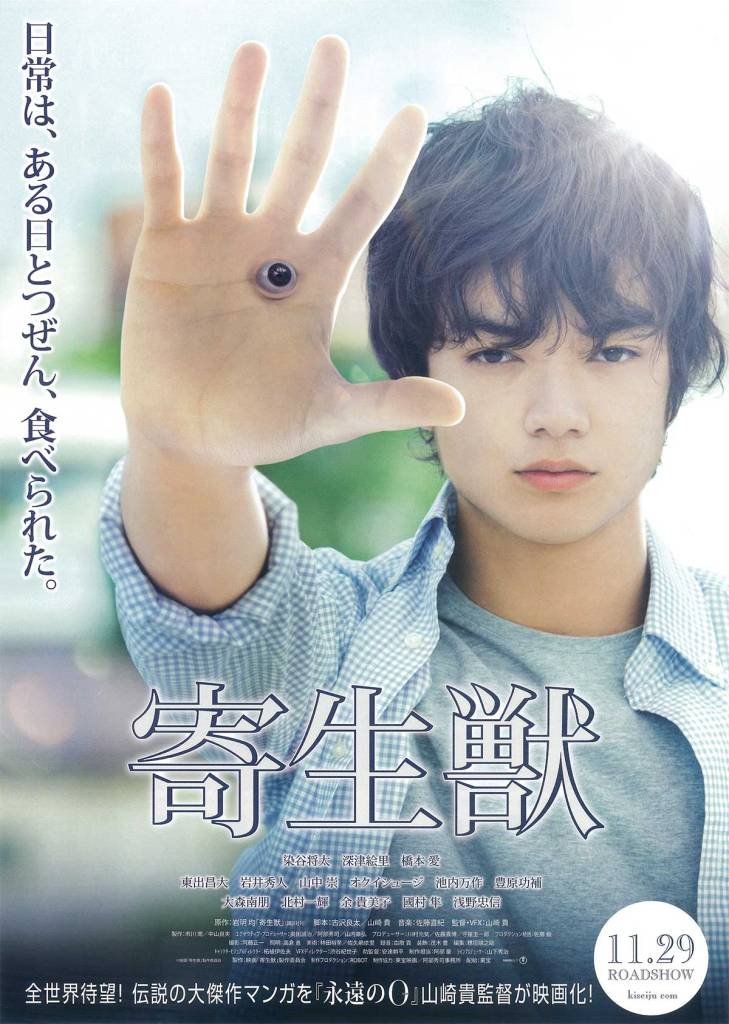
parasyte part oneReview of Takashi Yamazaki’s adaptation of Hitoshi Iwaaki’s manga Parasyte – Parasyte: The Movie Part 1 (寄生獣, Kiseiju) first published by UK Anime Network.


Humans – are we the biggest threat to our planet and ultimately our own survival? If the world population were halved, would we also halve the number of forests that are burned and the damage that we’re doing to our natural environment? These thoughts run as a voice over beginning the full scale blockbuster adaptation of Hitoshi Iwaaki’s classic manga which was also recently adapted into a critically acclaimed anime. The Parasyte of title most obviously refers to the extraterrestrial microbes which are climbing into the driving seat of an unsuspecting host’s brain with nothing less than the colonisation of our entire species on their “minds”, yet, is it we ourselves who are the real parasites feasting on the corpse of our dying planet? Parasyte is that rare blockbuster treat that is content to give us man-eating, shapeshifting, monsters and gore filled destruction but also wants us to dig a little deeper into our own souls at the same time.

Shinichi Izumi’s (Shota Sometani) mum (Kimiko Yo) probably told him not to sleep with his headphones on but luckily they’re about to save his life as a weird little bug tries to crawl into his ears but finding them blocked opts for the arm instead. Wrapping the cord around his elbow tourniquet style, Shinichi is able to stop the bug’s progress but the parasite has taken root and Shinichi is horrified to find his right hand is no longer his own but is now controlled by a dispassionate alien that eventually names himself “Migi”.

Shinichi and Migi develop an odd kind of partnership born of their mutual dependency which is threatened only by the presence of other Parasytes who have successfully infiltrated a human brain and can blend in with the general populace (aside from their cold and robotic natures). To his horror, Shinichi discovers a new teacher at his school is actually a Parasyte stooge who recognises the “research” potential of a hybrid team like Shinichi and Migi. Becoming very keen on “experiments” Ryoko Tamiya (Eri Fukatsu) has also mated with one of her fellow Parasytes in the hopes of exploring what will happen with the birth – will it be purely a human child seeing as it’s born of two human bodies or will something of the Parasyte get through? However, Ryoko’s “network” of Parasytes aren’t all as committed to scientific research as she is and Shinichi and Migi quickly find themselves becoming humanity’s last line of defence against the invading creatures.

Shinichi is the teenage lead of the picture but in this first part at least it seems to be Ryoko leading the show. She gives us the original voice over and it’s her burgeoning motherhood that gives the film its clearest ideological standpoint. As the dispassionate Ryoko comes to develop the beginnings of maternal pangs and a desire to ensure the survival of her child (or perhaps just her “experiment”), so Shinichi finds his humanity being erased by the parasitical “child” he is gestating in the form of Migi. At the same time Migi begins to take on a protective mentality towards his host which may be more than simple self preservation particularly after a traumatic near death experience bonds the two even tighter together, in a biological sense at least.

Though the film obviously references former genre classics, in particular Invasion of the Bodysnatchers with its difficult to detect pod people, it steers clear of the “red scare” inspired sense of paranoia and the feeling of intense mistrust that exists even between supposedly good friends. Migi is able to sense (to a degree) his own kind making the presence of potentially dangerous Parasytes easier to detect but the fact that the Parasytes are able to colonise and use the form of someone all too familiar to confuse their enemies restores something of their power to lurk unsuspected in the shadows.

All this seems to suggest that the big screen live action adaptation of Parasyte would be a fairly serious affair yet the tone is often lighthearted, maintaining the darkly humorous buddy comedy side of the relationship between normal teenager Shinichi and the almost omniscient yet strange Migi. Migi, as played by veteran actor Sadao Abe who is perhaps most closely associated with comedic roles, has a thirst for a different kind of “brains” than his fellow Parasytes and quickly devours any and all knowledge he can get his “hand” on though he lacks the emotional intelligence to make sense of everything he learns and thus is dependent on his host Shinichi to get a fuller understanding of the human world.

Like the blockbuster mainstream films of recent times Parasyte boasts generally high production values on a par with any Hollywood movie though it has to be said that the film is often undermined by unconvincing CGI. However, this is mainly a problem with the action scenes and Migi himself is generally well integrated into the action and oddly adorable to boot. In some ways it might have been interesting to see a fully “in camera” take on the effects ala Cronenberg whose spirit is most definitely evoked throughout the film which also harks back to ‘80s body horror with its synth score highlights and generally gruesome scenes of carnage. Though it’s hard to judge the overall effect from just this first instalment of a two part film which drops a decent number of threads to be picked up in part two, part one at least serves as a tantalising appetiser which only heightens expectations for its final conclusion.


Parasyte: The Movie Part 1 is currently available on DVD and blu-ray in the UK from Animatsu Entertainment with Part 2 to follow in June 2016.

Death Powder (デスパウダー, Shigeru Izumiya, 1986)

death powderCyberpunk, for many people, is a movement which came to define the 1980s and continues to enjoy various kinds of resurgences and rebirths even into the new century. Beginning the the ‘60s and ’70s in dystopian science fiction afraid of the impact of advancing technologies in society, it’s not surprising that the genre began to actively embrace influences from the East and especially that of the more technologically advanced and economically superior Japan. However, when Japan made its own cyberunk cinema, the “punk” element is the one that’s important. These movies sprang from the punk music scene and often star punk bands and musicians as well as featuring high energy punk rock inspired scores.

Death Powder (デスパウダー) is among the first of these tech themed experimental films and is the only feature to be directed by folk singer and poet Shigeru Izumiya who had also starred in Sogo Ishii’s massively influential Burst City in 1982. Hugely indebted to Blade Runner, it takes that film’s noir stylings and terminology to create an experimental surrealist film loosely themed around two bounty hunters in search of a “replicant”.

After beginning with a chase sequence past neon signs and through a contemporary Tokyo where the faces of passersby have been pixelated out, the story focuses in on the pair of street punk robot hunters, Kiyoshi and Noris, who have been charged with investigating a gang hideout which used to belong to an artist who keeps trying to come back. However, when the duo arrive they find that the reason the artist, Harima (played by Izumiya himself), keeps trying to attack the place is that they’ve been holding his girlfriend, Guernica – an android, in the basement. After Guernica is killed in the resultant fighting, her body turns into a kind of powder which Kiyoshi later snorts. This “Death Powder” allows Guernica to colonise his body producing changes in both his mind and physiology.

This is what passes for a plot summary, though in keeping with the best of cyberpunk film making from Japan the narrative is irrelevant. One character even says to another “Like life itself, this makes no sense” – that being the point in a sense, creating meaning from the meaningless. Though it starts off with a Blade Runner-esque aesthetic bearing all of the hall marks which would come to be associated with cyberpunk from the neon signs, darkened streets and noir tinged atmosphere right down to the shades and trilbies costuming, the film quickly moves into the experimental realm with strange robotic sperm flying across the screen and melting vistas of city scenes and memories.

Kiyoshi begins to merge with Guernica’s consciousness, inheriting her memories and what may or may not be android fears and emotions. He “remembers” a flashback sequence featuring the very strange figure of Dr. Loo – a rock god mad scientistic who built Guernica for some undisclosed reason and then passed her on to Harima on whom it, apparently, depends whether not not she can become human which requires showing her love that transcends human love and will become “memories”. Like the replicants in Blade Runner she has a limited four year lifespan but when she dies her body will become a powder which gives life to other things.

Guernica is a created being, devoid of human flesh, but can she become human through experiencing human emotions and can she overcome death by downloading her experiences into another being’s consciousness? All fundamental questions found in cyberpunk explorations of what in means to be human in a world of advancing technology but once again Death Powder offers no clear answers so much as a surrealist and experimental exploration of the individual changes undergone by the individual rather than the society in the face of increasing mechanisation.

The borders between life and death, consciousness and unconsciousness, man and machine have all become so hopelessly blurred that concept of reality itself has become corrupted and no longer carries any kind of currency. While it may not have the raw and sophisticated artistic power of Tsukamoto’s later Tetsuo the Iron Man which has come to define the genre, Death Powder is a surprisingly accomplished low budget cyberpunk body horror extravaganza which places sensory experience ahead of narrative. Undoubtedly hugely influential yet now little seen or remembered, Death Powder is an essential addition to the cyberpunk canon and one which deserves to be as widely distributed as the classics which later followed it.


Opening sequence of the film (very trippy but dialague free until right near the end. Fast forward to around four minutes in for the nighttime chase through Tokyo!):

COSMIC RESCUE -The moonlight generations- (コスミック・レスキュー ザ・ムーンライト・ジェネレーションズ, Shinsuke Sato, 2003)

Cosmic RescueIt’s often posited that Japan rarely produces “science fiction” literature or movies and some say that’s because, well, they already live there. However, this isn’t quite true, there are just as many science fiction themed projects to be found in Japan as elsewhere you just have to look a little harder to find them. Depending on your point view, if you succeed in tracking down a copy of Cosmic Rescue -The moonlight generations- (コスミック・レスキュー ザ・ムーンライト・ジェネレーションズ), you may feel the quest was not entirely worth the effort.

Starring the younger half of the Johnny’s idol group V6 (referred to as “coming century”), Cosmic Rescue takes place in 2053 when space travel has become easy and commonplace enough to require the presence of galaxy wide emergency services. Cosmic Rescue is the AA of space travel – they float around waiting for disaster to strike whereupon they will swoop in and rescue those in peril among the stars.

However, the three crew members of the rundown rescue ship from the 89th Division of Japanese CR mostly spend their days clearing crash debris and changing batteries. The rookie of the group Sawada (Junichi Okada) longs for a spot of heroism just like in his favourite manga which inspired him to join the CR in the first place, whereas ship’s engineer Eguchi (Ken Miyake) gets on with the day to day work of maintaining the ship while the captain Nanjo (Go Morita) mopes about slumming it with this lowly crew of cleanup artists despite being a CR legend after he was involved in a heroic rescue which cost the life of his best friend. However, when Sawada receives an emergency distress call from a young woman who claims to the be sole survivor of a space crash, the gang find themselves embroiled in a corporate conspiracy.

Directed by a young Shinsuke Sato who would later go on to become one of the most successful directors of mainstream Japanese blockbusters including Gantz and Library Wars among other smash hit franchises, Cosmic Rescue is a very competently made science fiction adventure given its obvious budgetary constraints. It’s fair to say that it’s largely been created as a vehicle for its three (hugely popular) leading men and so falls back on their charisma to plug any holes in the rather generic script and lack of production values but generally acquits itself pretty well.

That said, there are no shoehorned in singing sections and even if a low budget, televisual atmosphere remains there’s still a fun sci-fi adventure underpinning it all. Sawada is the ostensible lead as he longs to prove himself as a real “hero” by saving lives in space just like his captain had done before yet Nanjo’s story becomes equally important as he battles to overcome the guilt and fear he feels after losing his friend in an earlier mission. Engineer Eguchi gets a little sidelined in a technical role but each of the three guys get fairly equal weighting as members of the maverick, underdog space crew who are going to expose this mass conspiracy and save the damsel in distress no matter what the cost.

There is a (fairly trite) message here spelt out in voice over at the end of the film that it’s easy to forget who you are when you’re used to being “tied down” by gravity but if you can’t learn to save yourself you won’t be able to save anyone else. Cosmic Rescue is what it is – it isn’t really pretending to have any kind of deeper message other than showcasing its leading actors in a fun, slightly retro space adventure. Though a fairly low budget, disposable affair aimed squarely at fans of the band, Sato adds some interesting direction plus a vaguely 1960s inspired production design which help to lift the proceedings above the bonus feature category.


The Japanese release of Cosmic Rescue includes English subtitles!

Unsubbed trailer:

The Invisible Man vs The Human Fly (透明人間と蝿男, Mitsuo Murayama, 1957)

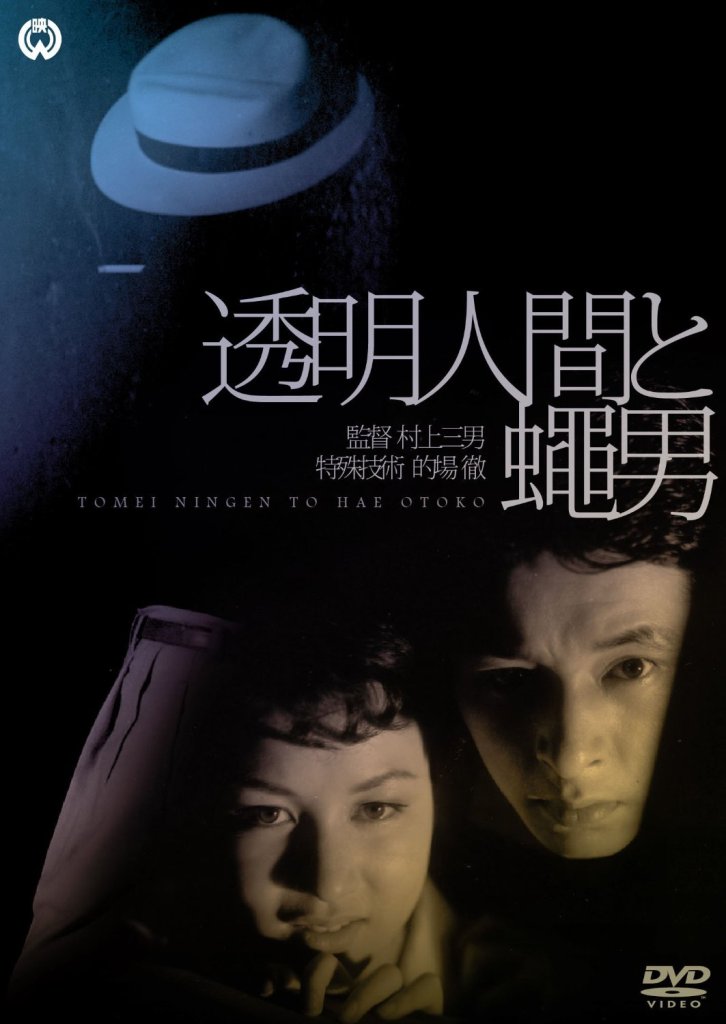
The Invisible Man Vs the Human FlyWho would win in a fight between The Invisible Man and The Human Fly? Well, when you think about it, the answer’s sort of obvious and how funny it would be to watch probably depends on your ability to detect the facial expressions of The Human Fly, but nevertheless Daiei managed to make an entire film out of this concept which is a sort of late follow-up to their original take on Invisible Man Appears from 1949. Like that film, The Invisible Man vs The Human Fly (透明人間と蝿男, Tomei Ningen to Hae Otoko) also adopts a deadpan, straightforward tone despite its rather ridiculous premise.

Tokyo is being plagued by a series of mysterious murders occurring in broad daylight in which the victim is stabbed through the back piercing the heart yet witnesses report seeing no suspicious activity near the crime scene. Perhaps The Invisible Man did it, hahaha….However, when the man sitting next to the professor in charge of researching the “imperceptibility device” is murdered in an aircraft toilet, the police get wise to a possibly surreal explanation for these bizarre crimes. The only other evidence they have is a connection between a sleazy nightclub owner, a friend of his and one of the murdered men who briefly served together during the war, the fact that one of the victims pointed at the sky before dying, and reports of a strange buzzing sound….

Interestingly, the major viewpoint here is from the policemen investigating the case and their attempts to get their heads around this extremely unusual series of events. As often happens with revisiting a form of technology which has been used for ill in the previous picture, here the “imperceptibility device” becomes a force for good as it might be able to help the powers at be stamp out The Human Fly. This time there’s not so much of the accompanying madness which is caused by going invisible but there’s still a heavy price to be paid as no one’s figured out a way of turning back which doesn’t involve rapid death from cancer immediately afterwards.

By contrast, The Human Fly is born of a man made serum developed by Japanese mad scientists during World War II and brought back by a man who was abandoned on an island by his comrades and subsequently left to take the wrap at a war crimes tribunal. He wants to use the technology to further his own success yet has a minion carrying out most of the dirty work. The Human Fly serum does, apparently, carry a number of psychological side effects including violent impulses, paranoia and addiction.

The special effects are not quite as good as in Invisible Man Appears though the invisible antics are not the focus of the film anyway. Bizarrely, The Human Fly is just a shrunken man who is somehow able to zip about like a regular fly even though he’s still dressed in his normal business suit and keeps his arms rigidly to his sides like some kind of human torpedo. Apparently, the buzzing sound is made because of his being very small (so says science) which gets around the inconvenient truth of him not having any wings or other fly-like characteristics other than the ability of flight.

It’s all very silly, though not quite silly enough in places. For the most part, the film plays out like a regular police procedural with slight noir undertones despite the obvious strangeness of the mysteries at hand. Though there’s obviously something to be made about the origin of the Human Fly serum and the anger of the “war criminal” who feels himself betrayed by his country, it’s a fairly subtle comment on post-war resentment. However, attitudes to the practice of scientific research do seem to have shifted with the researchers investigating the imperceptibility device cast as the good guys (though no particular reason for their work is ever offered) who can be relied upon to help catch the “bad guys” who are making use of “bad technology” to do “bad things”.

A fairly solid B-movie though one which is perhaps a little too po-faced for its genretastic title, The Invisible Man vs The Human Fly is an interesting mix of noir crime thriller with a little science fiction and even a few horror trappings thrown in. Thanks to its straightforward approach it may prove a little dull for genre enthusiasts but does offer its own kind of surreal iconography and it’s difficult to forget the sight of a tiny, angry looking besuited man flying around and committing random crimes while an invisible opponent stalks him from the shadows.


Library Wars (図書館戦争, Shinsuke Sato, 2013)

library-wars-2013-dojo-and-kasahara


Based on a series of light novels by Hiro Arikawa, Library Wars is another adaptation of a popular multimedia franchise from the director of the live action Gantz movies. Like Gantz, it’s another bug budget, tentpole style block buster with a subtle (though not insubstantial) desire to inject a bit of social commentary into what can be an entirely trivial genre. The manipulative forces at play here, however, are far less mysterious and unfortunately much more plausible than the mysterious black orbs of Gantz as they come in the form of crypto fascist censorship enthusiasts known as The Media Betterment Force. Having achieved the kind of success Mary Whitehouse could only dream of, The Media Betterment Force managed to pass the Media Betterment Act in the alternate Japan of 1989 which required all books containing ‘objectionable’ material to be destroyed. All is not lost though as the last bastion of intellectual freedom, the library, takes up arms and defends its right to disseminate whatsoever information anyone might desire with a government mandated assurance that library property can be safeguarded – with military force if necessary. Thirty years later in the near future of 2019, a young girl joins the LDF (Library Defence Force) full of idealistic zeal for protecting literature and a not so altruistic mission of finding the LDF officer who once saved her favourite book for her during in a MBF raid on a bookshop. Politics, romance, action! It’s all here for your edification and enjoyment.

If this all sounds a bit silly, well it is – but only in the best possible way. This is not a film about the evils of censorship, or how intellectual discourse and freedom of information are essential parts of any fully functioning society, though those themes are there if only in passing, so much as a big glossy blockbuster with just about every genre you can think of vying for the spotlight. The creeping totalitarianism is more backdrop than anything else but perhaps the absurdity of anyone picking up arms to defend access to information speaks to our unwillingness to prevent a gradual slide into a world of book burning and (not really) well meaning nannyism. First and foremost, Library Wars is science fiction action film modelled on the familiar boot camp genre following an underdog rookie recruit’s path to frontline glory. Yes we have training montages galore complete with the strained friendships and ‘you’re off the team!’ moments that appear in every film of this kind but the absurd premise and the film’s successful adoption of a warm comic tone help smooth over over any genre clichés and thankfully the film also manages to impress with several large scale battle scenes.

The romantic comedy element is arguably the least successful as it lacks the traditional climax many fans of the genre maybe hoping for (though one suspects a sequel may well put that right). That said the central relationship definitely falls into the ‘cute’ category and cleverly avoids the melodramatic nature of most blockbuster romances. Yes, the audience knows right away who the much sought after prince is but that only makes it more fun even if the post-idealistic bitterness of the man in question is another genre cliché. Supporting characters are also nicely fleshed out and each enjoys a decent amount of time in the spotlight creating a nice ensemble feel which is often rare in a blockbuster. As in Gantz the acting style remains fairly grounded rather the bigger, TV inflected performances which have been creeping into mainstream cinema and the strong performances from a fairly high profile cast help to lift Library Wars above some of its cinematic brethren.

Viewers expecting another Fahrenheit 451 or 1984 will obviously be disappointed in Library Wars’ fairly superficial examination of its themes but those hoping for a rip roaring, if slightly ridiculous, adventure are in line for a treat. Though the subject matter is itself absurd, such care has gone into the world building that it all makes a curious kind of sense assuming you’re willing to let yourself go with it. Most importantly, it’s remarkably self assured in terms of its tone – it knows exactly what it is and isn’t afraid to embrace its own nature. With much more heart than your average blockbuster, Library Wars is a warm and funny action comedy that also manages to be genuinely romantic. Now if they can only hurry up with Library Wars 2 so we can all enjoy the romantic resolution we’ve been waiting for!

Dragon Head (ドラゴンヘッド, Joji Iida, 2013)

220992

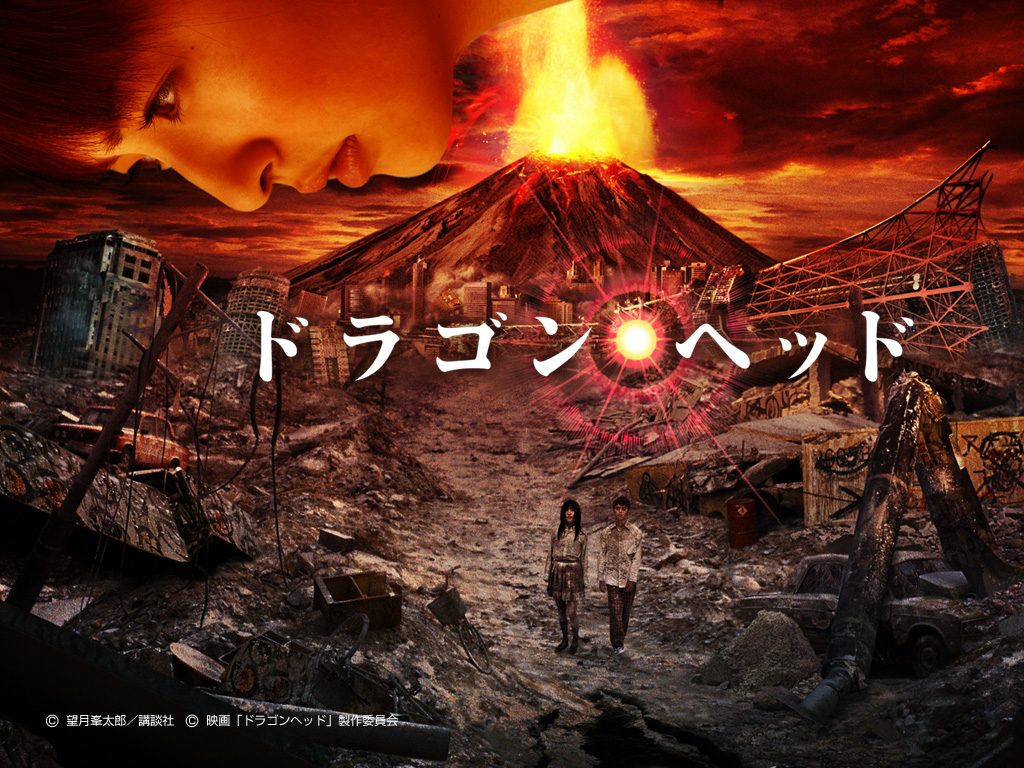
Judging from the scene that surrounds Teru (Satoshi Tsumabuki) as he struggles to open his eyes, he’s either just waking up after the best party ever or something truly awful must have occurred. Where is he? Feeling around it seems like there are a lot of seats – a plane, or a train? Yes, a train. He remembers being on some kind of trip with his school mates – they were all on the train together so where is everyone? Struggling to get up, stumbling against walls he finds them – dead, all dead. Seemingly the only survivor of some kind of accident, Teru tries to get off the train to find out what’s happened and look for other survivors. It seems the train is trapped in a tunnel, both ends blocked by fallen rubble. Beginning to fear he really is all alone he comes across another boy perched in the window of an adjacent carriage. Small relief however as Nobuo (Takayuki Yamada) seems to be acting very strangely and muttering on about red lights and embracing the darkness. Evading him leads Teru further along the train where he finds another survivor, a girl – Ako, desperately hiding from Nobuo after witnessing him completely losing control whilst looking for survivors.

You might think this is where our three plucky teenagers club together to figure out how to escape the train wreck and get home, but no this is not that type of film. Quicker than you can say Lord of the Flies, Nobuo has gone completely crazy – painting a strange grin on his face with some lipstick he found and dotting his his chest with it too, he even makes a makeshift spear go with with new tribal outfit as a sort of dedicatory effort to his new red light god. He’s very much of the opinion that this stretch of tunnel is the only safe space left on earth and its three inhabitants have inherited a new eden, if they’d just learn to accept it. Teru and Ako though, clearly terrified by Nobuo’s transformation, do little other than wait for help to arrive. When serious tremors start to shake the tunnel and they no longer have any choice but to act they finally manage to climb out through a supply tunnel. What they find on the other side though is a vast desert of ash – all visible signs of human civilisation have been destroyed and they seem to be alone in the world.

Dragon Head is a bleak, seventies style post-apocolyptic drama in which our ‘heroes’ discover that the threads that hold society together are incredibly weak and snap the moment the slightest pressure is placed upon them. Without spoiling too much, we never find out exactly what it is that has happened, only that whatever it was caused people to turn on each other in a terrible fashion and those few who have survived only want to forget. During in their travels our, frankly unbelievably clueless and incredibly lucky, duo come across a town full of men who’ve decided not to go on and don’t want anyone else to either; mercenary soldiers with dubious motivations; a pair of strange brothers who’ve been surgically altered to remove all trace of fear and sadness and myriad other examples of humanity’s darkest places.

In facing the successive crises, it has to be said that Teru and Ako are not exactly survival buffs. They react to each new situation in what might be termed a realistic fashion as far as two teenagers faced with seemingly impossible odds would do. Largely this means there is a fair amount of panic, crying, blind stumbling and a the recurrent idea of simply giving up. This realistic portrayal of ordinary people caught up in an extreme situation is quite refreshing and a direct contrast to the super smart, seemingly indestructible, level headed teens you often find in such movies. However, the vulnerability of the central couple may also be turn off those viewers who find them simply too whiny and wonder why they don’t get on with trying to find a better way to survive.

For what was seemingly quite a low budget picture shot on early digital, Dragon Head features some very impressive visuals. Making use of old school techniques like matte paintings alongside CG effects, the post apocalyptic landscape is rendered in an extremely convincing way and this is certainly one of those films that has made the best of what it had. In fact it benefits greatly from not relying on CGI to the extent other films of its era often did and so appears much less dated in comparison. Its real world effects and attention to detail mark it well above the some of the big budget disaster epics that began to appear around the turn of the century and help it become much more engaging as a result.

Dragon Head is not without its faults – it’s based on a manga which lends it an episodic structure which isn’t always conducive to good cinematic story storytelling. It’s also possible that some of the overarching mythology which isn’t really explored during the course of the film is more fully explained in the manga (not to mention the Seventies style ending) but really these are small problems. Dragon Head turns out to be much more impressive than you’d originally think it would be and offers a refreshing dose of bleakness that’s been absent from our screens for much too long.

Reviewed on R2 Japanese DVD release

Secret Cinema – 3rd June 2012. Prometheus

This Secret Cinema seemed a bit different, in that it seemed fairly obvious all along what the film was going to be. Secret Cinema evidently had quite a big budget with this one – full page ads in The Guardian, multiple websites and promo videos so there was less in the way of clues and intrigue but perhaps more in terms of content. After I had signed up to their website and bought ‘shares’ in Brave New Ventures – apparently some sort of R&D company – I was instructed to choose my career path from the website. I chose to be a ‘Data Scientist’ as it seemed to fit me best (I guess in the end it was more along the lines of a social archaeologist  or anthropologist). Uniforms could be obtained from BNV Stores and I would need a blue jump suit. Dutifully I went down to the store but being on the shorter side my new employers were unable to accommodate me; I bought a badge and found alternative arrangements for the coveralls.

As the day approached there wasn’t as much input from SC as there had been previously but nevertheless it was very exciting. I arrived at the meeting point at Euston Station a bit before my appointed time of 12pm and waited for other people in jumpsuits to arrive. While I was waiting I met Professor Edwards, who didn’t seem know anything about our mission either. Eventually there were quite a few of us there and we were marched up the road to the right and into where the BNV stores had previously been. After an ID check (read: ticket check) and currency exchange (I guess I effectively bought a tiny bit of orange perspex for £10 but it is quite cool), we had to queue up for decontamination (being sprayed with something in the car wash) before lining up at out appointed embarkation gate by order of profession.

Once the gate finally opened I, and the other data scientists, were led off to our section HQ by our leader (Holloway!) where we were briefed about out mission – finding out the origins of man etc. Looking round the room afterwards I was very excited to find a picture marked ‘The Ripley Scroll’.  After that there was some free roaming, I tried going up one set of steps but an alarm went off so I stopped. Going down some other steps I ended up in the cargo bay and got a mission to take a box to the infirmary, which I did so I roamed round there and eventually into the mess hall, crew areas etc. After a while there was a countdown to external shutdown and I was shuffled back to my original gate. I was told to hold onto the flowers while we launched. After that it was into the hypersleep pods! We lay there for about a minute listening to Radiohead’s Everything In Its Right Place.

After waking we were told to go to the mess hall but on my way David gave me a flower to take for analysis which I did, it was analysed by Dr Boden but she didn’t find anything and gave me a curt note for Holloway. On my way to find him however I was given ANOTHER FLOWER so I had to do the whole thing over again but Doctor Boden said she’d take me to the infirmary to make sure I was OK after the hypersleep.

However when we got to the cargo bay there was a mission just about to go down to the surface so I joined that. I had to put on green overall over my jumpsuit and a helmet (and eat some bread, which was very nice). The planet surface was pitch black so I mostly kept close to the people in front of me and followed the guides, we saw some of those geyser type things, alien markings and some kind of miraculous projection.

I wasn’t really sure what to do after that but just then people started getting ‘sick’, I tried wandering around but more and more areas were closed off because of ‘contamination’ and eventually I found myself herded back into a lift and  back at the cargo bay. Some people were on the floor convulsing and others were tying to help them. I stood on the side as more and more people became ‘sick’ and the BNV staff were obviously upset. Many of them were shouting things like ‘someone tell me what’s going on’ and ‘what’s happening’, ‘we need a containment officer over here’. After awhile of total chaos someone just started shouting to come this way so we followed and were led to the ‘escape pod’ (or screening room) to watch the film – Prometheus!

As a huge fan of Alien(s) this was absolutely fantastic to me, really loved being in the world and and interacting with Weyland-Yutani.The whole experience was just amazing, could not fault it!