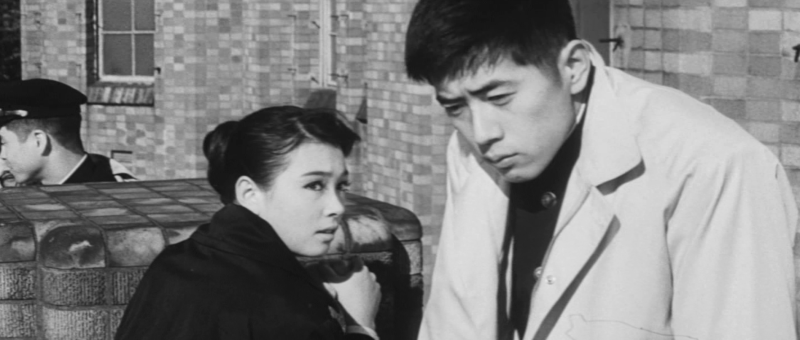
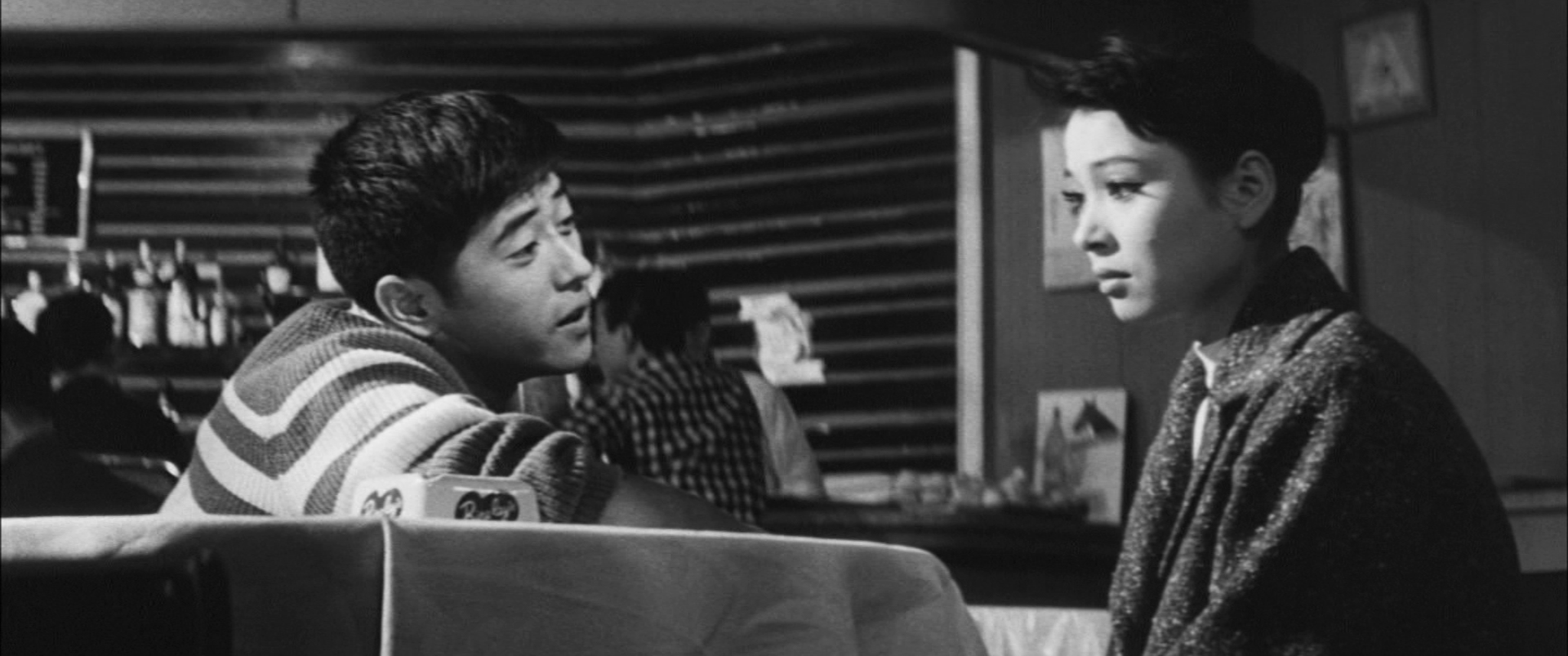
After finding out his older sister has had an abortion after her lover tells her he has no interest in marriage, a college student vows revenge in Yasuzo Masumura’s Disobedience (親不孝通り, Oyafuko Dori). The film’s Japanese title translates as something like “lack of filial piety street” and refers to an area where youth congregates to misbehave, bringing shame on their families with their debauched behaviour. It’s into this world that the cynical hero attempts to drag the sheltered heroine as part of his revenge plot while she apparently decides to stick with him even after he raped her during a college camping trip.
It is though notable that neither of them have much parental input to begin with. Kaneko’s (Hitomi Nozoe) mother has died and we’re told that their father spends all his time with a mistress and never comes home leaving her in the care of older brother Shuichi (Eiji Funakoshi), a salaryman. It’s not exactly clear where Katsuya’s (Hiroshi Kawaguchi) mother is, only that she lives somewhere else and occasionally writes while he is technically in the care of his older sister Akie (Yoko Katsuragi) who works as a tailor in a boutique store selling western fashions. Akie had been carrying on an affair with Shuichi she assumed would lead to marriage and was initially happy about the pregnancy only to be blindsided by Shuichi’s reaction. When he tells her that he has no intention to marry, she realises that the relationship is at a dead end and that an abortion is her only real option given the situation.
The irony is that Katsuya resents Shuichi for failing to take responsibility as a man and vows to take revenge by doing the same thing to his sister and seeing how he likes that. Though Akie points out that it’s nothing to do with Kaneko and tries to stop him, Katsuya is hellbent on playing the cad to make a point. Of course, he may also resent Shuichi, an executive salaryman, precisely because of the position he is in. There has been an economic downturn and he’s having trouble securing a job for after his university graduation. Some companies have halted recruitment entirely and another of Katsuya’s friends has already been through 11 unsuccessful interviews. Other young men have taken to politics, protesting new authoritarian legislation and investing in socialism. Katsuya and friends find this to be disingenuous, assuming it’s just another shrewd move to get on the ladder by finding employment in government or unions. The salaryman dream is a fairly new post-war invention, but it seems to be dying already and Katsuya can’t even really see what his education was for. He tells Kaneko that he only studies well enough to pass so that he can get a good job and the point of life is to figure out how to make money. If he can’t do that, then his life is meaningless and futile. That might be why he spends his time scamming entitled Americans (the only people with money), beating them at bowling, and hanging out in jazz bars. Though the Occupation is long over, the film has a strong but subtle sense of anti-Americanism as symbolised by the aeroplane flying above as Katsuya rapes Kaneko out in the mountains.
But for Kaneko the situation is not much different. The young women complain it’s even harder for them to secure employment. Katsuya dismisses Kaneko’s university education by calling it a bridal academy, though most of the women lament that marriage is the ultimate job and perhaps the point of university for them is meeting a husband, just as it’s securing employment for Katsuya. Later, when he confronts Shuichi, Katsuya describes Kaneko as damaged goods now that she’s no longer a virgin and is currently carrying a child for which he accepts no responsibility. That may be one reason that she decides to stick with her rapist, realising that her situation is now impossible given it may be difficult for her to marry someone else while supporting herself financially as a single woman is not yet a viable option. By pursuing a relationship with Katsuya, she reasserts control over the situation along with the narrative of what happened between them on the mountains.
On learning the truth, however, she makes a different decision from Akie in declaring that she will drop out of university and move to Osaka to live with an aunt and raise the baby alone there, declaring that she has decided to go on loving Katsuya no matter what he might think about it. Kaneko’s decision prompts a reversal of Akie’s thinking too. Though she had decided to be independent, starting her own business rather than planning for marriage, she returns to Shuichi and suggests they should get back together. To her the idea of running her own business and being married seem incompatible. Chastened by this whole affair, Shuichi’s thinking seems to have reversed too, to the extent that he decides to marry Akie after all, while Katsuya also decides to accept responsibility and go to Osaka with Kaneko where they will marry and stay together forever. It’s a strange “happy” ending, though it’s difficult to see how these marriages could ever really be happy given the circumstances that led to them and the discordant music that strikes over an ironic Merry Christmas sign as the film comes to an end suggests they probably won’t be. Nevertheless, the ending reverses a lack of filial piety in the shift toward conservatism through heteronormative marriages and the formation of new families as Katsuya, at least, takes responsibility for his paternity and exits the nihilistic world of clubs, bars, and bowling alleys in which his friends remain trapped.

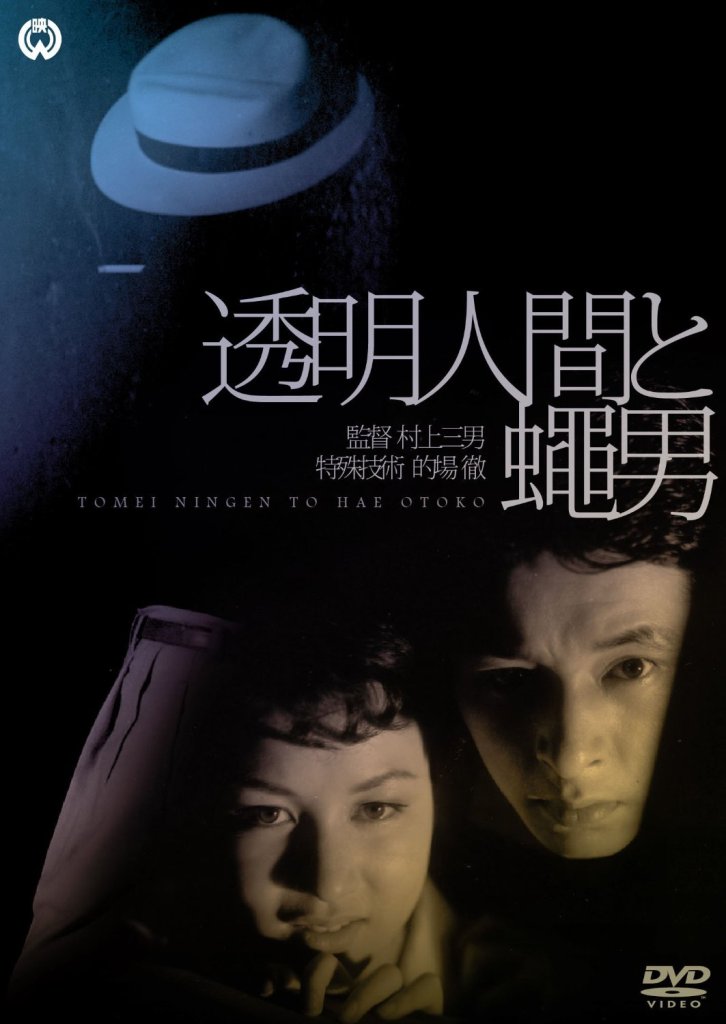 Who would win in a fight between The Invisible Man and The Human Fly? Well, when you think about it, the answer’s sort of obvious and how funny it would be to watch probably depends on your ability to detect the facial expressions of The Human Fly, but nevertheless Daiei managed to make an entire film out of this concept which is a sort of late follow-up to their original take on
  Windows on Worlds