My Wonderful Yellow Car (吹けよ春風, Senkichi Taniguchi, 1953)

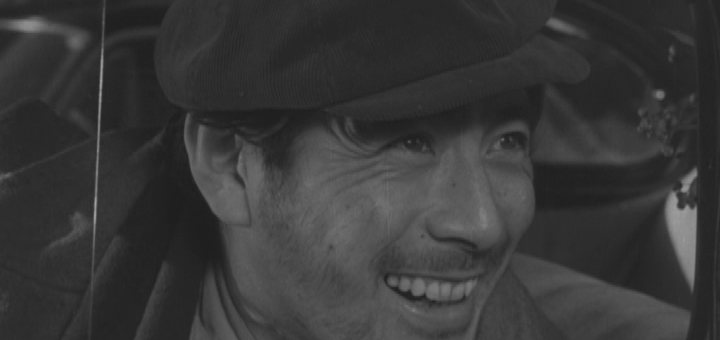
A kind-hearted taxi driver becomes our guide to the post-war society in a cheerful omnibus movie co-scripted by Akira Kurosawa and directed by Senkichi Taniguchi, My Wonderful Yellow Car (吹けよ春風, Fukeyo, Haru Kaze). Inspired by a Reader’s Digest column titled “human nature as seen in the rearview mirror”, the film follows cheerful cabbie Matsumura (Toshiro Mifune) as he drives around Tokyo in 1953 picking up various fares and sometimes adding commentary or trying to help with whatever kind of problem seems to be bothering them.

Then again, he stays well out of the first fare’s business as a young couple have obviously had some kind of falling out. Bursting into tears, the girl (Mariko Okada) announces that she wants to postpone the wedding and maybe even rethink this whole thing, while the boy reiterates with slight irritation that he’s said he’s sorry with the implication that that should be the end of it though we have no idea what (if anything) he’s actually done. In any case, they eventually patch things up over some canoodling in the back seat and ask to be dropped off so they can get something to eat. In some ways, the young couple represent a more hopeful vision of post-war youth who have no apparent worries besides their tiff and are financially comfortably enough not only to be getting married but can afford to travel by taxi and pay for a meal on the same occasion. 

Their situation is later contrasted with that of an older couple who’ve moved from Osaka to Tokyo in their old age and have bought a box of live lobsters to celebrate their silver wedding anniversary but as Matsumura notes though they appear to be quite well off they also seem somehow sad. That turns out to be because they lost their only son the previous summer and have moved into his old apartment. The old lady also cries in the back seat, but for a completely different reason. As they’ve only just moved here, they don’t have friends or anything to do and are completely lost in the wake of their son’s death. Matsumura’s kindness is demonstrated when he borrows three flowers from a bouquet delivered to a girl at the petrol station and presents them as an anniversary gift. The couple are so touched they invite him to enjoy their anniversary dinner with them and by the end of it have made the decision that they should go back to Osaka and restart their lives by re-opening their old business.

Throughout all this, Matsumura is very conscious of the meter. Every second he spent in the old couple’s apartment cost him money, but as he’s fond of saying you can’t always think of things like that. Even so, he reminds himself he has a wife and child so should be mindful of the clock but still turns down a fare to go back to the station and check on a young girl he’s pretty sure is trying to run away from home. A weird guy was sniffing around her and was in fact just about to lead her off when Matsumura gets back and announces he’s come to pick her up. Matsumura spends the rest of the ride trying to convince her to go home, repeatedly reminding her that most of the “panpans”, or streetwalking sex workers catering to US servicemen, were also once runaway girls. To more modern eyes we might wonder if sending her home is what’s best without knowing the reasons she wanted to leave. He goes so far as to buy her ramen which costs him more money on top of the lost fare which doesn’t collect from her either when he, a little less responsibly, abandons her when she refuses to tell him where she lives. Thankfully, it all seems to work out. The girl made a sensible decision to go home after all and is later seen happily doing her Christmas shopping with her mother who also thanks him for looking out for her.

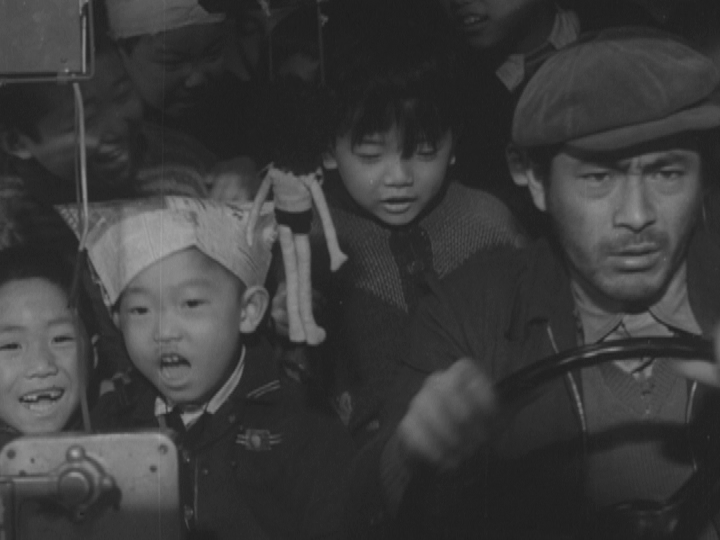
Perhaps these kinds of altruistic acts of kindness explain why Matsumura’s own clothes are quite ragged with a hole in his jumper and a tear to the shoulder of his jacket. He’s driving the cab in straw sandals which apart from anything else is probably quite cold in the winter. He spends another afternoon giving a free ride to some children, about 15 of them, who’ve crowdfunded 100 yen because they’ve never been in a car before and want to go as far it’ll take them having no idea that 100 yen is actually the initial charge so you can’t go anywhere on it all. Of course, Matsumura ends up taking them a bit further, and then realises he’ll have to take them back to where they were because they won’t have any other way of getting there or of knowing where they are now.

On the other hand, sometimes he ends up with nuisance fares such as two drunk guys who keep singing their university song. One of them even climbs out of the window and up onto the roof, causing Matsumura to assume he’s fallen off somewhere and he’ll have to go back and look for him to make sure he’s not hurt only to find him burbling in the footwell. He also ends up getting hijacked by a crook with a gun on his way back from Yokohama but getting a telling off from the police rather than a thank you for catching him after unwisely taking hold of the gun himself and messing up all the fingerprints. 

One might think the time he had a famous actress in the back of his cab who even sang along with the jingle he’d written for the cheerful yellow vehicle might make up for all that, but he says the story that best exemplifies why he loves driving a taxi is that of a middle-aged couple he picked up at the harbour shortly after a boat had docked repatriating people from China. Even in 1953, some had not yet returned after becoming trapped by the Chinese Civil War and eventual Communist victory. The man is dressed in military uniform and says he’s just been demobbed when Matsumura asks him, trying to lighten the mood while there’s obviously some degree of tension between the man and his wife. But as we gradually come to understand, it’s all just a ruse and he has in fact been in prison in Japan for the last seven years for an unspecified crime.

His wife asks Matsumura to drive around the city and attempts to show him how much things have recovered, suggesting that they can now put the past behind them and start over. But the man remains sullen and grumpy. He’s afraid to go home, afraid to face the neighbours worrying if they know what he did and that he’s been in prison. But most of all he’s afraid to face his children, the youngest of which he’s never met. The kids have been teaching themselves to say “Welcome home, Daddy,” in Mandarin believing he’s been in China all this time which the wife has to explain before they get there. The man tells his wife he understands if she doesn’t want him back, but she assures him that the children are excited as is she to start their new life together. Nevertheless, though they’ve been eagerly practicing, the older two children simply freeze when confronted by this anxious stranger who turns around to leave again feeling as if he doesn’t have the right to come back here after all only for the youngest one to suddenly pipe up with the phrase note perfect. It’s this kind of scene, getting people to where they need to be physically and emotionally, that seems to make Matsumura’s job worthwhile. In essence, he’s ferrying people towards the cheerful post-war future his cute yellow cab represents while driving round the rapidly changing city wondering who it is that’s going to end up in the rearview mirror today.


Title song (no subtitles)

The Lost World of Sinbad: Samurai Pirate (大盗賊, Senkichi Taniguchi, 1963)

Seemingly drawing influence from the series of Arabian fantasy films from Hollywood, Senkichi Taniguchi’s Lost World of Sinbad: Samurai Pirate (大盗賊, Dai Tozoku), sees the director reunite with Toshiro Mifune who had made his debut in the director’s Snow Trail which could not be more different from this crowd-pleasing adventure movie. The film is loosely based on the life of 16th century merchant Luzon Sukezaemon who eventually fled to Cambodia after all his possessions were seized by Hideyoshi Toyotomi and he was condemned on some trumped up charges.

The film’s opening scenes perhaps reflect this incident as Luzon (Toshiro Mifune) is branded a pirate and set to be burned at the stake, narrowly escaping after bribing an official with drugs. Resentful, Luzon decides he might as well become a pirate after all as he’s pretty sick of Japan and fancies seeking his fortune on the open seas only his ship is quickly destroyed in a storm and all his crew killed while the treasure he was carrying is seized by the fearsome Black Pirate (Makoto Sato). Washing up in a mysterious place aesthetically a mashup between South East Asia and the Middle East, Luzon is cared for by a hermit and then becomes embroiled in intrigue on finding out that the tyrannical king has been seizing local women in exchange for unpaid taxes and imprisoning them within his harem.

Luzon’s dreams are for riches and status so his sudden discovery of a love of justice is a bit of a surprise, but then he’s also most interested in the princess Yaya (Mie Hama) because he spotted one the necklaces from his treasure chest around her neck which suggests she might have a lead on the Black Pirate. Princess Yaya is engaged to a prince from the Ming kingdom which threatens a wider kind of geopolitical destabilisation should anything go wrong with this marriage which is a distinct possibility seeing as the corrupt Chancellor (Tadao Nakamaru) has been colluding with an evil witch to kill the king and seize the kingdom.

Rather than a pure pirate movie the film contains fantasy elements such as the presence of a Western-style castle which is clearly modelled on the one from Disney’s Snow White along with a weird hermit whose powers are weakened every time he sees an attractive woman. It is not, however, the kind of tokusatsu the English title bestowed by the US release implies as it contains no real monsters instead focussing its special effects on the magic used by the witch, who can turn people to stone with her eyes, and the hermit who can turn himself into a fly or disappear in a puff of blue smoke. Despite the prominent inclusion of SFX master Eiji Tsuburaya these effects are repeated several times are really the only ones featured in the film. 

In any case, what’s in play is famous merchant Luzon’s redemption arc in which he recovers the treasure but gives it back to the people, symbolically abandoning his dreams of wealth and status for something a little more community minded in vowing to sail the seven seas pursuing justice throughout the world. Having been a victim of authoritarianism in Japan, he rises up against tyranny abroad while teaming up with a group of local bandits and several times proudly proclaiming himself as Japanese though in a movie conceit everyone speaks his language including the Black Pirate who is later exposed as a snivelling fool tricked by the Chancellor on the promise of a chance to marry the Princess Yaya. Most of the derring do is reserved for the final sequence in which Luzon and the bandits storm the castle to defeat the evil chancellor but the screenplay also packs in genre elements such as trap doors and secret dungeons which keep Luzon busy as he does his best to overthrow an oppressive regime if only to put the rightful king back on the throne in the hope that might be better. Taniguchi certainly makes the most of his elaborate sets and costumes, creating a sense of tempered opulence along Middle-Eastern themes while adding a touch of the mythic in the attempt to weave a legend around the real life figure of Luzon Sukezaemon as a bandit revolutionary selling dreams of freedom on the sea as a pirate more interested in justice than money in otherwise corrupt society.


The Silent Duel (静かなる決闘, Akira Kurosawa, 1949)

Amid the labour strikes crippling Toho in the late ‘40s, Akira Kurosawa formed an association with other directors and film professionals and began working with different studios, the first being Daiei on a loose adaptation of a popular play in which an idealistic doctor struggles with his repressed desires while watching others wilfully embrace post-war selfishness and cynicism. Like many of Kurosawa’s films from this period, The Silent Duel (静かなる決闘, Shizukanaru Ketto) is essentially a meditation on post-war moral decline and what’s needed to correct it but also if somewhat accidentally the destructive effects of secret keeping and miscommunication. 

Kurosawa opens the film in 1944 with exhausted field medic Kyoji (Toshiro Mifune) operating on a badly wounded solider, Nakata (Kenjiro Uemura). Distracted by the constant dripping of a leaky roof, the adverse weather conditions outside, and the general stressfulness of the situation, Kyoji makes the fateful decision to remove his gloves to better accomplish the fiddly operation he is performing only to drop a scalpel and cut himself. He continues with the surgery, but realises that Nakata is likely infected with syphilis which he may have contracted through the wound on his finger. Kyoji tells Nakata, otherwise recovering well, that he should make sure to seek treatment but overhears him boasting that his injuries may soon save him from the battlefield. Kyoji continues to serve but is unable to treat the infection effectively with the limited resources available to him as a frontline medic allowing the disease to continue its progression largely unmitigated.

Taking a job at his father’s obstetrics clinic on his return to Japan, Kyoji breaks off his longstanding engagement to pre-war girlfriend Misao (Miki Sanjo) who has been waiting for him the last six years but refuses to explain to her why he cannot go through with their marriage. She assumes it must in some way be related to his war trauma, and in a way it is. The syphilis is an obvious metaphor for the corruptions of militarism. He declines to explain, he claims, because he is certain that Misao would vow to go on waiting for him until the disease is cured which would take at least three to five years assuming it can be cured at all. As she is already 27, he would be taking away Misao’s opportunity to make a happy marriage and have children with another man. In any case, he makes her decision for her which ironically conflicts with his later statement that she should be free to seek happiness on her own, not least because it seems she has been pressured into an arranged marriage by her financially troubled father. The act of childbirth is symbolically relevant though he does not seem to consider the idea of a platonic marriage perhaps uncertain that he could go on repressing his desires as a married man. So morally upright is he, that he also refuses to lie, saying nothing rather than allowing Misao to believe that he has fallen out of love with her, met someone else, or has another war-related issue that prevents his marrying her. Nor does he seem to consider telling her that he has syphilis and allowing her to come to the same conclusion as everyone else, that he contracted it through sleeping with sex workers during his military service which is most likely how Nakata became infected. 

The stigma associated with the disease adds a further dimension to Kyoji’s frustration given that he describes himself as having wilfully sublimated his physical desires in order to be able to return to a “peaceful marriage” with Misao whereas as Nakata who satisfied himself without a second thought returned home symptomless, married, and is soon to be a father. Re-encountering him by chance, Nakata who seems to have become wealthy doing something that is likely immoral if not illegal, tells Kyoji that his sickness is cured but does eventually bring his wife in for a free checkup to discover that he has passed the disease to her and to their unborn child. Yet even confronted with the truth, Nakata lies again and suggests that Kyoji has made all this up as revenge for something that happened in the war keeping the fact that he infected him from his wife. He blames Kyoji for destroying his family rather than accept his own responsibility and sees nothing wrong in his actions until directly confronted with the body of his stillborn child apparently so deformed and monstrous that they wouldn’t let the mother see it. 

The two men have clearly taken different paths, Kyoji certain that he must put others before himself and suppressing his own desires to ensure he cannot pass the disease on while Nakata buries his head in the sand and ignores it. It is a kind of metaphor for the post-war future, those like Kyoji acknowledging that the legacy of wartime trauma is something that must be acknowledged and actively healed before happiness is possible while those like Nakata simply plow on like nothing ever happened with no thought or consideration for those around them. Yet it is also Kyoji who lies by omission even in his selflessness just Nakata lied to his wife while the truth is only discovered by accident, firstly by reluctant nurse Minegishi (Noriko Sengoku) who walks in on him injecting the remedy for syphilis, she in turn then overheard by Kyoji’s father (Takashi Shimura) while Minegishi then overhears the explanation Kyoji gives him. She in a sense completes the cycle when she asks Misao to apologise to Kyoji on her behalf as she is too embarrassed to do so herself after realising that she got him wrong having resolved to turn her life around after learning of the depths of his selflessness. 

Minegishi had been a nightclub dancer who tried to take her own life after becoming pregnant by a man who abandoned her but was saved by Kyoji who gave her a job at the clinic and convinced her to raise the child. It’s this child, at first unwanted but later loved and embraced by all despite the stigma of his being born out of wedlock, that offers the clearest path towards a healthier future suggesting that the solution lies in accepting the past with a willingness to make something new out of it rather than in wilful denial and resentful self-interest. Yet Kyoji is also human and privately resentful. “If I’d known it would happen to me I would’ve done things differently” he sneers petulantly suggesting that his properness may be an affectation rather than deeply felt conviction but equally frustrated in feeling his fate is unjust and that he’s suffering for someone else’s sin. 

“Because of the blood of a shameless guy, my body became dirty without knowing any pleasure” he complains, hinting at a metaphor for his wartime contamination dragged into a conflict by forces outside of his control. The roles he plays are ironic, firstly a healer in a place of death and destruction and then as a deliverer of life at his father’s obstetrics clinic though he fears he will never have children of his own. He is in a sense trapped by his past as shown in the repeated visual metaphor of the closed gates outside the clinic on which the flowers that represent his relationship with Misao and hope for the future gradually wither. Minegishi tells him she’s in love with him and is willing to accept the risk of his disease to alleviate his desire, but he once again chooses to say nothing, immediately returning to business. As his father points out, he has (for the most part) resolved to channel his resentment into helping those less happy than himself but if he had been happy he may have become a snob, indifferent to the suffering of others. In some ways his problem is the familiar giri/ninjo conflict as he fights a silent duel within himself between his natural desires and his better nature but it’s also a battle against the slow poison of the wartime legacy through compassion and selflessness that may, like his inescapable illness, eventually drive him into madness.


The Silent Duel screens at the BFI Southbank, London on 2nd & 11th February 2023 as part of the Kurosawa season.