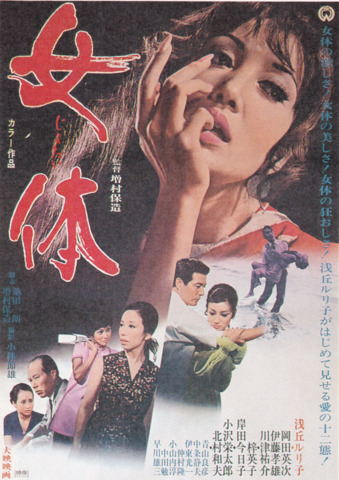
Vixen (女体, Yasuzo Masumura, 1969)

Vixen poster“Freedom for the masses!” cry the student protestors outside the claustrophobic environment of a corrupt educational institution at the heart of Yasuzo Masumura’s Vixen (女体, Jotai – lit. “a woman’s body”). While they cry for freedom, one young “liberated” woman finds she’s anything but free even in the throws of her liberation. Possessed of little power, she has a need to find herself a white knight but no sooner has she got him than she begins to long for new conquests, trapped in a destructive cycle of sex and violence. Subverting his own ideas of sex as liberation, Masumura reconfigures lust as a trap in the form of a siren song sung by a lonely young woman unable to find her place in the complicated post-war landscape.

Michi (Ruriko Asaoka), a modern young woman, has a brief episode of fondling an office chair while waiting to see the chairman of a university. Proudly showing off the bruises on her thighs, she accuses the chairman’s son of rape. Despite the evidence, Michi’s accusation is undermined by her mercenary behaviour which does not tally with that expected in such difficult situations. She’s come alone, flirts with the chairman’s secretary Nobuyuki (Eiji Okada), and is quick to talk money. Questioned at home the chairman’s son admits everything but thinks it’s no big deal because that’s just “how it’s done these days”. The chairman, worried more for his reputation which is already under strain given the widespread student protest movement, thinks paying Michi off is the best thing to do but there’s a disagreement over the amount. Nobuyuki’s wife Akie (Kyoko Kishida), sister of the accused and daughter of the chairman, only wants to give Michi half of the two million she’s asked for. Nobuyuki gives her the full amount anyway behind his wife’s back, winning Michi’s eternal admiration for his considerate treatment. Unwisely visiting her hotel room, Nobuyuki develops a dangerous fascination with the alluring young woman and embarks on a passionate, ill-advised affair.

Michi is, in many ways, the archetypal post-war woman. Orphaned at a young age she was raised by a grandmother in a small fishing village and has been living with another relative whilst working as a waitress in his ramen restaurant after coming to the city. She’s grown up in a more liberal era, has a “positive” attitude to sex, and lives outside of the “traditional” path for “respectable” young women of early marriage and continued monogamy. As someone later puts it, women like Michi are two a penny now that the economy is getting back on its feet – they live alone in the city, aren’t interested in marriage and value their independence. Michi, however, is more or less the opposite of this “new” kind of woman. Independence is something that frightens her beyond all else. She cannot survive without a man, does not want or know how to live alone as a “single” woman and uses her sex appeal in order to manipulate men into staying by her side to look after her. Sex is not what she craves so much as security, but security also frightens her and so each time she’s made one conquest she latches on to the next gallant young man who shows her any sign of kindness or courtesy.

Indeed, all Michi thinks she has to offer is her body – the “Jotai” of the title. Perhaps hinting at some past trauma in speaking of the roughneck fishermen that frequented her grandmother’s ramen shop, fatherless Michi says she’s chased men in her dreams since childhood, seeking new tastes and new sensations. She wishes she could find one man and stick with him because the chase and the longing cause her nothing but pain, but her need will not let her be. Asked what she will do when her appeal fades (as it inevitably will), Michi has no other plan than drinking herself into oblivion. “I’m a woman,” she says, “what is there for me to do but love?”. Quite far from the idea of the “liberated”, independent woman spoken of before who has learned to make her own way in the new “freedoms” promised by increased economic prosperity.

This false idea of liberality is one which originally attracts Nobuyuki. A straight laced salaryman working for his corrupt father-in-law and often doing his dirty work for him against his batter judgement, Nobuyuki has sacrificed his individual freedom for the rewards his society offers those who play by the rules. Also a war orphan, Nobuyuki sacrificed his youth to raise his younger sister (now preparing to marry herself), and has a comfortable, middle-class life with an austere if loving wife. Having worked his way into their upperclass world, Nobuyuki feels he doesn’t quite belong, something always nagging at him prevents Nobuyuki from fully committing to his drone-like life of pleasant conformity. A mad infatuation with Michi, an irritating child woman at the best of times, is an excuse to go all out in escaping the oppression of his conventional life but it’s not one with long term stability and his life with Michi is unlikely to offer him the freedom he had originally envisaged.

Later, Michi makes a play for the man Nobuyuki’s sister is set to marry. Akizuki (Takao Ito) is not like Nobuyuki – he’s a post-war man but one with definite ambitions and goals, each element of his life is a product of considered choices. As anyone would who took the time to really think about it, he’s turning Michi down, but for some reason he continues to help her placing a wedge between himself and his fiancée. This way of living – the considered, ordered, boring but pleasant life is directly contrasted with the chaotic, destructive, and perhaps exciting one that is offered by Michi, and the dull life is winning. Michi is miserable, and her self destruction is primed to drag any “nice” young man into her wake along with any other woman associated with him. Nobuyuki is left with a choice but it turns out not to be so binary as might be assumed. Personal freedom, if it is to be found, is not found in abandonment either to another person or to a job or way of life, but in the realisation that choice exists and can be exercised, freely, by all.
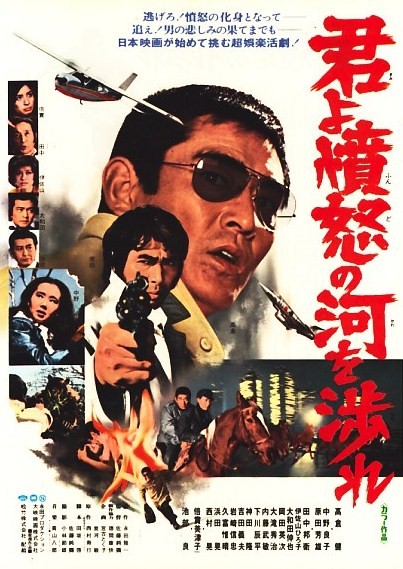
Manhunt (君よ憤怒の河を渉れ, Junya Sato, 1976)

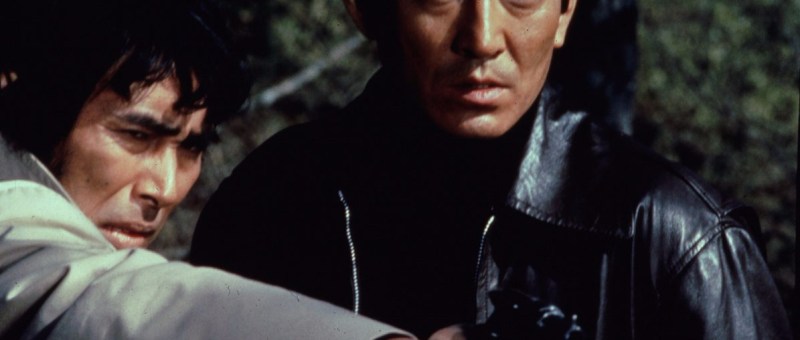
manhunt 1976 posterMost people, when faced with being framed for a crime they did not commit, become indignant, loudly shouting their innocence to the rooftops and decrying injustice. Prosecutor Morioka (Ken Takakura) reacts differently – could he really be a master criminal and have forgotten all about it? Does he have an evil twin? Is he committing crimes in his sleep? The answer to all of these questions is “no”, but Morioka will have to go on a long, perilous journey in which he pilots his first solo aeroplane flight, fights bears, and escapes a citywide police net via horse, in order to find out. Junya Sato’s adaptation of the Juko Nishimura novel Manhunt (君よ憤怒の河を渉れ, Kimi yo Fundo no Kawa o Watare, AKA Dangerous Chase, Hot Pursuit) is a classic wrong man thriller though it has to be said thrills are a little thin on the ground.

Morioka’s very bad day begins with a woman (Hiroko Isayama) pointing at him and screaming, clutching the arm of a policeman and insisting that Morioka is the man who burgled her a few nights ago and stole her diamond engagement ring. Morioka is very confused but goes calmly to the police station before asking to see an officer he knows, Yamura (Yoshio Harada). Unfortunately, at the police station things only get worse as they dig up another witness (Kunie Tanaka) who says Morioka mugged him in the street for his camera. Beginning to doubt his sanity Morioka is sure things will be sorted out when they search his apartment, only when they get there they do indeed find a camera, the ring hidden in his fish tank, and a whole lot of dodgy money. Realising the game is up and that his prosecutor buddies aren’t interested in helping him, Morioka takes to the road to clear his name, finding himself increasingly compromised every step of the way.

This being Japan Morioka’s options for disappearing are limited – it’s not as if he can dye his hair or radically change his appearance, he’ll have to make do with sunshades and burying his face in the collar of his mac. Looking askance at policemen and trying to avoid people reading newspapers, he tries to investigate his case beginning with his accusers who, predictably, are not quite who they seemed to be. When one of them ends up dead Morioka can add murder suspect to his wanted card but at least he correctly figures out that this all goes back to one particular case his boss was very keen to rule suicide but Morioka was pretty sure wasn’t.

During his quest Morioka picks up an ally – Mayumi (Ryoko Nakano), the daughter of a wealthy horse trader with political ambitions whom he saves during a random bear attack. Mayumi falls instantly in love with him and despite the best efforts of one of her father’s underlings determines to help him clear his name. Morioka is an honest sort of guy but does also pick up another girl in the city (a cameo appearance by Mitsuko Baisho) who rescues him and takes him home to recuperate from an illness. Much to her disappointment he only has eyes for Mayumi who unexpectedly saves the day thanks to her herd of horses, not to mention her father’s “kind offer” of a light aircraft which Morioka will have to learn to pilot “on the fly”.

Eventually Morioka gets himself confined to a dodgy mental hospital to find the final clue during which time he uncovers a corporate conspiracy to manufacture drugs which turn people into living zombies, all their will power removed and compliance to authority upped. Rather than a dig at corporate cultism, enforced conformity, and conspiratorial manipulation, the Big Pharma angle is a just a plot device which provides the catalyst for Morioka’s final realisations – that having experienced life on the run he can never return to the side of authority. For him, the law is now an irrelevance which fails to protect its people and the “hunted” are in a much stronger position than the “hunters”. Accepting his own complicity in the adventure he’s just had, he willingly submits himself to “justice” for the rules he broke as a man on the run but it looks like those sunshades, the anonymous mac, and the beautiful and loyal Mayumi are about to become permanent fixtures in his impermanent life.


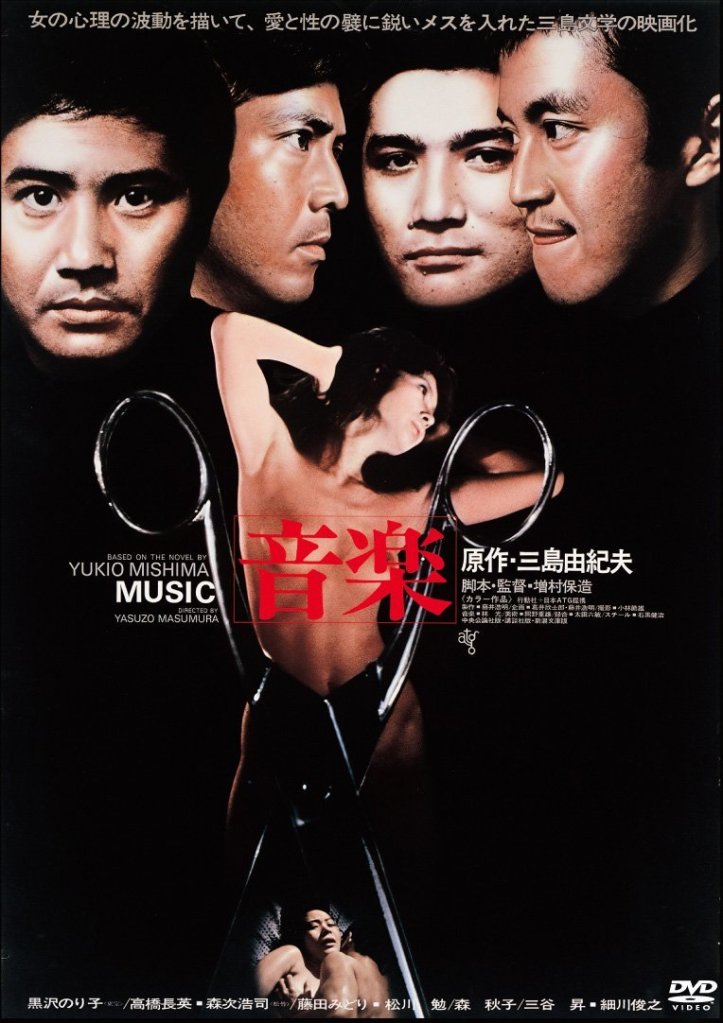
The Music (音楽, Yasuzo Masumura, 1972)

The MusicIf the under seen yet massively influential director Yasuzo Masumura had one recurrent concern throughout his career, passion, and particularly female passion, is the axis around which much of his later work turns. Masumura might have begun with the refreshingly innocent love story Kisses, but later he dived deep into the depths of depravity in Blind Beast and of manipulation in Manji before cycling back around the intense freudian character study which is The Music (音楽, Ongaku) in 1972. Based on a novel by Yukio Mishima (Mishima and Masumura – a match made in heaven), The Music is the story of one woman’s corrupted sexuality caused by a series of inappropriate sexual encounters during her childhood.
The film begins with a symbolic title sequence in which a large pair of scissors opens and closes rhythmically before being superimposed over the body of a woman – Reiko, our protagonist. She has made an appointment with a psychiatrist because, she claims, she has strange symptoms including constant nausea which led her to believe she was pregnant though medical doctors can’t find the cause of her sickness. The other thing is she can’t hear music, she can hear voices and sound effects but if music starts playing it’s like she goes deaf. Her psychiatrist isn’t quite convinced by Reiko and can tell she’s misleading him.

Sure enough he asks her to come back and she admits not hearing music was a symbolic way of explaining that she derives no pleasure from sex. Her boyfriend is a good man and she loves him, she doesn’t think the problem is with him, but she simply feels nothing when he touches her and it’s causing a rift in the relationship. This is the “music” she was talking about and which will become a recurrent motif throughout the film. Later, Reiko finds that she is able to derive a kind of satisfaction from sexual acts with men who are either dying or impotent, but should they simply get better she again loses all interest in them.

As might be expected, the reasons for Reiko’s strange behaviour lie in her childhood. Her fascination with scissors derives from a game of rock paper scissors she once played with the boy to whom she was betrothed to marry when they came of age. Reiko is the only girl in the group and when she loses the boys suddenly declare she’ll have to have her “thing” cut off – only she’s a girl and never had one in the first place. This leaves her feeling disturbed, humiliated, and in some way inherently deficient. From this point on she develops a masculine sensibility symbolised by one side of the closing scissors which becomes her own “thing”, leaving her with a desire for both cutting and being cut.

We also discover that Reiko was assaulted at a young age and that she also experienced early sexual contact with a family member as well as witnessing her aunt engage in an inappropriate relationship which greatly disturbed her. In all, it’s not surprising that Reiko is experiencing such a degree of confusion given all of the traumatic events that have followed her since her youth. Involved in an obsessive, incestuous sexual relationship Reiko is unable to move on with a “normal” life until she addresses the true cause of all her problems.

The psychiatrist is wiley guy, he can spot a lie a mile off and he has Reiko’s number pretty quickly. Amusingly, she does our job for us of trying to diagnose herself with the obvious solutions that seems to emerge from the latest story she’s told, only for the doctor to remind her it’s not so simple and untrained people shouldn’t try to analyse themselves. This is a little ironic in some respects as a trained psychologist would probably give much of Mishima’s cod Freudianism short shrift, but it works well enough in the context of the film. Reiko is about as unreliable a narrator as it’s possible to find but it does seem at last that the truth has been uncovered and Reiko set free from her improper sexual desires.

There’s a degree of campness involved in The Music with its heavy atmosphere and overtly theatrical melodrama. Masumura films with a perverse eye, animating Reiko’s recollections like dreams complete with bizarre perspectives and symbolic imagery to complete his Freudian approach to filmmaking. The Music may not be his most accomplished work, but it is nevertheless interesting and a late career return to his most pressing concerns.


Unsubtitled trailer (NSFW):

Red Angel (赤い天使, Yasuzo Masumura, 1966)

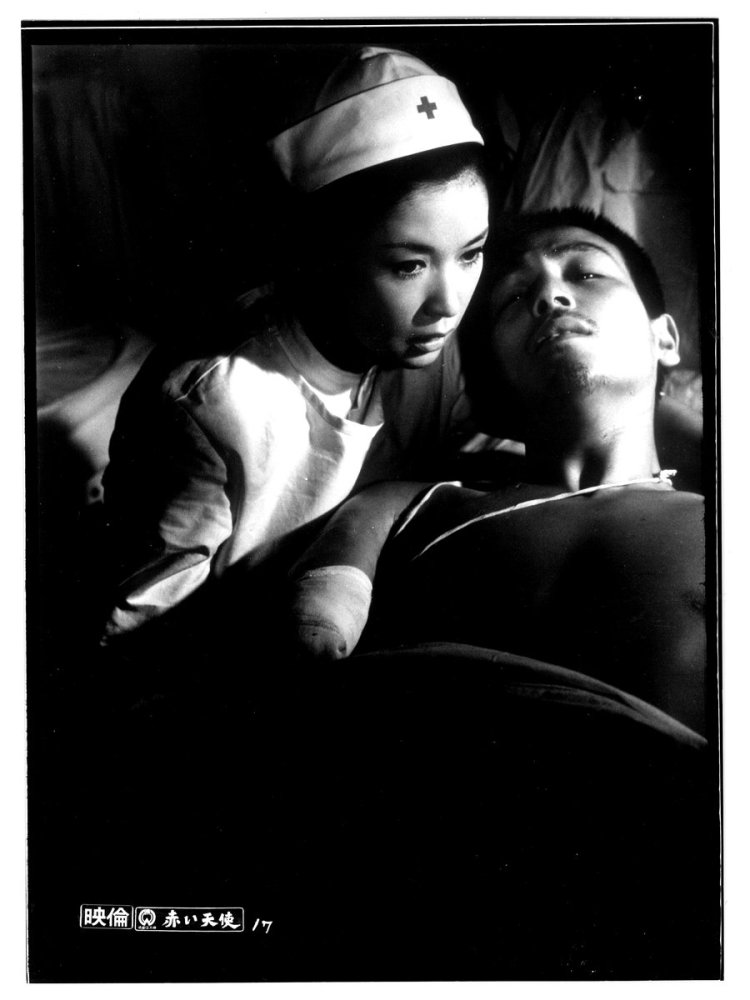
_1_image_size_900_xRed Angel (赤い天使, Akai Tenshi) sees Masumura returning directly to the theme of the war, and particularly to the early days of the Manchurian campaign. Himself a war veteran (though of a slightly later period), Masumura knew first hand the sheer horror of warfare and with this particular film wanted to convey not just the mangled bodies, blood and destruction that warfare brings about but the secondary effects it has on the psyche of all those connected with it.

The story begins as idealistic young nurse Sakura Nishi is sent to a military hospital in mainland China as the Japanese army continues its expansion into Manchuria. At this point the situation isn’t desperate, however, Nishi has barely settled into her new work when she’s grabbed by a patient who attempts to assault her. Far from coming to her rescue or raising the alarm, some of the other patients hold her down or guard the door while Nishi is raped. Reporting the incident to her superior the next morning, Nishi finds out she’s the third nurse this has happened to and only now the matron decides to have the patient (whom she brands a malingerer with mental problems) shipped back to the front lines. The soldier even has the audacity to say goodbye before he leaves whilst leering unpleasantly and if that wasn’t enough the friend also remarks that he enjoyed “the show” and is looking forward to “his turn”.

Things only get worse as Nishi is sent to the front line field hospital which is overrun with the dead and dying. The new patients are delivered by the truckload and the resident surgeon, Dr. Okabe, has to make split second decisions about who is most likely to survive and will receive treatment. Operations here generally result in amputations (whether strictly necessary or not) as this is the best way to prevent the onset of gangrene and other life threatening infections. Okabe was a top surgeon before the war but now he wonders if he’s even a doctor at all – let them die or mame them for life, these are his only options. Eventually, Nishi and Okabe develop a bond but in this desperate and dangerous environment, can you really trust anything or anyone or is every action simply part of the final death throws of those facing the ultimate horror of war?

The frontline field hospital is barely distinguishable from a charnel house as limbs are severed with terrifying efficiency by the conflicted Okabe. There’s little anaesthetic or even medication available and the men scream in agony, asking for their mothers until they finally pass out. Nishi retains some of her youthful compassion wanting to do the best for her patients but Okabe is already lost to a kind of fatalistic blankness.He knows the war itself is hopeless and repeatedly exclaims that China is just too big with too many people in it and they’ll make no impact at all here. At home at least he felt as if he could do something positive, save people’s lives, but here even if he manages to help someone they’ll be sent straight back to fight. They won’t even let the amputees go home for fear that the sight of so many limbless men will damage the nation’s morale.

Okabe, like most of the other men in the film, also has a preoccupation with sex and specifically how these men’s injuries may impact their later quality of life. As for himself, he’s been addicted to morphine for some time which has made him impotent and also places a barrier between himself and his developing relationship with Nishi. Perhaps for this reason he suddenly changes his mind about operating on a patient because it would mean interfering with an area of nerves directly related to sexual arousal and with so little time he’s worried it may be botched and ruin the man’s life so, as it’s likely he may survive without the surgery, he opts to leave it to the more capable hands of a homeland surgeon at a later date. Similarly, a sympathetic patient of Nishi’s who’s lost both of his arms later asks her to provide the “relief” that he is no longer able to supply for himself. Nishi comes to regard this as another of her duties of care and gives the man a few last minutes of comfort. However, this abundance of kindness proves to much for the man and only leaves Nishi feeling even more conflicted than before.

Despite the harshness of the environment, Nishi maintains her youthful and idealistic vision of the world. Okabe cautions her not to get attached to the patients and that the only way through is to view everybody as a stranger, she however refuses. Gradually, Nishi’s love and perseverance reawaken Okabe’s desire for life but in a world as chaotic and fragile as this one all human connections are fleeting and born of the proximity to death.

Red Angel plays out like a horror film full of blood and mangled bodies. Having opened with a series of broken skeletons, the film does not skimp on the macabre imagery and the scenes of buckets full of limbs and corpses being flung from sheets into mass graves are some of the most hauntingly authentic captured on screen. It’s raw and it’s grim, the frankness of its desire to address the murky sexual life of the wartime forces is also surprising from a film made in 1966. Yet there is passion and real connection here too. Throughout it all, Nishi never loses her desire to help or her commitment to love even in the darkest hours. She doesn’t, and cannot, win but her spirit remains unbroken. A harsh look at the animalistic nature of war and its destructive effect on basic human civility, Red Angel is one of the few films to deal with wartime sexuality in a frank way and is still, unfortunately, well ahead of its time.


Red Angel is available with English subtitles on R1 DVD from Fantoma and in the UK from Yume Pictures.

http://www.youtube.com/watch?v=6g8H7-x0gbY