Pressure of Guilt (白と黒, Hiromichi Horikawa, 1963)

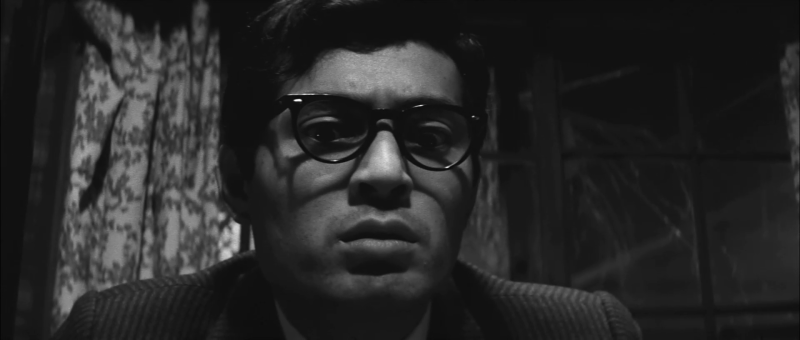
When a lawyer’s wife is found strangled at home, the police immediately arrest a “suspicious person” who is found to be carrying jewellery stolen from her room. Open and shut case, some might say, and prosecutor Ochiai (Keiju Kobayashi) agrees. But in reality nothing is really so black and white in the contemporary society of Hiromichi Horikawa’s crime drama, Pressure of Guilt (白と黒,, Shiro to Kuro). Perhaps ironically, the film opens in the same way as Tai Kato’s later I, the Executioner, with a man’s hands stretching around a piece of rope, and also features a law enforcement officer who is distracted from his duties by a bad case of piles he refuses to get treated.

Ochiai says his haemorrhoids are born of sitting down thinking too much, but the problem might be that he doesn’t think enough or that he suppresses thoughts which might prove inconvenient. There’s something that bothers him about the idea of Wakida (Hisashi Igawa) being the killer, but he shoves his doubts out of his mind and continues questioning him until he confesses. Some of this is born of prejudice. Wakida has a long criminal record mainly for burglary, and has been in and out of prison the whole of his adult life. Currently suffering from TB, he appears to be one of the young men who came to the city in search of work but found only exploitation and eventually had no option but to turn to crime. That he stole the jewellery is not in dispute, but Wakida continues to insist he didn’t kill Mrs Munakata (Koreya Senda). His lack of cooperation puzzles Ochiai, but it confuses him still more that Wakida keeps changing his story. He is, it seems, trying to tell him what he wants to hear, but finally becomes fed up with the whole thing after receiving a letter from his mother telling him to confess. She evidently thinks he did it too. Falling into hopelessness, Wakida declares that he no longer cares who did it and might as well be him because his life is essentially already over. In his condition he won’t last long in prison. There’s no prospect of turning his life around, either. So a death sentence won’t make any difference.

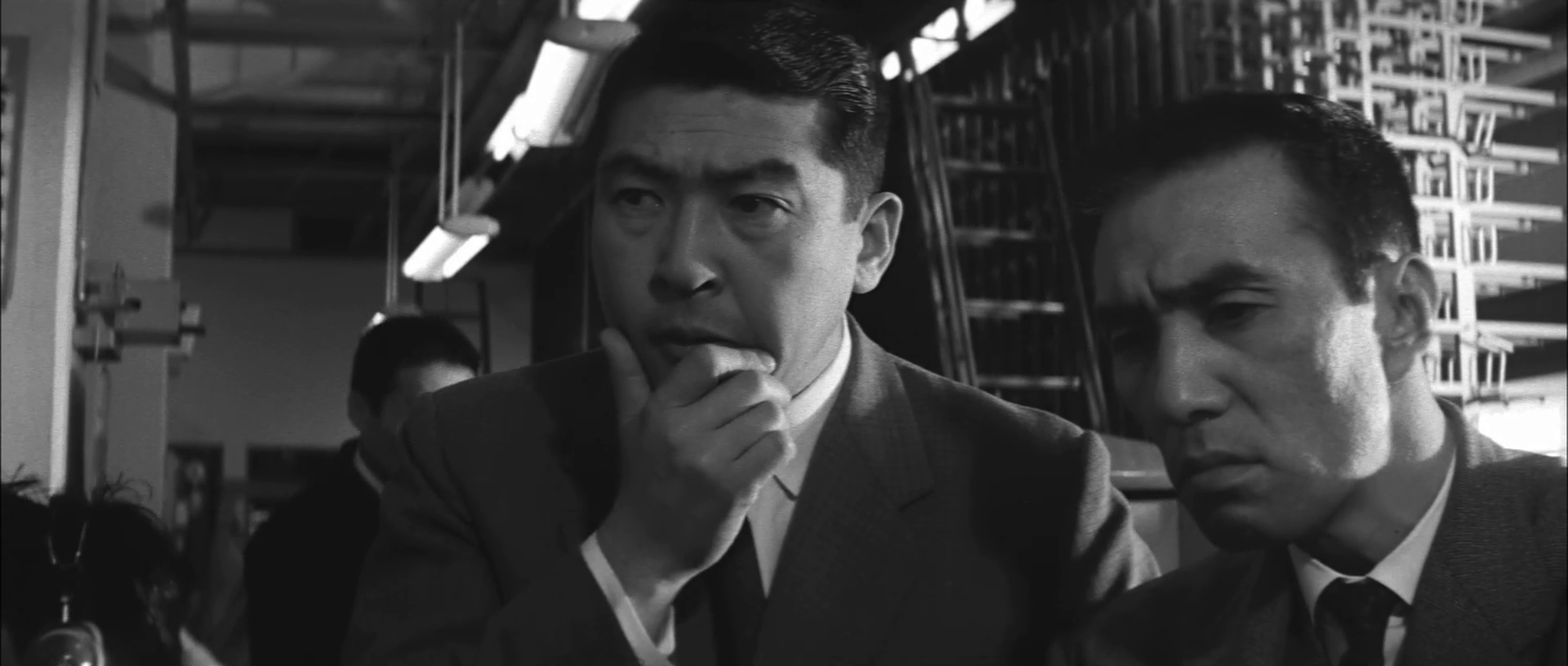
The funny thing is that it’s realising his fiancée must have figured out he did because she’s covering up for him that forces Hamano (Tatsuya Nakadai) into a confession. He’s plagued by guilt that Wakida might die for his crime, but not enough to exonerate him by coming forward. Nevertheless, he tries to talk Wakida round, asking why he confessed and if he was pressured by the prosecutors. The Japanese legal system places confessions above all else, but the issue is that Wakida’s confession is the only evidence that links him to the murder. Just because he stole the jewellery doesn’t mean he killed Mrs Munakata. Ironically enough, he’s defended by the victim’s husband (Koreya Senda), an anti-death penalty activist lawyer who agrees to represent him in part to vindicate his principles. Wakida only agrees to cooperate with Munakata and Hamano who is acting as his assistant when he confirms they’re not trying to help out of pity but only for their own self-interest. 

Yet Ochiai might have a point asking why Hamano is certain that Wakida didn’t do it, or why, on beginning to suspect him, he’s trying so hard to exonerate a man who was going to pay for his crime. It’s Hamano’s own suspiciousness that leads him to question his judgement about Wakida and ask himself if his thinking wasn’t too black and white and he should have investigated more thoroughly rather than pressuring Wakida into a confession and charging him. On realising he may have made a mistake, Ochiai puts the prosecution in a difficult position as his boss warns him of the potential reputational damage to the police and prosecutors if they’re shown to have made a mistake with the mild implication that, as he had assumed someone in Hamano’s position would want to, he should just keep quiet and let Wakida hang. 

Surprisingly, however, it only seems to improve the public’s view of the prosecution to be able to see them admit that they made a mistake and try to fix it rather than refuse to change their position. Mystery writer Seicho Matsumoto makes a cameo appearance as a TV pundit who says he admires Ochiai, while the film also uses a real TV show host to interview Ochiai boosting the sense of realism. As it turns out, there was more to the story than even Ochiai or Hamano thought, but still he declares that it’s better to be a fool than a hopeless idiot and that he was right to look for the truth even if it ended up biting him in the behind. The pressure of Hamano’s guilt, however, never really dissipates even as he struggles with himself, trying to find a way to save Wakida and avoid becoming a murderer twice over, without giving himself away. Nothing’s really that black and white after all, and this case wasn’t exactly open and shut, but the conviction that it had to be based on prejudice and circumstantial evidence might be the biggest crime at all no matter how it actually turned out.
A Mummy’s Love (木乃伊の恋, Seijun Suzuki, 1973)

vlcsnap-2018-05-28-23h20m55s542After getting fired from Nikkatsu for making films which made no sense and no money, Seijun Suzuki cemented his place as a thorn in the side of the establishment by suing them for breach of contract. The “dispute” dragged on, eventually seeing him blacklisted by the other major studios and unable to make a feature film for ten years. This did not mean however that Suzuki was entirely idle between the releases of Branded to Kill and his 1977 “comeback” movie A Tale of Sorrow and Sadness. Like many other directors who found themselves adrift in the changing film industry, Suzuki busied himself with short projects for television, both commercials and stand alone episodes of anthology series including one for Eiji Tsuburaya’s Twilight Zone-esque Horror Theater Unbalance.

Horror Theater Unbalance, produced by Tsuburaya Pro, was in keeping with the studio’s other similarly themed horror and science fiction SFX series but took the form of 13 one off one hour dramas. Although production began in earnest in 1969, filming didn’t finish until 1972 and the series eventually aired in 1973. Many of the episodes were inspired by well known mystery stories and each also featured a framing sequence in which author/actor/TV personality (and later politician) Yukio Aoshima introduced and then wrapped up the tale à la Alfred Hitchcock, Rod Serling, or perhaps Cookie Monster whilst sitting in a creepy mansion filled with weird skeletal objet d’art. Tsuburaya Pro was able to mop up some prime Nikkatsu talent which was gradually seeping out of the studio as it crept towards its eventual rebirth as the producer of Nikkatsu Roman Porno. This included not only Suzuki but also Yasuharu Hasebe and Toshiya Fujita among others, as well as outlying figures from the independent world such as Kazuo Kuroki.

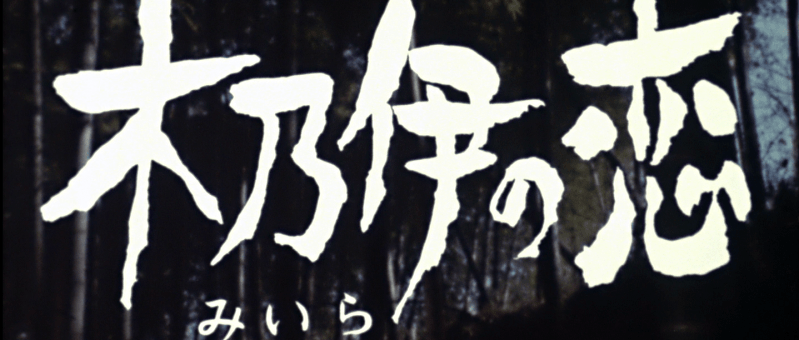
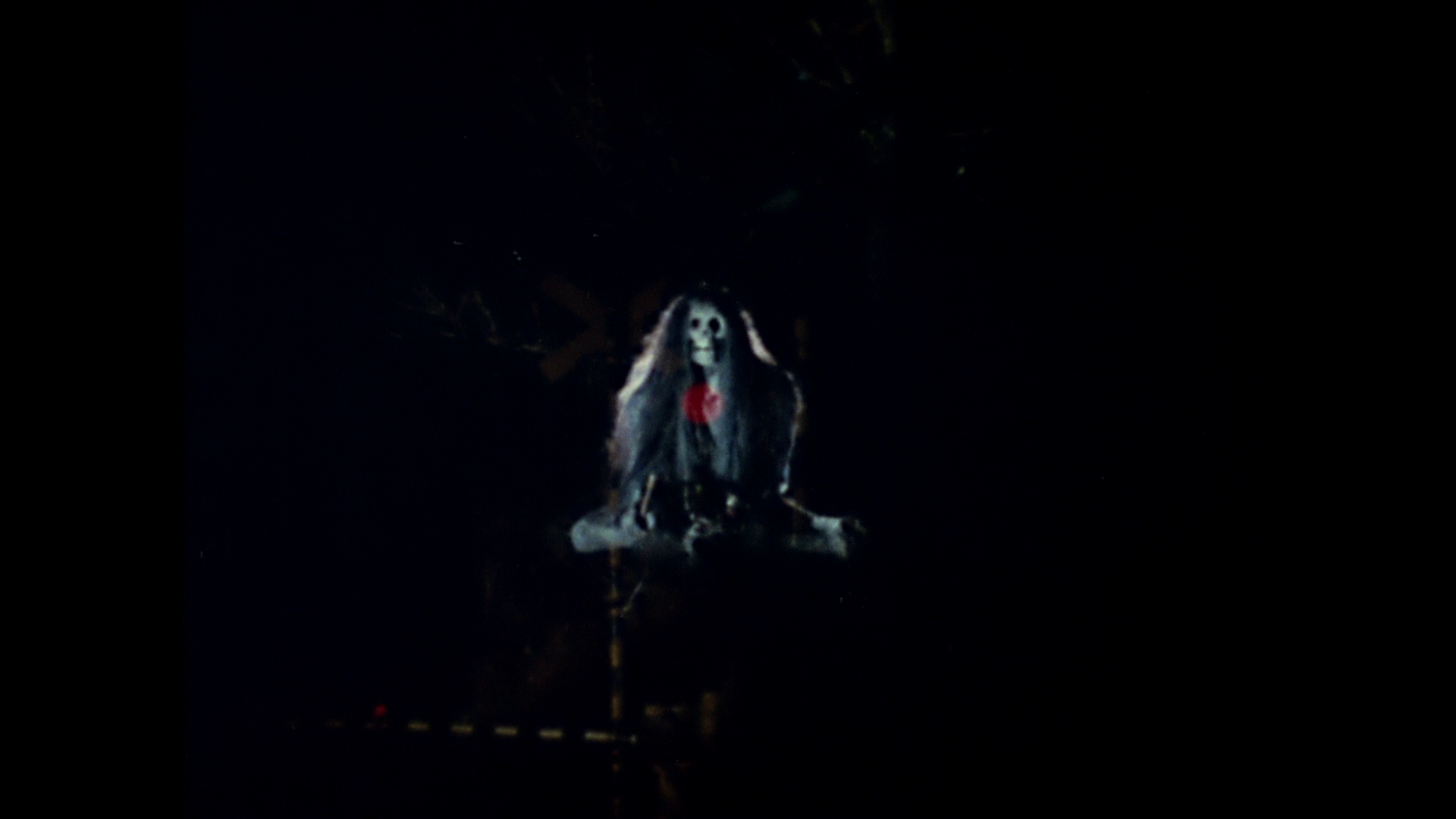
The first to be broadcast, Suzuki’s episode was adapted from a short story by Fumiko Enchi whose recurrent themes share much with those of the director in her frequent use of fantasy and eroticism. A Mummy’s Love (木乃伊の恋, Miira no Koi) is technically a triple tale as it contains an internal framing sequence in addition to the broader one common to the series. The lead is actually Shoko (Misako Watanabe) – a widowed middle-aged editor working with her now elderly professor on a new version of a classic tale from Japanese literature. Her memory is sparked when she catches sight of an oddly vacant-looking monk in the back of a car – eerily like the one in the story which revolves around the discovery of a monk who was buried alive as way of achieving enlightenment but has recently (or perhaps not) begun ringing his bell to alert those above to his conscious presence.

One of the villagers, Shoji, becomes fascinated with the idea of the unsleeping monk. When they dig up the corpse it’s a stiff, strangely robust skeleton which some of the villagers end up using for a game of punt the monk, but little by little his flesh returns. He is not, however, as enlightened as one might hope. To begin with he’s a gibbering wreck, and then finally something more like a crazed sex pest whose pent up amorous energy eventually wears out his new “wife” in a matter of days when she suddenly gives “birth” to a small army of mini dust buddhas. Shoji is sick of the monk and wants to get rid of him, but when he takes his own wife sometime later all he can hear is the sound of a little tinkling bell and suddenly he can’t bear to touch her.

The theme seems to be that unquenched desire will drive you insane with the ambiguous addition that desire itself is best overcome rather than satisfied. Having recounted to us the story of the monk, Shoko finds his tale echoing in her own life. A war widow she lost her husband young and has experienced near constant sexual harassment from her former professor, now bedridden and defeated. Unbeknownst to her, the professor has been keeping her engagement photo in his study for the last decade. He claims that it’s not impossible for an ordinary many to resurrect himself solely through the power of enduring sexual desire, rightly (but somewhat inappropriately) implying that Shoko too harbours lingering desires which have gone unsatisfied since her husband’s passing.

The story culminates with Shoko’s pleading hope for a resurrection as she unwittingly arrives at the place of her husband’s death where she encounters a strange man who might or might not be her late spouse. Making either real or hallucinatory love atop a grave with either a resurrected corpse, a ghost, a phantom of memory, out of body spirit, or just a random rough man talking shelter from the rain, Shoko is a prisoner of her desires but the source of her visitation remains difficult to discern.

Working within a TV budget, Suzuki reins himself in but lends his idiosyncratic sense of ironic fun to an otherwise gloomy, dread-laden tale as the villagers gleefully kick around the dried corpse of the old monk as if he were a long buried football and then seem to meet an unquiet knowingness in his ever hungry eyes. Peppered with surrealist touches, Suzuki’s contribution to Horror Theater Unbalance is a heady affair but one imbued with his characteristic twinned sense of irony and wistful melancholy in a tale of those undone by unresolved longing.