Don’t Buy the Seller (타겟, Park Hee-kon, 2023)

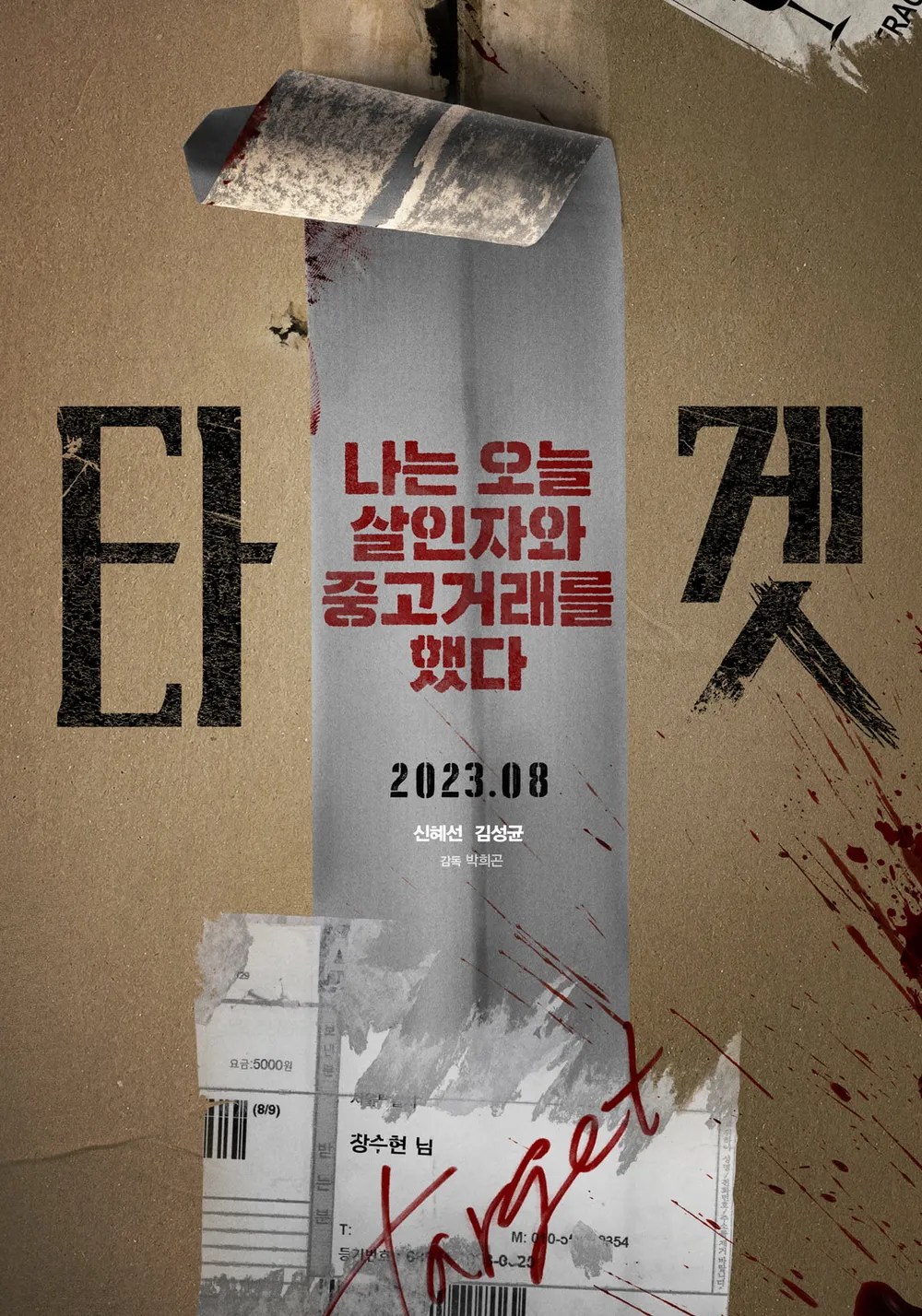
“Why do you always overreact?” a petulant craftsman eventually asks Soo-hyun, though Soo-hyun hasn’t overreacted so much as dared to assert herself in a world that often doesn’t listen to women. The irony at the centre of Park Hee-kon’s cybercrime thriller Don’t Buy the Seller (타겟, Target) is that it seemingly all unfolds because of a faulty washing machine, but like similarly themed films such as Door Lock, it soon becomes clear that Soo-hyun (Shin Hye-sun) isn’t really safe anywhere and there’s nothing this world objects to more than a woman who answers back.

In any case, it’s clear that Soo-hyun is not safe at work as her relentlessly creepy boss (Im Chul-soo) continues to sexually harass her while telling her off for taking things too personally when she finally complains. All he ever seems to do is yell at her for failing to enact his ludicrous demands while the guys at the construction site obviously don’t pay attention to her even though she’s the one managing this project. “Think he wants to work after being yelled at by a young lady?” one of the guys asks when one of the others doesn’t show up for his shift though Soo-hyun hadn’t actually yelled at him so much as asked him to please do his job and follow her instructions rather than ignore her in favour of his own judgement. 

She encounters a similar dismissiveness at the police station where she’s initially fobbed off as just another silly woman despite the younger policeman’s more sympathetic attempts to address her complaints even as his colleague leans over and explains there’s a four month backlog of fraud cases and they won’t even start to look for the guy who scammed her until then. Maybe he has a point, there are lots of victims of crime, but that only means they have lost the ability to enforce the law because the scammers know the police won’t catch them until they’re among the small number of unlucky criminals they do manage to get a lock on. Realising the police won’t help her, Soo-hyun vents her anger by tracking down the scammer on the reselling platform she tried to buy a washing machine from and leaving warnings not to buy on all his listings. Of course, this earns the stalker’s wrath because he too is another man who doesn’t like it when a woman answers back. 

But Soo-hyun has bitten off more than she can chew. This guy is seriously dangerous and into way more than just scamming people online by selling them broken appliances. We can see he has some kind of cyber lair and offers similar services to other men in which he agrees to provide a woman’s phone number, passwords, social media accounts and social security details to any man that wants them, for the right price. If he wants porn or videos posted, that’s extra. But it’s clear that a man with money can ruin a woman who says no with relative ease. Deep into his campaign, the stalker offers Soo-hyun the opportunity to end all this by paying him a large amount of money though as Soo-hyun knows there’s no guarantee he’ll keep his promise. Still after months of terror and constant harassment, she’s on the brink of giving in.

In this way, the stalker becomes an avatar of patriarchal male violence that slaps Soo-hyun right down in her place. She begins to feel insecure in the domestic environment as the stalker sends her nuisance deliveries of fast food at all hours of the day and night along with strange men who’ve been told to visit her for a good time and have evidently been given the code for the door lock. She’d only moved in here a week ago and moving out will incur a financial penalty she’s not well equipped to pay having been scammed in the first place. But the police seemingly can’t do anything while Soo-hyun is plagued by a sense of threat and unease that this person has so much control over her life and could turn up to cause her harm at any moment. Suddenly, she’s not a woman who answers back anymore but a timid and nervous zombie who can barely speak at all. 

Of course, this is exactly what the stalker wanted and what many of the men around Soo-hyun want too. They tell her to stop overreacting or that she brought this on herself by goading the scammer. They imply that she’s made herself an easy target by living alone and that buying goods second hand through apps which involve any kind of personal handover is inherently dangerous, but really they mean that like her friend Dal-ja (Lee Joo-young) she should have got married, chalked up getting scammed to experience, and above all kept quiet about it. Which is to say let her sleazy boss get away with making her feel uncomfortable as a kind of appeasement rather than challenge his behaviour or remind him that he does not have the right to make her feel this way, to abuse his position to interfere with her career, or otherwise oppress her. The message is, you don’t have to buy what they’re selling, faulty goods are after all not worth all this hassle.


International trailer (English subtitles)

Following (그녀가 죽었다, Kim Se-hwi, 2024)

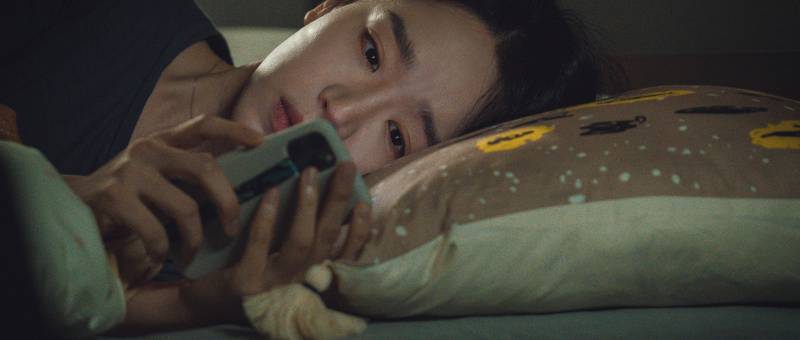
“None of this would have happened if you didn’t follow me,” the hero of Following (그녀가 죽었다, Geunyeoga jug-eossda) is told by his opposite number though he himself doesn’t see anything untoward about his voyeuristic hobby and justifies his habit of “peeping” into the lives of others on the grounds that it does no harm. Of course, he’s not very well placed to make that decision and too narcissistic to consider that while he watches someone may be watching him. 

In any case, what Jung-tae (Byun Yo-han) claims to want to see is “the real you” rather than the persona created for public consumption which is why he’s drawn to duplicitous influencer Sora (Shin Hye-sun) whom he spots simultaneously munching on a sausage and posting about eating a vegan salad. Of course, as an influencer “followers” are what most she most craves though not of the kind Jung-tae becomes nor does she want this particular kind of attention not least because it threatens the facade she’s created for herself as a “good person” posting about her altruistic deeds such as rescuing dogs and cats for which her followers send her monetary gifts and donations for various funds and charities. 

As for himself, Jung-tae thinks he remains a fairly anonymous person. As an estate agent, he projects an image of himself as being kind and trustworthy, while he runs a popular online blog under a pseudonym. He gives little of himself away and later acknowledges that part of the thrill of his voyeurism is a sense of superiority, that he is privy to privileged information about strangers that others do not have. Misusing his position, he sneaks into people’s houses and takes something insignificant as a trophy while also performing small household tasks in recompense. Perhaps it should have seemed like a red flag to him that Sora suddenly wanted to sell her apartment (on her landlord’s behalf), let alone that she didn’t make any attempt to tidy up before giving him a key, but he is so assured of himself that the possibility he has been discovered doesn’t really occur to him until he sneaks into Sora’s place and finds her dead, covered in blood on her living room sofa. Predictably, he does not call the police because he’d have to admit he let himself into her apartment when he shouldn’t have. 

Receiving a threatening letter, Jung-tae then becomes a classic wrong man in the firing line for Sora’s murder and in his mind unfairly persecuted for his “harmless” hobby. The irony is that the person who’s targeting him is doing so because they had something they did not wish others to see and fear Jung-tae may have done so which would give him power over them, while what Jung-tae wants to keep hidden is his own voyeurism. “It’s all about reputation,” he explains and his would be ruined if his clients knew he’d been misusing the keys they entrusted to him for professional purposes let alone the embarrassment of being exposed as a peeping tom even if in this case his peeping isn’t sexual but intimate on another level. 

The power dynamics between the seer and the seen are always shifting, not least because Jung-tae believed himself invisible and in fact continues to think that he is the victim as does the person targeting him. He later comes to realise that what he did was wrong and that he invaded these people’s privacy, but continues to centre himself and despite the glasses he now wears at the film’s conclusion he may not see anything any more clearly than before. What unites him with his own stalker is a sense of frustrated loneliness and longing for connection if also a kind of acceptance even if mediated through a “fake” persona to paper over the cracks in their identity. Yet ironically, even the killer’s words that none of this would have happened if he hadn’t been following them further bolsters his narcissistic sense of importance as much as it reflects the words of an abuser deflecting responsibility for their own actions. Jung-tae has met his mirror image and may not like what he sees (or perhaps does not see at all) while they equally struggle to understand why others cannot see that they are the victim. Told with a touch of humour and a degree of B-movie silliness, Kim Se-hwi’s taut psychological thriller nevertheless suggests that even as we obsess over the image we project to others and that they project to us, we remain largely blind to ourselves and all too keen to justify our actions to maintain a carefully constructed self-hood that is otherwise unlikely to stand up to scrutiny.


Following screened as part of this year’s London Korean Film Festival.

Original trailer (no subtitles)

Collectors (도굴, Park Jung-bae, 2020)

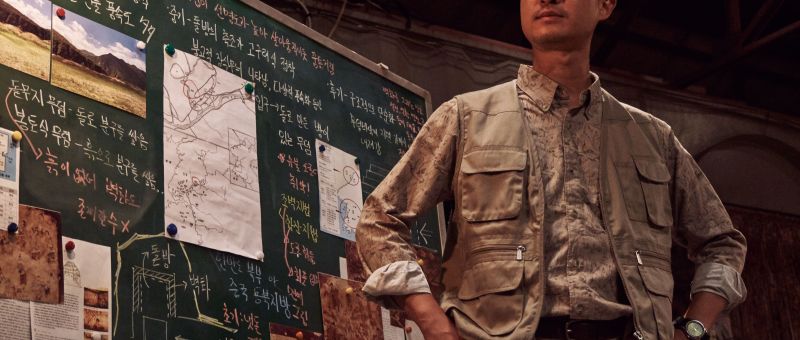
“Grave Robber” is ordinarily not a nice thing to call someone, let alone to be, yet the heroes of Park Jung-bae’s Collectors (도굴, Do-gul) are just that if in effect more like cultural Robin Hoods robbing the dead to reclaim the past than heartless thieves interested only in profit. Operating with a “this should be in a museum!” mentality, these grave robbers have a variety of motives, among them revenge both personal and national, as they take aim at lingering historical betrayals stemming back to the days of Japanese colonialism. 

As the film opens, intrepid thief Dong-gu (Lee Je-hoon) manages to trick a pair of Buddhist monks suspicious on the grounds that he’s a bit handsome for the religious life into letting him “guard” a pagoda that’s set for imminent dismantling in order to nab a precious miniature Buddha located inside. What puzzles the authorities is that Dong-gu leaves obvious evidence of the theft along with a trademark chocopie wrapper which suggests he wants everyone to know how clever he is. This may be true, Dong-gu is quite smug about his obvious abilities as a tomb raider, but he may also have ulterior motives in play. As a duplicitous broker points, out, however, it’s surprisingly difficult to make money trafficking artefacts because they are simply to famous to be sold openly meaning thieves and fences are all dependent on a small pool of super rich “collectors” with whom they have personal relationships or else are stealing to order. 

Stepping back a little, what this means is that not only are those like Dong-gu robbing the dead and selling their affects on the black market, but that they are in a sense traitors to their nation often selling these precious historical artefacts to foreigners and most problematically to the Japanese, ironically enough grave robbers themselves in having looted half the country during the colonial era. It will come as little surprise that the main villain Jin Sang-gil (Song Young-chang), a hotel entrepreneur and head of the Korea Cultural Asset Foundation, in fact owes his inherited wealth to his family having sold artefacts to the Japanese from 1910 onwards, and himself is keeping a large selection of plundered treasures in an ultra secure vault underneath his offices. 

The Buddha brings Dong-gu into Jin’s orbit, first made an offer by his gangster underling Gwang-chul (Lee Sung-wook) who is, perhaps conveniently, Chinese-Korean hailing from Yanbian, and then by his smart assistant Sae-hee (Shin Hye-sun) who is fluent in English, Chinese, and Japanese acting as a broker for wealthy Japanese clients which is how she finances Dong-gu’s upcoming operation to steal an ancient frieze from a grave located in what is now technically China but was then Korean. Dong-gu, meanwhile, despite claiming he got into grave robbing because he realised he’d never be able to buy a house working “like regular people do”, is remarkably uninterested in the money refusing Sae-hee’s “gift” of a fancy car, and instantly losing his fee in the hotel casino. As we later realise, what he seems to want is for the artefacts to be returned to their rightful owners, the Korean people. 

To complete his heist he recruits a series of “experts” including the slightly nerdy souvenir peddler nicknamed “Dr. Jones” (Jo Woo-jin) who even dresses like Indy himself, as well as a former miner recently released from prison renowned for his tunnelling abilities. Dong-gu’s methods are traditional in the extreme, locating the entrance to a burial mound by tasting the soil looking for traces of decomposing flesh, while his sister Hye-ri (Park Se-wan) is much more technologically advanced making frequent use of drones and angering her father and brother by drilling a tiny hole in the Buddha to insert a GPS tracker hoping to figure out what Jin is doing with the artefacts. In a touch of irony, the vault has itself been designed to mimic the security features of an ancient tomb if updated with biometric eye scanning and fingerprint technology topped off with a good old-fashioned key, but as it turns out there’s no security system that can protect you from betrayal especially if you’re generally unpleasant and no one trusts you anyway. 

Dong-gu’s target, however, is a royal tomb located in the centre of Gangnam from which he intends to steal the “Excalibur of Joseon” appealing to Jin’s sense of hubris, leaning into a kind of mythical prophecy in which he’d become a contemporary hero ruling over all Korea as the wielder of the sword. Taking in some additional social commentary in which the government has chosen to improve their approval ratings through spending money buffing up a tomb while when the guys try to rent a subbasement the flirtatious realtor admits the rents are low in this area because it often floods only to shake off some of her disapproval when they tell her they’re part of the restoration team, the central message is that the historical relics of Korea’s past belong to the Korean people, not to the shady businessmen further corrupting an already compromised economy, nor to former colonial powers. Sometimes, it seems to say, digging up the past is a necessary act of national reclamation. 


Collectors screens 13th November as part of this year’s London Korean Film Festival.

International trailer (English subtitles)

A Violent Prosecutor (검사외전, Lee Il-hyeong, 2016)

112997_47166_106Review of Lee Il-hyeong’s A Violent Prosecutor first published by UK Anime Network.


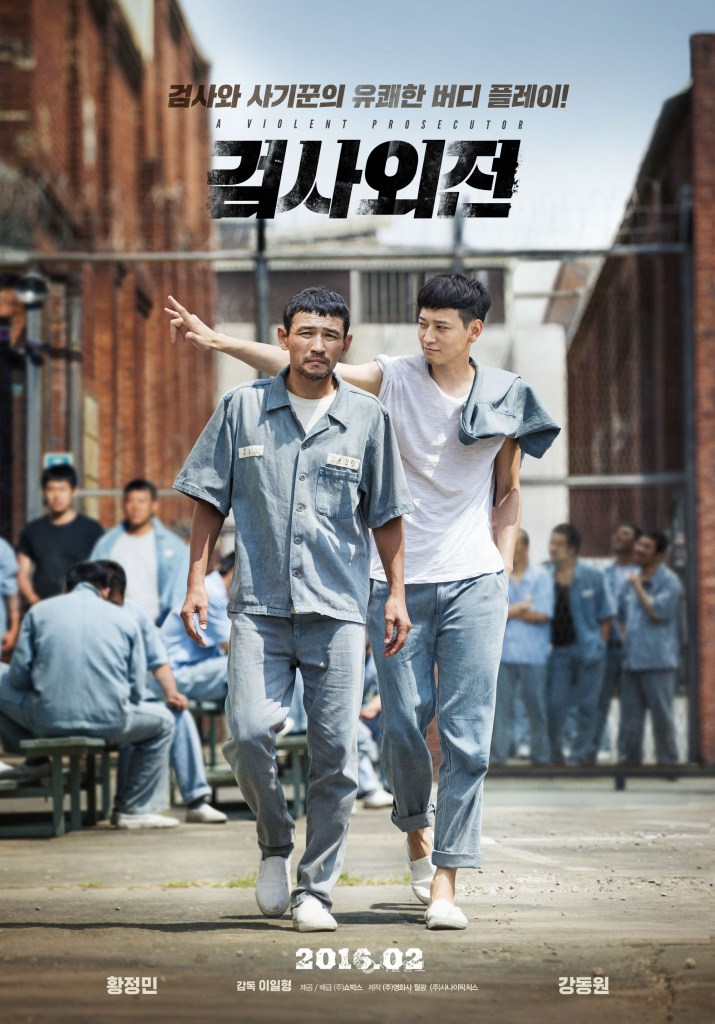
Police brutality is something of a hot button issue at the moment, so it’s a little disconcerting to see a film like A Violent Prosecutor (검사외전, Geomsawejeon) casting a rogue cop with a penchant for forced confessions as its hero. Then again, the theme plays into the obvious retro charm on offer and the film does, at least, make it plain that violence should have no place in law enforcement. The debut feature from director Lee Il-Hyeong, A Violent Prosecutor has a distinctly ‘70s vibe from its quirky credits sequence to the carefully managed tone which manages to be both serious and not at the same time.

Hwang Jung-min plays hardline prosecutor Byun Jae-wook, feared more than respected because of his willingness (or perhaps eagerness?) to indulge in physical violence in the name of justice. Already known as a trouble maker, Byun’s maverick status is an exploitable weakness and so when he kicks up a fuss trying to expose an obvious cover up, he’s framed for wrongful death after a witness dies in police custody.

Sent to prison among many of the men he helped to put there, Byun quickly finds his feet by providing free legal advice to the guards. Five years later, Byun has become the one of the prison’s top dogs but he’s still intent on clearing his name and nailing the guys who did this to him. Enter suave conman Chi-won (Gang Dong-won) and Byun sees an opening…

Aside from Byun’s problematic approach to his work, he’s definitely one of the good guys as justice, politics, and business have all come together in a whirlwind of mutually beneficial corruption. The whole mess begins during an environmental protest against an industrial complex which is about to be built right next to a bird sanctuary. The evil corporate bozos don’t want any delays so they pay a bunch of gangsters to infiltrate the protest and start a riot to make the environmentalists look like crazed, violent, loonies. Unsurprisingly, public opinion about the development improves following the unpleasant actions of the protestors. The police were just supposed to go along with this (police in Korean films never seem very interested in solving crimes after all), but Byun is different, he smells a rat and he’s not going to roll over and let powerful corporations abuse justice.

Unfortunately, his dedication is not matched by his colleagues who are more interested in their own careers than abstract concepts like truth or justice. Receiving pressure from above and realising Byun can’t be talked down, they decide to take drastic action. One of Byun’s bosses, Kang (Kim Eung-soo), later decides to move into politics, having solidified support through this alliance with the money guys, and is then interested in nothing other than his own success – lying, cheating, and smiling his way to the top. Corruption stemming from the power of monied corporations has become a constant theme in recent Korean cinema and A Violent Prosecutor makes good use of its cinematic background even if treating the subject matter in a necessarily light way.

Essentially, A Violent Prosecutor is a buddy comedy in which the two guys at the centre are kept apart for much of the film. Byun uses his hard won legal knowledge to fight his way out of prison by playing by the book, learning the error of his ways in the process. More often than not, he’s the straight man to Chi-won’s constant scamming as the charming conman comes up with one zany scheme after another trying to keep himself out of trouble whilst also helping Byun enact his plan of revenge. Actor Gang Dong-won is on fine form as the slippery but somehow loveable Chi-won whose main line of work is scamming chaebol daughters out of their inheritances by convincing them he’s a Korean-American Penn State business school graduate, peppering his speech with Americanisms but clueless when challenged on his English. He also deserves bonus points for subverting the “escape from prison dressed as a guard” trope by trying to escape from a corridor full of thugs by blending in with the very men sent to capture him.

Ending in a spectacular, if ridiculous, courtroom finale in which Byun defends himself by forcing a confession in a new, more acceptable way, A Violent Prosecutor delivers the necessary “justice” to all who seek it. Byun learns the error of his ways and accepts that his own violence was at least partly to blame for the way the situation developed, but also ensures that he gets justice for everyone else so that the rich and powerful can’t be allowed to ride roughshod over the people with no one to defend them. A smart buddy comedy, A Violent Prosecutor isn’t exactly the exploitative action fest the title seems to promise but is undoubtedly influenced by the bad cop movies of the ‘70s and excels at finding humour even in the strangest of places.


Reviewed at the 2016 London Korean Film Festival.

Original trailer (English Subtitles)

https://www.youtube.com/watch?v=_Cb-tYIsESg