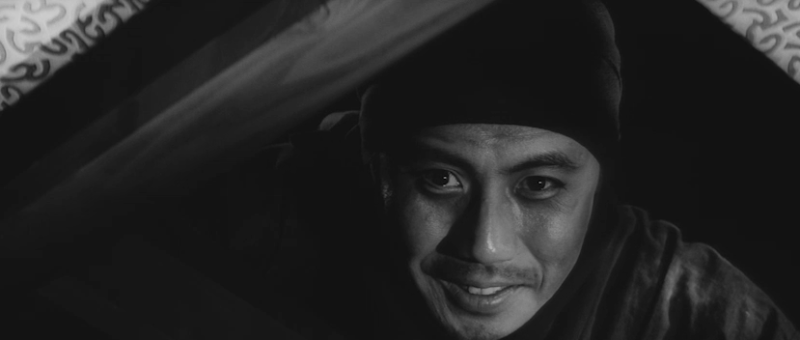
Shinobi No Mono 5: Return of Mist Saizo (忍びの者 続・霧隠才蔵, Kazuo Ikehiro, 1964)

At the end of the previous instalment, Saizo (Raizo Ichikawa) had escaped from the fall of Osaka Castle spiriting away Sanada Yukimura (Tomisaburo Wakayama) who, in contrast to what the history books say, did not die. The pair make their way towards Shimazu, where they are also not well disposed to Ieyasu (Eitaro Ozawa), but as Saizo is informed the Tokugawa clan will never die. Knocking off Nobunaga put an end to the Oda clan, getting rid of Hideyori took the Toyotomi out of the running, but killing Ieyasu will make little difference because another retainer will swiftly take his place.

As a reminder, that’s bad for Saizo because what he wanted was the chaos of the Warring States era back to restore the ninja to their previous status. Nevertheless, at the end of the previous film he claimed to have rediscovered a human heart in his devotion to Yukimura though it may of course be simply another ruse to meet an end. In any case, Ieyasu seems to be putting his ninjas to good use and is once again waiting it out apparently aware that Yukimura is alive and well in Shimazu.

Meanwhile, times are changing. Yukimura is convinced the future of warfare lies in firearms and whoever controls Tanegashima where the weapons are made will prove victorious. They think they can gain it by figuring out how they get access to high-quality iron when trading with anyone outside of Portugal is illegal and the Portuguese don’t have any. It’s access to foreign trade which is becoming a crunch issue as Ieyasu tries to solidify his power, later giving a deathbed order to ban Christianity to stop European merchants taking over the country. Saizo travels to Tanegashima to investigate and figures out that the secret is they’re trading with China, which is pretty good blackmail material, but also encounters two sisters who turn out to be the orphaned daughters of a Tokugawa ninja with vengeance on their mind.

In a surprising turn of events, it turns out that his main adversary is Hanzo Hattori (Saburo Date) but the fact he keeps outsmarting him eventually convinces Ieyasu that the ninja have outlived their usefulness. Hanzo becomes determined to kill Saizo to restore his honour, filling the palace with various ninja traps though unlike Goemon Saizo seems to be one step ahead of them. This lengthy final sequence is played in near total silence, and ironically finds Goemon just waiting, after dispatching several of Hanzo’s men, to see if his poison dart has taken effect and Ieyasu is on his way out. Only in the end Ieyasu just laughs at him. He’s 75. Saizo’s gone to too much effort when he could have just waited it out. Ieyasu has already achieved everything he wanted to. His control over Japan is secured given he’s just been appointed chancellor. He can quite literally die happy because nothing matters to him anymore. A title card informs us that when Ieyasu did in fact die, no one really cared. The Tokugawa peace continued. 

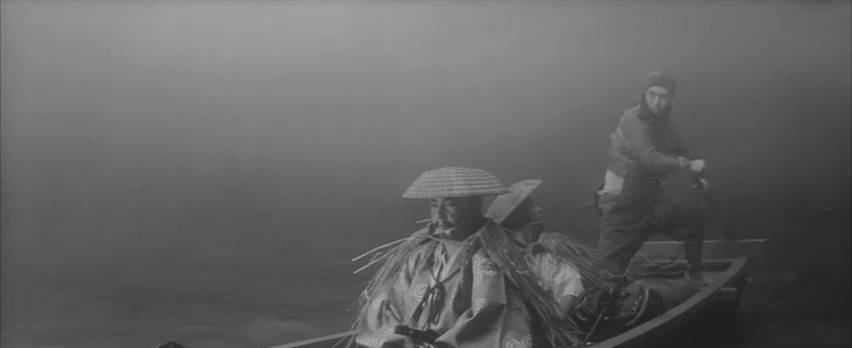
Here, once again, the Ninja too are powerless victims of fate despite their constant machinations. Yukimura tells Saizo to live and be human, advice he gives to the sisters in Tanegashima but does not take for himself staking everything on his revenge against Ieyasu which is, as he points out, pointless for Ieyasu was at death’s door anyway and his demise changed nothing. In his first of two entries in the series, Kazuo Ikehiro crafts some impressive set pieces beginning with a mist-bound underwater battle as Saizo and Yukimura make their escape by water to an epic flaming shuriken battle, though this time around the deaths are noticeably visceral. Men are drowned, stabbed, or caught on wooden spikes. Those who do not obey the ninja code are stabbed and pushed off cliffs while once again emotion is a weakness that brings about nothing more than death. Ikehiro’s frequent use of slow dissolves adds to the dreamlike feel of Saizo’s shadow existence even as the ninja themselves seem to be on the point of eclipse for what lies ahead for them in a world of peace in which there is no longer any need for stealth?


Destiny’s Son (斬る, Kenji Misumi, 1962)

“Sad is his destiny” laments a seemingly omniscient lord in Kenji Misumi’s elliptical tale of death and the samurai, Destiny’s Son (斬る, Kiru). A chanbara specialist, Misumi is most closely associated with his work on long running franchises such as his contributions to the Zatoichi series and Lone Wolf and Cub cycle, and though sometimes dismissed as a “craftsman” as opposed to “auteur” is also known as a visual stylist capable both of the most poetic imagery and breathtaking action. 

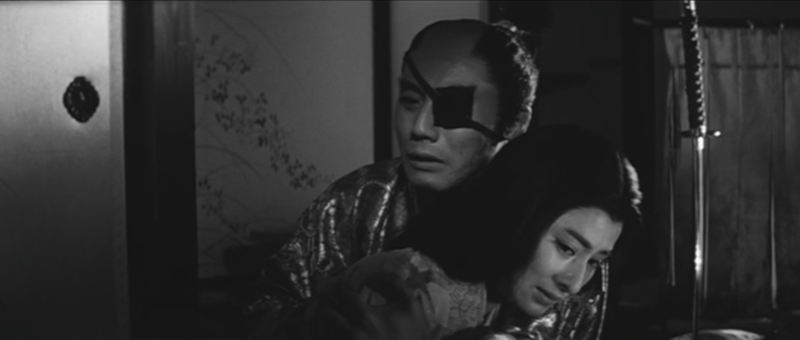
Scripted by Kaneto Shindo, Destiny’s Son follows cursed samurai Shingo (Raizo Ichikawa) who finds himself the victim of cruel fate and changing times during the turbulent years of the bakumatsu. His mother, Fujiko (Shiho Fujimura), a maid misused by a plotting courtier and talked into murdering the inconvenient mistress of a wayward lord, was executed for her crime by the man she loved, Shingo’s father who later renounced the world and became a monk. In a sense, it’s Shingo’s sense of displacement which later does for him, allowed the rare freedom of a three year pass from the apparently compassionate lord of the clan which took him in to go travelling during which he learns superior sword style something which came as a surprise to his old friends on his return who’d always thought him gentle and bookish. His talent makes him dangerous to an unexpected rival in his strangely mild-mannered neighbour who happens to have a crush on his sister Yoshio (Mayumi Nagisa) but is quite clearly under the thumb of his finagling father, Ikebe (Yoshio Inaba), who is convinced the family can “do better” as long as he triumphs in a contest of martial prowess with a passing master to whom the clan has given temporary shelter after he was cast out of his own. Of course, nothing goes to plan. The master easily defeats even the clan’s most talented warriors until Shingo is called up as a last resort only to best him with his signature move learned out on the road, a dangerous throat thrust. 

In a theme which will be repeated, Shingo finds himself in the middle of accidental intrigue through no fault of his own though the ill-conceived Ikebe revenge plot does at least allow him to discover the sad truth of his family history even as it deepens his sense of displacement. Slashing right into the mores of the chanbara, Misumi pares Shindo’s screenplay down to its poetic minimum as the hero sets off on his elliptical journey, achieving his revenge as the first stop before walking back into the past and then into an accidental future as a retainer to Lord Matsudaira (Eijiro Yanagi) himself at the centre of bakumatsu intrigue in trying to quell the divisions within the Mito clan some of whom have been involved in anti-shogunate terrorism setting fire to the British Legation shortly after the nation’s exit from centuries of isolation. An eternal wanderer, he resolves to have no wife and wanted no ties, haunted by the trio of women he couldn’t save from the mother who birthed him in part as a bid for mercy, to the sister who died a pointless and stupid death because of samurai pettiness, to another man’s sister whose name he never knew who stripped naked and threw her kimono at her assailants to save her brother’s life while they too were on the run after standing up to samurai corruption. He loses three women, and then three fathers, the first he never knew, the second taken from him in more ways than one, and the third betrayed by the complicated world in which they live. 

“I cannot be forgiven” Shingo exclaims, his end tied to that of his mother as a sword glints gently in the bright sunshine and blood drips, the only blood ever we see, on another woman’s breast. Elegantly composed and often set against the majestic Japanese landscape, Misumi’s ethereal camera with its dynamic tracking shots, controlled dolly movement, and frequent call backs to the setting sun lend Shingo’s journey an elegiac quality even in its evident nihilism as he finds himself consumed by the samurai legacy, discovering only futility in his rootlessness unable to protect himself or others from the vagaries of the times in which he lives. 


Original trailer (no subtitles)

The Third Shadow Warrior (第三の影武者, Umetsugu Inoue, 1963)

“In this world the weak are playthings of the strong” according to the hidden villain concealing himself slightly to the side in Umetsugu Inoue’s dark identity drama The Third Shadow Warrior (第三の影武者, Daisan no Kagemusha). Adapting a novel by Norio Nanjo, Inoue, most closely associated with sophisticated musicals, shoots in the manner of a ghost story adapting the trappings of a minor parable on the consequences of selling one’s soul for advancement in complicity with an inherently broken feudal order. 

Opening in 1564, the film wastes no time reminding us that the samurai were cruel and duplicitous, a troop of them riding through the contested mountain territory of Hida bearing the severed heads of their enemies casually insulting peasants as they go. Young farmer Kyonosuke (Raizo Ichikawa), however, can’t help but think that they’re heroic and dashing, longing like many young men as the voiceover explains to make his fortune as a samurai in this the age of war. Kyonosuke gets his wish when retainer Shinomura (Nobuo Kaneko) turns up and offers him a job at the castle, only it’s not quite what he expected. Bearing a striking similarity to lord Yasutaka, he has been hired as his third “shadow”, a decoy intended to shield the lord from harm. 

Sitting down with his two new brothers, Kyonosuke remarks how ironic it is that he’s here to escape the land but Kuwano (Katsuhiko Kobayashi) is patiently saving up his pay with the intention of using it to buy a farm and settle down with a beautiful wife. His is the most dangerous of doubling roles as the lord’s battlefield stand-in, while Ishihara (Yuji Hamada), a former actor apparently not much good with the sword, takes his place behind closed walls. Kyonosuke is quite taken with the world of the samurai, but Ishihara cautions that he’ll soon tire of this “phoney life”. In accepting this devil’s bargain, Kyonosuke has in essence consented to his own murder. A shadow man, he can no longer call himself Kyonosuke, but nor can he say he is Yasutaka. He has no fixed identity and is merely in waiting for a veil. Worse still as Ishihara has begun to suspect, they no longer have bodily autonomy because their physicality must match that of the lord. When he is blinded in a battlefield mishap with an arrow, so must they be. Deciding he’d rather not lose an arm, Kyonosuke finds himself in an altercation with his other self which leads to his demise. He intends to make a life for himself under his own name with another clan, but is forced to permanently assume Yasutaka’s identity after being cornered by Shinomura intent on manipulating him for his own ends. 

“I’m no puppet, I no longer need a puppeteer” Kyonosuke exclaims drawing strength from embracing his new identity as a samurai lord, but perhaps overreaches himself in ambitious desire failing to see the various ways he is still merely a pawn in a bigger game as Yasutaka himself once was because the lord is only ever an empty vessel and far more expendable than might be assumed. Princess Teru (Hizuru Takachiho), Yasutaka’s conquest bride, declares that she is “just a doll, the strongest will win me” but is of course playing a role herself, one which she does not desire but has been thrust upon her while her cousin, Sadamitsu (Shigeru Amachi), is engaged in a much more active piece of long form role play. Only the lord’s concubine (Masayo Banri) sees through him, falling for the gentle peasant after the rough lord who toyed with her, but their complicated love eventually seals his fate even as he believes it offers him victory. Kyonosuke became a samurai to escape his lack of agency but is arguably much less free than he ever was, driven slowly out of his mind by his fractured sense of identity and realising that in killing the only man who knew who he “really” was, he also killed himself. 

Quite literally imprisoned, Kyonosuke finds himself a shadow once again neither one man nor another, denied an identity and forever a puppet of duplicitous game players better versed in the realities of the samurai existence. “How ugly fighting over this transient kingdom” the princess disdainfully remarks while herself engaging this apparently meaningless foolishness, reminded by her cousin that a princess may hold the keys to a castle or even a nation even if he implies she is little more than his tool, a puppet to be manipulated if knowingly. Shooting with deep, expressionist shadows, chiaroscuro lighting, and a melancholy voiceover Inoue frames his tale as a parabolic caution against selling one’s soul for gold but also a crushing indictment of the inequalities of the feudal order built on wilful hypocrisy and cynical exploitation.