Invasion of the Neptune Men (宇宙快速船, Koji Ota, 1961)

Japan was well on the way to economic recovery by 1961, but the newly prosperous society also gave rise to other anxieties and most particularly in the light of the Cold War and space race with the nation fearful of falling behind in scientific development. Or at least, that’s something that particularly bothers the young heroes of Koji Ota’s kids tokusatsu, Invasion of the Neptune Men (宇宙快速船, Uchu Kaisokusen), in which the nation’s failure to build a space rocket is conflated with its traditional visions of masculinity. 

At least, the boys all agree that Tachibana (Shinichi Chiba), a young scientist who runs a kind of club with them at the research facility where he works, is pretty great but also a bit of a wimp who failed to stand up to some bullies who were hassling him at a local cinema. They think it would be better if he were cool, re-imagining him as a kind of tokusatsu hero named “Iron Sharp” for whom they even come up with a theme song. As part of their club activities watching satellites, the kids accidentally stumble across a spaceship belonging to Neptune men who are planning to invade though obviously as they are children no one really believes them until the Neptune men start causing other forms of destruction. 

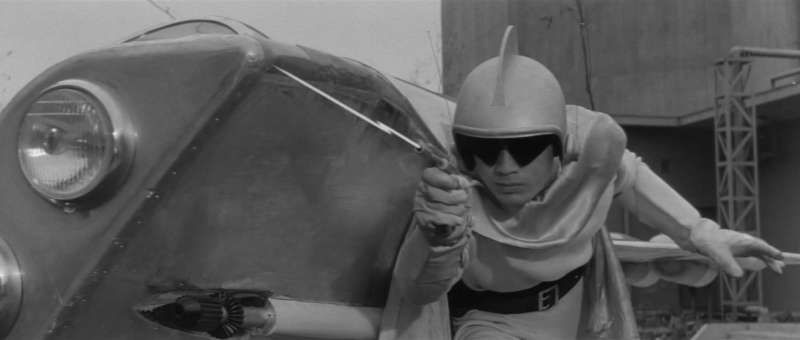
Attacked, the kids are saved by the hero they themselves made up flying in on a car/plane/spaceship though he too doesn’t really have a lot time for them and the kids don’t even really notice he looks a lot like Tachibana who is noticeably absent from the lab whenever he’s around. Even so, this being a kids film the major the problem is that no one else takes the boys very seriously, save Tachibana himself, leaving them to save the day on their own while the grown-ups argue amongst themselves. 

Getting people to argue amongst themselves turns out to be part of the aliens’ mission in exploiting Cold War paranoia to start world war three. The first attack results in a mushroom cloud which must have been fairly painful symbolism though the Americans immediately blame Russia who blame the US in return asking if they’re really intent on starting a nuclear war. The kids wonder why grownups are always so suspicious of other countries, hinting at a desire for a less xenophobic society eventually echoed in the calls for worldwide unity to defeat the Neptune men while otherwise repeatedly emphasising that Japan can’t be left behind by the US and Russia in the space race. 

Then again, there is something quite troubling in the fact that the invading Neptune men who’ve taken on human form appear as soldiers but wearing prominent feminine makeup, re-echoing the boys’ concerns regarding science and masculinity while introducing a seemingly unintentional dose of homophobia into the threat posed by the aliens who otherwise wield destructive nuclear powers echoing the atomic bomb in using their ray guns to vaporise their targets who then leave shadow imprints of themselves where they disappeared. The main weapon used to combat them is science, Tachibana and his boss, the father of one of the boys, coming up with an ingenious electric shield and then a series of magnetic rockets which allow them to shoot down the Neptunian’s ship. 

In this case, science is the “good” force that combats the “bad” use of nuclear weapons this time rendered alien rather than manmade therefore neutering the debate surrounding their use and the responsibilities involved with their discovery. Tachibana, the thinly disguised Iron Sharp, then becomes a hero of science racing round in his custom car and largely defeating the Neptunians through a more primal kind of hand to hand violence while embodying the kind of cool masculinity the boys the otherwise feared he lacked which is to say that unlike his real life guise, Iron Sharp is perfectly capable of standing up to “bullies” like extraterrestrial invaders. Reusing some of the effects footage from The Last War, the film emphasises the need for world unity and the end of the Cold War, but also sells a slightly contradictory, mildly nationalist message insisting that Japan can’t fall far behind technologically or will essentially be at the mercy of Russia and America, Tachibana having travelled to Moscow to assist with the creation of a new spaceship. Spurred on by their adventures, the kids all vow to become great inventors protecting Japan through their innovations, going on to explore Mars and Venus hinting at a new sense of possibility in the post-war society but also mindful of its geopolitical realities.

A Fishwife’s Tale (魚河岸の女石松, Eiichi Kudo, 1961)

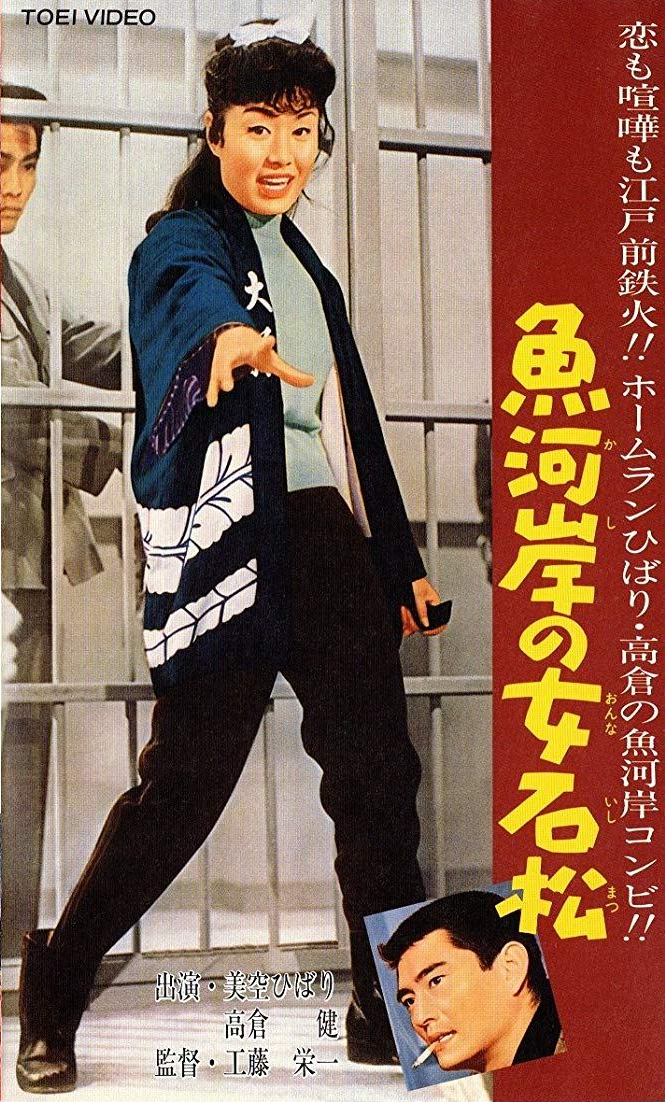
A Fishwife's Tale VHS coverWho better to take on post-war corruption and personal injustice than Hibari Misora? In another of her typically feisty roles, Hibari stands up for her friends, her community, and her family when they are threatened by the exploitative forces of the tabloid press, rubbish boyfriends, and evil corporations all while accidentally falling in love with Ken Takakura in an early role as cynical reporter with a heart of gold. Eiichi Kudo may be best remembered for a string of samurai movies in the ‘60s including 13 Assassins and The Great Killing, but like many of his generation he made a fair few programme pictures including several starring Hibari Misora of which A Fishwife’s Tale (魚河岸の女石松, Kashi no Onna Ishimatsu) is one.

Kudo opens with stock footage of a small fishing harbour which is all aflutter with the arrival of some unusual outsiders. A photographer from a “magazine” has arrived claiming that he wants to document the lives of ordinary working class people from the fishing industry. While some of the young women doll themselves up and plead with the photographer, “Lady Ishimatsu”, Keiko Kano (Hibari Misora), steals all the attention by defiantly rolling through in her truck ready for a day’s work. As predicted Keiko doesn’t want anything to do with this photography nonsense, and as it turns out she was right not to. The guys aren’t from the Sundays or National Geographic, they’re a scandal rag and they’ve bulked out their story with a lot of made up rubbish about the “sexy lives of fishwives” which paints them all as predatory nymphomaniacs. Matters come to a head when Keiko’s friend Yoko (Yukiko Nikaido) tries to kill herself in shame because of the paper’s implication that she’s a loose woman which causes her wealthy boyfriend to dump her (luckily, she’d mixed up tummy tablets with sleeping pills so thankfully survived even if feeling a little sick and silly).

The newspaper business has a second unforeseen consequence. When Keiko stands up to the achingly cool reporter, he realises she’s connected to another case he’s working on. Across town, a canned food magnate is facing ruin thanks to a standards scandal and is also earnestly searching for his long lost daughter, born to a geisha 20 years earlier and then adopted by another family. Dogged reporter Kitagawa (Ken Takakura), recognising the necklace around Keiko’s neck, wonders if she might be the girl Tachibana’s looking for. When it turns out that he’s right, Keiko’s world turns upside-down. Tachibana (Eijiro Yanagi), overjoyed to have found his daughter, goes about everything the wrong way and tries to take her back from her loving home with the promise of wealth and comfort, but Keiko loves her parents even if they aren’t hers by blood and resents the attempt to drag her away. 

Nevertheless, when the two cases turn out to be even more connected thanks to Yoko’s terrible boyfriend being the no good son of one of the conspirators, and Mr. Tachibana falling ill though the stress of his situation, the entire family reconsiders if they haven’t perhaps been selfish in resolutely rejecting a lonely old man trying to make up for a past mistake. Keiko becomes committed to standing up to the bullies. “We’re still young, as long we’re alive we’ll resist you” she tells her biological father’s arch enemy in what might as well be a rallying cry for post-war youth fed up with the corrupted older generation.

Then again perhaps things don’t change all that much. Rather than a salt scam or rice profiteering, this time it’s fiddling with the labels on tin cans but ordinary people are still having their food supply tampered with by those with enough money not to need to worry so much about food security – the amoral petty samurai of the Edo era have merely become amoral businessmen in the dog eat dog post-war world.

Comparatively light on song and dance – Hibari sings the title track as she drives in on her truck, hums a few tunes, and gets one dramatic musical number when she goes undercover as a nightclub singer to spy on the bad guys, Kudo ups the action quotient as Hibari makes herself the chief of the fishwives and takes on the photographers, sneaks around investigating, and then starts a full on brawl with goons in the final showdown. This time around the romance between frequent co-stars Hibari Misora and Ken Takakura is spiky and sparky, fuelled by Keiko’s strange positioning as a “tomboyish” bossy boots more at home in her truck and wellies than prancing around for the camera like the other girls. Oddly warm and filled with rebellious energy, A Fishwife’s Tale is, in its own quiet way, perhaps subversive in allowing a little political spirit of the age to creep in around the edges as Keiko steps forward to stay true to her roots, opposing injustice wherever she sees it and always acting on her own initiative.


Selection of scenes from the movie including Hibari’s big club number (no subtitles)

https://www.youtube.com/watch?v=o2C9SlTD278

Maintitles song – Hibari no Dodonpa

https://www.youtube.com/watch?v=LnATqXSHqbc