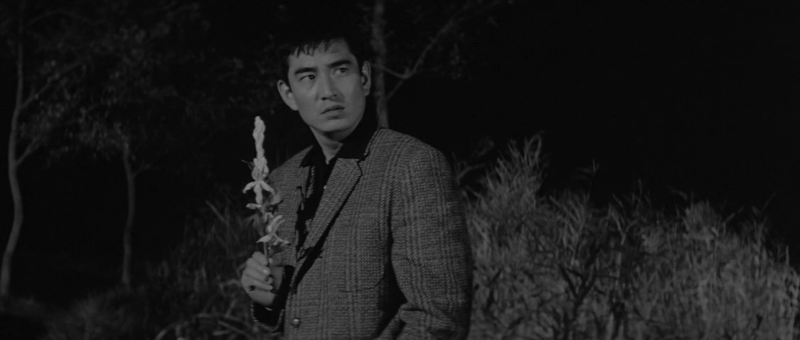
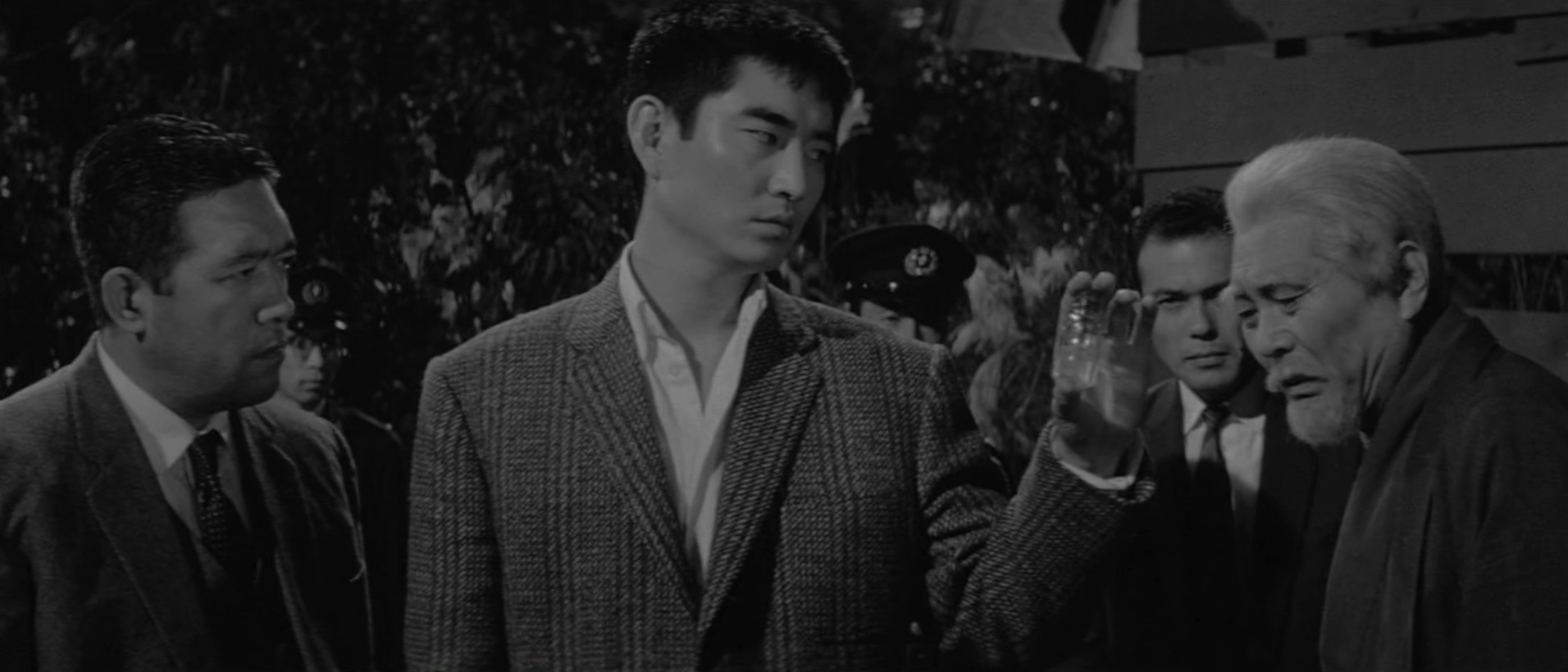
Devil’s Nursery Rhyme (悪魔の手毬唄, Kunio Watanabe, 1961)

Ken Takakura might seem like a slightly odd fit for Seishi Yokomizo’s iconic detective Kosuke Kindaichi who is known for his dishevelled appearance and general eccentricity. This 1961 adaptation of The Little Sparrow Murders, Devil’s Nursery Rhyme (悪魔の手毬唄, Akuma no Temari Uta), however, follows the path laid down by the Chiezo Kataoka-led series of Kindaichi movies in making Kindaichi a more conventional private detective who is also a consultant to the police force. As such, Takakura plays him as a dapper young man, first seen wearing a cravat and sunglasses while driving a distinctive sports car. In terms of his detecting style, however, he’s much Sherlock Holmes, relying on his observational skills to spot small details that help him to solve the mystery.

As for the mystery itself, it bears very little relation to Yokomizo’s novel. Director Watanabe was apparently unhappy with the script he was handed and had it entirely rewritten by Shinji Kessoku. Kessoku later recalled that he was only handed the original script to rewrite and wrote his version without ever reading the book, coming up with what is basically an entirely new, much simpler story that only keeps the feudalistic tensions of Yokomizo’s original in revolving around a family whose prosperity was effectively stolen through underhanded means.

Oldest daughter of the Nire family Sumako (Machiko Yashiro) has become a popular singer and is returning to her hometown for the first time in a while after receiving a threatening letter. Unfortunately, she is murdered on the way while her new single featuring her singing a local folksong plays on the radio. It soon transpires that her father, Gozo (Yasushi Nagata), has also been receiving threatening letters and is urged to go to the police by his son, Genichiro (Fumitake Omura), though Gozo insists the two things are not related. Meanwhile, he is perturbed by the return of local man Tatsuzo (Zeko Nakamura) after 18 years, fearing he means to poke into the death of his former boss Aoike whose land Gozo ended up acquiring less than ethically.

Kindaichi is in town after being contacted by Sumako and soon sets about investigating with the help of Kazuo (Tou Ono), the university boyfriend of Sumako’s younger sister Satoko (Kiwako Taichi). Kessoku and Watanabe don’t stick too closely to the classic Yokomizo formula and only include a little of the supernatural strangeness his work is known for such as the appearance of a weird old woman who seems to be a local shamaness, warning of the cursed plants near the lake and mentioning her frequent communications from the gods foretelling danger and disaster for everyone. Similarly, Gozo is apparently tormented by the Temari Uta song Sumako has just released, though unlike the novel it doesn’t have very much to do with the murders which don’t follow any particular pattern.

Though set in the present day rather than the slightly earlier setting of the novel, the “curse” does in fact relate to village dynamics and the unfair rise of the Nires who destroyed the Aoike family to become the village leaders. Not everyone who lives in a big house is a good person, Tatsuzo point out as if in one sense kicking back against the idea of feudal privilege but at the same time remaining loyal to the Aoikes and only resenting Gozo because he manipulated the system to claim a privilege he wasn’t really entitled to. The Nires have a bad reputation locally and this is likely why. People don’t like it that they usurped their position and expect the upper classes to be a little more morally upright, rather than objecting to their existence in the first place or rejecting the kind of power they still wield over them locally even in the democratic era.

Nevertheless, Satoko eventually decides to make amends by dissolving the family estate and giving the money to social causes while returning to university with Kazuo to lead a more modern life. Kindaichi, by contrast, already seems to have more cases lined up and will return to Tokyo with his secretary. He’s played a more obvious role, in some ways, than is usual in the series in which he sometimes just appears as a background character who reveals the solution to the mystery at the conclusion. Perhaps for these reasons, the film did not really fit the Kindaichi series and was not particularly successful, which might explain why Takakura never played him again, though it does perhaps say something of how Toei envisioned of the character in the early 1960s.
A Fishwife’s Tale (魚河岸の女石松, Eiichi Kudo, 1961)

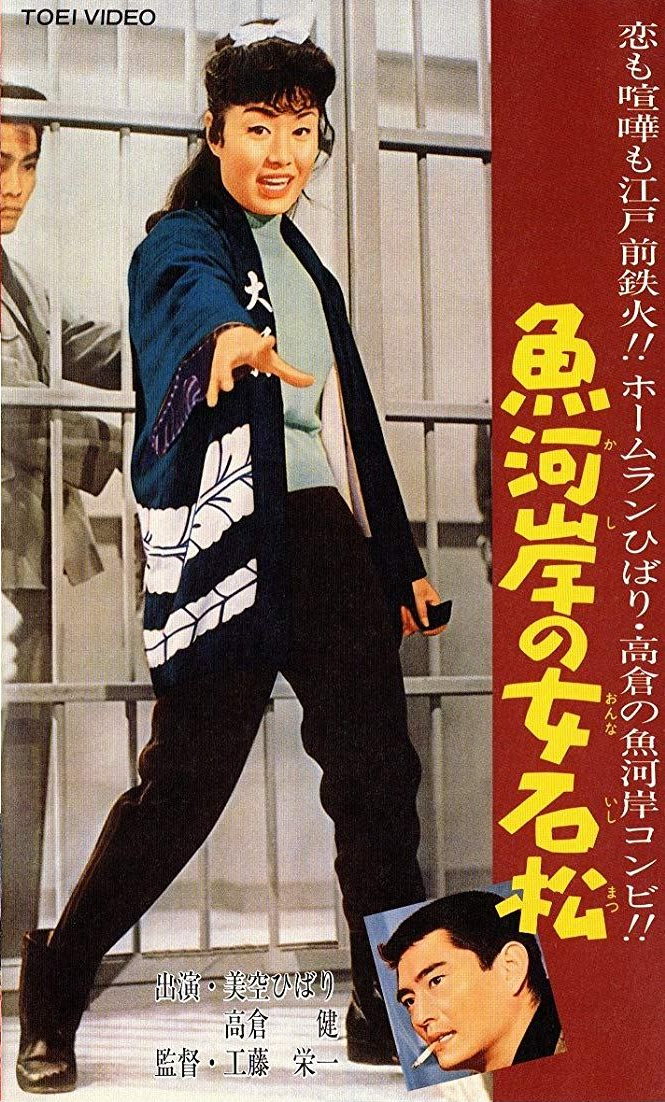
A Fishwife's Tale VHS coverWho better to take on post-war corruption and personal injustice than Hibari Misora? In another of her typically feisty roles, Hibari stands up for her friends, her community, and her family when they are threatened by the exploitative forces of the tabloid press, rubbish boyfriends, and evil corporations all while accidentally falling in love with Ken Takakura in an early role as cynical reporter with a heart of gold. Eiichi Kudo may be best remembered for a string of samurai movies in the ‘60s including 13 Assassins and The Great Killing, but like many of his generation he made a fair few programme pictures including several starring Hibari Misora of which A Fishwife’s Tale (魚河岸の女石松, Kashi no Onna Ishimatsu) is one.

Kudo opens with stock footage of a small fishing harbour which is all aflutter with the arrival of some unusual outsiders. A photographer from a “magazine” has arrived claiming that he wants to document the lives of ordinary working class people from the fishing industry. While some of the young women doll themselves up and plead with the photographer, “Lady Ishimatsu”, Keiko Kano (Hibari Misora), steals all the attention by defiantly rolling through in her truck ready for a day’s work. As predicted Keiko doesn’t want anything to do with this photography nonsense, and as it turns out she was right not to. The guys aren’t from the Sundays or National Geographic, they’re a scandal rag and they’ve bulked out their story with a lot of made up rubbish about the “sexy lives of fishwives” which paints them all as predatory nymphomaniacs. Matters come to a head when Keiko’s friend Yoko (Yukiko Nikaido) tries to kill herself in shame because of the paper’s implication that she’s a loose woman which causes her wealthy boyfriend to dump her (luckily, she’d mixed up tummy tablets with sleeping pills so thankfully survived even if feeling a little sick and silly).

The newspaper business has a second unforeseen consequence. When Keiko stands up to the achingly cool reporter, he realises she’s connected to another case he’s working on. Across town, a canned food magnate is facing ruin thanks to a standards scandal and is also earnestly searching for his long lost daughter, born to a geisha 20 years earlier and then adopted by another family. Dogged reporter Kitagawa (Ken Takakura), recognising the necklace around Keiko’s neck, wonders if she might be the girl Tachibana’s looking for. When it turns out that he’s right, Keiko’s world turns upside-down. Tachibana (Eijiro Yanagi), overjoyed to have found his daughter, goes about everything the wrong way and tries to take her back from her loving home with the promise of wealth and comfort, but Keiko loves her parents even if they aren’t hers by blood and resents the attempt to drag her away. 

Nevertheless, when the two cases turn out to be even more connected thanks to Yoko’s terrible boyfriend being the no good son of one of the conspirators, and Mr. Tachibana falling ill though the stress of his situation, the entire family reconsiders if they haven’t perhaps been selfish in resolutely rejecting a lonely old man trying to make up for a past mistake. Keiko becomes committed to standing up to the bullies. “We’re still young, as long we’re alive we’ll resist you” she tells her biological father’s arch enemy in what might as well be a rallying cry for post-war youth fed up with the corrupted older generation.

Then again perhaps things don’t change all that much. Rather than a salt scam or rice profiteering, this time it’s fiddling with the labels on tin cans but ordinary people are still having their food supply tampered with by those with enough money not to need to worry so much about food security – the amoral petty samurai of the Edo era have merely become amoral businessmen in the dog eat dog post-war world.

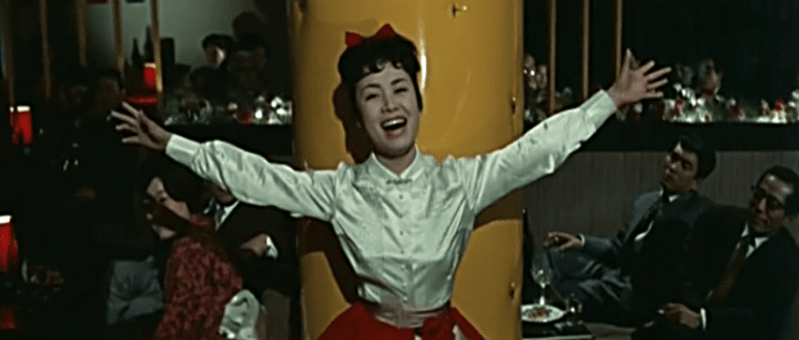
Comparatively light on song and dance – Hibari sings the title track as she drives in on her truck, hums a few tunes, and gets one dramatic musical number when she goes undercover as a nightclub singer to spy on the bad guys, Kudo ups the action quotient as Hibari makes herself the chief of the fishwives and takes on the photographers, sneaks around investigating, and then starts a full on brawl with goons in the final showdown. This time around the romance between frequent co-stars Hibari Misora and Ken Takakura is spiky and sparky, fuelled by Keiko’s strange positioning as a “tomboyish” bossy boots more at home in her truck and wellies than prancing around for the camera like the other girls. Oddly warm and filled with rebellious energy, A Fishwife’s Tale is, in its own quiet way, perhaps subversive in allowing a little political spirit of the age to creep in around the edges as Keiko steps forward to stay true to her roots, opposing injustice wherever she sees it and always acting on her own initiative.


Selection of scenes from the movie including Hibari’s big club number (no subtitles)

Maintitles song – Hibari no Dodonpa