Endless Desire (果しなき欲望, Shohei Imamura, 1958)

In the noir films of the immediate post-war era, the protagonists are often haunted by an inescapable past that prevents them from moving on into the new democratic Japan. But in Shohei Imamura’s Endless Desire (果しなき欲望, Hateshinaki Yokubo) the situation is ironically reversed as a group of former soldiers who on the surface of things at least seem to have made moderately successful lives for themselves reunite to dig up buried treasure from the dying days of the war greedy for a little more glamour than the world has seen fit to show them.

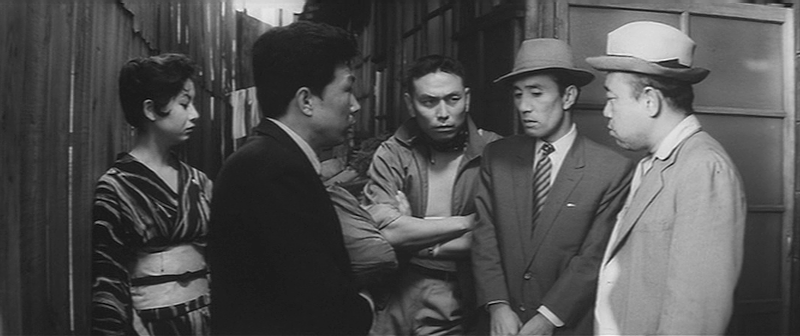
Their venal amorality is directly contrasted with the bumbling earnestness of Satoru (Hiroyuki Nagato), a young man who fears his childhood sweetheart, butcher’s daughter Ryuko (Sanae Nakahara), is going to marry another man because he is unemployed and cannot find a job in the still difficult if steadily improving post-war economy. As such, he’s incredibly excited by the opportunity to get into the real estate business, wandering around town dressed in a suit and carrying a briefcase to scout properties or otherwise doing odd jobs for the gang, which is a shame because unbeknownst to him the business is a sham set up as a front by the crooks who’ve rented a vacant shop from Satoru’s land shark dad so they can tunnel their way to the treasure which they think is buried under Ryuko’s butcher’s shop. 

The changing nature of the times is rammed home by the fact that the shopping district, which stands atop the site of the former military hospital where the gang buried a barrel full of stolen morphine at the end of the war ten years previously, is itself about to be torn down. Effectively a post-war shantytown, the area is now ripe for redevelopment with the economy beginning to bounce back thanks to the stimulus of the Korea War. The post-war era is not quite “over”, but it’s definitely on its way out which makes the gang’s determination to recover the stolen morphine all the more ironic especially as the market for hard drugs may not be as a lucrative as it once was not to mention to the logistical difficulties of turning it into cash. 

Nevertheless, the desire for it immediately sets the gang against each other. The problem is that the lieutenant, Hashimoto, who set the whole thing up has apparently died and extra person has turned up to claim some of the loot despite the gang members having been told there should only be three of them. They were not particularly close in the war and cannot exactly remember each other while Hashimoto had them all work separately without knowing who else was on board so they don’t even know which one of them is the potentially uninvited guest. Meanwhile, the presence of a woman, Shima (Misako Watanabe), who claims to be Hashimoto’s sister sets them all on edge with masculine jealously as she sometimes gleefully plays the femme fatale later even trying to seduce the innocent Satoru, convincing him she’s a victim of domestic violence in need of rescue in an attempt to quiet his concerns over what might be going on at the shop. 

The fact is that none of the gang members can really claim to be desperate, all are simply greedy and selfish silently plotting to keep all the money for themselves rather than share it. One of them is eventually crushed under the barrel, an embodiment of their insatiable desire, but with their dying breath insists it’s theirs and no one else can have any. As old man later says, this kind of greed only leads to a bad end unlike the greed he’s patiently practiced over decades which seems to be taking a little here and there where you find it such as asking Shima for some extra money for “helping” her before asking the police about a reward and turning her in anyway.

Even Satoru’s dad is “greedy”, renting the crooks a shop he new would soon be knocked down and then complaining when his tenants try to take the tatami mats and shoji doors they’d paid for themselves out of his property. Greed maybe the way of the world, at least for those who unlike the diffident Satoru do not lack for self-confidence, but endless desire has only one reward. Darkly comic and often deeply ironic, Imamura plays with a noirish sense of fatalistic retribution but finally returns to a sense of childish innocence in the bumbling courtship of Satoru and Ryuko who may be her own kind of femme fatale playing two suitors against each other while refusing to be dominated by any man but nevertheless riding off into the sunset on her bicycle with a diffident Satoru chasing along behind her.
The Last Kamikaze (最後の特攻隊, Junya Sato, 1970)

Junya Sato’s The Last Kamikaze (最後の特攻隊, Saigo no Tokkotai) opens with a title card explaining that it has nothing to do with the life of Matome Ugaki, which seems disingenuous at best given that the narrative has tremendous similarities with his life. In any case, 25 years after the war in a very different Japan which is perhaps becoming more willing to reexamine its wartime history, Sato’s film nevertheless walks an ambivalent line clearly rejecting the idea of the kamikaze special attack squadrons as absurd and inhuman yet simultaneously glorifying the deaths of the men who willingly took part in them. 

For sympathetic Captain Munakata (Koji Tsuruta) the issue is one of consent and willingness more than it is of essential immorality. Placed in charge of the very first suicide attack, he elects to go himself rather than ask someone else but is first overruled before deciding to go anyway after appealing for volunteers and coming up one short. His general, Yashiro (Bontaro Miake), who had voiced his opposition to the policy in the opening sequence reminding his own commander than even when men were given impossible missions in previous wars they were always ordered to return home if possible, takes the unprecedented step of climbing into an aircraft himself in an act of protest insisting that this be the last and final time that men were ordered to their deaths. The mission, however, does not succeed. All of the pilots bar Yashiro are shot down before reaching their targets while Munakata, injured and having lost sight of the general, aborts his mission and returns to base only to face censure from his superior officers. 

Sent back to Japan, he wrestles with himself over whether his decision was one of cowardice and he turned back because he was afraid to die rather than, as he justifies, because he did not want to die in vain and did what he thought was right. Far from cowardice, it may have taken more courage for him to ignore his orders and choose to live yet there must also be a part of him that believes dying to be heroic if not to do so is to be a coward. As the situation continues to decline and suicide attacks become the only real strategy, Munakata is recalled for an ironic mission of heading the escort squad designed to protect the pilots from enemy attack so they can reach their targets. He first turns this down too not wanting to be an angel of death but is finally convinced to accept on the grounds that the men will die anyway and at least this way their deaths will have meaning. 

Munakata was greeted on his return to Japan by the sight of his father (Chishu Ryu) being carted off by the military police for expressing anti-war views, stopping only to tell him that people should be true to their own beliefs. Nevertheless, even if Munataka objects to the tokkotai strategy he does not oppose it only emphasise that the men should should be willing and resolved rather than forced or bullied. There is indeed a shade of toxic masculinity in the constant cries of cowardice along with a shaming culture that insists a man who refuses to give his life for his country is not a real man. Munakata comes to the rescue of a young recruit, Yoshikawa (Atsushi Watanabe), who twice returns from a tokkotai mission claiming engine trouble but does not try to save him only to petition his superiors that he be given ground duty until such time as he gets used to the idea of dying. Because of Munakata’s kindness in saving him from a suicide attempt after being rejected by the mother he worried for if he were to die, Yoshikawa is pushed towards a “hero’s death” that does at least help to change the mind of Yashiro’s zealot son (Ken Takakura) who knew nothing of the reasons behind his father’s suicide and believed wholeheartedly in the necessity of the special attack squadrons. 

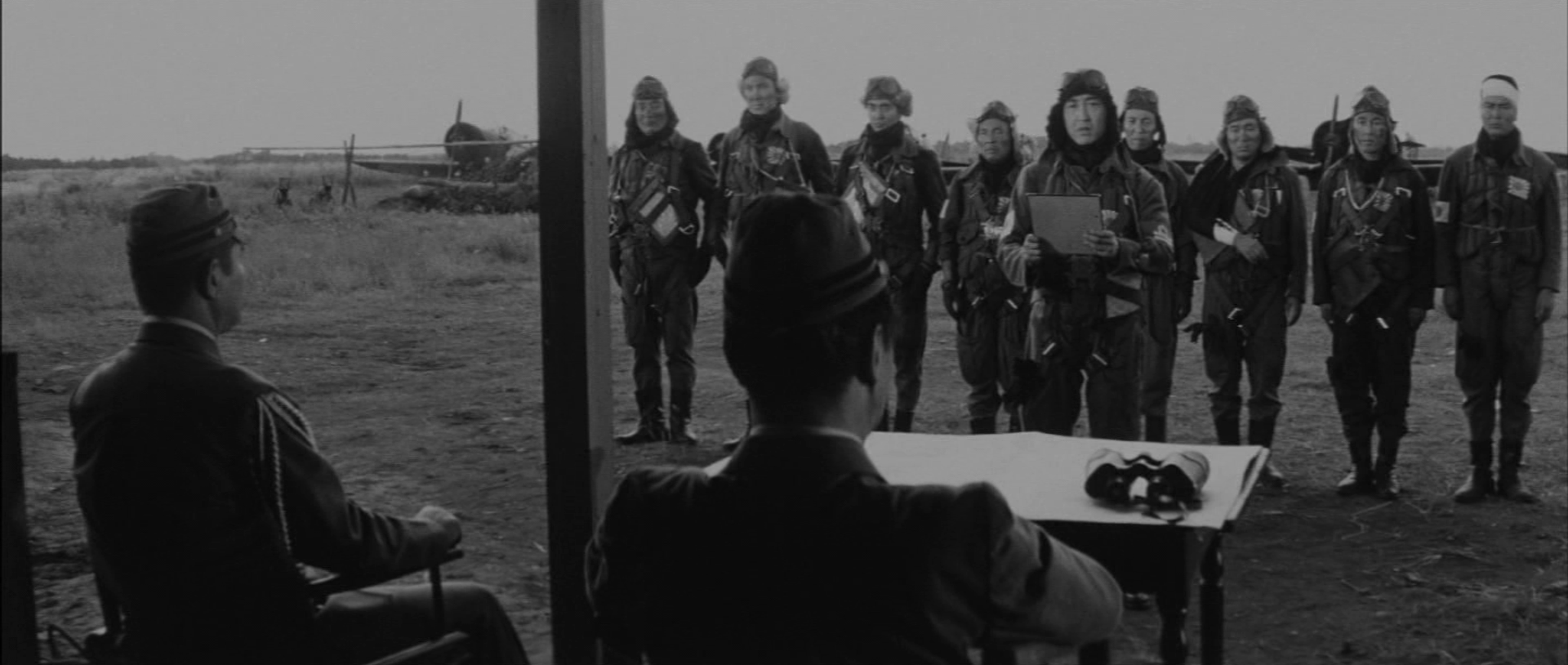
The younger Yashiro’s rationale had been that to show compassion to a man like Yoshikawa was to shame the memories of the men who had already died, yet even in realising the futility of the gesture he still resolves to proceed towards his own death as do others like him such as a student who had been against the war and ironically consents to the suicide mission in order to end it more quickly. “There’s nowhere to run to” Yoshikawa’s mother (Shizuko Kasagi) had said on his attempted desertion, echoing the words of another that there was no escape from this war, while poignantly crying over her son’s ashes that she wishes she had raised him to be a coward. The human cost is brought fully home as the families storm the airfield fence in an attempt to wave goodbye to their loved ones as they prepare for their glorious deaths, another pilot reflecting on the fact that each of these men is someone’s precious son rendered little more than cannon fodder in an unwinnable war. Even with the escort squads, only 30% of the special attacks succeed. Most of the pilots are so young and inexperienced that even assuming they survive the anti-aircraft fire they are incapable of hitting their targets. 

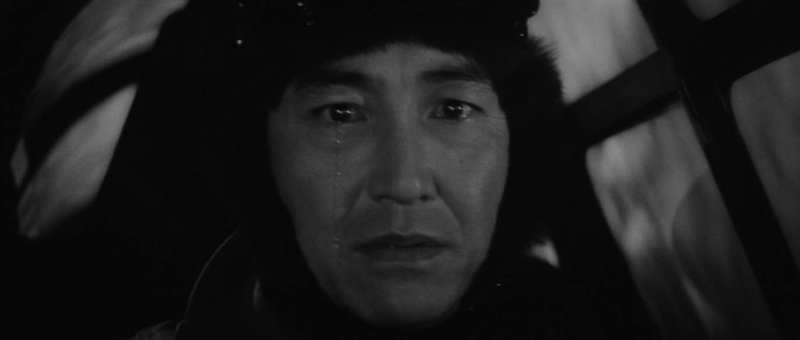
To add insult to injury, Munakata returns from his final mission to an empty airfield where a drunken engineer (Tomisaburo Wakayama) explains to him that the war is over and the generals knew it 10 days earlier but still sent these men to their deaths anyway. Overcome with remorse, Munakata posits his own suicide mission but is instructed to live on behalf of all those who died only to take off and fly into a technicolor sunset as Sato switches from the period appropriate black and white to vibrant colour elegising Munakata’s death while lending it an otherwise uncomfortable heroism. Casting ninkyo eiga icons Koji Tsuruta and Ken Takakura as the infinitely noble yet conflicted pilots and employing jitsuroku-esque narratorial voice to offer historical context the majority of the audience probably does not strictly need, Sato rams home the righteousness of these men while casting them as victims of their times trying their best to be true to what they believe but finding little prospect of escape from the absurdity of war. 


Drunken Angel (酔いどれ天使, Akira Kurosawa, 1948)

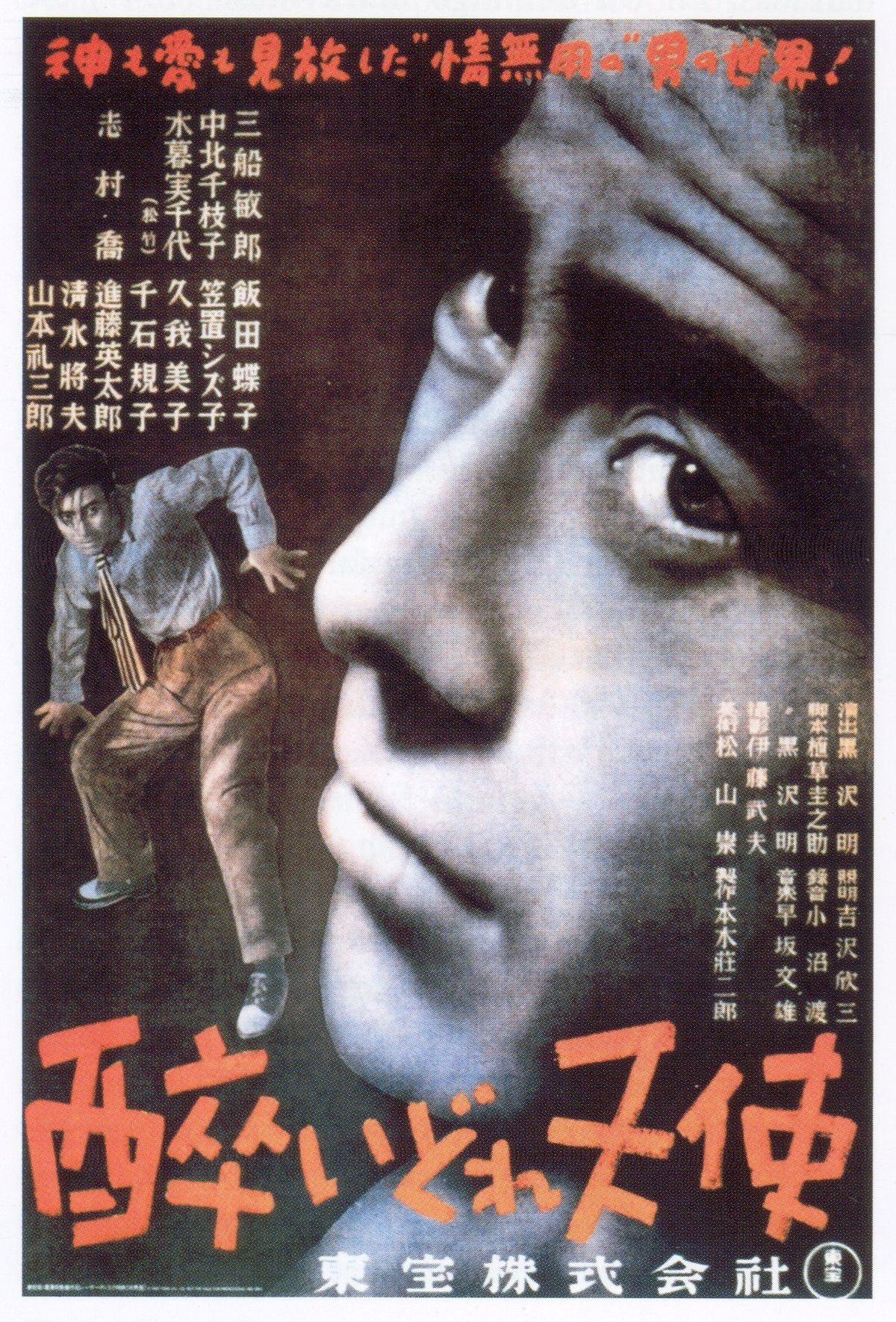
A gruff yet well intentioned doctor does his best to cure the ills of post-war Japan in a rundown slum on the edge of a fetid swamp in Akira Kurosawa’s noir tragedy, Drunken Angel (酔いどれ天使, Yoidore Tenshi). The doctor is most obviously the drunken angel of the title though it could equally apply to the unhappy yakuza he tries so hard to redeem whom most agree is not suited to that kind of life and trapped by the feudalistic thinking of the pre-war past.

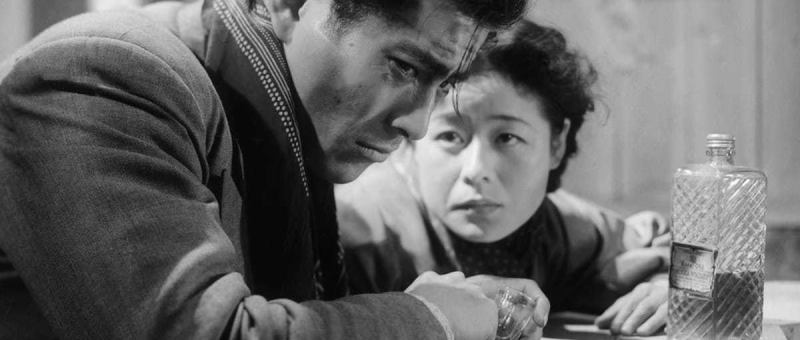
Matsunaga (Toshiro Mifune) is the big man around town, but jaded physician Sanada (Takashi Shimura) sees straight through him. “He acts tough and swaggers around but I know in his heart he’s incredibly lonely,” Sanada tells his assistant, Miyo (Chieko Nakakita), a young woman he took in to help her escape the clutches of the violent yakuza ex who left her with syphilis. Miyo bemoans Sanada’s terrible bedside manner and tendency to bully his patients but praises his dedication and remarks that few doctors go as far for those under their care as he does especially ones like these who don’t often have the money to pay. This is a little ironic given Matsunaga’s original objection that he doesn’t trust doctors because it’s not in their best interests to cure you, something which Sanada jokingly acknowledges while expressing the futility he feels in the face of the mass sickness that confronts him. 

When Matsunaga first comes into his office, Sanada remarks that’s its not just his lungs that are sick, he’s sick to the core. But still he seems to think that Matsunaga can be saved, not just physically but spiritually redeemed if only he can coax him away from the yakuza underworld. Matsunaga is suffering from tuberculosis, a common disease of the post-war era and closely linked to the squalid conditions in which he lives which are themselves symbolised by the swamp in the centre of town onto which Sanada’s clinic backs. Sanada tries to warn the local children not to play in it because of the risk of typhus not to mention the mosquitos it attracts but the kids don’t really listen to him and shout back that he’s “just a drunk”. Yet the swamp represents a world upside-down, the neon sign for the No. 1 cabaret bar constantly reflected in its bubbling waters while as the film opens we see a trio of sex workers preparing to head into the red light district and a pair of petty thugs fighting while a young man plays Spanish guitar on the ruins of a bomb damaged building. 

It’s as if it were this world that is slowly consuming Matsunaga, an old-school yakuza who insists “we still believe in things like honour and loyalty” certain that the big boss will side with him against the returned upstart Okada (Reizaburo Yamamoto), Miyo’s yakuza ex, even as Sanada tells him it’s money that matters and Matsunaga no longer makes any. Everyone tells him that he already looks like a ghost, his appearance increasingly gaunt in his parallel decline as the illness takes hold and he begins to lose his status to Okada only to overhear his boss call him an “amateur” that he was only keeping around as a potential sacrifice. In the end, Matsunaga is too good for this world. Naively believing in things like honour and loyalty which no longer mean anything in the dog-eat-dog post-war society he is left with nothing other than a nihilistic bid for vengeance and a desire to repay Sanada’s faith in him if only in the most ironic of ways. 

Like Matsunaga, Sanada sometimes says the opposite of what he means claiming that he doesn’t care what happens to Matsunaga but is determined to wipe out the TB inside him to stop it spreading it to others. He’s on a mission to “sterilise this contaminated town” by eradicating the twin threats of disease and the yakuza, calling Matsunaga a coward for failing to face his fear and loneliness succumbing to the quick fixes of his hedonistic yakuza lifestyle. He’s not perfect either, a doctor who drinks his medical ethanol supplies and berates his patients when he them catches out them out drinking when he told them not to, but is also very at home with who he is and doing his best with it. His disappointment in Matsunaga is mainly in his swagger, the false bravado that masks his human frailty and unwillingness to face his fear of death which manifests itself in a hauntingly expressionistic dream sequence. Using silent cinema composition and canted angles Kurosawa conjures a world of constant uncertainty amid the vagaries of the post-war society in which the only sign of salvation is a drunken doctor and his “rational approach” to the sickness of the age.


Drunken Angel screens at the BFI Southbank, London on 2nd & 10th February 2023 as part of the Kurosawa season.