Age of Nudity (素ッ裸の年令, Seijun Suzuki, 1959)

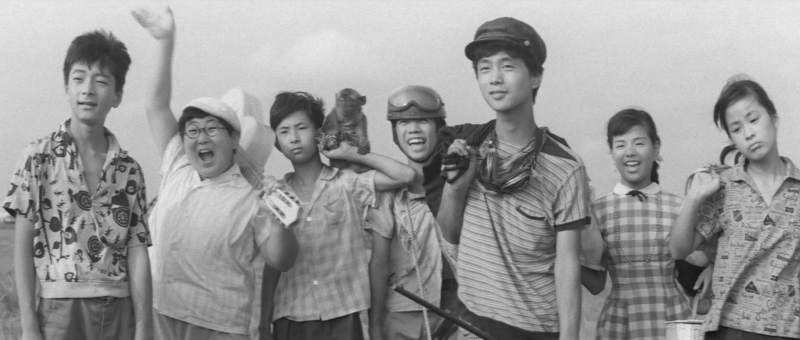
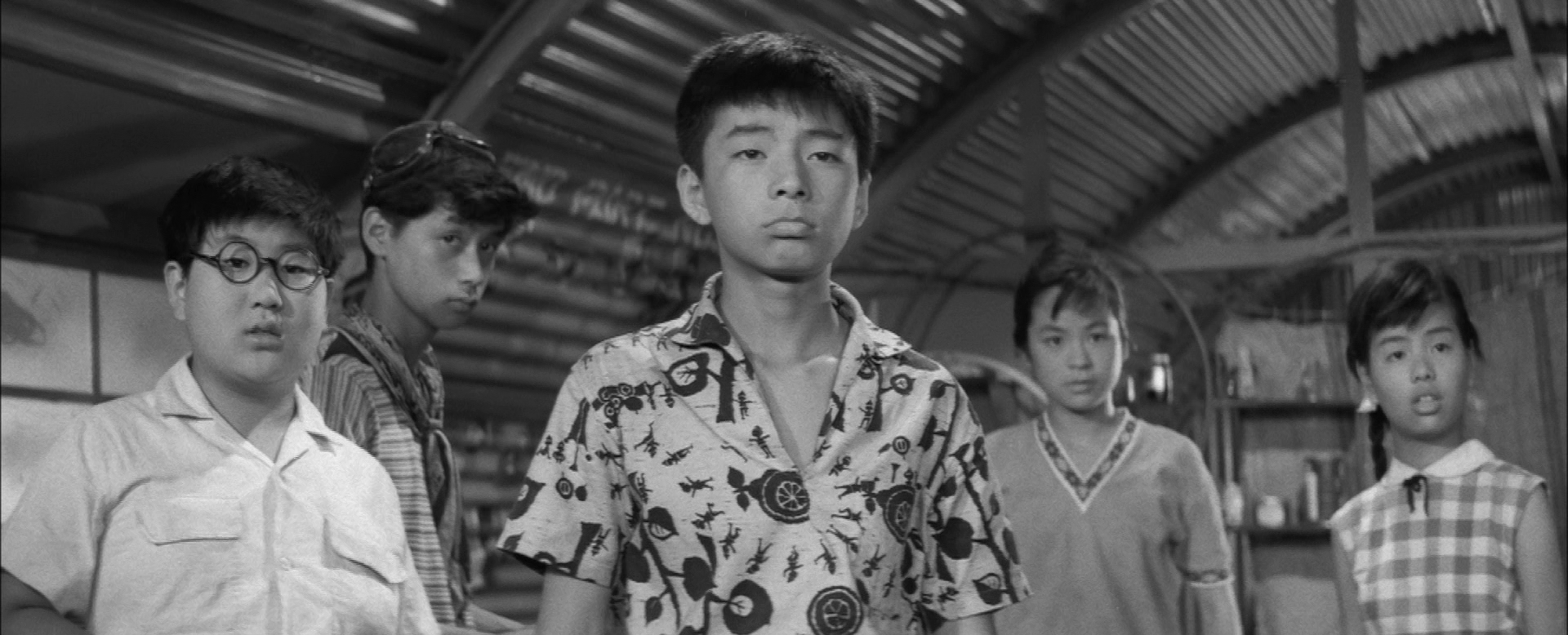
Stylistically speaking, Seijun Suzuki’s Age of Nudity (素ッ裸の年令, Suppadaka no Nenrei) is one of the least interesting of his early phase and features only brief moments of innovation such as using the cameo effect for Sabu’s flashback and elements of his taste for surrealism with unexpected cutting between events. It does however have something a little more interesting to say about the world of 1959 through the eyes of someone in the process of becoming an angry young man.

The film opens with Sabu (Saburo Fujimaki) in his school uniform gazing at motorbikes and exclaiming that adulthood must be wonderful because you can ride a bike whenever you want. Ken (Keiichiro Akagi), the leader of a group of mainly orphaned delinquents, shows him that he could do that now. His gang make a habit of “borrowing” bikes and makes money through reckless drag races. Ken’s instructions that the bikes must be returned afterwards is symbolic of his desire to live a more honest life. When Sabu gets involved with actual crimes such as robbing a local food stand, he becomes very angry with him for compromising his more noble vision of what this group should be. 

But Ken is also working with a newspaper reporter and selling him insider stories about pre-teen “delinquents” . It seems as if every day is a slow news day in the Japan in 1959, and the reporter continues to plant scare stories in an effort to create a moral panic about feral children. Ken seems to think that he’ll keep them out of it and not actually report on anything too back that directly involves them, but of course his conviction is naive. Nevertheless, he convinces himself that he’s doing it all for the group so he can get money to buy a fishing boat and support everyone through honest work. But at the same time the fact that it’s the newspapers echoes the ways in which these children have been pushed out of society, while also ironic in that the reason Sabu loses his pair round is because he’s unfairly called a troublemaker when trying to get a reluctant customer to finally pay her bill.

The newspaper round incident bears out the ways in which Sabu is unable to control his temper and his frustration often turns to violence. The reporter asks a friend of his at school hoping he will badmouth him, but the only says that he’s not a bad kid, it’s just that his family’s poor. What Sabu most wants is to stay in school, but his parents won’t pay and his mother even says that he’s getting above himself. Poor people like them don’t go to school they just work. But Sabu’s desire to break that barrier is thwarted by social prejudice and the frustration it arises in him. He first looks up to Ken as a role model, but is also the most betrayed on realising that it was Ken who leaked info on them to the press and that he’s planning to take their share of the loot and make a new life for himself alone in the country.

Humiliated after having been betrayed by the newspaper man, Ken then reverts to Sabu’s way of thinking, that as old as he gets this society won’t respect him. So perhaps he no longer needs to respect it or to stick to the nobility he was trying to teach the kids. Adulthood won’t be what we expected, he tells Yoko, as if he had thought that on turning 20 he’d suddenly be more respected and that he’d be able to forge his own future by buying a boat and becoming a fisherman. The film’s title does not translate particularly well, but the nuance is more like “the naked age” where age refers to that of a person rather than to an era. Sabu goes to the beach and marvels that everyone is “naked”, or rather that they’re all scantily clad in swimwear, and are therefore all the same with the divisions of class and wealth temporarily dissolves. But at the same time it’s more that he himself is naked in that he’s at his most raw and vulnerable. He feels himself to be alone, and has no role models to look to for how he should live his life. Resenting his father for bowing and screaming and his mother for her lack of ambition, he wants more for himself but also can’t find a way to get it. 

The fact that Ken is eventually killed in a fiery crash signals him out as a false prophet. The person the children should have been listening to was the homeless old man (Bokuzen Hidari) who appears in a vision of beatific pastorally at the film’s conclusion posed on a green hill with the sun behind him. Though the children sometimes make fun of him for his disability and what they see as a failure at life, the old man laughs it off and is constantly happy living in a tent with his little dog. He encourages the children and gives them helpful advice that helps to overcome the failures of their birth parents, while his presence suggests that true happiness is to be found only on escaping contemporary capitalist society. Sabu too perhaps comes to a similar conclusion, realising that their “independence” is an illusion when they have to compromise themselves morally in order to earn money. Ken may have given them false hope, but perhaps the old man is different in living his own “independent” life defined by humanism and simplicity free from the constraints of a society which only values and status.

Endless Desire (果しなき欲望, Shohei Imamura, 1958)

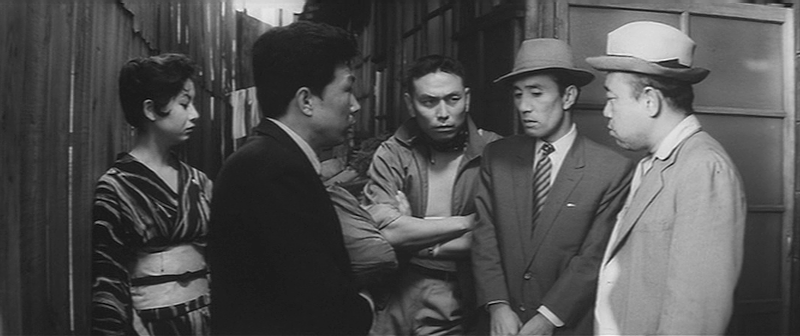
In the noir films of the immediate post-war era, the protagonists are often haunted by an inescapable past that prevents them from moving on into the new democratic Japan. But in Shohei Imamura’s Endless Desire (果しなき欲望, Hateshinaki Yokubo) the situation is ironically reversed as a group of former soldiers who on the surface of things at least seem to have made moderately successful lives for themselves reunite to dig up buried treasure from the dying days of the war greedy for a little more glamour than the world has seen fit to show them.

Their venal amorality is directly contrasted with the bumbling earnestness of Satoru (Hiroyuki Nagato), a young man who fears his childhood sweetheart, butcher’s daughter Ryuko (Sanae Nakahara), is going to marry another man because he is unemployed and cannot find a job in the still difficult if steadily improving post-war economy. As such, he’s incredibly excited by the opportunity to get into the real estate business, wandering around town dressed in a suit and carrying a briefcase to scout properties or otherwise doing odd jobs for the gang, which is a shame because unbeknownst to him the business is a sham set up as a front by the crooks who’ve rented a vacant shop from Satoru’s land shark dad so they can tunnel their way to the treasure which they think is buried under Ryuko’s butcher’s shop. 

The changing nature of the times is rammed home by the fact that the shopping district, which stands atop the site of the former military hospital where the gang buried a barrel full of stolen morphine at the end of the war ten years previously, is itself about to be torn down. Effectively a post-war shantytown, the area is now ripe for redevelopment with the economy beginning to bounce back thanks to the stimulus of the Korea War. The post-war era is not quite “over”, but it’s definitely on its way out which makes the gang’s determination to recover the stolen morphine all the more ironic especially as the market for hard drugs may not be as a lucrative as it once was not to mention to the logistical difficulties of turning it into cash. 

Nevertheless, the desire for it immediately sets the gang against each other. The problem is that the lieutenant, Hashimoto, who set the whole thing up has apparently died and extra person has turned up to claim some of the loot despite the gang members having been told there should only be three of them. They were not particularly close in the war and cannot exactly remember each other while Hashimoto had them all work separately without knowing who else was on board so they don’t even know which one of them is the potentially uninvited guest. Meanwhile, the presence of a woman, Shima (Misako Watanabe), who claims to be Hashimoto’s sister sets them all on edge with masculine jealously as she sometimes gleefully plays the femme fatale later even trying to seduce the innocent Satoru, convincing him she’s a victim of domestic violence in need of rescue in an attempt to quiet his concerns over what might be going on at the shop. 

The fact is that none of the gang members can really claim to be desperate, all are simply greedy and selfish silently plotting to keep all the money for themselves rather than share it. One of them is eventually crushed under the barrel, an embodiment of their insatiable desire, but with their dying breath insists it’s theirs and no one else can have any. As old man later says, this kind of greed only leads to a bad end unlike the greed he’s patiently practiced over decades which seems to be taking a little here and there where you find it such as asking Shima for some extra money for “helping” her before asking the police about a reward and turning her in anyway.

Even Satoru’s dad is “greedy”, renting the crooks a shop he new would soon be knocked down and then complaining when his tenants try to take the tatami mats and shoji doors they’d paid for themselves out of his property. Greed maybe the way of the world, at least for those who unlike the diffident Satoru do not lack for self-confidence, but endless desire has only one reward. Darkly comic and often deeply ironic, Imamura plays with a noirish sense of fatalistic retribution but finally returns to a sense of childish innocence in the bumbling courtship of Satoru and Ryuko who may be her own kind of femme fatale playing two suitors against each other while refusing to be dominated by any man but nevertheless riding off into the sunset on her bicycle with a diffident Satoru chasing along behind her.


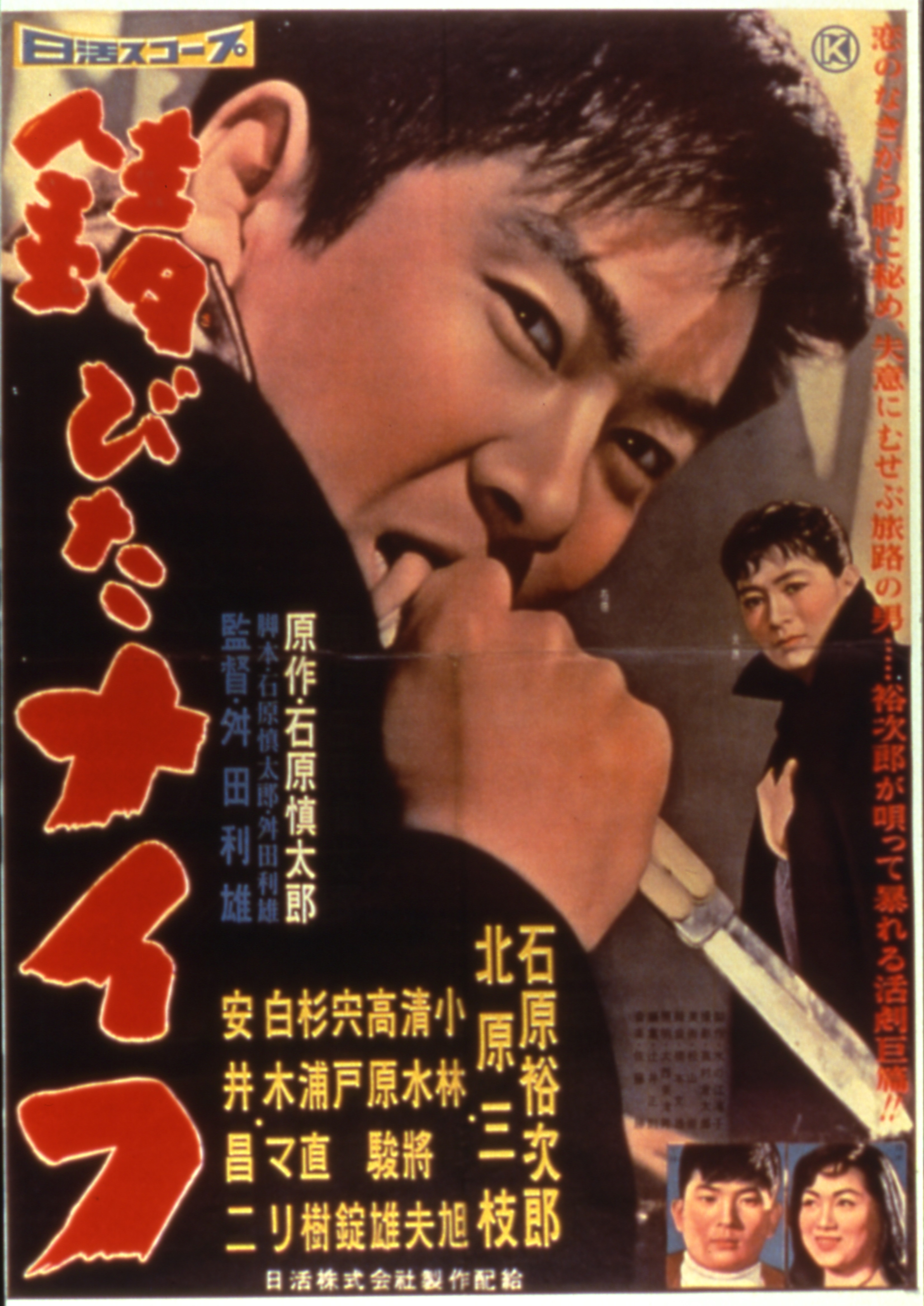
Rusty Knife (錆びたナイフ, Toshio Masuda, 1958)

rusty knife posterPost-war Japan was in a precarious place but by the mid-1950s, things were beginning to pick up. Unfortunately, this involved picking up a few bad habits too – namely, crime. The yakuza, as far as the movies went, were largely a pre-war affair – noble gangsters who had inherited the codes of samurai honour and were (nominally) committed to protecting the little guy. The first of many collaborations between up and coming director Toshio Masuda and the poster boy for alienated youth, Yujiro Ishihara, Rusty Knife (錆びたナイフ, Sabita Knife) shows us the other kind of movie mobster – the one that would stick for years to come. These petty thugs have no honour and are symptomatic parasites of Japan’s rapidly recovering economy, subverting the desperation of the immediate post-war era and turning it into a nihilistic struggle for total freedom from both laws and morals.

Public support is, largely, behind this new force of order as seen in the local uproar when top gangster Katsumata (Naoki Sugiura) is arrested in connection with an assault. Things being what they are, Katsumata is soon released to laugh at law enforcement from a safe distance but the past is coming for him. Some years ago Katsumata killed a local councillor, Nishida (Ikunosuke Koizumi), and made it look like suicide but three guys from a local gang saw him do it. He paid them to keep quiet, but now one of them feels like talking and thinks Katsumata might like to pay a little more to reseal the deal.

Chatty Tokyo thug Shima (Jo Shishido) gets pushed off a train for his pains but Katsumata is worried enough about the other two to send his guys out to make some enquires. He’s particularly worried about Tachibana (Yujiro Ishihara) – a “sleeping lion”, Tachibana is a hot head who’s now gone straight after coming out of jail for murdering a guy he thought was a direct cause of his girlfriend’s death. Luckily enough, Tachibana now runs a bar where he employs the other witness, Terada (Akira Kobayashi), to whom he acts as a stern big brother hoping to keep them both on the straight and narrow. Tachibana is unlikely to talk, he wants out of the gangster world for good, but Terada is young and ambitious with a girlfriend to impress. He takes more hush money from Katsumata, not realising what he’s getting himself into, and then lets it go to his head.

Tachibana is the rusty knife of the title. After letting his rage consume him in murdering a petty mobster in revenge for the rape of his girlfriend who later committed suicide, Tachibana has vowed to quell his anger and live a decent, peaceful life. Angry outbursts are, however, never far from the surface and following recent revelations, a rusty knife may find its cutting edge once again.

Keiko (Mie Kitahara), a customer at Tachibana’s bar, is making a documentary about violence in the city which coincidentally turns up a few clues as to Tachibana’s past, not to mention her own. The daughter of the murdered councilman, Nishida, and the niece of another powerful politician, Keiko is a figure of righteousness, charting her own course through the difficult post-war world and attempting to do so with dignity and elegance while refusing to abandon her sense of decency and compassion. Later a real life married couple, Kitahara and Ishihara were a frequent on screen romantic pairing though this time around the connection is more subtle as Keiko begins to sympathise with Tachibana’s plight and commits herself to saving him from destroying himself in becoming consumed by his barely suppressed rage.

Tachibana is indeed raging, though his rage is understandable. As someone later puts it “nothing in this city makes sense”. The systems are corrupt, the wartime generation continue to run the show and run it badly, or at least for their own ends, robbing youth of its rightful place at the forefront of economic recovery. Yet even if Ishihara is a symbol of youthful alienation, his rage is one which must be quelled. Even in this city where nothing makes sense, self control is one’s greatest weapon. If youth is to walk forward into the exciting post-war future, it will have to drop its rusty knives.


Original trailer (English subtitles)