Johnny Keep Walking! (年会不能停!, Dong Runnian, 2024)

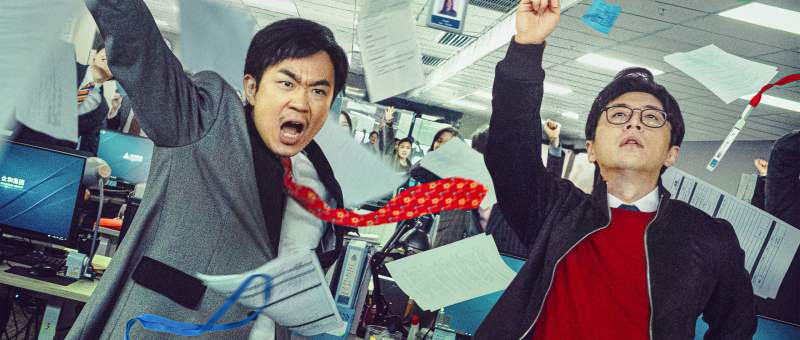
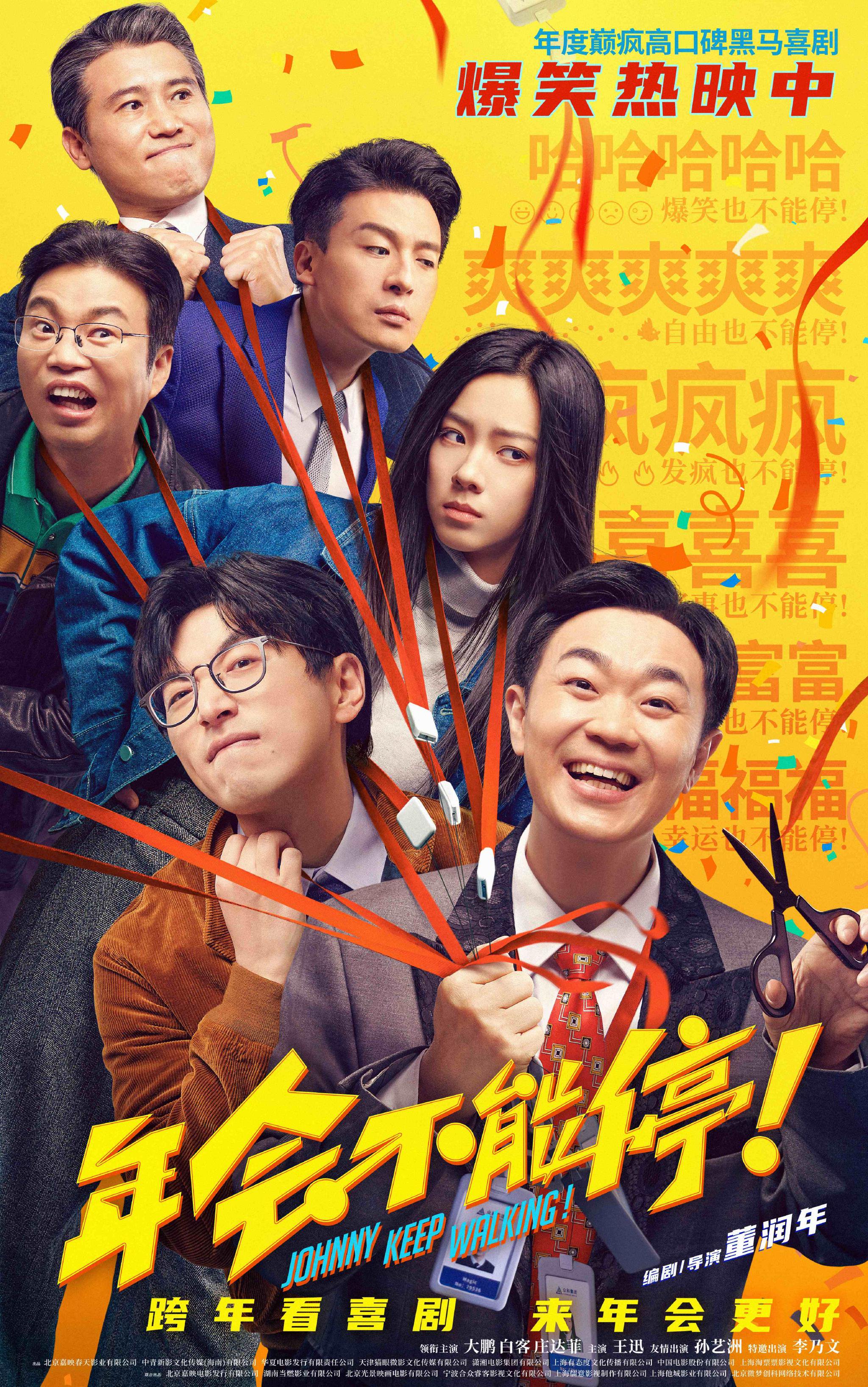
A satirical morality tale, Dong Runnian’s incredibly witty comedy Johnny Keep Walking! (niánhuì bùnéng tíng) sees a bumpkinish middle-aged factory worker still filled with an idealism that seems outdated even in the late 90s transferred into a lion’s den of corporate greed and dubious morality while ultimately expressing the younger generation’s increasing dissatisfaction with the inherent unfairness of corporate life in modern China. Ironically turning Tom Chang’s 1988 hit My Future is Not A Dream into a rallying cry from disillusioned youth, the film nevertheless places its faith in the moral generosity of a fat cat factory owner who struck gold in the nation’s 90s reforms but has largely forgotten those who helped him get there.

Key among them would be Jianlin (Da Peng) whom we first see trying to fix the disco ball at the factory’s 1998 gala and being asked to sing a song instead. 20 years pass with Jianlin still living the life of a model factory worker stuck on the same old salary while applying to perform in the company’s annual gala has become his only joy in life. Meanwhile, the factory owner has gone on to head an increasingly powerful multi-national company leaving Jianlin and those like him far behind deprived of the successes that the modern China has to offer. 

This is in part a paean for those left behind by the economic reforms of the 1990s which saw the end of the old factory system with mass unemployment and displacement amid frequent plant closures. Jianlin’s is still open, but devoid of the sense of comaradie that mark the opening scenes. His scheming floor manager, Zhangzi is trying to engineer a transfer to head office so that his son could attend a better school in the city and has been helping a series of corporate lackeys defraud the company, in addition to paying a direct bribe, in return for a job offer. A drunken mix up by office party boy Peter (Sun Yizhou) results in Jianlin being hired instead in a shock move that proves inexplicable to all. 

Jianlin is such an innocent that he thinks the reason he’s been given a huge promotion is because he was employee of the year for 12 years straight and the company probably want to send a message to the youngsters that hard work really will be rewarded. Of course, the opposite is true. HR manager Magic (Bai-Ke) quickly spots the mistake but is prevented from fixing it because it would get them all into trouble, and while it’s obvious to most people that Jianlin has no idea what he’s doing they choose to say nothing because they assume he must be a nepotism hire and they want to stay in the boss’ good books. Everyone at the company uses an English name with Jianlin rechristened “Johnny” though he understands no English and struggles with Chinese business jargon having no idea what people mean when they go on about “aligning the details”. Charged with firing someone under the company’s radical new “optimisation” programme, he takes the word at face value and gives them a promotion and a raise instead.

In fact, much of the film is him muddling along like typical middle-manager promoted beyond his abilities. He’s advised that good management is all about setting employees against each other so they forget about resenting you while basically delegating all your tasks to your subordinates who will be only too happy to help in order to curry favour. Slowly corrupted, Jianlin beings to play along, taking all the perks of corporate success while signing documents he couldn’t understand even if he actually read them.

Nevertheless, he develops a kind of team spirit with Magic, a man stuck in a mid-career rut because of his lack of skill at office politics, and Penny temp whose perpetually kept on the hook rather than being given full employee status so that the company can exploit her more. Penny also suffers sexual harassment at the hands of the party happy Peter with Jianlin getting her out of a sticky situation by telling her to finish a report and drinking with Peter himself. Together, and with the assistance of the workers at the factory and others about to be unceremoniously fired as part of the cost cutting enterprise, they attempt to expose corporate corruption and stage a protest against unfair working practices but the only saviour they have to turn to is the company president strongly suggesting a return to the old factory days which, it is implied, were much more wholesome and innocent. In any case, justice eventually wins out with the good rewarded and the bad getting their just desserts though it doesn’t do too much to tackle the inherent and quite ironic rottenness of the system in which the worker has been reduced to a mere tool to be used and discarded by a faceless and uncaring corporate entity. 


International trailer (English subtitles)

My Future is not a Dream (Tom Chang)

Under the Light (坚如磐石, Zhang Yimou, 2023)

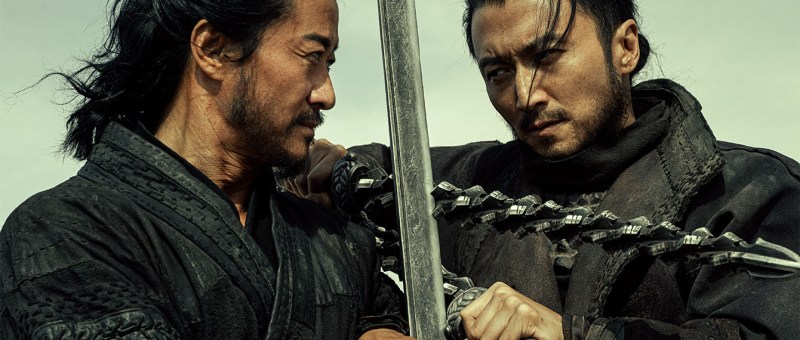
The irony at the centre of Zhang Yimou’s Under the Light (坚如磐石, jiānrúpánshí) is that it takes place in a neon-lit city of eternal visibility, though of course where you have light you’ll also find shadows. Even so, it appears he’s trying to make a point in the plain sight nature of political corruption and it’s connections with organised crime. At heart it’s a tense cat and mouse game between two men who share some kind of sordid past, but also of how it’s the next generation that often pay in the infinitely corrupted paternity of the contemporary society.

Zhang opens with a hostage crisis as a man hijacks a bus and threatens to blow it up if he doesn’t receive a visit from deputy mayor Zheng Gang (Zhang Guoli). Zheng attends but his policeman son Jianming (Lei Jiayin), currently assigned to the tech division, notices that the bomb can be detonated remotely and it doesn’t appear the hostage taker knew that it was real. In any case, all is not as it seems and as Zheng is soon squaring off against shady businessman Li Zhitian (Yu Hewei) who invites Jianming to dinner and puts on a show by blackmailing another business owner with a sex photo before forcing him to put his hand in boiling oil. 

In contrast to his ruthless exterior, Zhitian dotes on his grown up daughter currently pregnant with her first child and about to be formally married to his business heir David (Sun Yizhou). Jianming meanwhile has a complicated relationship with his father by whom he feels rejected in part because he’s adopted. Zheng also appears to be meeting with a mysterious young woman for unclear reasons, later hinting that she’s a kind of daughter figure someone at some point asked him to protect. In a strange and probably unintended way, it’s this parental quality of protection that has been disrupted by ingrained corruption and is then re-channeled in a desire to protect society in general. When it’s all over, Jianming asks his bosses why they trusted him to make the right decision, and they tell him it’s because he told them he wanted to be a “true policeman” for the people.

Apparently stuck in limbo for four years because of censorship concerns, the propaganda thrust of the film centres on the crackdown against political and judicial corruption. Zheng is engaged in a political project to target corrupt officials but is heavily implied to be on the wrong side of the fence himself which would explain his connection with Zhitian, a supposedly self-made man who keeps a heavy pole in his living room to remind him of his roots as a lowly porter in a rural town before taking advantage of the ‘90s economic reforms to make himself wealthy beyond his wildest dreams. 

They each have hidden secrets which Jianming becomes determined to drag into the light while working with the anti-corruption officers in his precinct, as well as old flame Hui-lin (Zhou Dongyu). Zhang adds in some distinctly retro comedy vibes not least in the frustrated romance of Jianming and Huilin who at one point dangle dangerously off a building while she later bites back, “don’t deprive me of the chance to protect you. It’s what they call love” when firing a pistol at a bunch or marauding bad guys. Yet the comedy seems incongruous with infinite bleakness of the resolution in which once again the children are made to suffer as Jianming comes to a greater understanding of his origins. 

In an ironic touch, the villains are later revealed to have been dyeing their hair which is in reality already white though they are not really all that old. Playing into the themes of duplicity, it also hints at the central message that the older generation must recede and the young, like Jianming, learn to find an accommodation with their failures in order to reclaim a sense of justice. Then again, the film itself is quite duplicitous with a series of glaring plotholes including a giant one relating to the DNA identification of a missing woman whose body is finally dragged into the light. Huiling warns Jianming that there are some boxes it’s better not to open. At the film’s conclusion he may wish he’d listened, but his job is to drag truth into the light and not least his own. In any Zhang’s infinitely bright, ever illuminated city of neon and glass has a host of hidden darkness only temporarily exorcised by the unusually lengthy parade of the now standard title cards explaining that the wrongdoers were caught and punished while deprived of their ill-gotten gains no matter how much it might seem that crime really does pay.


International trailer (Simplified Chinese / English subtitles)

This Is Not What I Expected (喜欢你, Derek Hui, 2017)

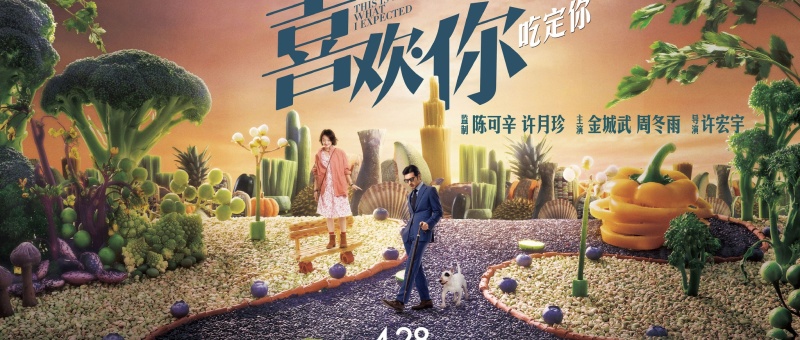
This is not what i expected poster 1The way to a man’s heart is through his stomach, as they say, but the course of true love never did run smooth. The debut directorial feature from editor Derek Hui, This is not What I Expected (喜欢你, Xǐhuan Nǐ) is, to be frank exactly what you’d expect it to be but that only works in its favour. A classic tale of opposites attracting, This is Not What I Expected takes its cues from The Shop Around the Corner only this time it’s not pen pals and music boxes but big business and culinary communication.

Ditzy chef Gu Shengnan (Zhou Dongyu) has been having an affair with her caddish boss whom she decides to teach a lesson by carving a rude message into the bonnet of his car. Only, in a motif which will be repeated, she got the wrong one and has actually left her mark on the car of uptight international hotel magnate Lu Jin (Takeshi Kaneshiro). Jin is after some new hotels to acquire so where should he fetch up at other than the one where Shengnan works? Jin hates pretty much everything about the second rate establishment including the food which is when Shengnan’s sleazy boss asks her to cook up something special to stop Jin from leaving. Cleverly analysing the leftovers from Jin’s rejected meals, she cooks him something to remember and succeeds in capturing his heart. Intrigued, Jin decides to stay on the condition that Shengnan cook all his meals from now on. However, Jin has no idea that Shengnan is the culinary mastermind he can’t stop thinking about and is increasingly irritated by all of their bizarre encounters.

Despite their superficial differences, Shengnan and Jin are perfectly in tune, their culinary messages perfectly understood by each on an elemental level. In real life, however, things are quite different. Jin, a ruthless if eccentric businessman with a mania for precision and a terror of anything remotely out of place, finds Shengan’s happy go lucky, disaster prone existence particularly difficult to understand. Hoping to escape her, he even gives Shengnan an electronic tag that will set off an alarm whenever she’s close by so the pair can avoid each other and the chaos that seems to happen when they meet.

Meanwhile, the conflicts continue to expand in the background. Shengnan doesn’t have much of an issue still being single past the socially acceptable age, but worries that she’s not getting anywhere in her career and will be stuck sous-cheffing forever despite her obvious talents while getting her heart broken by sleazy players like her odious, ambitious boss. Rosebud, the ironically named hotel, is hardly a top tier establishment and probably too much bother for Jin to consider taking on if weren’t for his strange fascination with the cook. His extended stay is beginning to raise eyebrows with his coldhearted father/boss while a mild conflict begins to flicker in his heart when he realises the business plan requires firing the entire kitchen staff and hiring a three star Michelin chef.

Hui does perhaps over egg the pudding in creating a “romantic” rival for Shengnan once she discovers that Jin also employs a (female) “private chef” whose return from vacation might explain why he abruptly stopped dropping by the hotel (and her apartment where he’d virtually moved himself in). The lines between desire and hunger remain increasingly blurred as the two women resentfully vie for the position of tastemaker, tussling over which of them understands Jin better and truly deserves to be the one providing him with sustenance. Yet as the personal chef finally comes to realise (a few steps ahead of Jin), what Jin’s hungry for is no longer just food, what he needs is something more organic than a contractual relationship.

Jin is, in a sense, an embodiment of heartless modern capitalism, raised to be “despised” in order to preserve “solitude” and a “clear mind”. Jin’s austere father is all about order and control, he doesn’t like the emotional because it’s irrational and unpredictable, but the straw that finally breaks Jin’s back is when he tells him that the food at the hotel can’t be “too good” because it would be “distracting” for the clients. For the first time, Jin begins to question his ideology and realises that perhaps it wasn’t so much that he enjoyed eating alone as that he convinced himself he did to avoid thinking about the fact that no one wanted to eat with him. An epiphany born of a strange blow fish fever dream shows him that life in Shengnan’s world, for all of its problematic chaos, could be charming not to say warm even in the rain. It’s not what he expected, but it’s good – like an expertly prepared meal, best to savour it while it lasts.


Original trailer (English/Traditional Chinese subtitles)