Both You and I (俺もお前も, Mikio Naruse, 1946)

Two dippy salarymen finally rise up against a feudalistic corporate culture in a rare comedy from Mikio Naruse, Both You and I (俺もお前も, Ore mo Omae mo). Essentially a vehicle for real life manzai double act Entatsu Yokoyama and Achako Hanabishi, it’s also an Occupation-era social message movie intended to discourage workers from extending too much deference to their employers, though its positioning of the left-wing student movement as the future countering the militarist past is perhaps surprisingly radical.

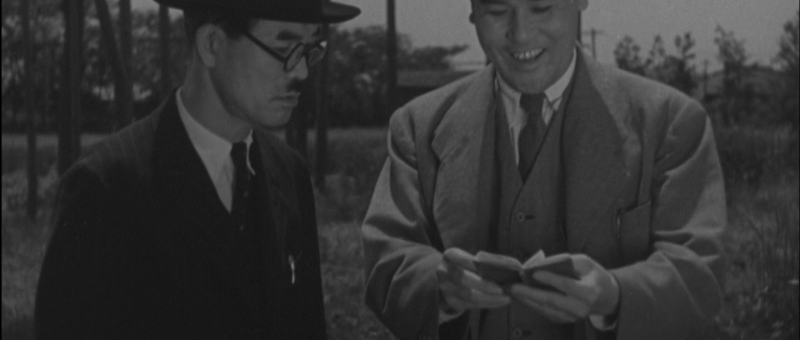
In other ways, however, it harks back to the salaryman movies of the 1930s such as Naruse’s own Flunky, Work Hard and Ozu’s I was Born, But… in which the male office worker has been essentially emasculated and forced to debase himself in order to please his boss. As the film opens, Ooki (Achako Hanabishi) and Aono (Entatsu Yokoyama) are guests at their boss’ dinner party at a geisha house where they’ve been ironically invited as entertainment. The pair of them take the place of the geisha doing a silly dance to entertain the boss who quips that they’re cheap considering how much it would cost to hire a pair of comedians. It’s worth saying that Ooki and Aono are not particularly doing this in a calculated way but actively appreciate being appreciated by the boss and see it as their duty to keep him happy. At times, others suggest that it’s their attempt to ingratiate themselves with him, though they seem quite surprised by the suggestion in part because they still believe in an old-fashioned idea of the employer-employee relationship in which the company is supposed to look after them, so they assume they’ll make career progress naturally by being affable team players and aren’t really worried about losing their jobs despite all this talk of restructuring.

Their boss, however, thinks the pair of them are idiots and takes advantage of their loyalty towards him by getting them to dig his garden and complete other inappropriate personal tasks. He gives them a pair of tickets for an onsen resort as a kind of reward, but once they get there, they realise he’s done it to get them to bring back his “luggage” which is actually black-market supplies for his daughter’s birthday party. The boss’ superiority over them is signalled by his large Western-style house, while Ooki and Aono both live in humbler, traditionally Japanese homes. Aono is a widower with four children though he can’t remember how old they are the oldest two daughters are of marriageable age. The boss even requests the eldest, Hatsuko’s presence at the party, but it quickly transpires that he wasn’t inviting her but asking her to do unpaid serving work signalling the class disparity between the middle-ranking salarymen and the boss.

But it’s at the party that things start to change as Hatsuko talks her father out of doing another silly dance as part of the entertainment, in part because of her embarrassment but mostly because her sister Yasuko’s (Itoko Kono) boyfriend is a guest and she’s worried it’ll put him off marrying her. This angers the boss, who insultingly suggests that Aono and Ooki aren’t even fully human and only become a whole person when together so one alone is as useless as an orphaned sandal. Meanwhile, Ooki’s son, whom he’s very proud to say is in university, is rehearsing a communist play that’s about a strike at factory. Ooki doesn’t really understand it, but is worried about the neighbours overhearing and the police getting involved. He still has a pre-war mindset and hasn’t realised that things like freedom of expression now exist. His son tells him that it’s only right to speak up. If you can’t say anything because you’re afraid of getting fired, then you’ll just end up getting exploited. But Ooki and his wife insist they feel too indebted to the boss to be able to talk about him like that. He thinks his son will change his mind when he enters the world of work. Sadao replies that he understands why his father had to do it, but insists that the world is unjust and has been created by the capitalists for their own benefit.

Pushed too far, Ooki and Aono do eventually decide to confront the boss even if they immediately back track when he arrives at the office by hanging up his hat and dusting his desk. They accuse him of being a wartime profiteer who caroused with militarists and made his money by exploiting their labour while he now abuses the black market. They find themselves supported by the other workers from the other side of the door as they insist they’ll fight the restructuring along with the boss’ underhanded plan to sell the company to a rival. They’ve discovered workers’ solidarity and resolved not to be complicit any more with a feudalistic working culture, though it’s unclear if anything will really come of it. They are nevertheless free from their lives of constant debasement and have reasserted their individual identities while otherwise being an unbreakable pair.
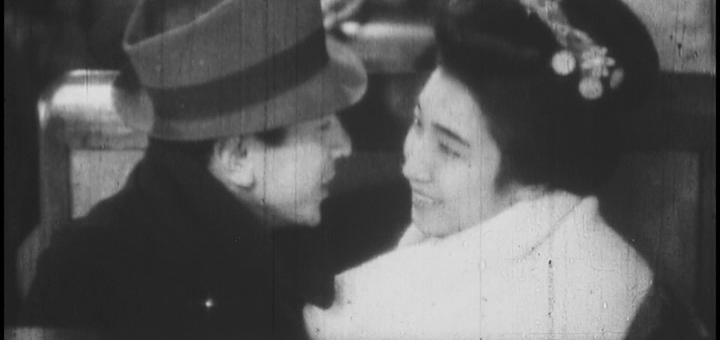
The Water Magician (瀧の白糸, Kenji Mizoguchi, 1933)

“As long as I breathe, I’ll remember my debt to you” avows a young man to his unexpected benefactor becoming one of many claiming they will never forget her kindness though in his case he actually means it. Kenji Mizoguchi would later become known for tragic tales of female suffering, but his central themes were established early on and very much in evidence in 1933 silent The Water Magician (瀧の白糸, Taki no Shiraito) in which a truly good woman tries to use her independent success to improve the lives of those around her but finds herself cruelly betrayed by a greedy and self-interested patriarchal society. 

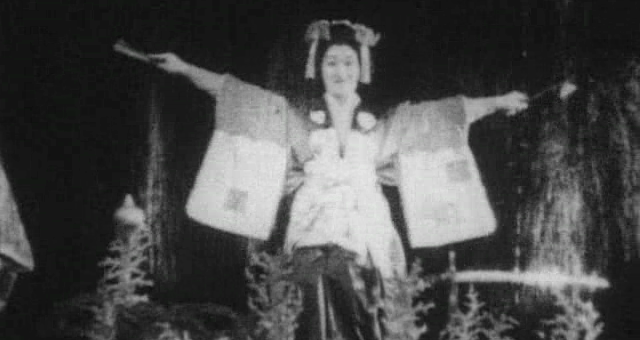
Tomo Mizushima (Takako Irie) goes by the stage name Taki no Shiraito, which means something like white threads of the waterfall, particularly apt seeing as she is a “water magician” with a troupe of itinerant players. A beautiful woman who can make the water dance, she has her share of followers and is financially independent if subject to the vagaries of the show business existence. Her life changes one day when she is travelling in a horse-drawn coach that is embarrassingly overtaken by a fast running rickshaw man. The passengers are irate, wondering what they’re paying for, while the driver ignores their pleas not to spare the horses. Tomo decides to use her feminine appeal and then her financial power to convince him to speed up, but he ignores her too until he eventually decides to gallop forward recklessly while the passengers shake inside until the coach’s axle finally snaps and leaves them stranded. A gallant young man, the driver grabs Tomo and throws her on his horse to get her to the next town. She faints on the journey and only comes round after the coachman has left but discovers herself in possession of a complicated law book she assumes is his.  

Tomo cannot stop thinking about the dashing young man, only identified as “Kin” (Tokihiko Okada). She is surprised to reencounter him asleep on a bridge though he seems not to remember her. After finding out that he is an unluckily orphaned former samurai who was fired from the coach for breaking the axle and endangering the passengers, she resolves to use her financial power to help him achieve his dreams of studying law in Tokyo. Tomo does this because she is in love and asks for nothing in return except a future promise of romantic union to which the young man does not exactly agree but does take her money and vows to live up to the faith she has shown in him. 

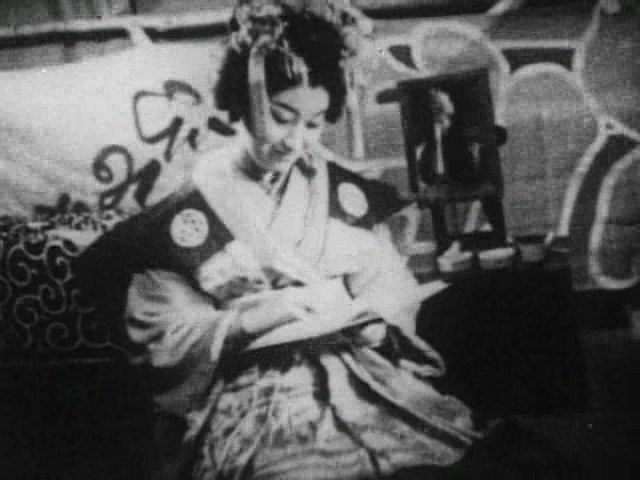
Alone once again Tomo tries to contend with the world around her while dreaming of Kinya, sending him her savings for his upkeep while the troupe continues to suffer especially during the traditional dry spells of the heavy winter. The troupe’s leader makes the decision to get involved with dangerous loanshark Iwabushi (Ichiro Sugai), a huge hulking man with a mean look and lecherous temperament. While Tomo dreams of Kinya, two romances mirror each other in the failed relationship of the cruel knife thrower Minami (Koju Murata) and his terrorised wife Gin (Kumeko Urabe), and the innocent young love of the beautiful Nadeshiko (Suzuko Taki) and the barker Shinzo (Bontaro Miake). Gin also borrows money from Tomo which she was reluctant to surrender because she saved it for Kinya, claiming she needs it to visit her sick mother in Tokyo and vowing once again never to forget Tomo’s kindness but later skipping out with a stagehand to escape Minami’s control. Nadeshiko and Shinzo, however, are forced to flee on learning that Minami plans to sell her to Iwabushi to settle his private debts. The couple regret leaving Tomo who has always supported them in the lurch, but she helps them escape, ushering them out the back towards a waiting boat and handing them still more money asking only that they be happy and stay together always. 

That’s not perhaps a power that’s in their keep, but the youngsters keep it as best they can and eventually attempt to protect her in the way she has protected them. The world, however, is cruel. With work thin on the ground Tomo finds herself unable to go on funding Kinya as she’d promised, and is only shamed by his well-meaning letter explaining that he’ll try to find a way of supporting himself until his studies are finished so she needn’t worry. She cuts a deal with Iwabushi and sells her body on Kinya’s behalf, but he is in league with Minami who sets his goons on her to retrieve the money seconds after she’s obtained it. 

Her hopes are at least repaid on discovering that her love is true to his word, has never forgotten her, and is well on the way to achieving his dreams as person of note. “Chance and fate, that’s all there is” Kinya had lamented on their second meeting, but he couldn’t know how right he’d be. Tomo’s dreams are fulfilled only their negation. Kinya must do his duty even if it does her harm, yet he too feels responsible and wants to share her burden though that, ironically, would only destroy everything for which she has sacrificed so much. “The river flows on as it always has and always will” the Benshi adds in solemn contemplation of this romantic tragedy, somehow inevitable in its cruelty. Tomo finds herself at the mercy of her times in which money is all, goodness is a weakness, and love too fragile to survive. The woman who made the water dance floats away on a river of tears, a victim of a cruel and unforgiving society.


The Straits of Love and Hate (愛怨峡, Kenji Mizoguchi, 1937)

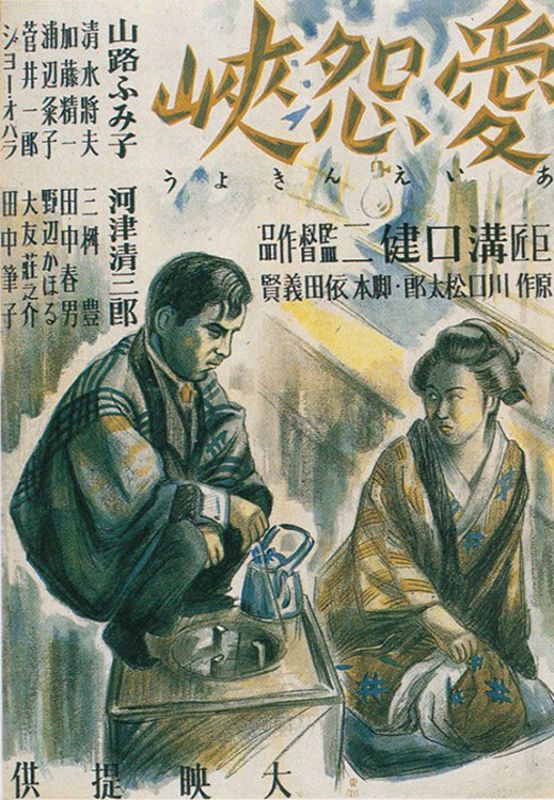
straits of love and hate poster“Tokyo is a dangerous city that traps innocent people like you” the heroine of Kenji Mizoguchi’s 1937 melodrama The Straits of Love and Hate (愛怨峡, Aien kyo) is told, but it’s not so much the darkness of the city streets as the world’s cruelty which threatens to consume her soul. Loosely inspired by Tolstoy’s Resurrection, then particularly popular in Japan and a frequent source for adaptation in the silent era, Straits of Love and Hate is a familiar tale of an innocent maid seduced and betrayed by the weak willed son of her social superiors, but rather than see her beaten by a broken heart Mizoguchi allows to her to find new strength in the determination to move forward in a direction of her choosing.

Kitchen maid Ofumi (Fumiko Yamaji) is in love with Kenkichi (Masao Shimizu ), the son of local hotel owners. Now that he’s finished his studies, his parents were expecting him to take over the inn so they’re not exactly pleased when he tells them he plans to go to Tokyo to become a teacher, nor would they be very happy about the idea of him marrying a lowly maid. After arguing with his father, Kenkichi more or less gives up on the idea of leaving, deciding to postpone until his parents come round or perhaps going on his own and sending for Ofumi when he’s financially stable. Twin pressures, however, force him to accept that it’s now or never. Ofumi is a few months pregnant and will soon be showing so his hand is in a sense forced. Meanwhile, Ofumi is keen to leave as soon as possible because her uncle, Murakami (Seiichi Kato), has turned up extremely drunk and is talking to her employers about taking her away to join his troupe of travelling players which she is desperate to avoid because she remembers her mother telling her he was no good and would sell her to a brothel as soon as look at her.

Kenkichi relents and the pair elope to Tokyo, but once there his general fecklessness resurfaces. The couple have begun to outstay their welcome at the apartment of a friend whose wife is becoming thoroughly fed up with Kenkichi who lounges about all day not looking for work, while an increasingly pregnant Ofumi is out job-hunting alone in the unforgiving city. A naive bumpkin, she’s nearly scammed by a street pimp who claims to be saving her from someone in fact just like him, but is rescued by Yoshi (Seizaburo Kawazu) – a wandering accordion player regarded by all as a petty thug. Kindhearted by nature, Yoshi takes pity on her and sets Ofumi up with a job in a cafe but is soon arrested for stabbing the pimp who was bothering her. Meanwhile, the irritated wife of Kenkichi’s friend has wired his dad who promptly arrives to retrieve his son. Spineless, Kenkichi walks out on his pregnant girlfriend leaving her only with a note that says “sorry, good luck with the rest of your life”, and an insultingly small amount of compensation money.

It’s easy enough to think that Kenkichi wasn’t really invested in his romance, got cold feet, or simply rejected adult responsibility, but the truth is more that he’s just as trapped by patriarchal social codes as Ofumi is and no more free even with his comparatively comfortable class background. He lacks the will to defy his father, and is simply too lazy to consider living an ordinary life in the city with a regular job where no one calls him “young master”. Ofumi, by contrast, fights for love. She breaks the class barrier, naively believes that Kenkichi’s parents will accept her because they cannot reject their grandchild, and forgives Kenkichi’s fecklessness because she truly believes in him. One word from his father, and he crumbles. Left alone Ofumi is forced to send her son out to foster parents and has no other choice than to become a bar hostess.

Unlike Kenkichi, Yoshi is patient and kind. He truly means to protect Ofumi and her son, but also has a self-destructive violent streak as manifested in his over the top attack on the pimp and later altercation with a remorseful Kenkichi. Ironically enough, Uncle Murakami whom she so feared becomes an unlikely source of salvation, inviting Ofumi and Yoshi to join the company as a standup double act. Witnessing Ofumi reenact her romantic tragedy on stage as part of a routine forces Kenkichi to confront his moral cowardice. While the intervening years have seen Ofumi become cynical and bitter, still angry and resentful, Kenkichi has become weary and resigned. His parents have moved to the country, and he now runs the hotel, but he’s still not free. Hoping to convince Ofumi to come back, he invites his dad to meet their son but it becomes clear to her that Kenkichi will never change. He lacks the strength to reject his father’s authority, and as he’s abandoned her before he will likely do so again.

Kenkichi, perhaps meaning well, offers to take the child, pointing out that growing up among travelling players is an inauspicious start in life whereas he can bring the boy up with all the advantages of middle-class comfort. Ofumi is guilty in her immediate refusal, acknowledging that she may be denying her son a “better life” than she can give him, perhaps selfish in her reluctance to be parted from her child, but equally certain that she doesn’t want her son to grow up like Kenkichi, a spineless product of a patriarchal social order unable to stand up to his father or seize his own agency. She tells Kenkichi that she’s fallen in love with Yoshi because theirs is a partnership of equals, they understand and support each other, moving forward as one. He won’t abandon her by choice, but he isn’t perfect either and his foolish self-destructive impulses and selfless nobility threaten his new hope for the future as he embarks on a high risk strategy to prompt Ofumi to accept the “better life” that Kenkichi can offer her. Nevertheless, the point is that the choice is finally hers – no man is going to make it for her, not even her son. What she chooses is a kind of independence, stepping boldly forward into a future that’s entirely of her own making.