Evil Dead Trap (死霊の罠, Toshiharu Ikeda, 1988)

The embattled host of a late-night TV show is confronted by the image of corrupted maternity after receiving a snuff film in the mail that seems to feature herself in Toshiharu Ikeda’s body horror slasher, Evil Dead Trap (死霊の罠, Shiryo no Wana). A giallo-esque slasher echoing alternately by Argento and Cronenberg, the film is in part an exploration of changing gender norms at the height of the Bubble era in which the career woman hero is essentially stalked by a monster baby because she reminds him of a mother he for some reason hates.

Nami’s (Miyuki Ono) late night TV show “for those who can’t sleep” relies on viewers for its content, making use of newfangled VHS technology to play videos sent in to the studio. Her bosses are thinking of canning it for being too “fluffy” which might be one reason Nami does not immediately call the police after receiving a disturbing video of a woman being tortured and killed who is later revealed to have her own face. Instead, she gets the all female (plus one “bodyguard” who is the boyfriend of one of the team) crew together and heads out to the abandoned US military base which appears to feature in the video. 

At several points, the women remark on how difficult it is for them working in the TV industry where they need a big story just to earn their place in their room. Nami even jokes that if she were to die investigating the tape it would only boost the ratings while simultaneously putting her life on the line for the sake of her career. Meanwhile, we later realise that Nami is being targeted in part because the killer, who has a child’s voice, thinks she looks like his mother whose voice is frequently heard playing on a loop via reel to reel tape. He later attempts to kill Nami by wrapping what appears to be an umbilical cord around her neck, while she is finally subjected to a forced birth as maternity is visited on her almost as an act of rape even as she resists it. It could even be said that she is a kind of mother to the group, and one who ultimately fails to take care of family as each of her team falls victim to one of the traps set by the killer.

Meanwhile, the film adopts a slasher-esque morality in which the first victim is killed shortly after having sex with her “bodyguard” boyfriend, assistant director Kondo (Masahiko Abe), who had up until that point been suffering with erectile dysfunction only to be sexually revived thanks to the violent and eerie space of the abandoned military base. Another of the women attempts to leave the compound, but is caught by a random man claiming to be working for the killer who violently rapes her but also strangely answers some of her questions about what’s really going on as he does he does so. Nami is also less than shocked by the video after putting it in the machine, giving a response which suggests it’s not unusual to receive this kind of material or to witness such brutal treatment of women. 

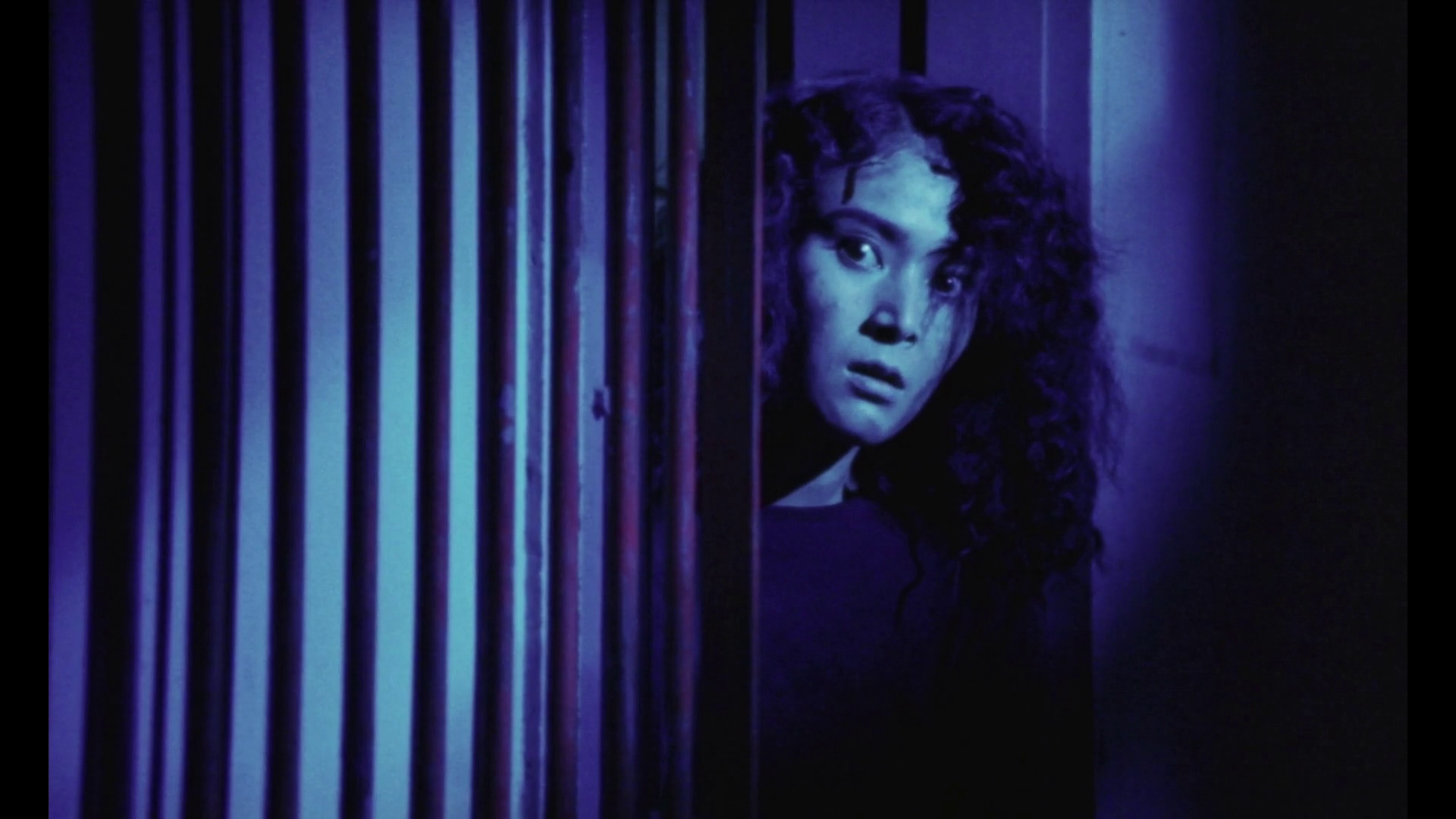
The killer does indeed make good and ironic use of new technology, at one point putting one of the victims on TV begging for their life to taunt Nami and having a giant set up featuring several screens plus the reel to reel tape. A mysterious man also lurking around the military base suggests to Nami that the sender of the video is likely a crazed stalker, a pervert who wanted to see her naked who lured her to this remote location and then murdered all her friends when actually it’s almost the reverse that’s true and Nami is being targeted both for and not being a mother. Often switching to a Testuo-style shuttling camera and blue-tinted filter, Ikeda enlivens his genre adventure with interesting composition and a fantastic use of lighting right down to the oscillating blue police light in the killer’s lair as Nami attempts to retake control of her image and escape the penetrating gaze of her audience along with the patriarchal cage of an oppressive society.


Trailer (dialogue free)
Red Beard (赤ひげ, Akira Kurosawa, 1965)

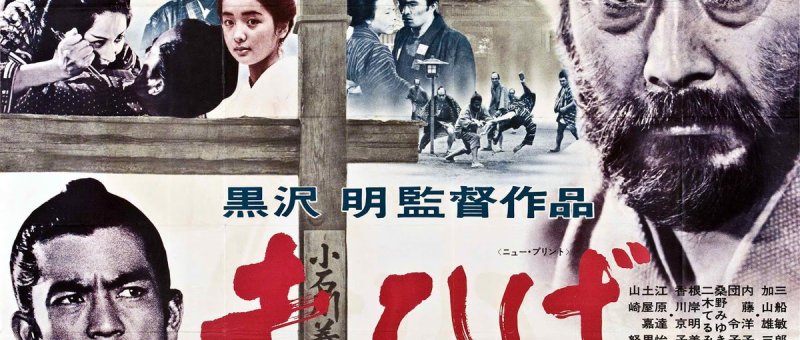
Red Beard posterAkira Kurosawa may be the most familiar golden age director of Japanese cinema to international audiences, but he was in many senses somewhat atypical. Where many of his contemporaries were eager to tell the stories of women, Kurosawa’s films are resolutely male and where many were keen to find the good among the bad, Kurosawa was often keen on the reverse. Nevertheless, that does not mean that he did not see goodness, merely that it was something which needed to be rooted out and fought for rather than simply permitted to exist. His final collaboration with Toshiro Mifune, Red Beard (赤ひげ, Akahige) finds the director at his most optimistic, fully embracing his natural tendency towards humanism even while making plain that goodness can often be hard to find, especially within yourself, and there may be no real cure for injustice but you have to treat the symptoms anyway.

The tale begins at the close of the Tokugawa era as a young doctor, Yasumoto (Yuzo Kayama), pays a courtesy call to the Koishikawa public clinic presided over by an old friend of his father’s, Doctor Niide (Toshiro Mifune) – otherwise known as “Red Beard”. Yasumoto, having just graduated from studying under the Dutch in Nagasaki, had only intended to make a brief visit on his way home and is therefore shocked to realise that he has been tricked into accepting a position at a hospital for the poor.

Our introduction to the Koishikawa clinic is through the eyes of Yasumoto as he receives a tour from another doctor who loudly remarks that he is glad that Yasumoto has now arrived because that means he can finally be free of this wretched place. Yasumoto’s nose wrinkles on smelling the “rotting fruit” of the poor waiting for afternoon appointments, while one of the patients complains about the “sterility” of the environment and his plain hospital clothes before a genial inpatient, Sahachi (Tsutomu Yamazaki), explains the reasoning behind such austerity and praises the attention to detail of head doctor Red Beard who has thought carefully about the best way to ensure his patients experience the best of care.

Yasumoto is extremely displeased by his predicament. He had believed himself on track to become a royal doctor working for the Emperor and being sent to poor clinic seems like a poor joke. He is indeed extremely full of himself, refusing to surrender his medical notes from Nagasaki as if he had made some great discovery and hoped to profit from it. Hoping Red Beard will fire him, Yasumoto behaves like a petulant child – refusing to wear his uniform, deliberately stepping into areas he knows are out of bounds, refusing to see patients, and just generally being unpleasant to have around. Red Beard is stoic and patient, though it gradually becomes apparent that perhaps Yasumoto has been sent here deliberately for a humbling everyone believes he had coming to him. Asked to perform the most routine of tasks, Yasumoto is forced to realise that the medical knowledge of which he was so proud is mostly book learning. He doesn’t know how to diagnose a living patient, has never been present at an operation, and has never sat with someone while they died knowing there was nothing more he could do for them. Reluctantly, he has to accept that the advice he received from the other doctors on his first day, that there was much to be learned here for those who wanted to learn it, was as true as it could be.

The first half of the film is indeed Yasumoto’s humbling as he begins to come around to the mysterious workings of Red Beard who gradually leads him to understand his first duty as a doctor is help those in need. Then again, Red Beard is an unwilling mentor. He is fully aware of the corruptions of the world in which he lives but has made a decision with which he remains conflicted to bend them to his advantage. Enraged to discover his government funding is being cut, Red Beard deliberately over charges the local lord whom he, amusingly enough, puts on a diet as he snorts like a piggy short of breath thanks to his unhealthy life of luxury. He also blackmails another local lord to save a young mother who turned a knife on an abusive husband, and later uses his medical knowledge to unfair advantage to take out a whole gang of yakuza. Red Beard isn’t sure he’s in a position to become anyone’s role model, but that only seems to make Yasumoto respect him more.

Nevertheless, there is darkness too in Red Beard’s philosophy. The real enemy here and perhaps everywhere is poverty and the selfishness which enables it. Most of the diseases Red Beard treats in his clinic are a direct result of impoverished living, mostly those of malnutrition and overwork as well as the necessity of living in cramped, unsanitary conditions. Yasumoto, a young man of means, has a puffed up sense of self and a natural ambition that tells him he is destined for the court and so he looks down on these unfortunate people as something other, something that does not concern him and is not worthy of his attention. He won’t put on his uniform out of spite, but eventually relents when Sahachi explains to him that the uniform marks him out as member of the clinic meaning that ordinary people who cannot afford to pay a doctor know that he is someone they can ask for help when no one else will help them.

As Red Beard says, there may be no real cures for disease. All they can do is fight poverty and mask their ignorance. Yasumoto learns by experience. He discovers the rampant injustice of his society in the sad stories that he hears. A “mad” woman who became a serial killer after years of childhood abuse, a woman who rejected a good father out of fear and allowed a bad mother to marry her to a bad man who was also her mother’s lover, a little girl adopted by a cruel madam who turned in on herself when she tried to press her into sex work at only 12 years old, a sex worker suffering with syphilis but too valuable to be released and sent home. This world is built is built on female suffering which is not, perhaps, something which Red Beard is in much of a position to treat.

The mad woman tries to hang herself and Red Beard wonders if it would have been kinder let her die, while the mother of a family who decided on group suicide asks him what the point was in saving her. The world is not an easy place to live in, but Red Beard’s prescription is refreshingly simple. One heals oneself by helping others, as he proves to Yasumoto through making him both doctor and patient to a wounded little girl who then passes her new found humanity on to another needy soul eventually reformed by kindness alone. Day by day, Red Beard goes to war against selfishness and indifference, treating the symptoms in order to undermine the disease which has infected his society in the hope that it might eventually decide to cure itself.


Original trailer (No subtitles)