Pornostar (ポルノスター, AKA Tokyo Rampage, Toshiaki Toyoda, 1998)

pornostarLooking back, at least to those of us of a certain age, the late ‘90s seem like a kind of golden era, largely free from the economic and political strife of the current world, but the cinema of that time is filled with the anxiety of the young – particularly in Japan, still mired in the wake of the post-bubble depression. Toshiaki Toyoda’s Pornostar (ポルノスター, retitled Tokyo Rampage for the US release) (not quite what it sounds like), is just such a story. Its protagonist, Arano (Chihara Junia, unnamed until the closing credits), stalks angrily through the busy city streets which remain as indifferent to him as he is to them. Though his wandering appears to have no especial purpose, Arano seethes with barely suppressed rage, nursing sharpened daggers waiting to plunge into the hearts of “unnecessary” yakuza.

After taking the early morning train into the city, the grey light of dawn gradually brightening as the streets fill with people busying themselves about their business, Arano walks around angrily bumping into anyone who happens to be in his path but nary a one of them even looks back at him before continuing onwards, zombie like, towards their destination. We then cut across town to another crossing where non-yakuza club boss Kamijo (Onimaru) also bumps into someone but stops to make sure the offending person realises the disrespect they’ve just shown him. The film will, in many ways, turn on the interaction of these two men who take a very different approach to a series of common problems. Anti-yakuza avenger meets anti-yakuza appeaser – their war will always be a zero sum game, but then, neither of them are very interested in winning it anyway.

If Arano and Kamijo represent the male forces of chaos and violence mixed with cowardice and self interest, the third axis turns on one of Kamijo’s escorts who is determined to travel to Fiji for “The Summer of Love” in 1999 (presumably the 30th anniversary celebration for a bygone era of hippiedom). Alice (Rin Ozawa) presents a possible point of departure for Arano as she temporarily takes charge, co-opting the boom box which is used to conceal the all important drugs and attempting to repurpose its darkness to find her own light only to crash and burn. The other female force in the film in a neat piece of symmetry mirroring the Arano/Kamijo dynamic is a destructive counter to Alice’s creative instincts. The unnamed woman mostly known for a tattoo across her chest which reads 5-Star Pussycat (Leona Hirota), acts like some kind of avenging angel with a purpose as unclear as Arano’s as she runs around the city taking out yakuza here, there, and everywhere.

The film’s title is, apparently, an obscure attempt at pairing the sleazy nature of the Shibuya environment with Arano’s oscillating, lonely planet existence. No reason is given for Arano’s intense loathing for yakuza whom he describes as “unnecessary” throughout the film (not unfairly, it has to be said), but vengeance seems to have become his entire reason for living. Allied with the knife in the film’s complex symbolic imagery, Arano becomes the personification of death, chaos, and violence as he almost ceases to exist as a person so turned inward and delusional has his mind become. Kamijo, by contrast, is a weaker figure yet no less linked with death through his constant references to his father’s grave. Given his close ties to his mother, it may be fairer to say that if Arano is a man already dead then Kamijo is one not yet born. Always on the threshold, Kamijo refuses the yakuza joining ceremony but continues to behave like a gangster even whilst rejecting the act of killing. Arano and Kamijo are locked in their perfect symmetry, a complementary pair forming one fully fleshed whole, but their union is inevitably a destructive one, unable to find a constructive purpose in their nihilistic world of violence and betrayal.

Similarly, Arano also rejects the possibility of salvation offered by Alice and her idealised Fijian paradise. Trying and failing to ride Alice’s skateboard even as she attempts to physically guide him, Arano cannot let go of his destructive cycle of violence in order to participate in her revolution of love, allowing her empty skateboard to roll away from them as symbol of their unattainable dreams. Alice may be the film’s only winner as, even if she too suffers and fails to break out of the constraining underworld environment, she remains free to fight for freedom, gliding away on her skateboard bound for love.

Though sometimes a little too obscure or displaying a slight incompleteness of thought, Pornostar is an accomplished narrative debut from Toyoda which addresses several of his ongoing concerns. Told with surrealist flair in its strange set pieces where knives fall from the sky or a girl dances madly in a dingy night club, Pornostar is a stylish piece marrying slo-motion and loud music with frenetic violence and the total absence of sound. A dispassionate tale of youth on fire but burning itself from the inside out, Pornostar is less a chronicle of its times than a lament for the aimlessness of the young, locked out of mainstream society and into a mind consuming itself through unresolved frustration.


Available now in the UK as part of Third Window Films’ Toshiaki Toyoda: The Early Years box set.

Opening scene (no subtitles)
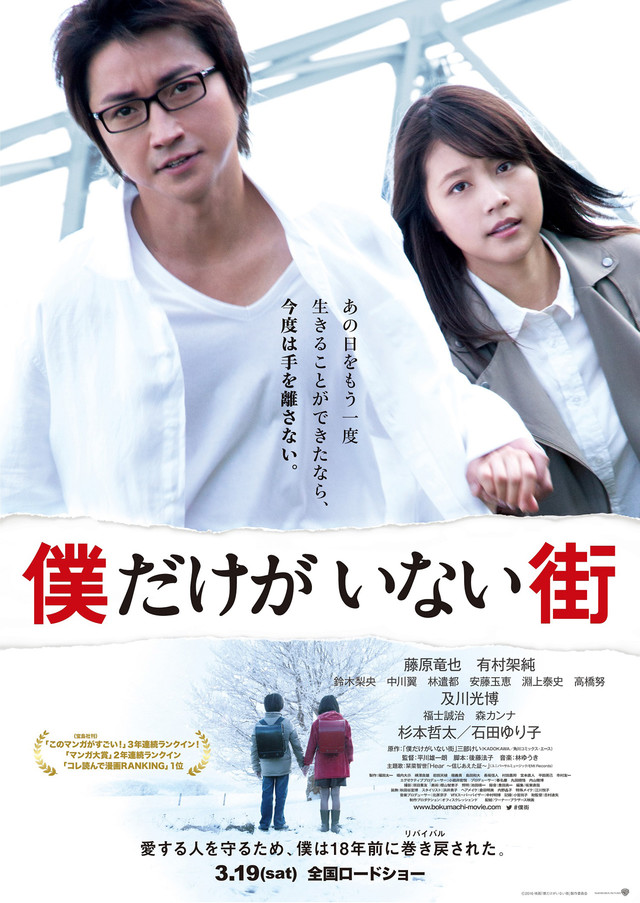
Erased (僕だけがいない街, Yuichiro Hirakawa, 2016)

erasedErased (僕だけがいない街, Boku Dake ga Inai Machi), a best selling manga by Kai Sanbe, has become this year’s big media spectacle with a 12 episode TV anime adaptation and spin-off novel series all preceding the release of this big budget blockbuster movie. Directed by TV drama stalwart Yuichiro Hirakawa, the live action iteration of the admittedly complicated yet ultimately affecting story of a man who decides to sacrifice himself to ensure his friends’ happiness, acquits itself well enough for the most part but changes two crucial details in its concluding section which unwisely undermine its internal logic and make for an unsatisfying conclusion to the ongoing puzzle.
Beginning in the “present” of 2006, Satoru Fujinuma (Tatsuya Fujiwara) is an aspiring mangaka making ends meet with a part-time job as a pizza delivery guy (a kind of “Hiro Protagonist”, if you will). Aloof and sullen, Satoru has no real friends but does possess an unusual supernatural ability – if a tragedy is about to occur in his general vicinity, he will enter a “Revival” loop in which he temporarily rewinds time, allowing him to figure out the problem and save everyone’s lives. Rescuing a child about to be hit by an out of control lorry, Satoru rides his pizza delivery bike into an oncoming car and winds up in hospital.

When he comes to he finds cheerful co-worker Airi (Kasumi Arimura), who witnessed the accident, waiting for him as well as his mother (Yuriko Ishida) coming in for visit. Reconnecting with his mother and getting closer to Airi (albeit reluctantly) Satoru’s life appears to be brightening up but the good times are short lived as Satoru’s mother is brutally murdered in his apartment leaving him looking like the prime suspect. This time when Revival kicks in it doesn’t just rewind a few minutes but 18 years, back to the winter of 1988 when Satoru’s small town was rocked by a series of child murders and abductions which resulted in the arrest of a local boy (Kento Hayashi) whom Satoru had always believed to be innocent.

Repossessing his childhood body but with a grown man’s mind, the “younger” Satoru is considerably less jaded than his 2006 counterpart, determined to change the future and save his mother’s life. The root causes of her death, he is sure, rest in this unresolved and traumatic period of his childhood. Swapping back and forth between 2006 and 1988 as Satoru makes the best of his opportunity to investigate from both sides, Erased is a tightly controlled time travel puzzle of trial and error in which Satoru must use all of the evidence he can gather to unmask the criminal in order to save both the lives of his friends in 1988 and that of his mother in 2006.

As in many similarly themed franchises, the plot turns on the bonds formed in childhood as the connections between Satoru and his friends become the binding glue in an otherwise fluid time travel dilemma. Older Satoru is better equipped to recognise the trouble one of his friends is in – Kayo, a sad and lonely girl who, in the original timeline, eventually became one of the victims attributed to the serial murders plaguing the town. Trapped in an abusive home environment, Kayo isolates herself for reasons of self preservation, both too afraid and too ashamed to let anyone know what’s going on at home. Managing to befriend her, Satoru does indeed help to change something for the better but only finds himself becoming more deeply entrenched in the central mystery.

It’s at this point that the film begins to diverge from its source material as Satoru is attacked by the murderer and “wakes up” back in 2006 but rather than having been in a coma for 18 years has apparently been leading a much more successful life than his previous incarnation. Within the peculiar laws of the franchise which don’t always match standard time travel logic, Satoru’s central timeline does not change – only his mind moves between bodies, he retains full knowledge of his original timeline as well as the changes he brings about. However, he now seems to magically receive memories of the life he never lived whilst also retaining his previous ones. Now knowing the identity of the real murderer and the probability that they are still out there, Satoru decides to re-team with his old friends but his showdown with the psychotic killer is entirely contrived to engineer a “tragic” ending, oddly more like something that might have befallen the 11yr old Satoru than his older counterpart, further undermining the already shaken sense of internal consistency.

The film’s Japanese title, Boku Dake ga Inai Machi (the town where only I am missing), takes inspiration from the short story which Kayo writes in school. Wishing that she alone could be transported to another life free of abuse and loneliness, Kayo writes herself into a better place. Satoru reimagines a similar scenario with himself in the lead as he makes the decision to sacrifice himself to save his friends. The ending of the original source material both undercuts and reinforces this idea as Satoru’s friends are both extremely proud and grateful for his efforts, but are also keen to point out that the world is a much better place with him in it than without. In removing the opportunity for Satoru’s friends to come to his rescue, the live action version of Erased also removes its most crucial message – that heroes are never “alone”, and Satoru’s salvation lies in that of his friends and family.

Yuichiro Hirakawa mostly opts for a lighter tone than the children investigating a serial killer whilst also trying to rescue their friend from her abusive mother narrative might indicate. There are some nice visual ideas including a switch to POV during the first time skip to 1988, the repeated hero of justice hand gestures, and thoughtful use of manga, but given the obvious problems with internal consistency, the high quality of the performances and cinematography can’t reconcile the various cracks within the film’s structure. Uneven, but strong until its contrived and illogical end point, Erased is a slightly disappointing live action adaptation of its source material in which it might have been (ironically enough) better to have more faith rather than pushing for the predictably melodramatic conclusion.


Original trailer (no subtitles)

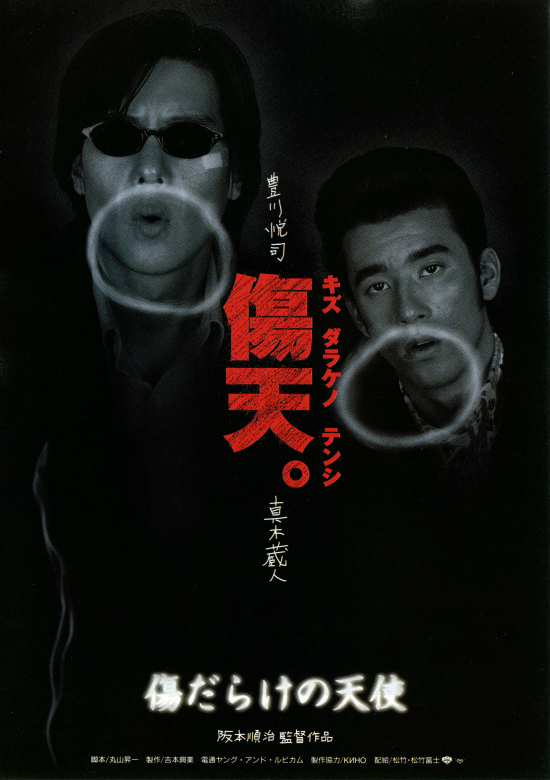
Injured Angels (傷だらけの天使, Junji Sakamoto, 1997)

injured-angelsDespite having started his career in the action field with the boxing film Dotsuitarunen and an entry in the New Battles Without Honour and Humanity series, Junji Sakamoto has increasingly moved into gentler, socially conscious films including the Thai set Children of the Dark and the Toei 60th Anniversary prestige picture A Chorus of Angels. Injured Angels (傷だらけの天使, Kizudarake no Tenshi) marries both of aspects of his career but leans towards the softer side as it finds genial private detective Mitsuru (Etsushi Toyokawa) accepting a request from a dying man to ensure the safe passage of his young son to the boy’s mother in Northern Japan.
Reluctantly taking on an assignment to question the last remaining tenant of an office block, Mitsuru discovers the man inside already mortally wounded. During their conversation, the man offers him all the money he has left to take his young son to his estranged wife, currently living in a small town in the North of Japan. Mitsuru doesn’t really want this kind of hassle but feels sorry for the man and his son and eventually decides to make sure the boy, Hotaru, gets to someone who can take of him. The pair set off on a kind of road trip eventually joined by Mitsuru’s partner Hisashi (Claude Maki) meeting friends old and new along the way.

Inspired by the 1970s TV series of the same title, Injured Angels adopts an oddly jokey tone throughout as Mitsuru has various strange adventures whilst trying to guide a small child to someone willing to take him in. At one stage, the film goes off on a long and improbable tangent in which Mitsuru runs into an old friend who is currently wearing a lucha libre mask “for work”. The pair then board the bus with the wrestlers before Mitsuru himself ends up in the ring. Though fun, the sequence has little to do with the ongoing plot other than adding to the already absurd atmosphere.

Predictably, when Mitsuru reaches the address he’s been given, Hotaru’s mother has already moved on but even when they eventually find her, the reaction is not the one you’d expect. Soon to be married again, Hotaru’s mother (Kimiko Yo) is not keen to resume custody of her son (or rather, her husband to be has no desire to raise another man’s child and even goes so far as to use physical violence on Mitsuru to show the strength of his feeling). Hotaru starts to grow attached to the two detectives who are probably giving him the most normal kind of family life that he has known for a very longtime. The guys seem to know they can’t keep him indefinitely and are intent on finding another relative but the mini family they’ve formed may be painful to break up.

While all of this is going on, Mitsuru also has a series of meetings with a woman from Tokyo, Eiko (Tomoyo Harada), who keeps bumping into him. Though an obvious attraction develops, Eiko is also fleeing her own kind of trouble and the pair seem content to leave things up to fate and possible drinks in Tokyo at an unspecified point in time, but this oddly integrated plot strand fails to have a real impact within the narrative as a whole. It does, however, add to Mitsuru’s ongoing existential dilemma as he begins to reexamine his life and relationships after bonding with Hotaru. Ultimately he opts for asking his partner, Hiasashi, to move in with him when they get back to Tokyo but at the same time Mitsuru seems to know he may be headed for another destination entirely.

This tonal strangeness is a serious weakness where would expect a more nihilistic atmosphere as Mitsuru’s journey begins to take shape but the inconsequential humour and mildly absurdist approach continues right until the anticlimactic ending. Perhaps feeling a need to recreate the feeling of the TV series, Sakamoto fails to reconcile these differing levels of seriousness into a convincing whole in allowing for the kind of light and breezy action in which everything is definitely going to be OK by next week’s episode. For what’s actually a look at neglected, abandoned children coupled with intense friendships and romantic dilemmas, the bouncy, ridiculous tone is an odd fit and robs the piece of its dramatic weight. Nevertheless, despite the structural problems, Injured Angels is often a fairly enjoyable, if odd, character drama even it ultimately fails to amount to very much as a whole.


Original trailer (no subtitles)

https://www.youtube.com/watch?v=9rbcjFtONGQ

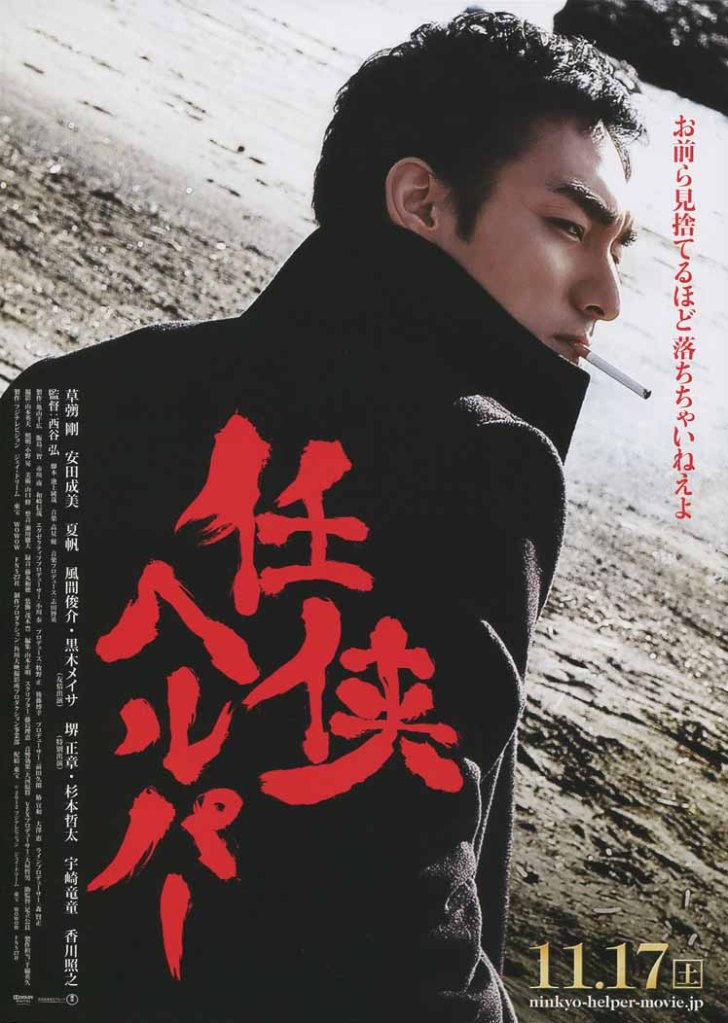
Beautiful World (任侠ヘルパー, Hiroshi Nishitani, 2012)

ninkyo helperIn old yakuza lore, the “ninkyo” way, the outlaw stands as guardian to the people. Defend the weak, crush the strong. Of course, these are just words and in truth most yakuza’s aims are focussed in quite a different direction and no longer extend to protecting the peasantry from bandits or overbearing feudal lords (quite the reverse, in fact). However, some idealistic young men nevertheless end up joining the yakuza ranks in the mistaken belief that they’re somehow going to be able to help people, however wrongheaded and naive that might be.

The hero of Hiroshi Nishitani’s Beautiful World (任侠ヘルパー, Ninkyo Helper) is just one of these world weary idealists turned cynics. We find him working a low rent convenience store job where he fills the shop with the kind of intensity that only a disappointed former yakuza can generate. Hikoichi (Tsuyoshi Kusanagi) was trying to make a go of things in the regular world, but when a sad little old man comes in with armed robbery on his to do list, Hikoichi shows his yakuza stripes by easily beating him down in front of his stunned colleague.

This might have earned him some brownie points at work, but overcome by pity for this pathetic old man reduced to robbing corner shops for petty change, he gives him the cash and tells him to run. The police soon turn up and arrest them both – during the robbery Hikochi’s colourful tattoos were caught on security camera and no one wants a yakuza working here, even if he did volunteer to pay back the tiny sum of money the old guy got from his own wages.

Meeting up in prison, Hikoichi and the armed robber eventually become friends and after his release, Hikoichi ends up in the old guy’s home town where he joins his former clan as an enforcer. Extremely bitter by this point, Hikoichi has decided to play the modern yakuza game to the max so when he finds out his assignment is running a dodgy “care” home which gets its residents by extorting old people through outrageous loans which send them bankrupt, he only briefly pauses.

The idea of a yakuza running a care home is a strange one. The Uminoneko residential care facility is far from what one would want from a old people’s home – there are no doctors, or even carers, the entire home is run by one nurse, herself an elderly woman who got her nurse’s certification and eldercare qualifications back in 1943!

With a rapidly ageing population, eldercare is a big topic in Japan as the birth rate has progressively fallen while lifespans have increased leaving many older people without family to look after them. With the nature of the family unit also changing, it’s become much harder to care for elderly relatives at home especially if they need around the clock attention. There are simply not enough facilities available to cope with the increasing needs of the older generation leaving families struggling to cope and social services overwhelmed. It’s not surprising that the yakuza have picked up on this as a growth area.

When Hikoichi arrives at the Uminoneko facility, which is just really a prefab shed with some futons in it, he finds a hellish place filled with unstimulated old people left on their beds to die. The place is filthy, and about the only attention the guests receive is the occasional offering of food to keep them alive so that the clan can keep claiming their pensions and welfare payments. Though Hikoichi goes along with this to begin with, it’s not long before his idealism rears its ugly head and he hits on the idea of reforming Uminoneko by turning it into a kind of old person’s commune in which the residents themselves will help out with the running of the place. What was a sad and gloomy prison of exploitation suddenly transforms as the older generation rediscover a place that they can belong, working together to build their own community. However, this of course means less money for the clan and more trouble for Hikoichi.

The clan aren’t his only problems as the town also has a progressive mayor who made a commitment to wipe out organised crime and turn the area into a tourist hotspot with a special focus on caring for the older generation. Teruo (Teruyuki Kagawa) has is own stuff going on which again causes a problem for Hikioichi as he also has a long standing crush on the older yakuza’s daughter, now a single mother with two young children and a mother of her own with senile dementia who needs expensive medical care. Yoko (Narumi Yasuda) has a grudge against yakuza after enduring decades of stigma and eventual abandonment by her father but is willing to deal with them if it will enable her to help her mother. Predictably she begins to develop a better understanding of her father as she bonds with Hikochi and warms to his noble tough guy ways.

Directed by Hiroshi Nishitani and inspired by a TV show (though functioning as a standalone movie), Beautiful World is a finely plotted drama which explores both the roles of the ageing population and eldercare explosion in Japan, and the conflicting role of the yakuza who seek to exploit those who are arguably the weakest in society. Hikoichi makes for a very Takakura-like, brooding presence as his innate idealism and desire to help those around him conflict with his experiences as a yakuza which teach him to distrust everyone and expect betrayal and exploitation at every turn. Resolving in an unconventional and unexpected way, this otherwise mainstream, if  beautifully photographed, drama develops into one of the more interesting character driven pieces of recent times.


Unsubbed trailer:

https://www.youtube.com/watch?v=Xyqd3v_-2oQ

Crying Out Love, in the Center of the World (世界の中心で、愛をさけぶ, Isao Yukisada, 2004)

sekachuJust look at at that title for a second, would you? Crying Out Love, in the Center of the World, you’d be hard pressed to find a more poetically titled film even given Japan’s fairly abstract titling system. All the pain and rage and sorrow of youth seem to be penned up inside it waiting to burst forth. As you might expect, the film is part of the “Jun ai” or pure love genre and focusses on the doomed love story between an ordinary teenage boy and a dying girl. Their tragic romance may actually only occupy a few weeks, from early summer to late autumn, but its intensity casts a shadow across the rest of the boy’s life.

The story begins 17 years later, in 2004 when Sakutaro is a successful man living in the city and engaged to be married. Whilst preparing to move, his fiancée, Ritsuko, who happens to be from the same hometown, finds an old jacket of hers in a box which still has a long forgotten cassette tape hidden in the pocket. Dated 28th October 1986, the tape takes Ritsuko back to her childhood and a long forgotten, unfulfilled promise. She leaves a note for Sakutaro and heads home for a bit to think about her past while he, unknowingly, chases after her back to the place where he grew up and the memories of his lost love which he’s been unable to put to rest all these years…

In someways, Crying Out Love is your typical weepy as a young boy and girl find love only to have it cruelly snatched away from them by fate. Suddenly everything becomes so much more intense, time is running out and things which may have taken months or even years to work out have to happen in a matter of hours. In real terms, it’s just a summer when you’re 17 but then when you’re 17 everything is so much more intense anyway even when you don’t have to invite Death to the party too. Aki may have a point when suggesting that the the love the local photographer still carries for their recently deceased headmistress who married another man only lasted so long because it was unfulfilled. Perhaps Aki and Sakutaro’s love story would have been over by the end of high school in any case, but Sakutaro was never given the chance to find out and that unfinished business has continued to hover over him ever since, buzzing away in the back of his mind.

“Unfinished business” is really what the film’s about. Even so far as “pure love” goes, there comes a time where you need to move on. Perhaps the photographer might have been happier letting go of his youthful love and making a life with someone else, although, perhaps that isn’t exactly fair on the “someone else” involved. The photographer’s advice, as one who’s lived in the world a while and knows loneliness only too well, is that the only thing those who’ve been left behind can do is to tie up loose ends. Sakutaro needs to come to terms with Aki’s death so he can finally get on with the rest of his life.

There is a fair amount of melodrama which is only to be expected but largely Crying out Love skilfully avoids the maudlin and manages to stay on the right side of sickly. The performances are excellent across the board with a masterfully subtle performance from Takao Osawa as the older Sakutaro equally matched by the boyishness of a young Mirai Moriyama as his teenage counterpart. The standout performance however comes from Masami Nagasawa who plays the seemingly perfect Aki admired by all for her well rounded qualities from her sporting ability to her beauty and intelligence but also has a mischievous, playful side which brings her into contact with Sakutaro. Her decline in illness is beautifully played as she tries to put a brave face on her situation, determined not to give in and clinging to her romance with Sakutaro even though she knows that she will likely not survive. Kou Shibasaki completes the quartet of major players in a slightly smaller though hugely important role of Sakutaro’s modern day fiancée saddled with a difficult late stage monologue which she carries off with a great deal of skill.

Impressively filmed by Isao Yukisada who neatly builds the films dualities through a series of recurrent motifs, Crying Out Love, in the Center of the World is not without its melodramatic touches but largely succeeds in being a painfully moving “pure love” story. Beautiful, tragic, and just as poetic as its title, Crying Out Love, in the Center of the World is a cathartic romance that like Sakutaro’s memories of Aki is sure to linger in the memory for years to come.


The Japanese R2 DVD release of Crying Out Love, In the Center of the World includes English subtitles (Hurray!).

(Unsubbed trailer though, sorry)

http://www.youtube.com/watch?v=PrtAJ8RsaYA