
Striking Rescue (惊天大营救, Cheng Siyi, 2024)

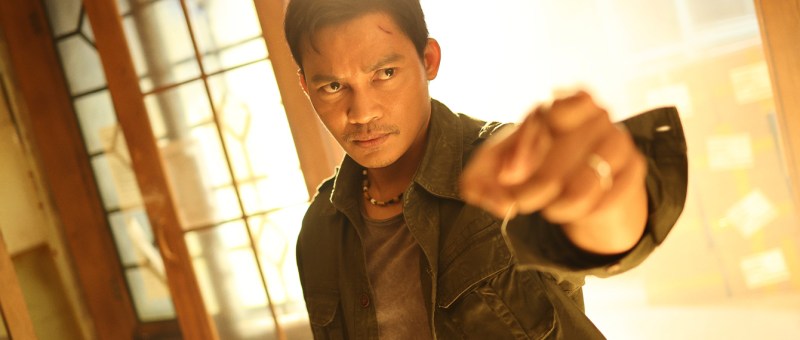
Once again set in a fictional South Eastern Asian nation largely inhabited by Mandarin speakers, Cheng Siyi’s action drama Striking Rescue (惊天大营救, jīng tiāndà yíngjiù) is a comeback vehicle for action star Tony Jaa who has mostly been relegated to cameos and supporting roles for the last decade or so. It’s also one of a string of recent films with a bee in its bonnet about the drugs trade, and a less obvious one about the powers of large corporations though in this case the fat cat turns out to be a good guy.

To begin with, we can’t be so sure about Bai An. A flashback reveals that his wife and daughter were just murdered in an apparent gangland killing, and now he wants revenge. After targeting a petty drug dealer, Bai An is told the man he’s looking for is He Yinghao (Philip Keung), the CEO of a phenomenally successful logistics business which has nevertheless been implicated for the smuggling of drugs. Something like this happened once before, but Yinghao is well connected and was able to make it go away just as he apparently has this time. Later he also reveals that his company is the only one that is exempt from customs checks, presumably because he’s bribed someone to make that happen.

We can’t really be sure about Yinghao, either. He doesn’t seem to know about the drugs but could be bluffing or attempting to shift the blame. His spiky teenage daughter Ting seemingly resents him for his authoritarian parenting and blames him for her mother’s death. She fires back at him that he behaves as if all problems can be solved with money, and she may have a point. After their convoy is attacked by drug gangs, Ting has no idea who to trust but continues to believe in her father’s innocence while unexpectedly teaming up with Bai, who wants to kill him, and trying to figure out what’s going on. The one thing she’s sure of is that she and her father really hate drugs because they caused her mother’s death, so if it really is him behind the local drugs trade then it’s even worse that she thought it would be. 

As the truth is gradually revealed, it allows both men to reclaim their paternity as Jaa becomes a kind of surrogate father to Ting. He attempts to protect her from this very dangerous world of drug dealers and criminals, though it may not have been all that far from the otherwise life of luxury she was used to leading. Her driver, Wu, had already taught her some martial arts skills for protection while she’s bullied by the thuggish boys at school who pick on her for being Yinghao’s daughter and a foreigner. But it’s Bai An who seemingly shows her what real fatherhood is like, which ironically causes her to reevaluate her relationship with Yinghao. He in turn is somewhat redeemed by his righteousness in the face of the gangsters as opposed to a snivelling new reporter picked up by Clay and forced to choose which son to kill before being killed himself.

Making Yinghao the hero may be a slightly awkward fit given that his business interests do not appear to be all above board which is one reason why he relocated here rather than stay in China where, the implication is, he wouldn’t have gotten away with it for so long. Indeed, the film ends with a series of title cards explaining that all of the wrongdoers, including Bai, were caught and punished. Nevertheless, as Bai later reminds us, it’s every man’s dream to be a hero to his daughter and both men have now a claim on “heroism”, at least in the eyes of the idealistic Ting. Though he could not save his own daughter, Bai steps in to protect Ting on several occasions. Fighting off hordes of thugs and one very weird female assassin, Jaa gets the opportunity to show off his martial arts skills once again while relentlessly pursuing his revenge and quest for answers about the death of his wife and child. But it’s also this defence of her that allows him to reconnect with his humanity and reclaim his image of himself as a father even while mired in his grief and anger towards a world full of corruption and betrayal.


Striking Rescue is available digitally in the US from April and on blu-ray from May 15 courtesy of Well Go USA.

US release trailer (English subtitles)

Detective Chinatown 3 (唐人街探案3, Chen Sicheng, 2021)

Cerebral sleuth Qin Feng (Liu Haoran) and his larger than life uncle Tang Ren (Wang Baoqiang) are back on the case in the third instalment in the Detective Chinatown franchise (唐人街探案3, Tángrénjiē tàn àn 3) picking up as promised in Tokyo as the duo take on another locked room mystery on the invitation of dandyish local investigator Hiroshi Noda (Satoshi Tsumabuki). This time around, the mystery is only tangentially connected to a Chinatown though the solution in itself does indeed lead back towards the Mainland and the complicated relations between China and Japan, while Qin in particular finds himself confronting the idea that oligarchy is in fact the “perfect crime”. 

Hired by a yakuza boss, Watanabe (Tomokazu Miura), accused of offing a Thai rival, Su Chaiwit, following a dispute over development rights in the local Chinatown, Qin and Tang Ren quickly find themselves hamstrung by their own discovery of evidence which further implicates their client and brings them to the attention of top cop Tanaka (Tadanobu Asano) who wastes no time telling them to mind their own business. Meanwhile they are also being pursued by muscly Thai detective Jaa (Tony Jaa) working for the other side. In a new high tech motif, the guys are each handed a simultaneous translation earbud which allows the Japanese and Chinese guys to converse with each other in their own languages though Hiroshi often chooses to speak directly in Mandarin instead while the Thai contingent exclusively use English. Unlike previous instalments the duo do not venture into the local Chinese community and Chinatown itself is merely territory contested by Japanese yakuza and South East Asian gangsters. 

Even so Qin and Tang Ren find themselves at a nexus of cross-cultural conflict caught between the cops, yakuza, and Thai gangsters each looking not so much for the truth but some kind of advantage for their side all of which culminates in a hilarious series of mixups at a morgue. Once again, Tang Ren falls in love with a local woman, in this case Su Chaiwit’s secretary Anna Kobayashi (Masami Nagasawa) who is certain Watanabe is guilty and later apparently kidnapped by a crazed serial killer (Shota Sometani) just by coincidence. Of course, all this cycles back towards the franchise’s growing mythology, Qin pursued and manipulated by the mysterious entity known only as “Q” which, as we learn, is as obsessed with the idea of the perfect crime as Qin largely in that they think they’ve perfected it in the stranglehold placed over civilisation by a shady elite. 

In this, the film may be taking aim at hidden oligarchy and the immorality of growing social inequality, but in its Japanese setting Chen is also freer to take potshots at contemporary Chinese society such as in Tang Ren’s confusion that they can’t simply bribe the police to get Qin out of jail when he is wrongfully arrested. “Justice and equality require sacrifices” Qin explains after solving a grim riddle only to be asked some difficult questions about the nature of justice and his own role within it by a manipulative villain, but in a classically censor-friendly move ends the movie with a brief monologue declaring that “justice always prevails and light overcomes darkness”, he and his team recommitting themselves to fighting “vices”, and presumably the shady elitism fostered by Q, wherever they arise. 

Like Detective Chinatown 2’s New York setting, the vision of Japan on display is deliberately stereotypical from an Akihabara cosplay carnival to tasks involving masked kendo fighters and a sumo wrestler, not to mention bumbling comedy yakuza forever threatening to cut off their fingers, the Shibuya Scramble set piece, or a playful homage to Phoenix Wright: Ace Attorney. Meanwhile, Chen continues his taste for huge ensemble action such as the complex slapstick routine that opens the film and now traditional end credits sequence featuring the cast dancing to theme tune “Welcome to Tokyo” dressed in the classic green detective mac worn by Qin. Truth be told, the solution to the central mystery is heavily signposted and slightly unsatisfying though Chen’s visualisations of Qin’s deductions are expertly rendered even as the hero’s growing confidence as a crimefighter unbalances his relationship with the increasingly silly if goodhearted Tang Ren. Boasting a host of A-list Japanese acting talent, the film also makes space for an unexpected cameo from one of the most recognisable faces in Sinophone cinema before teasing a further instalment to take place in London, home to the greatest consulting detective of them all. 


Detective Chinatown 3 is available to stream in the UK via iTunes, Google Play, Amazon Prime, Microsoft, Sky, and Virgin Media courtesy of Cine Asia.

Original trailer (English / Simplified Chinese subtitles)

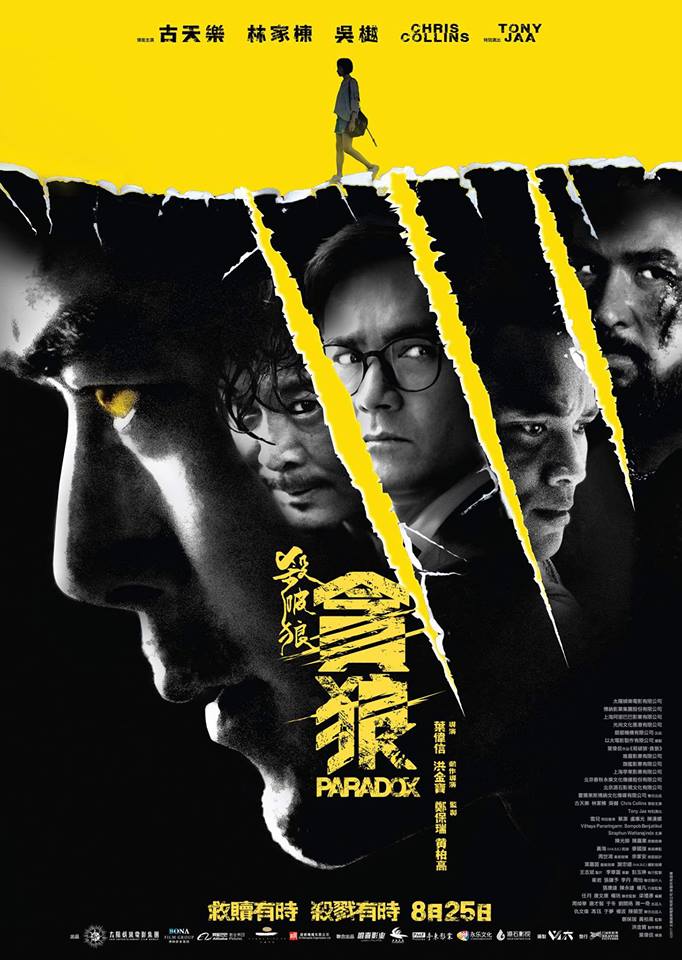
Paradox (殺破狼・貪狼, Wilson Yip, 2017)

paradox posterLouis Koo, possibly the hardest working actor in Hong Kong, has played his fair share of heroic (and not so heroic) cops but you’d be hard pushed to describe him as an action star. Proving nothing if not his dedication, Koo gives it his all as the lead in Paradox (殺破狼・貪狼), the latest in the SPL franchise directed by Ip Man’s Wilson Yip. Yip also directed the first in the series but stepped away for the second, though there is no narrative continuity with any of the films and, confusingly enough, the SPL tag seems to have been dropped from the international title altogether. In any case, what Paradox shares with instalments one and two is a series of intensely kinetic action scenes built around a storm of three incompatible personality types coupled with a quest narrative as Koo searches for clues in the disappearance of his 16 year old daughter.

Yip begins the film inside the memories of Hong Kong cop Lee Chung-Chi (Louis Koo) as he remembers the golden time when his daughter was young and worshipped her dad, crawling into his bed in the morning with a video camera ready for a whole day of birthday fun. Lee buys a cute a silver bracelet with a teddy bear charm but it’s the 16 year old Wing-Chi (Hanna Chan) he gives it to. Lee and his daughter are in a restaurant, not at home, and the air between them is tense. A boy turns up and Wing-Chi introduces him as her boyfriend but if Lee is annoyed things are about to get worse. The pair want to get married because Wing-Chi wants “to keep the baby”. Lee barely reacts save for abruptly stepping away from the table. When he returns he seems as if he’s composed himself, but in reality he has already made a catastrophic error of judgement which will force his daughter away from him.

Wing-Chi goes to Thailand to visit a friend and disappears. Lee goes to look for her, breaking out his best investigator skills and teaming up with local cop Chui Kit (Wu Yue) who is soon to be a father himself, but what he finds there leads him onto a dark path of paternal guilt, regret, and suffering whilst wading through the corruption and cruelty of the Thai underworld.

Though the narrative is, in a sense, unimportant, Yip homes in on the nature of fatherhood and the sometimes difficult or conflicted position a father finds himself in when trying to protect his child. Lee may think he’s “doing the right thing” when he clamps down on his teenage daughter’s plans to start a family of her own way ahead of schedule, but then again perhaps this was not his decision to make and ruining three lives to suit himself is nothing more than selfishness masquerading as love. It is his own actions which send his daughter into the path of danger, and then later decide her fate on a split second decision.

Later, Kit’s father-in-law (Vithaya Pansringarm) faces a similar dilemma when he’s threatened by government big wigs and fears his own daughter (and unborn grandchild) may be in danger if he does not play along. Lee’s quest to find Wing-Chi runs in parallel with that of the local mayor to win re-election, only the mayor has a bad heart which causes him to collapse before an important rally. Shady fixer Cheng (Gordon Lam) decides the mayor needs a heart transplant (seemingly unaware of the complexity of the operation and the time needed for recovery) which all links back to a dodgy American ex-pat (Chris Collins) who operates a large scale meat factory as a front for illegal organ trafficking.

The stories of Kit and Lee are linked by the curious use of the classic Chinese pop song The Moon Represents My Heart made famous by Teresa Teng. The song with its constant references to the “heart” which is also visually represented by the cheerful cards around the mayor’s bed perhaps over does things in the metaphor stakes but does its best to tug at the heartstrings in its insistence on a fathomless love in this case of fathers for their children. Koo’s rage only intensifies the more desperate he becomes as his quest hits continual dead ends punctuated by the discovery of various unpleasant characters lurking not just in the backstreets but in the police stations and political institutions of Pattaya.

The action scenes are visceral and kinetic though Koo makes the most impact when acting with stone cold efficiency, leaving the most memorable sequences to rising star Wu and Tony Jaa whose extremely brief appearance as a psychic / extremely buddhist cop may disappoint those deceived by his top billing into expecting his role to be more than a cameo. Nevertheless, Paradox delivers what it promised in Koo’s unexpected metamorphosis into an ultra cool action star whilst sending his moody cop on a dark journey of the soul as he confronts the depths of his own complicity in the corruption which is consuming him.


Screened as the opening film of Creative Visions: Hong Kong Cinema 1997 – 2017

Original trailer (English subtitles)

Co-stars Louis Koo and Wu Yue recorded a new version of The Moon Represents My Heart especially for the film

Teresa Teng’s The Moon Represents My Heart