 Hibari Misora was one of the leading lights of the post-war entertainment world. Largely active as a chart topping ballad singer, she also made frequent forays into the movies notably starring with fellow musical stars Izumi Yukimura and Chiemi Eri in the Sannin Musume series. This solo effort from 1955 is directed by the Sannin Musume director Toshio Sugie and follows a similar approach with the 18 year old Hibari starring as a teenage girl who looks really like Hibari Misora (but unfortunately cannot sing).
Hibari is playing a teenager here but she’s left school and is working as a bus conductoress. Bright and cheerful in her work, she takes some ribbing from the other employees because of her resemblance to the singing star (she has a large beauty mark drawn on her right cheek to make sure we know she’s not the “real” Hibari) and is a little embarrassed when they ask her to sing something because unlike her doppelganger, she’s tone deaf. Hibari lives at home with her mother and younger brother who’s still in school but their father seems to have left the household and there’s a degree of discord between the couple. Hibari tries to get her parents back together so they can live as a family whilst also maintaining her bus job, beginning a tentative romance with a former passenger, and even getting a few singing lessons from the real Hibari Misora herself!
Unlike the Sannin Musume movies, Harikiri Musume is shot in regular black and white though has pretty good production values for the time with some location shooting and outdoor scenes. Hibari is only 18 here but she’s already working at the bus company which seems like a pretty good gig all things considered (though her money is going to pay for her brother’s school fees, such is life). Her biggest problems are her no good father and her singing star doppleganger which continues to cause her embarrassment.
Harikiri Musume is a pop star vehicle but oddly Hibari doesn’t get to perform that much. Early on she laments not being able to sing as she listens to one of her bus company colleagues singing the song Rendezvous (also featured in one of the Sannin Musume movies) which is then followed by a more operatic track from a male colleague (of course, these two end up becoming a couple, united in their musical talents). She watches “herself” on TV and later mimes to a recording of the famous Hibari at home but the main subplot of the film takes hold once the two Hibaris meet in a neat cinematic doubling trick. Famous Hibari teaches ordinary Hibari how to sing properly using Misora’s famous song Ringo Oiwake. She then turns up in the finale at the wedding celebration of two employees with a new song just for the bus company as a special gift.
As well as Rendezvous, there are even a few callbacks to Jankenbon which also appears in So Young, So Bright which was released the same year. Hibari is mostly acting with herself here and it’s altogether a more modest affair than the Sannin Musume pictures with no real production numbers or complicated staging but somehow all the more charming for it. In keeping with other similarly themed movies, Hibari has the disrupted family subplot and a very slight romance which never really gets started until near the end but the film cleverly avoids any kind of heaviness in favour of a light and breezy youthful tone. First rate fluff, but nevertheless an interesting look at the “ordinary” people of movie land in the mid fifties and an entertaining musical comedy in its own right.
No trailer but here’s a clip of Hibari Misora singing Ringo no Oiwake almost 25 years later:
 Hibari, Chiemi and Izumi reunite in 1964 for another tale of musical comedy and romantic turmoil in Sannin Yoreba (三人よれば). Beginning as teenagers in
 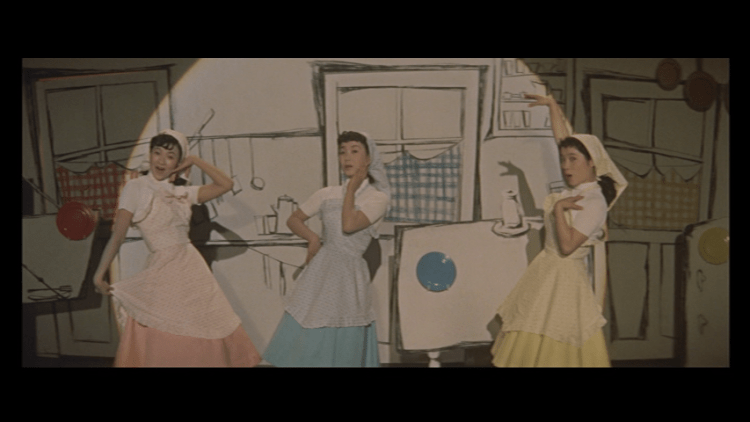 The Sannin Musume girls are growing up by the time we reach 1957’s On Wings of Love (大当り三色娘, Ooatari Sanshoku Musume). In fact, they each turned 20 this year (which is the age you legally become an adult in Japan), so it’s out with the school girl stuff and in with more grown up concerns, or more specifically marriage. Wings of Love is the third film to star the three Japanese singing stars Hibari Misora, Chiemi Eri, and Izumi Yukimura who come together to form the early idol combo supergroup Sannin Musume. Once again modelled on the classic Hollywood musical, On Wings of Love is the very first Tohoscope film giving the girls even more screen to fill with their by now familiar cute and colourful antics.
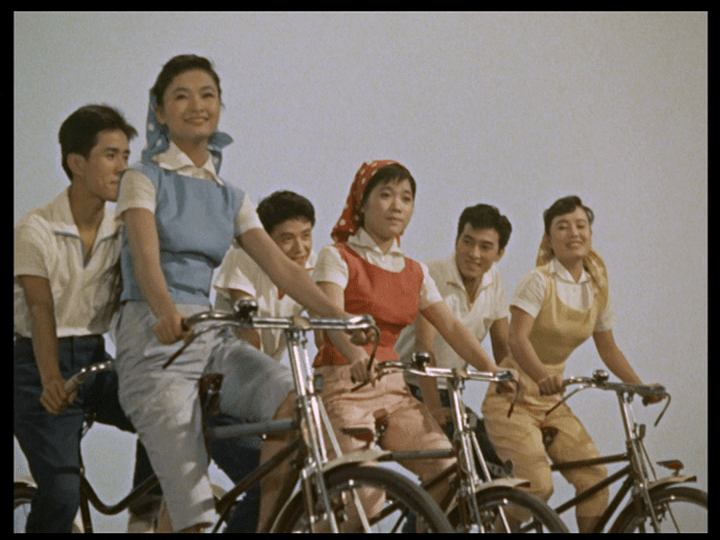 Romantic Daughters (ロマンス娘, Romance Musume) is the second big screen outing for the singing star combo known as “sannin musume”. A year on from
 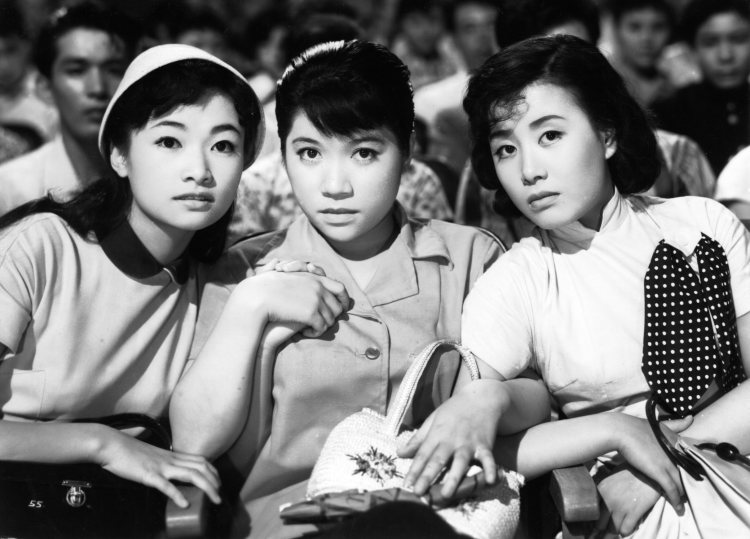 Pop stars invading the cinematic realm either for reasons of commerce, vanity, or just simple ambition is hardly a new phenomenon and even continues today with the biggest singers of the era getting to play their own track over the closing credits of the latest tentpole feature. This is even more popular in Japan where idol culture dominates the entertainment world and boy bands boys are often top of the list for any going blockbuster (wisely or otherwise). Cycling back to 1955 when the phenomenon was at its heyday all over the world, So Young, So Bright (ジャンケン娘, Janken Musume) is the first of four so called “three girl” (Sannin Musume) musicals which united the three biggest female singers of the post-war era: Hibari Misora, Chiemi Eri, and Izumi Yukimura for a music infused comedy caper.
 Windows on Worlds