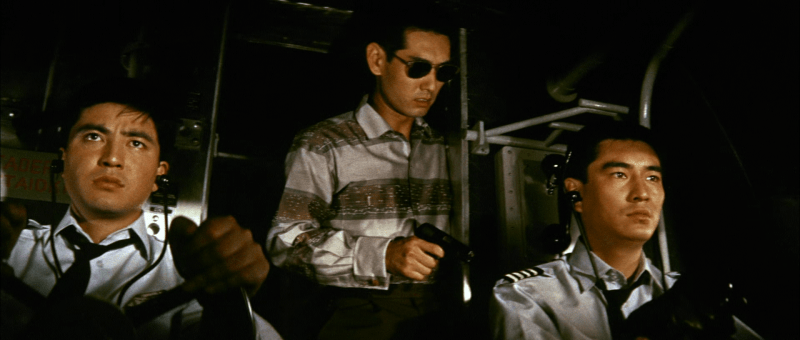
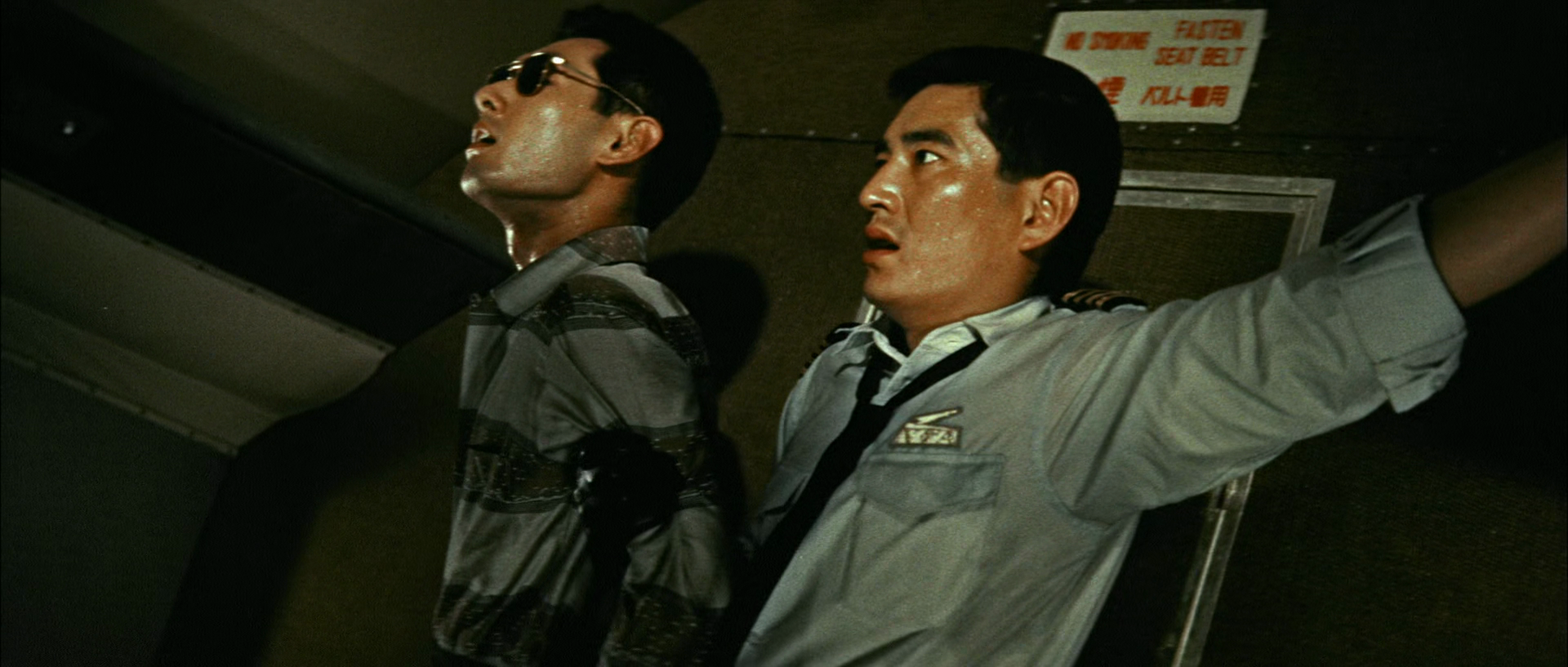
Four Hours of Terror (高度7000米 恐怖の四時間, Tsuneo Kobayashi, 1959)

It seems quite strange now to think of a time when air travel was both new and exciting and as easy as catching a bus. It’s this juxtaposition that Tsuneo Kobayashi’s hijacking thriller Four Hours of Terror (高度7000米 恐怖の四時間, Kodo Nanasen Metoru: Kyofu no Yojikan) plays with as an armed fugitive takes a passenger plane hostage in an attempt to escape after committing a murder while those on board struggle to accommodate themselves to this new form of transportation. 

This sense of exoticisation is obvious from the opening voiceover which sings the praises of Haneda airport as the gateway to a newly internationalised Japan though in actuality the flight in question is a domestic service travelling from Tokyo to Sapporo. The voiceover also introduces us to each of the passengers which come from differing strata of society and even includes a middle-aged American couple. There are in fact three generations of couples on board who seem to represent different stages of life from the newly wed students so wrapped up marital bliss that they barely notice anything else, to a long-married reporter and his wife on their first holiday together since their honeymoon, and an elderly couple returning from a trip to the capital who are mystified by this new age of mass media and air travel. The newlyweds apparently won this free trip on an aeroplane after agreeing to have their wedding broadcast on television in an early example of reality TV, reinforcing the sense of irony that they weren’t necessarily supposed to be on this doomed flight after all. 

Neither was car saleswoman Kazuko (Hitomi Nakahara) who has apparently been pulled away to Sapporo by a short notice business opportunity. She gets a standby ticket, as does her boyfriend/rival Fujio (Tatsuo Umemiya) who is also on track to the same opportunity. Weirdly, Kazuko is not overly sympathetic having randomly kicked a basket containing a little dog about to be smuggled on the plane by its doting owner, but does perhaps represent something of a more independent post-war womanhood even as she effortlessly deflects unwanted attentions from a client she may also have been exploiting in order to obtain his business. Having boarded the plane, she ends up sitting next to another man who requested a standby ticket and was using a surname that was the same as hers but evidently turns out to have been assumed. So lax is the security, you don’t necessarily have to travel under your legal name. In any case, she briefly flirts with him as an overture to a business relationship and also to annoy Fujio before overhearing a news report about the escaped fugitive on her portable radio.

Kida (Fumitake Omura), the fugitive, is dressed like a stereotypical yakuza which makes it odd that no one treats him with suspicion until they spot he’s carrying a gun which he had no trouble at all bringing on board. Though hijackings are not exactly unheard of, they aren’t particularly common either so no one would really suppose anyone had any reason to take a domestic flight to the provinces hostage, and really that was never Kida’s intention merely a last resort after being discovered. Later he gives a partial justification for his life of crime in that his mother beat him and then threw him off a cliff which is why he has a false leg. In any case, there’s a small moment of potential redemption towards the end when the kindly old lady tells him he can’t undo what he’s done, but could still resolve to change assuming they all survive this difficult situation with the plane which now has mechanical problems thanks to the gun going off. 

Even so, it’s the passengers who tie Kida up after the pilot ,Yamamoto (Ken Takakura), manages to disarm him by weaponising the plane. By flying to a high altitude, they knock him out with the air pressure, but are then faced with the mechanical failure of the landing gear which seems to be linked to with Yamamoto’s wartime trauma. A secondary drama revolves around his stoical character with one of the stewardesses apparently in love with him while simultaneously wary of his iciness given that he apparently showed no emotion after receiving the news his wife had passed away but simply flew the plane home as normal. Some see this as his devotion to the aircraft which is in a way a commitment to his duty over his human feelings, the factor that perhaps allows him to save the plane and get the passengers home safely. He is however saved by his love for his late wife with the cigarette case that contains her photo saving him from the worst effects of a bullet. 

The same may go for the co-pilot Hara (Kenji Imai) who is dragging his feet over his marriage to Yamamoto’s sister because he wants to achieve 3000 flight hours before getting married so he can call himself a real pilot. Though the film plants the seeds of these random plot threads and the social commentary that goes with them, it does not particularly engage while the hijacking itself remains fairly low key given that Kida is not a particularly “bad” bad guy. He just wants to go to a random place where the police won’t be waiting for him, but otherwise refrains from harassing the passengers save threatening a little boy travelling on his own to return to his parents after visiting his grandfather in Tokyo. In essence, there’s a kind of innocence and naivety in play which speaks to something of post-war hopefulness and a wonder in the frantic pace of progress in which the day is saved by keeping calm and carrying on even in the face of severe adversity.


Trailer (no subtitles)

Prison Boss (獄中の顔役, Yasuo Furuhata, 1968)

“Both you and I must do what a man must do and live this life to the very end” according to the melancholy theme song of Yasuo Furuhata’s fatalistic tale of gangster nobility, Prison Boss (獄中の顔役, Gokuchu no Kaoyaku). Another vehicle for tough guy star Ken Takakura, this post-war drama despite the name spends less time in a cell than one might imagine but casts its melancholy hero as a man imprisoned by the times in which he lives, too good to survive in an ignoble society and eventually brought down by his self-destructive need for retributive justice. 

As the film opens, Hayami (Ken Takakura) is goaded into a knife fight with a foot soldier from the evil Honma gang, Tetsu the Viper, and eventually kills him. Stumbling into a nearby bar, his only intention is to do the right thing and turn himself in filled with remorse as he is that he’s offed Tetsu in territory which belongs to “good” mob boss Tajima (Ichiro Ryuzaki). Tajima lives up to his name when some of his guys rescue Hayami and take him to their HQ where the old man insists that he rest and recover from his wounds. Whilst there, Hayami is cared for by Tajima’s teenage daughter Toshiko (Junko Fuji) who falls in love with him and vows to wait while he honours his word and spends seven years in jail for the killing of Tetsu. 

Meanwhile, awkward small-town politics is destabilising the precarious post-war environment as the Honma, embodiments of the new, venal and violent yakuza who care nothing for honour or humanity, are intent on squeezing Tajima’s influence mostly through muscling in on the running of the local bike races for which Tajima currently runs security. Though the Tajima gang is presented as an unambiguous good, the old style noble yakuza who live by a code and care about protecting the little guy, you can’t deny the levels of nepotistic corruption on display at the local council meetings given that the mayor and Tajima are apparently childhood friends while his rival shouts about allowing yakuza too much sway in politics while in the pay of Honma. 

Nevertheless, the central drama exists solely in the soul of Hayami who emerges from seven years in prison into this already destabilised environment owing a debt of honour to Tajima. Not quite a yakuza, he feels himself a perpetual other forever tainted by his crime having lost the right to live as other men live. Thus he struggles with discovering that Toshiko has also remained true to her word, having waited for him all this time running a small coffee bar rather than getting married. Even so, he finds himself dragged back into yakuza drama avenging the death of a Tajima man gunned down by Honma and thereby ending up back inside where he’s reunited with another childhood friend, Kurosaki (Ryo Ikebe), who’s been far less fortunate and is now affiliated with Honma.  

Kurosaki and veteran prisoner Pops (Shogo Shimada) are perhaps both mirrors of Hayami’s internal conflict, Kurosaki like him bound by a code but forced to act in ways which betray his own sense of honour and humanity and eventually paying a heavy price for doing so. Pops meanwhile as a man nearing the end of his life tries to talk him down from the road of destructive nobility, reminding him that he has a choice and ought to choose himself rather continuing to suffer for an outdated ideal. Hayami’s selflessness, his oft remarked tendency to disregard his own interest to protect others (the true mark of the noble gangster), is his weakness and fatal flaw. A yakuza’s daughter, Toshiko understands the code of manliness well enough and even she eventually tells him to run, to abandon his revenge and live free rather than becoming just another sacrifice on the altar of yakuza honour, but of course a man has to do what a man has to do. 

Though Hayami himself becomes a big man in prison, it’s Honma to whom the film’s title primarily refers hinting at the corruption involved in a society in which it is perfectly possible (and in some ways advantageous) to continue running a yakuza gang from behind bars, while the central crisis also turns on post-war desperation in betting all on controlling the lucrative bicycle races. In such a world as this, there’s precious little room for the noble gangster who must in the end damn himself if only to redeem it. 


Feisty Edo Girl Nakanori-san (ひばり民謡の旅シリーズ べらんめえ中乗りさん, Masamitsu Igayama, 1961)

Nakanori-san posterThe voice of the post-war era, Hibari Misora also had a long and phenomenally popular run as a tentpole movie star which began at the very beginning of her career and eventually totalled 166 films. Working mostly (though not exclusively) at Toei, she starred in a series of contemporary and period comedies all of which afforded her at least a small opportunity to showcase her musical talents. Directed by Masamitsu Igayama, Feisty Edo Girl Nakanori-san (ひばり民謡の旅シリーズ べらんめえ中乗りさん, Hibari Minyo no Tabi: Beranme Nakanori-san, AKA Travelsongs: Sharp-Tongued Acquaintance) once again stars Hibari Misora as a strong-willed, independent post-war woman who stands up to corruption and looks after the little guy while falling in love with regular co-star Ken Takakura. 

Nobuko (Hibari Misora) is the daughter of a formerly successful lumber merchant whose business is being threatened by an unscrupulous competitor. With her father ill in bed, Nobuko has taken over the family firm but is dismayed to find that a contract she assumed signed has been reneged on by a corrupt underling at a construction company who has been bribed by the thuggish Tajikyo (Takashi Kanda). Unlike Nobuko’s father Sado (Isao Yamagata), Tajikyo is unafraid to embrace the new, completely amoral business landscape of the post-war world and will do whatever it takes to become top dog in the small lumber-centric world of Kibo.

Tajikyo has teamed up with the similarly minded, though nowhere near as unscrupulous, Oka (Yoshi Kato) whose son Kenichi (Ken Takakura) has recently returned from America. Kenichi, having come back to Japan with with clear ideas about the importance of fair practice in business, is not happy with his father’s capitulation to Tajikyo’s bullying. Of course, it also helps that he had a charming meet cute with the spiky Nobuko and became instantly smitten so he is unlikely to be in favour of anything which damages her father’s business even if they are technically competitors.

As in the majority of her films, Misora plays the “feisty” girl of the title, a no nonsense sort of woman thoroughly fed up with the misogynistic micro aggressions she often encounters when trying to participate fully in the running of her family business. Though her father seems happy enough, even if casually reminding her that aspects of the job are more difficult for women – particularly the ones which involve literal heavy lifting and being alone with a large number of men in the middle of a forest, he too remarks on her seeming masculinity in joking that her mother made a mistake in giving birth to her as a girl. Likewise, Tajikyo’s ridiculous plan to have Nobuko marry his idiot son is laughed off not only because Tajikyo is their enemy, but because most people seem to think that Nobuko’s feistiness makes her unsuitable for marriage – something she later puts to Kenichi as their courtship begins to become more serious. Kenichi, of course, is attracted to her precisely because of these qualities even if she eventually stops to wonder if she might need to become more “feminine” in order to become his wife.

To this extent, Feisty Edo Girl is the story of its heroine’s gradual softening as she finally writes home to her father that she is happy to have been born a girl while fantasising about weddings and dreaming of Kenichi’s handsome face. Meanwhile, she also attracts the attentions of an improbable motorcycle champion who just happens to also be the son of a logging family and therefore also able to help in the grand finale even if he never becomes a credible love rival despite Nobuko’s frequent admiration for his fiery, rebellious character which more than matches her own.

Nevertheless, the central concern (aside from the romance) is a preoccupation with corruption in the wartime generation. Where Nobuko’s father Sado is “old fashioned” in that he wants to do business legitimately while keeping local traditions alive, the Tajikyos of the world are content to wield his scruples against him, destroying his business through underhanded methods running from staff poaching to bribery and violence. Kenichi’s father has gone along with Tajikoyo’s plans out of greed and weakness, irritated by his son’s moral purity on one level but also mildly horrified by what he might have gotten himself into by not standing up to Tajikyo in the beginning.

As expected, Nobuko and Kenichi eventually triumph through nothing more than a fierce determination to treat others with respect. Working together cheerfully achieves results, while the corrupt forces of Tajikyo eventually find themselves blocked by those who either cannot be bought or find the strength to refuse to be. Nobuko’s big job is finding prime lumber to be used to build a traditional pagoda in America as part of a cultural celebration. She wants to do her best not only because she takes pride in her work but because she knows this project will represent Japan overseas. Tajikyo, however, would cut corners, believing that the Americans wouldn’t notice even if he sent them rotten logs riddled with woodworm as long as the paperwork tallies. Filled with music and song, Nakanori-san is an action packed outing for Misora in which she once again succeeds in setting the world to rights while falling in love with a likeminded soul as they prepare to sail off into kinder post-war future.


Some of Hibari’s songs from the film (no subtitles):

https://www.youtube.com/watch?v=gCeE4lCTpW4