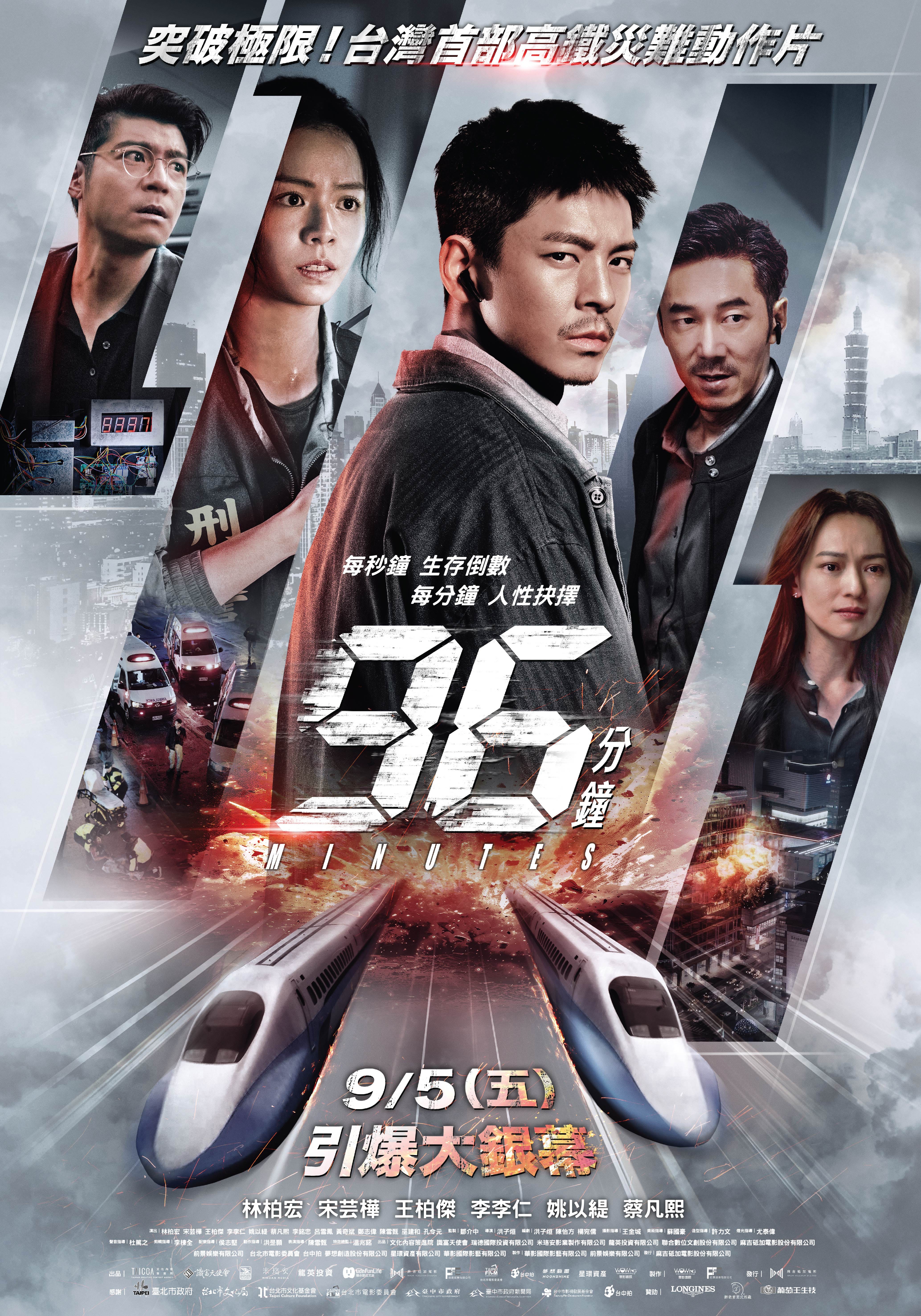
96 Minutes (96分鐘, Hung Tzu-Hsuan, 2025)

The needs of the many outweigh the needs of the few, as the famous goes. Prioritising saving lives where you can rather than risk spreading yourself too thin and not helping anyone as a result may be a sensible decision. But what if you or a loved are among those who’ve been deprioritised? Like many things, now it’s not just theory but here right in front of you and victims are real people not just anonymous numbers, it looks quite different.

At least, that’s how it is for A-Ren (Austin Lin), a brash bomb disposal expert. Though he disarmed a bomb in a cinema, another one went off across the road in a department store. The bomber had warned them that might happen, but A-Ren’s commanding officer Liu (Wang Bo-Chieh) convinced him they were probably bluffing. They were told there were two more bombs, one located in their command centre, and the other in the department store, and given a choice. Save the people in the department store by heroically blowing themselves up, or choose to save themselves even though this time they’re in the minority. 

Three years later, A-Ren has never forgiven himself, or Liu, for the bomb going off. He’s quit the police and though he’s married fellow officer Huang Xin (Vivian Sung), they never had a wedding and still haven’t been on honeymoon. His guilt is compounded by the fact that he’s been feted as a hero even though he knows he’s directly responsible for everyone who died in the department store. He gets a shot at redemption when the train he’s travelling on returning home after a memorial service for victims of the bombing receives a bomb threat, but at the same time he fears the eventual exposure of what really happened three years ago and is too ashamed to get his mind fully on the job.

On the other hand, it’s true that, ironically, no one on the train has been able to move on from the incident. All of them are mired in their grief and confusion, while looking for someone to blame. Needing to solve the case quickly, the police named a random victim with a criminal past as the bomber rather than admit they didn’t know who did it, making the police themselves a legitimate target for the resentment of the victims’ families given their cavalier attitude to life and death. Liu reminded A-Ren that the policemen in the command centre had families too, as if the people in the department store didn’t or that having a family made their lives weigh more, while Huang Xin was there too further influencing their decision and feeding into A-Ren’s guilt wondering if he was just selfish and made a choice to save her at the expense of the lives of a large number of people he didn’t know.

The bomber essentially gives him the same choice again, putting two bombs on two trains and leaving A-Ren with a binary choice of choosing to sacrifice one or the other to see if he will make the same hypocritical decision again in opting to save the minority because he is among them. Of course, they try a number of other high-risk strategies to disarm both bombs and/or evacuate passengers, but the bomber leaves them with little choice other than to accept the fact that one of the bombs has to go off. A-Ren and Liu can either blow themselves up figuratively by admitting that they chose to sacrifice the lives of the department store victims, or they can save themselves by blowing up the other train.

During a train derailment incident, Liu had cited his greater good philosophy in prioritising passengers who remained outside the tunnel rather than those trapped in the carriages inside, but he perhaps he was wrong to do so and should either have made more of an effort to help everyone or refrained from announcing his decision to let some of the victims die live on television. But then again, the victims’ families are also torn now they are directly involved with some leaning towards saving themselves rather the passengers on the other train whom they don’t after all even know. A-Ren, meanwhile, is in a race against time to restore his sense of integrity by disarming the bombs inside his mind to cure the lingering trauma of the department store bombing as the train rockets forward with only him between it and certain destruction.


96 Minutes screened as part of this year’s LEAFF.

Trailer (Traditional Chinese / English subtitles)
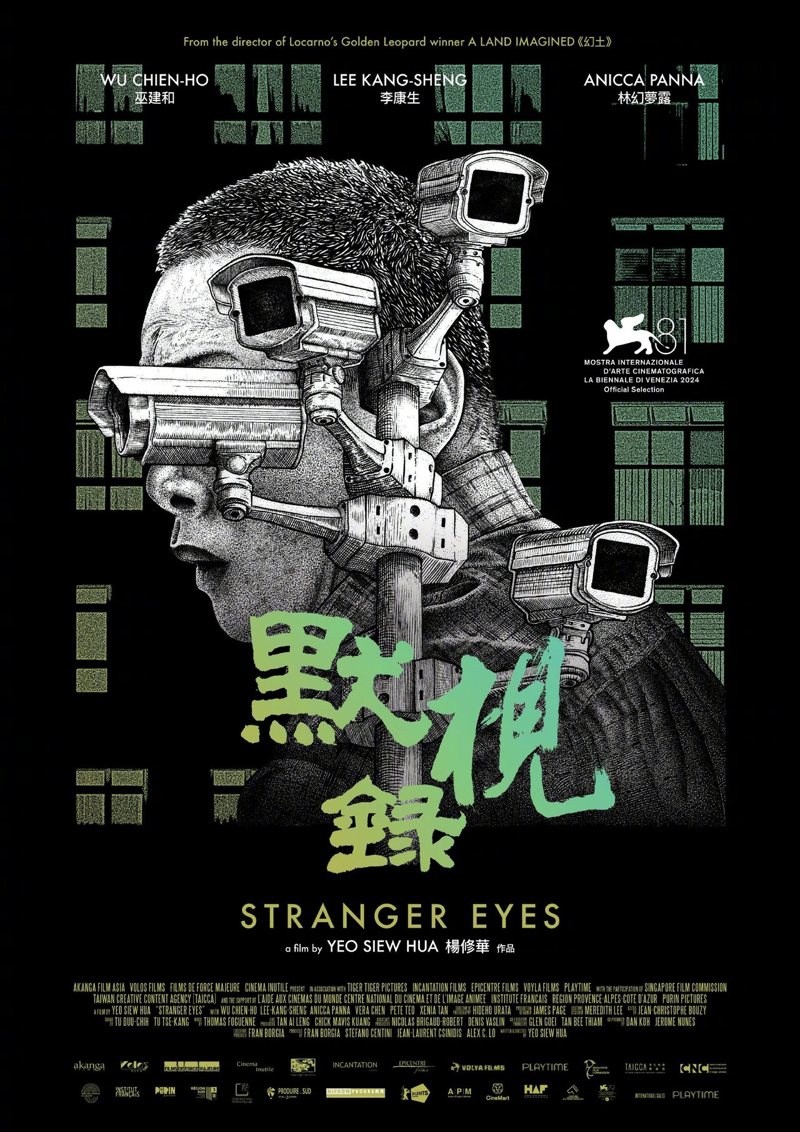
Stranger Eyes (默視錄, Yeo Siew Hua, 2024)

In some ways consciously and others not, we behave differently if we have an expectation of being observed than if we are confident we are alone. But the line between actions we think of as private and others public is often thinner than we assume and sometimes broken in moments of heightened emotion. A man sits and cries on a park bench, but he does so because he does not think anyone’s looking and feels himself alone though actually someone is watching. They often are, silently and at a distance that can itself be painful.

But then Yeo Siew Hua’s elliptical drama eventually suggests we are watched most by no stranger eyes than our own. Its “stalker”, Wu (Lee Kang-sheng), remarks that sometimes he feels as if he only watches himself an idea reinforced by the film’s continual doubling that suggests that we are in some ways caught between a series of overlapping timezones or entering a space of interactive memory. With echoes of Rear Window, the police accompany Shuping (Vera Chen), grandmother of a missing child, as she runs a pair of binoculars over the windows of her apartment block as seen from the balcony opposite while putting herself in the shoes of her observer. She stops on a young girl staring sadly from her window before beginning a strange dance that makes us wonder if Shuping is actually observing her younger self or if her own interiority simply colours what she is seeing. 

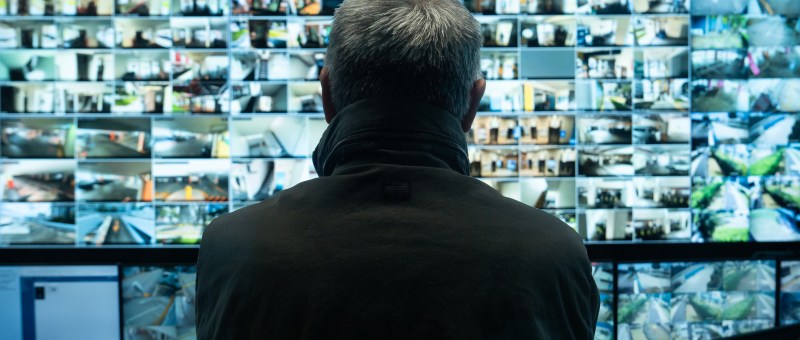
Shuping, along with her son Juyang (Wu Chien-ho) and his wife Peiying (Anicca Panna), is scanning the horizon for traces of their missing child, Little Bo, while closely examining old videos looking for signs of anything untoward. The ubiquitous presence of these cameras reminds us that we are often being observed if accidentally and the use of these images could put us at risk. Shuping wants to put a video of the family at the park online but Peiying objects, insisting Bo should have the right to decide when she’s older though the implication is that someone could have seen Bo there and been minded to take her. In any case, the irony is there’s nothing useful either in the videos or, the family initially thinks, in the vast networks of CCTV cameras that exchange our privacy for supposed safety. 

Wu relies firstly on his naked eyes, but then starts sending the family DVDs of videos he’s taken of them for unclear reasons but confronting Juyang and Peiying with the cracks in the foundations of their marriage along with the implication they are unfit parents. Juyang at one point simply walks off and leaves Bo sitting in a supermarket trolley while she cries her head off as if he were half hoping to be free of her. He in turn stalks another woman with a baby in a pushchair who turns to the side for a moment to help a man whose baby is crying, taking her eyes off her daughter long enough for Juyang to pick her up without her noticing. He could have easily have walked off with her, though you could hardly criticise this woman for simply having a chat with her daughter sitting just off to the side technically but perhaps not emotionally out of sight. Peiying meanwhile frets that Bo has been taken from her by some cosmic force because she didn’t love her enough and had considered an abortion before she was born again hinting at the fragility of the relationship between the parents who rarely occupy the same space and seem to live very parallel lives. 

Ironically Peiying feels as if it is only Wu who has truly seen her for everything she is rather than solely as a mother or the persona she adopts as a live-streaming DJ. She says she feels as if Juyang only sees her as air, as if he looks right through her while he looks at other women and seems to feel trapped by domesticity or perhaps by Shuping whose obsessive love for Bo and occasionally overbearing grandmothering seems to annoy both parents in overstepping their boundaries. We observe them just as Wu does, making our judgements in our silence though in this case confident they do not see us and that we are not ourselves currently being observed. But this confidence may also be painful to an observer such as Wu who wants to penetrate the screen while also interacting with his own sense of regret and is unable to make himself visible or express what he feels outside outside of the ghostly act of observation. The watchful soul observes itself as reflected in others who exist only in a world lost to them.


Stranger Eyes screened as part of this year’s BFI London Film Festival

Original trailer (English subtitles)

Born to be Human (生而為人, Lily Ni, 2021)

Taiwan is often regarded as among the more liberal of Asian nations, but it is certainly not free of outdated ideas of gender and sexuality as Lily Ni’s powerful sci-fi-inflected drama Born to Be Human (生而為人, Shēng ér Wèirén) makes clear. Like the similarly themed Metamorphosis from the Philippines which also made much of butterfly imagery, Born to Be Human finds a teenager’s ordinary existence upended by the sudden discovery that they are intersex along with the realisation that they have almost no agency over their medical decisions, but is ultimately more concerned with undermining the fallacy of the gender binary along with the sometimes duplicitous actions of the medical profession than with exploring the intersex identity. 

Unpopular at school 14-year-old Shi-nan (Lily Lee) is a regular teenage boy who secretly buys porn mags from the old man on the corner and enjoys playing online video games. Still embarrassed about his body, he is deeply worried on noticing blood in his urine after experiencing painful stomach cramps and half-convinces himself he has bladder cancer while too anxious to tell his parents or seek medical help. When his parents eventually find out they take him straight to the hospital but are fobbed off by an overworked doctor who diagnoses him with a urinary tract infection caused by an infected foreskin, something which they assume can be fixed by circumcision. Returning to school after some time off to recover, however, the problem recurs with Shi-nan collapsing during a sports lesson his shorts stained with blood. A more comprehensive medical exam reveals that Shi-nan is in fact intersex and has a functioning womb directly connected to external male genitalia. 

This unfortunately brings Shi-nan into the orbit of Dr. Lee (Yin Jau-Der), apparently a specialist in urology with an improbably futuristic office, who immediately latches on to Shi-nan’s case as a means of advancing his own career. He recommends to Shi-nan’s parents that they “correct” his physical body according to his chromosomal makeup, explaining that he may be at increased risk of cancer maintaining both sets of sex characteristics. On discovering the analysis has come back female, Shi-nan’s father’s first question is how he can carry on the family name if his son is now a daughter while his mother and the doctor fixate on Shi-nan’s viable womb and the all important ability to procreate. Feeling he will not understand, the parents decide not to share his medical diagnosis with Shi-nan even while he continues to believe that he is dying from bladder cancer, telling him only that he will undergo circumcision signing the consent forms for his gender confirmation surgery without ever consulting him. 

Already 14 years old and having lived all his life as a boy, this forced gender transition provokes a secondary sense of dysphoria as Shi-nan becomes Shi-lan and moves to the capital to attend an elite school presumably offered some kind of financial incentive from Dr. Lee who continues to monitor her progress. Removed from her previous environment, Shi-lan is plunged into hyper femininity as if the entirety of her previous personality had been erased. On her birthday she is given a pink cake with frills and a selection of dolls, while her bedroom is similarly pink and frilly, apparently part of Dr. Lee’s treatment programme to acclimatise Shi-lan to her new identity. Even her mother laments that she’s behind on her feminine education, unable to cook or do chores which she fears will interfere with her ability to get married. Shi-lan says she doesn’t intend to marry, but her refusal is met only with confusion as if a woman’s entire purpose lies in marriage and childbirth. Of course, the secondary issue is that Shi-lan is sexually attracted to women, upset and embarrassed to receive a love letter from a boy at school while pining for her sympathetic deskmate who later becomes her first friend. 

Meanwhile, she is forced to adopt a female personality more or less against her will, later explaining an old photo of herself as one of a younger brother who has unfortunately passed away but will remain always in her heart. Having been bullied at her last school, Shi-lan fears discovery but is subject to a secondary prejudice after a nosy girl goes through her bag and finds a bottle of pills she identifies as being for the treatment of depression later getting her parents to complain to the school that they shouldn’t be forced to share a class with a “mental patient”. 

In fact, Shi-lan has been lied to again, the pills aren’t for depression and she is in fact being tricked to take them against her will as part of her forced transition. She describes herself as a “monster”, neither male nor female, and is acutely compelled to feel that those are her only two options. Her new friend, Tian Qi (Bonnie Liang Ru-Xuan), takes her to a Taiwanese opera performance starring her mother in which a female scholar poses as a man in order to get her education only to fall for a classmate making it clear that an idea of gender fluidity has cultural currency yet Shi-lan has been denied the right to define her own identity, told that what she is is wrong or incomplete, and ultimately reduced to a subject for experimentation by an unethical doctor. Confronting him to be told he has turned her into a “normal person”, she later insists that she can ruin his work just as he has ruined her life, walking through a market witnessing flesh being butchered and fish gutted, before buying a bouquet of sunflowers echoing those on the doctor’s jigsaw puzzle. Whatever her intentions, Shi-lan perhaps comes into herself even if with a dark purpose in mind, actively claiming an identity that is defiantly her own in rebellion against a conservative society that refuses to accept her for all that she is.


Born to be Human screened as part of the 2021 Osaka Asian Film Festival

Original trailer (dialogue free)


The Silent Forest (無聲, Ko Chen-Nien, 2020)

There can be no justice in silence, but when those in a position to help refuse to listen what can be done? Inspired by true events, Ko Chen-Nien’s The Silent Forest (無聲, Wúshēng) takes aim at cycles of abuse and systems of oppression in society at large through a thorough investigation of the culture of silence at a school for deaf children in which endemic bullying spreads like a virus emanating from a single trauma inflicted by a negligent authority. Yet this kind of violence cannot be fought with violence and there must be empathy too for the bully or the chain will never end as Ko’s ambivalent conclusion makes clear. 

The film opens with a boy on the run, finally chasing down an old man and tackling him to the ground pummelling him until the police turn up and separate them. The policemen are frustrated. This is apparently the first time they’ve ever come into contact with a deaf person and have no idea how to communicate with him. Chang Cheng (Troy Liu Tzu-Chuan) tries to protest their injustice, but they continue to treat him as aggressor rather than victim even as he explains in writing that the old man had stolen his wallet (the old man claims he “found” it and was planning to hand it in). Finally a teacher from his new school, Mr. Wang (Liu Kuan-ting), turns up and interprets but it quickly becomes clear that he too is in a sense complicit, reporting that Cheng is sorry for what he did and grateful to the officers. In his view at least, the boy has his wallet back and there’s no harm done so why make a fuss? Just let it go and everyone goes home.

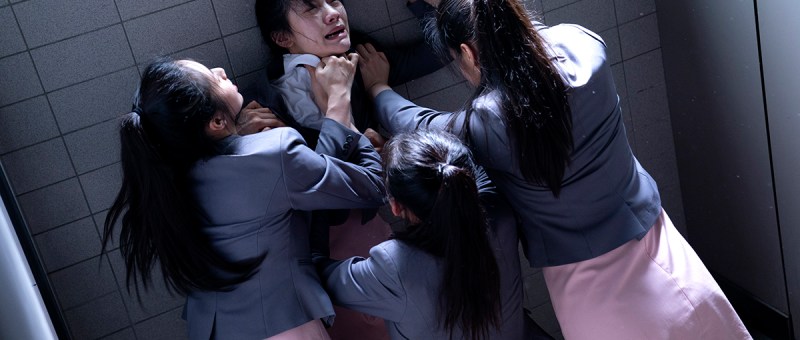
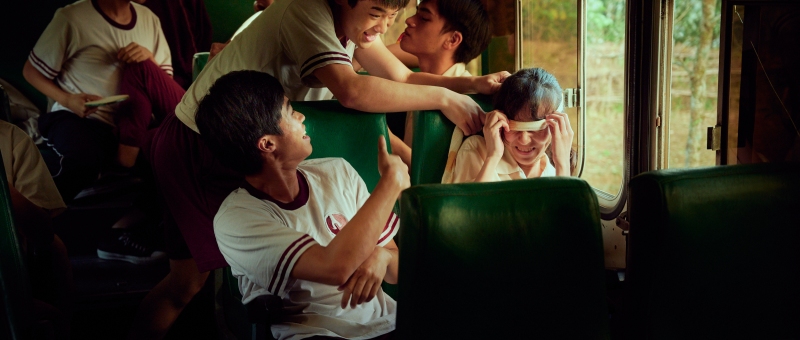
It’s this conflict between “silence” and justice that continues to prey upon Cheng’s mind after he starts at the school and becomes aware of the widespread culture of bullying witnessing a girl he likes being sexually abused by a gang of boys at the back of the school bus while the teacher sitting at the front does nothing. He tries to convince the girl, Beibei (Buffy Chen Yan-Fei), to tell one of the other teachers but she refuses, not wanting to “betray” her “friends”, insisting they were “just playing around”. Her reluctance however mainly stems from an intense fear of being sent away, that she might have to leave the school which is the only place she feels accepted. Both she and Cheng feel intensely othered in the hearing world, wary of being blamed for things that weren’t their fault as if their very existence were bothersome or “abnormal”. Even if it means putting up with extreme degradation, she would prefer it to the loneliness she felt before she found the school.

Yet the sense of social isolation is only one of the various oppressions to be found at the institution which ironically cultivates a culture of silence as regards the ongoing abuse as a means of preserving its reputation and therefore the “greater good” in providing the “safe space” from the social stigma the children face in the hearing world. Beibei points out that she was screaming, yet nobody could hear her. At first she tried to tell a teacher, but the teacher blamed it on her and implicitly on her disability insisting that the boys were “good kids” who were “just playing around” and didn’t understand she didn’t like it because she failed to communicate that she was uncomfortable. If they knew she was suffering they’d have stopped, the teacher insists before coldly walking away. Mr. Wang feels quite differently and wants to help but discovers that the culture of silence extends much deeper than he thought and the problem most likely cannot be solved through a few simple countermeasures but requires whole-scale systemic reform.

In fact, very little is done by the authorities leaving Chang Cheng with a hero complex believing that he has to be strong to beat the bad guys and save Beibei, but his righteous desire still leads him back towards complicity in order to protect her. The arch antagonist, Xiao Guang (Kim Hyun-Bin), bullies as a defence mechanism insisting that no one would dare bully him, manipulating others to do his bidding through the same mentality that one can either be a bully or a victim. Yet Xiao Guang is also a victim himself, a wounded damaged boy let down by a culture ruled by shame and unable to defend himself by any other means though apparently uniquely vulnerable to one particular aggressor. Only by addressing the root of his trauma can the cycle be brought to an end, but the concurrent cycles which he set in motion will in turn require their own resolution. A painful allegory, The Silent Forest boldly makes the case for speaking out but also admits that it doesn’t matter how loud you shout if no one is listening and without the desire for empathy and communication in all its forms the cycles will grow and repeat until the end of time.


The Silent Forest streams in Illinois until March 21 as part of the 12th season of Asian Pop-Up Cinema.

Original trailer (English subtitles)