That Guy and I (あいつと私, Ko Nakahira, 1961)

Likely intended as a slightly silly student rom-com, Ko Nakahira’s That Guy and I (あいつと私, Aitsu to Watashi) captures a sense of the changing gender roles and sexual mores of the early 1960s, if through a very male and at times even middle-aged lens. Adapted from a serialised novel by Yojiro Ishizaka and set amid the ANPO protests of 1960, the film is narrated by its heroine, a very ordinary young woman from a typical, moderately wealthy middle-class family, as she struggles with her attraction to a fabulously wealthy young man who pretends to be a boor but is actually a nice guy and unexpected feminist.

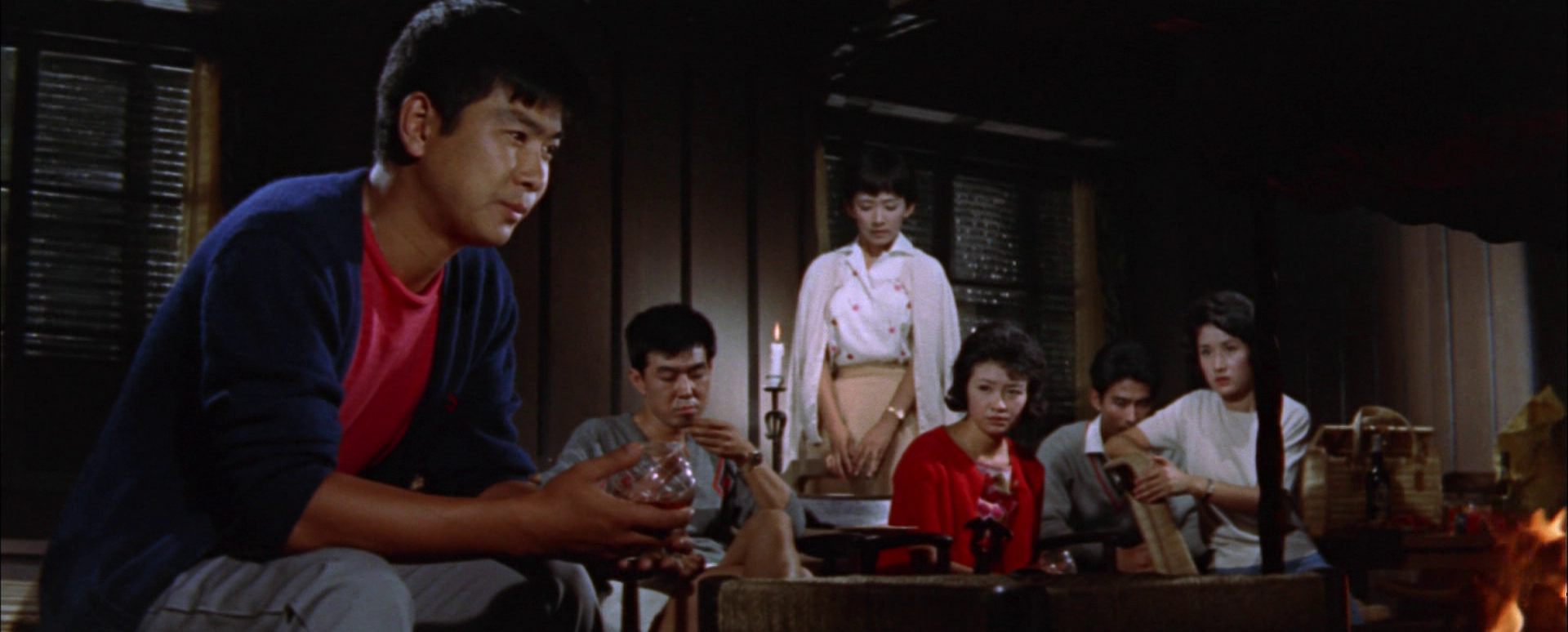
One of a new generation of women attending university with a prospect of independence, Keiko’s (Izumi Ashikawa) horizons seem to be broadening. She’s not exactly conservative and openly jokes about sex and dating with her friends, but is quite settled with her life, not particularly wanting anything more than she already has. Her psychology tutor highlights the problem of social inequality in their school that she had already raised in her opening voiceover in remarking that the rich kids all have cars and can drive themselves to school, while others are having to work to support themselves while they study. When he asks how much pocket money they all get, some are outraged and keen to stress they don’t get any help at all, but Keiko reveals that her parents actually give her a healthy allowance. It’s just that she has no real urge to spend it, so it’s been mounting up quietly in a desk drawer in her childhood bedroom while she still lives at home close to the university.

Saburo (Yujiro Ishihara), by contrast, boasts that he gets more than some people’s monthly wage as an allowance from his mother and blows it on drink, gambling, strip clubs and sex workers. It’s this last point that scandalises the female students who are all shocked and disapproving, even going so far as to ask the teacher to throw Saburo out because they don’t feel comfortable sharing a space with a man like that. The teacher also says he’s disappointed and wishes Saburo hadn’t added the last bit, only for Saburo to call him a hypocrite because sex work was legal in his day and he simply doesn’t believe that he’s never paid for sex. Most of the other boys join in on Saburo’s side, insisting that no man sees any problem with visiting sex workers which they regard as a natural right because the male sex drive is driven by “uncontrollable forces”.

But then there’s something unexpected that occurs among the female students in that some of them are obviously attracted by this very rough form of masculinity. “I’d rather have a wild beast than a meek sheep,” one intones, but nevertheless goes to join the group of girls confronting Saburo at the pool in the hope of gaining an apology for the offence he caused them. They’ve since found out that he probably made it up anyway, which is ironic because he claimed he’d only spoken the truth when they asked him to leave, but that’s somehow even worse because it means he said it deliberately to upset them. The upshot of it all is that Saburo ends up in the pool and is then forced to borrow some of the girls’ clothes while his dry off, signalling his awkward positioning between traditional masculinity and femininity in that he’s otherwise surprisingly sympathetic of women and makes sure to look out for them but in a way that encourages their independence and is never patronising. 

That might, in one way, be because of his unusual upbringing which is far more modern and bohemian than Keiko’s and in the beginning, at least, quite confusing for her. Saburo’s mother Motoko (Yukiko Todoroki) is a famous entrepreneur with a beauty shop empire. She writes her name in Western order and uses katakana for her first name which makes look foreign and therefore exciting and sophisticated even though it obviously isn’t. It was Saburo’s mild-mannered father who gave up his career in insurance to raise him, while his mother apparently blows off steam through numerous affairs. His father occasionally gets upset about this and the pair go through a charade of him leaving her while she professes her love for him, which seems to have a sexual dimension in itself. Perhaps this has given Saburo an alternative view of romantic relationships, though we also later discover that he was subject to what we’d now see as a form of sexual abuse as a teenager when his mother got a young but still adult woman, Michiko (Misako Watanabe), to essentially give him practical lessons in sex and satisfy his teenage urges, only he thought it was an organic romantic relationship and feels more than anything else emotionally betrayed. 

But then again, the film has a very of its time and defiantly male view of rape which is dealt with in a fairly flippant manner. Keiko rings her mother to tell her she’s realised that the reason she didn’t like the idea of her being at the ANPO protests was because she feared she’d be raped, which is at any rate an odd conversation to be having. Her mother asks her what her virginity has to do with ANPO, which is a fair question, but also implies that it’s not so much the physical and psychological harm of sexual assault that bothers her mother but the shame of premarital sex. One of the girls who goes to the protest, Ayako (Shigako Shimegi), is actually raped by the two boys she went with who deliberately plied her with alcohol and took her to a hotel knowing that she trusted them, but her roommate, who had a crush on one of the boys, immediately turns against her. Sadako (Kazuko Yoshiyuki), the most political of the students, calls her a slut who parades herself in front of men and says Ayako must have led them on. Only Keiko takes her side, walking her to the bath and waiting outside for her while admitting that she has conflicted thoughts about Saburo. She throws things at him to shoo him away, feeling that his presence as a man is inappropriate and not wanting him to see Ayako in this moment of vulnerability, but also she admits to herself because she’d be jealous and doesn’t want him to see a naked woman that isn’t her.

Something similar happens when she finds out about Saburo’s past and is jealous and resentful of Michiko, irrationally angry with Saburo, and on another level protective of him knowing that happened when he was a teenager was wrong. After she runs out into the rain and the pair argue about it, Saburo forces a kiss on her which, again, Keiko seems like in a show of robust manliness. Saburo is though also protective and sympathetic towards Ayako, insisting that that the way for her to move past her rape is to ensure she becomes financially independent and successful so that she can see it as just something unpleasant that happened to her rather than something that ruined her life or makes her unworthy of another man’s love. He even helps her to do that by getting her a job at his mother’s company. 

Saburo’s mother Motoko, meanwhile, gives Keiko some frank advice in disclosing the secrets of her life and Saburo’s birth. Even when Saburo suddenly announces their engagement without actually asking her, Keiko does not merely swoon but reflects that she’s got to have a proper think before actually agreeing which she is still free to do or not. Nevertheless, the film seems to have hit on a contradiction in redefining masculinity as both tough and soft. Keiko is despite herself attracted to Saburo’s forcefulness, but also his chivalrous nature and awkward kindness, his fair-mindedness and care, and recognition of women as actual human beings with interior lives and a right to independence. Nakahira may be a little less surreal than usual, but leans heavily into absurdity, on the one hand acknowledging the somewhat superficial quality of these privileged students’ lives in having them confront a band of angry rural workers and half-heartedly take part in the ANPO demonstrations without much thought to what they’re for or what they mean, but, in the end, characterises them as merely ordinary, slightly lost amid the rapid changes of the post-war society but otherwise cheerful and looking ahead to a bright future stretching out in front of them.


Trailer (no subtitles)

Terror in the Streets (悪魔が呼んでいる, Michio Yamamoto, 1970)

How much bad luck can one person have before they start thinking someone’s out to get them? Released as part of double bill with The Vampire Doll and based on a novel by Kikuo Tsunoda, Terror in the Streets (悪魔が呼んでいる, Akuma ga Yondeiru) draws inspiration from contemporary folk horror and the paranoia thriller as one young woman finds herself in the crosshairs of mysterious forces seemingly hellbent on derailing her otherwise very ordinary and aspirational existence. 

Yuri (Wakako Sakai) worries that her status as an orphan has set her back in life, attributing her inability to find permanent employment after managing to put herself through university by working as tutor to a societal stigma against people with no families. Up to now, things had been going pretty well. Though she was only a temp, she had a good gig as office admin staff at big company in the city, lived in a modest but homely flat complete with a small television, and was dating her college sweetheart. But then one day her boss looks at her with an odd expression and then abruptly drops the bombshell that he’s terminating her contract without offering a reason why. When Yuri calls her boyfriend he gives her the same look and says he’s breaking up with her, also refusing to give any kind of explanation aside from not wanting to see her anymore. If all that weren’t enough, her landlady then explains that someone else is very interested in her flat and will pay double for it so she wants Yuri out by the end of the month. 

It’s undoubtedly been quite a bad day, but Yuri tries to stay upbeat reflecting that she didn’t particularly like the job anyway and intends to apply for a position as an editor on literary magazine which would suit her better. But after that nothing quite goes to plan and everything she tries to improve her situation backfires until she finally considers taking her own life at railway crossing only to be rescued by a mysterious man, Fujimura (Takashi Fujiki), who appears as her saviour but then convinces her to take some kind of pill to calm her nerves which predictably leaves her dazed and confused. He then takes her back to her apartment and claims they’re legally married, but when Yuri wakes up the following morning he’s dead with a knife in his chest. 

It’s not the first time that Yuri has experienced an apparent gap in her memory which causes her re-evaluate her sense of reality. She’s beginning to feel as if something or someone is out to get her, realising that Fujimura was the same sinister man she’d caught sight of before staring into her window. Meanwhile, she often hears a strange tune played on an ocarina that sounds like a medieval fugue. The film’s Japanese title is “the Devil calls” and it’s not a huge stretch to assume that Yuri’s been caught up in some kind of dark magic or supernatural curse, yet it’s also the collision of outdated and feudalistic notions of class and patriarchy that have her in their clutches. All of these weird men seemingly want to marry her or at least make her theirs with less than romantic overtures while chief among her aggressors Katagiri (Hideji Otaki) describes himself as an Earl and insists that noble blood is the most valuable thing in the world.

But far as she knows Yuri has no noble blood and is alone and friendless as an orphan with only a “distant relative” she mentions in passing who does not live in Tokyo. She has in effect been made a pawn in a cruel and ironic game played by a distant aristocracy which makes sport of the innocent and powerless by wielding the privileges of wealth and class. The only way she can escape is by renouncing her claim on its legacy, declaring herself uninterested in their games or rewards while ceding the prize to another woman who seems to have been driven out of her mind by a similar series of torments that may have lasted her entire adult life. Yamamoto films the contemporary city in an eerie light, a place of greed and darkness inhabited by sinister and shady forces that prey on the innocent and earnest like Yuri but then there is something to be said for the idea that in the end you can’t con an honest man and Yuri’s pure hearted rejection of unearned wealth just might be her salvation.


Original trailer (no subtitles)

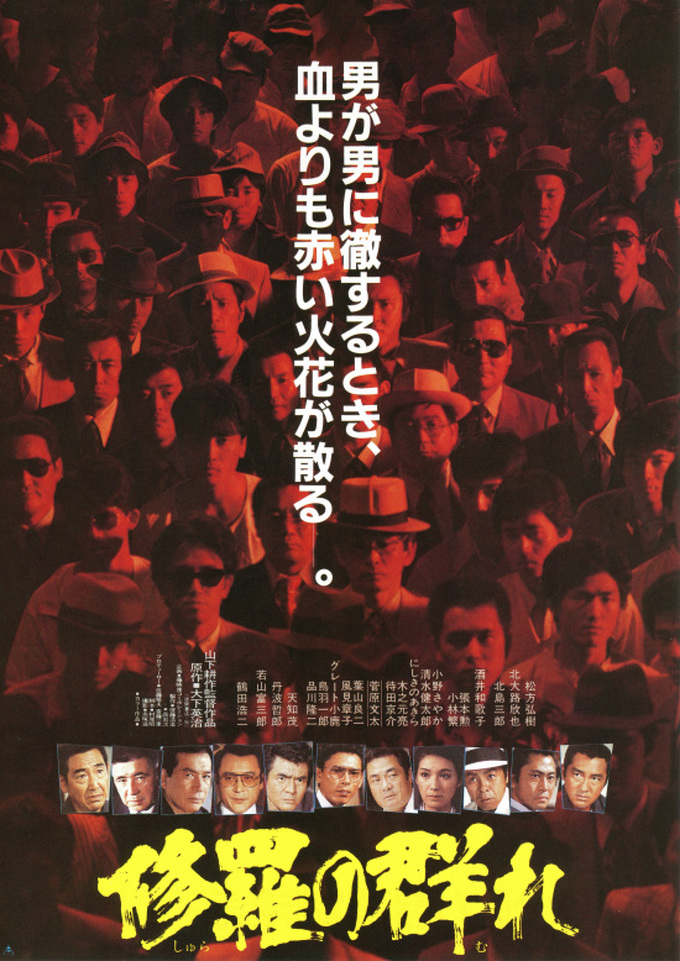
The Story of a Man Among Men (修羅の群れ, Kosaku Yamashita, 1984)

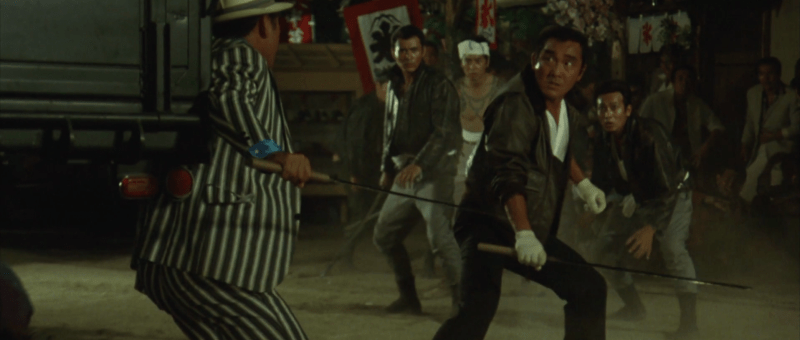
The ninkyo eiga, chivalrous tales of noble gangsters standing up for the little guy with decency and honour, had been Toei’s mainstay throughout the 1960s but a decade later the image of righteous yakuza had been well and truly imploded by the advent of the jitsuroku or “true account” movie which drew inspiration from real life tales of post-war gangsterdom using voiceover narration and onscreen text for added authenticity as it proved once and for all that there was no “honour and humanity” to be found in the gangster life only nihilism and futility. Still, the ninkyo, like many of its heroes, proved hard to kill as 1984’s Story of a Man Among Men (修羅の群れ, Shura no Mure) perhaps proves. A throwback to an earlier era with its infinitely noble hero and unexpectedly if not quite happy then defiantly positive ending, Kosaku Yamashita’s manly drama nevertheless adopts some of the trappings of the jitsuroku in its infrequent use of voiceover and emphasis on concrete historical events. 

The hero, Ryuji Inahara (Hiroki Matsukata), is like many heroes of post-war gangsterdom an orphan though his story begins in the mid-1930s as he’s recruited by a friendly yakuza at a karate dojo. As his teacher explains, Ryuji has already been offered a job with the police but given the chance to join the other side instead immediately agrees, explaining that his life’s ambition has been to gain revenge against the force that ruined his father and destroyed his family, gambling. He chooses to do this, however, not by destroying gambling dens everywhere but by becoming a gambler himself determined to be a winner which is, it seems, a textbook example of having learned the wrong lesson. Still, his noble gangster cool stands him in good stead in the yakuza world where he quickly earns the loyalty of other men, rapidly advancing up the ranks to head his own gang by the crime heyday of the mid-1950s. 

As the title implies, this is a story of a man, a very manly man, among other men. The gangster world is intensely homosocial and founded on ideas of brotherhood and loyalty. Thus, Ryuji finds a surrogate father figure in fellow gangster Yokoyama (Koji Tsuruta) who constantly gives him advice on what it is to be a proper man. “Don’t be a fool, don’t be too smart, and most of all don’t be half-hearted” he advises, later adding “you can’t be a man if you’re dirty about money”, and “taking action isn’t the only way to be a man. It takes a man to have patience.” (this last one as Ryuji hotheadedly discharges himself from hospital to get revenge on a punk who got the jump on him outside a shrine). To be a man, Ryuji intervenes when he sees some less than honourable young toughs hassling an old couple running a dango stand at the beach and the young woman from the caramel stall next-door, throwing his entire wallet on their counter to make up for the damage in what will become something of a repeated motif. His manliness earns him the eternal devotion of the young woman, Yukiko (Wakako Sakai), who eventually becomes his devoted wife against the will of her concerned mother who is nevertheless brought round on realising the love she has for him because of his intense nobility. 

Indeed, Ryuji lives in a noble world. He’s a gambler by trade but only because he hates gambling and is trying to best it. He doesn’t participate in the seedier sides of the yakuza life such as drugs or prostitution and is also in contrast to jitsuroku norms a humanist who defiantly stands up against racism and xenophobia, taking another gambler to task for using a racial slur against a Korean opponent while opting to befriend the “foreign” gangs of Atami when eventually put in charge of the lucrative area rather than divide and conquer. This is apparently a lesson he learned from his flawed but goodhearted father who hid a Korean man and his daughter from the pogroms after the 1923 earthquake because “we’re all the same human beings”. Spared the war because of an injury to his trigger finger, Ryuji kicks off against an entitled son of a gang boss for acting like a slavedriver while working at a quarry but earns only the respect of his superiors further enhancing his underworld ties because of his reputation as a standup guy willing to stand up to oppression. 

Such an intense sense of uncomplicated righteousness had perhaps been unseen since the ninkyo eiga days, and Ryuji’s rise and rise does in that sense seem improbable as his goodness only aids his success earning him the respect of over 1000 foot soldiers even as he finds himself in the awkward position of having to exile one of his most trusted associates for getting too big for his boots and disrespecting the yakuza code. His children also suffer for their connection to the gangster underworld, but are reassured that their father is a good man if with the subtle implication that he has damned them as his father did him. Shot with occasional expressionist flourishes such as crashing waves or a midnight sky, A Story of a Man among Men is not free from manly sadness and indeed ends on the sense of a baton passing from one era to another but does so with an unexpected sense of moral victory for its righteous hero who vows to bring his manly ideas with him into a new age of gangsterdom. 


Original trailer (no subtitles)

Inn of Evil (いのちぼうにふろう, Masaki Kobayashi, 1971)

inn-of-evil“Sometimes it feels good to risk your life for something other people think is stupid”, says one of the leading players of Masaki Kobayashi’s strangely retitled Inn of Evil (いのちぼうにふろう, Inochi Bonifuro), neatly summing up the director’s key philosophy in a few simple words. The original Japanese title “Inochi Bonifuro” means something more like “To Throw One’s Life Away”, which more directly signals the tragic character drama that’s about to unfold. Though it most obviously relates to the decision that this gang of hardened criminals is about to make, the criticism is a wider one as the film stops to ask why it is this group of unusual characters have found themselves living under the roof of the Easy Tavern engaged in benign acts of smuggling during Japan’s isolationist period.

Led by the innkeeper Ikuzo (Kan’emon Nakamura), the Easy Tavern is, effectively, the hideout of a smuggling gang conveniently located on a small island in the middle of a river where they can unload goods from the Dutch boats before shipping them on to Edo. Everything had been running smoothly, but the friendly policeman has been moved on and the new guy seems very straight laced. The gang’s routine existence changes one night when they receive two unexpected visitors – a young man they save from a beating in the street, and a drunk who wanders in looking for sake. The younger man, Tomijiro (Kei Yamamoto), brings a sad story with him in that all of his troubles have been caused by trying to save the woman he loves from being sold to a brothel. Moved by Tomijiro’s innocent ardour, even the most hardhearted residents of the Easy Tavern become determined to help him. Accepting a job everyone had a bad feeling about in order to get the money for Tomijiro to buy back his lady love before it’s too late, the gang’s unusual decision to risk their lives for someone else’s happiness may be the first and last time they ever do so.

The residents of the Easy Tavern have various different backstories, but the thing they all have in common is having been rejected by mainstream society at some point in their lives. The most high profile, Sadashichi (Tatsuya Nakadai), is known as “The Indifferent” which is both apt and slightly ironic. Sullen and cynical, he puts on a show about caring for nothing and no one but, as inn keeper’s daughter Omitsu (Komaki Kurihara) has figured out, it’s more that the opposite it true – he cares too much about everything. Abandoned as a child, Sadashichi’s sad story is that he once thought his saw his mother long after they were separated but killed her because she’d fallen into prostitution. Then again, perhaps it was just a woman who looked like her, or perhaps he made he whole thing up. Coming across a lost baby bird shortly after killing a man, Sadashichi is determined to look after it but is later distressed by the words of the drunk who reminds him that the bird’s mother is probably going crazy with worry. Sadashichi may identify with this lost little bird, but his empathy also extends to Tomijiro’s plight as his plaintive looks and gloomy face prompt him into action, if only to make them go away.

Similarly, the other members including “The Living Buddha” – a rabidly bisexual former monk thrown out of his temple for his lascivious ways, an effeminate homeless man, a stutterer, and an invalid all have reasons for living outside the law. As the sympathetic inn keeper later tries to explain to a policeman, most of these men are people who’ve faced rejection in one way or another. Craving sympathy, they’ve turned violent and suspicious, pushed away from the very things they wanted most. Far from an Inn of Evil, the Easy Tavern is the only place where these people have been able to find acceptance, building a community of lost souls from those cast out from society at large.

The decision to try and help Tomijiro to rescue his childhood sweetheart, cruelly sold by her selfish and uncaring father, is, in once sense, a selfless one but perhaps also reminds them of all the times they were also betrayed or abandoned and no one came to help. Even knowing the plan is unlikely to end well, the inn keeper is proud of his men’s decision, if they didn’t try to help the girl no one else would. They may be throwing their lives away in a pointless endeavour, but if they don’t at least try then what’s the point in living at all. This more than anything expresses Kobayashi’s constant preoccupation throughout his career in pointing to the essential goodness of those who refuse to simply accept acts of injustice as normal and stand up to oppose them, even if their resistance will produce little or no actual change.

Filming in a crisp black and white, Kobayashi creates an eerie atmosphere aided by Toru Takemitsu’s strangely ethereal score. The world of the The Easy Tavern is a dark one in which cruelty and betrayal lie at every turn and men ruin themselves through thoughtless and reckless decisions, but the best of humanity is to be found among this gang of outlaws who collectively decide it’s world risking their lives for someone else’s love story. Filled with impressive visual imagery including the strange sight of the looming bright white police lanterns and the impressively staged last stand as Sadashichi holds off the troops for Tomijiro to escape, Inn of Evil is a tightly controlled, minutely detailed character drama in which men who’d throw their lives away for nothing find that their sacrifice has not been in vain.