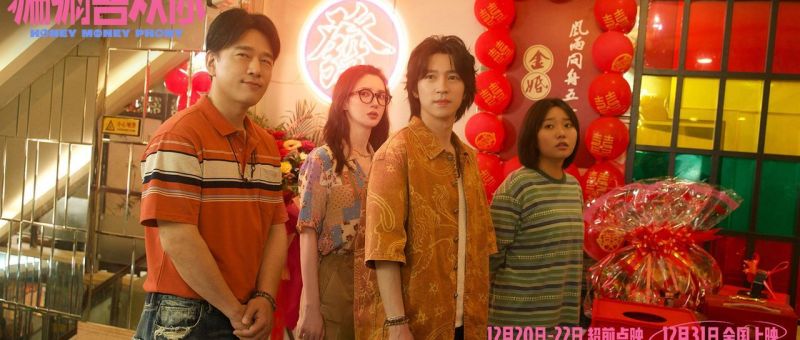

Honey Money Phony (“骗骗”喜欢你, Su Biao, 2024)

Can you really say a scammer who just takes people’s money without messing with their feelings is any better than one who just robs them? That’s a justification put forward by fraudster Ouyang (Sunny Sun) in Su Biao’s remake of Thai rom-com The Con-Heartist, but it’s a difficult one to swallow. After all, even if you just trick someone out of a small amount of cash,the psychological effects can be devastating though the pain may not be quite the same as getting your heart broken in a love scam.

Qinglang (Jin Chen) has indeed had her heart broken by the lothario Zijun (Wang Hao) whom she met at a tennis class she started going to after moving to the fictional city of Aoo Kang. Later it’s revealed that the cause of her move was getting fired from her company for reporting her boss for sexual harassment while she was also in a bit of debt from breaking a non-compete clause by getting another job, something which Zijun apparently sorted out for her. But not long after she took out a loan to give him money supposedly for his university tuition, Zijun ghosted her and she realised she’d been the victim of a romance scam. Now she’s on the hook for that too, working a series of part-time jobs in fast food restaurants and walking dogs as well as an unsuccessful gig as a vlogger in addition to her regular job in insurance. 

Experience is maybe why she suddenly thinks twice after being contacted by someone purporting to be from the vlogging site telling her she’s been suspended and needs to pay a fine. After getting Ouyang’s info from the bank she threatens to expose him but then makes a deal, if he helps her scam Zijun into giving back the money she gave him she won’t take this any further. Of course, there’s no guarantee Ouyang hasn’t just switched to a different con while Qinglang remains quite naive and despite herself trusting him. Then again, he’s the exact opposite of Zijun who took advantage of her despair and offered himself as a source of constant support. His aloofness and apparent honesty about what he is may in their way reassure her. 

There is something that might be comforting in Ouyan’s unflashiness. Though he drives a convertible, it’s not a particularly glamorous sort and has a busted taillight and in any case, he also lives in it. According to him, that’s so he can get away quickly if he needs to, but also suggests that it’s not really all about the money. Zijun, meanwhile, is greedy and materialistic, hopping from one wealthy woman to the next while hoping to join the social elite and live a high life of fast cars and wild parties. A justification for Ouyang’s scamming is given in a tragic backstory which may or may not be true suggesting that he was born out of wedlock and his mother died in childbirth. He was raised by his grandmother and uncle while his birth father entered his life at one point and tried to connect with him but it turned out it was all because his other son from a different relationship needed a bone marrow transplant. As soon as he found out Ouyang wasn’t a match, he disappeared from his life. 

The implication is that Ouyang scams as a kind of revenge because he doesn’t trust people and therefore is unable to live an ordinary, honest, life but through connecting with Qinglan and falling in love he develops the desire to live with more compassion and stability. Qinglang, meanwhile, gains confidence in herself and realises that her low self-esteem left her vulnerable to manipulation. Her friend, Xiaohui (Li Xueqin), who was also in massive debt and ended up posing as a blind person to carry out accident scams, also puts the skills she’s learned to good use to progress her acting career which might all be a very contradictory message even if there’s something satisfying about scamming a scammer and especially one as full of himself as Zijun. Released for Western New Year, the film has a zany wholesomeness despite its bleak subject matter and hints at a sense of despair in contemporary life in China but does indeed suggest that cheaters don’t necessarily need to prosper and you do have a degree of control over your life even if it’s just deciding to choose love and move on rather than wallow in a sense of futility. 


International trailer (English subtitles)
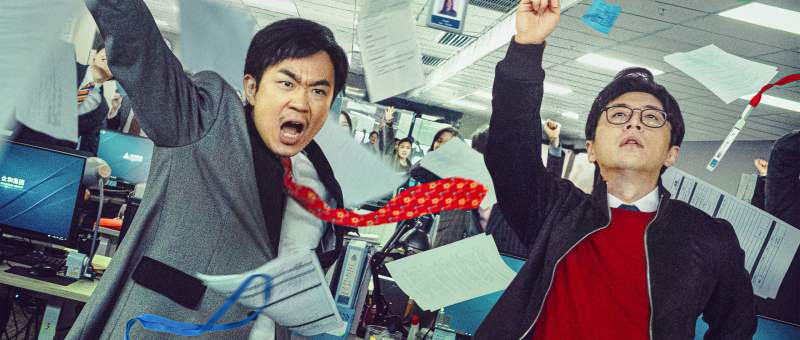
Johnny Keep Walking! (年会不能停!, Dong Runnian, 2024)

A satirical morality tale, Dong Runnian’s incredibly witty comedy Johnny Keep Walking! (niánhuì bùnéng tíng) sees a bumpkinish middle-aged factory worker still filled with an idealism that seems outdated even in the late 90s transferred into a lion’s den of corporate greed and dubious morality while ultimately expressing the younger generation’s increasing dissatisfaction with the inherent unfairness of corporate life in modern China. Ironically turning Tom Chang’s 1988 hit My Future is Not A Dream into a rallying cry from disillusioned youth, the film nevertheless places its faith in the moral generosity of a fat cat factory owner who struck gold in the nation’s 90s reforms but has largely forgotten those who helped him get there.

Key among them would be Jianlin (Da Peng) whom we first see trying to fix the disco ball at the factory’s 1998 gala and being asked to sing a song instead. 20 years pass with Jianlin still living the life of a model factory worker stuck on the same old salary while applying to perform in the company’s annual gala has become his only joy in life. Meanwhile, the factory owner has gone on to head an increasingly powerful multi-national company leaving Jianlin and those like him far behind deprived of the successes that the modern China has to offer. 

This is in part a paean for those left behind by the economic reforms of the 1990s which saw the end of the old factory system with mass unemployment and displacement amid frequent plant closures. Jianlin’s is still open, but devoid of the sense of comaradie that mark the opening scenes. His scheming floor manager, Zhangzi is trying to engineer a transfer to head office so that his son could attend a better school in the city and has been helping a series of corporate lackeys defraud the company, in addition to paying a direct bribe, in return for a job offer. A drunken mix up by office party boy Peter (Sun Yizhou) results in Jianlin being hired instead in a shock move that proves inexplicable to all. 

Jianlin is such an innocent that he thinks the reason he’s been given a huge promotion is because he was employee of the year for 12 years straight and the company probably want to send a message to the youngsters that hard work really will be rewarded. Of course, the opposite is true. HR manager Magic (Bai-Ke) quickly spots the mistake but is prevented from fixing it because it would get them all into trouble, and while it’s obvious to most people that Jianlin has no idea what he’s doing they choose to say nothing because they assume he must be a nepotism hire and they want to stay in the boss’ good books. Everyone at the company uses an English name with Jianlin rechristened “Johnny” though he understands no English and struggles with Chinese business jargon having no idea what people mean when they go on about “aligning the details”. Charged with firing someone under the company’s radical new “optimisation” programme, he takes the word at face value and gives them a promotion and a raise instead.

In fact, much of the film is him muddling along like typical middle-manager promoted beyond his abilities. He’s advised that good management is all about setting employees against each other so they forget about resenting you while basically delegating all your tasks to your subordinates who will be only too happy to help in order to curry favour. Slowly corrupted, Jianlin beings to play along, taking all the perks of corporate success while signing documents he couldn’t understand even if he actually read them.

Nevertheless, he develops a kind of team spirit with Magic, a man stuck in a mid-career rut because of his lack of skill at office politics, and Penny temp whose perpetually kept on the hook rather than being given full employee status so that the company can exploit her more. Penny also suffers sexual harassment at the hands of the party happy Peter with Jianlin getting her out of a sticky situation by telling her to finish a report and drinking with Peter himself. Together, and with the assistance of the workers at the factory and others about to be unceremoniously fired as part of the cost cutting enterprise, they attempt to expose corporate corruption and stage a protest against unfair working practices but the only saviour they have to turn to is the company president strongly suggesting a return to the old factory days which, it is implied, were much more wholesome and innocent. In any case, justice eventually wins out with the good rewarded and the bad getting their just desserts though it doesn’t do too much to tackle the inherent and quite ironic rottenness of the system in which the worker has been reduced to a mere tool to be used and discarded by a faceless and uncaring corporate entity. 


International trailer (English subtitles)

My Future is not a Dream (Tom Chang)