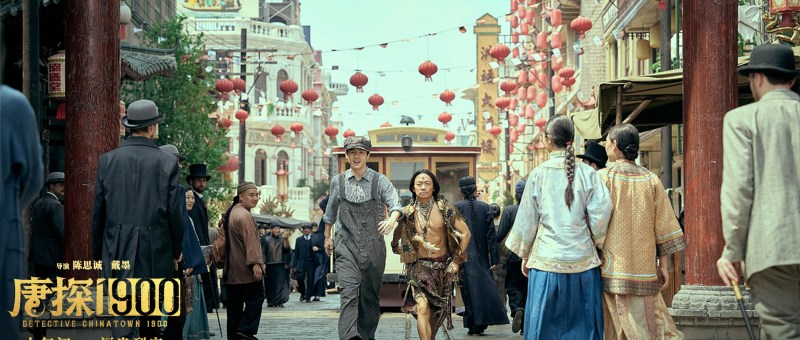

Detective Chinatown 1900 (唐探1900, Chen Sicheng & Dai Mo, 2025)

The Detective Chinatown team head back to turn of the contrary San Francisco in the latest instalment of the mega hit franchise, Detective Chinatown 1900 (唐探1900, Tángtàn 1900). Like many recent mainstream films, its main thrust is that Chinese citizens are only really safe in China, but also implies that diaspora communities exist outside the majority population and therefore can only rely on each other. Nevertheless, there’s something quite uncanny in the film’s ironic prescience as racist politicians wax on about how here rules are made by the people rather than an emperor and plaster “make America strong again” banners on their buses. 

The crime here though is the murder of a young white woman, Alice (Anastasia Shestakova), the daughter of Senator Grant (John Cusack) who is attempting to push the renewal of the Chinese Exclusion Act through government and destroy all the Chinatowns in the United States. An older Native American man was also found dead alongside her. Some have attributed the crime to Jack the Ripper as Alice was mutilated before she died and some of her organs were taken. The son of local gangster Bai (Chow Yun-Fat), Zhenbang (Zhang Xincheng), is quickly arrested for the crime while his father hires Qin Fu (Liu Hairan) to exonerate him believing Qin Fu to be Sherlock Holmes. 

What Qin Fu, an expert in Chinese medicine recently working as an interpreter for the famous consulting detective, finds himself mixed up in is also a slow moving revolution as it turns out Zhenbang is involved with the plot to overthrow the Qing dynasty (which would finally fall in 1912). As the film opens, corrupt courtiers to sell off large golden Buddha statues to American “allies” who are later seen saying that they plan to fleece China and then renege on their promises to protect it. Meanwhile, the Dowager Empress has sent emissaries to San Francisco to take out the revolutionaries in hiding there including Sun Yat-sen.

Of course, in this case, the Qing are the bad guys that were eventually overthrown by brave Communist revolutionaries that paved the way for China of today which is alluded to in the closing scenes when Zhenbang’s exiled friend Shiliang (Bai Ke) says that China will one day become the most powerful country in the world implying that no-one will look down on the Chinese people again. But on the other hand, they are still all Chinese and so the emissary tells Qin Fu to “Save China” as he lays dying having met his own end shortly after hearing that the British have invaded Peking signalling the death blow for the Qing dynasty. 

Nevertheless, there is a degree of irony in the fact that the secondary antagonist is an Irish gang who have signs reading “no dogs, no Chinese,” mimicking those they themselves famously face. The Irish gang is in league with Grant and content to do his dirty work, while Bai is supported by another prominent man who speaks Mandarin and pretends to be a friend to the Chinese but in reality is against the Exclusion Act on the grounds he wants to go on being able to exploit cheap Chinese labour. In this iteration, Ah Gui (Wang Baoqiang) is “Ghost,” a man whose parents were killed building the American railroad and was subsequently taken in and raised by a Native American community. In Bai’s final confrontation with the authorities, he takes them to task for their hypocrisy reminding them how important the Chinese have been in building the society in which they alone are privileged while “equality” does not appear to extend to them.

Through reinforcing these messages of prejudice and exploitation, the film once again encourages Chinese people living abroad to return home. Though set in 1900, the scenes of protest can’t help but echo those we’ve seen in the wake of the Covid-19 pandemic when racist hatred towards Asian communities has become much more open and pronounced. Qin Fu and Ghost do at least succeed in solving the mystery through scientific principles while ironically assisted by an earnest American policeman who says he thinks it’s important to uphold the law even as we can see the head of the golden Buddha sitting behind the victorious politician’s banquet table and realise that in reality taking out Grant has made little difference for the Exclusion Act will still be renewed (it was repealed only in 1943). They may have saved Chinatown, but Bai must sacrifice his American wealth and return to China much the way he left it having reflected on his life in light of the revolutionary course charted by his more earnest son. As Ghost and Qin Fu remark, if things were better there no one would want to come here though they themselves apparently elect to stay, solving more crimes and making sure that their descendants know they were here and where they were from.


International trailer (Simplified Chinese / English subtitles)
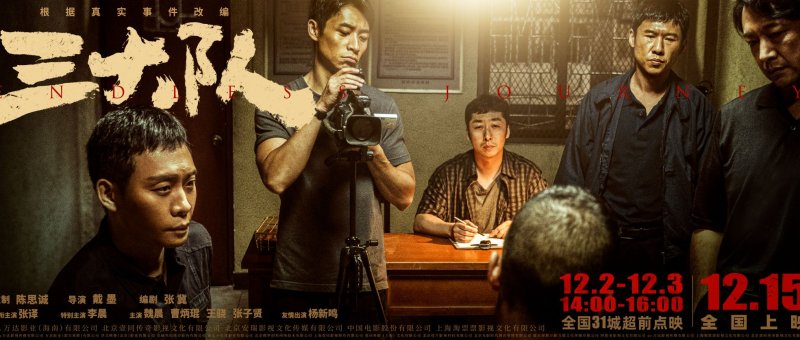
Endless Journey (三大队, Dai Mo, 2023)

The police officers at the centre of Dai Mo’s Endless Journey (三大队, Sān Dàduì) are soon stripped of their badges, accused of excessive force contravening laws existing since the medieval era to prevent vigilante justice. Yet in someways that’s essentially what they end up doing, extra-judicial investigators with a personal vendetta rather than a pure-hearted interest in justice even if the victim of the crime weighs heavily on their conscience. 

Though the film plays into the recent trend in Sino-noir and popularity of mystery thrillers at the Chinese box office, it is surprising that a film that is at least subtly critical of the justice system, featuring police who break the rules and are sent to prison, was approved by the censors board even if the central message is one of heroism as Captain Cheng (Zhang Yi) doggedly chases his suspect all over China for several years. Then again, the hero of this true life case turns out to be China itself as Cheng is reminded that his search is unnecessary given that the fugitive, Eryong (Zheng Benyu), is sure to be captured by the burgeoning surveillance network of CCTV cameras then being rolled out across the country. Years later, it’s the system that allows Cheng to identify Eryong as his DNA and fingerprints throw up positive matches within seconds of samples being taken thanks to the nation’s DNA database. 

Even so, as the veteran officer, Zhang (Yang Xinming), reminds the rookie behind every major case there’s a ruined family broken by their loss which is one reason why he doesn’t relish the prospect of investigating one so late in his career. This particular crime is so heinous that it’s become front page news which means that they’ve also got their boss breathing down their necks to get it solved as soon as possible with the existence of Division 3 itself on the line. Cheng pops home for a matter of minutes to check on his wife and daughter, shutting down his wife’s suggestion that they get a security system for their windows on the grounds that it would be an embarrassing thing for a detective’s home to have. The reason she wants one is that the victim in this case had been a little girl of around their daughter’s age unexpectedly home alone when thieves broke in by climbing over their aircon unit and smashing a window. Finding nothing of value they raped and killed the daughter. 

After a police officer dies as a result of the investigation, the squad take things too far questioning the first suspect leading to his death which is how they end up disgraced and sent to prison. After his release, Cheng has lost his family, his home, his job and identity as a protector of justice yet his determination to catch Eryong is born more of his desire to avenge a friend than it is to prevent further crime. His fellow officers join him in the beginning, but during the endless searching each make the decision to move on for easily understandable reasons such as their marriages, children, and illness but Cheng cannot let go even when prompted by an old friend from the force who tells him they have this in hand though there is perhaps a subtle implication that the police force isn’t really doing enough otherwise Cheng wouldn’t have to be chasing Eryong all over the country. 

But haunted by reflections of his own face, ageing, at times dishevelled and hopeless, Cheng is also searching for himself and a means to reclaim the self he once was by vindicating himself as a policeman along with Division 3 in finally completing their mission. The ominous score by Peng Fei with its stinging strings adds to the noirish feel as does the perpetual inevitability of Cheng’s forward motion in the dogged pursuit of his prey, unable to rest until Eryong has been brought to ground. His quest robs him of his life, but there is an undeniable poignancy to it in Cheng’s inability to find himself outside of the chase only to be left with a moment of uncertainty no longer sure who he is or where he goes now, left alone and with no sense of direction in the absence of his quarry.


Endless Journey is in UK cinemas now courtesy of CMC.

International trailer (English subtitles)

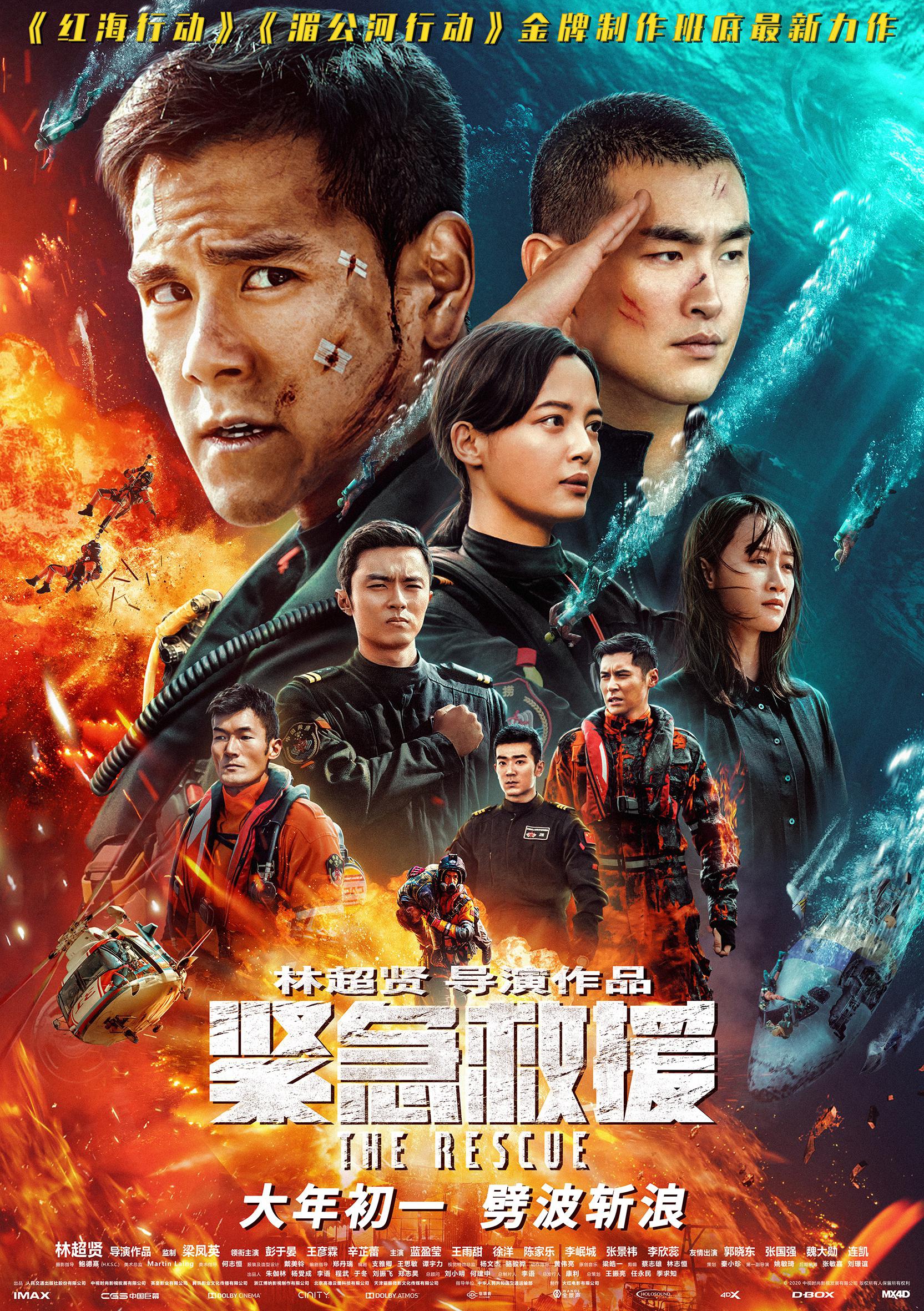
The Rescue (紧急救援, Dante Lam, 2020)

The rescue poster 3

It’s tempting to see Dante Lam’s latest foray into big budget mainland action as a continuation of his previous hits Operation Mekong and Operation Red Sea which paid tribute to the police and navy respectively, but it is also the latest in a series of films featuring China’s finest bravely battling against the odds to save the day. Like Tony Chan’s The Bravest which celebrated the selfless heroism of China’s firemen as they risked their lives to stop a potentially catastrophic fire in an oil refinery, The Rescue (紧急救援, Jǐn Jyuán) pays tribute to another undersung arm of the emergency services – China’s Coast Guard.

Our hero, Captain Gao Qian (Eddie Peng Yu-yen) of China Rescue And Salvage, is a devil-may-care hero who throws himself into danger without a second thought where lives are at stake. The motto of China Rescue And Salvage is “we risk our lives to give others hope”, but some feel that Gao Qian is too reckless with his and fear that he’s forgotten that you can’t save anyone if you get yourself killed playing at heroics. That’s something that’s temporarily brought home to him when the pilot of his helicopter is badly injured during a rescue on an oil rig engulfed by flames, leaving the inexperienced co-pilot to fill-in on his behalf. Gao Qian works his magic in the nick of time, but both of the pilots quit the team immediately afterwards, the pilot struck by the proximity of death and the co-pilot by his sense of inadequacy in feeling as if he failed to live up to the job.

Luckily the team soon get a new pilot – a lady, Yuling (Xin Zhilei), who clashes with Gao Qian in true disaster movie fashion in her desire for rational action and the kind of heroics that are strictly by the book. Against the odds, however, they make a good team, eventually bonding in mutual admiration for their complementary skills. Meanwhile, Gao Qian is also dealing with some home drama in that he’s just brought his young son Congcong (Zhang Jingyi), who had been staying with his grandmother, to live with him. Congcong seems to be suffering with some kind of illness, but is otherwise cheerful enough and hoping that his dad will get him a new mum, like, for example, the beautiful Yuling.

The death of his wife, his son’s illness, and the loss of colleagues he was forced to leave behind, haunt Gao Qian like a cosmic joke, as if he’s being “punished” for snatching so many other lives from the jaws of death. No matter how hard he tries, there are lives which cannot be saved – no helicopter can rescue you from terminal illness or debilitating disease. Nevertheless, he continues to do his best no matter the personal costs. “Everyone has their own battleground, mine is rescue” he tells a superior with determination after his priorities are questioned. In training, the coach reminds the rescuers that their enemy is nature. They push their bodies as far as they can go, willingly risking all to let others know that someone is always looking out for them and will come in their time of need. Faced with certain death, Gao Qian enters an eerily beautiful existential space born of liminality in which he is perhaps able to feel everything that is to be alive while his son, fighting his own battle, does something much the same.

The strangely poetic quality of life in extremis is directly contrasted with the hokey comedy of Gao Qian’s home life and the brotherly comradeship of the base which are both much more of the typical “New Year Movie” mould. Lam fares much better than Chan in heading off the obvious melodrama, though he too resorts to the obvious foreshadowing of a young man daring to get wedding photos taken while planning to risk his life for the greater good, while the quirky production design and wholesome warmth of Gao Qian’s home life as he attempts to make the world safe for his son offer a much needed escape from the anxiety of his disaster-fuelled existence. Unlike that of Red Sea, the world of The Rescue is a more open and hopeful one in which Gao Qian does his best to save everyone who needs saving no matter their nationality, feted far and wide as a hero even if he awkwardly embodies a magnanimous China as a world protector as he does so. Nevertheless, Lam once again manages to elevate his material beyond its propagandist aims, edging towards a more ambivalent contemplation of selfless nobility and the costs of courageous endurance.


In UK cinemas from 25th January courtesy of CMC Pictures. Unfortunately, the release of The Rescue has been postponed because of the Coronavirus outbreak in China. We will update you as soon as we hear of new release date!

Original trailer (English subtitles)

Operation Red Sea (红海行动, Dante Lam, 2018)

Operation Red Sea posterDante Lam, a Hong Kong action icon, is one of many to have begun looking North, tempted by the bigger budgets and audience potential of the Mainland. Following 2016’s Operation Mekong, Lam is back on manoeuvres with a second in what may develop into a series, Operation Red Sea (红海行动, Hónghǎi Xíngdòng). Red Sea is not connected to Mekong in terms of narrative and only features a cameo by the earlier film’s star, Zhang Hanyu, who remains firmly ensconced on the bridge of the all powerful Chinese warship while an elite troop of special forces handles the rapidly deteriorating situation on the ground, but it is once again “inspired” by a true story and perfectly positioned to show the Chinese security services in a more than favourable light.

The action begins in 2015 when the Chinese navy wades in to defend a merchant ship attacked by Somali pirates, managing to apprehend the “bad guys” with a minimum of bloodshed before they escape Chinese waters. Having suffered a casualty, the squad are then dispatched to rescue Chinese citizens caught up in an Middle Eastern coup. Their mission is helped and hindered by intrepid Chinese-French journalist, Xia Nan (Hai Qing), who has discovered evidence that a dodgy “businessman” caught up in the attack is in possession of a consignment of “yellowcake” along with a deadly dirty bomb formula which he plans to sell on to the terrorists currently waging war on the city.

Though Operation Red Sea is, perhaps, no more jingoistic than any British or American war film, its focus is more definitively centred on home concerns than an attempt to police the world. The Chinese military exists to defend Chinese citizens, even if those citizens are increasingly scattered throughout an unstable world. This presents a point of conflict between idealistic, and occasionally reckless, journalist Xia Nan whose mission is to stop the terrorists and rescue her friends, and the soldiers whose primary mission is to evacuate Chinese citizens though they hope to be able to provide assistance to citizens of other nations too if their mission parameters allow.

The Jiaolong, elite Chinese special forces, are indeed an impressive fighting force who proceed with military precision but are not without compassion. Informed by a local soldier that the terrorists often force civilians to become suicide bombers, the team’s bomb disposal officer puts himself at great risk to defuse a device and free a man destined to become a car bomb, rather than simply neutralising the threat. Protecting Chinese in peril is the official goal, but on a human level the soldiers are overcome with sorrow and anger for the local population, lamenting that they may have saved some lives but many have lost their homes and they will simply leave them behind to deal with the situation alone when they succeed in their mission of evacuating stranded Chinese diplomatic personnel.

Despite the overtly propagandistic elements which paint the Chinese military as a force for good, fighting bravely for their countrymen overseas, the landscape of war Lam paints is a hellish one full of blood, guts, and scattered body parts. Much of the film plays as a two hour recruiting video for the Chinese navy – it’s almost a surprise there aren’t people waiting with clipboards outside the theatre, but it’s difficult to believe anyone would be in a big hurry to sign up after witnessing the pure human carnage of a foreign battlefield and the very real threats the soldiers subject themselves to all while stoically pursuing their mission, committed to the protection of their nation and people.

Nevertheless Lam’s spectacle is impressive and action choreography unsurpassed. Working on a huge scale with everything from snipers to tank battles, Lam keeps the tension high as the team attempt to adapt to a situation which is rapidly deteriorating leaving them all but stranded behind enemy lines where each and every one of them faces a very real threat of death or serious injury. Despite an overuse of CGI slow motion bullet vision, Operation Red Sea largely earns its bombast with relentless fury, leaving its propaganda aims to dangle the background until the final coda which seeks to remind us that China rules the waves and will protect its citizens and territory wherever they may be.


Currently on limited release in UK cinemas courtesy of China Lion.

Original trailer (English subtitles)

https://www.youtube.com/watch?v=F0D-TEo0AEo