

Ryoma (Kaname Yoshizawa) and Ikuto (Danhi Kinoshita) are boys without brakes trying to get some kind of a handle on lives on that are racing away from them. Caught between compromised father figures, an oppressive social structure, and the overriding despair of a life without prospects, they feel themselves to be beaten down and defeated. But then Ikuto isn’t the sort of guy to be cowed by authority and is willing to speak truth to power even if it might not be advantageous for him to do so.
Indeed, Ikuto becomes a kind of saviour as a figure of idealised masculinity that embodies the paternal presence the other boys are lacking for one reason or another. Ryoma’s father isn’t really mentioned, though he appears to have a strained relationship with his mother’s boyfriend and freely admits that until he met Ikuto in juvenile detention he was floundering. Picked up for a series of petty crimes, he blames another boy, Kosuke, for his predicament having been forced to steal to pay an exorbitant sum to bullies he was unable to defend himself from. Ironically enough, Ikuto has actually been framed and for a crime that Ryoma himself committed and perhaps it’s their sense of defiance against injustice that allows him to stand strong in the face of a corrupt authority represented by the prison guard Hakamada (Wataru Ichinose).
Though the warden at Ryoma’s admission had told him that he should think of his time there not as a punishment but an opportunity while the reformatory was a space of rehabilitation, but Hakamada openly tells the boys that they are inherently bad and their lives will amount to nothing. In the prison yard, they tend to the pigs which is what Hakamada deems them to be. He abuses his authority because he is weak and cannot bear it that Ikuto might be right when he says that the reason he’s working here as a guard is because he too has failed at life. When Hakamada tries to take revenge by jeopardising Ikuto’s parole, it’s his mother, Haruka, who stands up to him by wielding her old righteousness to insist that he too abide by the rules he is supposed to represent thereby presenting another more positive vision of resistance that goes beyond the purely physical and allows a petite middle-aged woman to challenge a physically opposing man in a position of authority.
Part of the reason that Hakamada had said that Ikuto was doomed was because his father was prison and Ikuto too had rejected him for that reason. He resented his father because of the way the stigma of crime was visited on him, that he became an undesirable child tainted by his father’s transgression. At this time, he presumably had a solid faith in the justice system and believed his father to be guilty but given his own experience of false imprisonment has now come round to the idea that his father could be telling the truth and is innocent after all. Their struggles become directly linked when Ikuto is scheduled to square off against the prosecutor’s son, but in a more spiritual sense they are both battling against an oppressive society.
This Ikuto slowly comes to see on realising that he and primary antagonist Jun are basically the same as Jun is also battling the spectre of his father, a yakuza. Rejected by those around him because of the stigma of being a yakuza’s son, Jun (whose name means “pure”), has turned inward in bitterness and become a violent thug attempting to order his life through physical dominance. Accepting that he too was careering towards a cliff edge, Ikuto reflects that Jun is still hanging on if barely by the skin of his teeth which is to say he can wants to be saved in the way that Ikuto has been. But it wasn’t the reform system or the prison guards that helped him see a way forward but an inspirational lecture from real life MMA star Mikuru Asakura on whose life the film is loosely based. Asakura tells the boys that they have a right to dream and that their goals are achievable if only they can put their minds to them. That they hear this from a big brother figure rather than an older man in a paternal position makes it clear that these boy must save themselves through mutual solidarity in place of the positive paternal presence that is missing in most of their lives.
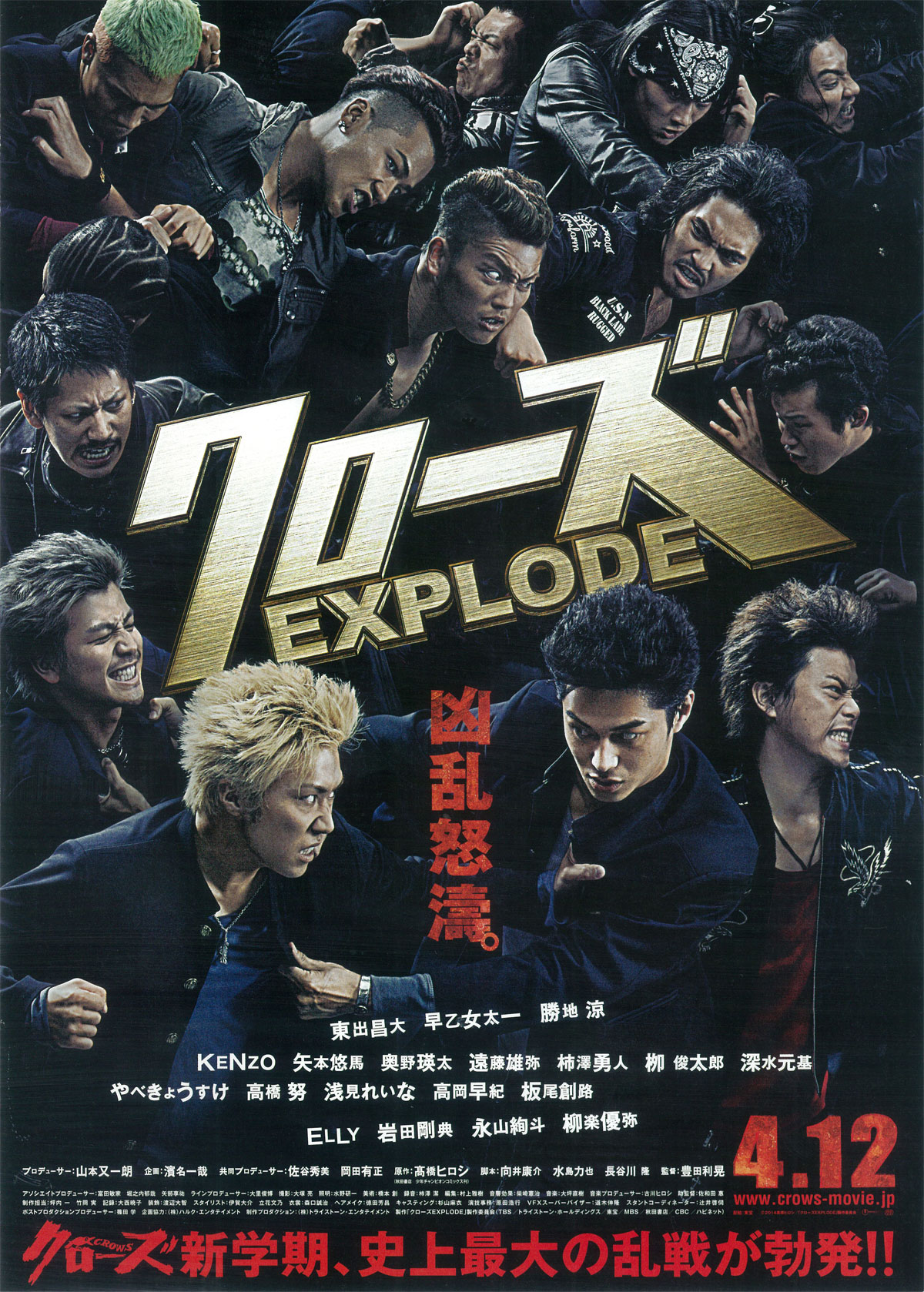
The film is filled with figures of those who have turned their lives around from Asakura himself to the former yakuza who runs the dry bar where the kids hang out. The coach at their gym also provides a supportive presence that makes the ring a safe place. But the ring is of course life and the point is to keep fighting. Winning and losing aren’t important, all that matters is getting back up when someone knocks you down and staying in the fight. The young men are not adversaries but comrades supporting each other as they battle a world with few rewards and endless temptations. In Ikuto, Ryoma finds the strength to stop blaming others for his failures while trusting more in himself and learning to value this new community that he’s discovering. Harking back to the Crows Zero series and a wider tradition of high school delinquent movies, Takashi Miike makes a series of loving jabs at the genre but at the same time transforms it into something a little less angsty as these blazing fists are turned not on each other but against the world that refuses to give these young men a chance as they band together to demand the right to their dreams.
Trailer (English subtitles)


 Toshiaki Toyoda made an auteurst name for himself at the tail end of the ‘90s with a series of artfully composed youth dramas centring on male alienation and cultural displacement. Attempting to move beyond the world of adolescent rage by embracing Japan’s most representative genre, the family drama, in the literary adaptation
 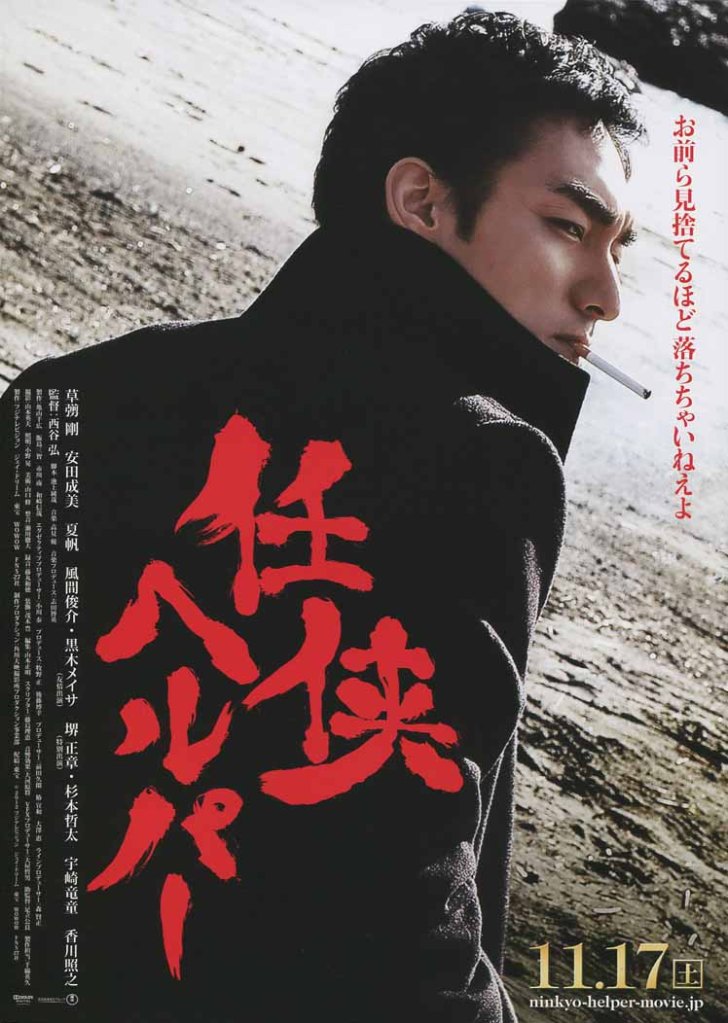 In old yakuza lore, the “ninkyo” way, the outlaw stands as guardian to the people. Defend the weak, crush the strong. Of course, these are just words and in truth most yakuza’s aims are focussed in quite a different direction and no longer extend to protecting the peasantry from bandits or overbearing feudal lords (quite the reverse, in fact). However, some idealistic young men nevertheless end up joining the yakuza ranks in the mistaken belief that they’re somehow going to be able to help people, however wrongheaded and naive that might be.
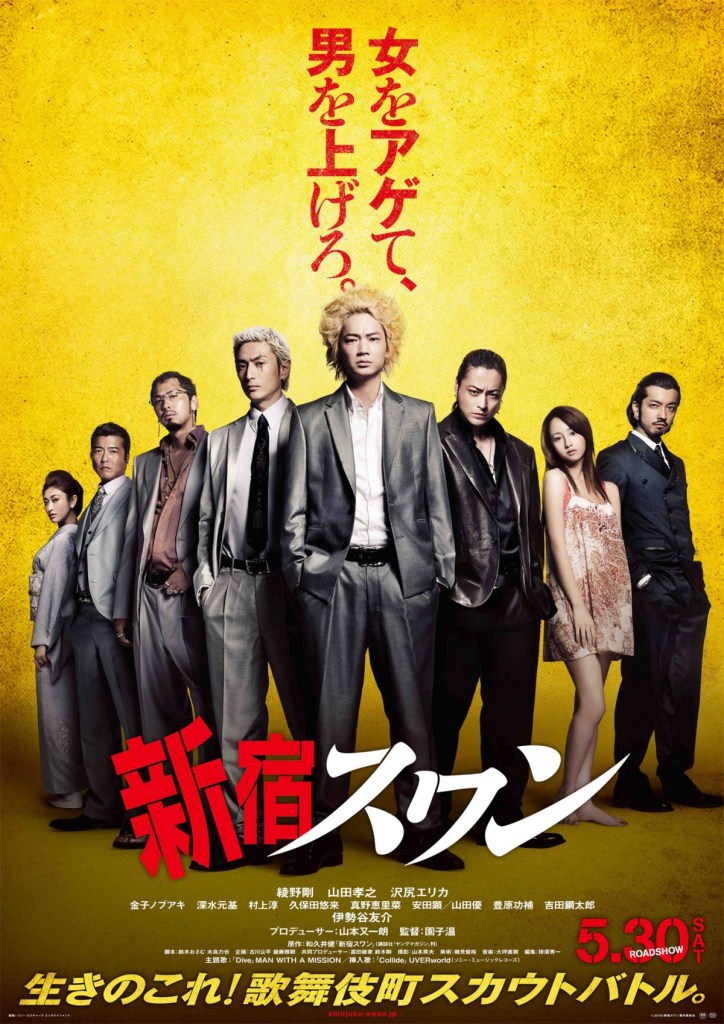 Enfant terrible of the Japanese film industry Sion Sono has always been prolific but recent times have seen him pushing the limits of the possible and giving even Takashi Miike a run for his money in the release stakes. Indeed, Takashi Miike is a handy reference point for Sono’s take on Shinjuku Swan (新宿スワン) – an adaptation of a manga which has previously been brought to the small screen and is also scripted by an independent screenwriter rather than self penned in keeping with the majority of Sono’s directing credits. Oddly, the film shares several cast members with Miike’s Crows Zero movies and even lifts a key aesthetic directly from them. In fact, there are times when Shinjuku Swan feels like an unofficial spin-off to the Crows Zero world with its macho high school era tussling relocated to the seedy underbelly of Kabukicho. Unfortunately, this is somewhat symptomatic of Sono’s failure, or lack of will, to add anything particularly original to this, it has to be said, unpleasant tale.
 Review the concluding chapter of Takashi Yamazaki’s Parasyte live action movie (寄生獣 完結編, Kiseiju Kanketsu Hen) first published by
  Windows on Worlds