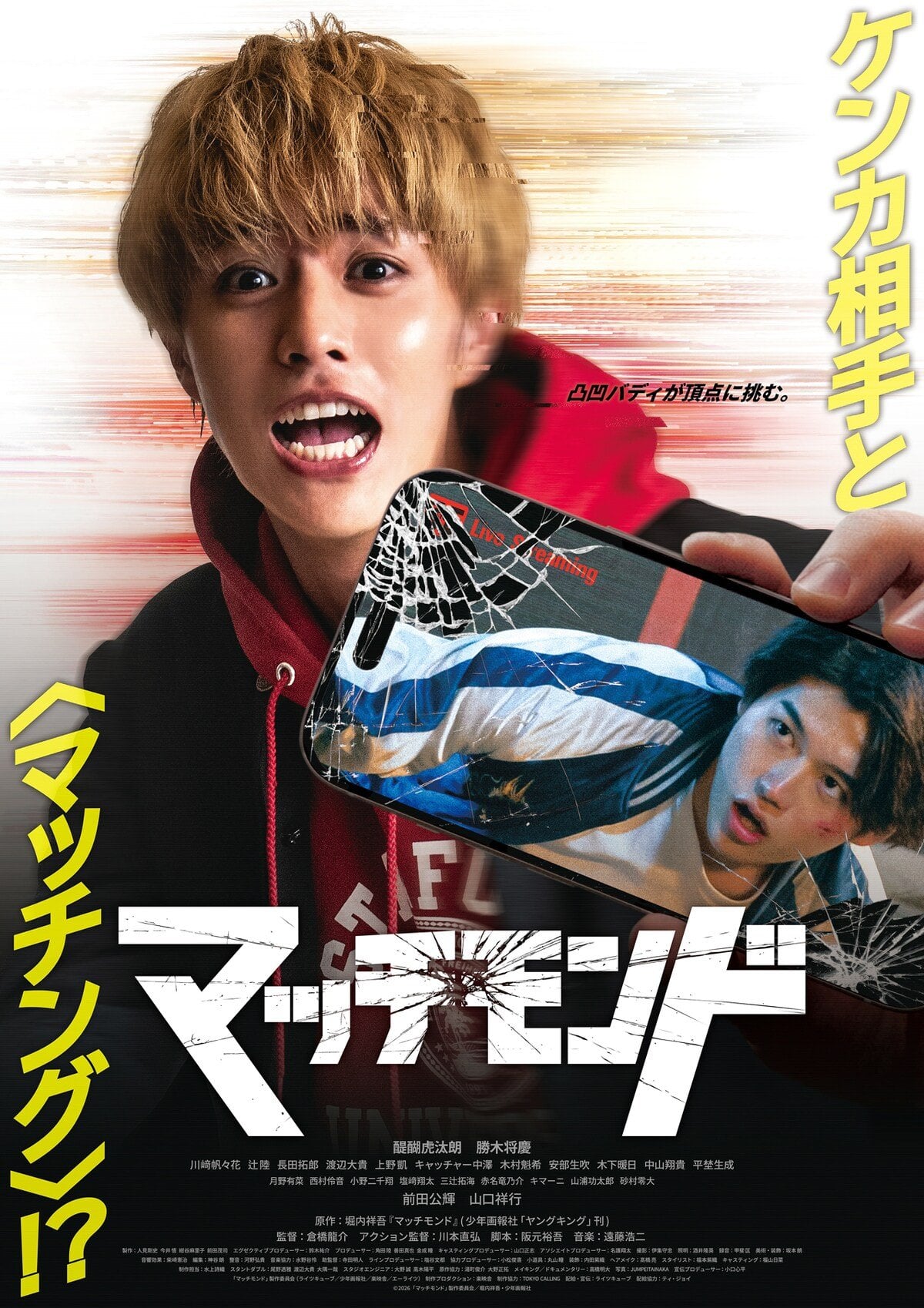
Match Monde (マッチモンド, Ryusuke Kurahashi, 2026)

Scripted by Yugo Sakamoto, Ryusuke Kurahashi’s low-budget adaptation of the Shogo Horiuchi manga Match Monde seems to be aiming for a Baby Assassins vibe while placing a contemporary spin on the classic high school delinquents fighting manga. Unlike many similarly themed films, high school never actually features and most of the users of fighting app Match Monde appear to be long past high school age even if it’s supposed to be limited to those 18 and under. 

The title is a kind pun in that Match Monde operates in the same way as a dating app, though it allows members to find worthy opponents for fighting. Users can also monetise their pugilistic talents though taking the “bounty” from defeated opponents, or pick up tips through live streaming. It’s not really clear why Mikio (Kotaro Daigo) is on this app as he dislikes fighting and seems to be something of a coward. In the opening sequence, he waits outside pretending to play on his phone while his best friend Yuta is beaten up by a bullying gang of older kids that Mikio later hides in a bin to avoid. It’s while running away, however, that he bumps into Mahiro (Masayoshi Katsuki) who can’t really be bothered to fight anyone but gives Mikio some life advice to the fact that he should be fighting to protect something important rather than just to protect himself. 

Mahiro is a bit a stock character in these kinds of stories, walking around with a beatific smile permanently on his face and carrying a strangely vacant aura. Obviously, it turns out that he’s a top fighter and high school drop out who is willing to fight for Mikio after seeing him develop his resolve to stand up to the bullies rather than let his friend get beaten up on his own again. Like Baby Assassins, however, the film is perhaps a little bit more interested in the boys’ mundane lives than it is in the fighting. Mahiro ropes Mikio in to help out at a part-time job working in his childhood friend Suzuna’s cafe because he says he seems kind earnest, which is broadly true, while Mahiro struggles to knuckle down and work and fears letting his friend down in that way.

While it may have strongly homoerotic undertones, particularly in the relationship between sometime villain Mairu and his late “best friend” Kitano who was murdered after becoming a delinquent, the film’s humour is distinctly old school and in some ways spills over into sexism as the defeated bullies are seen acting in stereotypically feminine ways such as knitting scarves for each other. Meanwhile, Mahiro and Mikio aren’t really afraid of getting into fights with the delinquents, but are apparently terrified of being told off by Shizuna. 

The focus is indeed on traditional masculinity which is rooted in protecting those weaker than oneself, especially women, though here also avoiding becoming someone who deliberately picks on picks on easy targets to assert their dominance as Mikio had been doing. Perhaps the only reason he was on the app was to prove Yuta wrong when he called him a coward, though he quickly ends up being exploited by the bullies who force him to fight so they can take his winnings, as optimistic as that might be. As the so-called “Penniless King”, Mahiro comes to occupy the space of an underdog hero who isn’t even technically in the game, but ends up winning it anyway just by virtue of being a cool guy who’s good with his fists.

Speaking of which, the fight scenes are sometimes unpolished but generally well choreographed. There seems to be some attempt to set up a continuing series with repeated references to a friend who is no longer on the scene as well as an incongruous appearance by Danhi Kinoshita, the star of Takashi Miike’s Blazing Fists, seemingly in a background, non-speaking part as a random member of Mairu’s gang. The potential there is quite interesting given that the natural result of all these boys fighting is that they end up becoming friends, even as Mairu insists he wants to defeat all the delinquents in revenge for his friend’s death so he’ll be the only one left and they’ll cause no more harm. Who knew that what they were really fighting was loneliness? Maybe Match Monde is friendship app after all.


Match Monde screens 23rd August as part of Big Bad Film Fest.

Trailer (no subtitles)

Blazing Fists (BLUE FIGHT 蒼き若者たちのブレイキングダウン, Takashi Miike, 2025)

Ryoma (Kaname Yoshizawa) and Ikuto (Danhi Kinoshita) are boys without brakes trying to get some kind of a handle on lives on that are racing away from them. Caught between compromised father figures, an oppressive social structure, and the overriding despair of a life without prospects, they feel themselves to be beaten down and defeated. But then Ikuto isn’t the sort of guy to be cowed by authority and is willing to speak truth to power even if it might not be advantageous for him to do so.

Indeed, Ikuto becomes a kind of saviour as a figure of idealised masculinity that embodies the paternal presence the other boys are lacking for one reason or another. Ryoma’s father isn’t really mentioned, though he appears to have a strained relationship with his mother’s boyfriend and freely admits that until he met Ikuto in juvenile detention he was floundering. Picked up for a series of petty crimes, he blames another boy, Kosuke, for his predicament having been forced to steal to pay an exorbitant sum to bullies he was unable to defend himself from. Ironically enough, Ikuto has actually been framed and for a crime that Ryoma himself committed and perhaps it’s their sense of defiance against injustice that allows him to stand strong in the face of a corrupt authority represented by the prison guard Hakamada (Wataru Ichinose). 

Though the warden at Ryoma’s admission had told him that he should think of his time there not as a punishment but an opportunity while the reformatory was a space of rehabilitation, but Hakamada openly tells the boys that they are inherently bad and their lives will amount to nothing. In the prison yard, they tend to the pigs which is what Hakamada deems them to be. He abuses his authority because he is weak and cannot bear it that Ikuto might be right when he says that the reason he’s working here as a guard is because he too has failed at life. When Hakamada tries to take revenge by jeopardising Ikuto’s parole, it’s his mother, Haruka, who stands up to him by wielding her old righteousness to insist that he too abide by the rules he is supposed to represent thereby presenting another more positive vision of resistance that goes beyond the purely physical and allows a petite middle-aged woman to challenge a physically opposing man in a position of authority.

Part of the reason that Hakamada had said that Ikuto was doomed was because his father was prison and Ikuto too had rejected him for that reason. He resented his father because of the way the stigma of crime was visited on him, that he became an undesirable child tainted by his father’s transgression. At this time, he presumably had a solid faith in the justice system and believed his father to be guilty but given his own experience of false imprisonment has now come round to the idea that his father could be telling the truth and is innocent after all. Their struggles become directly linked when Ikuto is scheduled to square off against the prosecutor’s son, but in a more spiritual sense they are both battling against an oppressive society.

This Ikuto slowly comes to see on realising that he and primary antagonist Jun are basically the same as Jun is also battling the spectre of his father, a yakuza. Rejected by those around him because of the stigma of being a yakuza’s son, Jun (whose name means “pure”), has turned inward in bitterness and become a violent thug attempting to order his life through physical dominance. Accepting that he too was careering towards a cliff edge, Ikuto reflects that Jun is still hanging on if barely by the skin of his teeth which is to say he can wants to be saved in the way that Ikuto has been. But it wasn’t the reform system or the prison guards that helped him see a way forward but an inspirational lecture from real life MMA star Mikuru Asakura on whose life the film is loosely based. Asakura tells the boys that they have a right to dream and that their goals are achievable if only they can put their minds to them. That they hear this from a big brother figure rather than an older man in a paternal position makes it clear that these boy must save themselves through mutual solidarity in place of the positive paternal presence that is missing in most of their lives.

The film is filled with figures of those who have turned their lives around from Asakura himself to the former yakuza who runs the dry bar where the kids hang out. The coach at their gym also provides a supportive presence that makes the ring a safe place. But the ring is of course life and the point is to keep fighting. Winning and losing aren’t important, all that matters is getting back up when someone knocks you down and staying in the fight. The young men are not adversaries but comrades supporting each other as they battle a world with few rewards and endless temptations. In Ikuto, Ryoma finds the strength to stop blaming others for his failures while trusting more in himself and learning to value this new community that he’s discovering. Harking back to the Crows Zero series and a wider tradition of high school delinquent movies, Takashi Miike makes a series of loving jabs at the genre but at the same time transforms it into something a little less angsty as these blazing fists are turned not on each other but against the world that refuses to give these young men a chance as they band together to demand the right to their dreams.


Trailer (English subtitles)