Detective Chinatown 1900 (唐探1900, Chen Sicheng & Dai Mo, 2025)

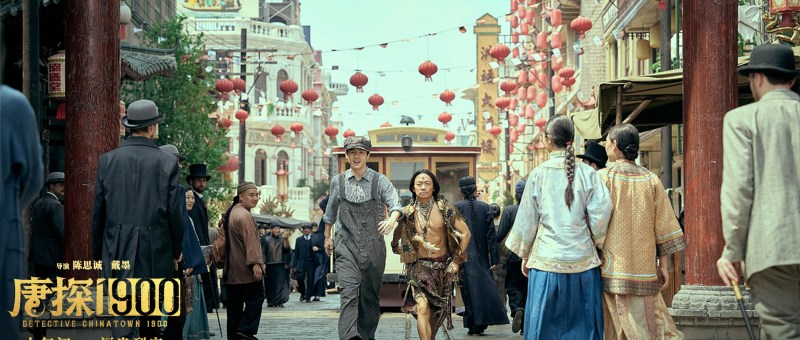
The Detective Chinatown team head back to turn of the contrary San Francisco in the latest instalment of the mega hit franchise, Detective Chinatown 1900 (唐探1900, Tángtàn 1900). Like many recent mainstream films, its main thrust is that Chinese citizens are only really safe in China, but also implies that diaspora communities exist outside the majority population and therefore can only rely on each other. Nevertheless, there’s something quite uncanny in the film’s ironic prescience as racist politicians wax on about how here rules are made by the people rather than an emperor and plaster “make America strong again” banners on their buses. 

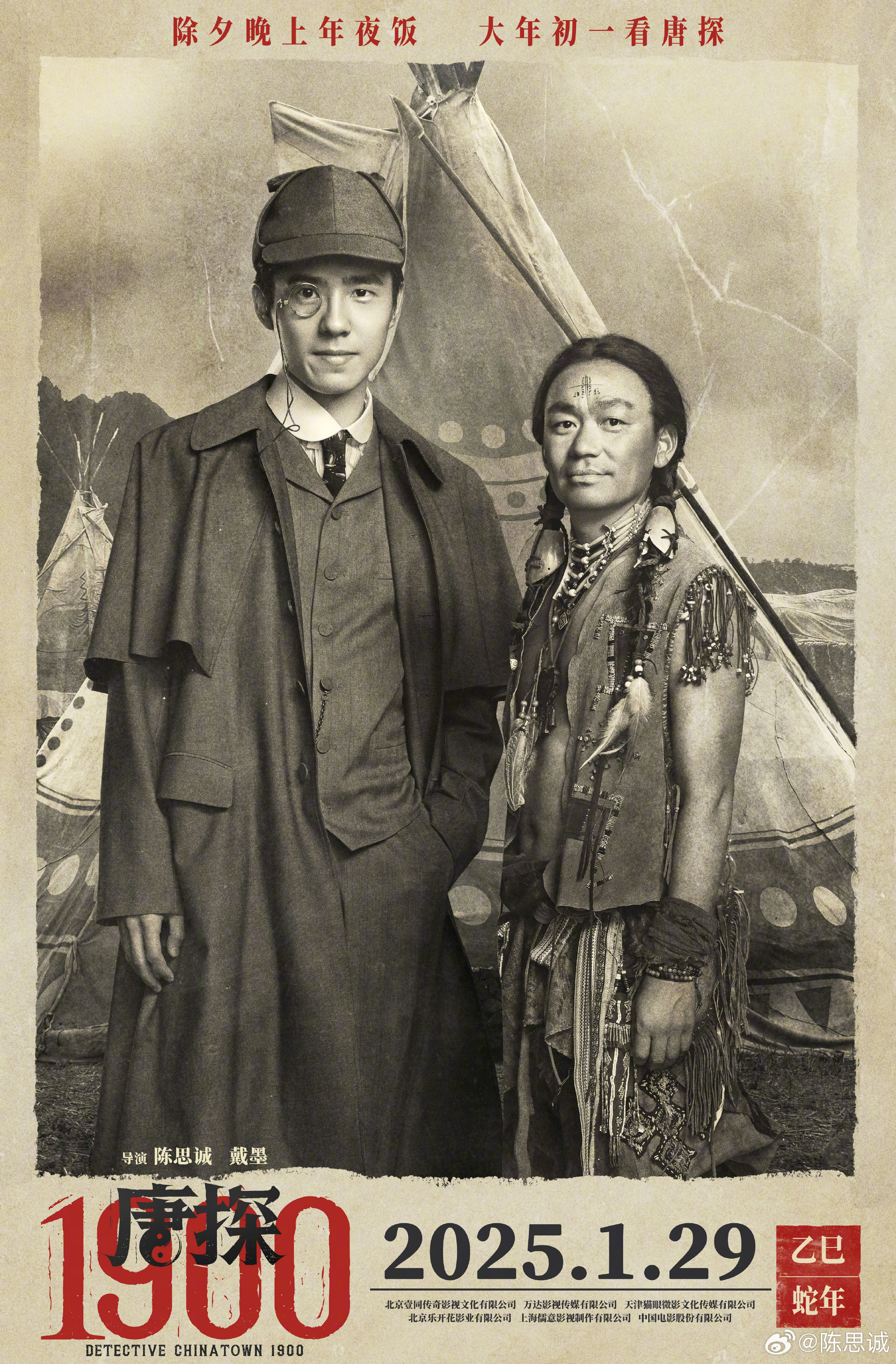
The crime here though is the murder of a young white woman, Alice (Anastasia Shestakova), the daughter of Senator Grant (John Cusack) who is attempting to push the renewal of the Chinese Exclusion Act through government and destroy all the Chinatowns in the United States. An older Native American man was also found dead alongside her. Some have attributed the crime to Jack the Ripper as Alice was mutilated before she died and some of her organs were taken. The son of local gangster Bai (Chow Yun-Fat), Zhenbang (Zhang Xincheng), is quickly arrested for the crime while his father hires Qin Fu (Liu Hairan) to exonerate him believing Qin Fu to be Sherlock Holmes. 

What Qin Fu, an expert in Chinese medicine recently working as an interpreter for the famous consulting detective, finds himself mixed up in is also a slow moving revolution as it turns out Zhenbang is involved with the plot to overthrow the Qing dynasty (which would finally fall in 1912). As the film opens, corrupt courtiers to sell off large golden Buddha statues to American “allies” who are later seen saying that they plan to fleece China and then renege on their promises to protect it. Meanwhile, the Dowager Empress has sent emissaries to San Francisco to take out the revolutionaries in hiding there including Sun Yat-sen.

Of course, in this case, the Qing are the bad guys that were eventually overthrown by brave Communist revolutionaries that paved the way for China of today which is alluded to in the closing scenes when Zhenbang’s exiled friend Shiliang (Bai Ke) says that China will one day become the most powerful country in the world implying that no-one will look down on the Chinese people again. But on the other hand, they are still all Chinese and so the emissary tells Qin Fu to “Save China” as he lays dying having met his own end shortly after hearing that the British have invaded Peking signalling the death blow for the Qing dynasty. 

Nevertheless, there is a degree of irony in the fact that the secondary antagonist is an Irish gang who have signs reading “no dogs, no Chinese,” mimicking those they themselves famously face. The Irish gang is in league with Grant and content to do his dirty work, while Bai is supported by another prominent man who speaks Mandarin and pretends to be a friend to the Chinese but in reality is against the Exclusion Act on the grounds he wants to go on being able to exploit cheap Chinese labour. In this iteration, Ah Gui (Wang Baoqiang) is “Ghost,” a man whose parents were killed building the American railroad and was subsequently taken in and raised by a Native American community. In Bai’s final confrontation with the authorities, he takes them to task for their hypocrisy reminding them how important the Chinese have been in building the society in which they alone are privileged while “equality” does not appear to extend to them.

Through reinforcing these messages of prejudice and exploitation, the film once again encourages Chinese people living abroad to return home. Though set in 1900, the scenes of protest can’t help but echo those we’ve seen in the wake of the Covid-19 pandemic when racist hatred towards Asian communities has become much more open and pronounced. Qin Fu and Ghost do at least succeed in solving the mystery through scientific principles while ironically assisted by an earnest American policeman who says he thinks it’s important to uphold the law even as we can see the head of the golden Buddha sitting behind the victorious politician’s banquet table and realise that in reality taking out Grant has made little difference for the Exclusion Act will still be renewed (it was repealed only in 1943). They may have saved Chinatown, but Bai must sacrifice his American wealth and return to China much the way he left it having reflected on his life in light of the revolutionary course charted by his more earnest son. As Ghost and Qin Fu remark, if things were better there no one would want to come here though they themselves apparently elect to stay, solving more crimes and making sure that their descendants know they were here and where they were from.


International trailer (Simplified Chinese / English subtitles)
Ride On (龙马精神, Larry Yang, 2023)

“Jumping down is easy, stepping down is hard” an ageing stuntman reflects in Larry Yang’s meta Jackie Chan vehicle Ride On (龙马精神, lóngmǎjīngshén). The Chinese title, like the English, may hint at late career resurgence but the film at times feels more like a swan song for Chan himself as it lovingly looks back at some of his greatest action hits while gently suggesting that his era may have passed in this new age of CGI and greater awareness of health and safety regulations. 

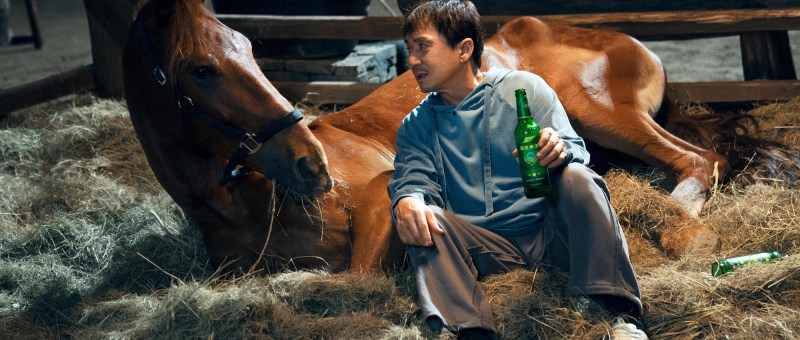
That does certainly seem to be the case for his stand-in, Luo, who has fallen on hard times following serious injury and financial ruin. These days he mainly works as an extra and supplements his income posing for photographs with his beloved horse Red Hare whom he saved from being euthanised at birth and has raised since he was a foal. When the twin forces of vicious loansharks and a weird, wealthy businessman who collects horses come calling for Red Hare it’s like they want to take the last dregs of Luo’s legacy away from him all of which forces Luo to reconnect with his estranged daughter Bao (Liu Haocun), a law student engaged to a rookie lawyer. 

The familial themes play into those of celebrating the brotherhood of stuntmen (and one woman) as one large family who must necessarily take care of each other given that their line of work is incredibly high risk. Yet it’s also true that Luo’s reconciliation with Bao seems to come too easily given her original animosity towards him for being unable to play the role of father to her seeing as her parents separated when she was an infant and she’s met him only a handful of times in her life. Nevertheless, she’s quickly won over by Red Hare even if perhaps identifying a little with him as Luo refers to the horse as his “son” only to belatedly realise that he may have been mistreating him by forcing him to perform dangerous stunts pretty much against his will despite his obvious affection for him. 

Likewise, Bao comes to a new appreciation of her father after watching videos of his old stunts many of which show him incurring serious injuries. The clips are all famous scenes from Chan’s movies such as the shopping mall jump from Police Story or the bus and umbrella stunt which are posited as the glory days of action cinema, yet from a modern perspective we might ask ourselves if all this risk is worth it for simple entertainment even if as Luo later suggests it’s the risk that makes the action entertaining. After getting back on the horse, literally, Luo is offered a series of new stunt jobs one of which requires him to perform a dangerous jump on a badly designed set, while on another he’s told he doesn’t need to perform the dangerous part because they’ll fill in the rest with CGI. Luo is outraged and insists on performing the stunt in camera only to think better of it when considering that he’s making a decision on Red Hare’s behalf that he might not have the right to make. 

The film laments the passing of the age of daredevil stuntmen, but there is a minor irony in the fact that Ride On makes fair use of CGI itself as it fully admits in the closing outtakes which feature several stagehands dressed in green to be erased later. It’s also less a celebration of stunt people than it is of Chan himself and his legendary career as an action star which may be nearing its end which would be fair enough seeing as Chan is now 69 years and clearly making (occasional) use of stunt doubles. Nevertheless, there’s an undeniable sweetness in the relationship between Bao and her fiancé Mickey (Guo Qilin) as they commit themselves to saving Red Hare and forge new familial bonds with the rough and ready Luo that echo the themes of familial reconciliation even if letting Luo off the hook a little too easily for his absence from his daughter’s life. “Stepping down” might be hard, but it doesn’t necessarily mean walking away completely only entering a new phase of compassion and solidarity and not least for a wily horse in search of a loving home.


Ride On is in UK cinemas now courtesy of CineAsia.

UK trailer (English subtitles)

Detective Chinatown (唐人街探案, Chen Sicheng, 2015)

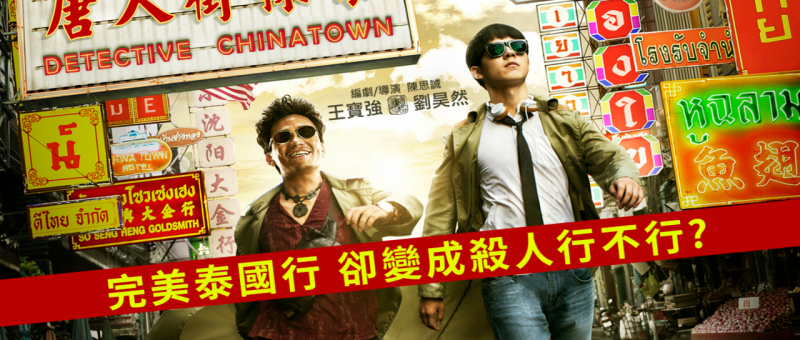
detective chinatown posterCrime exists everywhere, but so do detectives. When one young man fails his police exams because of an unfortunate impediment, he seeks refuge abroad only to find himself on a busman’s holiday when the relative he’s been sent to stay with turns out to be not quite so much of a big shot as he claimed and then gets himself named prime suspect in a murder. Detective Chinatown (唐人街探案, Tángrénj Tàn Àn) is one among many diaspora movies which find themselves shifting between a Chinese community existing to one side of mainland culture, and a mainland mentality. This time the setting is Bangkok but second time director Chen Sicheng is careful not to surrender to stereotype whilst also taking a subtle dig at men like uncle Tang Ren who can unironically refer to Thailand as a paradise while indulging in many of the aspects which might leave other residents with much more ambivalent emotions.

Qin (Liu Haoran), a young man with a fierce love of detective fiction, has his dreams shattered when his interview to get into the police academy is derailed by his stammer and an unwise tendency towards reckless honesty. His doting grandma who raised him suggests Qin take a holiday to take his mind off things by going to stay with his uncle who is, apparently, a hot shot detective in Bangkok – Qin might even get some valuable experience whilst thinking about a plan B. Sadly, uncle Tang Ren (Wang Baoqiang) has been sending big fish stories back home for years and though he claims to be the best PI in Chinatown, he’s really a petty marketplace fixer with a bad mahjong habit and a side hustle in “finding” lost dogs. When Tang Ren accepts an errand to transport a statue from a workshop, he accidentally finds himself the prime suspect in the murder of the sculptor who is himself the prime suspect in a heist of some now very missing gold. Qin, tainted by association, vows to use his awesome detective skills to find the real killer (and the gold) to clear his uncle’s name whilst generally serving justice and protecting the innocent.

Despite the fact his secret is clearly about to be exposed, Tang Ran greets his long lost relative with immense enthusiasm (which is, as it turns out, how he does everything). Wang Baoqiang commits absolutely to Tang Ren’s cynical good humour attacking his larger than life personality with gusto though one has to wonder why Qin’s poor unsuspecting grandma thought Tang Ren would be a good guardian for her teenage grandson, especially as his first act is to take him to a strip club and spike what might actually be the first real drink of his life. Qin, quiet (that stammer) and introspective, is not a good fit for the loud and brassy world of insincerity his uncle inhabits, but forced into some very challenging situations, the two men eventually manage to combine their respective strengths into a (hilariously) efficient crime fighting team.

Meanwhile, Qin and Tang Ren are also contending with some serious political shenanigans in the local police department. Two Chinese cops are currently vying for a promotion and the job has been promised to whichever of them manages to identify the murderer and locate the missing gold. Luckily or unluckily, cop 1 – Kuntai (Xiao Yang), is a good friend of Tang Ren’s and doesn’t want to believe he is secretly some kind of criminal genius (but could well believe he killed a guy by mistake). Cop 2 (Chen He) is a hard-nosed (!) type who, for some reason, dresses like a cowboy and has a crush on Tang Ren’s landlady (Tong Liya) with whom Tang Ren is also in love. What this all amounts to is that everyone is stuck running circles around each other, trapped inside the wheel of farce, while the gold and the killer remain ever elusive.

Qin, finally beginning to overcome his stammer, puts some of his hard won detective nouse to the test and eventually figures out what’s going on but, by that point, he’s also warmed to his uncle enough to let him do the big drawing room speech. Filled with slapstick and absurd humour as it is, Detective Chinatown is also a finely constructed mystery with an internally consistent solution that offers both poignancy and a degree of unexpected darkness when the final revelations roll around. It is, however, the odd couple partnership between the sullen Qin (secretly embittered) and larger than life Tang Ren (secretly melancholy) that gives the film its winning charm, ensuring there will surely be more overseas adventures for these Chinatown detectives in years in to come…


Currently available to stream in the UK & US via Amazon Prime Video.

Original trailer (English subtitles)

The Monkey King 3 (西遊記女兒國, Cheang Pou-soi, 2018)

the monkey king 3 posterSun Wu Kong and his band of merry scripture seekers will face many challenges on their journey to the West, but none so dangerous as the poison of love! Aaron Kwok reprises his role as the titular Monkey King in the third of the ongoing series directed by Cheang Pou-soi (here credited as Soi Cheang) but steps back a few paces into a supporting role while noble hearted monk Xuanzang (William Feng Shaofeng) takes centre stage to face the multifaceted dilemma of love and personal fulfilment vs the fulfilment of his quest to better the lives of all mankind. An age old problem, but one you can’t truly address until you have stake in the game.

Xuanzang, now returned and dressed in white, has a romantic destiny – something which makes him a little nervous as he happily sails along a picturesque river in the company of companions Wujing (Him Law) and Zhubajie (Xiaoshenyang) while Wu Kong (Aaron Kwok) flies along behind, apparently having mislaid his trousers somewhere along the way. All of a sudden the atmosphere darkens as the gang sail into a “demonic” area where they are attacked by a giant, whale-like river god and subsequently thrown into another dimension thanks to an intervention from the Goddess of Mercy (now played by Liu Tao in place of the series’ previous cameo from Kelly Chen).

The guys have inadvertently landed themselves in Womanland which is 100% man free. In fact men are illegal and to be executed on sight which is a bit of a problem seeing as it’s also impossible to leave. Not so much of a problem, however, as the strange moment which occurred between Xuanzang and the Queen of Womanland (Zhao Liying) as their eyes met during a near fatal fall from a cliff edge. Following the childish exuberance of the first film and the morbidly gothic horror of the second, it’s love which now threatens to derail our heroes’ quest and with it the possibility of salvation for all mankind.

Womanland was founded by a woman scorned who turned her back on faithless men forevermore, instructing her followers that men are selfish and duplicitous, that they lie to win the hearts of women which they later break in forsaking them for the next conquest. The holy scriptures of Womanland warn of the “poison of love” which is (usually, they say) spread from man to woman and leads to nothing but inescapable suffering. Foreswearing all romance (apparently there is no concept of romantic love in the all woman kingdom save the rumour that there was once a young woman who fell in love with a river she was never able to see) turns out not to be the best solution to the problem as we discover that all the ruckus in the world above is in someway caused by these repressed or denied emotions as well as by a failure to accept that sometimes feelings must be sacrificed in favour of greater responsibilities.

Whereas the second film pitted Wu Kong and Xuanzang against each other as advocates of compassion and rationality, this time Xuanzang must face a monk’s dilemma alone in deciding whether the love of one woman is equal to that of the whole of mankind. His choice is a forgone conclusion but serves to remind the monk that denying one’s true feelings is not the same as facing them and wilfully isolating oneself from possible suffering is not the same as overcoming it. The residents of Womanland discover something similar in the parallel journey of their embittered first minister (Gigi Leung) whose own unfulfilled romantic desires have made her cruel and vindictive only to be presented with another choice and find herself denying love for duty once again.

Duty, however, turns out to be warmer than it sounds – in Womanland, maternal love trumps the romantic, undercutting the otherwise progressive atmosphere of a society of women doing fine on their own with a return to maternity as central virtue of womanhood. Love is the force which threatens to undo carefully won civility (a “bourgeois affectation” as the more dogmatic definition would have it), but desire repressed rivals love scorned as a force to burn the world. Xuanzang has a choice to make, but the choice itself is not so important as the conscious act of choosing. Aside from a bizarre subplot featuring male pregnancy and forced abortion, Monkey King 3 makes a largely successful shift away from gung-ho adventuring into poignant romantic melodrama. With the gang en route to Fire Mountain, where will their journey take them next?


Currently on limited release in UK cinemas courtesy of China Lion Film.

International trailer (English subtitles)

The Monkey King 2 (西遊記之孫悟空三打白骨精, Cheang Pou-soi, 2016)

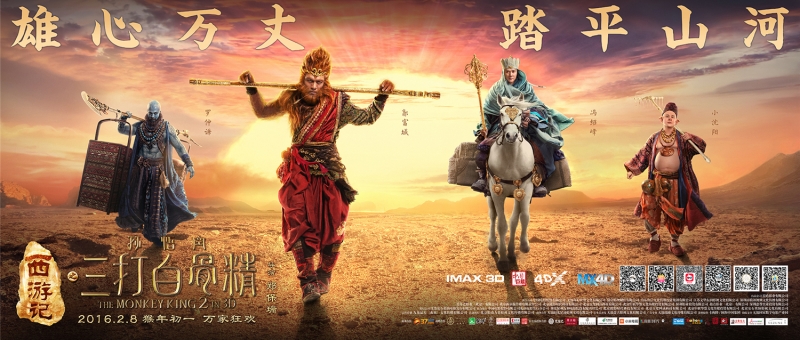
Monkey King 2 posterThe Monkey King returns! Again! This time it’s Aaron Kwok (who, confusingly enough, played the villain in the first film) picking up the staff of the titular hero for Cheang Pou-soi in place of martial arts star Donnie Yen but otherwise it’s business as usual for the mischievous Sun Wu Kong as he finally sets off on his journey to the west with the preliminaries already well sorted out. After 500 years trapped under a mountain, you’d think Wu Kong might have had some time to reflect on his behaviour but alas, there is still a very long journey ahead of him

So, 500 years after the end of the first film which saw Wu Kong imprisoned under Five Finger Mountain by the Goddess of Mercy, a young monk, Xuanzang (William Feng Shaofeng), gets himself into a sticky situation with a giant white tiger. Crawling into a crevice to hide, he finds himself face to face with Wu Kong who urges him to remove the magic tag which keeps him imprisoned. Xuanzang, little understanding what he’s letting himself in for, tugs on the tag. Wu Kong busts right out of his rocky cage and valiantly defeats the “evil demonic” tiger. Of course this is all in the grand plan envisioned by the Goddess (Kelly Chen) who has a mission for Wu Kong – escort Xuanzang to the West where he will find a set of scriptures which will unlock the truths of the world.

Monkey King 2 (西遊記之孫悟空三打白骨精) focusses on Wu Kong’s battle with the White Lady (AKA White Boned Demon, played by Gong Li) who has been nursing a deep and incurable grudge for even longer than Wu Kong was trapped under that mountain. Like Wu Kong, the White Lady was rejected by her own kind, blamed for something that wasn’t her fault and cast out as a demon to be pecked to death by vultures all alone on a rocky outcrop. You can understand why she’d be upset, but rather than an end to her suffering the White Lady wants only immortality to indulge her grudge still further. Unfortunately for Wu Kong, she has taken a fancy to Xuanzang who she thinks would make quite the tasty snack and help her live forever as a demon rather than die as a hated human – one of those who has so badly wronged her.

Wu Kong serves the Goddess of Mercy but his primary motivation in accompanying Xuanzang is to get the metal tiara he’s wearing taken off so he can misbehave again. Nevertheless, through their journey Wu Kong develops deep respect for the goodhearted monk even if they do not always see eye to eye. Wu Kong whose fiery eyes see one kind truth can recognise a “demon” when he sees one and his hardheartedness means he has no trouble killing them on sight. Xuanzang by contrast sees with his heart and is constantly troubled by Wu Kong’s desire for violence even if it’s in his name. Wu Kong sees Xuanzang’s philosophy of love and forgiveness as naive and prefers to be proactive in the face of danger (his fiery eyes do, after all, ensure he is “right” when comes to identifying demons), but Xuanzang worries that Wu Kong’s unforgiving heart creates only more suffering in a world already overflowing with negative emotions and their unfortunate effects.

It is, however, the Monkey King who is on a journey here – away from selfish mischief and towards a more responsible use of his vast powers. Wu Kong is tempted by the White Lady, seductively played by Gong Li with a strangely alluring quality of malevolence. Yet for all that (when all that sometimes means eating innocent monks and being suspected of drinking the blood children), the White Lady is not completely unsympathetic and Xuanzang’s desire to save her admirable in his commitment to lifting those in pain out of their dark places even if it comes at great personal cost to himself.

Kwok makes for a less cartoonish Monkey King than Yen, embracing the impulsivity of the unpredictable Wu Kong but also capturing something of his complicated emotional landscape as he finds himself drawing closer to Xuanzang’s way of thinking only to rebel against himself. Learning from the mistakes of the first film, Cheang ends the headache inducing sugar rush in favour of a more normal Chinese fantasy aesthetic while also ensuring the (still frequent use of) CGI is of a much better (if imperfect) quality. All in all, the second venture of the Monkey King can be counted a success which is fortunate indeed because his journey is far from over.


Original trailer (English subtitles)

https://www.youtube.com/watch?v=2uzTY7SiLSM