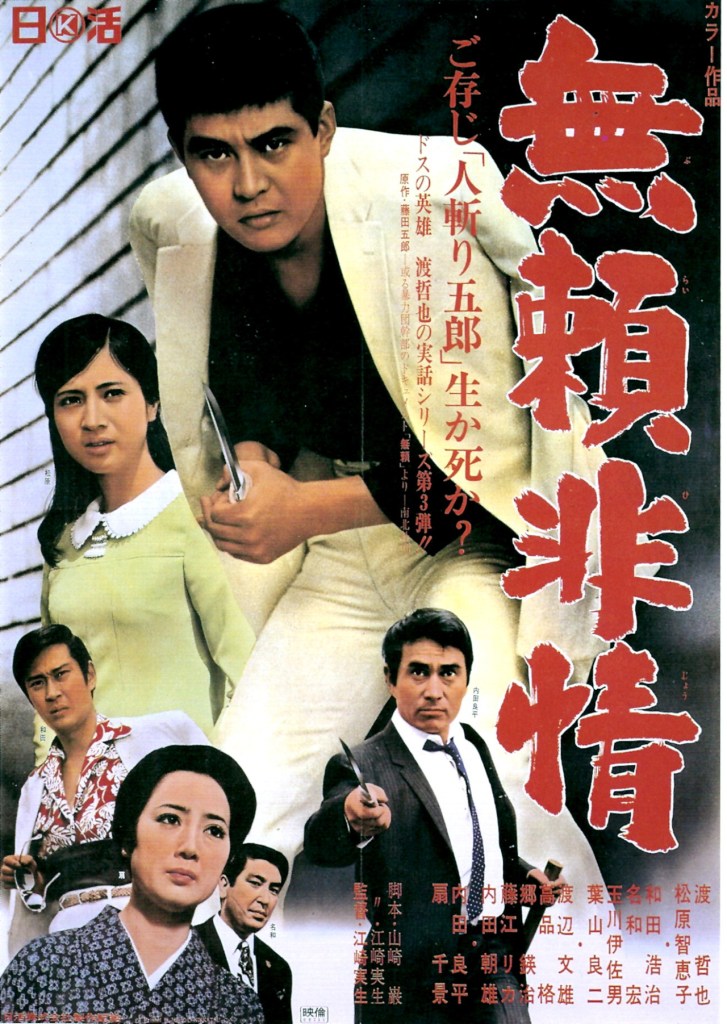
 Things take a slight detour in the third of the Outlaw series this time titled “Heartless” (大幹部 無頼非情, Daikanbu Burai Hijo). Rather than picking up where we left Goro – collapsed on a high school volleyball court, it’s now 1956 and we’re with a guy called “Goro the Assassin” but it’s not exactly clear is this is a side story or perhaps an entirely different continuity for the story of the noble hearted gangster we’ve been following so far. The only constant is actor Tetsuya Watari who once again plays Goro Fujikawa but in an even more confusing touch the supporting characters are played by many of the actors who featured in the first two films but are actually playing entirely different people….
So, it’s 1956 and this time Goro is out on a job to take out a rival gangster only he has a change of heart when the man’s wife pleads with him. Goro tells the pair to leave through the back door but one of the other gangsters turns up before they can escape and takes care of the husband whilst casting a watchful eye on the now treacherous Goro. Right before his lights go out, the murdered man tells Goro that he’s been framed as part of the boss’ gambling scam and tasks Goro with taking his sickly wife to Nagoya for medical treatment. After cleaning out the bad guys at the gambling den, Goro takes off with wife in tow and even runs into an old friend along the way but as usual nothing’s quite a simple as it seems.
If the problem with Gangster VIP 2 was staying too close to the formula established in the previous film, then Heartless perhaps attempts to overcorrect this flaw by doing something completely different. It’s really not clear how this film links in with the other two and the presence of most of the same actors playing entirely different characters is more than a little confusing to say the least, though it is a problem which occurs quite frequently with these kinds of films and is largely due to the way they were produced at studio level.
Once again the roots of restless gangsters lie post-war turmoil as the fellow ex-mobster Goro runs into is another childhood friend from the streets – Goro actually saved his life when he became dangerously ill by sneaking onto a US military base to “acquire” some penicillin (quite a canny move for a young boy, it has to be said). There’s less harking back to the theme of homes and hometowns than in the first two movies – yakuza wives take on a bigger role instead, becoming the symbol of a more normal life that is somewhat denied to both gangsters (ex or otherwise) and also burdening their husbands with the need to ensure their safety.
As in the first two films, Goro is referred to as being “different” from the regular yakuza. His potential love interest (again played by Chieko Matsubara but not as Yukiko from the other two movies) argues with her father who was also a yakuza but gave up the gangster life for love of her mother – he warns her off men of Goro’s ilk as they rarely do anything from the kindness of their hearts, but she remonstrates with him that Goro isn’t that kind of gangster. This time he’s also carrying around a bracelet that belonged to an old flamed called “Natsuko” that we haven’t heard of before but gives his pleas not to take a man like him to heart a little more weight.
Heartless is the only film in the series to be directed by Mio Ezaki (the first being directed by Toshio Masuda and the others by Keiichi Ozawa) and has little of the visual style of the first two movies though the title sequence of Goro single handedly raiding the gambling den proves a stylish early highlight. In keeping with the other two films we still have a large scale fight sequence nearing the finale which is played against the song of a cabaret singer and there’s even a little strange slapstick as the final fight ends up in some kind of decorators’ warehouse with everyone sliding around and getting covered in paint. After taking care business Goro tries to exile himself again, staggering off in an uncertain direction whilst the song playing extols the lonely fate of a “wandering man” which is perhaps the only heart he carries – the ruined heart of a “heartless” man with no roots or anchor to tie him home, a wanderer with no clansmen and no hope of salvation.
Outlaw: Heartless is the third of six films included in Arrow films’ Outlaw: Gangster VIP The Complete Collection box set (which is region free on DVD and blu-ray and available from both US and UK).
English subtitled original trailer:
 Sogo (now Gakyruu) Ishii was only 20 years old when Nikkatsu commissioned him to turn his smash hit 8mm short into a full scale studio picture. Perhaps that’s why they partnered him with one of their steadiest hands in Yukihiro Sawada as a co-director though the youthful punk attitude that would become Ishii’s signature is very much in evidence here despite the otherwise mainstream studio production. That said, Nikkatsu in this period was a far less sophisticated operation than it had been a decade before and, surprisingly, Panic High School (高校大パニック, Koukou Dai Panic) neatly avoids the kind of exploitative schlock that its title might suggest.
 Windows on Worlds