Okuni and Gohei (お國と五平, Mikio Naruse, 1952)

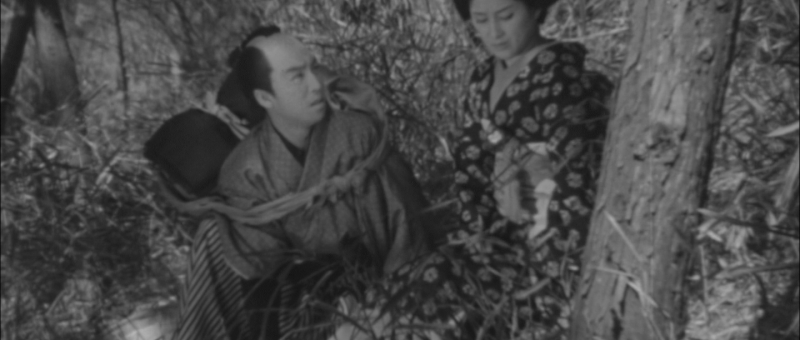
“It’s a rough and difficult road.” The heroes of Mikio Naruse’s Okuni and Gohei (お國と五平, Okuni to Gohei), adapted from a kabuki play by Junichiro Tanizaki, are two displaced between the old world and the possibility of a new one if only they were brave enough to step away from the beaten path. Unbeknownst to them, they are being followed by the man they are seeking whose shakuhachi playing haunts them wherever they go as if taunting them with its presence. 

In this iteration of the tale, Tomonojo (So Yamamura) takes on a slippery quality almost if he were some supernatural devil sent to torment Okuni (Michiyo Kogure) and Gohei (Tomoemon Otani) leading them either towards or away from their salvation or damnation. In Okuni’s flashback, which is obviously coloured with her own nostalgia and regret, he’s a sensitive young man who promised himself in marriage to Okuni. But she is forced to refuse him. Her father rejects Tomonojo because he is without standing or prospects, and instead demands she marry a wellborn man of his choosing, Iori (Jun Tazaki). Iori is then killed in the street, uttering only Tomonojo’s name before he dies. It could then be that this is Tomonojo’s revenge on a society that has rejected him and robbed him of his love, yet the Tomonojo we later meet is much different than this idealised version in Okuni’s memory. He never denies killing Iori and offers no justification for it, but corners Okuni when she’s alone to tell her to free herself by dropping her quest for revenge. He’s also subtly blackmailing her, implying he heard her having sex with her manservant Gohei the previous night and in reality wheedling away pleading for his life.

For her part, Okuni seems torn in her motivations, uncertain whether she’s looking for Tomonojo to reunite with him or kill him, or perhaps is deliberately avoiding finding him at all. She was not married to Iori for very long and he was at the very least an insensitive and emotionally distant husband who spent most of his time at his friend’s house, claiming that it was “boring” to stay home with her. She has no great emotional desire for revenge, but has been told she must accomplish it in order to return to the samurai world, having been condemned to a kind of limbo as the widow of a murdered man. Even so, she has tired of her quest and asks herself what’s to become of them if Tomonojo is already dead. She repeatedly hints to Gohei that they should give up on finding him and on returning home, instead contenting themselves with their life on the road or else find somewhere to settle together in a new world in which a lady and her retainer could live as man and wife.

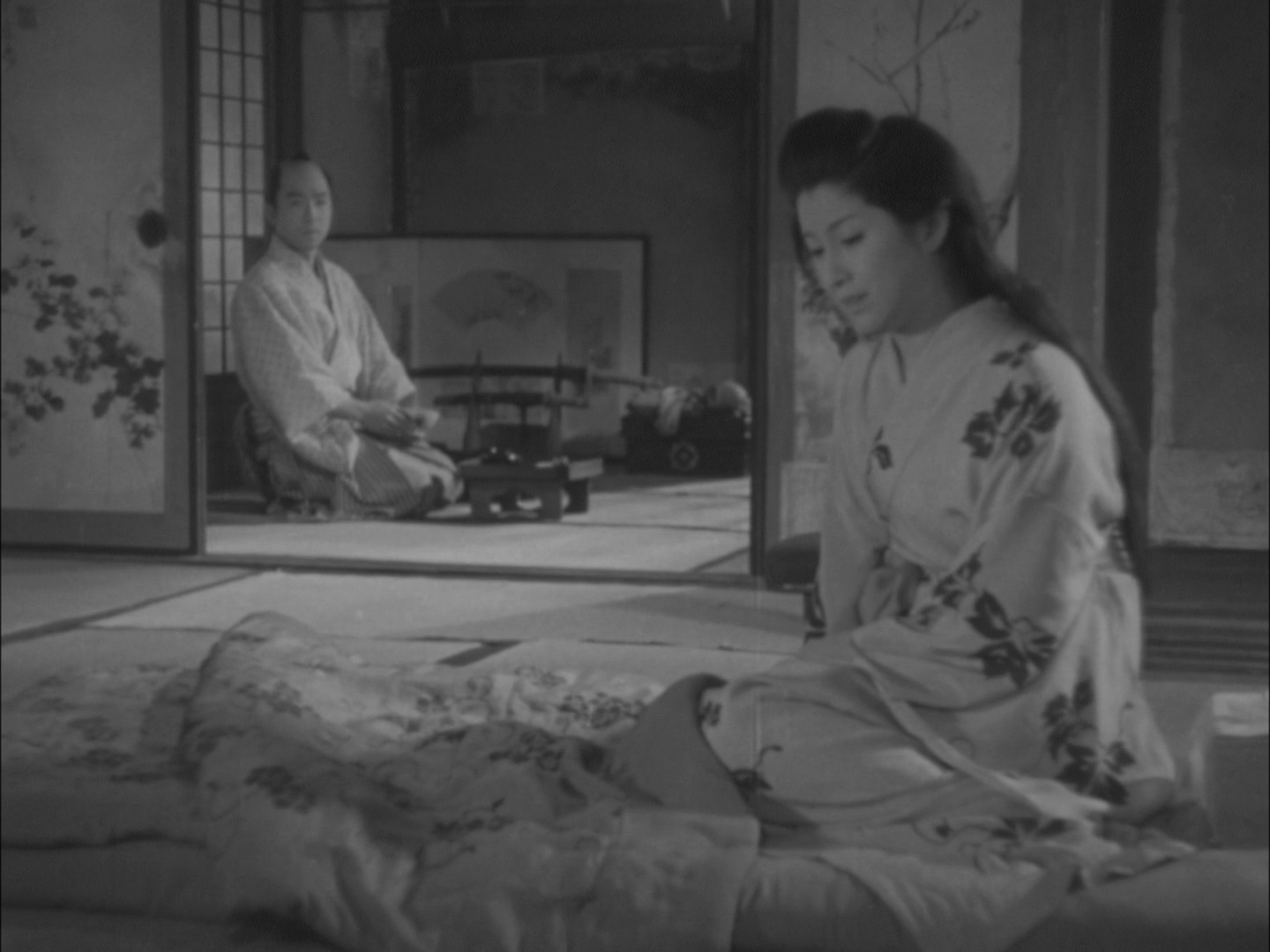
The film is both coy and somewhat transgressive in its depiction of the growing sexual tension between Okuni and Gohei from his taking hold of her injured foot and tender care for her when she falls ill, to the way they draw closer and then instinctively move apart. Passion later gets the better of them and it’s heavily implied that they sleep together, but Gohei instantly regrets it and cannot accept his class transgression. Given this development in their relationship, Okuni asks him to stop calling her “madam” but as she does so she is on one side of the fusuma and he on the other, so they remain in separate rooms divided by the ridge in the tatami. Gohei cannot let go of the old ways and is desperate to complete their quest so that his debt to Iori will be repaid and he can return in glory to be rewarded with position and the esteem of being a true samurai. Even if he tells Okuni that this quest has been his happiness in being on the road with her and knows that killing Tomonojo will end it, he does not turn back.

But the implication is that they can never escape Tomonojo who will, in fact, forever be following them. He taunts the pair with his shakuhachi and visits them in disguise. When they catch up to him, he tries again to convince them to give up their quest and live quietly together in a place free from the constraints of the samurai world, but Gohei cannot do it. Okuni first picks up her dagger and one wonders whether she about to use it on herself, but then turns on Tomonojo though it’s uncertain whether she now does so out of resentment or as revenge of herself for the way Tomonojo has again ruined her life. Just as she was a pawn of her father married off against her will to an indifferent man, she is further imprisoned by patriarchal social codes as Tomonojo needles Gohei that he had slept with her before her marriage. She has in fact already confessed to this to Gohei who transgressed by asking her what exactly Tomonojo was doing with his “shakuhachi” when they were courting, though she did so obliquely in telling him to remember his place and that he should “forget about the past.” Nevertheless she denies it now, but Gohei continues to see her as a “loose” woman with Tomonojo’s words ringing in his ears as a final revenge on the morally compromised lovers.

Their inability to let go of the quest, to do as Okuni suggests and continue on as they are along the rough and difficult path to a more egalitarian future spells their damnation. You can’t go back again. Their “home” is already lost to them. As a pedlar tells the pair along the way, they’ve already been forgotten and the village is filled with other gossip, but now they really have nowhere to go. The message may be for the coming post-occupation era that they shouldn’t try to turn back but keep moving forward into the new Japan or else risk becoming lost in a purgatorial world of confusion like Okuni and Gohei haunted by the choice to betray love for the outdated ideal of samurai honour. Haunted alternately by Tomonojo’s shakuhachi and the words of the villagers who told them they couldn’t be accepted until they fulfilled this quest, they find themselves displaced, unbalanced and uncertain amid the shifting power dynamics of class and gender, their duty and their feelings, but ultimately trapped by their cowardice in their unwillingness to cross the threshold to claim their freedom and happiness.

Husband and Wife (夫婦, Mikio Naruse, 1953)

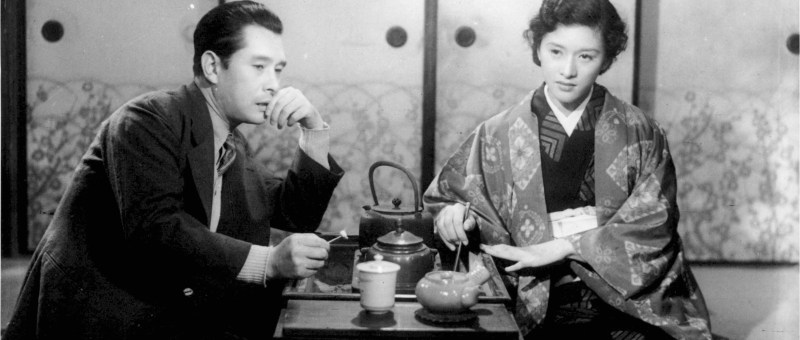
Kikuko (Yoko Sugi) climbs the stairs to the roof of a department store and pauses at the top looking down on her friends below, but they appear to be looking down on her. They’re disappointed. She looks so “provincial”, even though she has no children and therefore more time to spend on herself. They’re envious of her “freedom” to return home late while they have to get back to their husbands or in-laws, but Kikuno isn’t really free at all while trapped in a stifling marriage to the incredibly dull and petulant Isaku (Ken Uehara). 

One of a series of films about marriage and originally envisaged as a sequel to Repast until Setsuko Hara fell ill, Husband and Wife (夫婦, Fufu) paints a rather bleak picture of married life even by Naruse’s standards. The couple are quite literally but also spiritually “homeless” in that they cannot find a home to share, while the absence of a domestic space to call their own prevents them from solidifying their marriage. They’re pushed out of Kikuko’s parents’ home because her brother’s getting married and they need the space, but Isaku drags his feet over finding somewhere else and leaves much of the legwork to Kikuko alone. The main problem seems to be that Isaku can’t afford anything decent, which places a strain on his male pride, but in a repeated motif, rather than confront the situation, he ignores it completely and then crassly presses his recently widowed colleague to let them rent a room in his now much emptier house. 

It’s a mystery why Isaku has so many financial problems when he and Takemura (Rentaro Mikuni) work for the same company, save that Isaku had evidently spent some time working in the provinces, and his colleague had already bought a home with no apparent money worries, but it further sets the two men apart and fuels Isaku’s sense of inadequacy. Having returned from a leave of absence following his wife’s death, Takemura is grief-stricken and apparently uxorious. He complains that he’ll never find another woman like his late wife, all while Isaku won’t shut up about the house and others relentlessly encourage him to remarry. Nevertheless, after the couple move in with him, a natural connection arises between Kikuko and Takemura who is Isaku’s total opposite, both in his treatment of Kikuko and general personality. Where Isaku is sullen and resentful, Takemura is cheerful despite his grief and generous of spirit. Kikuko effectively becomes a wife to both men, taking care of each of them by cooking and cleaning, but while Takemura goes out of his way to thank her, all Isaku does is run her down and humiliate her in front of company.

Then again, having fallen in love with Kikuko precisely because she is a “proper wife,” Takemura then runs his own late wife down by complaining that she wasn’t very pretty and couldn’t cook. The only thing she had going for her was her health, and then she died. He says got a bum deal, and that Kikuko has shown him a different side of womanhood. When two colleagues come to the house and compliment Kikuko’s cooking but are surprised when she eats nothing herself (because they have no money), Isaku responds to their assertion that it’s difficult to be a housewife by replying that men work hard all day while women “only” have to look after the house. For her part, Kikuko says that she was happier when she was working. Men can fall in love several times, but once a woman’s married her romantic life is over. As her friend tells her, men soon get bored of their wives and hers has already taken a mistress at work. 

At several points and with the women in earshot, the men warn each other about the pitfalls of marriage. Irritated that Kikuko has returned to their home on New Year’s Eve after becoming fed up with Isaku, her father advises her brother that women show their true faces after six or seven years and it’s going to horrify him. Isaku tells him not to be too nice or obedient during the early days because his wife will get used to it, while Kikuko counters that men are overgrown children and as long as you make sure to cradle them like babies everything will be fine. Neither of them seem to have a very positive idea of what marriage should be and frame it almost in terms of a war in which they are continually at odds with each other. Isaku describes a husband and wife as a pair of scissors, intending it as a positive metaphor about how one half can’t cut alone, before reframing it as two knives coming together. He becomes unpleasant and chauvinistic, blaming Kikuko for everything by complaining that it’s her fault that he wears a torn up old coat that causes him some embarrassment in front of his boss and a tactless geisha, while criticising her for not having the bath ready when he comes home tired from working all day. Kikuko points out that men seem to assume they’re the only ones who get tired while her loved up brother swears he’ll be different and even if they’re in the honeymoon phase, they do seem much happier and more suited than the already resentful Kikuko and Isaku.

It’s the sister-in-law who throws them a lifeline by introducing them to a relative looking to rent a vacant room, allowing them a means to save their marriage by leaving Takemura’s house. Increasingly resentful of the growing attachment between Kikuko and Takemura, Isaku starts avoiding coming home and hanging out with a young woman at the office with, at least, the danger of a burgeoning affair for which he’s taken to task by Takemura. As Takemura says, it’s not much of a marriage if Isaku can’t trust his wife while Kikuko is eventually so sick of the cold shoulder and constant denigration that she considers leaving him. The new apartment finally gives them a domestic space they can call their own, but it comes with the caveat. The landlady doesn’t allow children because the tenant next door is an ikebana teacher who demands peace and quiet, but Kikuko is in fact already pregnant which might present another means of saving their marriage by becoming a family but Isaku immediately rejects it. He complains he doesn’t have any more money to move again and tells Kikuko to get an abortion, strong-arming her when she refuses. Kikuko can’t go through with it and the nicest thing Isaku says to her in the entire picture is that they can go home, he’s giving in and will raise the child even if it’s difficult. But even this bittersweet moment seems more like condemning them to marriage rather than repairing their relationship with Isaku only grudgingly accepting, most likely because he realises that his marriage is dead anyway if he forces Kikuko to give up their child against her wishes. Despite the changing season, the air between them remains frosty, and marriage is exposed for the prison that it is trapping each of them in loneliness and resentment rather than bringing them together in joy as they prepare to become a family rather than just husband and wife.


Husband and Wife  screened at Japan Society New York as part of Mikio Naruse: The World Betrays Us – Part I.

Tokyo Profile (都会の横顔, Hiroshi Shimizu, 1953)

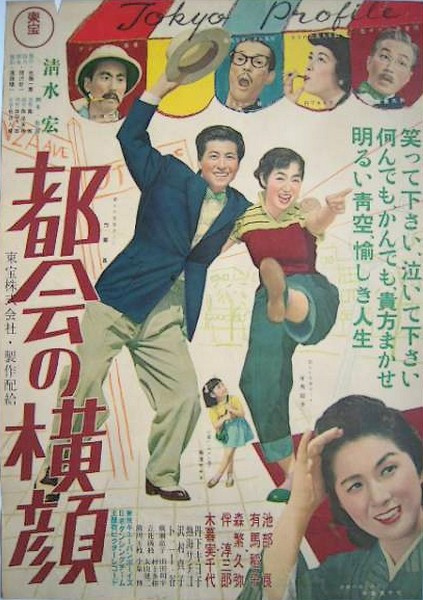
Tokyo Profile posterJudging by the vision presented in the cinema of the time, the Japan of 1953 was one still fighting to emerge from post-war disillusionment and destruction. Set in the glittering Ginza, Hiroshi Shimizu’s Tokyo Profile (都会の横顔,Tokai no Yokogao) is, like much of the director’s work, a more cheerful affair. This world is a very different one from the dingy attics and rundown tenements of the average social drama in which the struggling urban poor battle economic impossibilities while earnestly investing in their future, a somewhat barbed aspirational comedy which lays bare the increasing gap between rich and poor but in a humorous, perhaps resigned fashion save for its strangely cutting finale.

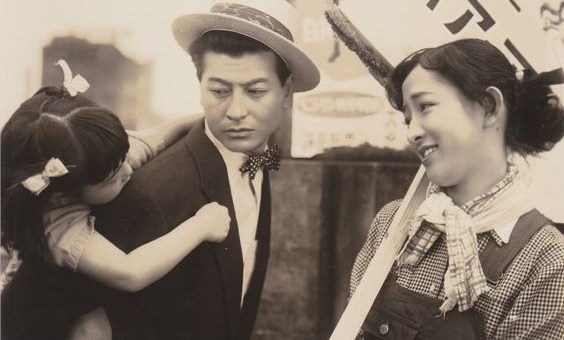
Shooting once again almost entirely on location, Shimizu opens with a lengthy shot captured from the back of a tram traveling through contemporary Ginza – then and now an elegant and refined part of town home to numerous upscale department stores from all around the world. It’s an ordinary Saturday afternoon and the streets are only middling busy. A crowd has gathered around something mysterious, gradually attracting more people and becoming a spectacle in its own right. Thankfully there hasn’t been an accident. A shoeshine girl (Ineko Arima) is trying to comfort a crying child, Michiko (Sachiko Atami), who has become separated from her mother. Michiko is five years old and knows her parents’ names by rote, but all she can tell the concerned people trying to help about her home is the general vicinity it might be located in and that it’s next to Yoshiko’s house, which is not very helpful. Luckily a young man, nicknamed “Mr. Sandwich”  (Ryo Ikebe) because he’s one of Ginza’s many sign carriers, offers to take her to the police station while looking around and attracting attention with his sign (and patented silly walk) in case they spot her mum in the street.

Meanwhile, Michiko’s mother Asako (Michiyo Kogure) is wandering around frantically terrified she might never see her daughter again. Unfortunately she is accosted by a pushy neighbour who promises to help her look for Michiko but keeps pulling her into other business before finally landing her with the bill for two cream sodas which, needless to say, she cannot afford (and didn’t even want).

Michiko and her family are from Meguro which is quite a way out from the centre of the city and one gets the impression this is quite a rare day out for them. Michiko is very excited when she tells the shoeshine girl that they came to buy her a hat and a pair of red shoes, but as we later hear from Asako, Michiko’s presents are tiny splash of luxury in an otherwise economically anxious home. Shinji, Michiko’s father, was a Lieutenant-Commander during in the war but like many of his generation found himself unwanted after its end and struggled to find proper employment. Much to the family’s relief, he’s recently got a steady job as an accountant, but it still doesn’t pay enough to live on. Wanting to buy summer clothes for the children, Shinji worked overtime and walked to work rather than taking the train but little Yoshiko’s parents have bought her little red shoes and now Michiko wants a pair too. Doting parents, Asako and Shinji feel dreadful that they aren’t able to buy their daughter the things that other children have, but today she’s come to Ginza to see what she can do with what she has (which isn’t much either way).

Shimizu follows Michiko as she travels round the city with various adults looking for her mum but also having a grand adventure. Though she was originally quite distressed, Michiko is a clever little girl and quickly decides to start having fun instead of being sad. The sandwich man takes her all around Ginza, bumping into various people that he knows including a philandering boyfriend and the girl waiting for him, the girl he was with who has several boyfriends but has the most fun when standing them up, a shady gangster type not normally around during the day (he’s on his way to Osaka), and a geisha girl who’s taking classes in English for the “service” industry from an extremely camp instructor.

The irony is that Michiko and her family aside, the sandwich man, shoeshine girl, and everyone else they meet are people with no money who earn their living on the streets where rich people come to play. The gangster offers sandwich man a cigarette and he takes it, only to consider throwing it away when he sniffs it and realises it’s a cheap and nasty variety. Meanwhile, Asako’s horrible neighbour convinces her to ask a streetside psychic to help finding Michiko but he keeps interrupting their consultation to chase after discarded cigarette butts which he puts in a big pot and later smokes with the help of his pipe-like cigarette holder. The people who come to Ginza to play don’t care about smoking their cigarettes down to the last because they know they can buy more. Streetside psychics can’t even afford to buy any.

Nevertheless, no one seems to be unhappy with their life in Ginza. Sandwich man is nursing a crush on shoeshine girl which she might or might not return. So obviously good with children he longs for many, which is a problem because the one thing shoeshine girl dislikes about the city is that there are too many people – she only wants two. His desire for a big family means he doesn’t envisage spending the rest of his life as a sandwich man, but then it seems to be alright for the time being while he waits for something better to come along (which he seems to think it will). Shimizu takes us on a jaunty journey through the glitzy Ginza, taking in the musical halls and cafes while now famous tunes celebrating the area play unironically in the background, but as much as he celebrates the aspirational swankiness of the recovering city he’s always keen to remind us that not everyone who lives here lives in the same world and little girls like Michiko risk getting left behind for good if no one stops to think about that.