
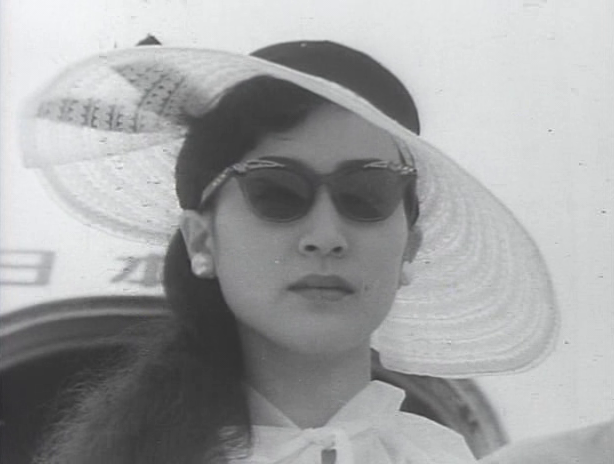
Revenge of the Pearl Queen (女真珠王の復讐, Toshio Shimura, 1956)

Born amid the labour disputes that engulfed Toho in the late 1940s, Shintoho began as a rather lofty endeavour mostly geared towards artistic films, but after a series of box office failures was soon in the red. Impresario Mitsugu Okura was brought in to turn the company around, but his ethos was decidedly populist. He shifted the studio away from the auteurist focus of its early days towards the racy dramas and ghost films with which it would become associated. 

Revenge of the Pearl Queen (女真珠王の復讐, Onna shinju-o no fukushu) was key to this transformation and made a star out of its leading lady Michiko Maeda who had been discovered working in the kimono department of the Mitsukoshi department store. Though sometimes billed as the first mainstream feature to depict full female nudity, what it really sells is the promise rather than the reality. The nudity in the film is generally abstract or artistic, shooting Maeda from behind and at a distance amid nature or capturing brief shots of her rear as her skirt flutters in the wind. Otherwise, she is seen in loose, torn clothing or with her hands covering her bare breasts as she, ironically, tries to escape from a series of men trying to assault her.

Adapted from a novel by Yoshihisa Aoki, the film is also inspired by a real life incident in which a group of men and one woman were marooned on Anatahan island at the end of the war. The men eventually ended up killing each other over the woman. The same incident inspired the 1953 film by Josef von Sternberg. Natsuki (Michiko Maeda), an office worker, is engaged to diligent employee Kizaki (Ken Utsui) and about to undertake a trip abroad with her boss, Asamura (Susumu Fujita). An early scene sees their passports arrive with some fanfare as it was still difficult at this time for ordinary people to acquire one or indeed to travel outside of Japan. But it soon turns out that her boss has an ulterior motive. Kizaki is framed for the murder of the company president, while Asamura first attempts to blackmail Natsuki into entering a sexual relationship with him, then tries to assault her when she refuses. She manages to get away from him, but he chases her and she ends up being thrown overboard.

She then washes up on an island and is “rescued” by five shipwrecked sailors. Three of them are desperate to rape her, while the oldest of the men Ishizuka (Saburo Sawai) is against it and tries to protect her along with his son-in-law to be Yuzo (Shigeru Amachi). Ishizuka takes the men to task and asks them how they could show their faces in Japan having done something so heinous, but they just laugh at him. In some ways, this seems to be an echo of wartime atrocities and the fishermen stand-ins for men who did terrible things overseas and then were able to forget about it and live normal lives in post-war Japan. The same is true of Asamura whose wartime service in intelligence is often referenced, though his subordinate Noguchi (Tetsuro Tanba) later suggests he’s embellished his record. Asamura isn’t even his real name, though he’s been able to build a business empire for himself largely based on fraud, tax evasion, forgery, and apparently also drug smuggling. He used Kizaki as a foil to kill his boss and take over the company, while hoping to also bed Natsuki at the same time.

Nevertheless, after the three aspiring rapists turn on each other and are killed, Natsuki discovers a wealth of riches under the sea while attempting to save one of them from a whirlpool. Spending her entire time diving for pearls, she becomes incredibly wealthy and is able to rebrand herself as “Helen Minami”, a Japanese-American “pearl queen”, on her return to Japan. Sharing her riches with Ishizuka and Yuzo, the trio plot revenge hoping to clear Kizaki’s name and expose Asamura’s corruption. They use the money to attack them through the stock market while also discouraging their clients from doing business with them until the company is finally on its knees. The crows are coming home to roost for Asamura with Natsuki returning to expose all his wrong doing, though such occurrences were perhaps rare for other men like him in reality. By reinventing herself, Natsuki is at least able to cure this corruption and restore her innocent connection with Kizaki in a dramatic nightclub showdown in which justice is finally served.
Tokyo Profile (都会の横顔, Hiroshi Shimizu, 1953)

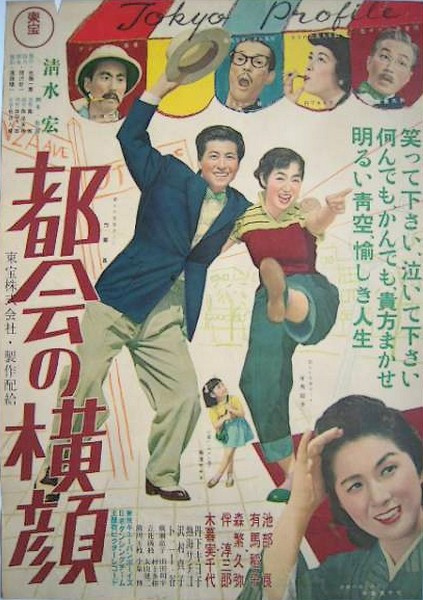
Tokyo Profile posterJudging by the vision presented in the cinema of the time, the Japan of 1953 was one still fighting to emerge from post-war disillusionment and destruction. Set in the glittering Ginza, Hiroshi Shimizu’s Tokyo Profile (都会の横顔,Tokai no Yokogao) is, like much of the director’s work, a more cheerful affair. This world is a very different one from the dingy attics and rundown tenements of the average social drama in which the struggling urban poor battle economic impossibilities while earnestly investing in their future, a somewhat barbed aspirational comedy which lays bare the increasing gap between rich and poor but in a humorous, perhaps resigned fashion save for its strangely cutting finale.

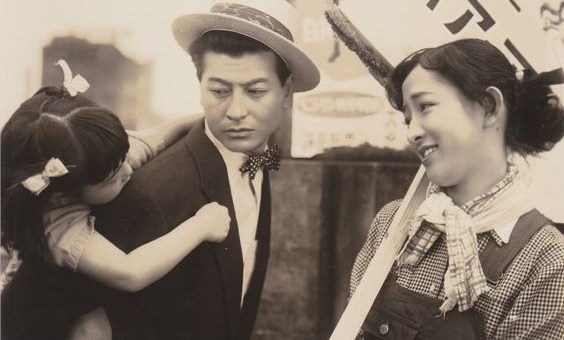
Shooting once again almost entirely on location, Shimizu opens with a lengthy shot captured from the back of a tram traveling through contemporary Ginza – then and now an elegant and refined part of town home to numerous upscale department stores from all around the world. It’s an ordinary Saturday afternoon and the streets are only middling busy. A crowd has gathered around something mysterious, gradually attracting more people and becoming a spectacle in its own right. Thankfully there hasn’t been an accident. A shoeshine girl (Ineko Arima) is trying to comfort a crying child, Michiko (Sachiko Atami), who has become separated from her mother. Michiko is five years old and knows her parents’ names by rote, but all she can tell the concerned people trying to help about her home is the general vicinity it might be located in and that it’s next to Yoshiko’s house, which is not very helpful. Luckily a young man, nicknamed “Mr. Sandwich”  (Ryo Ikebe) because he’s one of Ginza’s many sign carriers, offers to take her to the police station while looking around and attracting attention with his sign (and patented silly walk) in case they spot her mum in the street.

Meanwhile, Michiko’s mother Asako (Michiyo Kogure) is wandering around frantically terrified she might never see her daughter again. Unfortunately she is accosted by a pushy neighbour who promises to help her look for Michiko but keeps pulling her into other business before finally landing her with the bill for two cream sodas which, needless to say, she cannot afford (and didn’t even want).

Michiko and her family are from Meguro which is quite a way out from the centre of the city and one gets the impression this is quite a rare day out for them. Michiko is very excited when she tells the shoeshine girl that they came to buy her a hat and a pair of red shoes, but as we later hear from Asako, Michiko’s presents are tiny splash of luxury in an otherwise economically anxious home. Shinji, Michiko’s father, was a Lieutenant-Commander during in the war but like many of his generation found himself unwanted after its end and struggled to find proper employment. Much to the family’s relief, he’s recently got a steady job as an accountant, but it still doesn’t pay enough to live on. Wanting to buy summer clothes for the children, Shinji worked overtime and walked to work rather than taking the train but little Yoshiko’s parents have bought her little red shoes and now Michiko wants a pair too. Doting parents, Asako and Shinji feel dreadful that they aren’t able to buy their daughter the things that other children have, but today she’s come to Ginza to see what she can do with what she has (which isn’t much either way).

Shimizu follows Michiko as she travels round the city with various adults looking for her mum but also having a grand adventure. Though she was originally quite distressed, Michiko is a clever little girl and quickly decides to start having fun instead of being sad. The sandwich man takes her all around Ginza, bumping into various people that he knows including a philandering boyfriend and the girl waiting for him, the girl he was with who has several boyfriends but has the most fun when standing them up, a shady gangster type not normally around during the day (he’s on his way to Osaka), and a geisha girl who’s taking classes in English for the “service” industry from an extremely camp instructor.

The irony is that Michiko and her family aside, the sandwich man, shoeshine girl, and everyone else they meet are people with no money who earn their living on the streets where rich people come to play. The gangster offers sandwich man a cigarette and he takes it, only to consider throwing it away when he sniffs it and realises it’s a cheap and nasty variety. Meanwhile, Asako’s horrible neighbour convinces her to ask a streetside psychic to help finding Michiko but he keeps interrupting their consultation to chase after discarded cigarette butts which he puts in a big pot and later smokes with the help of his pipe-like cigarette holder. The people who come to Ginza to play don’t care about smoking their cigarettes down to the last because they know they can buy more. Streetside psychics can’t even afford to buy any.

Nevertheless, no one seems to be unhappy with their life in Ginza. Sandwich man is nursing a crush on shoeshine girl which she might or might not return. So obviously good with children he longs for many, which is a problem because the one thing shoeshine girl dislikes about the city is that there are too many people – she only wants two. His desire for a big family means he doesn’t envisage spending the rest of his life as a sandwich man, but then it seems to be alright for the time being while he waits for something better to come along (which he seems to think it will). Shimizu takes us on a jaunty journey through the glitzy Ginza, taking in the musical halls and cafes while now famous tunes celebrating the area play unironically in the background, but as much as he celebrates the aspirational swankiness of the recovering city he’s always keen to remind us that not everyone who lives here lives in the same world and little girls like Michiko risk getting left behind for good if no one stops to think about that.