The Lost Alibi (黒い画集 あるサラリーマンの証言, Hiromichi Horikawa, 1960)

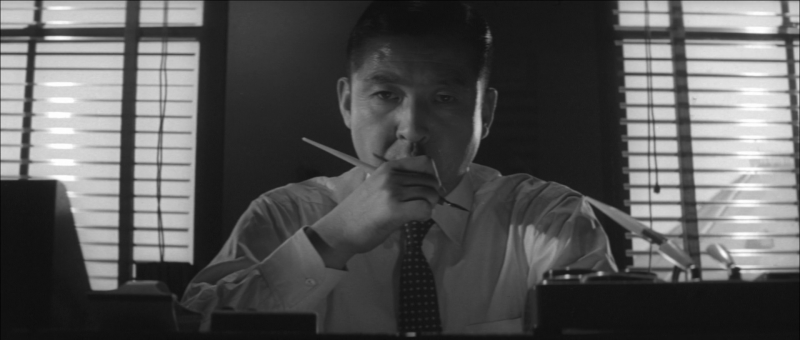
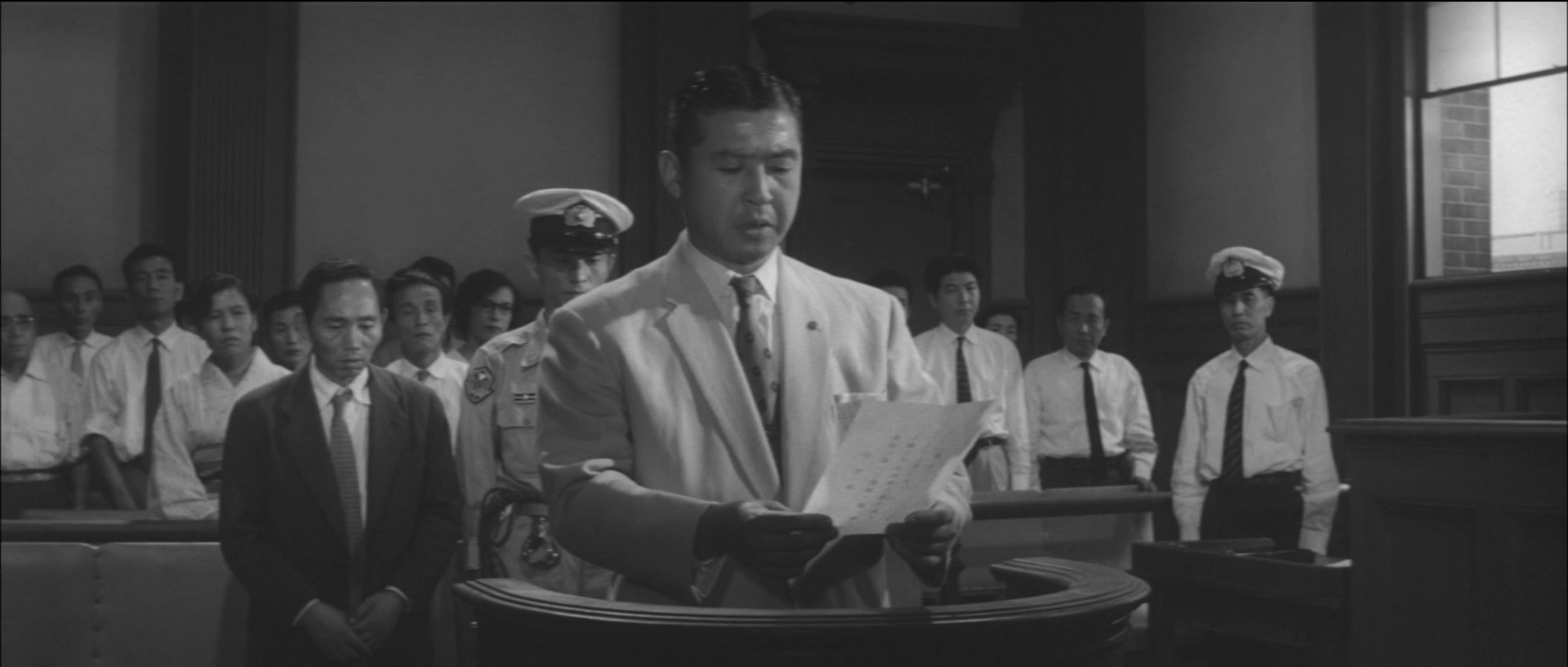
“What did I do to deserve this?” the hero of Hiromichi Horikawa’s The Lost Alibi (黒い画集 あるサラリーマンの証言, Kuroi Gashu: Aru Sarariman no Shogen) ironically asks himself, as if he assumed the answer to be “nothing at all”. Adapted from one of Seicho Matsumoto’s “Black Album” novellas, as in much noir fiction even small transgressions can have drastic consequences and even a step out of line can seriously derail an otherwise ordinary life. Ishino’s (Keiju Kobayashi) dilemma is that he knows if he speaks the truth he may damn himself and ruin the “boring, routine” life he’d built, but if he says nothing another man may pay with his life for a crime he didn’t commit. 

The film’s Japanese title is “testimony of a salaryman,” and that’s really want Ishino is giving in his opening voice over. He explains that he’s a high-ranking executive on a good salary living a fairly successful life working not at the top company in his field but the second best, which he’s fine with. He gets on with his boss precisely because he’s not interested in his job and is even hopeful he could stay on past retirement if he wanted to for that exact reason. But on the other hand, he’s 42 and has 13 years until he’s able to retire. He has no more ambition and his life is essentially on autopilot. All he has to do is stay the course for the next decade or so and everything will be fine.

But when he leaves the office, Ishino doesn’t go straight home as he tells his colleague he will when refusing an invitation, but hangs out in the city drinking and playing pachinko before going to see his mistress, Chieko (Chisako Hara), one of the secretaries working in his office. The affair may be a way of rebelling against his ordinary life or of playing with fire knowing that he could lose everything if his sexual transgression were exposed. Then again, he tells his wife he’s been to the cinema on his own, which in some ways isn’t all that different from having an affair seeing as he’s still skipped out on his domestic responsibilities and left her home alone to look after the children.

The film is mildly critical of this modern salaryman tendency in drawing a direct link between a series of murders of women who were home alone, as if their men had left them vulnerable by vacating the domestic space. Ishino’s wife Kuniko (Chieko Nakakita) even says that she feels a little afraid seeing as she’s home on her own all day while the children are at school and Ishino at work. Ishino suggests they get a dog and in the back of his mind wonders if he should get one for Chieko too. It’s not immediately clear what she is getting out of this affair, though it seems fairly likely that Ishino is paying for her upkeep which is why it’s so easy for him to force her move after they’re unwittingly dragged into the spotlight when the accused man, Sugiyama (Masao Oda), tries to use Ishino as an alibi after bumping into him in the street leaving Chieko’s apartment.

Sugiyama is his neighbour and Ishino only knows him on nodding terms, but he’s immediately worried that he may expose him. After all, he regards this as a low-class area he had no real reason to visit and does not want to have to explain what he was doing there. It doesn’t occur to him that his neighbour may not have wanted to either, if he not been accused of murder. The situation looks quite bad for Sugiyama given that the police have a lot of circumstantial evidence against him, though Ishino alone knows that Sugiyama didn’t do it because he really did see him at a time that makes it difficult to place him at the scene of the crime. But Ishino denies that he was ever there. Those around Ishino seem to condone the idea that he should just keep quiet. He’s under no obligation to help Sugiyama and it’s really nothing to do with him, anyway.

But the irony is that as things spiral out of control even Ishino seems to believe in the absolute power of a confirmatory witness. When he imagines himself talking to the police, the policeman doesn’t believe him because he lied the first time and the information is inconvenient to his case. He tells Ishino that his confession isn’t worth anything without a secondary witness to back it up, meaning he’d have to produce Chieko. It doesn’t really occur to Ishino that if he had told the truth to begin with the police might have been discreet about it. After all, admitting you were with another person whose reputation you do not wish to compromise seems to work well in crime novels. When he finds himself blackmailed by a student living in Chieko’s building, he too tries to get the student’s friend to come as a witness, bizarrely thinking that having someone else there ought to provide security seeing as he could also go to the police and accuse him of extortion if something went wrong never quite thinking that the friend might simply lie just as he did. 

A kind of comparison is indeed being drawn between Ishino and Matsuzaki (Tatsuyoshi Ehara), the student, who is painted as someone with a bad character who has got himself into debt not solely because of his economic circumstances but greed and an irresponsibility with money. Matsuzaki also behaves in an inappropriate way with Chieko in making passive-aggressive romantic overtures and becoming angry when she brushes them off, later basically forcing himself on her having just threatened blackmail. They are each in their way symptoms of post-war moral decline in their intense selfishness. Ishino has achieved the salaryman dream, but now he feels hemmed in by it and empty inside. Matsuzaki, meanwhile, is greedy and amoral, desperate enough to resort to loan sharks and blackmail while chasing the dream that Ishino has already achieved all too easily. 

But the truth is that Ishino had done a lot to deserve this, and got off fairly lightly in the end. A single moral transgression can snowball, and it’s true enough that none of this would have happened if he hadn’t had the affair in the first place. If he’d only told the truth about it, Sugiyama may not have had to go to trial and it would never have come out. If Sugiyama had been executed for this crime, Ishino would be a murderer, and maybe twice over as the person who killed the woman, and maybe several others, may have gone on to kill again until someone finally caught them, if ever. He’s endangered his wife and family, quite literally in physical terms, but also their future and wellbeing given the possibility of his reputation being ruined leading to losing his job while his children would suffer the stigma of his disgrace. He felt conflicted, chased to the brink and even considering suicide knowing his cowardice could condemn Sugiyama to death, but still chose the path of extreme selfishness which seems to be that which defines the post-war era. Even when all’s said and done, he can’t help thinking it’s all a little unfair. All he did was cheat on his wife and lie about it, why is he the one losing everything? But in the end, that’s exactly why. He cheated the salaryman dream, and the retribution was swift. Only too late did he realise the value of his “boring, routine” life of easy comfort in the increasingly compromised post-war society.


Trailer (no subtitles)
The H-Man (美女と液体人間, Ishiro Honda, 1958)

H-man
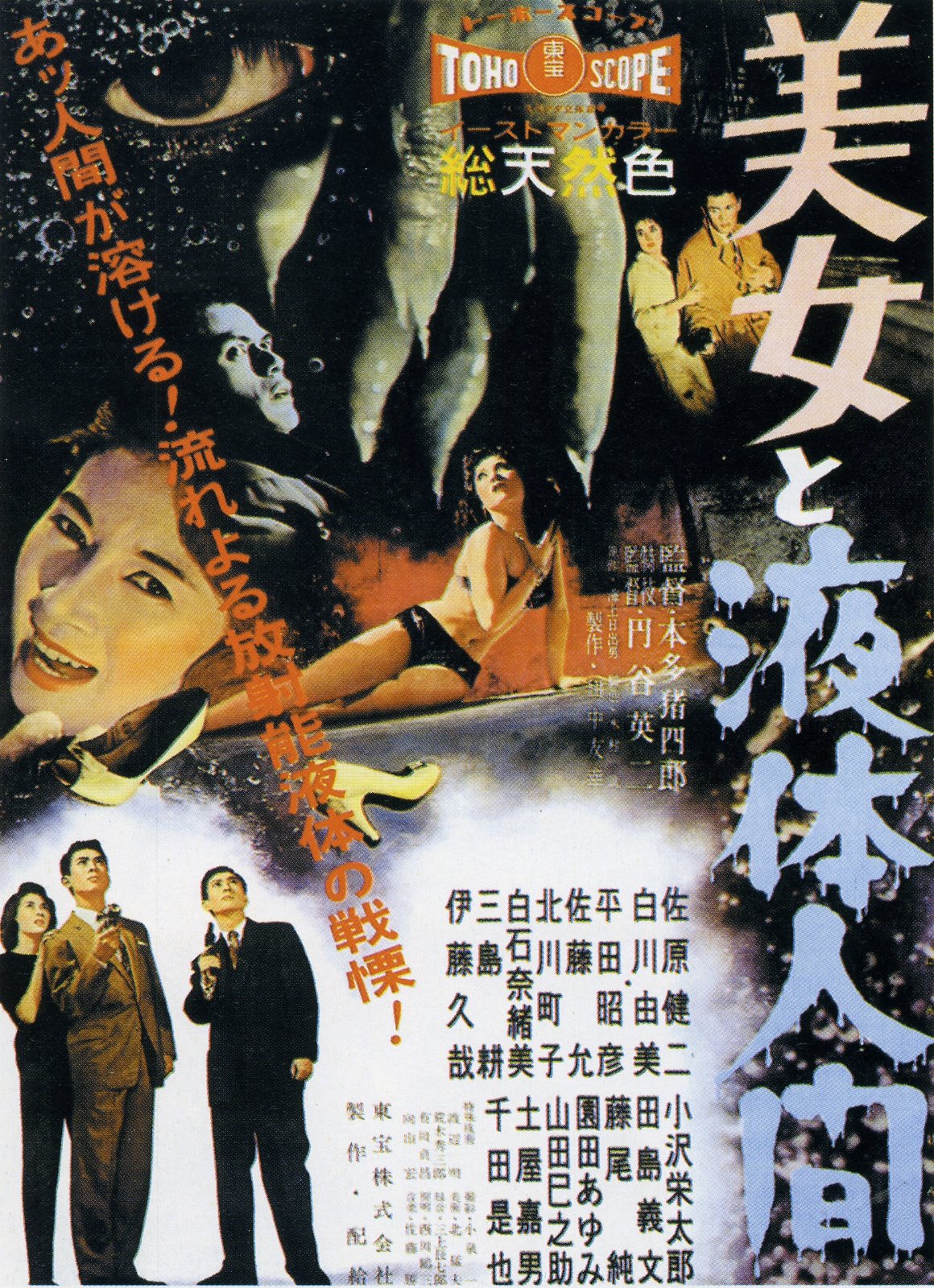
Toho produced a steady stream of science fiction movies in the ‘50s, each with some harsh words directed at irresponsible scientists whose discoveries place the whole world in peril. The H-man (美女と液体人間, Bijo to Ekitainingen), arriving in 1958, finds the genre at something of an interesting juncture but once again casts nuclear technology as the great evil, corrupting and eroding humanity with a barely understood power. Science may have conjured up the child which will one day destroy us, robbing mankind of its place as the dominant species. Still, we’ve never particularly needed science to destroy ourselves and so this particularly creepy mystery takes on a procedural bent infused with classic noir tropes and filled with the seedier elements of city life from gangsters and the drugs trade to put upon show girls with lousy boyfriends who land them in unexpected trouble.

Misaki (Hisaya Itou) is not a man who would likely have been remembered. A petty gangster on the fringes of the criminal underworld, just trying to get by in the gradually improving post-war economy, he’s one of many who might have found himself on the wrong side of a gangland battle and wound up just another name in a file. However, Misaki gets himself noticed by disappearing in the middle of a drugs heist leaving all of his clothes behind. The police immediatetely start hassling his cabaret singer girlfriend, Chikako (Yumi Shirakawa), who knows absolutely nothing but is deeply worried about what may have happened to her no good boyfriend. The police are still working on the assumption Misaki has skipped town, but a rogue professor, Masada (Kenji Sahara), thinks the disappearance may be linked to a strange nuclear incident…..

Perhaps lacking in hard science, the H-Man posits that radiation poisoning can fundamentally change the molecular structure of a living being, rendering it a kind of sentient sludge. This particular hypothesis is effectively demonstrated by doing some very unpleasant looking things to a frog but it seems humans too can be broken down into their component parts to become an all powerful liquid being. The original outbreak is thought to have occurred on a boat out at sea and the scientists still haven’t figured out why the creature has come back to Tokyo though their worst fear is that the H-man, as they’re calling him, retains some of his original memories and has tried to return “home” for whatever reason.

The sludge monster seeps and crawls, working its way in where it isn’t wanted but finally rematerialises in humanoid form to do its deadly business. Once again handled by Eiji Tsuburaya, the effects work is extraordinary as the genuinely creepy slime makes its slow motion assault before fire breaks out on water in an attempt to eradicate the flickering figures of the newly reformed H-men. The scientists think they’ve come up with a way to stop the monstrous threat, but they can’t guarantee there will never be another – think what might happen in a world covered in radioactivity! The H-man may just be another stop in human evolution.

Despite the scientists’ passionate attempts to convince them, the police remain reluctant to consider such an outlandish solution, preferring to work the gangland angle in the hopes of taking out the local drug dealers. The drug lord subplot is just that, but Misaki most definitely inhabited the seamier side of the post-war world with its seedy bars and petty crooks lurking in the shadows, pistols at the ready under their mud splattered macs. Chikako never quite becomes the generic “woman in peril” despite being directly referenced in the Japanese title, though she is eventually kidnapped by very human villains, finding herself at the mercy of violent criminality rather than rogue science. Science wants to save her, Masada has fallen in love, but their relationship is a subtle and mostly one sided one as Chikako remains preoccupied over the fate of the still missing Misaki.

Even amidst the fear and chaos, Honda finds room for a little song and dance with Chikako allowed to sing a few numbers at the bar while the other girls dance around in risqué outfits. The H-man may be another post-war anti-nuke picture from the studio which brought you Godzilla but its target is wider. Nuclear technology is not only dangerous and unpredictable, it has already changed us, corrupting body and soul. The H-men may very well be that which comes after us, but if that is the case it is we ourselves who have sown the seeds of our destruction in allowing our fiery children to break free of our control.


Original trailer (no subtitles)

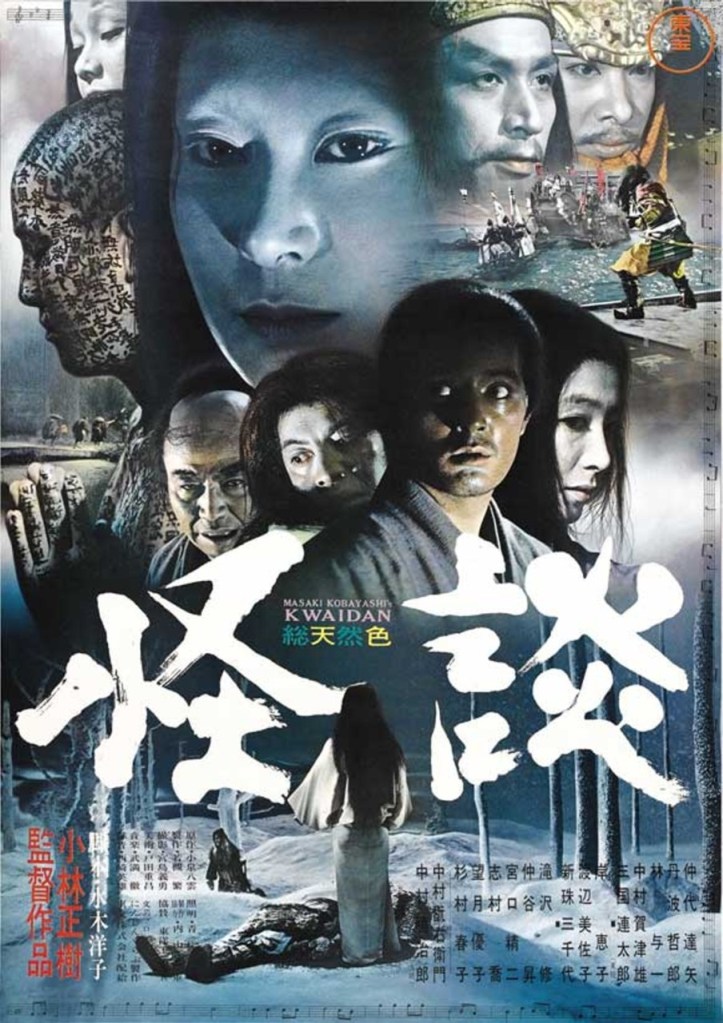
Kwaidan (怪談, Masaki Kobayashi, 1964)

tumblr_ly5zbgdNH61rn3yrmo1_1280Kwaidan (怪談) is something of an anomaly in the career of the humanist director Masaki Kobayashi, best known for his wartime trilogy The Human Condition. Moving away from the naturalistic concerns that had formed the basis of his earlier career, Kwaidan takes a series of ghost stories collected by the foreigner Lafcadio Hearn and gives them a surreal, painterly approach that’s somewhere between theatre and folktale.

The first tale, Black Hair, is the story of an ambitious young samurai (Rentaro Mikuni) who abandons his one true love to marry a wealthy woman and advance his career. However, his second marriage is far from happy and he begins to appreciate just what it is he’s cast aside. Eventually returning home he meets his former wife again and harbours the desire to start afresh. However, when the sun comes up all is not as it seems.

Tale two, The Woman of the Snow, begins when two woodsmen are caught in a blizzard and a mysterious woman appears to suck one of them dry of blood. She spares the other, Minokichi (Tatsuya Nakadai), because she’s moved by his youth but she instructs him never to reveal the events of that evening or she will return to finish what she started. Minokichi returns home and meets another mysterious woman who later becomes his wife and bears him three children but will he remember to keep his secret even from the love of his life?

The third tale is perhaps the most famous, Hoichi the Earless, and features the sad tale of a blind biwa player (Katsuo Nakamura) whose storytelling ability is so great that the dead themselves petition him nightly to recount their story. Eventually the head monk finds out and disapproves of Hoichi’s dealings with the supernatural so the monks paint sutras all over his body to protect him from the malevolent spirits. However, like achilles and his vulnerable heel, they forget to paint Hoichi’s ears…

The fourth tale, A Cup of Tea, is a little more whimsical and opens with a framing sequence lamenting the fact that some ancient tales were never finished for one reason or another. The tale within the tale features a samurai who keeps seeing a face appear in his tea. Obviously this is quite disturbing, but eventually he just decides to drink it anyway only for the owner of the face to suddenly appear and complain about soul having been stolen.

Like all good fables the stories each have a moral to offer but also, crucially, paint the protagonists as victims of circumstance more than rash or unwise people. The samurai feared poverty so he abandoned his love in search of riches only to discover he’d been chasing the wrong kind of dreams. Minokichi momentarily forgot himself, perhaps entrapped by the Snow Woman’s final trick, Hoichi just wanted to play his biwa but his desires were frustrated by the powers at be who further mess things up for him by botching the sutra application. The protagonist of A Cup of Tea does choose to drink the tea himself but the resultant madness is not something that could ever have been reasonably expected. These are worlds of spirits where the doorway to the supernatural is always ajar, waiting for some ordinary person to tumble through accidentally.

Though employing slightly different styles for each of the four segments, Kobayashi sets his stage with a deliberately theatrical, almost hyperreal set design. Obviously shot on a soundstage, the tales take on the feeling of stories which have been told and retold, replayed countless times across the great theatre of life. Black Hair steers closest to a traditional kabuki play, an effect aided by Toru Takemitsu’s more traditional score but The Woman of the Snow gives way to intense color play full of cold blue ice vistas mixed with impressionistic, passionate red skies. Hoichi’s tale begins with an overlay of a scroll painting recounting the famous The of the Heike of which Hoichi sings his song. Full of epic battle scenes, ghostly apparitions and a whole load of biwa music, this segment is the lengthiest but also the meatiest when it comes to subtext. The final tale by contrast is much more straightforward and brings a little chanbara exuberance to the otherwise heavy atmosphere though it does leave us with one of the most haunting images in the entire film.

Kwaidan may look like an exercise in style for Kobayashi – it was also his first colour picture and he makes full use of that aspect of the film. However, that isn’t to say he’s abandoned his recurrent concerns. The people in the stories are all ordinary, they’re flawed but they aren’t evil. The samurai comes closest to bringing his fate on himself when he makes the selfish decision to abandon his loving wife for money and status though he pays a heavy price when he finally realises his foolishness. Minokichi’s crime is a loss of faith of perhaps of having doubted the truth of his tale in itself. In the end, he simply forgot his promise rather than making a conscious decision break it like the samurai. Hoichi is something of a passive player here as his blindness renders him unable to understand his plight – he is unable to keep his promise to the fallen samurai firstly because of the physical toll it’s taking on him and secondly as he’s prevented by his superiors. The protagonist of the final tale simply gives in to temptation and then to madness perfectly symbolising human weakness. Kobayashi maybe more artful here than acerbic but his bleak view of human nature still wins out. However, what Kobayashi crafted in Kwaidan is a beautiful, dreamlike canvas of supernatural visions which continue to dazzle in their artistry long after the screen has gone dark.


Kwaidan is available on blu-ray in the US from Citerion and on DVD in the UK from Eureka Masters of Cinema.