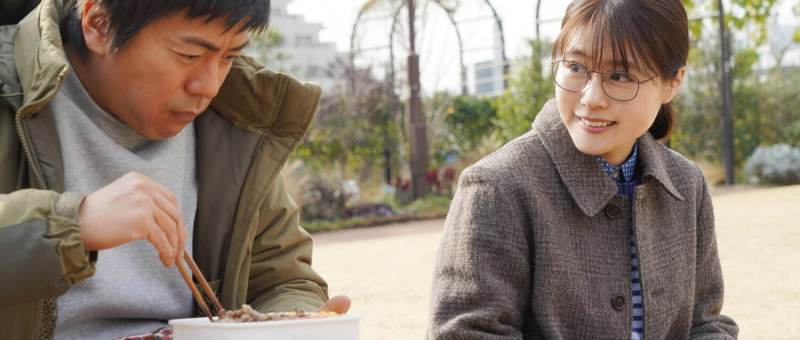
Sunset Sunrise (サンセット・サンライズ, Yoshiyuki Kishi, 2024)

In a way, the 2020 coronavirus pandemic presented a kind of turning point in which it became possible to envision a different kind of future brokered by technological advance in which society was no longer ruled by the dominance of the cities. If people could work remotely from anywhere, then they could easily improve their standard of living by moving to more rural areas for cheaper rents and healthier environments. Assuming the infrastructure was in place to allow them to do so, they could also support and reinvigorate communities struggling with depopulation in which the young have all left for the cities leaving the elderly behind to fend for themselves.

It’s an elegant solution that solves many of the problems of the contemporary society, but change isn’t always as straightforward as it seems as the hero of Yoshiyuki Kishi’s Sunset Sunrise (サンセット・サンライズ) finds out after he jumps at the chance to move into an abandoned house in Tohoku for a fraction of the rent he’d have to pay for a flat in Tokyo if he didn’t still live with his parents. The catch is, however, that houses have souls too and are more than just places to live for those that own or inherit them. Momoka (Mao Inoue), who decides to put her own empty house on the market, has her reasons for not wanting to live there herself nor for selling it completely but renting it out is also emotionally difficult. In the end, she only really does it after being put in charge of the town’s empty house problem at her job working for the council and thinking she should probably start with her own. Not knowing what to charge, it hadn’t really occurred to her someone would be as interested as Shinsaku (Masaki Suda), a fishing enthusiast longing to escape his salaryman life in the city for something a little more traditional in a peaceful rural area. 

Then again, that’s not to say that Shinsaku is a traditionalist and his decision quickly sparks controversy but also attracts the attention of his boss who senses a promising business opportunity. Momoka’s is a slightly special case, but Japan is filled with these so-called “akiya” which might, amid the work from home revolution of the pandemic, now be attractive to young professionals looking for a better environment to start a family. Houses generally start to deteriorate quite quickly when no one lives in them, and it’s true a lot of them need some work doing but it’s an idea that could work out well for everyone. Younger people who can’t find decent living space in the cities would be able to afford larger homes in the country where they would also then be contributing and integrating into the local community to provide support for its elderly residents.

Shinsaku becomes a part of the local community quite quickly and strikes up a friendship with an elderly woman whose children have all moved to Tokyo and rarely visit now that their own children are getting older. They’ve asked her to move to Tokyo with them, but as she points out, it would be the same as them moving back. There’s nothing for her to do there, and she’d have no friends. She’d only feel in the way and that she was getting under her daughter-in-law’s feet. Nevertheless, they fear for her especially as the area is still dealing with the scars of the 2011 earthquake which have left many clinging to a now bygone past. Once Momoka and Shinsaku start working with his boss on the akiya project, they find it hard to convince the inheritors of the houses to agree. Though they won’t live there, they might want to pop back a few times a year just for the memories and somehow can’t bear to part with their childhood or relative’s homes. But Shinsaku points out, it doesn’t necessarily have to be a case of either or and the renovation projects they undertake modernise the houses in a sympathetic way that brings them up to date with modern living yet honours the past even sometimes incorporating some of the previous resident’s furniture and belongings while issuing a caveat that the owners are welcome to visit should they wish to.

Essentially, the idea is a kind of co-existence with the past but also with unresolved trauma such as that presented by the earthquake and the ongoing pandemic. Momoka too is struggling to move on and while a gradual romance seems to arise between herself and Shinsaku, she isn’t sure she can ever let the past go though he makes it clear it’s okay to bring it with her. For his part, despite the initial fears of the early pandemic period and the suspicion of him as an outsider, Shinsaku’s quickly taken in by the community and adapts to a more rural way of life with relative ease though his boss’ big plan is rather undermined by his later insistence that he come back to Tokyo to run the project from the office like a many a contemporary CEO rolling back promises of flexible working environments that make this kind of utopian ideal much harder to materialise. In any case, there’s something quite refreshening in the eventual resolution just to do their own thing, not particularly paying attention to labels or what other people might think, but just doing what makes them happy right now. As an old fisherman’s song says, the sun sets but then it rises again. Scripted by Kankuro Kudo and adapted from a novel by Shuhei Nire, the film has kind of wholesome optimism that is rooted in a sense of continuity but also the potential to start again and make a new life inside the old that is less bound by outdated social norms than brokered by the gentle solidarity between people and a generosity of spirit that allows all to seek happiness in whatever way they choose.


Sunset Sunrise screens in Chicago 22nd March as part of the 19th edition of Asian Pop-Up Cinema.

Trailer (English subtitles)

(Ab)normal Desire (正欲, Yoshiyuki Kishi, 2023)

There’s a pun embedded in the Japanese title of Yoshiyuki Kishi’s heartfelt drama (Ab)normal Desire in that first character in the word for “sexual desire” (seiyoku, 性欲) has been replaced by one that can be read the same but has the meaning of “correct”, or “proper”. But “normal” is also relative construct that implies conformance with the majority even if that may not actually be the case. As one of the protagonists later remarks “everyone is pervy” though they themselves feel such a degree of shame and otherness that it’s largely prevented them from living any kind of life at all.

In that sense it may be hard to understand why a fetish for water would invite such severe self-loathing in that it causes no harm to others if admittedly resulting in ridicule if exposed. Then again, society can be a fierce watchdog. Department store shop assistant Natsuki (Yui Aragaki) is taken to task by her pregnant colleague who refuses to take her seriously when she says she’s not really interested in getting a boyfriend before giving her a lecture about her biological clock. Though Natsuki appears uninterested in her vacant prattling, the woman later becomes upset and harshly tells her that she was only trying to be “nice” because she felt “sorry” for her and that making people be nice to you in this way is actually a form of harassment which, whichever way you look at it, is some particularly twisted logic.

Her alienation seems to stem from the fact that she feels “abnormal” and that her fetish for water is a part of herself she must be careful to hide. Her parents watch a news report on Tokyo Rainbow Pride and marvel at the idea that there are now choices other than marriage and children but even among the young there remains confusion and shame amid an inability to reconcile the seemingly opposing concepts of “normality” and “diversity” as they struggle to define themselves. A plan to have a male dancer who usually dances in a masculine style dance in a more feminine way backfires when he points out that asking someone to dance in a way they don’t want to doesn’t really do much to advance “diversity”.

But diversity isn’t considered an ideal by all and parents of young children find themselves confused and conflicted when their kids begin to reject conventionality at an early age by asking to withdraw themselves from school and instead focus on other kinds of education that align with their interests. Challenged by his wife about why he never listens to their son’s concerns, prosecutor Hiroki (Goro Inagaki) replies that he should “just be normal” and later describes people who are “unable to live normal lives” as bugs in the system which must eradicated. A symbol of lingering authoritarianism, Hiroki is an intensely conservative man obsessed with properness who thinks it’s his job to decide which crimes everyone is guilty of rather than make any attempt to understand the world around him outside of binary terms like right and wrong or normal and abnormal. When his assistant passes him information on fetishes as a potential explanation for the case of a man who repeatedly steals taps, he simply rolls his eyes and dismisses it.

Yet he perhaps has his own fears and internalised shame as evidenced by his outrage on discovering that another man has been coming to the house to help his wife with tech setup for their son’s new outlet in livestreaming and not only that, he was able to blow up the balloons that Hiroki himself failed to inflate. It’s his rigid authoritarianism that eventually alienates his wife and son who come to see him only as an oppressive bully unable to accept anything that differs from his own definition of “normal”. Finally, he’s the one who is isolated, imprisoned by his own repression and lack of understanding or unwillingness to accept those around him.

Even so, despite its positive messages that no one should feel themselves alone or that society has no place for them the film muddies the waters by introducing fetishes that are necessarily problematic in that they cause harm to others who do not or cannot consent and could not and should not be accepted by mainstream society though oddly those that have them seem to feel less shame only fearing being caught because acting on their desires is against both moral and judicial laws. In any case, in discovering togetherness, that they are not alone, those who feel their desires to be “abnormal” can begin to ease their loneliness and find a place for themselves in an often judgemental world.


(Ab)normal Desire screened as part of this year’s Toronto Japanese Film Festival.

Original trailer (English subtitles)

Prior Convictions (前科者, Yoshiyuki Kishi, 2022)

An earnest young woman finds herself questioning her way of life after one of her charges is implicated in a spate of murders in Yoshiyuki Kishi’s social drama Prior Convictions (前科者, Zenkamono). As the double meaning of the English title implies, the issue is as much about preconceived notions and unfair judgements as it is about “crime”, its causes and legacies, while ultimately arguing for a more compassionate approach to law enforcement which prizes healing and rehabilitation over meaningless punishment. 

Kayo (Kasumi Arimura) is what’s known as a volunteer probation officer which is to say that she assists those who’ve recently been released from prison to reintegrate into mainstream society so that they can live comfortable lives within the law. She is not however a civil servant and though making regular reports to an official probation officer has very little power and no pay for her work which can at times be difficult and emotionally draining especially considering that she also needs to work a regular job in a convenience store to support herself. In what seems like a very poor safeguarding decision, she meets most of her clients in her own home where she lives alone one of them even breaking in while she’s not there for an impromptu hotpot party. 

While she is exasperated by some of her charges such as a woman who can’t seem to stick to a regular job no matter how many she finds her, Kayo is incredibly proud of her work with Kudo (Go Morita), a quiet and soulful middle-aged man who was convicted of murder after stabbing a co-worker who had been bullying him so badly that he lost the hearing in one ear. Kudo had been struggling to reconcile himself to his crime, intensely worried that while unable to understand why he did it he might end up doing it again. When Kudo suddenly disappears after being linked to a series of suspicious deaths most assume the worst, but Kayo alone refuses to believe that Kudo could be the killer and is determined to find out what’s really going on if only to vindicate her conviction that her work is good and useful rather than naive and misguided as some including intense police officer Takimoto (Hayato Isomura) seem to see it. 

As Kayo later reveals she’s carrying some baggage herself which contributed to her decision to begin working with those who’ve been convicted of crimes, but is doing it with the aim of reducing suffering and ending the cycle so that there are no more victims or victimisers. Also wounded, Takimoto tells her that murderers aren’t human and can never be rehabilitated, while she’s forced to consider the problem from all angles meeting with a lawyer (Tae Kimura) who defended an abusive husband who murdered his wife and learning that she did so for similar reasons to herself certain that he too deserved a second chance and could perhaps be reformed if given the proper treatment. Kayo sees that many of the people she meets ended up committing crimes because of traumatic personal circumstances and if someone had helped them earlier they may not have offended in the first place. She can’t change the past but at least in helping them now she might prevent further crimes in the future while giving them a source of stability as they attempt to root themselves more firmly in mainstream society. 

Inspired by Masahito Kagawa’s manga, Prior Convictions was previously adapted into six-part WOWWOW TV drama to which the film is technically a sequel though fairly stand alone in its gentle unpacking of Kayo’s own unresolved trauma and subsequent epiphanies as regards her relationships with those she’s trying to help. As one young woman puts it, they find her vulnerability reassuring in contrast to the often authoritarian, didactic approaches taken by law enforcement and social services who only talk down to them from a condescending place of superiority rather than trying to meet them on a more human level. In the end it’s about healing, trying to find an accommodation with the traumatic past and limiting its legacy to break the cycle of pain and violence. The prior convictions which most need addressing are those of a judgemental society that all too often contributes to the mechanisms of violence in seeking to punish rather than to help.


Prior Convictions screened as part of this year’s Camera Japan.

International trailer (English subtitles)

Wilderness (あゝ、荒野, Yoshiyuki Kishi, 2017)

wilderness posterWhen Shuji Terayama published his only novel in 1966, Japan was riding high – the 1964 Olympics had put the nation back on the global map and post-war desperation was beginning shift towards economic prosperity. In adapting Terayama’s jazz-inspired avant-garde prose experiment for the screen, Yoshiyuki Kishi updates the action to 2021 and a slightly futuristic Tokyo once again feeling a mild sense of post-Olympic malaise. Terayama, like the twin heroes of Wilderness (あゝ、荒野, Ah, Koya), got his “education” on the streets of Shinjuku, claiming that more could be learned from boxing and horse races than any course of study. Both damaged young men, these lonely souls begin to find a place for themselves within the ring but discover only emptiness in place of the freedom they so desperately long for.

Shinji (Masaki Suda), abandoned to an orphanage by his mother after his father committed suicide, has just been released from juvie after being involved in a street fight which left one of his best friends paralysed. Discovering that his old gang won’t take him back he’s at a loss for what to do. Meanwhile, shy barber Kenji (Yang Ik-june) who stammers so badly that he barely speaks at all, is battling the possessive stranglehold his drunken, violent ex-military father weilds over him. Raised in Korea until his mother died and his father brought him back to Japan, Kenji has always struggled to feel a part of the world he inhabits. The two meet by chance when Shinji decides to confront the man who attacked his gang, Yuji (Yuki Yamada) – now an up and coming prize fighter. Shinji is badly injured by the professional boxer while Kenji comes to his rescue, bringing them to the attention of rival boxing manager Horiguchi (Yusuke Santamaria) who manages to recruit them both for his fledgling studio.

The Tokyo of 2021 is, perhaps like its 1966 counterpart, one of intense confusion and anxiety. Plagued by mysterious terrorist attacks, the nation is also facing an extension of very real social problems exacerbated by a tail off from the temporary Olympic economic bump. As the economy continues to decline with unemployment on the rise, crime and suicides increase while social attitudes harden. In an ageing society, love hotels are being turned into care homes and wedding halls into funeral parlours. The elder care industry is in crisis, necessitating a controversial law which promises certain benefits to those who commit to dedicating themselves either to the caring professions or to the self defence forces.

Yet nothing much of this matters to a man like Shinji who ignores the crowds fleeing in terror from the latest attack in favour of “free” ramen left behind by the man who recently vacated the seat next to him out of a prudent desire to make a speedy escape. Shinji takes up boxing as way of getting public revenge on Yuji but also finds that suits him, not just as an outlet for his youthful frustrations but in the discipline and rigour of the training hall as well as the camaraderie among the small team at the gym. Kenji, by contrast, is kind hearted and so shy he can barely look his opponent in the eye. He comes to boxing as a way of finally learning to stand up for himself against his bullying father, but eventually discovers that it might be a way for him achieve what he has always dreamed of – connection.

Asked why he thinks it is we’re born at all if all we do if suffer and long for death, Kenji replies that must be “to connect” though he has no answer when asked if he ever has. For Kenji boxing is a spiritual as well as physical “contact sport” through which he hopes to finally build the kind of bridges to others that Shinji perhaps builds in a more usual way. Shinji tells himself that the only way to win is to hate, that in boxing the man who hates the hardest becomes the champion but all Kenji wants from the violence of the ring is love and acceptance. Shinji’s friend, Ryuki (Katsuya Kobayashi), has forgiven the man who crippled him and moved on with his life while Shinji is consumed by rage, warped beyond recognition in his need to prove himself superior to the forces which have already defeated him – his father’s suicide, his mother’s abandonment, and his friend’s betrayal.

While Shinji blusters, shows off, and throws it all away, Kenji patiently hones his craft hoping to meet him again in the boxing ring and “connect” in the way they never could before. There’s something essentially sad in Kenji’s deep sense of loneliness, the sketches in his notebook and strange relationship with an equally sad-eyed gangster/promoter (Satoru Kawaguchi) suggesting a hankering for something more than brotherhood. Nevertheless what each of the men responds to is the positive familial environment they have never previously known, anchored by the paternalism of coach Horiguchi and cemented by unconditional brotherly love.

Caught at cross purposes, the two young men battle each other looking for the same thing – a sense of freedom and of being connected to the world, but emerge with little more than scars and broken hearts, finding release only in a final transcendent moment of poetic tragedy. Kishi’s vision of the immediate future is bleak in the extreme, a nihilistic society in which hope has become a poison and death its only antidote. A tragedy of those who want to live but don’t know how, Wilderness is a minor miracle which proves infinitely affecting even in the depths of its despair.


Screened at Nippon Connection 2018.

Original trailer (no subtitles)

Interview with director Yoshiyuki Kishi conducted at the Busan International Film Festival (Japanese with English subtitles)

A Double Life (二重生活 , Yoshiyuki Kishi, 2016)

double-lifeA Double Life (二重生活, Nijyuu Seikatsu ), the debut feature from director Yoshiyuki Kishi adapted from Mariko Koike’s novel, could easily be subtitled “a defence of stalking with indifference”. As a philosophical experiment in itself, it recasts us as the voyeur, watching her watching him, following our oblivious heroine as she becomes increasingly obsessed with the act of observance. Taking into account the constant watchfulness of modern society, A Double Life has some serious questions to ask not only of the nature of existence but of the increasing connectedness and its counterpart of isolation, the disconnect between the image and reality, and how much  the hidden facets of people’s lives define their essential personality.

Tama (Mugi Kadowaki) is an MA philosophy student working on a thesis regarding the nature of existence in contemporary Japan. Discussing her work with her supervisor, Shinohara (Lily Franky), Tama reveals that she was drawn to her subject because she is unable to understand why she herself is alive. Her proposal was largely based on the tried and tested method of a survey but Shinohara is hoping for something more original. Catching sight of a Sophie Calle book on his desk, he suggests that Tama’s project might benefit from examining the life of one subject in depth and so he tasks her with following a random person and observing their daily activities in order to figure out what makes them tick.

Tama is conflicted, but when she catches sight of her neighbour at a book shop she makes an impulsive decision to follow him which will later develop into an all consuming obsession. Ishizaka (Hiroki Hasegawa) is a successful editor at a high profile publishing house with a pretty wife, cute daughter and lovely home just over the way from the apartment Tama lives in with her illustrator and game designer boyfriend, Takuya (Masaki Suda). However, while following Ishizaka to a local coffee shop Tama catches him illicitly meeting another woman. Not quite believing what she sees, Tama’s obsession with her target continues to grow until the fateful day that her cover is finally blown.

Tama, and her supervisor, both regard the exercise as essentially harmless because all Tama is supposed to do is observe. The nature of her experiment means that she must remain unseen so that the subject does not change his or her behaviour but Tama quickly becomes a passive observer to an unpleasant domestic episode when Ishizaka’s wife discovers the affair. Tama is, always, a passive presence. As she says herself, she carries a deep-seated sense of emptiness that prevents her from fully connecting with other people. Her stalking activities, however, reawaken a sense of connectedness that she had been unable to find in her everyday life.

While Tama is watching Ishizaka, she herself is also being watched. Firstly, of course, by us, but also by the busybody landlady whose obsession with the proper way to dispose of rubbish has led to her installing spy cameras to capture the offending tenants on film. Of course, the cameras capture a lot of other stuff too which, when used alongside other forms of evidence, paint a slightly different picture. The old lady is a classic curtain twitcher, albeit one with access to more sophisticated equipment, and looms big brother-like over her tiny domain, the possessor and disseminator of all information. Tama’s rules mean she must not be seen, but someone is always watching, collecting information to be repurposed and repackaged at the convenience of the collector.

Cameras capture images but humans conjure pictures. From the outside, the Ishizakas are the perfect model family – a successful husband, warm and friendly housewife who is quick to get involved in community events, and a lovely, well behaved little daughter. As we find out Ishizaka is not the committed family man which he first seems. After treating all of the women in his life extremely badly, Ishizaka adds Tama to his list after the affair is exposed and his life ruined. Tama was only ever a passive observer whose presence had no effect on the narrative, yet Ishizaka blames his predicament on her rather than address the fact the situation is entirely his own fault. He does, however, have a point when he accuses Tama of exploiting his secrets for her own gain.

Tama’s observations are limited to the public realm and so she’s left with a lot of unknown data making her conclusions less than reliable. The gap between her perception and the reality becomes even more apparent once she begins observing the life of her supervisor, Shinohara. In an elliptical fashion, the film begins with Shinohara’s presumed suicide attempt and for much of the first half we seem him struggle with the grief of his mother’s terminal illness. This again turns out to be not quite as it seems, undermining Tama’s whole research proposal as her conclusions on Shinohara’s reason for living were based on a deliberately constructed scenario.

Ironically enough, Tama’s attempts to connect eventually ruin her own relationship as she finds herself living “a double life” as a vicarious voyeur. Abandoning her sense of self and living through her subjects, Tama begins to connect with the world around her but it’s more overlapping than a true union of souls in which she becomes a passive receptacle for someone else’s drama. Hers is the life of a double, shadowy and incomplete. Take away a man’s life lie and you take away his happiness, so Ibsen told us. Tama would seem to come a similar conclusion, that the essence of life may lie in these petty secrets and projected images. An intriguing philosophical text in itself, A Double Life is an intense look at modern society and all of its various artifices which marks Kishi out as a promising new cinematic voice.


Reviewed at Raindance 2016

Original trailer (English subtitles)