Nine-Ring Golden Dagger (挡马夺刀, Feng Xiaojun, 2024)

The daughters of General Yang venture into Liao territory in search of their father’s famed “nine-ring nation stabilising sword” in Feng Xiaojun’s wuxia adventure, Nine-Ring Golden Dagger (挡马夺刀, dǎng. mǎ Set in the middle of the Song Dynasty, the film draws inspiration from the western in its dusty frontier town setting if also clearly from King Hu’s Dragon Inn in the design of its central staging post where a series of action set pieces take place.

Emperor Taizong has expelled the Khitan in the north and is intent on reclaiming the sixteen prefectures of Yan and Yun for the Han people. General Yang (Wu Yue) leads his men against the invading Liao while the Middle Army do nothing and wields his nine-ring nation stabilising golden sword but is cut down by Liao general Liu and his sword is captured as loot. Yangying, (Liu Shinlei) Yang’s ninth daughter, cannot stand the injustice and is determined to march into Liao and get it back. Her sister, Yanqi (Zhang Xintong), tries to stop her but then relents and decides to go with her instead. 

The sword is in the home of the South Prime Minister of Liao, Zhang Hua (Tan Kai), who is Han and resented by some of the Liao warriors for being a token hire designed to appeal to the Han population who they fear are taking over now they’ve joined the Liao. Though Dowager Empress Xiao is minded to make peace, General Liu and Zhang would rather the war continue because it facilities their advancement amid an otherwise rigidly hierarchical social system.

One expression of this is in hilarious comic relief character Xiao Pusage (You Xianchao) who has a long and pointless intro he’s fond of reciting that explains he’s the Dowager Empress’ nephew. Jiao Guangpu (Song Tianshuo), owner of the staging post, was thinking about killing him but decides to let him go instead because they only kill evildoers and Pusage actually seems quite nice and enjoys doing good things like helping the poor. Jiao is also a former Song soldier trapped behind enemy lines without the resources to go home but dreaming of reclaiming Yang’s sword and taking it back with him. Nevertheless, he originally distrusts the Yang daughters believing them to be Liao soldiers and therefore his enemies. He too has a witty intro song in which he gives away his origins only no one seems to be paying attention. 

But in some ways, Jiao’s desire to reclaim the sword is more sentimental than that of the daughters even though part of the reason why they want it is to avenge the deaths of their father and brothers. Even so, their main mission is taking it back to stabilise the nation and symbolically end the war with Liao. Jiao, by contrast, wants it to fulfil an obligation he feels to General Yang who fought bravely in the film’s opening sequence but was executed by a cowardly arrow from Liu. After a botched attempt at assassination and an intense fight through the inn, the trio form an uneasy alliance and agree to travel back to Song together only to be continually frustrated by Liao forces who eventually have them surrounded at the staging post.

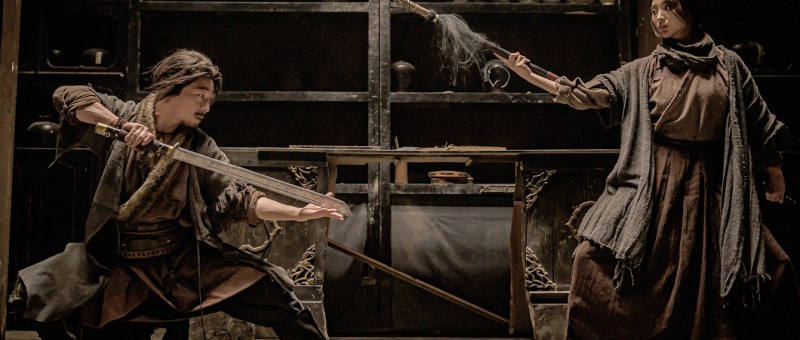
While the design may echo Dragon Inn, Feng uses the techniques of Peking Opera to stage the battle between Yangqi and Jiao while otherwise echoing the western through the newspaper-like onscreen text and dusty frontier sensibility as the Yang sisters make their way back to the border with their father’s sword in hand. Through somewhat epic in scope despite its compact runtime, the film is essentially structured around a series of action sequences from the daring raid to retrieve the sword with its various booby traps to a chase through a cornfield and the final confrontation at the inn. Each is impressively choreographed and expertly performed to make full use of the well-designed sets and meagre budget. The lean, mean feel and linear progression also add to the retro sensibility while there’s something undeniably satisfying about seeing these two rather slight women run rings around the Liao forces thanks to the training they received from their father as they become the inheritors of his legacy and saviours of Song by retrieving the sword and ushering in a new era of peace and coexistence.


Nine-Ring Golden Dagger is released Digitally in the US on July 1st courtesy of Well Go USA.

Trailer (English subtitles)

Sakra (天龍八部之喬峰傳, Donnie Yen & Kam Ka-Wai, 2023)

Donnie Yen returns to the (co-)director’s chair in an adaptation of Jin Yong’s classic wuxia Demi-Gods and Semi-Devils, Sakra (天龍八部之喬峰傳, Tiānlóng Bā Bù zhī Qiáo Fēng Zhuàn). 59-year-old Yen also stars as the tragic wuxia hero Qiao Feng who is repeatedly stated to be around 30, though he also appears in a handful of scenes as Qiao’s father which might help to explain the casting choice. Even so, Yen mostly pulls it off while striking an authoritative figure fighting for justice in an unjust world. 

As the opening titles reveal, this was a fairly tragic age in which “those who had feelings were all caught in it”. The Northern Song Dynasty faces invasion by the Khitan-led Liao, while the Yan are also vying to restore their lost power. Discovered as a foundling and raised by a Song couple, Qiao Feng joins the notorious Beggar Gang and becomes a powerful martial artist often defending their territory against Khitan raiders. After rescuing a young man held captive by a monk who describes him as a human sacrifice, Qiao returns to be accused of treachery by the Beggars. His leader, Ma, has been murdered, and Ma’s wife Min (Grace Wong Kwan-hing) claims she saw Qiao do it. Ma had apparently told her that he feared Qiao would kill him because he had come into an incriminating letter which suggests that Qiao’s biological parents were in fact Khitans and he is some kind of treacherous sleeper agent. 

Qiao realises there’s nothing he can really do to counter their suspicion except leave and discover the truth about his origins for himself. Unfortunately, however, everyone he could have asked ends up dead with him framed as the killer. Meanwhile, he wrestles with questions of identity asking himself if he can be both a “good” person and a “Khitan” but later coming to doubt his allegiance to Song after witnessing some soldiers massacre a group a of Khitan peasants out on the road. While investigating he ends up saving the life of mysterious spy Azhu (Chen Yuqi) who like him is looking for her origins, having been told by Yan warlord Murong Fu (Wu Yue) for whom she is working that he would tell her if she stole a scroll from the Shaolin temple. Azhu is the only one continues to believe in him, reassuring Qiao that regardless of his identity he is still a “good person”, and the pair soon fall in love vowing to leave the martial arts world behind to raise cattle in the country once their respective quests are concluded successfully. 

Even so, he later claims not to fight only for his land but for a righteous world against the amoral machinations of the villainous Murong Fu and all those who conspired with him. The Beggar Gang is not entirely innocent either, subject to a struggle for succession that made Liao’s existence inconvenient to some while Qiao is later confronted by the realities of a situation he may have misunderstood. Qiao may learn the secret of his origins, but is also left with a new mission in the necessity of stopping Yan’s despotic bid to reclaim Song, riding straight into battle with only a loyal companion at his side. 

Though struggling under the sheer complexity of Jin Yong’s sprawling novel, Yen and Kam showcase the key incidents such as the opening rescue of Duan Zhengchun’s son, and Liao’s epic battle against the Beggars after wading straight into a meeting knowing he’d likely be killed but looking for a doctor for Azhu. The action scenes are visceral and impressive, making the most of the movie’s high production values with a mixture of CGI and practical effects as Qiao faces off against hundreds of men at once or makes daring wire-assisted leaps from under a dome of enemy shields. There is also a genuine poignancy in the tragic romance between Azhi and Qiao who just want to be free of their legacies and the machinations of the martial arts world to live quiet lives as innocent farmers but are reminded there is no real escape from the political reality. Having covered half of Liao’s arc in Jin Yong’s text, a door is left open for a sequel in which Qiao continues to pursue justice and clear his name while hinting at a battle still to come in world in which “those who have feelings are all caught”.


Sakra is released in the US on DVD & Blu-ray June 13 courtesy of Well Go USA.

Original trailer (English subtitles)

Raging Fire (怒火, Benny Chan, 2021)

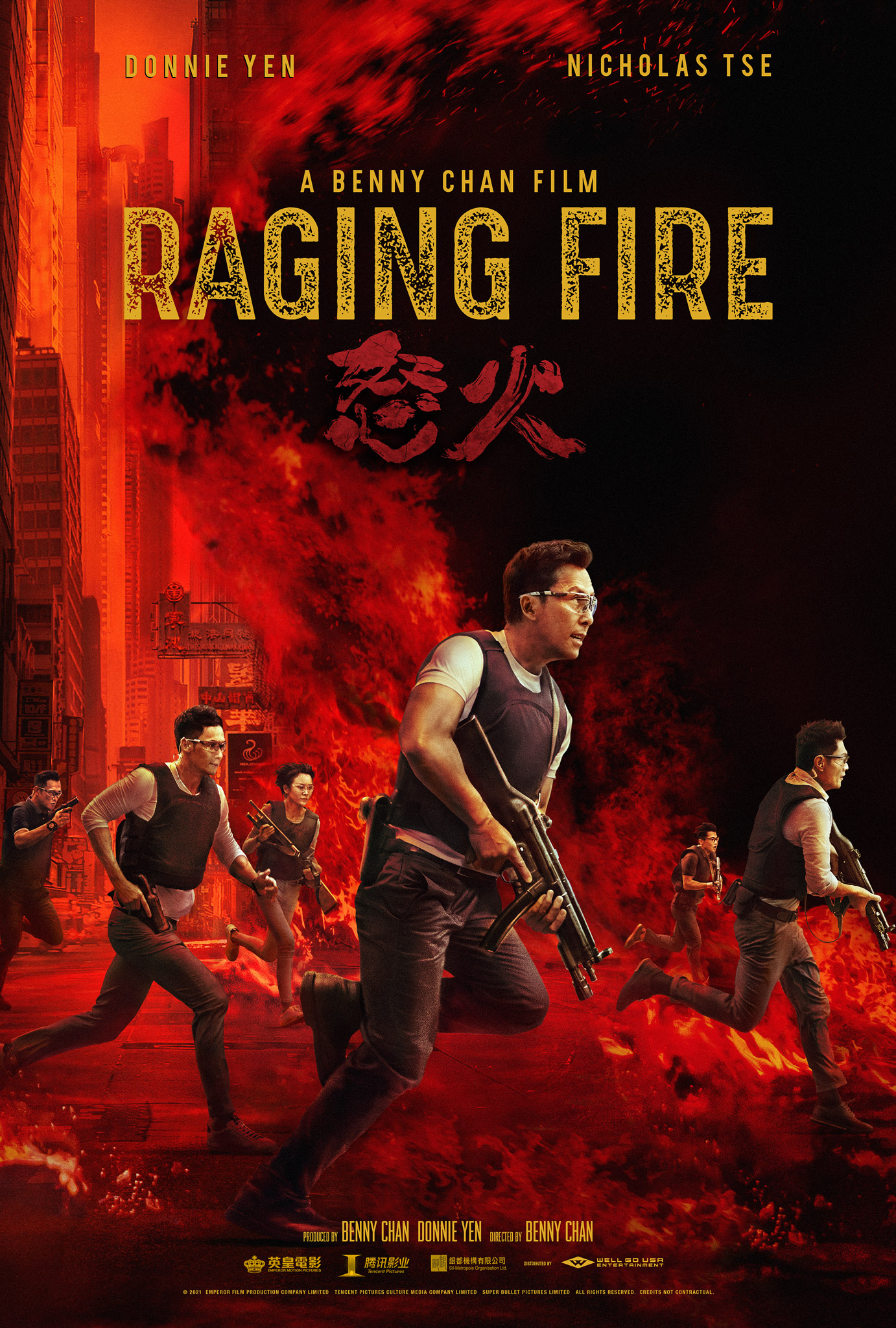
“If you had chased Coke that day, would our destinies have been reversed?” a cop turned villain asks of his righteous colleague, but his friend has no answer for him. The final film from director Benny Chan who sadly passed away last year after being diagnosed with cancer while filming, Raging Fire (怒火) pits a disgruntled police officer wronged by the system against an incorruptible detective but suggests that the real villain is an increasingly corrupt society in which the rich and powerful have a direct line to justice. 

As the film opens, noble officer Cheung (Donnie Yen) is racing towards some kind of altercation in a shipyard but later wakes up next to his much younger and very pregnant wife (Qin Lan). After a years long operation, his team is about to take out a petty criminal involved with a previous investigation which resulted in fellow officers getting sent to prison for excessive use of force. After refusing to to help a wealthy businessman make his son’s drunken car accident go away, Cheung is taken off the case while the raid turns out to have been a trap leaving eight of his friends dead and many more injured. Through his investigations, Cheung begins to realise that his former colleague Ngo (Nicholas Tse), recently released from prison, may be responsible for the deaths of his friends in pursuing a vigilante revenge against the police force he feels betrayed him. 

“This society doesn’t reward good men” Ngo later insists, though his total and relatively sudden transformation from earnest cop to bloodthirsty psychopathic killer seems something of a stretch. Cheung aside, the Hong Kong police force is depicted as infinitely corrupt and working at the behest of the rich and powerful to further agendas not always in the interests of justice. The case which caused so much trouble related to the kidnapping of a prominent financier and the secretary he was canoodling with at the time, the financier’s wife having obeyed the kidnappers’ instructions not to call the police by ringing a government contact instead which is why the operation is covert. Ngo and his team were told to do whatever it took to extract information from a suspect who later wound up dead but were hung out to dry by the superior officer who ordered it. Not unreasonably they see themselves as victims of a corrupt system but care little who might get in the way of their vicious bid for revenge. 

For his part, Chueng is also a thorn in the side of his colleagues because of his refusal to play along with the base level corruption all around him. Dragged to the meeting with the businessman by nervous colleague Beau (Patrick Tam), Cheung sips tea rather than the wine everyone else is drinking and eventually storms out making a point of paying for his exorbitantly priced beverage while refusing to be complicit with systemic corruption. So upright is he that he asks a passing driver if he has insurance before borrowing his car to chase down Ngo and when he himself is accused of breaking protocol the entire squad shows up to petition the disciplinary panel on his behalf. Ngo asks him if the situation would have been reversed had it been Cheung who had questioned the suspect that night, but of course it wouldn’t because Cheung would never have beaten a suspect to death in the first place. 

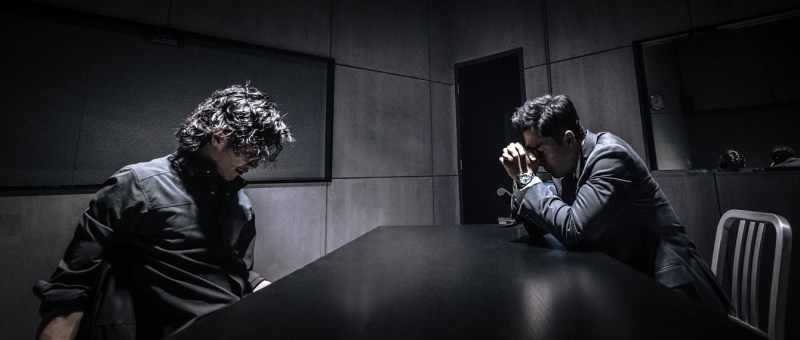
Chan places this debate front and centre by setting the final showdown in a church currently undergoing renovation, Ngo seemingly judged for his moral transgressions while Cheung meditates on the man he used to be in a bromance montage that laments the tragedy of Ngo’s fall from grace. The battle of wits between the two men, Ngo of course uniquely positioned to game the system he rails against, ends only in futility while the system which created him remains unchanged. Chan shoots with characteristic visual flare sending his compromised cops through a golden hellscape of the contemporary city veering between beautifully choreographed, high octane action sequences including a lengthy car chase through a highly populated area, and procedural thrills tinged with ambivalent social commentary in which justice itself has become commodified while police officers exceed their authority and bow to the rich and powerful. A throwback to classic Hong Kong action, Chan’s final film is a fitting finale for the career of a director taken far too soon. 


Raging Fire screened as part of this year’s New York Asian Film Festival and will be released in US cinemas on Aug, 13 courtesy of Well Go USA.

International trailer (English subtitles)

Kung Fu Killer (一個人的武林, AKA Kung Fu Jungle, Teddy Chan, 2014)

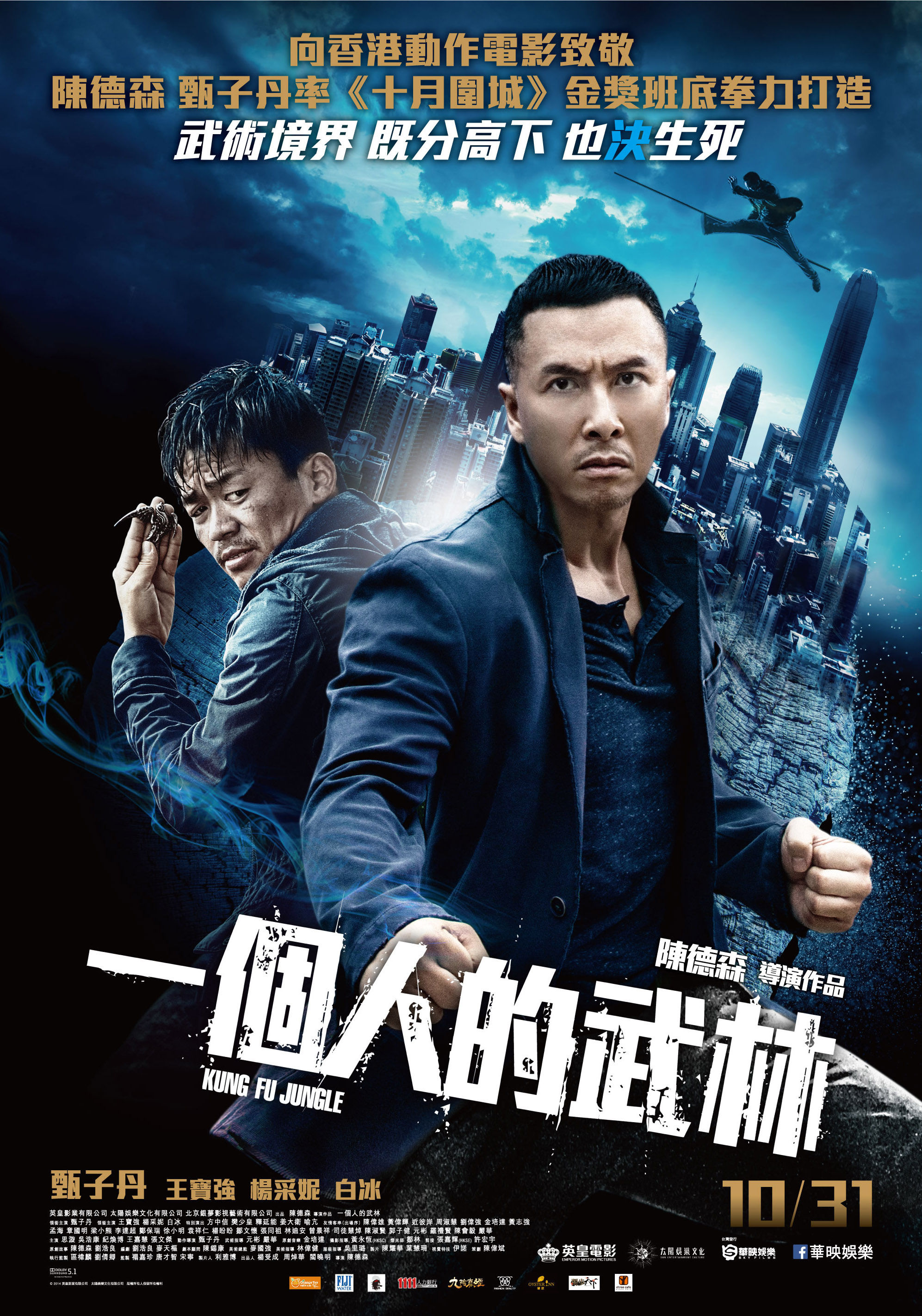
kung fu killerKung fu movies –  they don’t make ‘em like they used to, except when they do. Kung Fu Killer (一個人的武林, AKA Kung Fu Jungle) is equal parts homage and farewell as its ageing star, Donnie Yen, prepares to graduate to the role of master rather than rebellious pupil. What it also is, is a battle for the soul of kung fu. Just how “martial” should a martial art be? Is it, as our antagonist tells us, worthless with no death involved or will our hero prove the spiritual and mental benefits which come with its rigorous training and inner centring transcend its original purpose? Of course most of this is just posturing in the background of a lovingly old fashioned fight fest complete with a non-sensical plot structure motivated by increasingly elaborate set pieces.

Yen plays Hahou Mo, a martial arts master and instructor to the HK police who hands himself in one day covered in blood and confesses to having killed someone. Three years later Hahou is a man of peace, paying for the accidental death of an opponent by patiently waiting out his prison time. However, when he sees a news report about a serial killer with martial arts ability targeting fellow martial artists he goes on a violent rampage trying to get the attention of the police. If they’re going to solve this crime, they’re going to need someone who knows the martial arts world intimately and Hahou spies an opportunity to earn his freedom through helping someone not so unlike himself realise the error of their ways.

In keeping with the genre, its not so much of a whodunnit as a whydunnit and so the crazed murderer is unmasked fairly quickly. Fung Yusau (Wang Baoqiang) is determined to be number one in each and every discipline, taking on the accepted masters and besting them every time, even going to far as to leave a sarcastic trophy on every body. Hahou once shared his ambition, his reckless need to prove his skill is the reason his life has gone the way it has after all, but the two men share fundamentally different beliefs about the nature of their art. Fung Yusau believes martial arts exist for the reason of killing people – fights in which both challengers live are, to him, pointless and incomplete.

Even if Hahou once harboured the same desire to prove his skills superior to all others, his was a more internal quest. For him, at least now, kung fu is a sacred art of self improvement which can be used for self defence but is essentially about learning to live a harmonious life. Having learned from his own misfortune, he knows the folly of being no. 1 – in that it’s an essentially lonely and insecure place to be. Martial arts should be used to kick down walls and build bridges, his desire is to move forward in togetherness teaching people how to be happy rather than working against each other in an unnecessary and artificial kind of competition.

The police need Hahou’s help because the martial arts world is so essentially alien to them. Despite a shared culture, this insular universe is something which they know nothing about and is so dependent on interpersonal knowledge that no degree of wikipediaing is likely to help them understand it. Only by learning from those with direct knowledge and able to guide them through the particular thought processes of the killer will they stand any chance of being able to catch him. However, the strangely alternative nature of the martial arts universe also makes trusting Hahou and the veracity of his information a big ask for hardheaded cops.

Yen wisely cedes most of the action to Wang Baoqiang other than in the early prison riot sequence and final showdown. The fight scenes are innovatively choreographed and always exciting, except perhaps for going overboard with CGI especially during the motorway set finale during which the additional speeding cars become an unwelcome reminder of just how much less is at stake than during the heady Hong Kong heyday of death defying stunts. Still, the relative quality of the action goes a long way to covering for the otherwise under developed story elements.

A nice fusion of the classic and the modern, Kung Fu Killer wears its love on its sleeve with a final credits sequence celebrating the various Hong Kong greats who’ve all contributed to the film in some way even if in more of a spiritual capacity. Necessarily an exercise in genre, Kung Fu Killer makes no claims to breaking new ground or doing anything particularly interesting, but does provide ample scope for a celebration of Hong Kong action cinema as well as the handing of the baton from Yen to Wang as each showcases their respective martial arts prowess.


Original trailer (English Subtitles)