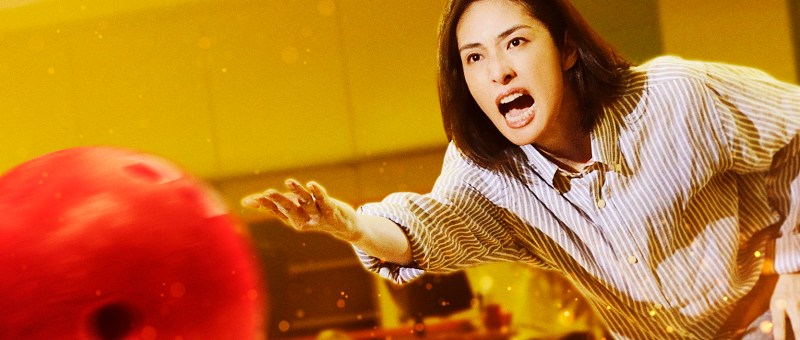

What Happened to Our Nest Egg!? (老後の資金がありません!, Tetsu Maeda, 2021)

A minor controversy erupted in Japan in 2019 when then finance minister Taso Aso issued a statement recommending that couples should have 20 million yen (£104,620 total at the time of writing) saved for their retirement on top of the state pension in order to live a comfortable life in old age. All things considered, 20 million yen actually sounds like quite a low sum for two people who might live another 30 years post-employment. Nevertheless, Atsuko (Yuki Amami) and her husband Akira (Yutaka Matsushige) are now in their mid-50s and don’t have anywhere near that amount in savings. They’re still paying off their mortgage and though their children are grown-up, neither of them seem to be completely independent financially and both still live at home. 

Tetsu Maeda’s familial comedy What Happened to Our Nest Egg!? (老後の資金がありません!, Rogo no shikin ga arimasen!) explores the plight of the sandwich generation which finds itself having to support elderly relatives while themselves approaching retirement and still needing to support their children who otherwise can’t move forward with their lives. Seeing an accusatory ad which seems to remind her personally that even 20 million yen isn’t really enough when you take into consideration the potential costs of medical treatment or a place in a retirement home, Atsuko has a sudden moment of panic over their precarious financial situation. The apparently sudden death of Akira’s 90-year-old father acts as a sharp wake up call especially as Akira’s apparently very wealthy but also selfish and materialistic sister Shizuko (Mayumi Wakamura) bamboozles him into paying for the entirety of the funeral while pointing out that they’ve been footing most of the bill for the parents’ upkeep over the last few years.

There was probably a better time to discuss the financial arrangements than with their father on his deathbed in the next room, but in any case Shizuko doesn’t pay attention to Atsuko’s attempt to point out they’ve been chipping in too. Akira’s mother Yoshino (Mitsuko Kusabue) also reminds them that their family was once of some standing and a lot of people will be attending the funeral so they need to make sure everything is done properly. The funeral arranger is very good at her job and quickly guilts Atsuko into spending large sums of money on pointless funeral pomp to avoid causing offence only to go to waste when hardly anyone comes because, as she later realises, all of the couple’s friends have already passed away, are bedridden, or too ill to travel. 

Yoshino is however in good health. When Shizuko suddenly demands even more money for her upkeep, Atsuko suggests Yoshino come live with them but it appears that she has very expensive tastes that don’t quite gel with their ordinary, lower-middle class lifestyle. Having lived a fairly privileged life and never needing to manage her finances, Yoshino has no idea of the relative value of money and is given to pointless extravagance that threatens to reduce Atsuko’s dwindling savings even more while in a moment of cosmic irony both she and Akira are let go from their jobs. Now they’re in middle age, finding new ones is almost impossible while their daughter suddenly drops the bombshell that she’s pregnant and is marrying her incredibly polite punk rocker boyfriend whose parents run a successful potsticker restaurant and are set on an elaborate wedding.

The film seems to suggest that Atsuko and Akira can’t really win. They aren’t extravagant people and it just wasn’t possible for them to have saved more than they did nor is it possible for them to save more in the future. Instead it seems to imply that what they should do is change their focus and the image they had of themselves in their old age. One of the new colleagues that Akira meets in a construction job has moved into a commune that’s part of the radical new housing solution invented by his old friend Tenma (Sho Aiwaka). Rather than building up a savings pot, the couple decide to reduce their expenses by moving into a share house and living as part of a community in which people can support each other by providing child care and growing their own veg. Yoshino too comes to an appreciation of the value of community and the new exciting life that she’s experienced since moving in with Atsuko. It may all seem a little too utopian, but there is something refreshing in the suggestion that what’s needed isn’t more money but simply a greater willingness to share, not only one’s physical resources but the emotional ones too in a society in which everyone is ready to help each other rather than competing to fill their own pots as quickly as possible. 


What Happened to Our Nest Egg!? screens as part of this year’s Japan Foundation Touring Film Programme.

Trailer (English subtitles)

Baian the Assassin, M.D. (Part 1) (仕掛人・藤枝梅安, Shunsaku Kawake, 2023)

A traumatised assassin takes it upon himself to get rid of a few villains on realising there’s something not quite right with his latest contract in Shunsaku Kawake’s classic jidaigeki homage, Baian the Assassin, MD: (Part 1) (仕掛人・藤枝梅安, Shikakenin Fujieda Baian). The titular hero is the protagonist of a series of novels by Shotaro Ikenami which have spawned several previous adaptations on the big and small screens. Produced in celebration of Ikenami’s centenary the film, one of two, harks back to the golden age of period drama if with a more contemporary sensibility. 

Baian (Etsushi Toyokawa) is ostensibly an acupuncturist though by night he uses his needles to kill rather than to heal. Hired to take out the second wife an inn owner, Omino (Yuki Amami), his suspicions are raised on realising that he had also been the assassin who killed the man’s first wife two years earlier. He blames himself in part for having agreed to assassinate a woman in the first place, and remains conflicted even after accepting the job wondering if Omino is next in the firing line or if she was actually the one who had the other woman killed in order to usurp her place. 

The film makes clear from the outset what a difficult place Edo could be for a woman as Baian carries out an assassination on a boatman who had raped a samurai’s wife and then blackmailed her into further sexual favours only for her to hire an assassin and then kill herself confessing all. Omino had apparently been the stepdaughter of a gang leader who sexually abused her and then died leaving her with no support and nowhere to turn except to sex work. Maybe no one could blame her for taking advantage of a besotted client to escape her terrible circumstances though getting rid of his wife would obviously be a different matter. Omon (Miho Kanno), a maid Baian takes a liking to while investigating, admits something similar that as a widow with a young son realistically speaking there is nowhere else that could she work to support him except on the fringes of the sex trade. Then again, as she says the previous mistress was strict but it was because she cared, whereas Omino is just mean and self-interested. She’s fired all the old staff and brought in pretty young women who are quite obviously being expected to entertain their male customers in more direct ways. 

In any case, Baian soon finds himself drawn into a wider series of plots when his friend Hiko (Ainosuke Kataoka), a skewer maker who assassinates people with poison darts, is tasked with taking out first a lascivious carpenter and then a rogue samurai who has supposedly raped and kidnapped the daughter of his lord which obviously turns out not quite to be the case. Rape and kidnap are depressingly common in Edo-era society where it is largely women who suffer under a patriarchal society with intensely oppressive social codes that demand female purity. In a post-credits sequence, we come to understand that Hiko too is seeking vengeance for the death of a woman who killed herself and her child after being raped by bandits. Meanwhile, Baian reveals that he had a mild hatred of women himself born of pain in having been abandoned by his mother who left with another man and took only his sister with her after his father’s death. He had to overcome that resentment in order to fulfil himself as a doctor treating women’s bodies but struggles when he realises that someone involved in the case is closely linked with his own traumatic past and death may be the only way to save them. 

Both he and Hiko end up breaking the assassin’s code but only in defence of justice, which might sound odd considering the nature of their work. Nevertheless, they each have their scruples and don’t like to think of themselves as having been used or inadvertently killed someone who didn’t really deserve it. As Baian puts it, the greatest villains may really be “well-meaning weak cowards” though perhaps corrupt lords can’t really complain about falling victim to their own tactics. With noticeably polished production values and atmospheric cinematography, Kawake pays tribute to classic jidaigeki and eventually sets his heroes back on the road awaiting the next battle for justice in the distinctly unjust feudal era. 


Baian the Assassin, M.D. (Part 1) screened as part of this year’s Camera Japan.

Original trailer (English subtitles)

Mary and the Witch’s Flower (メアリと魔女の花, Hiromasa Yonebayashi, 2017)

Mary and the witch's flower posterWhen Studio Ghibli announced that it would be ceasing production, it couldn’t help but feel like the end of an era. The studio which had made Japanese animation an internationally beloved art form was no more. Into the void stepped a brand new animation studio which vowed to pick up the Ghibli gauntlet – Studio Ponoc was formed by former Ghibli producer Yoshiaki Nishimura who enlisted a host of other ex-Ghibli talent including Arrietty director, Hiromasa Yonebayashi. 

Mary and the Witch’s Flower (メアリと魔女の花, Mary to Majo no Hana), Ponoc’s first feature is, like Yonebayashi’s When Marnie was There, an adaptation of a classic British children’s novel. Part of the ‘70s children’s literature boom, Mary Stewart’s The Little Broomstick was more or less forgotten until the film, paradoxically, brought it back into print. Like many post-war children’s novels, The Little Broomstick is the story of a clever and kind little girl who thinks she doesn’t quite fit in. Mary and the Witch’s Flower is no different in this regard, even in updating the tale (seemingly) to the present day as its spiky heroine finds herself taking on mad scientists and crazed witches in a strange fantasy realm all while trying to get used to the comparatively gentle rhythms of country life.

Mary Smith (Hana Sugisaki) is bored. She hates her frizzy red hair which a horrible local boy, Peter (Ryunosuke Kamiki), uses as justification to describe her as a “red haired monkey”, and fears that the rest of her life will merely be a dull exercise in killing time until its inevitable conclusion. Mary has just moved in with her Great-Aunt Charlotte (Shinobu Otake) in the country while her parents are apparently working away and, as she still has a week left of summer holidays until school starts, she’s desperate for something to do. Unwisely following two cats into a misty forest, she chances upon a mysterious flower – the “Fly By Night” which blooms only once every seven years. With no respect for nature, Mary picks herself some of the pretty bulbs to take back to the gardener but unwittingly opens up a portal to another world. Taking hold of an abandoned broomstick, she finds herself swooped off to Endor College – an elite institution of witchcraft and wizardry where she dazzles all with her magical skills. Thinking she’s finally found her place, Mary is content to go along with everyone’s assumption that she is the new student they’ve been waiting for but on closer inspection, Endor College is not quite all it seems.

Mary’s initial dissatisfaction with herself is somewhat sidelined by the narrative but there’s something particularly poignant about her loathing of her red hair. In British culture at least, those with red hair often face a strange kind of “acceptable” prejudice, bullied and ostracised even into adulthood. Thus when Peter calls Mary a “red haired monkey” it isn’t cute or funny it’s just mean and she’s probably heard something similar every day of her life. When she rocks up at Endor and they tell her that her red hair makes her special and is the sign of high magic potential, it’s music to her ears but it’s also, perhaps, reinforcing the idea that simply having red hair makes her different from everyone else.

Feeling different from everyone else perhaps allows her to look a little deeper into the world of Endor than she might otherwise have done. Despite her conviction that she doesn’t fit in and is of no use to anyone, Mary is never seriously tempted by the promises of Endor which include untold power as well as a clear offer of acceptance and even respect. When she realises that the couple who run the school – a witch and a scientist, have been abusing their powers by committing heinous acts of experimentation on innocent “test subjects”, Mary learns to stand up for those who can’t stand up for themselves even if she couldn’t have done it for herself.

Messages about the seductive power of authoritarian regimes exploiting feelings of disconnection, the scant difference between magic and science, and the need for respect of scientific ethics in the pursuit of knowledge, all get somewhat lost amid Mary’s meandering adventures, as does Mary herself as her gradual progress towards realising that she possessed her own “magic” all along ticks away quietly in the background. Yet the biggest problem Mary and the Witch’s Flower faces is also its greatest strength – its ties to Studio Ghibli. With echoes of Yonebayashi’s previous adaptations of classic British literature, Mary and the Witch’s Flower also indulges in a number of obvious Ghibli homages from the Ponyo-esque flying fish and Laputa influenced design of Endor to the overt shot of Mary riding a deer on a rocky path, and the unavoidable girl+broomstick echoes of Kiki’s Delivery Service. Even if Mary and the Witch’s Flower cannot free itself from the burden of its legacy, it does perhaps fill the void it was intended to, if in unspectacular fashion.


Mary and the Witch’s Flower will be released in UK cinemas courtesy of Altitude Films in May 2018.

Original trailer (English subtitles)

The Magic Hour (ザ・マジックアワー, Koki Mitani, 2008)

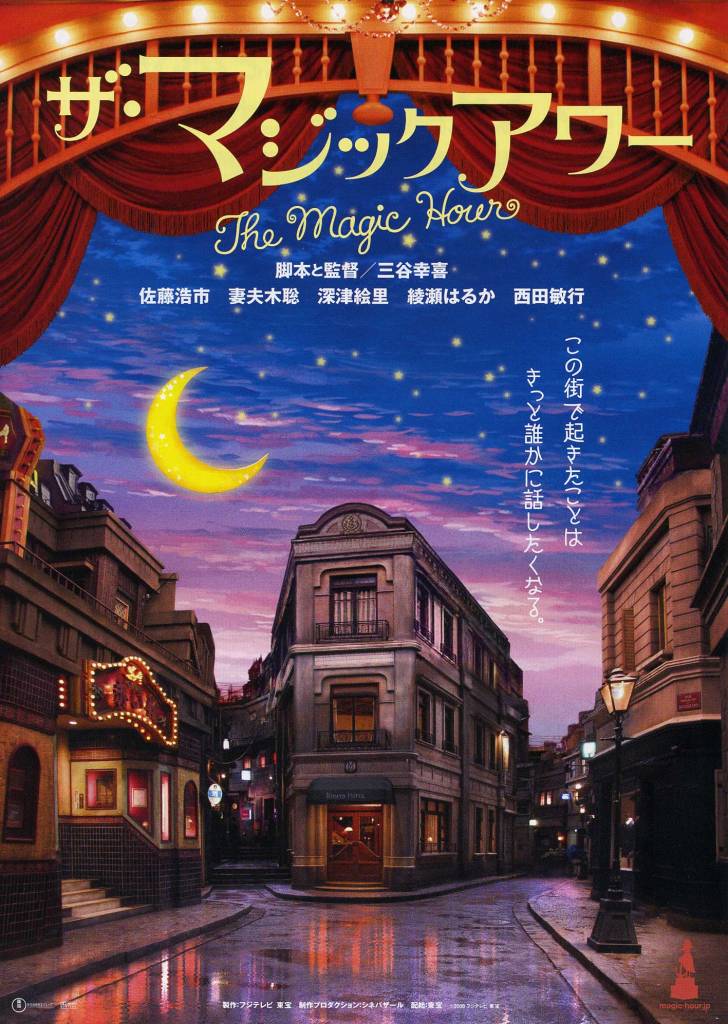
Magic Hour PosterIf there’s one thing you can say about the work of Japan’s great comedy master Koki Mitani, it’s that he knows his cinema. Nowhere is the abundant love of classic cinema tropes more apparent than in 2008’s The Magic Hour (ザ・マジックアワー) which takes the form of an absurdist meta comedy mixing everything from American ‘20s gangster flicks to film noir and screwball comedy to create the ultimate homage to the golden age of the silver screen.

In classic style the film opens with a bunch of goons chasing a scantily clad club owner out of a hotel window. Bingo (Satoshi Tsumabuki) has been hitting the jackpot with the boss’ girl, Mari (Eri Fukatsu), so the two are about to be given a new set of kicks in the latest fashion – cement. Luckily Bingo overhead some of the other guys talking about looking for another gangster, Della Togashi, so he quickly starts talking about him as if he were a long lost friend. The boss, Tessio (Toshiyuki Nishida), gives the pair a reprieve on the condition Bingo tracks down Togashi and brings him in within five days. Slight hitch – Bingo had never heard of Togashi before today and has no idea where to start. Finally, with the help  of some of his bar staff he hatches on the idea of getting a random actor to play the part, seeing as no one knows what Togashi looks like. However, the actor, Murata (Koichi Sato), plays his part a little too well and gets hired to work for the gang all the while thinking it’s just a movie! Pretty much everyone is getting a little more than they bargained for…

If you’re thinking that the oddly American looking 1920s street scene looks a little fake and everyone seems to be overacting like crazy, you wouldn’t be wrong but like everything else there’s a reason for that. What originally looks to be the primary setting for the film is a strange bubble which seems to co-exist with the modern world only its filled with people straight out of The Public Enemy or Scarface who think cement shoes is an efficient way of dealing with traitors. Murata, by contrast, is from our world and is completely oblivious to the strangeness of this movie gangster sound stage universe.

Murata is fixated on the Casablanca-esque final scene of his favourite movie in which a dyed in the wool tough guy entrusts the love of his life to a loyal friend before heading off to face certain death. His own career has not been going particularly well and even if he originally turns down Bingo’s offer as working with a first time director on a film where there’s no script sounds pretty fishy to begin with, circumstances soon find him throwing himself into the mysterious leading role with aplomb. Indulging his long held gangster dreams, Murata becomes the archetypal movie hit-man. He’s giving the performance of his life but has no idea there is no film in the camera.

The “Magic Hour” of the title refers to the twilight time near the end of the day when the light is dying but the conditions are perfect for making a movie. Mitani doesn’t fail to remind us we’re watching a film with constant exclamations of “just like a movie” or “doesn’t this look like a film set”. It’s a Barnum & Bailey world, just as phoney as it can be – but somehow it all just works despite its rather arch, meta approach. By the point we’ve hit Mari sitting on a crescent moon to give us her rendition of I’m Forever Blowing Bubbles (we’re back to The Public Enemy again) we’ve hit peak ‘20s though we scarcely mind at all.

Though he is indeed sending a lot of these classic ideas up, there’s real love here particularly for those golden age Hollywood movies with their wounded tough guys and beautiful chorus girls in need of rescue. Mitani adopts a primarily theatrical tone which meshes well with the absurdist, artificial atmosphere but always makes sure to leave us a fair few clues in the way of laughs. However, probably correctly assuming we know these films as well as he does, Mitani doesn’t give us the typical narrative that would almost write itself (or allow Bingo to write it based on his own trips to the motion picture house). The “bad” guy turns out to be not so bad, the “hero” wasn’t who we thought he was and none of our central guys winds up with a girl. Beautifully silly yet intricately constructed, The Magic Hour is another comedy masterpiece from Mitani which is filled with his characteristic warmth, mild sentimentalism and plenty of off-centre humour of the kind only Mitani can come up with.


The Japanese DVD/blu-ray release of The Magic Hour includes English subtitles.