

Now a sprawling multi-media franchise, Detective Conan began with Gosho Aoyama’s manga which published its first instalment in 1994 and is still going strong 30 years later. The series was released in the US in the 2000s under the name Case Closed and in a decision which was perhaps more common then than today anglicised all of the character’s names and settings (the Japanese publisher then began releasing its own English language translation of the manga maintaining all the original Japanese names and plot details). Meanwhile Detective Conan remains hugely popular across Asia and regularly tops the Japanese box office with the annual release of a feature film revolving around a major case for Conan in addition to the ongoing anime and manga.
Which is all to say it has a very well developed universe and vast cast of characters which weave in and out of Conan’s various adventures. The main thing to note about Conan himself, which is explained very briefly in a short introductory sequence to the movie, is that he’s actually a 17-year-old high school detective but his body was shrunk to the size of a small child when he was drugged by the mysterious Black Organisation after witnessing to of their agents getting up to something shady in a park. Only a handful of people know his true identity while he often works with the police solving crimes, and is common with Japanese crime fiction more often than not locked room mysteries.
The Million-Dollar Pentagram (名探偵コナン 100万ドルの五稜星, Meitantei Conan 100-man Dollar Michishirube), the 27th Conan movie, is somewhat different in this regard as it’s more of a treasure hunt in which Conan (voiced by Minami Takayama) and his associate Heiji (Ryo Horikawa) must attempt to figure out the mystery of some missing treasure which might have something to do with a pair of swords stolen by one of Conan’s arch nemeses, Kid the Phantom Thief (Kappei Yamaguchi). Like many of these kinds of stories, the mystery turns on historical detail in this case stemming back to the Meiji Restoration and legendary Shinsengumi boss Hijikata Toshizo, if by way of a long-dead industrialist who got rich quick during the pre-war goldrush in Hokkaido. Some of his estate apparently went missing after his death and now his grandson, who’s messed up the family business, wants to find it and so does Conan but for slightly different reasons. In any case, no one even knows what the treasure is and they may be disappointed when they find out especially as it might not show grandpa Onoe in a particularly good light.
There is undoubtedly quite a lot going on with a prominent subplot focusing on Heiji’s crush on love interest Kazuha (Yuko Miyamura) and his rivalry with Kid the Phantom Thief with his big plan to finally confess his feelings aligning with the climax of the mystery taking place on Mount Hakodate. A port town in Hokkaido, Hakodate has not often been well served by cinema often appearing in indie films such as And Your Bird Can Sing, Sketches of Kaitan City, and Over the Fence as a moribund post-industrial centre the protagonists can’t escape, but here seems pleasant and relaxed as a kind of Northern Kyoto rich in period history. The film’s success has apparently spiked a mini tourist boom in the area.
The filmmakers apparently did not want to destroy any of the town’s architecture even in animation, hoping to make the most of the city’s famous night scenes and beautiful scenery. Nevertheless, there are the usual series of impressive action sequences including one of Conan riding a jet-powered skateboard not to mention taking out a suspect with a football while Heiji fights another on the wings of a biplane. As for the mystery itself, it’s not the kind where the audience will be able to work it out seeing as it depends on very specific cultural knowledge that even Conan needs a hint to key into but eventually broadens into something more international involving arms dealers and corrupt businessmen. Long-standing fans of the franchise will want to stay put for a very interesting post-credits sequence and even newcomers will get a kick out of an unexpected punchline to the film’s closing moments. All in all another classic case for the Conan team peppering its key mystery with the humour and warmth the franchise is known for.
Detective Conan: The Million-Dollar Pentagram opens in UK cinemas 27th September courtesy of CineAsia.
Original trailer (Traditional Chinese & English subtitles)
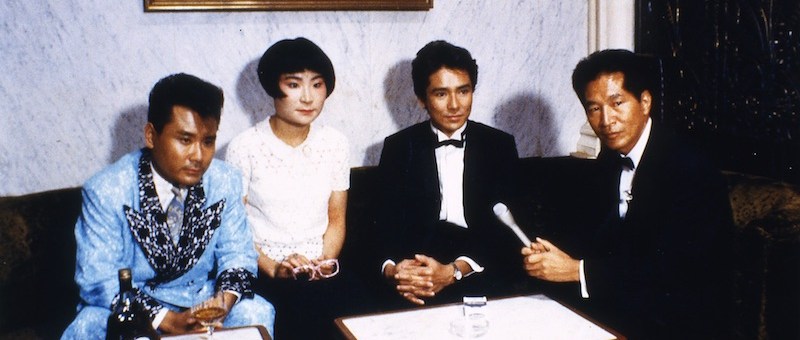
 The word “paparazzo” might have been born with La Dolce Vita but the gossip hungry newshound has been with us since long before the invention of the camera. Yojiro Takita’s 1986 film No More Comics! (コミック雑誌なんかいらない, Komikku zasshi nanka iranai AKA Comic Magazine) proves that the media’s obsession with celebrity and “first on the scene” coverage is not a new phenomenon nor one which is likely to change any time soon.
 Windows on Worlds