
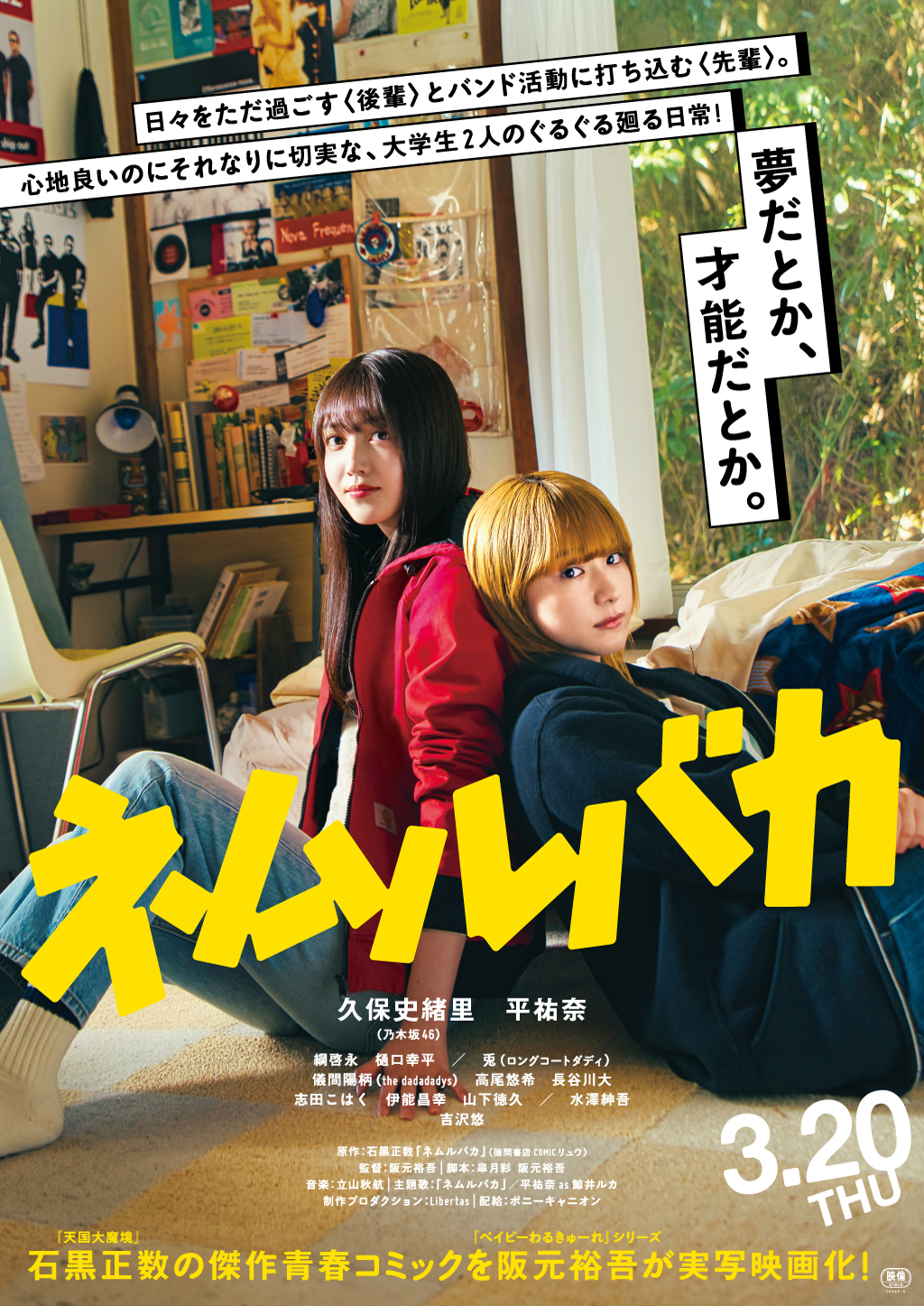
Nemurubaka: Hypnic Jerks (ネムルバカ, Yugo Sakamoto, 2025)

Is it better to have a goal and know what you want, or is it easier to be just kind of muddling along? The heroines of Yugo Sakamoto’s oddly titled slacker comedy Nemurabaka: Hypnic Jerks (ネムルバカ) are coming at this from opposite sides. Ruka (Yuna Taira) is a rock band and her dream is to make it as a musician, though she isn’t really sure she has what it takes, while Yumi (Shiori Kubo), though in some ways the more sensible of the pair, has no idea what she’s doing with her life.

The fact that Yumi addresses Ruka only as “sempai” bears out the ways in which she feels slightly inferior to her, and, in fact, to everyone. As she says to Ruka, it’s like everyone else has a foot on the ladder, but she can’t even see where the ladder is let alone climb it. Ruka offers to split her pay for polishing up some ornaments for a friend who works as a maid at a posh person’s house as long as she does half of it, adding that now at least Yumi’s on the bottom rung while simultaneously trying to make her an equal. While Yumi idolises Ruka, Ruka seems to be jealous of Yumi’s carefree nature and relative lack of impetus. 

Then again, the way she seems to quickly shut down anyone making romantic overtures towards Yumi along with her habit of gazing at her while she’s asleep may suggest another kind of desire. The gazing turns out to have a practical dimension, at least, that somewhat dissolves the disparity as it’s Yumi who has facilitated Ruka’s art and, to an extent, all her songs appear to be about her. This may be what she means when she tells Yumi that she’s very important to her to try and quell her feelings of low self-worth and inferiority. Nevertheless, this notion of being somehow lesser is only reinforced by the intrusion of a guy, Taguchi (Keito Tsuna), who pretends to have romantic interest in Yumi but is in reality after Ruka who exploits him for free food and the use of his car. 

Exposed, Taguchi calls Yumi “low-tier” and “a simpleton”, but inexplicably still expects Ruka to date him despite having just confessed to using her friend and then insulting her as part of a botched apology. Part of the problem is that Taguchi is a spoiled rich kid who doesn’t understand how the world works. He has a useless GPS device installed in his car featuring a maid-style character who deliberately gives rubbish directions because men like him generally prefer women to be stupid and cute even though he’s set his sights on Ruka who is moody and rebellious. While the girls are humming and hawing over a new rice cooker and going hungry at the end of the day, he’s obsessing over getting a new outfit for his GPS mascot. His comparatively more sensible friend who sort of mirrors Yumi indulges in superhero fantasy and is jealous of Ruka because of her certainty about her path in life even if Ruka is anything but certain in her ability to follow it.

It’s that sense of uncertainty that, in a way, convinces her to accept an offer of a record contract despite the fact they only want her and not her bandmates while she’ll also have to move out of the flat she shares with Yumi to go to Tokyo. She admits that she’d like to live this aimless life with her for longer, but is frightened of becoming stuck and never able to progress to anything else. But the price of that is she ends up making soulless idol pop for the commercialised music industry despite having been signed for a punk anthem about youthful despair. Yumi may be the “sleeping idiot” of the title in a more literal sense, but perhaps Ruka isn’t really fully awake either but allowing others to lead her towards what she should want but perhaps really doesn’t. In any case, unlike similarly themed films, this one doesn’t really lean into the idea that an aimless life is fine itself but encourages Yumi and the others to try and find a sense of purpose as she becomes a “sempai” herself, if also maintaining the courage to walk away from a compromised vision of success that isn’t at all what they wanted.


Nemurubaka: Hypnic Jerks screens as part of this year’s Japan Foundation Touring Film Programme.

Images: © Masakazu Ishiguro, Tokuma Shoten_Nemurubaka Film Production Committee
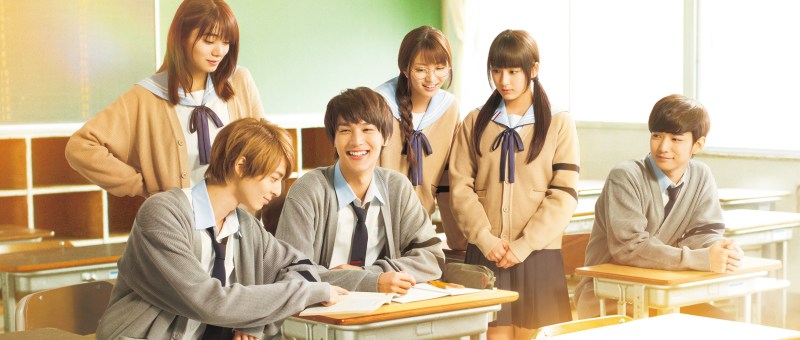
ReLIFE (ReLIFE リライフ, Takeshi Furusawa, 2017)

Is there such a thing as toxic conventionality? The hero of Takeshi Furusawa’s manga adaptation ReLife (ReLIFE リライフ) has driven himself into despair in his failure to achieve conventional success in contemporary Japan, fearing that in having fallen from one of the earliest rungs of the ladder he’ll never be able to climb back up and therefore has no real future. Even so, his dissatisfaction is turned entirely inward rather than channelled into a desire to change society for the better, his eventual epiphany amounting to the determination to help others persevere amid constant disappointment rather than encouraging them to reject the mainstream and search for bespoke happiness. 

At 27, Arata (Taishi Nakagawa) isn’t sure why his life turned out this way. He thought he’d follow the conventional path, graduate uni, get a steady salaryman job, marry around 25 and settle down into a comfortable middle class life, but now he’s trapped in a perpetual cycle of job seeking and part-time work with his savings running out and final demands pouring in. Invited to a gathering with old friends one of whom is getting married, he shaves and puts on a suit playing the role of the conventional salaryman they all assume him to be too ashamed to let them know he’s struggling. So when he’s accosted in the street by a strangely elfin young man, Yoake (Yudai Chiba), who tries to recruit him into an experimental programme in which they’ll pay his living expenses while he spends a year as a high school senior he finds himself agreeing. 

This is no time travel story, however, the magic pills merely turn Arata back into a 17 year old to enrol in a contemporary high school with kids 10 years younger than himself. He can’t literally change his past but is supposed to use the time to grow as a person, rediscovering a sense of possibility that comes with youth and dwindles with age. His initial intention is just to ride it out seeing as he’ll have no immediate worries for food or shelter and has been guaranteed help with the job hunt when the year is up and he returns to being 28, but inevitably finds himself drawn into teenage intrigue helping each of his new friends reach their own epiphanies in gaining the courage to declare their feelings or overcome their shyness in trying to decide the further course of their lives. 

Part of his own epiphany lies in his renewed desire to be part of a community, no longer isolated in his personal shame but actively participating while embracing his innate kindness and desire to help others. As we later learn, he quit his company job on uncovering workplace sexism and petty harassment, unable tolerate it that a talented colleague (Mikako Ichikawa) found her career sabotaged by men who didn’t like it that she was good at her job and therefore presented a threat to their success. Arata naively brought the matter to the attention of his boss but his boss sided with the guys and had her transferred out. Given this information, it makes little sense that Akira quit his job in protest but then continued to apply for new ones with other companies presumably assuming they would be different rather than accepting workplace bullying is a systemic issue. 

This is the fundamental problem with his experiences in ReLife in that the path he eventually discovers lies in helping other people endure this already corrupt system which isn’t working for anyone, let alone himself. His emphasis on the spirit of never giving up and being there for those in need is noble, but ultimately only enables the system which caused so many to fall into despair in insisting that it is they who need to live up to these culturally defined ideals of conventional success rather than challenging the deeply ingrained social codes which prevent them from pursuing personal happiness. Part high school nostalgia drama complete with a potentially inappropriate romance, ReLIFE is replete with typical genre motifs such as the cultural festival and summer fireworks display along with the continual sense of something coming to an end as Arata finally convinces himself to “treasure the moment” rather than remain trapped between past regret and fear of an uncertain future, but perhaps sends the uncomfortable message that adult life is something you just have bear rather than actively enjoy. 


ReLIFE streams until 27th February in several territories as part of Japanese Film Festival Online 2022.

Original trailer (English subtitles)

The Dark Maidens (暗黒女子, Saiji Yakumo, 2017)

dark maidens posterThe world of teenage girls is often arcane and impenetrable to those outside of its extremely exclusive bubble, but The Dark Maidens (暗黒女子, Ankoku Joshi), Saiji Yakumo’s adaptation of the Rikako Akiyoshi novel, takes duplicity to new heights. When the school darling dies by falling (oh so beautifully) off a roof, speculation is rife and a rumour quickly spreads through the otherwise repressive educational environment that her very best friends are somehow to blame. Each implicates the others in turn, indulging their petty grudges and jealousies seemingly falling over themselves to express their closeness to the departed “sun”, but all is not quite as it seems and these collective acts of fantasy perhaps expose a little more than they were first intended to.

Itsumi Shiraishi (Marie Iitoyo) is dead. The daughter of the chairman at the elite all girls Catholic high school, Virgin Mary Academy, Itsumi was loved by all as the radiant sun whose innate goodness was the very embodiment of the school’s Christian aims. Immediately before the school holidays, the literature club – the most prestigious and exclusive of school associations of which Itsumi had been founder and president, are to meet one last time presided over by Itsumi’s best friend Sayuri (Fumika Shimizu). The girls will each read a story they have written “inspired” by Itsumi’s death, each of which attempts to tell her story from their perspective but ultimately paints themselves in a favourable light whilst casting doubt on the others. 

The sole clue to the mystery is the lily of the valley Itsumi clutched to her breast, Snow White-like, as she lay pale and wan amid the flowers, elegantly arranged as always despite an apparently violent death. Quickly the girls run through a series of possible motives each with a degree of internal consistency but veering off in their own particular directions. Three of the girls awkwardly hint at their (unrequited?) love for their dead friend, insisting on a kind of ownership of her memory and of their rightful place at her side while the fourth descends into a xenophobic horror story casting the half-Bulgarian girl as a “vampire” come to suck the life out of the previously warm and vivacious Itsumi.

Yakumo delights in sending up the ever present girls school trope of repressed lesbianism and passionate friendships, but it remains true enough that the love card was apparently not one which Itsumi was afraid to play. The stories are all, in part at least, fabrications intended to cover up the various skeletons each of the girls has in their closets, but what they reveal is the series of manipulative machinations which underpins this seemingly sweet and elegant collection of conservative young ladies indulging a love for literature and the Christian virtues. Affairs, blackmail, inappropriate sexual relationships, forced abortions (at a Catholic school!), arson, all of these precede the presumed murder of Itsumi in a vast web of deception and illicit activity.

Teenage girls are often desperate to fit in, to be accepted by the “elite”, at the best of times but especially in an environment as otherwise repressive and exacting as an all girls Catholic high school. Adolescence is a time for trying on different personalities, but there can be something inherently plastic about the identity of a high school girl wanting in to the popular club. Hiding their true feelings, their fears and jealousies, the girls play the parts of they’ve been assigned – supporting cast in the tragic history of Itsumi, a girl betrayed who remained beautiful even in death. Then again, there might be some push back from those growing to resent their peripheral status and beginning to wonder if the spotlight was not theirs for the taking all along. A sun, however, will always need its lesser stars to demonstrate how much brighter it can shine.

Adapted from the novel by Rikako Akiyoshi, The Dark Maidens is a perfect mix of European drawing room mystery and gothic melodrama. Yakumo ups the camp fantastically with the girls sitting round a mysterious pot of stew in a room lit only by candlelight while a storm rages outside and each revelation is accompanied by crashing thunder and flashes of light. The setting is oppressive and sinister, but the only horror in the room is entirely human as each of these young women eagerly submits themselves to someone else’s control in fear of being, in some way, exposed, while those who seek to play the lead have to stoop to underhanded methods just to make “friends” who are really just minions rather than true believers. A sad and sorry state of affairs – who knew teenage cliques could be so, well, dark?


Screened as part of the Japan Foundation Touring Film Programme 2018.

Screening again:

  • Brewery Arts Centre – 16 February 2018
  • Macrobert Arts Centre – 19 February 2018
  • Showroom Cinema – 1 March 2018

Original trailer (English subtitles)

Mumon: The Land of Stealth (忍びの国, Yoshihiro Nakamura, 2017)

MumonJapan prides itself on its harmonious society, but just like the Spartans of Ancient Greece, there have always been those who choose to do things differently. In the late 16th century, Japan was divided into a number of warring states but one visionary general, Oda Nobunaga, had begun a campaign of conquest which he intended to extend across the nation creating peace through unification under a single ruler. One tiny province held out – Iga, home to the ninja and renowned for the petty heartlessness of its mercenary men.

In the September of 1579, two rival ninja clans are engaging in a little practice fighting to the death during which Mumon (Satoshi Ohno), “the greatest ninja in Iga”, takes a commission to assassinate the younger son (Shinnosuke Mitsushima) of the opposing general, which he does with characteristic style and efficiency. The dead man’s older brother, Heibei (Ryohei Suzuki), is heartbroken not only by his brother’s death but by the relative lack of reaction it provokes in his father (Denden) who remarks that the loss of a younger son is no different to that of a foot soldier, and foot soldiers die all the time.

Ironically enough for a man nicknamed “no doors” because no doors can bar him, Mumon is currently locked out of his own house because his wife is upset about his meagre salary. When he stole her away from her noble home, Mumon exaggerated slightly in his tales of his great wealth and social standing and now Okuni (Satomi Ishihara) has decided he can’t come home ’til she gets what she was promised.

The death of Heibei’s brother sets in motion a chain of politically significant events which are set to change not only the course of history but the outlook of at least two men in the “land of stealth”. In Iga, the men are known are known for their beastliness and lack of common human decency. Skilled in stealth warfare, they have no allegiance to any but those with the biggest wallets and live by the doctrine of strength. The weak die alone, and that’s a good thing because it means the tribe is strong.

Later a retainer (Makita Sports) to the son of Oda Nobunaga, Nobukatsu (Yuri Chinen), says something similar – that only might can unite, the weak must either follow or be destroyed. He regards Iga as weak because it is small and alone, but Iga thinks it is strong for exactly the same reasons. The Nobunaga contingent have no idea just how beastly and petty minded the Igans can be when comes to defending their independence, little suspecting that they are embroiled in a well planned conspiracy.

Heibei, disillusioned with the inhumanity of his fellow ninja defects, offering his services to the new regime with the advice that they invade and wipe out the heartless warriors like the beasts they are. Mumon, sold to the Iga as a child, has known nothing but the Iga way of life and is as greedy and self-centred as any other ninja save being able to command a higher price thanks to his fame and abilities. He now has a problem on his hands in the form of Okuni who manages to dominate him fully with her insistence on replicating the way of life she was originally promised. Mumon cares deeply for his stolen bride and does not want to lose her, but she objects to his natural indifference to the cruelty of his people, opening his eyes to the harshness he had always regarded as normality.

When greed is the only accepted virtue, there can be no honour and without honour no unity. This Mumon eventually comes to understand. Far from the famed independence of the Iga, he, Heibei, and a host of others have been well and truly played by a corrupt and secretive tyranny. Daizen (Yusuke Iseya), an honourable samurai forced to betray his own code in killing his former lord, has a point when he says that the ninja spirit has not been destroyed but merely scattered and will endure through the ages – a chilling thought which results in an echo of the modern world and the horrors wrought by intensive individualism. Rather than embrace the traditional genre tropes of the jidaigeki, Nakamura opts for a post-modern style filled with punk and jazz while the ninjas perform their death defying stunts and Mumon pauses to wink at the camera. The result is an anarchic foray in a historical folly in which triumph is followed quickly by defeat and always by the futility of life without compassion.


Mumon: The Land of Stealth (忍びの国, Shinobi no Kuni) was screened as part of the Japan Foundation Touring Film Programme 2018.

Also screening at:

  • QUAD – 10 February 2018
  • Phoenix Leicester- 11 February 2018
  • Showroom Cinema – 13 March 2018
  • Eden Court – 15 March 2018
  • Broadway – 17 March 2018
  • Firstsite – 25 March 2018

Original trailer (English subtitles)