The Chef, The Actor, The Scoundrel (厨子戏子痞子, Guan Hu, 2013)

“They were described as insane. But others said they were heroes,” according to the opening narration of Guan Hu’s zany wartime comedy, The Chef, The Actor, The Scoundrel (厨子戏子痞子, Chúzi Xìzi Pǐzi). Of course, the truth is that they seem to be both, a band of anonymous avengers desperately trying to end the cholera outbreak in Beijing in 1942 by stealing a vaccine from the Japanese and distributing it to the local population. 

They do this by kidnapping two Japanese soldiers who were involved with Unit 731 working on bioweapons. In a touch of irony, they may have intended to spread the disease intentionally to use to local Chinese population as test subjects, but the Japanese army in China is now so heavily affected they think it might just cost them the war. In any case, the plan goes awry because Ogasawara (Masanobu Otsuka) turns out not to be carrying the vaccine, but a sample of an even deadlier strain against which the existing version won’t work. Meanwhile, the restaurant where the gang are holed up is also surrounded by bandits who think the soldiers were carrying a different sort of treasure. 

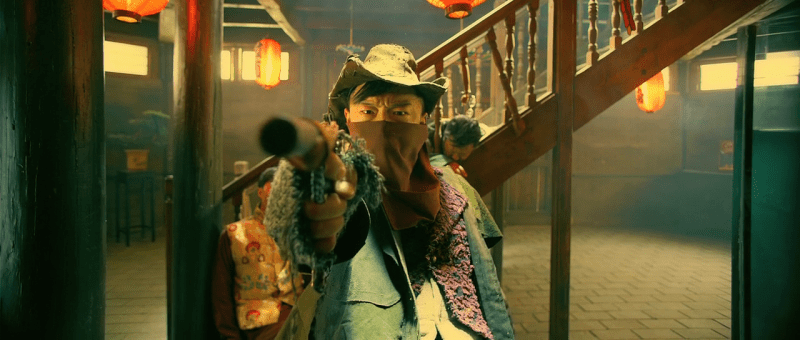
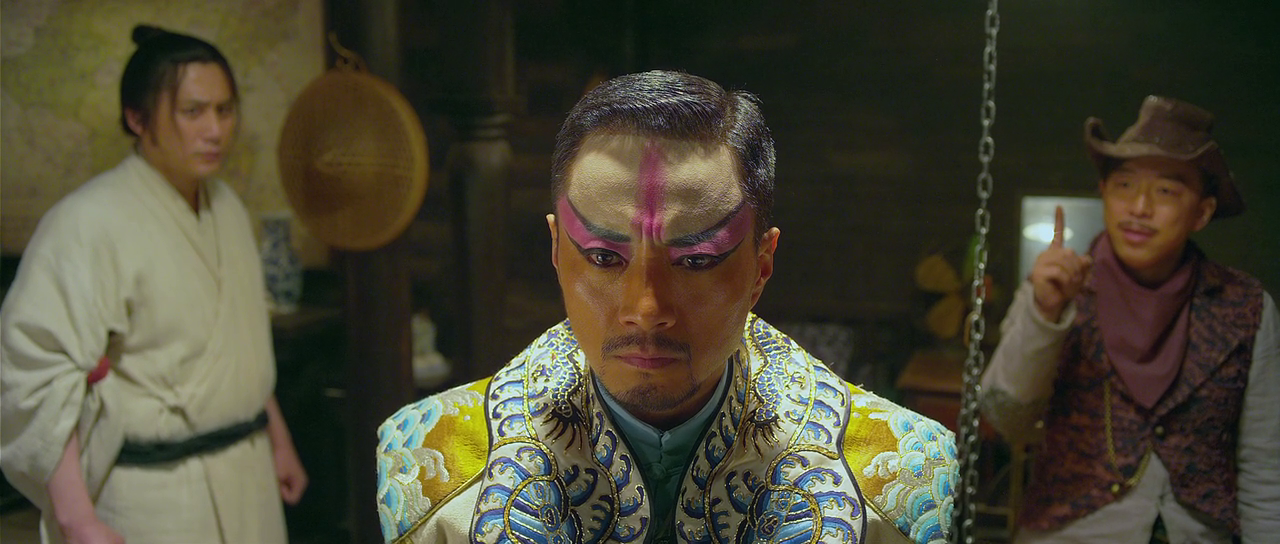
In truth, the gang are scientifically trained special agents with a mission to retrieve the vaccine but having realised that the Japanese can’t be tortured into giving it up, are forced to put on a charade pretending to be a camp sushi chef, his mute wife, a Peking opera performer, and a cowboy. What looks like completely random, bumbling incompetence is actually a finally turned plan designed to get Ogasawara to give up the secret of the vaccine. When Ogasawara’s ogre-like assistant points out they’ve killed far too many people for their captors to let them go, Ogasawara insists they weren’t people, they were test subjects, before explaining that their captors’ biggest weakness is a lack of unity.

This is, of course, ironic, as even if the band are pretending to be at each other’s throats trying to take control of their prey, they are actually working together. Meanwhile, though it may, at times, seem as if Ogasawara is playing them at their own game, it turns out he doesn’t have a game plan either and isn’t really thinking that far ahead. The Japanese just want the code to create the vaccine, and only commit to rescuing Ogasawara when it turns out the recipe he gave them doesn’t work, meaning they need him to come back and work on the project. But the heroes are a little bit ahead of him, realising they might have access to what’s needed to create the vaccine for themselves and spread it throughout the city. 

The final title card dedicates the film to “the movies we loved when we were young,” and Guan certainly does make good use of silent film aesthetics, even in also falling into a more mainstream sensibility and employing may of the same mannerisms as similar blockbuster movies with split screens and fast zooms. The film’s zany humour plays out almost as a kind of reaction to the grim and absurd world all around it in which death lurks all around, along with Japanese Imperial forces and bandits, and nothing is quite as it first seems to be. The Japanese soldiers refer to the Chinese as “Shinajin,” a sort of derogatory term meaning “Chinaman,” while the trio refer to the Japanese as “kimonos” as if to signal their mutual animosity while the dialogue itself is full of silly puns and weird swearing. 

Which is quite something considering the darkness of the premise. Not only are we dealing the atrocities of Unit 731 which is not only responsible for the cholera outbreak, but potential apocalypse for China which is under threat from several angles including the Nationalists and bandits. The sickness they are really trying to cure is their subjugation as they take care to issue the vaccine to ordinary Chinese people without seeking fame or fortune. Nevertheless, the closing titles insist they were based on real people who studied at Yenching University Medical College before the war and then went on to lead quite ordinary lives after this brief moment of heroic insanity as they harness nonsense as a weapon to trick the enemy into betraying themselves before giving up the ghost.


Trailer (Simplified Chinese and English subtitles)

If You Are the One 3 (非诚勿扰3, Feng Xiaogang, 2023)

It’s been 15 years since the release of Feng Xiaogang’s If You Are the One, a phenomenally popular romantic dramedy in which a seemingly mismatched pair of lovelorn souls attempt to build on the spark of connection. A sequel was released in 2010 that turned a little more wistful in meditating on the brevity of life and its circular qualities, but returning all these years later Feng ventures in a surreal direction setting the film, as the sequel promised, in 2030 as Qin Fen (Ge Yu) approaches his 70th birthday in a colourful vision of an AI future.

Qin Fen still lives in the same house as he did in If You Are the One 2 only it’s had a complete redesign. Before it was cluttered and traditional, a comforting cabin overlooking the beautiful Chinese countryside but now it’s fairly minimalist and heavily stylised in a bold colour scheme that echoes the fashions of the mid-20th century. We learn that he has not seen Xiaoxaio (Shu Qi) for 10 years since she abruptly took off with a bunch on cult-like international rubbish collectors but has been patiently waiting for her return. His old friend Lao Fan (Fan Wei) who has launched a successful company selling uncannily real AI robots gifts him one that looks just like Xiaoxaio though it of course lacks her sarcastic character and is programmed to obey him totally which is how he thought he wanted but of course is nothing like the real Xiaoxiao.

At this point, the film seems to open a dialogue about the nature of love and the realities of marriage. Can the lonely Qin Fen be satisfied by this ersatz recreation of the woman he loved, or will it only cause him more pain? The answer seems to be a little of both, especially as she cannot eat or drink with him let alone sleep in the same bed. Meanwhile, unbeknownst to him the real Xiaxiao has returned but is too nervous to approach him having been out of contact for a decade, only now getting bored with rubbish collecting which is being taken over by AI robots anyway. Disguising herself as a upgraded version of the robot, she attempts to figure out how he really feels about her in a strange echo of the trial marriage from the previous film wondering if he’ll be able to figure out which version of her is “real” and which a fantasy of his own projections.

Then again, set largely within this futuristic cabin, now a little more surrounded by other similar dwellings, we might start to wonder if something else of going on and this place doesn’t quite exist in the way we think it does as if Qin Fen were literally living inside a memory. Having jumped on an additional eight years, the timelines and details do not always mesh exactly with a reappearance of Xiangshan’s daughter who should be around 30 but appears more like a sullen college student in the company of Xiangshan’s second wife, Mango (Yao Chen), who was not her mother nor raising her but apparently continued caring for her mother-in-law after her ex-husband’s death. Small splinters in the reality encourage us to doubt it, as if they corrupted files in Qin Fen’s ageing memory.

Feng presumably doubts our memory too, inserting frequent flashbacks to footage from the other movies whenever one of the returning cast allude to them in addition to providing a lengthy recap at the beginning of the film. Playing out a bit like a greatest hits compilation, the flashbacks prove unnecessarily clumsy and largely disrupt the flow of the ongoing drama while perhaps helping to fill in the blanks for those jumping in to part three without having seen one or two given that it has been fifteen years since the first film’s release. A little surprisingly given the tightening censorship regulations, Feng was able to continue the sympathetically presented running gag of Qi Fen’s male admirer, now having undergone a K-pop makeover and looking even younger, who also finds himself contemplating the nature of love after commissioning a Qin Fen robot to cure his own lovelorn desires.

A nod to the present day is given in a Lunar New Year movie-style epilogue (though the film was released around Western New Year) in which Shu Qi and Ge Yu play themselves dressed in matching outfits and nostalgically look back reflecting that young couples who came to see If You Are the One in 2008 might have teenage kids of their own or at least fond memories of an old love that wasn’t to be. Just at the end at they drop in the words that marriage is a commitment worth its weight in gold which feels like an approved message tackling the historically low rates of young people getting married. Nevertheless, it’s a cute and quirky way to bring the series to a close following the surreal absurdity of the two hours which preceded it.


International trailer (Simplified Chinese / English subtitles)

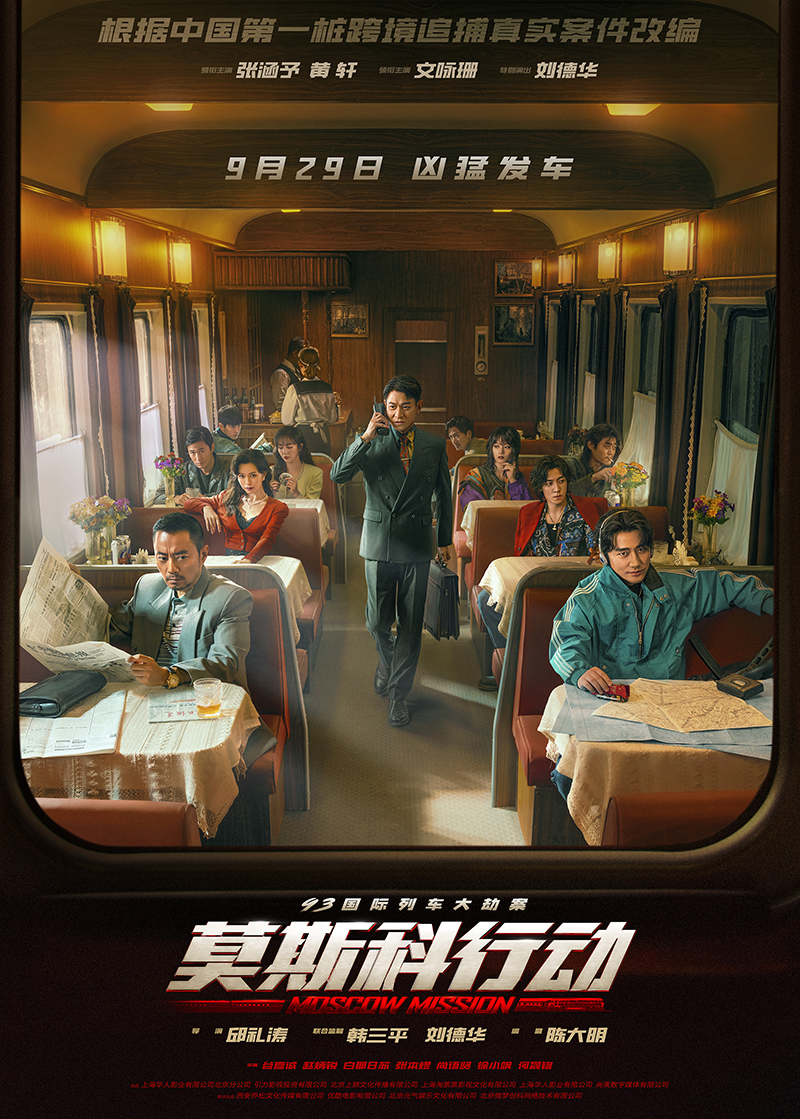
Moscow Mission (93国际列车大劫案:莫斯科行动, Herman Yau, 2023)

In the early 1990s, China and Russia were each struggling to accommodate new political and economic realities. This is at least one reason offered in explanation for the nexus of crime that overtook the long distance train connecting the two capitals in Herman Yau’s action drama Moscow Mission (93国际列车大劫案:莫斯科行动, guójì lièchē dà jié àn Mòsīkē xíngdòng). Inspired by a real life train heist in 1993, the film suggests that China was pulling ahead free of the labour protests which appear frequently in Moscow amid the collapsing Russian economy but equally insists that the bandits must be stopped because they not only endanger China’s international reputation but its trading relations with the former Soviet Union.

In truth there’s no real reason given for the mysterious D’s (Huang Xuan) heinous crime spree save a later allusion to a troubled childhood and the sudden death of his sensitive musician father when he was only 13 (which would put it shortly before the end of the Cultural Revolution). In any case, those around him have more complex motivations such as those of Zhenzhen (Janice Man Wing-San), a former sex worker employed by the gang to identify wealthy passengers and inform the rest of the crew by note, who needs the money for a sick relative. In any case, nearly everyone on this train is concealing vast amounts of hard cash, mostly in their underwear. Not content with the money, D also stops to rape a woman who had resisted but was found with a large amount of money stuffed in her bra. 

In short, there’s nothing noble about D’s gang or any implication they’re rebellious outlaws just thuggish crooks taking advantage of a geopolitical vulnerability. Local fixer Vasily (Andy Lau Tak-Wah), however, is otherwise depicted as a victim of circumstance cruelly separated from a then newborn daughter for whom he is continually searching. He made his money digging a tunnel from Shenzhen to Hong Kong and using it to smuggle luxury goods in much the same way many now use the train as is evident by the scenes at Russian station when passengers suddenly start leaning out windows flogging pairs of jeans. Vasily’s in on that trade too, as well attempting to broker a deal for a wealthy man to buy a former Soviet fighter jet, but seems unhappy with his life of petty crime selling fake passports to dodgy people and also has an ongoing non-romance with Zhenzhen who is trapped in an abusive relationship with D’s brother-in-arms Zhiwen (Jason Gu Jiacheng). 

Intense police captain Cui (Zhang Hanyu) is dispatched to catch the train robbers and avenge China’s international reputation by bringing order to the train but also stumbles on another crime in progress in the Russian capital. He has an opposite number in Sergey (Andrey Lazarev), a former KGB now FSB officer who hints at a new world order if also at a society very much in flux. In some ways the film suggests Cui’s inevitable victory is aided D’s hubristic overreach and the cooperation of the Russians rather than his own powers as a Chinese policeman, but also that China will clean up after itself taking down a Chinese gang while technically on foreign soil and making sure they return to China for justice. 

Yau opens strong with the high impact sequence of the original heist as the camera first pans along the inside of the train before finding Zhenzhen and then rest of the gang, while otherwise continuing to escalate the action with a climax at an abandoned rocket base and then a final shootout at the train depot where the carriages must quite literally change the gauge to shift from the old Soviet railways to the modern China. The gang members may implicitly be among those who’ve lost out in the face of new economic realities, though aside from D’s possibly duplicitous musing on the life he might have led if his father had not died leaves them little justification for the cruelty of their crimes. Meanwhile, Cui’s justice is not implacable, taking pity on both Zhenzhen and Vasily and promising to treat them fairly in acknowledgement of their cooperation as opposed to D who had problematic gang members bumped off by the possibly the worst hitman in Moscow and has been using Vasily’s daughter to manipulate him for last few years with no certainly that he actually knows where she is. Making a minor point about empty consumerism in the constant references to stolen watches, Yau goes big on spectacle but also homes in on the smaller stories of trauma and displacement that eventually provoke it.


International trailer (Simplified Chinese / English subtitles)

The Captain (中国机长, Andrew Lau, 2019)

The Captain poster 2Chinese cinema loves the miraculous, but it loves stories of ordinary heroism even more. Inspired by real events which occurred on 14th May 2018, not quite 18 months before the film’s release, The Captain (中国机长, Zhōngguó Jīzhǎng), is a classic story of everything going right after everything goes wrong. Implicitly praising the efficacy of a system which values military precision over individualistic handwringing, Lau’s dramatisation reserves its admiration for those who keep their cool and follow the rules in the midst of extremely difficult circumstances.

Beginning in true disaster movie fashion, Lau opens with a brief yet humanising sequence which sees the otherwise austere pilot Captain Liu (Zhang Hanyu) say goodbye to his little girl, promising he’ll be back in time for her birthday party that very evening. Thereafter, everything is super normal. The pilots and cabin crew arrive at the airport, get to know each other if they haven’t flown together before, and run through their drills. The cabin crew laugh through the “we’re professionally trained and are confident we can ensure your safety” mantra rehearsed in case of emergency hoping they’ll never actually have to say it, but disaster strikes a little way into the flight when the windscreen cracks, eventually shattering and sucking rookie co-pilot Liang Peng (Oho Ou) halfway out.

Of course, the story is already very well known so we can be sure that the plane will land safely with no one (seriously) hurt, but it’s still an incredibly tense time for all. As Liu explains to Liang Peng, everything in the cockpit must be done with the upmost precision. It’s when you get complacent that things will start to go wrong. A former air force pilot, Liu is not the most personable of captains with his permanently furrowed brow and serious demeanour, but he’s exactly the sort of person you need in a crisis, calmly and coolly making rational decisions under intense pressure. While he’s doing his best at the controls, the entirety of the Chinese air aviation authorities are springing into action to try and ensure the plane’s safe landing – airspace is cleared, the military monitor the situation, and the fire and ambulance services are already on standby in the hope that Liu can safely land at Chengdu airport.

Keeping the tension high, Lau resists the temptation to sink into melodrama, more or less abandoning a hinted at subplot about stoical cabin supervisor Nan’s (Quan Yuan) possibly unhappy home life while introducing a fairly random diversion in a group of aircraft enthusiasts furiously tracking the plane’s trajectory online and then heading out to the airport in the hope of witnessing a miracle. Before the potential catastrophe takes hold, the crew have to deal with unpleasant passengers intent on throwing their weight around, nervous flyers, and people travelling with small children, but do their best to provide service with a smile even in the most trying of circumstances. They are frightened too, but have to muster all of their professionalism in order to be strong for the passengers, keeping them calm and preventing them from creating additional problems while the guys in the cockpit try to find a solution that keeps everyone safe.

Released for National Day, The Captain’s brand of propagandistic patriotism is of the more subtle kind, only really rearing its head during the final moments during which awkward captain Liu suddenly starts singing a folksong in praise of the motherland while celebrating their lucky escape on its one year anniversary in the time honoured fashion of a group hot pot. Nevertheless, the point it’s making is in the virtues that Liu states after landing, valuing life and duty. Liu landed the plane because he followed procedure perfectly, kept his head, and made well-informed decisions. A master of understatement, his speech on landing is simply an apology to his passengers that he wasn’t able to take them safely to Lhasa. After waiting for the investigators, he thinks the passengers are hanging round outside the plane because they’re angry and want an explanation, little realising they are just overjoyed to be alive and wish to thank him for saving all their lives. A tense tale of selfless heroism aided by good training and immense professionalism, The Captain is a subtle endorsement of an authoritarian system but also of the importance of keeping cool in a crisis as the best weapon against catastrophe.


The Captain is currently on limited release in UK cinemas courtesy of Cine Asia, and in the US from Well Go USA.

Original trailer (English subtitles)

https://youtu.be/Vy3nA6VDGyw

Operation Red Sea (红海行动, Dante Lam, 2018)

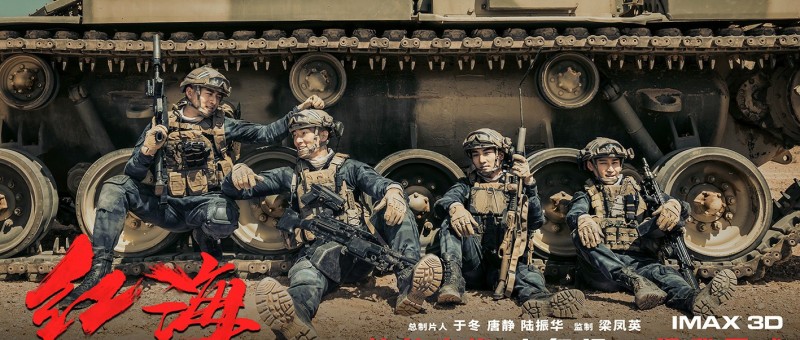
Operation Red Sea posterDante Lam, a Hong Kong action icon, is one of many to have begun looking North, tempted by the bigger budgets and audience potential of the Mainland. Following 2016’s Operation Mekong, Lam is back on manoeuvres with a second in what may develop into a series, Operation Red Sea (红海行动, Hónghǎi Xíngdòng). Red Sea is not connected to Mekong in terms of narrative and only features a cameo by the earlier film’s star, Zhang Hanyu, who remains firmly ensconced on the bridge of the all powerful Chinese warship while an elite troop of special forces handles the rapidly deteriorating situation on the ground, but it is once again “inspired” by a true story and perfectly positioned to show the Chinese security services in a more than favourable light.

The action begins in 2015 when the Chinese navy wades in to defend a merchant ship attacked by Somali pirates, managing to apprehend the “bad guys” with a minimum of bloodshed before they escape Chinese waters. Having suffered a casualty, the squad are then dispatched to rescue Chinese citizens caught up in an Middle Eastern coup. Their mission is helped and hindered by intrepid Chinese-French journalist, Xia Nan (Hai Qing), who has discovered evidence that a dodgy “businessman” caught up in the attack is in possession of a consignment of “yellowcake” along with a deadly dirty bomb formula which he plans to sell on to the terrorists currently waging war on the city.

Though Operation Red Sea is, perhaps, no more jingoistic than any British or American war film, its focus is more definitively centred on home concerns than an attempt to police the world. The Chinese military exists to defend Chinese citizens, even if those citizens are increasingly scattered throughout an unstable world. This presents a point of conflict between idealistic, and occasionally reckless, journalist Xia Nan whose mission is to stop the terrorists and rescue her friends, and the soldiers whose primary mission is to evacuate Chinese citizens though they hope to be able to provide assistance to citizens of other nations too if their mission parameters allow.

The Jiaolong, elite Chinese special forces, are indeed an impressive fighting force who proceed with military precision but are not without compassion. Informed by a local soldier that the terrorists often force civilians to become suicide bombers, the team’s bomb disposal officer puts himself at great risk to defuse a device and free a man destined to become a car bomb, rather than simply neutralising the threat. Protecting Chinese in peril is the official goal, but on a human level the soldiers are overcome with sorrow and anger for the local population, lamenting that they may have saved some lives but many have lost their homes and they will simply leave them behind to deal with the situation alone when they succeed in their mission of evacuating stranded Chinese diplomatic personnel.

Despite the overtly propagandistic elements which paint the Chinese military as a force for good, fighting bravely for their countrymen overseas, the landscape of war Lam paints is a hellish one full of blood, guts, and scattered body parts. Much of the film plays as a two hour recruiting video for the Chinese navy – it’s almost a surprise there aren’t people waiting with clipboards outside the theatre, but it’s difficult to believe anyone would be in a big hurry to sign up after witnessing the pure human carnage of a foreign battlefield and the very real threats the soldiers subject themselves to all while stoically pursuing their mission, committed to the protection of their nation and people.

Nevertheless Lam’s spectacle is impressive and action choreography unsurpassed. Working on a huge scale with everything from snipers to tank battles, Lam keeps the tension high as the team attempt to adapt to a situation which is rapidly deteriorating leaving them all but stranded behind enemy lines where each and every one of them faces a very real threat of death or serious injury. Despite an overuse of CGI slow motion bullet vision, Operation Red Sea largely earns its bombast with relentless fury, leaving its propaganda aims to dangle the background until the final coda which seeks to remind us that China rules the waves and will protect its citizens and territory wherever they may be.


Currently on limited release in UK cinemas courtesy of China Lion.

Original trailer (English subtitles)

https://www.youtube.com/watch?v=F0D-TEo0AEo

Manhunt (追捕, John Woo, 2017)

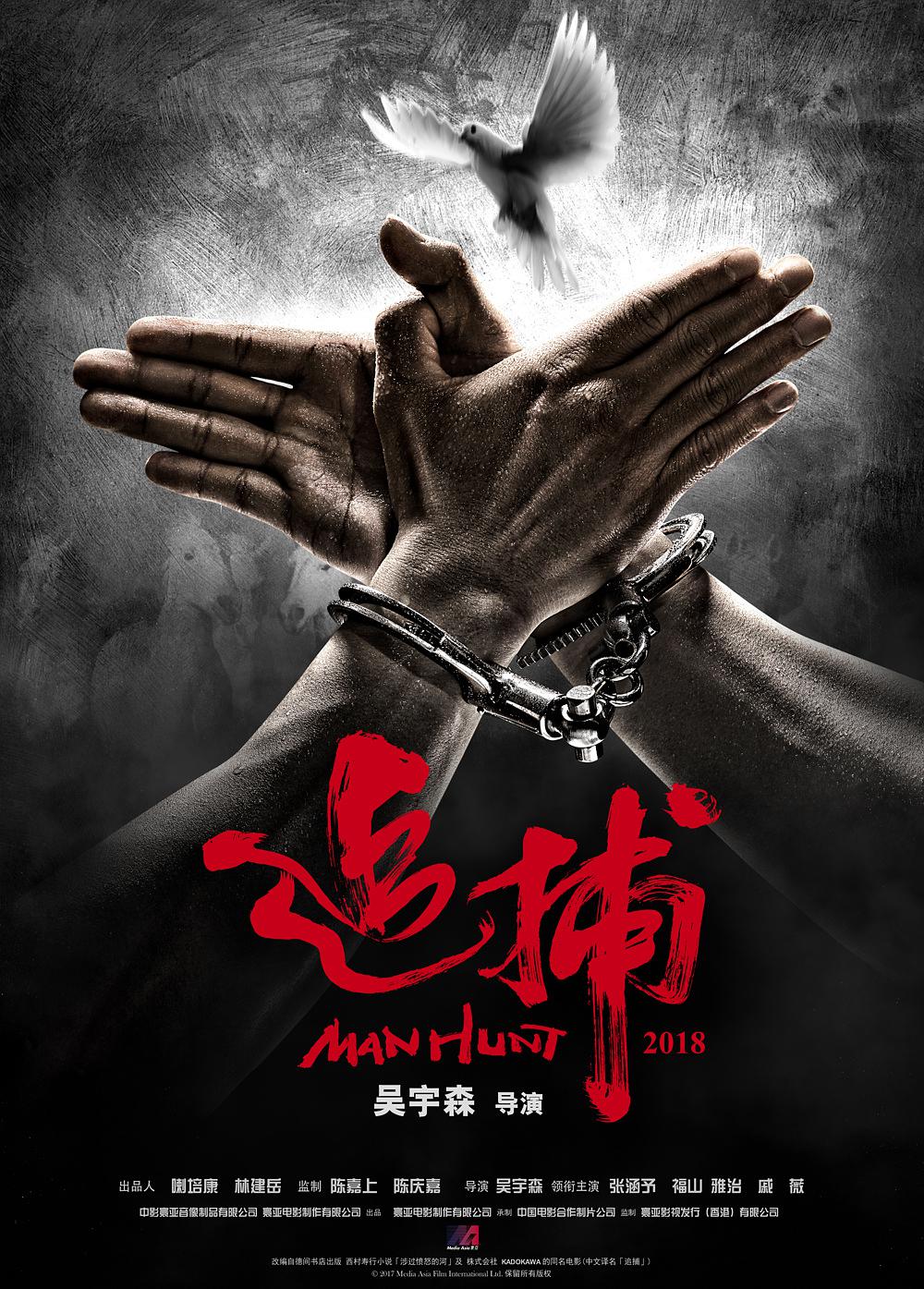
Manhunt30 years ago John Woo was one of Hong Kong’s most bankable directors. The father of heroic bloodshed, Woo’s bullet ballet sent shockwaves through action cinema not only in his home country but around the world. Unsurprisingly Hollywood came calling and Woo was one of the first Asian directors to enjoy mainstream US success with ‘90s hits Broken Arrow and Face/Off before his overseas career began to stall and he eventually returned to Hong Kong directing period epics Red Cliff and The Crossing. Manhunt (追捕, Zhuībǔ) is intended as a kind return to source as Woo gets back into the groove of his beautifully choreographed ‘80s action hits but intentionally or otherwise he sails dangerously close to self parody with a mix of Big Pharma conspiracy and wrong man thriller.

Chinese corporate lawyer Du Qiu (Zhang Hanyu) is a trusted employee of a Japanese pharmaceuticals company but is shortly to be transferred overseas, much to CEO Sakai’s (Jun Kunimura) displeasure – Du knows too much about the company’s less than transparent operations. Sakai sets up a honey trap to convince Du to stay but before it can spring Du is accosted by another woman, Mayumi (Qi Wei), who wants to talk to him about a difficult case three years previously in which an employee ended up committing suicide. After talking with Mayumi, Du goes home but the next thing he remembers is waking up in bed next to a dead woman. Du does the right thing and calls the cops, but the cops are working for Big Pharma and soon he finds himself on the run while maverick police chief Yamura (Masaharu Fukuyama) and two female assassins (Ha Ji-won & Angeles Woo) try to track him down.

Manhunt is inspired by the 1976 film starring Ken Takakura which was one of the first non-native movies to open in China following the Cultural Revolution. Woo apparently made the film as a kind of tribute to the actor after he passed away in 2014, but he takes his cues from the source novel by Juko Nishimura rather than the Takakura film and the 2017 Manhunt shares little in common with the 1976 version other than a general plot outline involving a man on the run and unethical practices in the pharmaceuticals trade. Du Qiu is not a stuffy, by the book, prosecutor but a compromised employee of a shady organisation who is oblivious to his own complicity in its extremely unpalatable way of doing business.

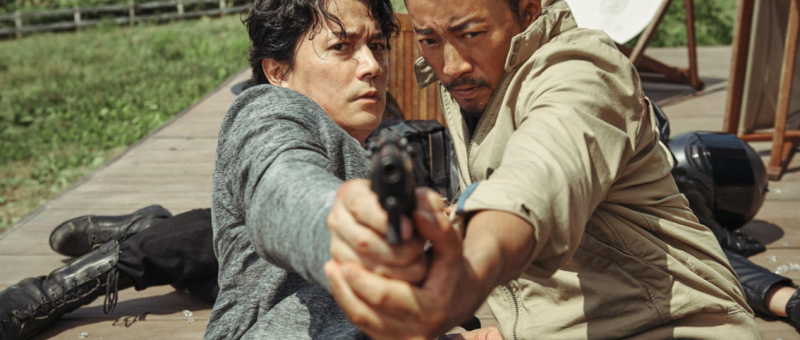
Despite this, Du Qiu is just as lucky as Takakura’s Morioka in that everyone he meets immediately wants to help him. Even sworn enemies with their hearts set on revenge eventually wind up joining team Du as they each descend on the pharmaceuticals research laboratory where the deadly secrets will be revealed. Woo returns to his heroic bloodshed roots in allowing dogged policeman Yamura and the increasingly confused Du to form an odd couple buddy duo which begins with spiky one liners and ends with becoming one as each places his uncuffed hand on the same pistol to take down a few bad guys through the power of togetherness.

Woo’s action credentials remain unchanged as he races from set piece to set piece from the opening surprise massacre to Du’s subway chase escape, jet ski race, and mansion showdown before getting anywhere near the endgame of the research lab. Perfectly choreographed, the sequences bear out Woo’s distinctive sense of humour while also poking fun at his back catalogue through a series of homages including an entire coop full of white doves just waiting for their chance to fly.

Set entirely in Japan, Manhunt shifts between Japanese and Mandarin though it has to be said that the film suffers from its reliance on English which is often poorly delivered and deliberately stylised to ape classic action movie one liners the like of which have been out of fashion for two decades. Woo neatly sends himself up with an opening discussion of “old movies” allowing one of the film’s two female assassins to develop an odd fascination with Du which leads to her eventual awakening from company brainwashing, but he also pays his dues with the theme music to Sato’s 1976 version playing over the first scene of mass bloodshed. Woo may have slipped into self parody with his deliberately over the top theatrics, but he has fun doing it and his gleeful self skewering proves extremely hard to resist.


Screened at the BFI London Film Festival 2017.

International trailer (dialogue free, English captions)