The London Korean Film Festival has always made a space for documentary in its packed out programme but for this year’s edition they’ve decided to go a little further and give it a spotlight of its own with two weekends dedicated to the art. On August 11/12, and 18/19, six short and feature lengths films will be screened with directors Kim Dong-won and Song Yun-hyeok making an appearance to present their work.
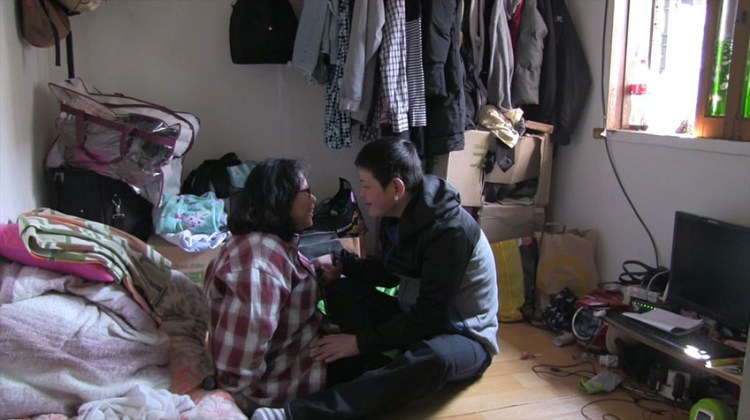
Song Yun-hyeok examines the social reality behind the prosperous facade of contemporary Korean society through the lives of those living in “slice rooms”. Director Song Yun-hyeok will also be in conversation with Nam In Young following the screening.
Kim Dong-won’s 1988 documentary Sanggyedong Olympics follows the resistance movement towards urban regeneration amongst a community north of Seoul who had been unfairly evicted from their homes without proper compensation or adequate time to find new accommodation. Kim planned to stay only one day but ended up living amongst the community for three years.
The 6 Day Struggle at the Myeongdong Cathedral, completed during 1996-7, looks back at the pivotal 1987 sit-in which became a catalyst for the June democracy movement.
Following the two short docs, Kim Dong-won will also be in conversation with Nam In Young.
In what many consider his masterpiece, Kim Dong-won examines the lives of the “unconverted” – North Korean “spies” who refuse to renounce their communist beliefs despite longterm imprisonment in the South. Refused the possibility of returning to the North on release, most were left without support in South Korea facing economic hardship and social stigma, dependent on solidarity networks to help them integrate into society. Kim follows two such men over a decade as they try to rebuild their lives in the fluctuating political climate of the ’90s.
The film will be followed by a conversation with Kim Dong-won chaired by Chris Berry.
A roundtable panel discussion chaired by Professor Chris Berry discussing the Korean independent documentary scene from the late ’80s to the present. Nam In Young of Dongseo University will provide an overview of filmmaking collectives within the sociopolitical history of South Korea while directors Kim Dong-won and Song Yun-hyeok will be on hand to offer their personal experiences.
Park Bae-il’s Soseongri follows a community of elderly farmers facing rural depopulation problems who find themselves in conflict with the police when the decision is taken to place the THAAD anti-aircraft system in their village.
Kim Dong-won’s most recent film pays tribute to North American Jesuit priest, Jung Il-woo, who dedicated his life to improving the lives of the poor in South Korea.
All the events are free to attend but tickets must be booked in advance via the links above. Full details for all the films are available via the official website, and you can keep up with all the latest news via the festival’s Twitter, Facebook, Flickr, Instagram and YouTube channels
By 1965, Japan was back on the international map as the host of the last Olympics. The world was opening up, but the gleefully surreal universe of Toho spy movies isn’t convinced that’s an entirely good thing. Jun Fukuda had begun his career at Toho working on more “serious“ fare but throughout the 1960s began to lean towards comedy of the absurd, slapstick variety. 1965’s Ironfinger (100発100中, Hyappatsu Hyakuchu) boasts a script by Kihachi Okamoto – Okamoto might be best remembered for his artier pieces but even these are underpinned by his noticeably surreal sense of humour and Ironfinger is certainly filled with the director’s cheerful sense of cartoonish fun with its colourful smoke bombs, cigarette lighters filled with cyanide gas, and zany mid-air rescues. The English title is, obviously, a James Bond reference (the Japanese title is the relatively more typical “100 shots, 100 Kills”) and the film would also get a 1968 sequel which added the spytastic “Golden Eye” (though it would be given a more salacious title, Booted Babe, Busted Boss, for export). Strangely the unlikely villains this time around are the French as Tokyo finds itself at the centre of an international arms smuggling conspiracy unwittingly uncovered by a “bumbling vacationer”.
We first meet our hero as he’s writing a postcard to his mum in which he details his excitement in thinking that he’s made a friend of the nice Japanese man in the next seat seeing as he’s finally stopped ignoring him. When they land in Hong Kong, our guy keeps shadowing his “friend” until he decides to ask him about “Le Bois” to which his “friend” seems surprised but is gunned down by bike riding assassins before he can answer though he manages to get out the word “Tokyo” before breathing his last. Picking up his friend’s passport and swanky hat, our guy becomes “Andrew Hoshino” (Akira Takarada) – a “third generation Japanese Frenchman” and “possibly” a member of Interpol.
The bumbling “Andy”, who can’t stop talking about his mother and is very particular about his hat (for reasons which will become clear), is obviously not all he seems. Despite his penchant for pratfalls and cheeky dialogue, he also seems to be a crack shot with a pistol and have an ability to talk himself out of almost any situation – at least with the aid of his various spy gadgets including his beloved cigarette lighter and a knife concealed in his wristwatch for cutting himself free should he get tied up. Andy “said” he was just here on holiday, but are all those postcards really for his dear old mum waiting for him in Paris or could they have another purpose? Why is he so keen on finding out about “Le Bois” and why does he always seem to end up at the centre of the action?
These are all questions which occur to one of his early antagonists – Yumi (Mie Hama), the ace explosives expert who often feels under-appreciated in the otherwise all male Akatsuki gang. Apprehending Andy, Yumi originally falls for his bumbling charm only to quickly see through his act and realise she might be better hedging her bets with him – hence she finally teams up with Andy and straight laced streetcop Tezuka (Ichiro Arishima) who’s been trying to keep a lid on the growing gang violence between the Aonuma who now run the town and the Akatsuki who want to regain control. Andy doesn’t much care about sides in a silly territorial dispute, but it might all prove helpful in his overall mission which is, it turns out, very much in keeping both with that of the gang-affiliated Yumi and law enforcement officer Tezuka.
There isn’t much substance in Ironfinger, but then there isn’t particularly intended to be. There is however a mild degree of international anxiety as our heroes become, in a sense, corrupted by French sophistication whilst “relying” on “Interpol” to solve all their problems (“Interpol” is frequent presence in Toho’s ‘60s spoofs providing a somewhat distant frontline defence against international spy conspiracies). Fukuda keeps things moving to mask the relative absence of plot as the guys get themselves into ever more extreme scrapes before facing certain death on a mysterious island only to save themselves through a series of silly boys own schemes to outwit their captors. Perhaps not as much fun or not quite as interesting as some of Toho’s other humorous ‘60s fare, Ironfinger is nevertheless a good old fashioned espionage comedy filled with zany humour and a cartoonish sense of the absurd.
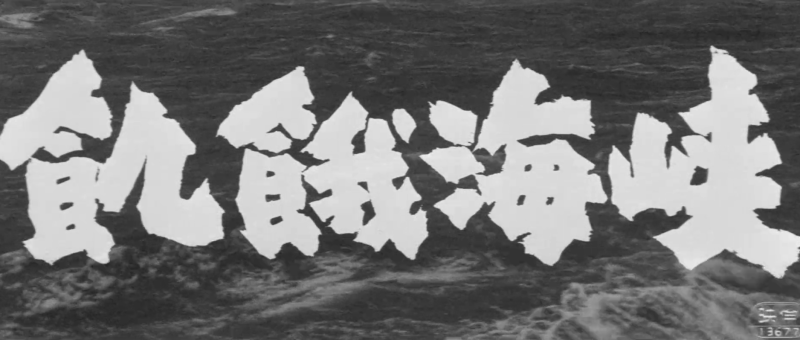
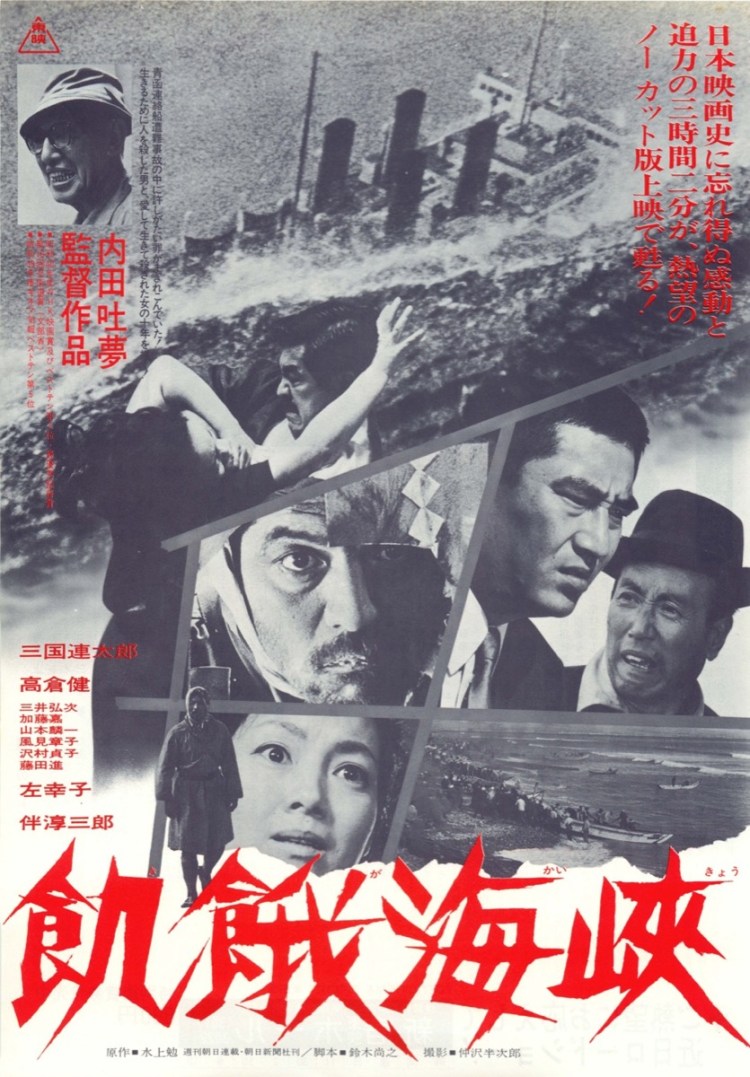
“There’s no way back” intones a spirit medium in the throws of a possession early on Tomu’s Uchida’s three-hour police procedural, A Fugitive from the Past (飢餓海峡, Kiga kaikyo, AKA Straits of Hunger). Her message will be repeated frequently throughout the journeys of our three protagonists – a guilty man seeking escape from himself, the hooker with a heart of gold who thinks of him as a “kind person”, and the obsessive policeman whose quest to find him threatens to destroy his own family and chance of ongoing happiness. Beginning in 1947, Uchida’s adaptation of the novel by Tsutomu Minakami is a cutting indictment of post-war inequalities but is also keen to remind us that the war was merely a symptom and intensifier of problems which existed long before and are likely to survive long after.
In 1947, three men in military uniforms attempt to escape from Hokkaido after committing a crime while the island is subject to a typhoon warning. Using a ferry disaster in which hundreds of people have been killed as cover, the men steal a boat and try their luck on the stormy seas. Only one of them makes it. Once all the bodies from the ferry are accounted for, two more are discovered and later identified as recent parolees from Abashiri prison. The dead convicts are then linked to a local robbery, murder, and arson case in which a large amount of money was stolen leaving the third man, described by witnesses as bearded, tall and imposing, the prime suspect in the deaths of the two prisoners as well as the original robbery.
Calling himself “Inugai” (Rentaro Mikuni), the “third man” takes off with all the money and ends up forging an unexpectedly genuine connection with a cheerful prostitute just on the way back from her mother’s funeral. Yae (Sachiko Hidari), claiming to have seen through to Inugai’s kindly soul, seems to reawaken something within him but the next morning he moves on leaving only a vast a mount of money and some nail clippings behind him. Meanwhile, Yumisaka (Junzaburo Ban), the dogged policeman who discovered the convicts’ bodies, tracks him at every turn.
The world of 1947 is a hellish one in which perpetual hunger is the norm and crushing impossibility all but a given. Inugai is starving. With rationing in place the black market is flourishing while the unscrupulous profiteer off the back of other people’s desperation. This is a land of defeat where to survive at all is both shame and victory, yet somehow you have to go on living. Inugai, like many a hero of golden age Japanese cinema, is engaged in an internal war to erase the dark past, drawing a veil over what it took to move from post-war privation to economic prosperity. He does however take his unseeing further than most in adopting a new, more respectable persona, remaking himself as self-made man and wealthy philanthropist keen to “pay back” the society which has been so supportive of his “success”.
Thus when Yae, whose attempt to remake herself in the capital has fared far less well, spots Inugai’s photo in the papers and decides she just must track him down, it’s not that Inugai fears blackmail or even really that she poses a threat but that she shatters the integrity of his carefully crafted post-war persona and reminds him who he really is. A climactic storm mirroring that which illuminated their first meeting also graces their last as “Inugai” finally resurfaces, committing an impulsive act of animal violence which tugs at the strings of his new life and sets the whole thing unravelling.
Yae used Inugai’s money to pay off her debts and get out of the brothel, but even if the Tokyo of 1947 was warmer than that of Hokkaido it was no more kind and her attempt to lead an “honest” life was quickly derailed by underworld crime and unforgiving law enforcement. Realising there’s nowhere left for her to go she resigns herself to life in the red light district but does at least manage to find a “nicer” establishment run by a kindly older couple where the girls are like one big family. Her meeting with Inugai has come to take on mythical proportions in her mind – she even worships a tiny relic of him in the form of one of his nail clippings. Hoping to repay his kindness she commits herself to hard work and barely spends any of her money on herself, dreaming of the day she will one day see him again.
Yumisaka, however, mirrors Yae’s devotion in his all encompassing “hate” for Inugai as his obsession consumes him, costs him his job, and threatens to ruin his family. Alerted by two more bodies washing up out of the sea, a young detective (Ken Takakura) puts two and two together and gives Yumisaka a chance to vindicate his long held convictions but what they discover through the shifting sands of invented truths and corrupted memories is a legacy of suffering and resentment which runs far further back than the recent wartime past. As Yumisaka later puts it, those who’ve never been poor or miserable cannot understand the desperation felt by those who have in the presence of money. Inugai, poor and trapped by circumstance, longed to escape the drudgery of Hokkaido life but couldn’t live with what he did to do it and so conjured up another history for himself.
Still, the truth will out and there really is “no way back”, not for Inugai or for his nation which seems determined to continue unseeing the darkness of the previous 30 years as it begins to find a degree of comfort once again. Incorporating strong spiritual overtones from the sutras Yumisaka is so strangely adept at reciting to the gloomy intoning of the spirit medium, Uchida imbues all with a heavy sense of dread as a man attempts to outrun his fate by running from himself only to be tripped up by sudden moment of panic born of a lack of faith in his only true believer. A chronicle of the post-war era, A Fugitive From the Past makes poverty its ultimate villain but attempts to paper over spiritual corruption with the pretty trappings of conventional success will only end in ruin as the unresolved past eats away at the foundations of a brave new world.
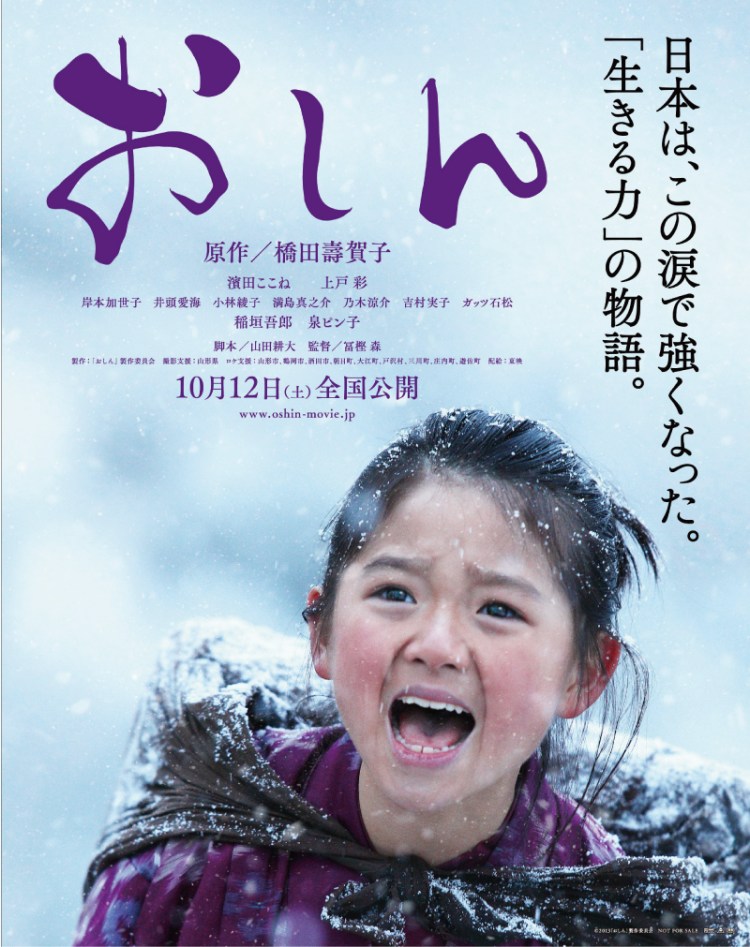
Back in the 1980s, an “asadora” named “Oshin” proved so popular with Japanese television viewers that its title became a byword for tenacity and perseverance, attached to any underdog who battled bravely against insurmountable odds. The “asadora”, as its name suggests, is a 15 minute drama serial broadcast in the mornings and therefore mainly targeted at housewives. As such it often focusses on the lives of women and particularly on women who work hard to triumph over adversity. Oshin is no different in this regard except that it also recounts the painful history of 20th century Japan through that of its stoical heroine who travels from a life of poverty in snowy Yamagata to becoming the owner of a supermarket chain in the bustling consumerist economy of 1983. In celebration of the 30th anniversary of the TV series, Oshin graduated to the big screen. Shin Togashi’s Oshin (おしん) movie focusses exclusively on Oshin’s childhood at the tail end of the Meiji era in which she suffered all the downsides of lingering feudalism and benefitted from few of the new freedoms of the age.
The winter of 1907, Yamagata – snow country. Oshin (Kokone Hamada) lives with her parents, grandmother, and siblings and looks forward to finally being allowed to go to school when spring arrives. Sadly, Oshin will not be going to school after all. Her father has arranged for her to work for another family who own a timber yard a few towns over for the period of one year. Only seven years old, Oshin pleads not to be sent away but her father will not back down. There is not enough food to feed the family and, unbeknownst to Oshin, her mother (Aya Ueto) is pregnant again.
Finally agreeing to go after her mother takes drastic action to try and reduce the burden on the family, Oshin arrives at the timber yard but is treated cruelly by the head housekeeper who refuses to recognise that Oshin is only a child and will of course lack basic knowledge as to how to run a household. Though Oshin bears the constant hardship for her family she eventually runs away when falsely accused of theft.
The world of 1907 is harsh and cruel. Women have few rights and almost no say in their lives or destinies. Oshin might count herself lucky that she’s merely been contracted as a household servant in an age where selling one’s daughter to a brothel to feed one’s sons was not an unusual event, but nevertheless her life at the timber yard is hard. Bright and curious, Oshin longs to learn to read and write but because of her lowly “peasant” birth, she is constrained into a life of drudgery where her labour will only ever be in service of her family and never herself.
A “peasant” background is, as a kinder mistress reminds Oshin, a burden in that she is always likely to be viewed with suspicion. This is doubly true when she runs away and is rescued by a fugitive deserter hiding in a mountain shack. Shunsaku (Shinnosuke Mitsushima), a sensitive young man marked by service in a war he no longer believes in, teaches Oshin how to read and write as well as giving her a grounding in humanitarian politics. He is, however, a problematic figure for going against the martial culture of the age and having “betrayed” his nation by deserting. Oshin is tainted by her association with such a radical young man, but boldly comes to Shunsaku’s defence when others seek to discredit his memory.
This boldness is a part of Oshin’s essential “goodness” in which she refuses to give in to injustice even whilst stoically bearing all of the troubles that come her way. Eventually she finds herself a servant in a much nicer house where the staff take pity on her and welcome her warmly into their extended family. Treated with such kindness, Oshin works even harder to repay it and impresses all with her earnestness and morally upright character. She does, however, clash with the spoilt daughter of the house, Kayo (Manami Igashira), who has her own share of troubles though hers are those of the privileged classes. Lonely and bored, Kayo resents the attention golden girl Oshin seems to get from the staff but the two eventually become friends when Kayo realises Oshin is the only person willing to treat her as an equal rather than the young mistress.
Though the overall arc of the TV series painted a more positive picture of female resilience and capability, the film’s focus on the late Meiji childhood era is unavoidably more conservative in its pointed message that a woman’s life is served in dedication to others with the unpleasant undertone that she must keep nothing back for herself and that she is not entitled to personal happiness but only that of repaying the sacrifices that have been made on her behalf by other women (and especially by mothers – biological and surrogate). Nevertheless, Oshin’s earnestness and deep love for her family are admirable qualities and when she trudges back out into the snow again, always waiting for the spring, she does so with hope and determination.
Oshin is screening in London on 18th August as part of the Japan Foundation London’s Summer Explorers season of free film screenings.
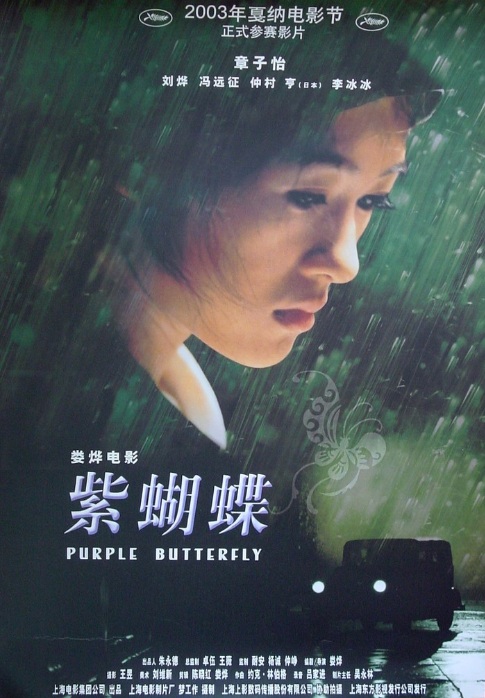
Chinese films about the resistance movement towards the Japanese occupation tend to veer towards the hagiographic. The business of resistance may be complex, may require unfortunate moral compromises, and may in fact prove ruinous but it is always righteous. Lou Ye’s Purple Butterfly (紫蝴蝶, Zǐ Húdié) wants to tell a different, sadder story. Set between 1928 and 1937, Purple Butterfly pits love and oppression against each other and asks whether feeling is a worthy causality of war or if compassion is merely a weakness which must be eradicated in the quest for political freedom.
In Manchuria in 1928, Ding Hui (Zhang Ziyi) is having an affair with a Japanese man raised in China who is also a childhood friend. Itami (Toru Nakamura) is being called back to Japan and has asked Ding Hui to go with him. As if trapped within a melancholy film noir, she goes to the station but does not board the train. When she comes home, she witnesses her brother, the editor of an underground resistance newspaper, being assassinated by a Japanese nationalist. Ding Hui joins the cause.
Flashforward to 1931 and Ding Hui makes her second trip to the station as part of an operation to pass important papers to an operative. However, the operation goes as wrong as it could possibly go. Szeto (Liu Ye) – an ordinary passenger, picks up the assassin’s jacket by mistake and is passed the briefcase. When he tries to give it back, the operative panics and starts shooting, assuming they have been betrayed. Many innocent people are killed, including Szeto’s fiancée Yiling (Li Bingbing) who had made the perilous journey to the station to meet him despite the ongoing unrest gripping the city.
Train stations become a point of transition, of loss and compromise in more ways than one and especially for Ding Hui who feels herself fracturing, anxious to the point of breakdown and wondering what exactly it is they’re fighting for. As coincidence would have it, also on the train is Itami – returned from Japan and now an intelligence officer tasked with rooting out the “Purple Butterfly” resistance cell of which Ding Hui is a prominent member. It is decided that Ding Hui must rekindle her romance with Itami in order to have an eye in the intelligence department and engineer access to assassinating the top officer, Yamamoto (Kin Ei).
Lou deliberately fragments his narrative, allowing the shockwaves from the central train station sequence to radiate outward as the three protagonists dance around each other willingly or otherwise. Dance is, indeed, the primary metaphor as he digresses from the central narrative to give us Szeto’s backstory in his dreamy, innocent romance with Yiling which is destined to end in tragedy. The pair dance to Shanghai jazz, giddy, as if the world itself has receded from them and they exist only within this present and this space. Later Szeto puts the same record on again as he contemplates suicide, longing to be back inside that moment. As we had two train stations we also have two dances but our second is danced to a Japanese tune as Ding Hui and Itami attend a party, each sorrowful, each dreading what must come next but also perhaps mildly hopeful that it will finally be over and perhaps they can both catch that train out of Shanghai after all.
War defeats them all. Szeto’s life is ruined, as are the lives of many, by resistance panic at a busy train station. His pain and his rage and the impotence of his times threaten to push him over the edge, consumed by hatred for both sides who have each taken from him the only things which ever mattered. Ding Hui sacrificed her love for patriotism, Itami sacrificed patriotism for love, they win and lose in equal measure cementing only the inevitable sense of impossibility which continues to define Shanghai in the 1930s. Lou paints their destinies like film noir, fatalistic and romantic yet human and painful. Feeling is powerless in the face of historical circumstance, or so Lou seems to say as he closes out with a selection of stock footage depicting the fall of Shanghai and the Nanjing Massacre. What are we fighting for? Ding Hui asks, but it’s a question with no answer when all around is chaos.
Purple Butterfly is available to stream on Mubi UK until 3rd September 2018.
Original trailer (dialogue free, English captions)
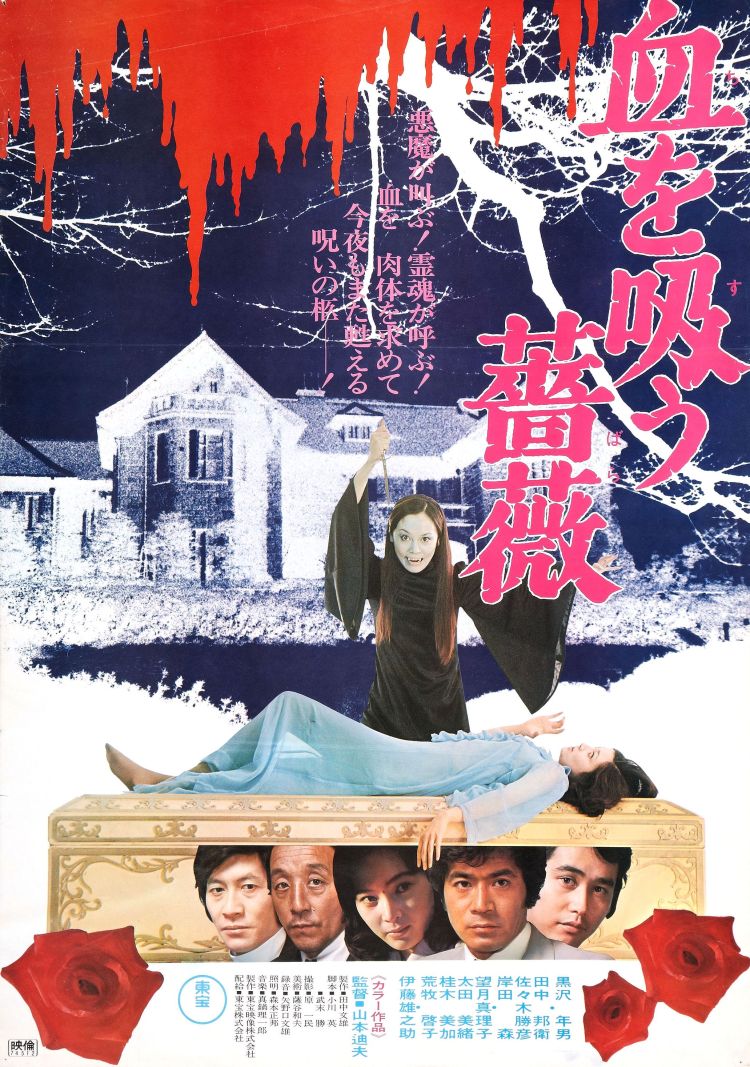
The first two of Michio Yamamoto’s “vampire” movies for Toho made a valiant attempt to repurpose the idea of the bloodsucking ghoul to explore something other than their usual reason for being. In The Vampire Doll, the vampiress at the centre was a knife wilding, grudge bearing ghost of vengeance in keeping with the familiar image from Japanese folklore. In Lake of Dracula, Dracula was (uncomfortably) a bearer of bad blood and a symbol of the destructive capabilities of a repressed memory. Evil of Dracula (血を吸う薔薇, Chi wo Su Bara) takes us back to source as this time Dracula really is a sex crazed, bloodsucking maniac with a sideline in strange ambitions which include being the headmaster of an all girls’ high school in a no horse town somewhere in the frozen north.
Professor Shiraki (Toshio Kurosawa) gets off the train in a tiny provincial town but there’s no welcoming party there to great him. The station seems to work on an honour system and he drops his money in the box, but when Shiraki walks past the ticket office there is an employee, only he seems to be allergic to customers. The attendant gruffly explains that there are no busses running today and goes back to his paper, leaving Shiraki to wonder what to do next. Someone from the school he’ll shortly be working at eventually comes to fetch him but Mr. Yoshii (Katsuhiko Sasaki) is a bit strange too. It’s nothing, however, next to his new employer (Shin Kishida) whom, he learns, was widowed a few days ago when his wife died in a terrible car accident. In fact the headmaster’s wife is still at rest in the cellar – a “local custom” apparently demands holding off on burial for seven days while praying for the deceased’s “resurrection”. Shiraki is surprised to learn from the headmaster that he is being groomed as a potential successor which is why he asks him to stay over so they can get to know each other better. Whilst there, however, Shiraki has a “dream” in which he’s attacked by (he presumes) the headmaster’s wife and another much younger woman dressed in blue…
Evil of Dracula situates itself neatly in the middle of the girls’ school exposé, upping the camp factor with its overexcited adolescent girls apparently chomping at the bit for a little male attention. Shiraki is the new psychology teacher and one would expect him to be a paragon of ethics and an astute judge of character. He is, however, very much of his time and has a distinctly ‘70s approach to sexual politics. When the girls, flirting with him while he (refusing to deflect) appears flattered, complain to him about the “creepy” Mr. Yoshii who keeps leering at them from behind chainlink fences, he tells them Yoshii can’t be blamed because the girls are all so pretty to which they giggle and turn coy. Of course, they’ve all instantly fallen in love with Mr. Shiraki but unbeknownst to them there’s much more going on with creepy guys at the school than they could ever have guessed.
Shiraki finds out a girl recently went missing (apparently that’s something that happens often enough that no one thinks much of it), and can’t get it out of his mind that that’s the girl he saw in his “dream” even though he obviously didn’t know what she looked like. Meanwhile another of his charges, Kyoko (Keiko Aramaki), has turned pale and entered a semi-catatonic state. Her friends have agreed to stay behind and look after her while everyone else goes on vacation but Shiraki remains worried, especially as the school’s folklore obsessed doctor (Kunie Tanaka) has told him what happened to his predecessor.
Yamamoto goes back to source in partially blaming the girls for being led to destruction, allowing their nascent sexuality to pull them into the path of a supernatural evil rather than remaining chaste and innocent as schoolgirls should, punishing them for being flattered when Shiraki (with a slightly condescending air) tells them they can’t be annoyed by men looking them because that’s their fault too in being so very “pretty”. This time around the vampires like to bite their prey above the heart which takes us into the artier realms of exploitation as blood drips salacious from the girls’ bared breasts, though Yamamoto does his best to mitigate the sleaze factor by pushing a heavily romanticised gothic aesthetic complete with innocent white roses which ultimately turn a violent blood red once the vampires have had their way.
Once again, the “corruption” is foreign born though this time it has a Japanese catalyst,as folklore expert Dr. Shimomura explains. Long ago, a European washed up in Japan after a shipwreck, but he was a Christian when Christianity was illegal. He was persecuted, they made him betray his god and it turned him into a bloodsucking demon whose rage has lived on through a succession of Japanese hosts for more than a century. Why he particularly wants to be the headmaster of an elite girls boarding school in the middle of nowhere is never explained but it does at least seem to give him ready access not only to young and innocent victims, but also to weak willed minions.
The police, deciding vampires aren’t in their remit, declare themselves disinterested leaving Shiraki all that stands between the innocent young girls and the bloodsucking predator. The atmosphere is florid in the extreme, each frame filled with a macabre beauty as bodies fall artfully and vampires move with the elegance of dancers, but Yamamato also gives free reign to Hammer-inflected camp humour as hands almost wave from an open coffin behind the still unsuspecting Shiraki and the headmaster comes to a sticky end on the point of his own poker. Repeating the death motif from the second film which itself echoed Christopher Lee’s demise in the 1958 Hammer classic, romanticism is where Yamamoto chooses to end as his vampires decay, melting into skeletons but together, caught in one last gesture of an oddly eternal “love”.
Evil of Dracula is the third of three films included in Arrow’s Bloodthirsty Trilogy box set which also includes extensive liner notes by Jasper Sharp detailing the history of vampires and horror cinema in Japan.
The Vampire Doll, the first in a loose trilogy of films along vampiric themes released by Toho in the 1970s, had done its best to relocate Hammer-style horror to contemporary Japan. Adopting the best of the gothic from thundery skies to creepy mansions in the middle of nowhere, Vampire Doll successfully merged the Japanese longhaired grudge bearing ghost with the “romantic” bloodsucking tragedy of a young woman corrupted by illicit desires (though in this case for revenge). Returning to the theme a year later, Michio Yamamoto steps away from Japanese folklore altogether and positions his “foreign” Dracula as a “living” embodiment of repressed trauma, sucking the life out of his unwitting enemy until she finally learns to remember him, burning him away in the bright sunlight of his own eye.
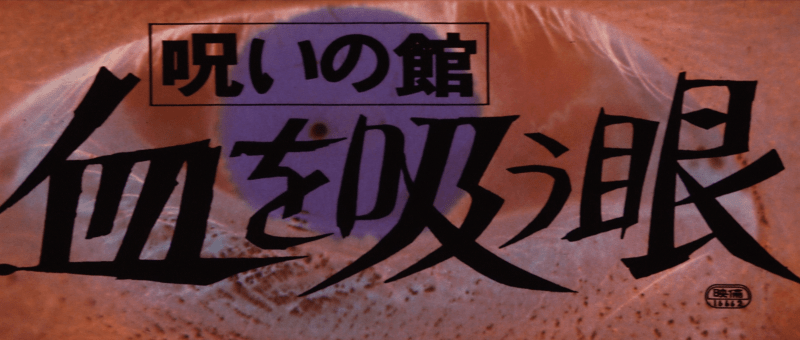
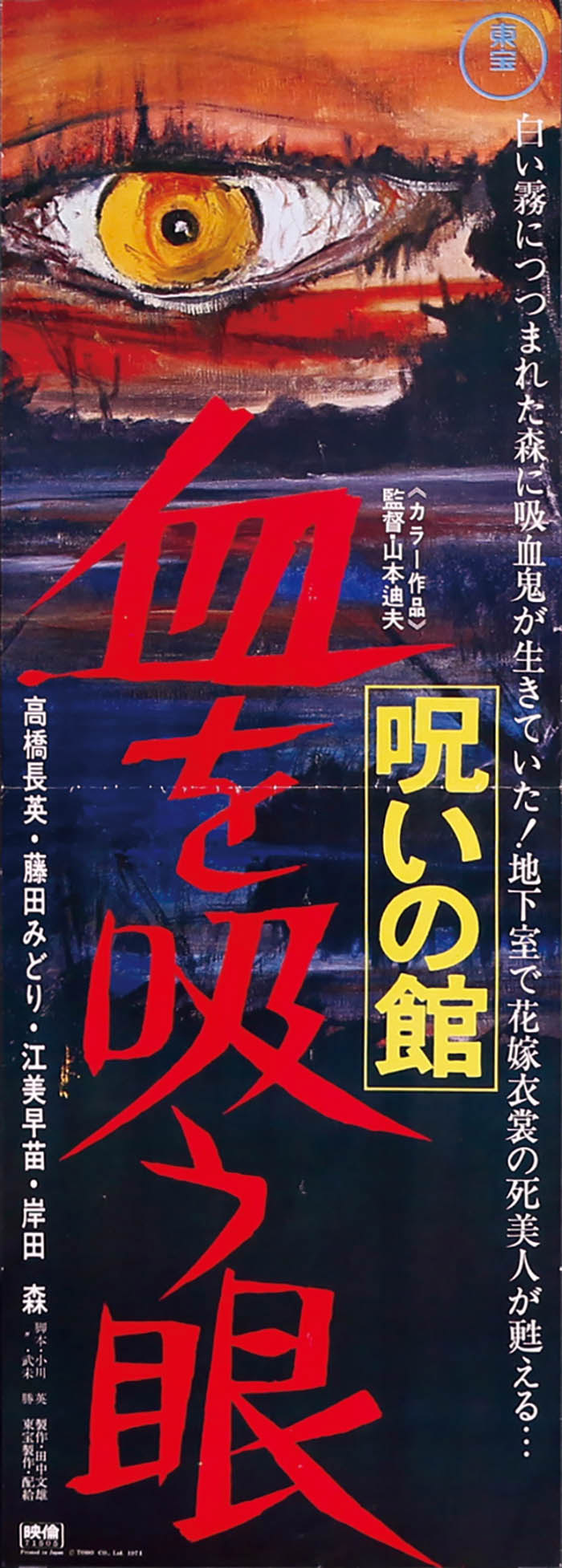
Unlike Vampire Doll, Lake of Dracula (呪いの館 血を吸う眼, Noroi no Yakata: Chi wo Su Me) begins with a short prologue in which some children play on a rocky outcrop underneath a strangely ominous pink sky. When little Akiko’s pet dog Leo uncharacteristically runs off, she follows him and he leads her straight into the path of danger. Finding herself in a creepy mansion complete with stained glass windows and a dead body posed at a piano, the last thing that Akiko remembers is the pale face of a strange man with golden eyes and blood staining his chin.
Flashforward 20 years and Akiko (Midori Fujita) is a school teacher still living with her younger sister Natsuko (Sanae Emi) in their childhood home. She is convinced her traumatic childhood incident must have been a dream though it continues to haunt her enough to be a frequent subject in her artwork including a striking canvas she has just completed featuring a frightening golden eye looming over a tiny girl and her dog. Akiko has nice boyfriend, Takashi (Choei Takahashi), who is a doctor in the city, and all things considered a pretty nice life. Sadly it is not to last.
The trouble begins when someone randomly delivers a coffin to the local boathouse. First Akiko’s dog goes missing, then her trusted uncle figure tries to attack her before running off never to be seen again. Meanwhile, at Takashi’s hospital, a young “runaway” has been brought in in a catatonic state though no one can find much wrong with her until Takashi spots two suspicious bite marks on her neck. In case you’d forgotten about Natsuko, she has also begun behaving strangely – offering snide comments to her sister, going out alone in the middle of the night, and most alarmingly she has begun to grow pale.
Like Vampire Doll, Lake of Dracula is also an experimental vampire movie hybrid – a B-movie stalker picture in which Dracula is the creepy guy who can’t seem to take no for an answer. Yamamoto films the “naturalistic” action in standard Toho fashion but shifts into a higher register for his conception of heightened vampiric romanticism as Akiko’s “dream” erupts under a blood red sky and eventually leads her to an artfully appointed gothic cottage in which even the dead bodies are tastefully arranged.
Yet what Dracula comes to represent is the soul sucking power of the repressed past. Akiko has largely been able to move past her traumatic childhood adventure, convincing herself it was nothing more than a dream, and seems to be living a pleasant enough life even if her paintings betray her continuing anxiety. As we later find out, it is not quite so much the episode itself as the refusal to accept it which has caused Akiko so many problems – not least a buried rift with her treasured sister resulting from unfortunate sibling rivalry never fully dealt with both because of the incident and the early death of their parents. Akiko, resentful of having a new sister who had “displaced” her in her parents’ affections, sought to win back her rightful place by being the ideal child – good and obedient. Hence when no one believed her about the creepy house and strange man, she backed down, let them tell her it was only a dream to avoid being thought argumentative. Now she wonders if Natsuko harboured ill will towards her too for “stealing” back her parents’ love through her crazy story and perhaps relegating her to second place when she had become used to first.
Familial love becomes an odd kind of theme as we discover Dracula had a father of his own – a descendent of non-Japanese immigrants who had purposefully built a creepy mansion in the middle of nowhere in order to limit the possibility of his “bad blood” wreaking havoc in the world. The bad blood apparently skips a generation here and there and so Dracula, the third generation, is the first to be affected by it. His father tried to sacrifice himself to control his son, but now the demon is loose and is after Akiko who, creepily enough, seems to have caught his eye all those years ago (when she was five!) and he is determined to make her his “wife”. Vampirising someone’s sister is probably not a good way to win their heart, but Dracula, oddly, has never been very good at conventional romance.
Dracula’s “foreign” origins are perhaps an uncomfortable nod back to the xenophobic nature of the vampire myth. Despite being 3/4 Japanese and born and raised in Japan, Dracula’s late in the game exposure as not properly “Japanese” enough unfortunately reinforces the idea that “mixed” blood is somehow “impure”, even dangerous, and that even those who’ve spent their lives in Japan are not the same as those who are descended from long lines fully recorded 100% Japanese ancestors. Thus the danger becomes a “foreign object” which must be expelled to restore the integrity of the whole.
Restoring integrity is Akiko’s quest as she, along with her doctor boyfriend, attempts to solve the mystery through revisiting her traumatic childhood incident and finally learns to put it behind her. Yamamoto’s direction shifts between standard B-movie naturalism and florid avant-garde compositions but perhaps fails to capitalise on their inherent theatricality. Picking up the pace for the final set piece, Yamamoto also allows himself to go grim in taking a leaf directly out of the Hammer book by lifting the final death scene from the Christopher Lee starring Hammer Horror from 1958 in his crumbling, melting vampire, not to mention the other decomposing corpse resting in the house whose skin slides sickeningly from his body. A strange, hybrid adventure, Lake of Dracula makes an early attempt to pair the vampire chiller with serial killer thriller and does so moderately successfully even if its psychology remains firmly within the realms of the B-movie.
Lake of Dracula is the second of three films included in Arrow’s Bloodthirsty Trilogy box set which also includes extensive liner notes by Jasper Sharp detailing the history of vampires and horror cinema in Japan.
In a roundabout way, Toho can almost be thought of as the most “international” of mainstream Japanese cinemas operating in the late ‘60s and ‘70s. Though their view of “the foreign” was not always positive, their forays into science fiction often made a point of the need for international co-operation to combat extraterrestrial threats and “Interpol” became a (slightly humorous) fixture in the studio’s small number of sci-fi inflected spy films. If the spy movies were an attempt to echo the increasing ‘70s cold-war paranoia coupled by post-Bond camp, Toho was also looking overseas for inspiration in its wider genre output which is presumably how they wound up adding Hammer-esque vampire horror to their tokusatsu world.
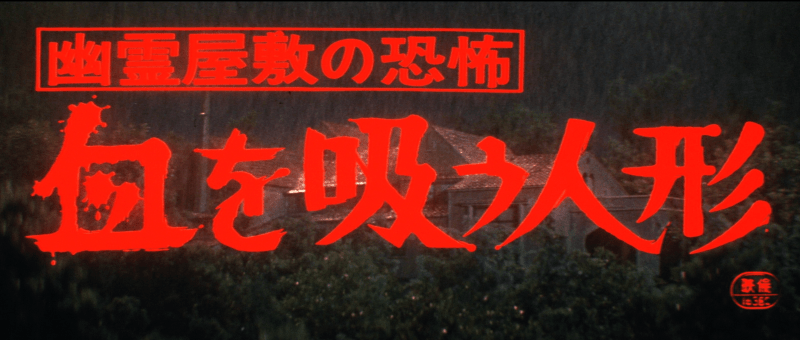
The Vampire Doll (幽霊屋敷の恐怖 血を吸う人形, Yurei Yashiki no Kyofu: Chi wo Su Ningyo) draws influence both from classic European gothic and, perhaps less predictably, Alfred Hitchcock’s Psycho to create a new hybrid horror model which effectively merges the Western “vampire” mythology with the “traditional” long haired, grudge bearing ghost. The tale begins with a young man who has recently been “abroad” for a number of months and has been looking forward to reuniting with his fiancée. When Sagawa (Atsuo Nakamura) reaches the gothic country mansion owned the family of Yuko (Yukiko Kobayashi), his longed for love, he learns that she has, unfortunately, passed away in a car crash just two weeks previously. Heartbroken he decides to stay over but is unable to sleep, not because of the grief or shock, but because of strange noises and the conviction that he has seen Yuko wandering around the house. Visiting her grave the next day, he finally meets her but she seems “different” and tearfully asks him to end her life.
Cut to the city, Sagawa’s sister Keiko (Kayo Matsuo) wakes up from a nightmare in which Yuko killed her brother and tries to cancel a date with her boyfriend to go look for him. Keiko’s boyfriend Hiroshi (Akira Nakao) eventually agrees to drive her to Yuko’s country pile to help investigate. On arrival, Yuko’s mother Shidu (Yoko Minakaze) tells them Sagawa left in heartbreak the day before, but Keiko doesn’t believe her and the couple fake car trouble to stay the night and investigate further.
Yamamoto’s film does indeed raid classic vampire movie tropes and mine them for all they’re worth. The curiously gothic architecture is explained away by Shidu’s husband having been a diplomat who developed a fondness for the European while overseas, but the presence of the hunched over, barely verbal servant Genzo (Kaku Takashina) seems a much more obvious Hammer homage. Shidu laments that the house is now “very old” and crumbling, a remnant of a pre-war world of lingering feudalism, all faded grandeur and declining influence – a fitting seat for a vampiric meditation of changing class and value systems with its kimono’d mistress and seemingly incongruous temporality.
Yet Yuko, not quite a “vampire” as we would usually think of them, is an extension of the traditional ghost story villainess rather than the sex crazed bloodsucker of European literature. Once again, the war is raised as a partial explanation of the tragedies which have befallen the family, if in a more logical fashion than the otherwise outlandish narrative would imply. Shidu carries a prominent scar across her neck – the mark of having tried to take her own life after a frustrated demobbed soldier massacred the family on learning that the woman he loved had married someone else while he was away fighting. This is apparently the origin of Yuko’s grudge (as the film clumsily explains), leaving her with a profound sense of rage against the world that killed her mother’s husband as well as intense resentment that she would die mere days before true happiness was finally in her grasp after enduring so much suffering.
Yuko may put on the billowing white nightgown of the repressed vampiress, her hair a flowing a chestnut-brown, but her blood lust is born of vengeance – she craves destruction rather than satisfaction. Toho flexes its tokusatsu muscles as lightning forks over the gothic mansion, perfectly achieving the air of oppressive supernatural unease provoked by the claustrophobic Western estate which seems to have even the local residents resolved to take the long way home to avoid it. Fusing European gothic with Japanese ghost story, Yamamoto’s first “vampire” movie is an unusual take on the material, refusing the foreign origins of the demonic for a homegrown tale of violence and tragedy consuming the life of a young woman attempting to find happiness in the rapidly changing post-war society.
The Vampire Doll is the first of three films included in Arrow’s Bloodthirsty Trilogy box set which also includes extensive liner notes by Jasper Sharp detailing the history of vampires and horror cinema in Japan.
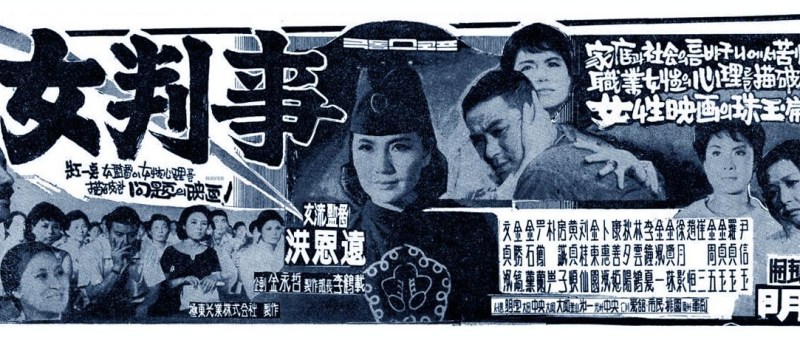
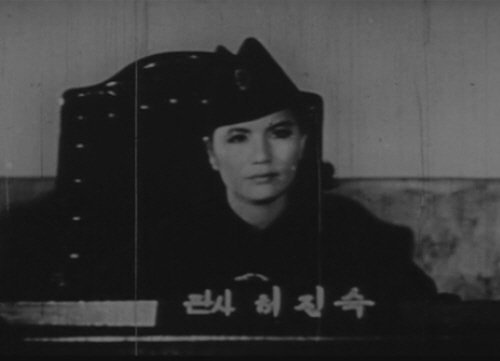
The 1960s were a time of great social change the world over, but while Doris Day was showing the world how to have it all (to a point, at least), not everywhere found the idea of women’s liberation quite so aspirational. In the comparatively more liberal period before the Motion Picture Law brought in by Park Chung-hee there had indeed been a fair few films challenging persistent misogyny and advancing the cause of equality, but there had also been those which ran the other way and pushed an intensely conservative message. Han Hyung-mo’s A Female Boss from 1959, for example, centres around a seemingly successful female editor of a woman’s magazine whose business is in trouble. Eventually she ends up marrying an employee and becomes a housewife, neatly reinforcing the idea that women do not belong in the work force. Three years later and just just before the advent of a more stringent censorship environment, Hong Eun-won’s A Woman Judge (女判亊 / 여판사, Yeopansa) takes a much more positive attitude to the idea of women having the right to personal fulfilment outside of the home but again only to a point and only partially.
Jin-suk (Moon Jeong-suk), a youngish woman from a humble home, is studying for the judges’ exams. Though her father is supportive and encourages her to study, Jin-suk’s mother (Hwang Jung-seun) worries – she cannot envisage a life for a woman who does not marry and doesn’t want her daughter to end up alone, unhappy, and isolated. Jin-suk also finds unexpected resistance from her childhood sweetheart, Dong-hoon (Park Am), who makes a motion to solidify a long held but never spoken promise that the pair would marry but only on the condition that Jin-suk give up her intentions of becoming a judge and agree to be solely his wife. Jin-suk, of course, refuses. Meanwhile, a construction magnate who caught sight of her on the road has taken a liking to her which is only deepened when he reads of her success in the papers. He becomes determined to get Jin-suk to marry his son, Gyu-sik (Kim Seok-hun), and add some sophisticated modernity to his otherwise soulless home.
The great surprise (or perhaps it is in its own way unsurprising) is that Jin-suk’s greatest supporters are two middle-aged men – literally her patriarchal elders in the form of her own father and her father-in-law. Each of the two men is impressed by Jin-suk’s fortitude and intelligence, they believe in her and want her to succeed. The women, however, feel quite differently. Jin-suk’s mother is caring and supportive but locked into the social codes of her youth, unable to envisage a successful life for a woman which does not involve marriage or children. Jin-suk’s mother-in-law by contrast is harsher, actively resenting Jin-suk’s insistence on maintaining her career and seeing it as a rejection of the idea of the good wife. The most surprising enemy, however, is Jin-suk’s new sister-law, Geum-won, who, despite being a modern woman exhibits extremely conservative values even at one point berating Jin-suk for not showing the proper respect to her husband and failing in her wifely duties. Women oppress other women, making it almost impossible to break free of the conspiratorial forces of a conservative social order even when there are women as brave and determined as Jin-suk willing to pave the way.
That said, Jin-suk is only prepared to go half the distance. She marries and then resigns herself to double duties, insisting that she can manage both a career and a home with no support. There is no suggestion of a rebalancing of the domestic world, no one asks anything of Jin-suk’s petulant husband Gyu-sik other than he do what he’s told. Gyu-sik married Jin-suk knowing she would prioritise her career, but it’s less the fact that she works that begins to irritate him than her growing “celebrity” as “the woman judge” coupled with the paternal oppression he too feels as his father’s son. Even though he is head of accounts, his secretary won’t cash his checks without his dad’s signature – he’s not “in charge” at home or at work and feels himself increasingly emasculated. Which is perhaps why he lets his sister manipulate him into an affair with his mousy secretary who conforms much more strongly to the feminine ideal and therefore allows him to feel like “a man”.
The affair between Gyu-sik, and his lonely secretary, Miss Oh, eventually turns dark and leads the pair to consider double suicide. Gyu-sik, a coward, is unwilling to leave his “unhappy” marriage but Miss Oh does not want to end up a perpetual mistress. The first case Jin-suk presides over is a divorce in which a man has cited his own adultery to divorce his wife because she works too much. Obviously, Jin-suk does not approve of his reasoning but it’s the accomplice who becomes unexpectedly sympathetic. Jin-suk asks her if she knew her lover was married to which she says she did not and that had she known she would never have become involved with him. When the woman affirms that she only slept with the man because she believed they would be married, Jin-suk asks her a perhaps cruel question with a wry smile – if she thought the same thing with each and every man she had ever slept with (implying there must have been many in an unintentional act of slut shaming). Rather sadly, the woman replies that yes she did – she may be naive, but she loved them all and firmly believed they would marry her only to be let down just as she’s being let down now.
Such is the difficult position in which women find themselves in a liberalising but not liberal society. One of Gyu-sik’s friends even petitions him to get Jin-suk to help him get rid of a paternity suit filed by a girl he’s got into trouble while engaged to marry someone else and has now disowned. In fact one of the frustrations fuelling Gyu-sik’s resentment is that he has become a mini conduit to Jin-suk as just about everyone attempts to make use of the familial connection to ease their legal woes, little knowing that Jin-suk is not that kind of judge. She entered the law to heal society like a doctor heals the sick, but begins to doubt herself when the disorder in her own home threatens to boil over.
Disorder shifts into murder. A surprising second act twist puts us back in the realms of the courtroom drama as Jin-suk finds herself first a suspect and then presumed an intended victim before being forced to interrogate, literally, her own family and prove her devotion to it in the process. Though it’s Jin-suk determination, perseverance and legal skill coupled with compassion and emotional intelligence that eventually save “the family”, the jury is still out on whether she will be allowed to continue her legal career or be forced to give it up to fully repair the fracturing family home. While Jin-suk is committed to the idea that all women have the right to fulfil their potential, she too is wedded to the patriarchal ideas of the home and family and never truly considers living outside of them, only insisting on being allowed to continue working as a wife if not, ultimately, as a mother (though it is also interesting that she never suggests her career necessitates a rejection of those things or that there is an active choice available to her). A Woman Judge provides a fascinating insight into the prevailing social codes of Korean society in the early 1960s, even if taking only small steps towards a larger goal.
Abridging a work of fiction can be a taxing task. The job of a judicious abridger is the use their own judgement to reduce a larger work to its most essential elements either for those who, for one reason or another, need a more immediate digest or for those looking for greater accessibility. When it comes to a work of art, abridgement can be a dubious task and, unfortunately, the temptation is simply to excise the “best bits” shorn of all the “heavy stuff” and supporting material. Sion Sono who had been in a particularly prolific phase was given something of an unusual opportunity in creating Tokyo Vampire Hotel (東京ヴァンパイアホテル) – a chance to do as he pleased with a sizeable budget to create a television series for Amazon Prime, which is to say marrying mainstream commercial concerns with idiosyncratic artistry. The 6.5hr, eight episode, series was released via the streaming platform in June 2017 (initially in Japan only with international streaming available a few months later) but Sono also took the step of creating a 2hr22min feature length cut for film festival distribution.
The titular Tokyo hotel is the lair of a sect of modern day vampires. As a long prophesied war between rival clans – the Corvins in Japan and the ancient Draculas of Romania,brews, the Corvins have engineered a plan to lure lonely unsuspecting Tokyoites to an exclusive singles mixer where they will not only be given a sizeable fee for attending but also tempted with the possibility of meeting the love of their life, never suspecting that all this is too good to be true and they are really being recruited for a kind of blood farm to feed the various appetites of their bonkers captors.
Meanwhile, “the chosen one”, Manami (Ami Tomite), is about to come of age. Born during an “auspicious” alignment of the stars, Manami is one of three children given special vampire blood and thought to be all powerful, species saving hybrids. As such she is wanted by every side and is eventually “rescued” from a massacre at a restaurant by ice cool vampire K. (Kaho) – a Japanese vamp currently working for Dracula.
It has to be said that Sono’s original TV cut is extremely convoluted and initially confusing. The hotel, a Japanese vampire hub, is connected to the vampire capital in Romania by a magical tunnel with the narrative flowing freely between both spaces. What we lose in condensing to feature length is the entirety of the extensive back story with the consequence of shifting the focus from the protagonist of the TV series, Manami, to the more exciting figure of second lead K. whose gradual disillusionment with becoming a puppet in someone else’s revolution coupled with romantic heartbreak eventually reawakens her sense of “humanity” as she becomes committed to “saving” Manami from becoming yet another slave to the Dracula cause.
Meanwhile, Sono satirises modern Japan’s ambivalence towards romance as a collection of youngsters are forced into an extreme situation in order to successfully couple off and form a “traditional” family solely to satisfy the demands of a bunch of vampire overlords standing in for a bloodsucking state. Yamada (Shinnosuke Mitsushima), the conflicted hero of the Corvins who longs for escape from his unwanted immortality and an egotistical, individualist world harbours intense resentment towards his own “hypocritical” father who “sold” him to the vampires as a baby in return for various favours by which he has now become the “Romantic Party” Prime Minster of Japan preaching traditional family values and a “wholesome” future for the little children who otherwise face a difficult existence in a country which has “lost its way”.
Sono doubles down on his usual sense of romanticism as his flamboyant vampires adopt an oddly foppish, Regency era aesthetic whilst speaking in a deliberately theatrical manner filled with bold philosophical statements and a florid sense of repressed melodrama. Harking back to Bad Film – another attempt to reorder extensive footage into a narratively cohesive whole, the conflicts are often about love more than death with suffering and sorrow marking the lives of our gloomy immortals, oppressed by their own inability to transcend their natures and find the escape they so desperately crave.
Sono seems to reemphasise their unhappy fates by engineering an altogether different, infinitely abrupt ending which, in contrast to the TV drama, hands the victory back to the people but does so in historically uncomfortable fashion as the victorious hotel guests revel in acts of atrocity against their captors which are framed as a kind of genocide and accompanied by stills from violent classical paintings featuring scenes of unbridled carnage. A contrarian to the last, Sono mutilates his own endeavour and then frankensteins it into something else, twisting his own words and tying himself in knots in the process. Viewers seeking clarification would be well advised to invest their time in the 6.5hr experience rather than opting for the convenient shortcut of an edited version, but there is certainly plenty to ponder in Sono’s truncated tale of love and death in post-Olympic Tokyo.
This review refers to the theatrical cut of Tokyo Vampire Hotel which was screened as part of the Fantasia International Film Festival 2018. You can also stream the original TV drama in most territories via Amazon Prime.
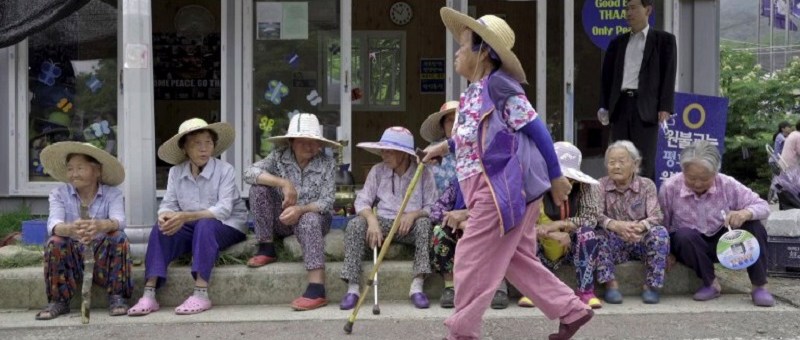



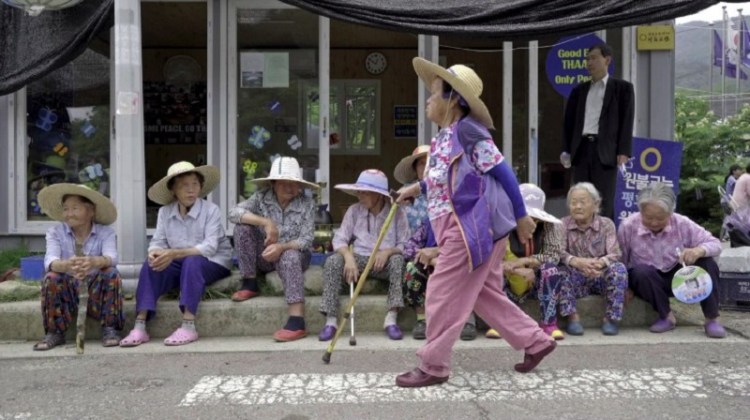 Park Bae-il’s Soseongri follows a community of elderly farmers facing rural depopulation problems who find themselves in conflict with the police when the decision is taken to place the THAAD anti-aircraft system in their village.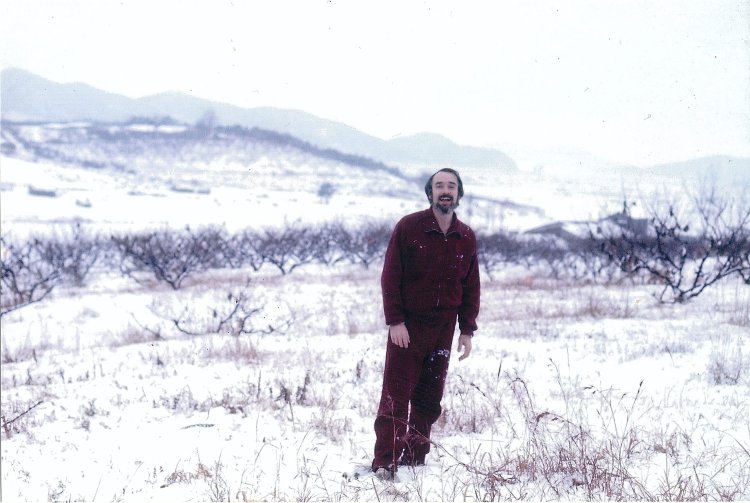








 Windows on Worlds