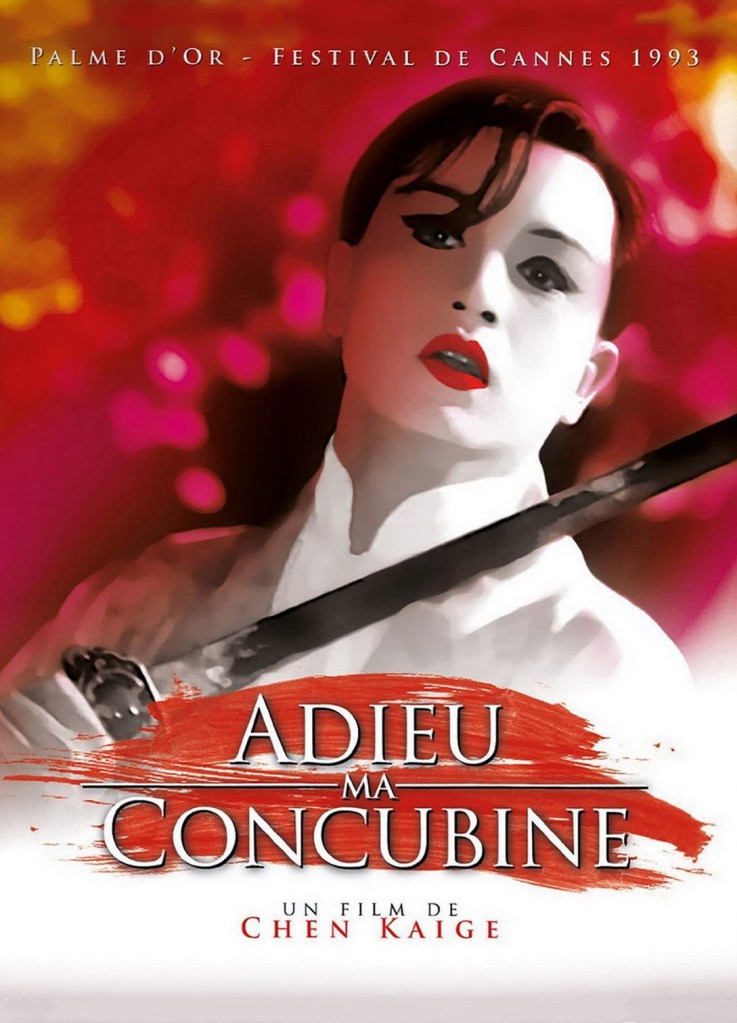
Farewell My Concubine (霸王别姬, Chen Kaige, 1993)

farewell-my-concubine-1993
French DVD cover

Review of Chen Kaige’s 1993 masterpiece Farewell My Concubine (霸王别姬, Bàwáng Bié Jī) first published by UK Anime Network.


“Why does the concubine have to die?” Spanning 53 years of turbulent, mid twentieth century history, Farewell My Concubine is often regarded as the masterpiece of fifth generation director Chen Kaige and one of the films which finally brought Chinese cinema to global attention in the early 1990s. Neatly framing the famous Peking Opera as a symbol of its nation’s soul, the film centres on two young actors who find themselves at the mercy of forces far beyond their control.

Beginning in 1924, Douzi (later Cheng Dieyi) is sold to an acting troupe by his prostitute mother who can no longer care for him. The life in the theatre company is hard – the boys are taught the difficult skills necessary for performing the traditional art form through “physical reinforcement” where beatings and torturous treatment are the norm. Douzi is shunned by the other boys because of his haughty attitude and place of birth but eventually finds a friend in Shitou (later Duan Xiaolou) who would finally become the king to his concubine and a lifelong companion, for good or ill.

Time moves on and the pair become two of the foremost performers of their roles in their generation much in demand by fans of the Opera. However, personal and political events eventually intervene as Xiaolou decides to take a wife, Juxian – formerly a prostitute, and shortly after the Japanese reach the city. Coerced by various forces, Dieyi makes the decision to perform for the Japanese but Xiaolou refuses. After the Japanese have been defeated Dieyi is tried as a traitor though both Xiaolou and Juxian come to his rescue. The pair run in to trouble again during the civil war, but worse is to come during the “Cultural Revolution” in which the ancient art of Peking Opera itself is denounced as a bourgeois distraction and its practitioners forced into a very public self criticism conducted in full costume with their precious props burned in front of them. It’s not just artifice which goes up in smoke either as the two are browbeaten into betraying each other’s deepest, darkest secrets.

Farewell My Concubine is a story of tragic betrayal. Dieyi, placed in the role of the concubine without very much say in the matter, is betrayed by everyone at every turn. Abandoned by his mother, more or less prostituted by the theatre company who knowingly send him to an important man who molests him after a performance and then expect him to undergo the same thing again as a grown man when an important patron of the arts comes to visit, rejected by Xiaolou when he decides to marry a prostitute and periodically retires from the opera, and finally betrayed by having his “scandalous” secret revealed in the middle of a public square. He’s a diva and a narcissist, selfish in the extreme, but he lives only for his art, naively ignorant of all political concerns.

Dieyi doesn’t just perform Peking Opera, he lives it. His world is one of grand emotions and an unreal romanticism. Xiaolou by contrast is much more pragmatic, he just wants to do his job and live quietly. On the other hand, Xiaolou refuses to perform for the Japanese (the correct decision in the long run), and has a fierce temper and ironic personality which often get him into just as much trouble as Dieyi’s affected persona. The two are as bound and as powerless as the King and the Concubine, each doomed and unable to save each other from the inevitable suffering dealt them by the historical circumstances of their era.

The climax of the opera Farewell My Concubine comes as the once powerful king is finally defeated and forced to flee with only his noble steed left beside him. He begs his beloved concubine to run to sanctuary but such is her love for him that she refuses and eventually commits suicide so that the king can escape unburdened by worry for her safety. Dieyi’s tragedy is that he lives the role of the concubine in real life. Unlike Xiaolou, his romanticism (and a not insignificant amount of opium) cloud his view of the world as it really is.

It’s not difficult to read Dieyi as a cipher for his nation which has also placed an ideal above the practical demands of real living people with individual emotions of their own. Farewell My Concubine ran into several problems with the Chinese censors who objected not only to the (actually quite subtle) homosexual themes, but also to the way China’s recent history was depicted. Later scenes including one involving a suicide in 1977, not to mention the sheer absurd horror of the Cultural Revolution are all things the censors would rather not acknowledge as events which took place after the birth of the glorious communist utopia but Farewell My Concubine is one of the first attempts to examine such a traumatic history with a detached eye.

Casting Peking Opera as the soul of China, Farewell My Concubine is the story of a nation betraying itself. Close to the end when Dieyi is asked about the new communist operas he says he finds them unconvincing and hollow in comparison to the opulence and grand emotions of the classical works. Something has been shed in this abnegation of self that sees the modern state attempting to erase its true nature by corrupting its very heart. Full of tragic inevitability and residual anger over the unacknowledged past, Farewell My Concubine is both a romantic melodrama of unrequited love and also a lament for an ancient culture seemingly intent on destroying itself from the ground up.


Farewell My Concubine is released on blu-ray in the UK by BFI on 21st March 2016.

Original US trailer (with annoying voice over):
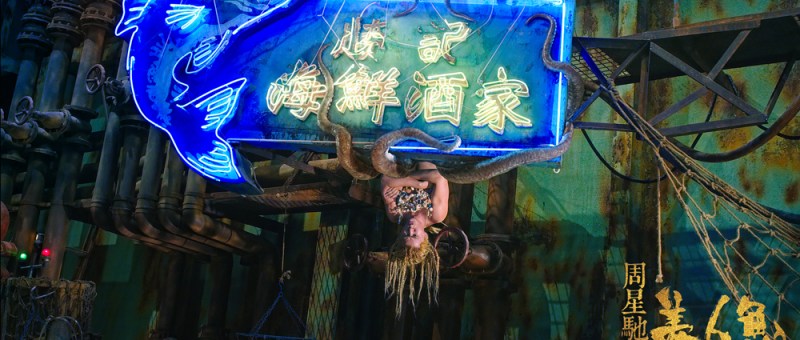
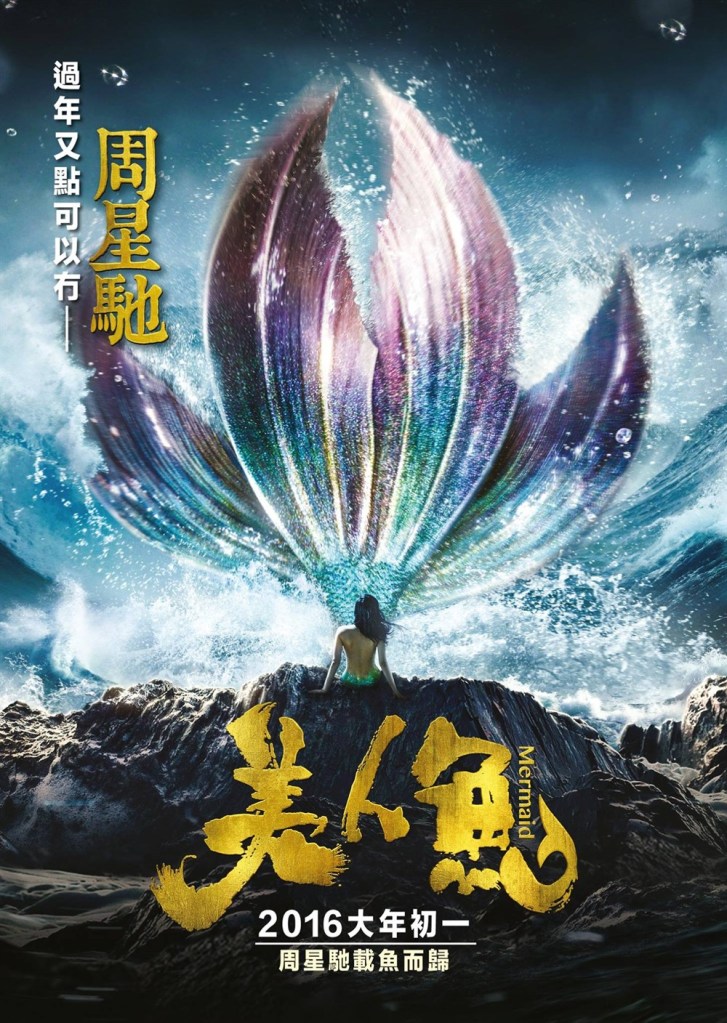
The Mermaid (美人鱼, Stephen Chow, 2016)

Mermaid

Stephen Chow unexpectedly became a mini phenomenon with that rarest of beasts – a foreign language comedy that proved a mainstream crossover hit, in the form of the double punch that was Kung Fu Hustle and Shaolin Soccer. However, his once ascendant star has been in retrograde ever since when it comes to screens outside of Asia. The surprise worldwide theatrical release of this latest film, The Mermaid (美人鱼, Mei Ren Yu), might be about to change all that.

Loosely inspired by The Little Mermaid, Chow paints a world of consumerism in overdrive as heartless capitalists fall over themselves to destroy the beauty of the natural world to buy even more flashy status symbols even though they only make them even more miserable. After opening with some newsreel footage of mass deforestation and a bloody dolphin massacre, Chow shows us the natural world exploited in a different way as a group of visitors visit an “exotic animal show” which includes such wonders as a live tiger (actually a pet dog with stripes painted on its fur), a “Batman” (with fried chicken for ears), and, crucially a “Mermaid” (a fried fish with a doll’s head on the top).

We’re then introduced to rich playboy businessman Liu Xuan (Deng Chao) who lives life large in a giant western style estate surrounded by gold digging dollybirds. He’s bought some “surprisingly well priced land” to use in a reclamation project, only the problem is it’s technically a nature reserve. His underlings have come up with a scheme to frighten away the wildlife with sonar devices so they can destroy the area of outstanding natural beauty in peace. However, they didn’t know about the colony of Merpeople hiding out there who have a serious problem with Liu and have dispatched one of their number, Shan (Jelly Lin), to assassinate him!

Predictably, the assassination plot does not all go to plan with often hilarious results. Like Chow’s other movies, the main spine of the narrative is a romantic comedy in which a foolish and arrogant man is made to realise his own weaknesses through finally noticing a woman he previously had no interest in. This time Shan turns up looking like a crazy lady with her bizarre makeup and fake mermaid outfit which gets her instantly thrown out of Liu’s place though she does succeed in giving him her phone number. Usually, Liu isn’t the type to call back but he gets goaded into it by mistake and then his henchman actually brings Shan to his office where she fails at assassinating him first with poison and then with sea urchins. By this time the course is set as the pair bond during their macabre meet-cute with Liu becoming attracted to Shan’s otherworldliness and she to the goodness that might be buried inside him.

Liu, it seems, experienced extreme poverty in his childhood and so now cares only about making money. Or says he does, his depressing solo karaoke dances to a hit pop song with the chorus “no one understands my loneliness” might tell a different story. Being super rich is actually kind of boring and everyone he meets only cares about his money so meeting Shan (who is predominantly interested in killing him) proves refreshing. Nevertheless, money also becomes an anchor dragging you down, even if Liu starts to come over to the Merpeople’s point of view (particularly after testing out those sonar devices on his own ears) his associates aren’t likely to agree.

It all goes a bit dark towards the end – wildlife massacres and kidnappings for “scientific research” which seems to include things like vivisection and live experimentation not to mention the intentional eradication of the entire living environment of these hitherto hidden creatures all the while preaching about scientific progress and a desire for understanding. Chow is many things but subtle has never been one of them so he lays his environmental message on with a trowel but the rest of the movie is so big anyway that he gets away with it (and in style).

Light and bright and colourful, The Mermaid is another characteristically madcap effort from Chow who packs in all the absurdist humour one could wish for plus a decent dose of sight gags and good old fashioned slapstick. It has to be said that the quality of the CGI (of which there is an awful lot in the film) is, on the whole, woeful, though somehow this just ends up adding to its charms as another facet of its self-effacing wackiness. A hilarious return to form from Chow who has been away for far too long, The Mermaid looks set to continue its enormous box office success by becoming one of the director’s most fondly remembered efforts.


The Mermaid is currently in UK cinemas but the distributors have gone down the Bollywood route of chasing the diaspora audience only (as RogerEbert.com discovered during the US release) and not engaging with the regular film press in any way, shape, or form. Therefore there has been almost no coverage of the cinema screenings in the non-Chinese media. Here’s a list of the surprisingly high number of UK cinemas screening the film courtesy of my friends at Eastern Kicks so check it out because it very likely could be playing at a cinema near you!

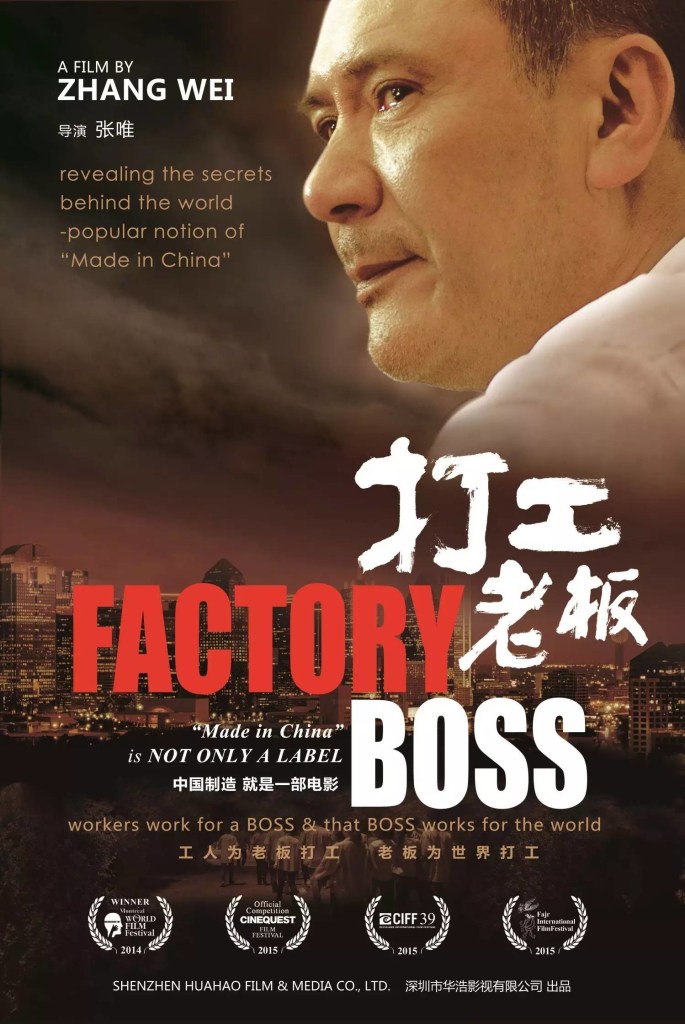
Factory Boss (打工老板, Zhang Wei, 2014)

factory bossGenerally speaking, capitalists get short shrift in Western cinema. Other than in that slight anomaly that was the ‘80s when “greed was good” and it became semi-acceptable to do despicable things so long as you made despicable amounts of money, movies side with the dispossessed and downtrodden. Like the mill owners of nineteenth century novels, fat cat factory owners are stereotypically evil to the point where they might as well be ripping their employees heads off and sucking their blood out like lobster meat. Zhang Wei’s Factory Boss (打工老板, Dagong Laoban) however, attempts to redeem this much maligned figure by pointing out that it’s pretty tough at the top too.
Shenzhen used to have over 1000 toy factories, but following the worldwide financial crisis, there are barely 100 left. Dalin is one of the lucky ones still holding out, if just barely. The employees haven’t been paid in a couple of months and there are debts outstanding which are only being held at bay thanks to a series of promises. The boss, Lin Dalin, has negotiated a massive deal to manufacture a large order for an American company which just might save them but he’s also biting off a little more than he can chew. The workforce are starting to get antsy – they’ve already burnt a car on the forecourt and some are talking about a walkout. To get this order through he’ll have to ask for even more from his already over stretched employees.

Just around this time, a young, ambitious reporter has developed a bee in her bonnet about workers’ rights at the local factories and has taken an undercover job at Dalin hoping to expose some of its shortcomings to the outside world. What she finds is worse than she’d ever imagined – faulty ventilation systems, air thick with the sickening smell of melting plastic, illegal “overtime” schedules, no breaks, shortened lunch times and a culture of shame and bullying intended to cow workers into playing along.

The film encourages us to see Lin as a generally “good” person. It says he wasn’t like this prior to the financial collapse and that it’s the current environment that has turned him into a ruthless exploiter of the “tools” at his disposal – i.e. his employees. Following on from the communist system, factories are still run like work groups where the employee base becomes a surrogate family with everyone living in shared workers accommodation on the complex. The workers also get lunch at the factory (but this comes out of their final pay).

Lin, like a feudal lord, sees himself as a paternal figure who has a duty to protect these people, but this means ensuring the factory’s survival. This is how he justifies his increasingly exploitative behaviour to himself, that if the factory goes under all of these people, and some of them are now old having worked there for 25+ years, will lose their jobs and with all the other factories in the same position, they will be left with nothing.

However, though Lin never behaves in an extravagant or intimidating fashion, it is also true that he lives all alone in a mansion drinking imported wine and chatting to his daughter via a shiny macbook while she studies overseas. He complains there’s little profit in his business these days, but he doesn’t seem to be tightening his own belt while his employees worry about their futures.

One of Lin’s friends has sold his local factory and relocated to Burma where the labour is even cheaper and there are even fewer labour laws. Lin is reluctant because he wants to make his nation great again and reverse the meaning attached to the phrase “Made in China” whilst also helping to build a better future for the people under his care but he is also at the mercy of market forces.

Thanks to a late in the game change of sympathies from our lady reporter, we’re pointed towards the real villains which would be the international corporations who manufacture in China because it’s cheaper but are squeamish about the country’s treatment of the working classes. These companies say they enforce strict conditions and make personal factory inspections, but their commitment is only really halfhearted. They know the reason why the labour is so cheap, but they drive the prices down anyway preaching against sweatshops but knowing, economically speaking, that there is no Earthly way these targets can be met on time and on budget with workers’ rights fully respected to the degree stated in their own mission statements. As soon as labour laws are revised in China and wages necessarily rise, they will simply switch to using cheaper labour forces in less developed parts of the world.

To be frank, this is just capitalism. A business is a business and each will constantly be looking to maximise their own profit margin. They will push and push until they feel resistance, and then they will push some more to find out how much their opponents will push back. No matter which way you spin it, the little guys will pay. Yes, Lin too is a victim, but it’s a little rich to pretend the consequences for a man like him are the same as they are for his employees. China has moved from the “Iron Rice Bowl” system of guaranteed lifetime employment to the relative insecurity of global capitalist society but its modernisation has been so rapid that the base line workers have been left with the rawest deal – poor pay and conditions coupled with the constant pressure of possibly being let go or being forced into exploitative arrangements just to keep a job which barely feeds you.

Factory Boss is an interestingly constructed look at the little seen life of the everyday factory which has a healthy level of naturalistic feeling detail. Zhang does however fall into a slightly didactic approach, particularly in his hagiographic depiction of Lin, and some of the later monologues appear oddly theatrical in contrast to the straightforward nature of the rest of the film. He catches China in the midst of its transformation, trapped in a moment of indecision as it finds itself cast in the role of middle man offering its services in the service of the enterprise of others while the individual dreams of men like Lin who long to set up on their own are crushed by forces beyond their control. Redeeming the figure of the fat cat is a nice a idea and Zhang certainly succeeds in casting Lin as a decent man corrupted by circumstance but his central message that the middle man needs love too and the real mean daddies are greedy corporate overlords is one which, true as it may be, can’t help feeling a little trite.


Reviewed as part of the Asia House Film Festival 2016.

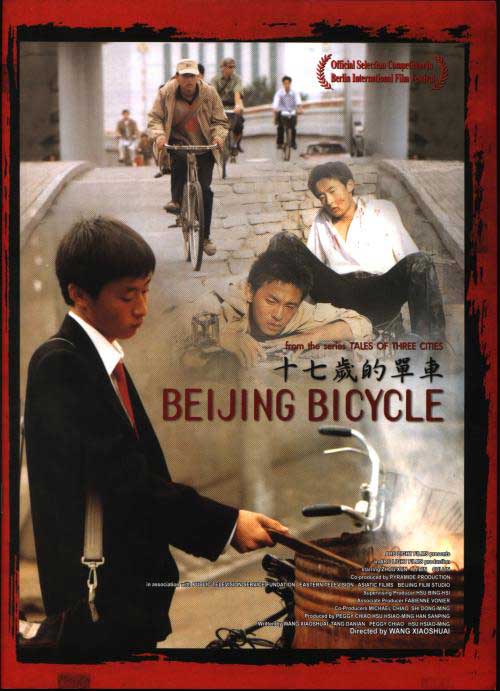
Beijing Bicycle (十七岁的单车, Wang Xiaoshuai, 2001)

BeijingBicycleThere are nine million bicycles in Beijing (going by the obviously very accurate source of a chart topping song) but there are 11.5 million inhabitants so that’s at least two million people who do not own a bike. Still, if you’re in the unlucky position of having your bike stolen by one of the aforementioned two million, your chances of finding it again are slim. Luckily for the protagonist of Wang Xiaoshuai’s Beijing Bicycle (十七岁的单车, Shí Qī Suì de Dānchē), he manages to track his down through sheer perseverance though even once he gets hold of it again his troubles are far from over.
A young guy from the country, Guei has lucked out with a good job at a bicycle courier company. Each of the new employees is given a new, high-tech bicycle which they will eventually own after working off the cost through a 20/80 salary split and once the bike is theirs they’ll be on an even better 50/50 pay rate. This is a dream job for Guei and he’s pretty good at it – he’s nearly paid for the bike in under a month. However, after being messed about by a hotel reception desk which keeps him hanging around longer than usual, he emerges to find his bike no longer waiting for him.

The vehicle turns up in the hands of another boy of a similar age but very different background. Jian is a lower middle-class boy at a posh school where most of his classmates are considerably better off than he is and it seems to get to him. Jian’s father has been promising to buy him a bicycle for years but something always comes up and now it’s that his little sister got into a better school so they need the money for her fees. Resentfully, Jian gets himself a bike to hang out with his posh friends through other means and generally continues to be a little shit about it.

Quite obviously inspired by De Sica’s neo-realist classic Bicycle Theives, Beijing Bicycle doesn’t quite have that movie’s harsh sentimentalism but goes about as far as Wang could take a similar message and still get around China’s frighteningly tight censorship regulations. Guei does everything right – well, almost everything, he gets so upset about losing his bike that he forgets to deliver his final package which is what gets him fired from the delivery firm (they didn’t really mind about the bicycle anyway). He offers to find the bike and bring it back and is promised a second chance if he can actually beat the odds and track it down but his boss doesn’t seriously expect to see him again. Guei needs the bike to live, he can’t work without it and this was about the best job he’s likely to get in the bustling metropolis of Beijing without qualifications or family connections.

On the other hand, it becomes increasingly difficult to sympathise with Jian and his petty squabbles with his very reasonable father and attempts to blend in with the equally awful group of thuggish rich boys from school. Of course, it’s all about a girl really – somehow he thinks she’d care about him having a bicycle (she wouldn’t) and luckily said girl is too sensible to hang out with someone who’d beat up some poor kid and take away his only way of supporting himself just because he could. Yes, he’s a young man and he’s angry so he’s doing stupid teenage boy stuff but he’s ruining lives in the process and desperately needs someone to explain to him about the world not being fair.

Guei eventually steals back his bike, only for Jian’s mates to beat him up and take it again. Guei doesn’t give up though and eventually the two end up sharing the bike even though Jian only uses it for swanning around and trying to impress a girl who isn’t interested in him. Needless to say it all ends quite badly. Jian gets Guei into even more trouble that he didn’t ask for and both boys end up losing out both ways. As in De Sica’s film, society turns us all into bicycle thieves whether we wanted to be or not. The boys are both chasing an unattainable dream but they’re doing it from very different places and though both are arguably at a disadvantage boys like Guei will always lose out to cowardly thugs with muscle like Jian.

Nicely filmed in a modern indie, neo-realist inspired style Beijing Bicycle does suffer a little with its lengthy running time especially as the tussle over the bicycle itself turns into a repetitious saga in which you just want someone to give Guei back his bicycle and have done with it. Nevertheless, having said that it actually does quite a lot with an economical script though Zhou Xun’s virtual walk on of a cameo as the glamorous neighbour feels a little underdeveloped even if it pays off in the second half of the film. A sadly realistic tale of a very unlucky boy who just wants to get on and works hard to get there only to come up against cowards and thugs with money Beijing Bicycle does what it can do to highlight the unfairness inherent in the post-communist world.


Beijing Bicycle was previously released by Tartan in the UK and is currently available to stream via Amazon. In the US it’s currently available on DVD through Sony Pictures Classic.

Watched via Mubi.


The Bullet Vanishes (消失的子弹, Law Chi-leung, 2012)

20128291720405212Review of Law Chi-leung’s The Bullet Vanishes (消失的子弹, Xiāo Shī Dè Zǐ Dàn) – first published on UK Anime Network in June 2013.


In 1930’s Shanghai there’s a bullet factory where a young girl has been accused of pilfering. The punishment, it seems, is a cruel and very public trial by Russian roulette where fate, the gods or whoever will judge her innocent or guilty with a simple click or a loud bang. Crying out her innocence to the end, the girl pulls the trigger and presumably never actually hears the outcome as her co-workers look on in horror – she must have been guilty though, right? Or she would have been spared by the immortal powers at be.

Following this horrific incident, other deaths start to occur in the factory – the strange thing is, on examining the bodies, no trace of a bullet can be found (nor any casings at the scene). Some of the munitions workers start to believe the ghost of the poor girl who died must have returned to take revenge – perhaps she was innocent after all. To solve this intriguing mystery, the police turn to two unorthodox detectives – recently transferred former prison warden Song (Lau Ching-Wan) and maverick cop “fastest gun in town” Guo (Nicholas Tse). Neither of these two are buying the “supernatural” explanation and both are determined to get to the truth even if they work in very different ways. The solution is going to be a lot more complicated than anyone could have thought, and will, ultimately, be painful to hear.

Let’s get this out of this way first – yes, the film owes a significant debt to the recent “westernisation”, if you want to put it that way, of Ritchie’s Sherlock Holmes and other Victorian set crime dramas (e.g. Ripper Street) which seek to present themselves as taking place in a totally lawless world denizened by a criminal population that is somehow both repellent and glamourous. Although The Bullet Vanishes is set in 1930s, it still has a noticeably “Victorian” sensibility presenting a world in which rapid industrialisation has brought about mass corruption and a decline in morality. Once again, setting a film in China’s past proves to be a surefire way of getting subtextual criticisms of modern China past the country’s strict censorship regulations.

The murder mystery itself is certainly very intriguing with a series of unpredictable twists and turns. The idea of disappearing bullets might not be a new one, but The Bullet Vanishes manages to find an original solution that is perfectly plausible within its own time setting. Also, the “supernatural” element exists only as an idea and is never seriously entertained as an explanation by any of the investigators – something of a break from the genre norm.

The two detectives seem much more like rivals than partners for much of the film though an awkward sort of camaraderie does eventually grow up between them. Lau and Tse both give excellent performances but Tse in particular who’s often criticised for being a pretty boy trading on family connections, really proves himself with his surprisingly complex Guo. There is, however, the familiar criticism that the female characters are severely underdeveloped and seem almost like a rushed afterthought. Yang Mi gives a lot to the barely two dimensional Little Lark but can’t disguise the fact that the character only exists as a love interest for Guo and that in turn a love interest for Guo only exists so that we can have the “obligatory” love scene. That wouldn’t be so much of a problem if the love scene itself didn’t feel quite so “obligatory” – it could easily have been excised and the film would have remained pretty much unchanged as the scene feels as if it exists purely to satisfy a perceived audience need for romance.

There really isn’t much to fault with The Bullet Vanishes. As a slightly cerebral mainstream period thriller it’s certainly very successful. It has an engaging mystery element, strong characters played excellently by the cast and extremely slick, modern direction. In Song they’ve created a very interesting character who’d be very welcome in a sequel or two. His relationship with female prison inmate, a sort of Irene Adler figure to Song’s cerebral detective, who he’d previously investigated before being transferred was quite an usual idea that would really benefit from further exploration. All in all The Bullet Vanishes is a very impressive and enjoyable period procedural that is truly a cut above its genre origins.


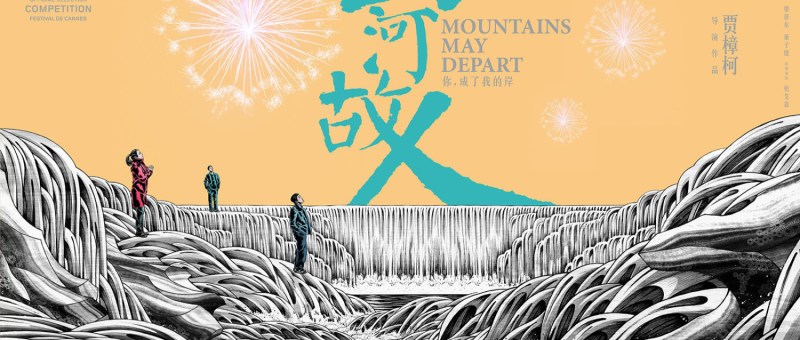
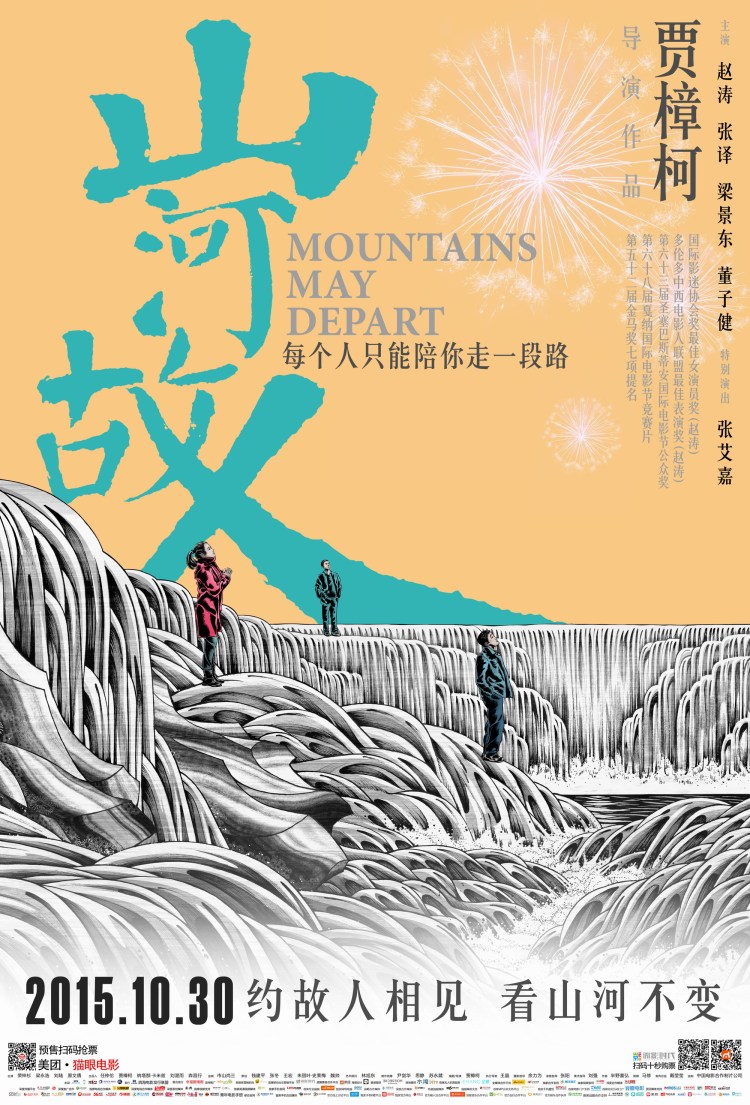
Mountains May Depart (山河故人, Jia Zhangke, 2015)

mountains may depart poster verticleJia Zhangke has made something of a career out of charting his nation’s history through the lives of ordinary people caught up in the business of living when everything about them is changing. Mountains May Depart (山河故人, Shānhé gùrén) isn’t the first of his films to span a comparatively wide period of time, though it is the first to venture into the “future” if only by a decade or so. Through a story of dislocation and isolation both cultural and personal, Jia has traversed the melancholy odyssey of those who grow up to discover that all the wrong choices have already been made.
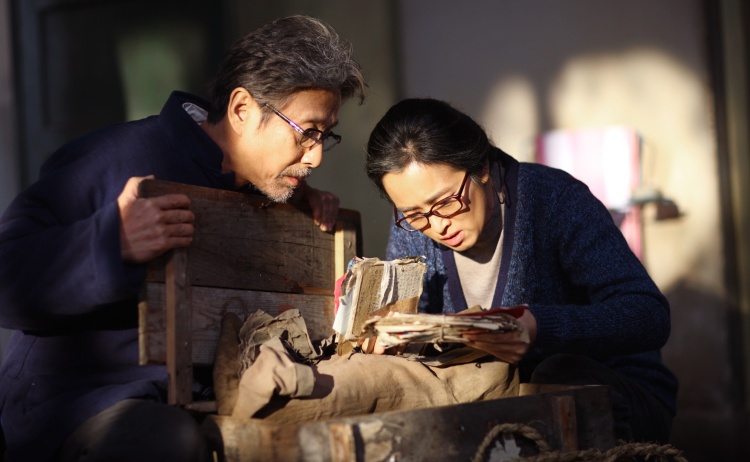
The film begins at Chinese New Year 1999 – the dawning of a new age. Tao line dances and conga lines to The Pet Shop Boys’ Go West before joining in the celebrations by singing a song in the town square. She’s good friends with Liangzi whose company she seems to enjoy and they seem to get on together very well but it’s unclear if there’s anything more to it than that. Obnoxious rich boy Jiangsheng is also VERY interested in Tao and resents her friendship with Liangzi. Eventually things come to a head and Tao has to choose, and she does but in trying not to hurt anyone she ends up hurting everyone. On Tao’s eventual marriage to Jiangsheng, Liangzi, heartbroken, leaves town intending never to return. The segment ends with the birth of Tao and Jiansheng’s son, Dollar.

In 2014, Tao is divorced and Jiangsheng has taken her son to live with him in Shanghai where he’s a high stakes capitalist mogul. Liangzi, meanwhile, has married and had a child but has ended up working in a coal mine and has now become gravely ill. Unable to work he returns home and considers asking friends and family to help him through these difficult times. Sometime later a family tragedy occurs – the one silver lining being that Tao gets to see Dollar again but he barely remembers her and makes constant phone calls to his “mommy” in Shanghai.

In 2025, Dollar and Jingsheng have moved to Australia. Dollar is taking classes in Chinese which he barely remembers while Jingsheng has become a dishevelled and angry old man. Dollar has almost no memory of his real mother or his childhood in China and starts up an oedipal relationship with a lonely, middle-aged Chinese woman.

Jia paints the passing of time through a series of expanding screen ratios – beginning with 4:3 in 1999, to 16:9 in 2014 and finally 2.35:1 in 2025. The world literally gets bigger, wider, and our focus shifts from Tao to a more expansive canvas of displaced Chinese citizens finally reaching far across the seas. The first segment is more like Jia’s earlier films as Tao is caught between two lovers with possibly tragic consequences whereas the second part has more in common with his more recent work but part three takes things in an entirely new direction.

The 2025 segment doesn’t even feature Tao until the very end and focuses on her son – the ironically named “Dollar”. Having lived the last ten years in Australia he barely speaks Mandarin and has become an angry young man determined to drop out of college because “nothing really interests” him. Jinsheng never learned English and the pair can’t communicate. Gone is Jinsheng’s swagger – now he has a paunch, dishevelled hair and an unruly mustache. In 1999 he dressed in the self consciously stylish clothes of someone who has money and really wants you know it, but now his clothes are worn out and typical of any old man you might find sitting reading a paper on the side of a road. Dollar is lost. Eventually he strikes up a friendship with his Chinese teacher that’s founded on the shared loneliness of two people who’ve been separated from their homelands and loved ones. Looking for his mother in all the wrong places, Dollar’s eventual romance is likely to end in tears but luckily his Chinese teacher is a wise and kind woman who is able to offer some of her wisdom and a steady hand of guidance.

Though much has been made of the “futurism” of the 2025 segment, it’s in no way a science fiction experiment. The chief difference, as might be expected, is in technology though even this is subtle – see through tablets, electronic displays rather than blackboards (only a little more advanced than many institutions already use) and a much more intuitive embedding of google translate. More distracting are the strange anachronisms – vinyl records being played on a classroom turntable, visiting a travel agent to book a flight (does anyone even do this now?) and a preference for older cars. Most damaging though is that, as it’s set in Australia, the bulk of the dialogue is in English which somehow never sounds convincing despite the quality performances on offer.

Dollar wants his freedom from his overbearing, failure of a father though freedom itself is also a burden. The son flails aimlessly while the literal motherland, Tao, is alone, abandoned and forgotten. There’s something quite heartbreaking in the way Jia sculpts his overarching story. We begin with so much hope as Tao and her friends dance enthusiastically to the rather ironic choice of Go West in 1999 as her life is just beginning. When she dances to it again, alone, with the snow falling all around her it’s as if she’s crawled inside a memory, reliving a happy day rather than exulting in the now.

Mountains May Depart is a rich and complex film that is heavy with symbolism and metaphor. Jia wants to ask us where we’re going, and where we’ve been – China’s modernisation has occurred at such a breakneck speed that it’s left an entire nation bewildered. Facing a choice between “going west” and “taking care” of Chinese values (Sally Yeh’s 1990 Cantopop hit Take Care forms the opposing musical motif of the film) many, like Tao, have found themselves choosing poorly and paying a heavy price. What’s in store? A lonely, but wealthy, future devoid of all human connection where “sons” forget their “mothers”? The title suggests old friends like mountains and rivers never part but once the erosion sets in mountains crumble and rivers run dry – you have to look around you and remember what it is that’s really worth living for.


This is getting a full UK release from New Wave Films in Spring 2016!

For the curious here is Sally Yeh’s (葉蒨文) 1990 Cantopop hit Take Care (珍重) which does its best to tug at the heartstrings throughout the later part of the film (and largely succeeds).

First published by UK Anime Network.

The Grandmaster (UK Release) (UK Anime Network Review)

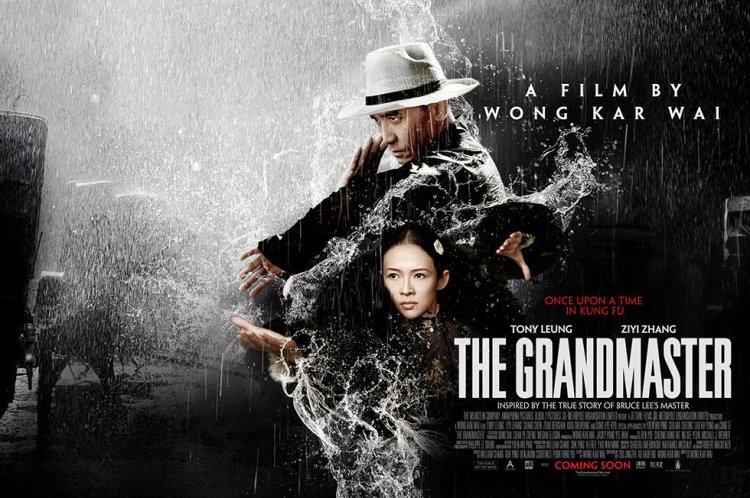
background_46481“Once upon a time in Kung Fu”? Really? “Inspired by the True Story of Bruce Lee’s Master”? Yeah, this poster tells you everything you need to know. 1000+ word rant Review of the Weinstein cut of Wong Kar Wai’s latest up at UK Anime Network.


You’d be hard pressed to find a more internationally well loved Chinese director than the achingly cool Wong Kar-wai. When it was revealed that Wong was going to tackle the story of legendary martial arts practitioner Ip Man with frequent collaborator Tony Leung along for the ride, excitement levels were obviously dangerously high and only set to rise. However, the project never quite seemed to get off the ground and, in fact, several other Ip Man movies were made in the meantime including the hugely successful series starring Donnie Yen the third of which is currently in development. The film finally found its way to the Berlin Film Festival in 2013 and received a brief cinema run in the UK last year but is only now reaching UK homes courtesy of Metrodome.

As usual with Wong who’s never quite managed to find the “save & quit” button, The Grandmaster exists in three different versions – the first being the original “Chinese cut” which runs 130 minutes, the second the “Berlin Cut” which runs 123 minutes and then there’s the “Weinstein Cut” which is 108 minutes long. If alarm bells are already ringing on hearing the name Weinstein, you are unfortunately correct – the UK release is limited to the shorter Weinstein cut. Not only is the film 18 minutes shorter than the longest version, it is an entirely different movie. Subplots have been streamlined or removed altogether, scenes have been reordered and rearranged and crucially additional voice over and explanatory title cards have been added for the “benefit” of an international audience. Seeing as few people will have the opportunity to see either of the other cuts of the film, there’s little point in explicating every last difference but suffice to say if you do have the opportunity to view the 130 minute Chinese version of the film it is a much better option than this overly accommodating “Ladybird Book” style international offering.

As for the plot of this Weinstein version, it runs more like a traditional martial arts thriller with Ip Man as the challenger who must fight various bosses to become the king of martial artists with some stuff about not kowtowing to the Japanese thrown in. The film has been “refocused” to centre more definitely on Ip Man himself as THE Grandmaster whereas the Chinese cut of the film situates him slightly to one side of things – almost an impassive observer of the chaotic events which over took Chinese society from the mid 1930s through to the early 1950s as seen through the mirror of the popularism of the kung-fu world both real and imaginary. In fact, in the Chinese  version the real story is arguably that of Zhang Ziyi’s Gong Er whose tragic life story serves as a metaphor for the dangers of a stubborn adherence to traditional values. Left with little to reflect on, this Ip Man’s story is relegated to a martial arts serial style retelling of the early adventures of the man who went on to train Bruce Lee which is both reductive and actually a little insulting.

The Chinese cut of the film is a sweeping, operatic epic rich with restrained emotions and barely suppressed personal, and implied national, tragedies. Most obviously the subtleties of the central love story between Ip Man and Gong Er are all but lost in this version as the scenes which allowed them to build up the necessarily emotional resonance have either ended up on the cutting room floor or been rearranged ruining the careful rhythms of their relationship and robbing the film of its beating heart in the process. Adding to the zombified feeling are the various title cards interspersed throughout the film which simply display a a few stage directions in an extremely ugly white font, almost like the kind you might see in the restoration of a rare film in which some reels are missing and the only way to fill in the blanks for the audience is to provide a scene synopsis for the intervening action. To put it bluntly, this is an extremely amateurish solution which both takes you out of the ongoing action of the film and adds to the feeling that one is being talked down to.

However, it isn’t all bad. The beautifully balletic fight sequences and often stunning cinematography have both made it through largely unscathed. The film has an undeniable aesthetic appeal and those action scenes are just as exciting as they are good to look at. Likewise, the central performances, though often frustrated by the problems raised by this new edit, are universally strong though it’s shame that Zhang Ziyi’s quite extraordinary work here is being unfairly disrupted by the butchering of her character arc. Coming to the film cold entirely unaware that another version exists, you may feel it’s a so so art house kung-fu movie with a bit too much talking, not enough fighting and altogether too much too much distance between the two but perhaps not find it altogether unenjoyable.

It’s a shame that the UK will likely never see the longer cut of The Grandmaster. Though apparently Wong Kar-wai worked closely with Harvey Weinstein to create a version that was more accessible to non Chinese viewers, it’s difficult to believe this extremely dumbed down approach could really be what he was looking for. After all, there is no dubbed track here – viewers opting to watch a subtitled film most likely aren’t looking for something familiar, they’ve chosen it because they’re interested enough in another culture to spend two hours exploring it. They almost certainly don’t need the kind of bald explanatory text offered here (though, really, who would?) and will most likely feel insulted at having been treated like children who need every last little thing explained in painful detail. Nevertheless, if this is the only way to see the latest film from Wong Kar-wai, there is still a fair amount to enjoy but be aware that it’s far from the true version of The Grandmaster and it may be worth your while to seek out the 130 minute Chinese cut to see Wong’s complete vision.


Coming Home (UK Anime Network Review)

coming-home-film-decembre-2014-sortieZhang Yimou’s latest reviewed at UK Anime Network


Dealing with the recent past in mainstream Chinese film can be a difficult business. While you may be able to get away with making a comment on the present through looking at the pre-communist past, raising the spectres of some of the darker episodes in the post Mao Zedong China is, at best, taboo. That Zhang Yimou, more recently moving into the mainstream as one of China’s most bankable directors both abroad and domestically, has been able to make a film about the suffering endured by countless citizens during The Cultural Revolution is therefore a little surprising. However, Coming Home is far from an examination of the period’s horrors but rather a metaphor for modern China reframed as a melodrama of deep love and marital happiness frustrated by historical circumstance.

Based on The Criminal Lu Yanshi a book by Yan Geling, the central story focuses on the trio of Lu – a professor sent for “re-education” at the beginning of The Cultural Revolution, his wife Feng and their daughter Dandan. The first part of the film sees Dandan attending a ballet school and hoping to gain the lead in the upcoming propaganda ballet Red Detachment of Women. However, despite being the most talented dancer she learns she will not be chosen for a leading role because of her father’s disgrace – a situation further complicated because it transpires her father has escaped from the camp and may be trying to return home. Despite the warnings and the obvious danger, Feng is desperate to see her husband again though Dandan, who was just an infant when her father was taken away, is angry and resentful. Lu’s attempt to return ends in recapture and it’s not until the end of The Cultural Revoltion years later that he’s finally able to come home. However, Feng now suffers from mild dementia and refuses to recognise this much older version of the man she’s been waiting for all this time. Every fifth day of the month she goes to the station to wait for her husband completely unaware that he has already returned.

It’s the second half of the story that occupies the bulk of the running time as Lu’s original escape attempt becomes more or less a prologue to the main story. Having returned home, Lu tries to reawaken his wife’s dormant memories by reminding her of their shared past. Feng can take care of herself day to day though she forgets things and muddles up timescales, but is unable to acknowledge Lu as her husband. Along with the remorseful Dandan who only now understands exactly what her parents have been through, he tries to remind her of happier times by reading her letters or playing the piano as he used to do. In someways the political circumstances take a back seat here as Feng’s dementia could easily be solely of natural causes (though the film strongly suggests a blow to the head during Lu’s escape attempt and subsequent traumas maybe a partial cause of her memory loss) and Lu the loving husband trying to keep their past alive. However, the situation is further complicated as the couple have now been separated for over twenty years with no contact at all. There was immense suffering on both sides with Lu desperate to see his wife and daughter again but never knowing if he would, and his wife making great sacrifices to try and protect him in the hope that he would survive and one day return home.

The film never really goes into what Lu did, other than his having been a professor which might have been enough on its own, or probe into very much detail about his life being re-educated. Bar a final reveal and a general feeling of melancholy, it doesn’t much delve into Feng’s life other than her devotion in waiting for Lu. In fact, it sort of leaves The Cultural Revolution to one side as much as it can. However, its ambiguity is almost an analogy for the way modern China wishes to think about its past – both remembering and not at the same time. Lu endures all, suffers all only to return to a world where he doesn’t quite exist. Patiently, he tries to undo this painful knot of memory that has paralysed his wife’s brain so that he might regain something of what he’s lost but the more he tries to show her the less she seems to see. She can only recognise him as the man he is now, a kindly neighbour, and not as the man that was taken from her all those years ago and for whom she still waits. There are those like Lu who are desperately trying to reconcile the past with the present so they can move forward but there are also those like Feng who are unable to come to terms with everything they’ve suffered and accept the now for what is. The result being a kind of numb limbo which leaves everybody waiting at the station for a train which will never arrive.

Coming Home probably goes as far it’s allowed to go, but that still isn’t terribly far. As a film about China’s turbulent recent history, it’s a start but doesn’t begin to approach some of those darker themes with any kind of depth. That said, it’s really much more of an old fashioned melodrama about a faithful husband who comes home to his devoted wife after many years of enforced separation only to find that, far from having “forgotten” him, she can’t forget the him that was taken away long enough to recognise that he’s come home. Fans of romantic drama will find a lot more to like than those hoping for a hard hitting examination of horrors The Cultural Revolution but Coming Home does do what it promises in a typically polished style. A little bit stuffy and noticeably restrained, Coming Home is not exactly a late career masterpiece from the director of Raise the Red Lantern, but it does at least open a few doors.


Spring in a Small Town (小城之春, Fei Mu, 1948)

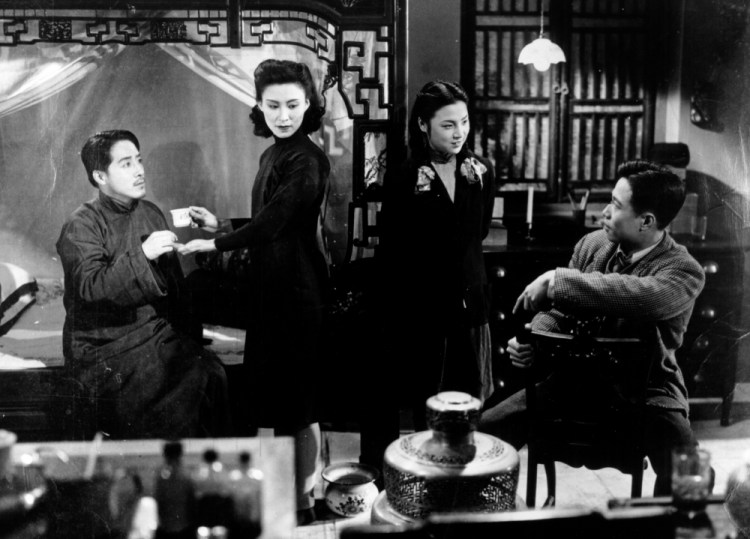
spring-in-a-small-town-1948-001-two-couples-in-the-householdReview of this Chinese lost classic up at UK Anime Network


Fei Mu’s Spring in a Small Town is often regarded as one of the great lost masterpieces of Chinese cinema. Completed in 1948, it stands on the borderline of China’s transformation into a communist state and ultimately paid the price for its “questionable” politics (or, indeed, lack of them). Fei like many at the time relocated to Hong Kong where he set up a production company but sadly died not long after at just 44 years of age and Spring in a Small Town became his final film. Based on a short story by Li Tianji, the film is a complex portrait of frustrated hopes and failed marriages against the backdrop of a society in rapid change.

Yuwen is a married woman who lives for her daily errands which take her out of the decaying house she shares with her invalid husband and his school aged younger sister. Her one pleasure in life is the solitary walk she’s accustomed to take along the ruined wall which leads into town. Her husband, Liyan, believes himself to be suffering from tuberculosis and confines himself to what remains of their estate and its once fine garden. The house is little more than rubble in places and bears the heavy scars of the war years on its un-repaired exteriors. One day, an old friend of Liyan’s, Zhang – a doctor, comes to visit. Unbeknownst to anyone, Zhang and Yuwen grew up in the same village and were, in fact, childhood sweethearts until time and circumstance forced them apart.

Shot through with Chekhovian melancholy resignation (but perhaps without his trademark sense of humour), Spring in a Small Town is a tightly wound character drama which uses the plight of its characters to deliver a much wider message. Yuwen narrates her inner life for us (a stylish device which anticipates the technique coming into its prime nearly twenty years later in the French New Wave), giving voice to thoughts that could never be expressed directly. Her unhappiness is the first thing that strikes the viewer along with the decayed grandeur of her surroundings. Having become more nurse than wife to a husband that she never loved, Yuwen has resigned herself to a life of morning walks and embroidery devoid of all stimulation. Zhang’s unexpected re-entry into her life spells both doom and salvation. Liyan suspects nothing and even sees Zhang as a potential match for his sixteen year old sister, Xiang! Zhang’s arrival threatens to throw a hand grenade into this delicately balanced yet unhappy household with long buried emotions slowly working their way to the surface.

Fei keeps the tension up by keeping a tight lid on the repressed emotions of the time. What could so easily have become an overwrought melodrama retains its emotional power precisely because of its naturalistic restraint. Spring in a Small Town has been described as “the Chinese Brief Encounter” and it certainly shares something of that film’s powerful emotional manoeuvring pushed through with a level of reserve many would consider typically British. Both films also resolutely reinforce the prevailing social order of the day where duty conquers all and properness comes before personal happiness. However, where Brief Encounter ends on a note of melancholic restoration, Spring in a Small Town dares to be a little more upbeat (if still just as melancholic) with a sense that spring may really have returned to these four people after a long and hard winter. The frost has finally thawed and new life can begin again.

It’s not completely clear what exactly the new regime found problematic about Spring in a Small Town though it’s certainly a long way from socialist realist cinema. The world it depicts is an upper class one with not a little sorrow over the decline of this once noble house and fretting about its legacy neither of which gel very well with communist party guidelines. Otherwise the film is fairly apolitical which would render it a little frivolous from their point of view but far from trivial in ours. Enormously influential since its rediscovery by the Fifth Generation filmmakers in 1980s, Spring in a Small Town is a gloriously melancholic character study that deserves to finally take its rightful place alongside finest romantic dramas the golden age of cinema has to offer.


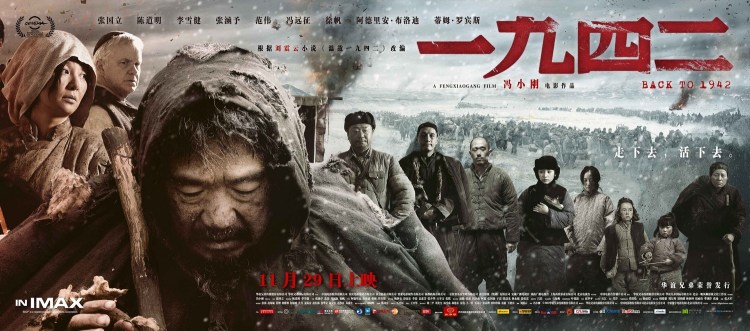
Back to 1942 (一九四二, Feng Xiaogang, 2012)

back-to-1942-poster08Review of this (slightly stodgy) war time starvation drama up at UK Anime Network.


Feng Xiaogang might not exactly be a household name in the West but at home he’s one of China’s most bankable directors. Dubbed the Chinese Spielberg (perhaps a little reductively) he made his name with a series of crowd pleasing comedy films that had audiences queuing ‘round the block in expectation. In recent years, he’s moved away from the comedy genre in favour of big budget, Hollywood style dramas centred around historical events like the 1976 Tangshan Earthquake in Aftershock or the Civil War themed Assembly. Back to 1942 sees him step back even further in time to one of China’s great hidden tragedies, the great Henan famine of 1942.

In 1942 China was in a precarious political position as it faced the ongoing Japanese incursion and came under increasing pressure to align itself with Japan’s enemies as part of the wider global conflict. A serious drought could not have come at a worse time as ever dwindling resources were pulled in several directions at once. The story here concerns the landlord, Fan, who had originally a sizeable grain store set aside to feed his family and retainers. However, after his village is raided by bandits he too is forced to travel westwards in hope of finding better supplies. Along with his wife, pregnant daughter-in-law, daughter and servant as well as another family from the village he faces increasing hardship as he tries to find food to survive. Meanwhile an American journalist employed by TIME magazine has got wind of the story and is trying to get something done about it but to no avail. The government has the war effort as its top priority – what does it matter if a few peasants die as long as the army remains well fed.

Politically speaking, you can get away with talking about ‘unpleasant’ historical events assuming that they happened before the communist revolution. The finger here is pointed quite squarely at Chang Kai-shek and his nationalist government who are portrayed not only as unfeeling and self interested but also as ineffectual when it comes to the business of conducting war with the Japanese. Indeed, at once point Chang suggests simply ceding Henan to the Japanese rather go to the expense of defending this barren stretch of land. Though it is clear he is aware of the extent of the famine, he does little about it until eventually sending “emergency supplies” to “the disaster area” to try and alleviate the damage to his reputation and diplomatic relations with other powers when news of the famine finally reaches them after the conflict. Though the local governor appears genuinely concerned and does his best to get help for the starving people (even if it’s only to alleviate the ridiculous burdens placed on them to supply grain for the army even though there is none) he is hamstrung by the top heavy hierarchical system.

No help is going to come from the government for Fan and his family. They might have been bigwigs once but now they’re in the same boat as everyone else – forced on a virtual death march through the arid land desperately trying to find anywhere that will yield to them the resources to survive. Bodies litter the landscape as the weaker succumb to starvation, donkeys and pack horses are eaten and finally wives and children are bought and sold in the hope of surviving a few hours more. Make no bones about it, Back to 1942 is almost two and a half hours of pure misery as one tragic yet inevitable event follows on the next. Unfortunately, Feng has laid the gloom on a little thick in this understandably bleak tale. The tone never wavers and somehow the constant nature of its sorrows fail to engage as they take on a sadly predictable air. Despite the obvious potential of the story, there’s precious little actual drama and the performances fail to capture the audience’s sympathies as Fan & Co. forced into increasingly degrading acts trying to ensure their own survival.

However, Back to 1942 was an expensive production and you can see all of that money on screen as the battle and action sequences rival those of any Hollywood blockbuster. Whatever reservations there may be with the plotting, it always looks good and you could never accuse it of skimping out on its production design. The only minor criticism may be that the performances of non-Chinese actors feel significantly under rehearsed with Tim Robbins’ priest being the obvious example as he struggles with a strange accent and unclear position in the narrative. Adrien Brody fares better as the idealistic reporter but still fails to convince. The film doesn’t quite seem to know where to put itself when it comes both to the role of religion and of other powers active in China at this time and though neither of those ideas are at the forefront of this film, they muddy the waters in ways other than intended by the filmmaker.
An often beautifully photographed film Back to 1942 is also a cold one and given its depressing subject matter something of a chore. The famine that struck the Henan region in 1942 and subsequent (non) reaction to it from the powers at be is indeed something that should be addressed and brought to light in the modern world but perhaps it doesn’t need to be in such a blunt fashion. The film is long, and wearing but ultimately fails to connect with the viewer in a non cynical way making its drawn out proceedings a little on the tedious side for most viewers. Those with a taste for sentimental melodramas with high production values may find a lot to enjoy with Back to 1942 but those who prefer a more nuanced drama will likely leave disappointed.