Killing (斬、, Shinya Tsukamoto, 2018)

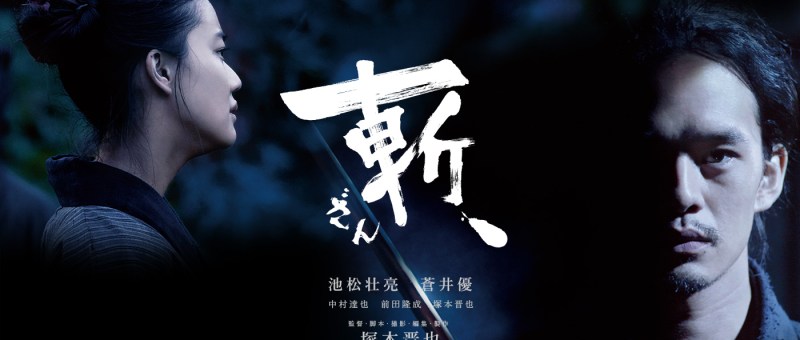
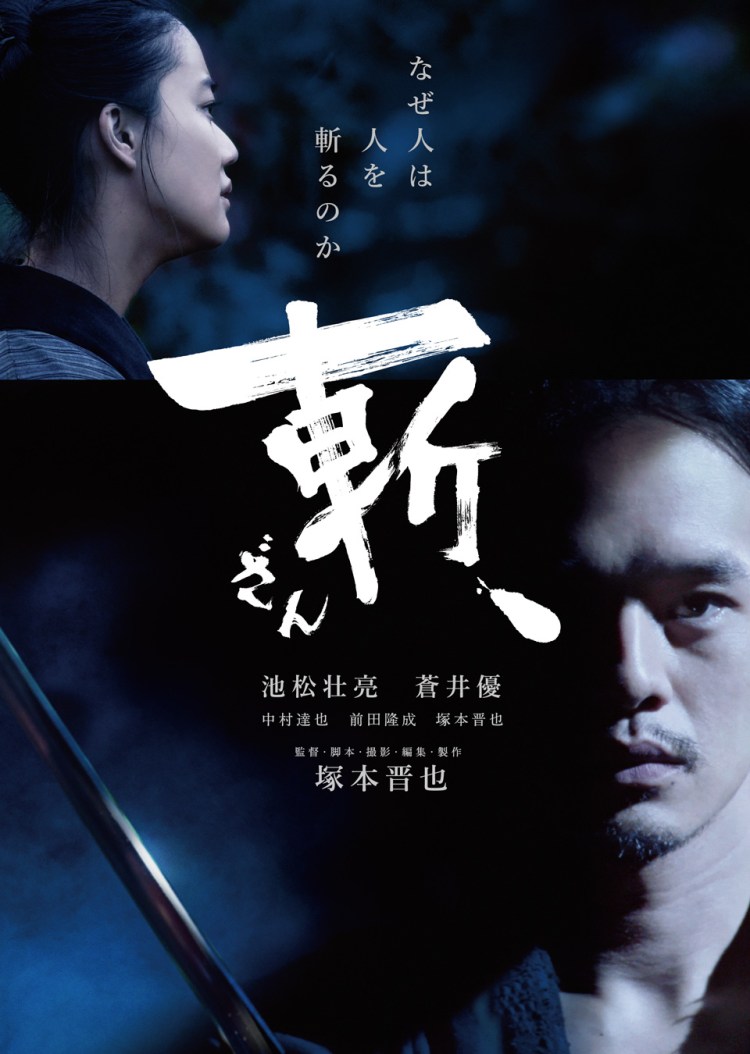
Killing posterOppressed peasantry abandoned by their lords and under threat of violence have only ronin to turn to – it’s a familiar, some might say even the archetypal, jidaigeki story. Forever the iconoclast, Shinya Tsukamoto makes his first foray into the world of the samurai, Killing (斬、, Zan,), in typically contrary fashion, turning the classic formula on its head as samurai “justice” brings only more chaos, blood, and terror to the otherwise peaceful fields of ordinary farmers in Bakumatsu-era Japan.

In return for food and lodging, Mokunoshin (Sosuke Ikematsu), a young masterless samurai, has been living alongside a village of kindly farmers who, while deferent to his status, are grateful to have him around because they are desperately short of hands. In addition to helping out with farm work, he’s also been sharing his sword skills with local boy Ichisuke (Ryusei Maeda) who has developed delusions of grandeur that he might one day be allowed to hold a sword of his own. Ichinosuke’s sister Yu (Yu Aoi), meanwhile, has become fond of the handsome samurai but is conflicted by his corruption of her brother with “samurai” values he can never hope to aspire to while she also must know that whatever she might feel nothing good can come of it because a samurai will not marry a farmer’s daughter.

The problems begin when twin threats descend on the village – first the appearance of cooler than ice ronin Sawamura (Shinya Tsukamoto) who wants to recruit Mokunoshin for his mission to support the rule of the Shogun in Edo and Kyoto, and the second a group of bandits hovering menacingly on the horizon but as yet doing no real harm. A pragmatist at heart, Mokunoshin prefers diplomacy to action and so he talks to the bandits and rates them as minimally dangerous as long as they’re treated fairly. Unfortunately, fairness is not what they get from hotheaded Ichisuke whose small conflict with them soon sparks into a conflagration when Sawamura starts wielding the sword of justice and doing it imperfectly, bringing yet more chaos down on all their heads.

Violence spreads like a virus contracted by the sword. A victim of his ideology, Sawamura sees his blade as his whole being and the embodiment of his right to act with honour and authority. He thinks the answer is to stamp out the bandits, whereas Mokunoshin knows there are always more than it first seems and to strike at them simply means there will never be an end to the petty tit for tat reprisals. His solution is to let it lie, but to Sawamura that simply looks like cowardice and dereliction of duty.

Despite the prevailing ideology of the world in which he lives, Mokunoshin is opposed to the idea of killing yet if pressed his reasoning is less humanistic pacifism than personal discomfort. Mokunoshin may be a samurai and a fine swordsman, but he has never killed and it seems is afraid to do so. He sees those around him whom he has come to love endangered but cannot act, refusing to raise his sword while the bandits do as they please with none of the existential confusion which cripples Mokunoshin’s ability to serve his own ideals. Rather than insist on an end to the rule of the sword, Mokunoshin resents himself for wishing he could kill as easily as Sawamura and be like the other men of his age.

Yu meanwhile looks on from the sidelines as the samurai code of violence tears her world apart and finally infects her too as she finds herself, far from pleading with him not to die as a substitute for asking him not to leave, insisting that Mokunoshin be the one to fix the mess he made by infecting her brother with a samurai’s lust for glory. Sawamura, meanwhile, becomes fixated on the notion of fixing Mokunoshin through a duel to death in which it is kill or be killed. He is prepared to die for his ideal and hopes that Mokunoshin will in the end choose his life over his soul and become the prized warrior for the Shogun that he knows he is destined to be.

Opening in flames as if to imply the sword is a weapon forged in hell, Killing centres itself not so much on the act but on its repercussions. The bandits too are a product of the inequalities of their times, and if they visually resemble the ragged soldiers of Fires on the Plain it is probably no accident. The code of violence spreads from one generation to the next with inexorable inevitability. Ending in a wail of despair, Killing finds little cause for hope in its relentlessly bleak conclusion which sees no release from the meaningless cycle of violence while humanity refuses to reject the cruel and oppressive social codes which fuel its existence.


Killing was screened as part of the 2019 Nippon Connection Film Festival.

Original trailer (no subtitles)
The Legend of the Stardust Brothers (星くず兄弟の伝説, Macoto Tezka, 1985)

Stardust Brothers poster 2More or less out of fashion today, concept albums were all the rage back in the ‘70s and ‘80s but few of them ever made it to the big screen. Macoto Tezka’s The Legend of the Stardust Brothers (星くず兄弟の伝説, Hoshikuzu Kyodai no Densetsu), apparently drawing inspiration from The Who’s Tommy, is a rare exception though you’d be forgiven for never having heard of it seeing as it’s been mostly forgotten since receiving a decidedly frosty reception from critics on its 1985 release. Tezka would revisit the Stardust Brothers in 2016 with a Brand New Legend, but this now fully restored “director’s cut” distributed by Third Window Films who are also co-producing Tezka’s latest work – an adaptation of a manga by his legendary father Osamu Tezuka starring Fumi Nikaido, is the first opportunity many will have to reappraise the film in 34 years.

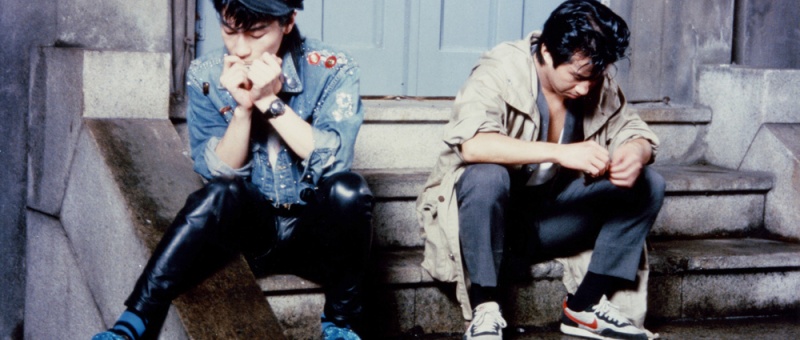
Inspired by an “imaginary soundtrack” composed by Haruo Chicada, The Legend of the Stardust Brothers concerns itself with aspiring musicians Shingo (Shingo Kubota) and Kan (Kazuhiro Takagi) who seem to have a healthy rivalry in the intense 1980s Japanese underground club scene. Their luck changes one day when they are each handed a card for a shady-looking management company, Atomic Promotion, where the manager, Minami (played by voice of the ’70s crooner Kiyohiko Ozaki), promises to make them stars beyond their wildest dreams but only on one condition – they have to form a band of two, or it’s no dice.

On their first arrival at Atomic Promotion, the boys are introduced to a young woman, Marimo (Kyoko Togawa) – an aspiring singer who has been repeatedly kicked out of Minami’s office because he doesn’t hire girls (seemingly a satirical reference to an all powerful agency controlling most of Japan’s A-list male idols). Kan comes to her rescue and, in a throwaway comment, casts himself as Urashima Taro rescuing the “turtle” from, in this case, belligerent security guards. It is tempting, in an impish sense, to read the rest of the ongoing tale as an extended retelling of the Urashima Taro myth as the boys find themselves catching a ride to another kingdom filled with untold wealth and unimaginable pleasure only to tire of their newfound luxury and discover that while they were trapped within a tiny champagne bubble of success other stars were also rising.

It is indeed the “plateau” of success which highlights the differences between the two guys and threatens to send each of them on different paths as they contemplate the demands of showbiz life. Shingo, an insecure rocker, begins to resent the presence of the ultra modern Kan whose punkish energy and zeitgeisty features have captured the hearts of the youth. Numbing the emptiness with drink and drugs, he dreams himself swallowed whole by his sworn brother before being chased by creepy zombies emerging from their human suits to suck whatever of his soul remains right out of him.

Bored by their fame, the boys resent the implication that their “stardom” comes only at the price of their artistic integrity. They long to break free of the corporate straightjacket which attempts to strip them of their individuality in order to replace it with a manufactured, marketable persona in another jab at the increasingly commodified idol world of the burgeoning bubble era. Meanwhile, the corporate machine moves on, mass media is exposed as yet another medium of propaganda with a (perhaps conflicted) Minami propositioned by a politician with a son keen to get into the business. Fearing the Stardust Brothers are too “vulgar”, the powers that be want a new face to sell the message of love and peace to the young, which sounds much more positive than it really is. The boys’ rival, Kaworu (visual kei pioneer Issay), is very much a figure of the age – an androgynous, Bowie-like counter culture personality who is in essence the face of entrenched privilege insidiously camouflaged to infiltrate alternative youth subculture. 

Yet the political message is not perhaps the point so much as anarchic, absurdist fun. Perfectly in tune with lo-fi late punk / early New Wave sensibilities, Tezka’s script freewheels from one surreal set piece to another following the flow of Chicada’s expertly composed score which encapsulates the variety of the age while remaining absolutely of its time. Filled with youthful energy and true punk spirit, The Legend of the Stardust Brothers is the strange tale of the dust that stars are made on and its unexpected ability to find its way home even if it takes a little longer than expected.


The Legend of the Stardust Brothers is released on blu-ray later in the year courtesy of Third Window Films. It will also be screened as part of the 2019 Nippon Connection Film Festival on 1st June, 22.30.

Trailer (English subtitles)

Bonus:

Kiyohiko Ozaki’s 1971 hit Mata Au Hi Made

https://www.youtube.com/watch?v=Jmo33gyKgaw

And its fantastic use in Isshin Inudo’s La Maison de Himiko

Melancholic (メランコリック, Seiji Tanaka, 2018)

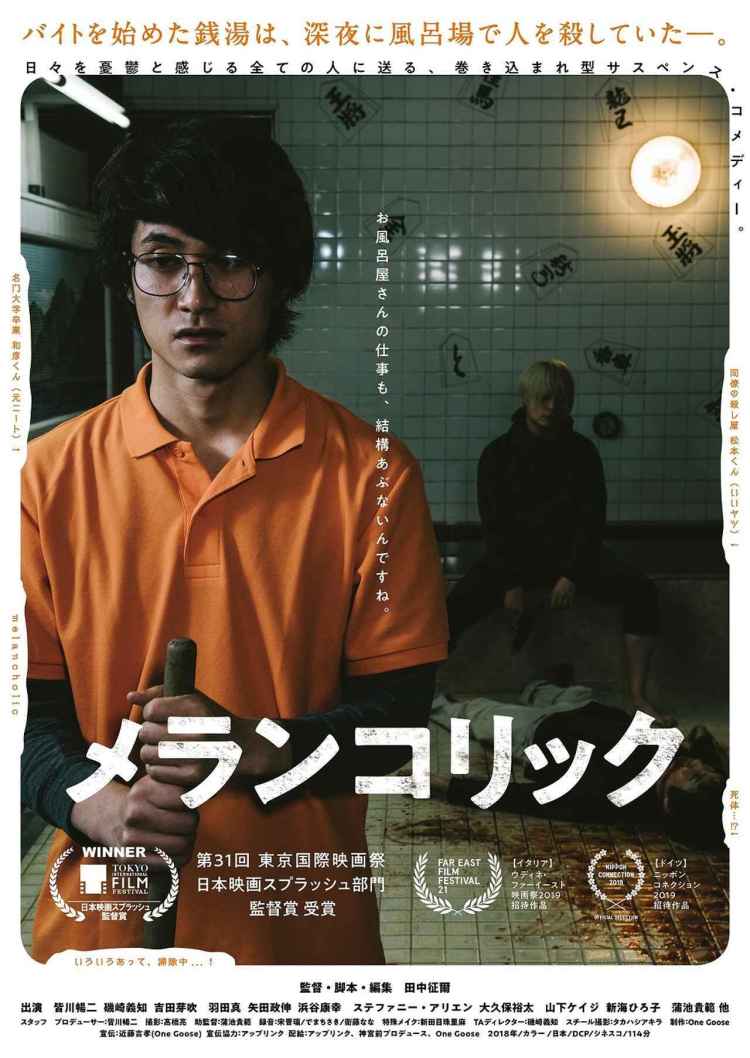
Melancholic posterJust because you’re smart and graduated from a top university, does that necessarily mean you have to put on the salaryman straitjacket in order to become “a success”? The dejected hero of Seiji Tanaka’s Melancholic (メランコリック) isn’t quite so sure, but then he’s always been the type to amble through life going wherever the wind blows him. The time is about to come, however, when decisions must be made and priorities decided lest someone else decide them for you.

Kazuhiko (Yoji Minagawa) graduated from Tokyo University but he’s never been in full time employment and has no definite career plans. Still living at home with his parents, he floats between part-time jobs with little sense of forward motion while his mum and dad are content to let him find his way, if a little exasperated. On a rare visit to a public bathhouse he ends up running into an old high school classmate, Yuri (Mebuki Yoshida), who half-jokingly advises he apply for the open job at the baths seeing as it’s bound to be less stressful than your average salaryman gig. Smitten but too awkward to do much about it, Kazuhiko applies for the job and consents to go to a school reunion as a means of seeing Yuri again. Much to his surprise, however, the bathhouse has a second life as a yakuza kill room with on site body disposal facilities.

Asking questions about what goes on at the bathhouse after dark, Kazuhiko’s boss Azuma (Makoto Hada) tells him that it’s dangerous to know things you aren’t supposed to know, but Kazuhiko is not good with hints and his natural curiosity won’t it let it rest. After he finds out about the secret yakuza backroom deal, Kazuhiko has a “difficult” choice to make – elect to help out with the “night shift”, or die. Kazuhiko chooses to help out (he likes being helpful) and discovers that he actually doesn’t mind it all that much, especially considering the “bonus” package Azuma gave him for being a good boy.

The extra money made Kazuhiko feel as if he could grasp that swanky salaryman life without having to submit himself to the rat race. He uses the money to take Yuri to a fancy French restaurant where he’s flummoxed by the wine list and she’s uncomfortable, but still it goes well even if they both resolve to go somewhere more casual next time. Kazuhiko’s inferiority complex is only enflamed by the lingering presence of Tamura (Yuta Okubo), another old classmate made good, who is also interested in Yuri and is everything Kazuhiko feels himself not to be – handsome, successful, filthy rich, cultured, and confident.

Being allowed in on the after hours business made Kazuhiko feel as if he’d been promoted, that Azuma obviously trusted him and that there might be more overtime coming if he played his cards right. His confidence receives a further knock, however, when he realises that a punkish colleague who joined at the same time as him, Matsumoto (Yoshitomo Isozaki), is technically in a more senior position despite being a barely literate drop out with bleach blond hair. In way over his head, Kazuhiko still desperately wants to regain some of that status and approval he felt was his when the cleanup business was their little secret.

An awkward, naive, but sincere man, Kazuhiko marvels on realising how many yakuza seem to be “around” before Azuma and Matsumoto remind him that not everyone involved with crime is a bona fide yakuza. The bathhouse outfit is, more or less, run by freelancers but still at the mercy of mob boss Tanaka (Masanobu Yada) who has an iron hold over Azuma because of outstanding debts. Azuma would like to put a stop to the night shift, but can’t – or so he claims. As is later pointed out, for those getting on in years an unsatisfying status quo is often preferable to a turbulent new. Though Kazuhiko has no real objection to working the night shift as far as the clean up goes, he is not completely comfortable with its wider implications, often asking why it was someone had to die only for Matsumoto and Azuma to shrug and say it doesn’t matter. They had orders and carried them out, anything else is an irrelevance they don’t need to worry about.

Kazuhiko, however, does worry if in a fairly minor way until his gradual descent into the world of crime drags him into a vicious quagmire in which he must accept the seriousness of his situation along with its potential costs. Despite the original animosity and natural sense of distrust, what wins out is a sense of fellow feeling between unlikely allies Matsumoto and Kazuhiko who begin to see a way out of their mutual malaise through seizing their own futures and daring to pin their hopes on things they assumed unattainable, like love and friendship. Rather than chasing the salaryman dream, or climbing to the top of the yakuza tree, they pick an ordinary kind of “good enough” success in which moments of warmth and togetherness become the only things which give life meaning. A surreal ode to just muddling through and learning to be happy in the moment, Melancholic more than lives up to its name but despite all the darkness eventually finds real joy in the easy pleasures of mediocrity and mutual acceptance.


Melancholic was screened as part of the 2019 Udine Far East Film Festival. It will also be screened at the 2019 Nippon Connection Film Festival where director Seiji Tanaka and actor Yoshitomo Isozaki will be present for a Q&A.

Original trailer (English subtitles)

Ten Years Japan (十年 Ten Years Japan, Chie Hayakawa, Yusuke Kinoshita, Megumi Tsuno, Akiyo Fujimura, Kei Ishikawa, 2018)

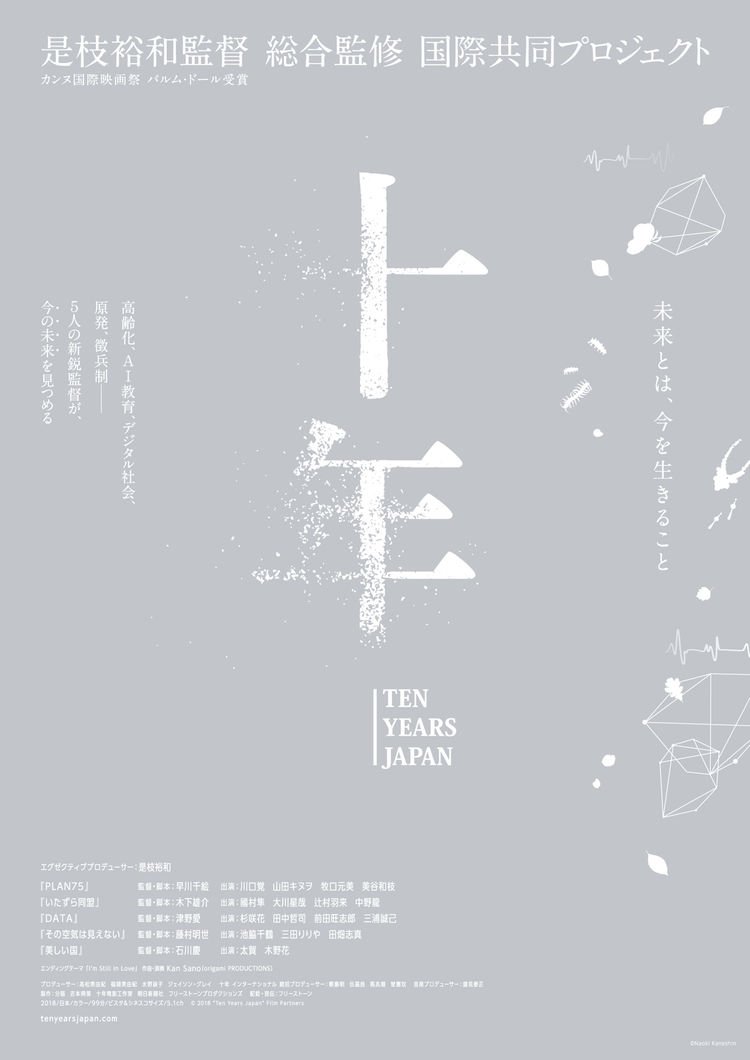
Ten Years Japan posterBack in 2015, five aspiring Hong Kong filmmakers came together to present a collection of shorts speculating on the fate of their nation in 10 years’ time. Coinciding with if not directly inspired by the Umbrella Movement, Ten Years was a deliberately political project which tapped into the nation’s unique preoccupations almost 20 years on from the end of British rule and a little more than 30 before One Country, Two Systems expires. The film proved an unexpected box office hit and has gone on to become an unconventional franchise with a host of other Asian nations creating their own omnibus movies musing on what may or may not have occurred in a decade’s time.

Unlike the original Hong Kong edition, Japan’s vision (十年 Ten Years Japan) is decidedly less political, perhaps reflecting a greater level of stability. Nevertheless, taken as a whole there are a number of recurrent themes running through each of the segments from the ageing population to the increasing power of the state and the dark possibilities of technology.

In Chie Hayakawa’s Plan 75, the first and darkest of the shorts, a conflicted salaryman (Satoru Kawaguchi) makes his living selling the titular “retirement” plans to those who have reached the age of 75 and decided enough is enough. Japan’s population is ageing faster than any other and caring for the elderly has placed a significant strain on the young. The old and infirm are therefore encouraged to think of themselves as burdensome, that they should do the decent thing and relieve the pressure on their loved ones by going gracefully at the right time. So far so Ballad of Narayama, but age isn’t quite the issue – the rich are excluded because they’re still spending their money and therefore economically useful. The government would rather roll out the invitations to the “unproductive”.

Ironically enough, a little girl who wants to be a vet in Yusuke Kinoshita’s Mischievous Alliance is advised to become a doctor instead and specialise in elder care which is in fact a growth industry. Unlike the elderly in Plan 75, the kids of Mischievous Alliance are not quite so willing to sit back and conform despite being fitted with invasive headsets connected to a monitoring program which “corrects” their bad behaviour whenever they try to break the rules. The hero rejects his oppressive schooling by self identifying with a stabled horse previously used for medical experimentation, longing to run free if only for a few moments.

If the “promise” system at the centre of Mischievous Alliance presented a vision of a future in which privacy and individual agency have all but disappeared, Data asks us if we have the right to reconstruct someone’s identity after they’ve gone by examining their digital footprint. A high school girl (Hana Sugisaki) tries to adjust to the idea of her widowed father’s (Tetsushi Tanaka) new girlfriend by opening up her mother’s “digital inheritance” but learns more than her mother might have wanted her to know. High school videos and pictures of old boyfriends jostle with beautiful flowers and private anxieties, but when it comes right down to it the organic memories are the only ones that count and the only things to make sense of the cluttered imagery in an uncurated personal museum of random digital moments.

Youth’s desire for knowledge and freedom is also at the heart of Akiyo Fujimura’s The Air We Can’t See which is the only one of the shorts to address nuclear anxiety in the post-Fukushima world. After some kind of event has made the surface uninhabitable, humanity has survived underground. A curious little girl, however, is fascinated by the idea of the outside. Longing to hear the birds and feel the rain, she imagines herself an exterior world but also comes to wonder if her home is a kind of prison born of fear and maybe it’s all alright up top if only you have the courage to look.

Meanwhile the apocalypse is still a little way off in Kei Ishikawa’s For Our Beautiful Country which hints obliquely at the growing threat of North Korea as missiles fly overhead with increasing frequency. The references, however, are older. A cynical ad man (Taiga) oversees a campaign promoting Japan’s remilitarisation but is later charged with letting the elderly, eccentric graphic designer (Hana Kino) know her poster is being “substituted” with something more “powerful”. After spending the day with her and coming to understand the subtle act of rebellion which has made her poster unusable for its propaganda purposes, the ad man gets a new a mission. It’s all up to the young now who have both an opportunity and a duty to ensure their country does not fall into the same kind of ugliness that sent young men off to die in the name of beauty.

Bookending the piece, Hayakawa and Ishikawa present the bleakest visions in which the descent into cruel authoritarianism may have already passed the point of no return. The children, however, seem to disagree and universally turn away from oppressive social codes, preferring to find their own truths and committed to exploring their own freedoms. Ten Years Japan may shed the overtly political overtones of its Hong Kong inspiration but finds brief rays of hope in the midst of despair in a child’s ability to break the programming and strive for a better, fairer world free of adult duplicity.


Screened as part of the 2018 London East Asia Film Festival.

Original trailer (no subtitles)

Being Natural (天然☆生活, Tadashi Nagayama, 2018) [Fantasia 2018]

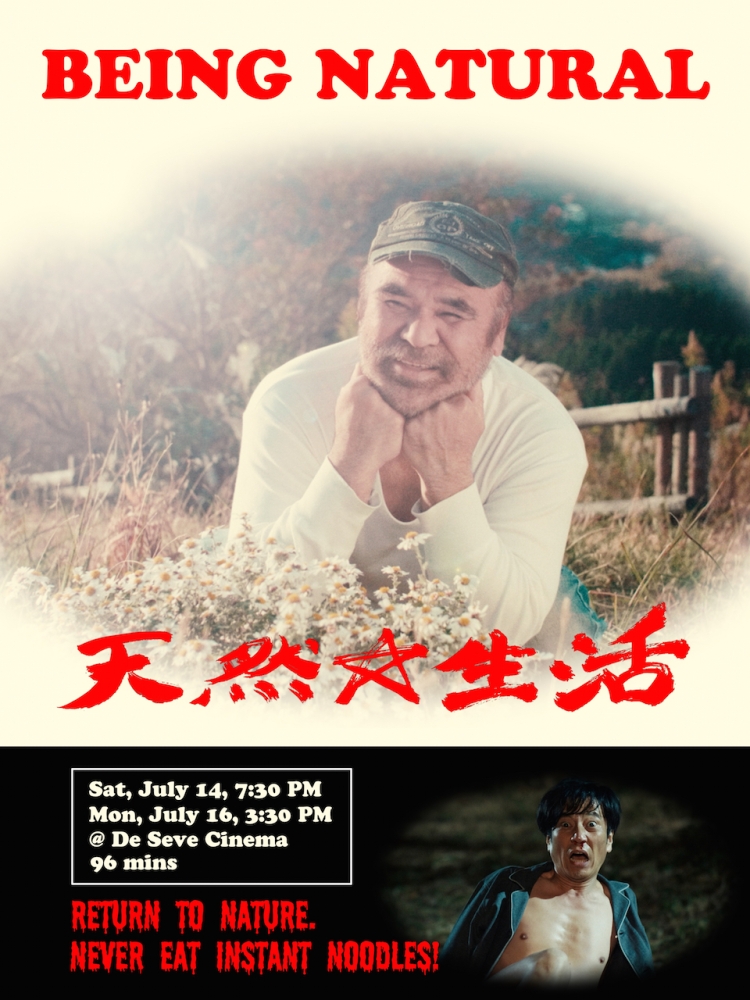
Being Natural posterModern life is stressful and perhaps does not offer the kinds of material rewards that previous generations took for granted. Moving back to the country to experience a simpler, more sincere kind of life has become a mini trope in contemporary Japanese cinema as the young men and women of Japan become disillusioned with a stagnating economy and, feeling trapped within a conformist society, decide to embark on a life of self sufficiency free of material burdens. What such stories have not yet asked is if the influx of outsiders from the city amounts to a colonisation of so far untouched land as the newcomers bring with them their newfangled desires and attitudes. Tadashi Nagayama’s gentle satire Being Natural (天然☆生活, Tennen Seikatsu) is partly an attack on rampart xenophobia and small scale colonialism but also a mild condemnation of corporatised hippiedom and its tendency to destroy the thing it claims to honour in remaking it to fit a city dweller’s ideal of idyllic country life.

Shy and awkward, Taka (Yota Kawase) is an unemployed middle-aged man who lives with his elderly uncle in the ancestral family home. Taka’s uncle suffers from dementia and, it seems, was always a “difficult” person even in his youth which is perhaps why the rest of the family have abandoned him with only the gentle Taka prepared to stay behind and look after the ageing patriarch. When his uncle dies, Taka’s world threatens to collapse but thankfully his embittered cousin Mitsuaki (Shoichiro Tanigawa) is talked round by his sister and decides to let Taka stay in the family home as a thank you for taking care of everything for so long. Not only that, Mitsuaki also gets Taka a job working at the local fishing pool alongside another old friend, Sho (Tadahiro Tsuru).

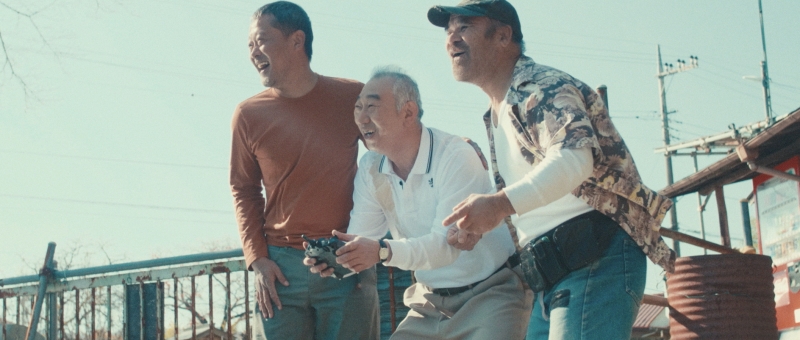
Reverting to childhood, the three men generate an easy camaraderie, looking after turtles, having barbecues, and making music together under the moonlight. The idyllic days are not to last, however. The harbingers of doom are a hippyish family from Tokyo who moved into the village with the intention of opening a coffee shop. The Kuriharas – Keigo (Kanji Tsuda), his wife Satomi (Natsuki Mieda), and daughter Itsumi (Kazua Akieda), are into the “natural” way of life and have moved from Tokyo for the benefit of their health. Rather than shop at the supermarket like everyone else, they’re keen to buy from Sho’s grocery store even when he explains to them that all his veg is old and shrivelled rather than freshly plucked from local fields. Still, the family are determined even if it means projecting their vision of “rural life” onto the evident reality.

The Kuriharas are literally intrusive – rudely opening the sliding doors of Taka’s house without permission and waking him up, offering the excuse that they were unable to find the “intercom” on this traditional Japanese house that they claim to admire so much. The original site having fallen through, they’ve set their sights on setting up shop in Taka’s home, exploiting the “traditional” architecture for their warm and welcoming cafe. This is all very well but it does of course mean displacing Taka from his natural habitat. As shy and mild mannered as he is, there’s only so much a man can take and Taka resents being evicted from his family home by a bunch of invading interlopers with commercial concerns.

While Satomi natters on about organic veg, Itsumi skips the English classes her controlling mother makes he go to and guzzles additive loaded instant ramen when she thinks no one’s looking. Wanting to preserve the “natural beauty of glorious Japan”, Keigo goes slightly nuts when he realises Taka’s pet turtles are a non-native breed, exploding with xenophobic fury over the dangerous presence of a disease laden predator whose presence threatens the safety of the true Japanese amphibian. Wondering exactly who or what is the “non native” threat, Taka launches a full scale resistance movement, papering the house in giant graffiti posters reminiscent of the student protest era reminding all that turtles, no matter where they’re from, have a right to life too and must be defended. Yet the corporately minded hippies will stop at nothing to get what they want – manipulating Mitsuaki with a new girlfriend and then turning the town against Taka by means of a heinous, life ruining rumour. 

Forced out and heading to the city, Taka is reminded that he is now the hostile foreign element – that the park is not his “home” but belongs to “everyone”. When his beloved bongos are ruptured, Taka’s rage turns radioactive and sends him off on a quest of vengeance only to recede as his better nature regains control and he commits himself to using his new found powers to improve the lives of those around him in small but important ways. A satirical take on the romanticisation of country life by self-interested city dwellers, Being Natural eventually takes a turn for the macabre that possibly undercuts rather than reinforces some of its central concerns but makes a case for according the proper respect to the natural world as well as the people who live within it rather than attempting to exploit it for oneself whilst wilfully ruining it for others.


Being Natural received its international premiere at Fantasia International Film Festival 2018.

Original trailer (English subtitles)