Yocho (Foreboding) (予兆 散歩する侵略者, Kiyoshi Kurosawa, 2017)

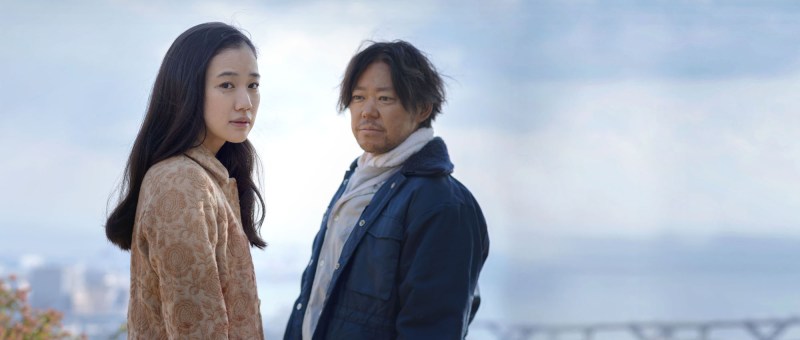
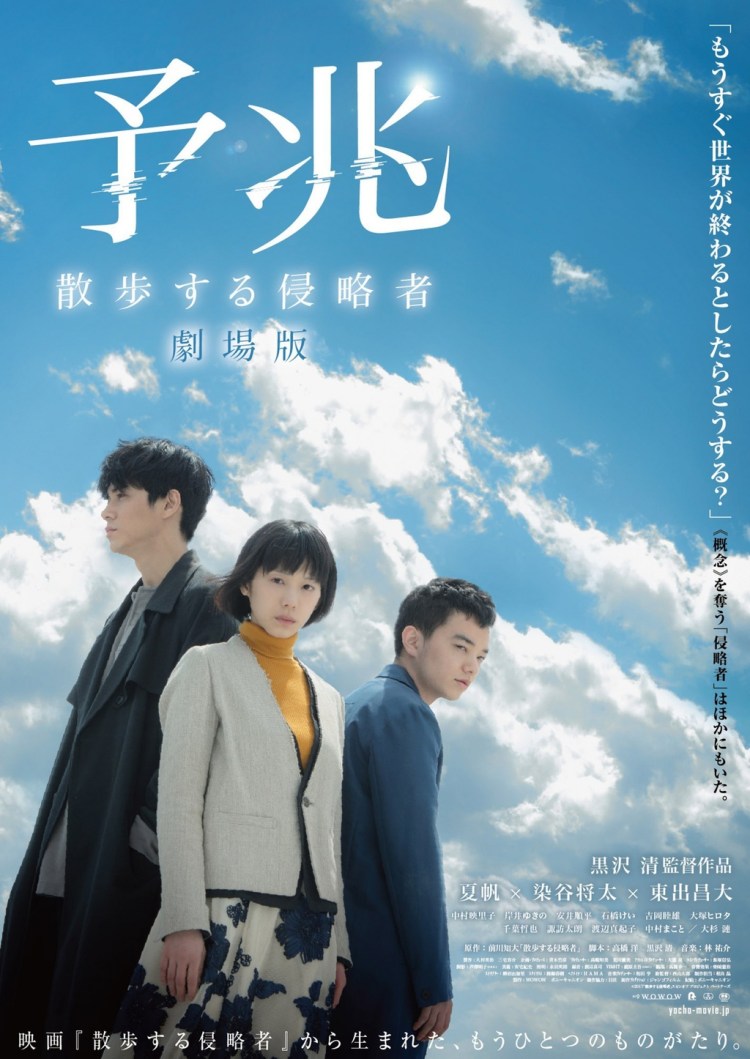
Yocho posterBefore We Vanish, Kiyoshi Kurosawa’s take on the alien invasion drama, was an oddly romantic affair which made a case for the ineffability of love as the only possible form of human salvation. Meanwhile, cheating on cinema with television, Kurosawa tells us a different story. Yocho (Foreboding) (予兆 散歩する侵略者, Yocho: Sanpo Suru Shinryakusha) was first conceived as a TV drama running as a companion piece to the big screen experience but its canvas is noticeably darker. At heart, we have the same story with a slight variation as a bold wife attempts to save her weak willed husband from alien manipulation, risking all to keep him safe him while the world burns around her. What we see this time is less the enduring power of love as a force for good, than yet another form of human weakness which encourages selfishness and creates a space into which nefarious forces may move.

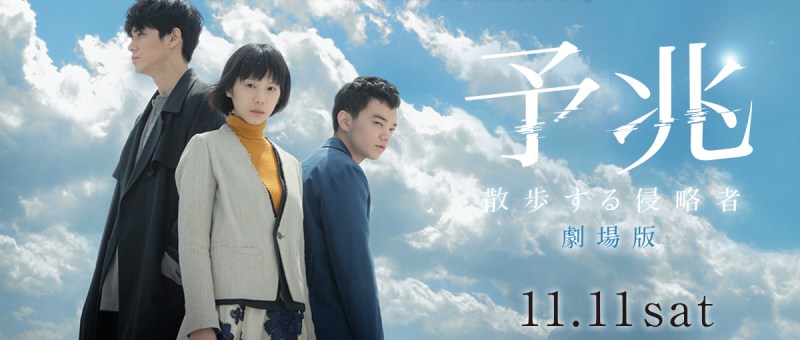
In contrast to Masami Nagasawa’s conflicted, wounded wife of Before we Vanish, Etsuko (Kaho) is happily married to Tatsuo (Shota Sometani) who works at the local hospital. As she loves her husband so much, Etsuko is quick to realise there’s something not quite right in the way he’s been silently gazing off into space and walking around like a man possessed. Meanwhile, she’s accosted by a friend at work who asks to stay over because she’s too afraid to go home on account of “the ghost”. Eventually Etsuko goes investigating and discovers “the ghost” is really just her friend’s dad only her friend seems to have forgotten all about him and doesn’t quite understand what a “father” is anymore. Fearing the worst, Etsuko arranges to take her to the hospital, which is where she comes into contact with the strange and intimidating Dr. Makabe (Masahiro Higashide).

Dr. Makabe is one of the alien invaders seen in Before We Vanish who have come to Earth on a scouting mission ahead of its destruction. His mission is to steal “concepts” from people’s heads so the aliens can catalogue soon to be extinct humanity. Makabe has recruited Tatsuo to be his guide but this is a very different arrangement to that Shinji makes with his “wife” Narumi. Tatsuo is not so much an interpreter as an informant. His “job” is to select Makabe’s “victims” in return for preferential treatment when the apocalypse arrives. Increasingly conflicted in betraying his own species, Tatsuo is going slowly off the rails while the world disintegrates all around around him.

Etsuko, meanwhile, has a kind of superpower of her own in that she is apparently “immune” to alien interference. They can’t take concepts from her, they can’t manipulate her will, and they can’t break her bond with her beloved (if slightly useless) husband. The power of love still reigns supreme but this time it’s not entirely a good thing as Etsuko, who has the means to resist the evil invaders, focusses on rescuing her one true love rather than defending humanity. Love is her weakness, whereas Tatsuo’s seems to be a low lying resentment of his lack of authority. A showdown with Makabe sees him offer a grim prognosis, as long as humans lust for power there will be no escape.

Makabe, meanwhile, has experienced the opposite revelation to his Before we Vanish counterpart in learning about death and human fear of mortality. Suddenly knowing what it means to die, he understands something of human existence, realising that death is forever beside you. Love maybe be the cure for “eternal loneliness”, but Makabe’s enlightenment is born of fear and darkness rather than human warmth.

Yocho, in a sense, mirrors Before We Vanish but in a darker hue. Etsuko and Tatsuo maybe a “happier” couple than Shinji and Narumi, but Tatsuo has already crossed to the dark side, abandoning his humanity and committing heinous and unthinkable acts on behalf of his alien master out of fear and desire. Makabe, taking Tatsuo to task, points out his weakness in his need for painkilling drugs to overcome the punishment Makabe has handed down for his betrayal. Humans, he says, always choose the comforting lie over the painful truth, swallowing pain killers rather than killing the pain by dealing with its root cause. This is in a way what Etsuko has chosen to do in her quest to save Tatsuo rather than using her skills to resist the alien invasion, though Makabe remains oddly fascinated by her various unusual qualities. Foreboding fills the frame as Etsuko meditates on the various oddities of her world while the skies thunder behind her, sending curtains billowing ominously in the absence of wind. A wounded Makabe ironically remarks that he has “underestimated the power of love”, reminding us that the greatest of human strengths is also its weakness, promising destruction as much as salvation.


Screened at the 20th Udine Far East Film Festival.

Original trailer (English subtitles)

https://www.youtube.com/watch?v=9_vEqvtUdxM

One Cut of the Dead (カメラを止めるな!, Shinichiro Ueda, 2017)

One Cut of the DeadYou know how it is – you turn up to make a low budget zombie movie in a disused water filtration plant apparently once used by the military for dodgy human experimentation and a load of real zombies suddenly turn up to join the fun. Then again, at least zombies don’t have over protective managers hovering on the sidelines or require catering services so in some ways they are the perfect extras. The debut feature from Shinichiro Ueda, One Cut of the Dead (カメラを止めるな!, Camera wo Tomeru na!) is a clever bait and switch, opening with a frenetic low budget zombie chase sequence before cutting to behind the scenes where just about everything is going hilariously wrong.

As the film opens, an actress is in the middle of the 42nd take of a scene in which she is attacked by her zombified boyfriend when the director yells “cut” and begins berating her for her non-existent acting skills before storming off in a huff. The actress, the boyfriend, and the makeup artist whose many hobbies include women’s self defence are enjoying a cup of coffee when a bunch of real zombies suddenly show up with murderous intent. All shot in one cut, the 40 minute chase sequence is a celebration of all things zombie with appendages flying off with gay abandon as blood soaks the screen and our plucky heroine ends up somehow in the middle of a pentagram painted on a rooftop.

Viewers who aren’t paying attention and attempt to leave after “credits” roll will be doing themselves a huge disservice – this high impact opening has been something of a ruse to take us into the real meat of the drama in the zany backstage antics in which just about everything is going just about as wrong as it could possibly go. It turns out “One Cut of the Dead” is a one camera one cut TV special made to launch a brand new zombie channel. Our director, Higurashi, who played “The Director” in One Cut, has found himself at the helm because no one else would take on such an outrageous proposal and, unlike his onscreen counterpart, is too kind and mild mannered to say no.

Higurashi’s career has perhaps become zombified in itself. The producers have chosen him for his ironic slogan – “Fast, cheap, but…average”, and he’s made his way in the minor TV film biz by keeping his head down and just getting on with the job even when it’s as “inconsequential” as a reconstruction sequence for cheesy TV news item. The chance to direct a drama is then an exciting one even if it’s for an equally cheesy TV horror show with a gimmick that’s doomed to fail.

Thus he finds himself on set with a pair of idols – she constantly worrying about what her agency will say to the various problems presented by being in a zombie movie, and he constantly rude and arrogant. Meanwhile, a previous acquaintance of Higurashi’s set to play the cameraman has a serious drink problem, the actor playing the boom operator has a series of digestive issues, and the woman playing the makeup artist is in a car accident with the man playing the director just a couple of hours before the camera rolls. Improvising wildly and making fantastic use of a set of cue cards, Higurashi manages to keep it all together despite the ensuing chaos.

The real genius of the film lies in the cleverness of the original bait and switch. The aesthetic of the zombie sequence is pure low budget horror with noticeably low grade camera quality and deliberately iffy special effects. On the first pass through there are several moments that look like shoddy direction – Higurashi talks to the cameraman who isn’t supposed to be there, the three actors witter on about nothing, the actress continues screaming for way too long etc but each of these mini moments loops back perfectly into the second half farce in which the crew is desperately trying to overcome several obstacles at once and keep the camera rolling to get through the 30-minute live broadcast without anyone noticing.

In the background, Higurashi is also facing some minor family drama with his grown up daughter who wants to direct but needs to work on her people skills. Her keen eye for detail and youthful ingenuity eventually helps the crew figure out a way to keep going, but in the end it’s teamwork that sees them through as they learn to overcome their differences and work together to get what they need. Hilarious, self aware, and filled with homages to classic horror, One Cut of the Dead is an oddly warmhearted comedy in which the zombies are the least of anyone’s worries.


One Cut of the Dead received its international premiere at the 20th Udine Far East Film Festival and will be released in the UK by Third Window Films later in the year.

Original trailer (English subtitles)

The Name (名前, Akihiro Toda, 2018)

b5_ol

Names are a complicated business. Most people do not choose them for themselves, yet they come to define an identity or at least provide a substantial peg on which to hang one. If you give someone a fake name you are by definition shielding your essential self from view, refusing connection either in fear of discovery or intention to harm. The protagonist of Akihiro Toda’s The Name (名前, Namae) adopts several different titles as a part of his increasingly disordered everyday life in which he takes a hammer to his original identity in an ongoing act of guilt-ridden self harm. Meanwhile, his teenage would-be saviour, engages in a little role play of her own hoping to discover an essential truth about herself only to be disappointed, in one sense, and then perhaps find something better.

Masao Nakamura (Kanji Tsuda), if that is his real name, is not just leading a double life but is currently engaged in a number of iffy scams each compartmentalised under a different title and in which he plays an entirely different version of himself. Once a successful businessman, personal tragedy, marital breakdown, and bankruptcy have left him a floundering, cynical mess living in a rundown rural hovel with a pernickety neighbour and a decidedly lax approach to housekeeping. Masao’s main “job” appears to be working in a recycling plant where he’s managed to wangle a preferential contract by telling the higher-ups that his (non-existent) wife is seriously ill in hospital. Just as Masao’s scheme is about to be discovered, a mysterious teenage girl suddenly appears out of nowhere and plays along with Masao’s sob story, claiming to be his daughter come to remind him that he needs to leave earlier today because mum has been moved to a different hospital (which is why his boss’ contact had never heard of her).

Emiko Hayama (Ren Komai), as we later find out, is a more authentic soul but has decided on a brief flirtation with duplicity in observing the strange and cynical life of the morally bankrupt Masao. Facing similar issues but coming from the opposite direction, the pair meet in the middle – regretful middle-age and anxious youth each doing battle with themselves to define their own identities. Like Masao, Emiko is also living in less than ideal circumstances with her bar hostess single-mother, forced into adulthood ahead of schedule through the need to take care of herself, purchasing groceries, cooking, and keeping the place tidy. Thus her approach to Masao has, ironically enough, a slightly maternal component as she tries to get him back on his feet again – cleaning the place up and giving him something more productive to do than wasting his idle moments in bars and other unsavoury environments.

Masao’s current problems are perhaps more down to a feeling of failure rather than the failure itself. Once successful, happily married and excited about the future, he felt it all crash down around his ears through no real fault of his own. Nevertheless he blamed himself – his intensive work ethic placed a strain on his relationship with his wife and his all encompassing need for success blinded him to what it was that really mattered. By the time he realised it was already too late, and so it’s no surprise that he longs to escape himself through a series of cardboard cutout personalities, enacting a bizarre kind of wish fulfilment coupled with masochistic desire for atonement.

Now cynical and morally apathetic, Masao lets Emiko in on a secret about the grown-up world – it’s all lies. You have to put on disguise or two to get by; the world will not accept you for who you really are. Teenage girls might know this better than most, though Emiko is a slow learner. She might tell Masao that pretending to be other people is fun, but the one role she hasn’t yet conquered is that of Emiko Hayama – something which particularly irritates the demanding director of the theatre club she’s been cajoled into joining. Like Masao, Emiko’s life begins to fall apart through no fault of her own as she finds herself swallowed up by a typically teenage piece of friendship drama when her best friend’s boyfriend dumps her in order to pursue Emiko. Branded a scheming harlot and ejected from her group of friends, berated by the director of the theatre troupe, and having no-one to turn to at home, Emiko finds herself increasingly dependent on the surrogate father figure of Masao who is happy enough to play along with the ruse so long as it is just that.

Through their strange paternal bond, Emiko and Masao each reach a point of self identification, figuring out who it is they really are whilst facing the various things they had been afraid to face alone. Lamenting missed opportunities while celebrating second chances, The Name makes the case for authenticity as a path to happiness in a world which often demands its opposite. Melancholy but gently optimistic, Akihiro Toda’s peaceful drama is a heartwarming tale of the power of unexpected connection and the importance of accepting oneself in order to move into a more positive future.


Screened at the 20th Udine Far East Film Festival.

Tremble All You Want (勝手にふるえてろ, Akiko Ohku, 2017)

tremble all you want posterShojo manga has a lot to answer for when it comes to defining ideas of romance in the minds of its young and female readers. The heroines of Japanese romantic comedies are almost always shojo manga enthusiasts – the lovelorn lady at the centre of Christmas on July 24th Avenue even magics herself into a fantasy Lisbon to better inhabit the cute and innocent world of a manga she loved in childhood. The heroine of Tremble All You Want (勝手にふるえてろ, Katte ni Furuetero), Yoshika (Mayu Matsuoka), does something similar in creating an alternate fantasy world filled with intimate acquaintances each encouraging and invested in her ongoing quest to win the heart of a boy she loved in high school who became the hero of her personal interest only manga, The Natural Born Prince.

At 24 Yoshika is still obsessed with “Ichi” (Takumi Kitamura) who is forever number “One” in her affections. Working as an office lady in the accounts department, Yoshika’s fingers tip tap over the calculator all day long until she can finally go home and read about her favourite topic, extinct animals, on the internet before it’s time to head back to work. Because of her undying love for Ichi (whom she has not seen or heard from in many years), Yoshika has never had a boyfriend or engaged in “dating” – something which causes her a small amount of anxiety and embarrassment when considering the additional awkwardness of starting out at such a comparatively late age.

Yoshika’s dilemma reaches a crisis point when, much to her surprise, a colleague becomes interested in her. Kirishima (Daichi Watanabe), whom she rechristens number “Two”, is, like her, slightly shy and bumbling but also outgoing and with a need to say things out loud. Seeing as this is apparently the first time this has ever happened to Yoshika, she finds it very confusing – not least because she can’t decide if “dating” Kirishima is a betrayal of Ichi or if she is really ready to leave her Natural Born Prince behind.

The dilemma isn’t so much between man one and man two but between fantasy and reality, idealism and practicality. Yoshika, painfully shy, lives in a fantasy world of her own creation as we discover during a tentative, emotionally raw musical number in which she is forced to confront the fact that the reason she doesn’t know the names of any of the people we’ve seen her repeatedly engage with is that, despite her longing and her loneliness, she has never been able to pluck up the courage to actually speak to them. Thus they exist in her head as a series of nicknames, theoretical constructs of “friends” with whom to engage in (one-sided) conversations – a frighteningly relatable (if extreme) concept to the painfully shy. Deprived of her fluffy fantasy, Yoshika arrives home to collapse in tears and finds her world growing colder, riding the bus all alone and eventually cocooning herself in her apartment.

Thus when Kirishima starts to show an interest, Yoshika can’t quite figure out which “reality” she is really in. The idea that he might simply like her doesn’t compute so she assumes the worst and pushes him away in grand style, retreating to the entirely safe world of Ichi worship in which she, in a sense, has already been rejected so there is nothing left to fear. Coming up with a nefarious plan to meet Ichi by stealing the identity of a former classmate and organising a reunion, Yoshika’s fantasy is challenged by the man himself or more specifically his perception of events which differs slightly from her own owing to not placing herself at the centre. Though Yoshika had correctly surmised that Ichi was uncomfortable with the attention he received as the school’s “number one” and decided to ignore him as a token of her love, she remained unaware of the degree to which he suffered in her obsession with her own unrequited desires.

Wondering if she should just “go extinct” like the animals she loves so much who evolved in ways incompatible with life on Earth – literally too weird to live, Yoshika begins to lose her grip on the divisions between fantasy and reality, unable to accept the “real” attention and affection of those who would be her real world friends if she’d only let them while continuing to engage in the wilfully self destructive mourning of her illusions. Tremble All You Want (but do it anyway) seems to become Yoshika’s new mantra as she makes her first active decision to gravitate towards the land of the real despite her fear and the conviction that it will not accept her. Filled with whimsical charm but laced with a particular kind of melancholy darkness, Ohku’s tale of modern love in a disconnected world is a strangely cheerful affair even as our heroine prepares to swap her colourful fantasy for the potential comforts of the everyday.


Screened at the 20th Udine Far East Film Festival.

Original trailer (hit the subtitle button to turn on English subs)

Mary and the Witch’s Flower (メアリと魔女の花, Hiromasa Yonebayashi, 2017)

Mary and the witch's flower posterWhen Studio Ghibli announced that it would be ceasing production, it couldn’t help but feel like the end of an era. The studio which had made Japanese animation an internationally beloved art form was no more. Into the void stepped a brand new animation studio which vowed to pick up the Ghibli gauntlet – Studio Ponoc was formed by former Ghibli producer Yoshiaki Nishimura who enlisted a host of other ex-Ghibli talent including Arrietty director, Hiromasa Yonebayashi. 

Mary and the Witch’s Flower (メアリと魔女の花, Mary to Majo no Hana), Ponoc’s first feature is, like Yonebayashi’s When Marnie was There, an adaptation of a classic British children’s novel. Part of the ‘70s children’s literature boom, Mary Stewart’s The Little Broomstick was more or less forgotten until the film, paradoxically, brought it back into print. Like many post-war children’s novels, The Little Broomstick is the story of a clever and kind little girl who thinks she doesn’t quite fit in. Mary and the Witch’s Flower is no different in this regard, even in updating the tale (seemingly) to the present day as its spiky heroine finds herself taking on mad scientists and crazed witches in a strange fantasy realm all while trying to get used to the comparatively gentle rhythms of country life.

Mary Smith (Hana Sugisaki) is bored. She hates her frizzy red hair which a horrible local boy, Peter (Ryunosuke Kamiki), uses as justification to describe her as a “red haired monkey”, and fears that the rest of her life will merely be a dull exercise in killing time until its inevitable conclusion. Mary has just moved in with her Great-Aunt Charlotte (Shinobu Otake) in the country while her parents are apparently working away and, as she still has a week left of summer holidays until school starts, she’s desperate for something to do. Unwisely following two cats into a misty forest, she chances upon a mysterious flower – the “Fly By Night” which blooms only once every seven years. With no respect for nature, Mary picks herself some of the pretty bulbs to take back to the gardener but unwittingly opens up a portal to another world. Taking hold of an abandoned broomstick, she finds herself swooped off to Endor College – an elite institution of witchcraft and wizardry where she dazzles all with her magical skills. Thinking she’s finally found her place, Mary is content to go along with everyone’s assumption that she is the new student they’ve been waiting for but on closer inspection, Endor College is not quite all it seems.

Mary’s initial dissatisfaction with herself is somewhat sidelined by the narrative but there’s something particularly poignant about her loathing of her red hair. In British culture at least, those with red hair often face a strange kind of “acceptable” prejudice, bullied and ostracised even into adulthood. Thus when Peter calls Mary a “red haired monkey” it isn’t cute or funny it’s just mean and she’s probably heard something similar every day of her life. When she rocks up at Endor and they tell her that her red hair makes her special and is the sign of high magic potential, it’s music to her ears but it’s also, perhaps, reinforcing the idea that simply having red hair makes her different from everyone else.

Feeling different from everyone else perhaps allows her to look a little deeper into the world of Endor than she might otherwise have done. Despite her conviction that she doesn’t fit in and is of no use to anyone, Mary is never seriously tempted by the promises of Endor which include untold power as well as a clear offer of acceptance and even respect. When she realises that the couple who run the school – a witch and a scientist, have been abusing their powers by committing heinous acts of experimentation on innocent “test subjects”, Mary learns to stand up for those who can’t stand up for themselves even if she couldn’t have done it for herself.

Messages about the seductive power of authoritarian regimes exploiting feelings of disconnection, the scant difference between magic and science, and the need for respect of scientific ethics in the pursuit of knowledge, all get somewhat lost amid Mary’s meandering adventures, as does Mary herself as her gradual progress towards realising that she possessed her own “magic” all along ticks away quietly in the background. Yet the biggest problem Mary and the Witch’s Flower faces is also its greatest strength – its ties to Studio Ghibli. With echoes of Yonebayashi’s previous adaptations of classic British literature, Mary and the Witch’s Flower also indulges in a number of obvious Ghibli homages from the Ponyo-esque flying fish and Laputa influenced design of Endor to the overt shot of Mary riding a deer on a rocky path, and the unavoidable girl+broomstick echoes of Kiki’s Delivery Service. Even if Mary and the Witch’s Flower cannot free itself from the burden of its legacy, it does perhaps fill the void it was intended to, if in unspectacular fashion.


Mary and the Witch’s Flower will be released in UK cinemas courtesy of Altitude Films in May 2018.

Original trailer (English subtitles)
The Third Murder (三度目の殺人, Hirokazu Koreeda, 2017)

Third Murder posterJapanese cinema has often put the justice and legal system on trial and found it wanting. From Yoji Yamada’s Flag in the Mist in which a “selfish” lawyer contributes to the death of an innocent man, to Yoshitaro Nomura’s spiralling, feverish The Incident, Yoshimitsu Morita’s Kafka-esque Keiho, Gen Takahashi’s pointed Court of Zeus, and Masayuki Suo’s comparatively more straightforward I Just Didn’t Do It, the entire justice system takes on an almost spiritual quality of absurdity, tormenting the accused for the sake of a pantomime of justice, little caring for his or her guilt or innocence and intent only on propping up its own sense of absolute authority.

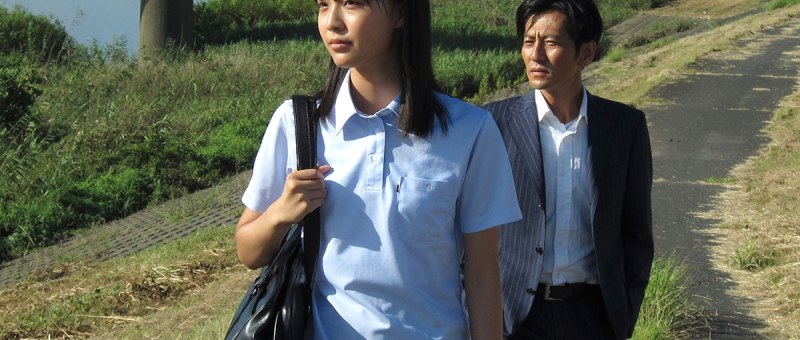
Like Yoji Yamada in Flag in the Mist, The Third Murder (三度目の殺人, Sandome no Satsujin) finds director Hirokazu Koreeda in unfamiliar territory though, at heart, it all comes back to family. A top lawyer, Shigemori (Masaharu Fukuyama), currently in the middle of a divorce, is asked to represent a man who has freely confessed to murder. As the son of the original judge who sentenced the accused, Misumi (Koji Yakusho), to the 30 year sentence he had not long been released from before (allegedly) committing the crime, Shigemori feels a responsibility to act but is frustrated by his client’s constantly shifting story. Nothing he says adds up, and every new angle Shigemori uncovers provokes only more doubt as to the true nature of the case at hand.

Shigemori, somewhat condescendingly, criticises the junior lawyer in the office for his naivety in wanting to to investigate the crime. Understanding and empathy are “unnecessary” in defending a client. The business of a lawyer, on either side, is to assess the evidence at hand, create an argument that withstands scrutiny, and eventually triumph in debating one’s opponent. In the face of the law, the “truth” is an irrelevance.

Shigemori’s cynicism is however rocked by the eerie presence of Misumi who seems to carry with him a kind of deepening emptiness. Misumi has already served 30 years in prison for the murder of two loansharks, the theft of their money, and an act of arson committed on their property to disguise the crime. Shigemori’s father, now a much older man, laments his youthful naivety in handing down a compassionate judgement which took into account the mitigating circumstances – Misumi’s troubled childhood, his poverty, the dire economic situation in which the closure of the local mines had led to mass unemployment and provided fertile ground for unscrupulous money lenders, and a series of personal tragedies which may have unbalanced his mind, but now he thinks some people are just bad and Misumi’s third murder is, in a sense, also his responsibility in allowing him the freedom to commit it.

Yet, there is also a doubt that Misumi’s first crimes are even his. We are told that, like the current case, Misumi couldn’t stick to one story – a common phenomenon with those who confess under duress, saying yes to everything in order to make the questioning stop but later forgetting what exactly they confessed to. Misumi later says he confessed only because he was told that confessing was the only way to avoid the death penalty which, ironically enough, is what he now faces. He also claims he was intimidated by the (admittedly stern) prosecutors, and when it looks as if a new trial may be necessary, the judge opts for the most “judicially economical” solution to incorporate the new demands into the current trial for reasons which the lawyers attribute to his personal need to get the case off his docket in good time so as not to muddy his own reputation. Japan’s 99% conviction rate is less an endorsement of judicial efficiency than a worrying indictment of the legal process in which trials are mere formalities held for show, a pantomime intended to reinforce an idea of “justice” which does not quite exist.

The weight of justice itself is called into question. We learn that the victim was guilty of several crimes, some of them more forgivable than others. Yet is his death “justice” or “murder”, was he “killed” or was the act one of “salvation” for his victims? There are no easy answers and the uncomfortable fact remains that one kind of justice may not necessarily be any different from another. Misumi remains a cypher, his motives for committing the crime(s) (if he even did commit them at all) unclear yet there is also something in him that suggests he is merely a reflection of ourselves, a projection of our own primal need to see justice done that our civil selves have tried and failed to codify into a universally recognised system of fairness known as law. Then again perhaps all we really want is a story we can understand and empathise with, perhaps we don’t want justice at all – we want narrative, a strategy for defence against the cruel and arbitrary charges of an unforgiving world. Shigemori stands at a crossroads, cleansed of his cynicism but unsure what to replace it with, as, perhaps, as we.


Currently on limited release in UK cinemas courtesy of Arrow Academy.

International trailer (English subtitles)
Birds Without Names (彼女がその名を知らない鳥たち, Kazuya Shiraishi, 2017)

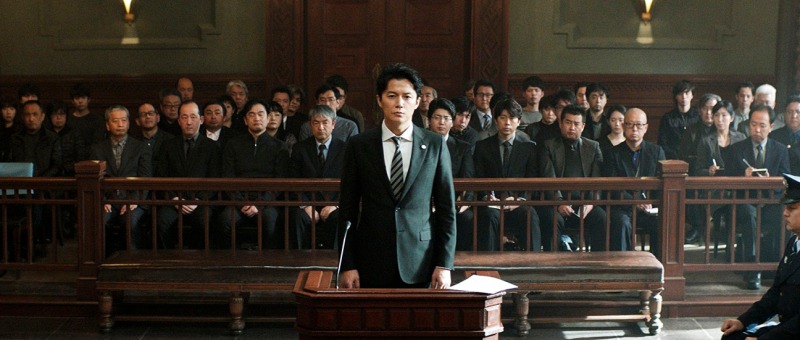
Birds Without Names poster“Human beings are lonely by nature”, a statement offered by someone who could well think he’s lying but accidentally tells the truth in Kazuya Shiraishi’s Birds Without Names (彼女がその名を知らない鳥たち, Kanojo ga Sono Na wo Shiranai Toritachi). Loneliness, of an existential more than physical kind, eats away at the souls of those unable to connect with what it is they truly want until they eventually destroy themselves through explosive acts of irrepressible rage or, perhaps, of love. The bad look good and the good look bad but appearances can be deceptive, as can memory, and when it comes to the truths of emotional connection the sands are always shifting.

Towako (Yu Aoi), an unmarried woman in her 30s, does not work and spends most of her time angrily ringing up customer service departments to complain about things in the hope of getting some kind of compensation. She lives with an older man, Jinji (Sadao Abe) – a construction worker, who is completely devoted to her and provides both financial and emotional support despite Towako’s obvious contempt for him. Referring to him as a “slug”, Towako consistently rejects Jinji’s amorous advances and resents his, in her view, overly controlling behaviour in which he rings her several times a day and keeps general tabs on her whereabouts.

Depressed and on edge, Towako’s life takes a turn when she gets into a dispute with an upscale jewellery store over a watch repair and ends up beginning an affair with the handsome salesman who visits her apartment with a selection of possible replacements. Around the same time, Towako rings an ex-boyfriend’s number in a moment of weakness only to reconsider and hangup right away. The next day a policeman arrives and informs her that they’ve been monitoring her ex’s phone because his wife reported him missing five years ago and he’s not been seen since.

Towako views Jinji’s behaviour as possessive and his continuing devotion pathetic in his eagerness to debase himself for her benefit. Her sister Misuzu (Mukku Akazawa), however, thinks Jinji is good for her and berates Towako for her ill treatment of him. Despite the fact that Towako’s relationship with her ex, Kurosaki (Yutaka Takenouchi), ended eight years previously, Misuzu is paranoid Towako is still seeing him on the sly and will eventually try to get back together with him. Misuzu does not want this to happen because Kurosaki beat Towako so badly she landed in hospital, but despite this and worse, Towako cannot let the spectre of Kurosaki and the happiness promised in their earliest days go. She continues to pine for him, looking for other Kurosakis in the form of other handsome faces selling false promises and empty words.

Mizushima (Mukku Akazawa), the watch salesman, is just Towako’s type – something which Jinji seems to know when he violently pushes a Mizushima look-alike off a busy commuter train just because he saw the way Towako looked at him. Daring to kiss her when she abruptly starts crying while looking at his replacement watches, Mizushima spins her a line about an unhappy marriage and his craving for solitude which he sates through solo travel – most recently to a remote spot in the desert and cave they call an underground womb. Mizushima describes himself as a lonely soul and claims to have found a kindred spirit in Towako whose loneliness it was that first sparked his interest. Like all the men in the picture, Mizushima is not all he seems and there is reason to disbelieve much of what he says but he may well be correct in his assessment of Towako’s need for impossible connections with emotionally unavailable men who only ever cause her pain.

It just so happens that Kurosaki’s apparent disappearance happened around the time Towako began dating Jinji. Seeing as his behaviour is often controlling, paranoid and, as seen in the train incident, occasionally violent, Towako begins to suspect he may be involved in the mysterious absence of her one true love. Then again, Towako may well need protecting from herself and perhaps, as Misuzu seems to think, Jinji is just looking out for her. The deeper Jinji’s devotion descends, the more Towako’s contempt for him grows but the suspicion that he may be capable of something far darker provokes a series of strange and unexpected reactions in the already unsteady Towako.

A dark romance more than noirish mystery,  Birds Without Names takes place in a gloomy Osaka soaked in disappointment and post-industrial grime where the region’s distinctive accent loses its sometimes soft, comedic edge for a relentless bite in which words reject the connection they ultimately seek. Rejection, humiliation, degradation, and a hopeless sense of incurable loneliness push already strained minds towards an abyss but there’s a strange kind of purity in the intensity of selfless love which, uncomfortably enough, offers salvation in a final act of destruction.


 Screened as part of the Japan Foundation Touring Film Programme 2018.

Also screening at:

  • Firstsite (Colchester) 9 February 2018
  • HOME (Manchester) 12 February 2018
  • Watershed (Bristol) – 13 February 2018
  • Exeter Phoenix – 27 February 2018
  • Depot (Lewes) – 6 March 2018
  • Filmhouse (Edinburgh) – 8 March 2018

International trailer (English subtitles)
Lu Over the Wall (夜明け告げるルーのうた, Masaaki Yuasa, 2017)

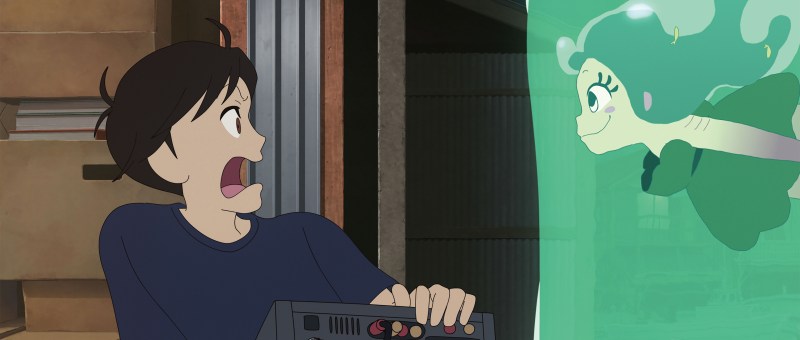
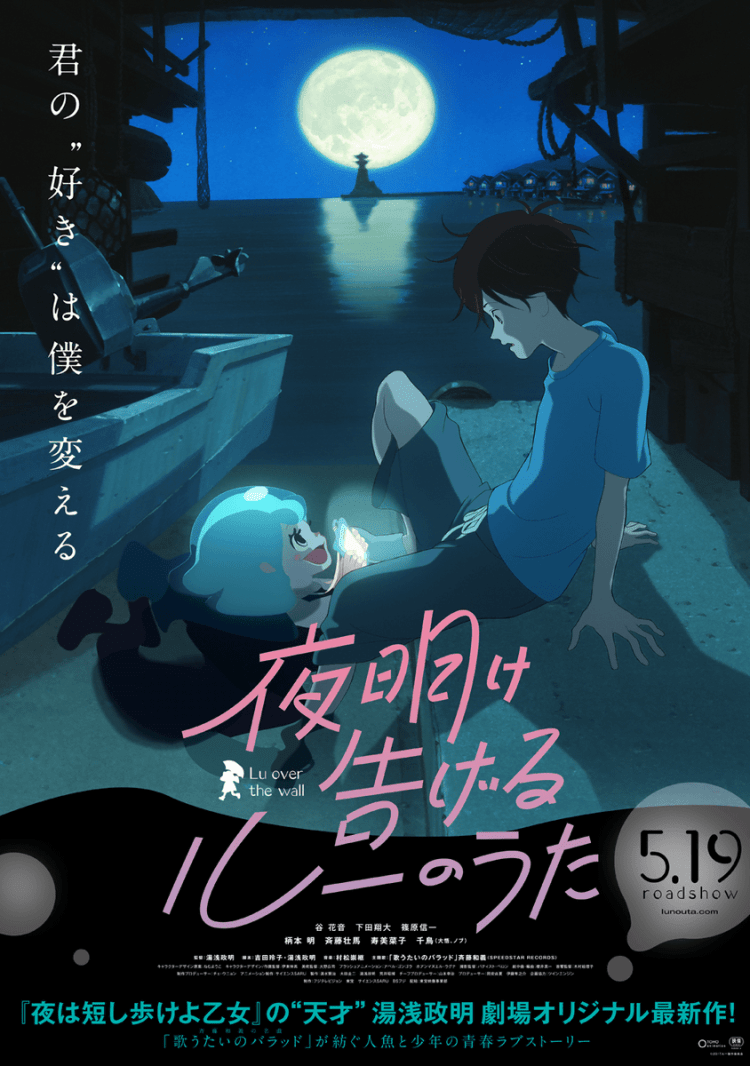
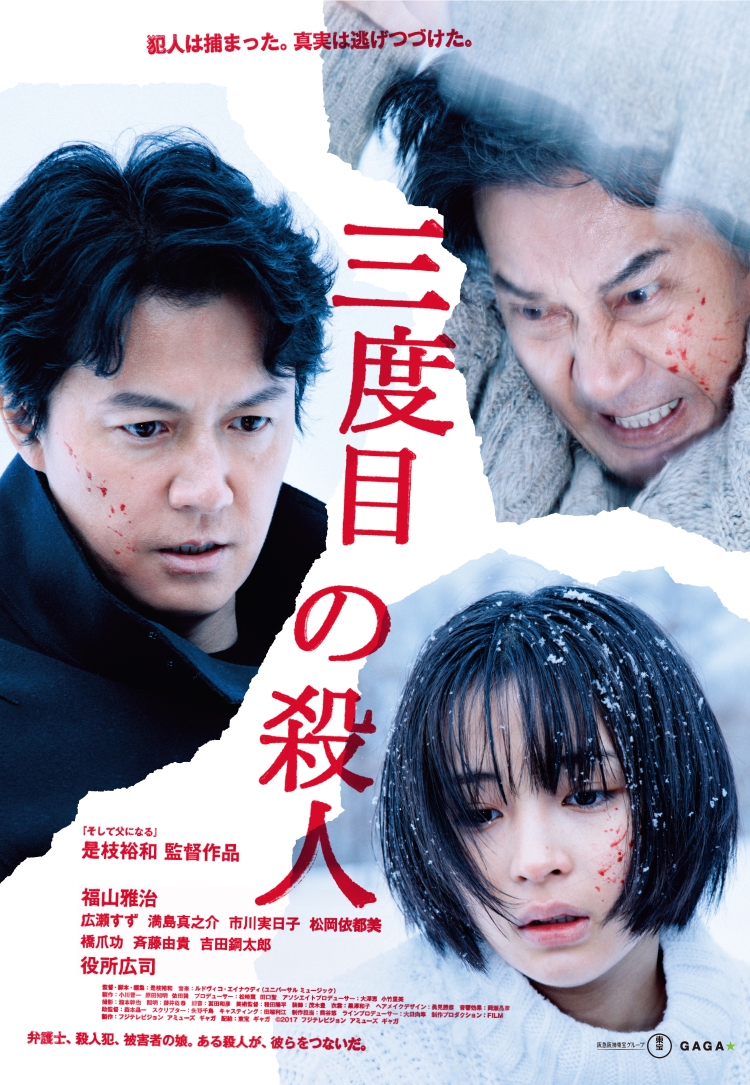
Lu over the wall posterComing of age dramas are the mainstay of anime, but if anyone was going to take one in a pleasingly new direction it would be Masaaki Yuasa. His second release of 2017 following the comparatively more abstract The Night is Short, Walk on Girl, Lu Over the Wall (夜明け告げるルーのうた, Yoake Tsugeru Lu no Uta) is the tale of a boy learning to break of out his emotional repression in order to step into a healthier adulthood but it’s also one of learning to live with loss and grief. From the Irish selkie to the conventional mermaid, people of the sea have more often than not stood in for people from a land of lost things where souls are carried away and lonely sailors lured to their doom, but perhaps we’ve simply misunderstood them and the song they sing isn’t intended to make us sad but only to make us remember the joy of living.

Sullen teenager Kai (Shota Shimoda) is in his last year of middle school with a lot of decisions awaiting him as to the further direction of his life. For the moment, Kai lives in the small fishing village of “Hinashi” somewhere in Southern Japan. “Hinashi” literally means “sunless” and the town is indeed overshadowed by a large cliff which blocks the town from the sun but there’s a more metaphorical kind of gloominess lurking here too. Kai is not the only miserable one, pretty much all of the townspeople once dreamt of escape but have either proved unable to get away from their small town roots, or have tried and failed to make it somewhere else before reluctantly returning, salmon-like, to the place of their births. The only one, it seems, to successfully make it out is Kai’s mum who left the family when Kai was small.

Much to his father’s (Shinichi Shinohara) irritation, Kai’s big dream is music though he’s less than thrilled when bamboozled into joining two other aspiring rockstar teens, Kunio (Soma Saito) and Yuho (Minako Kotobuki), as the third member of “Seirèn” even if it does give him an excuse to explore the generally forbidden territory of Mermaid Island. Whilst there, the trio’s song calls out to a music loving Merfolk girl, Lu (Kanon Tani), who can’t resist joining in and, awkwardly, is a much better lead vocalist than the divaish Yuho.

Lu, a charmingly vibrant toddler-type, is perfectly primed to bring this moribund town back to its sunny old self. Able to conjure her own portable corridors of water to travel over land, Lu tracks down Kai hoping to hear more wonderful music and making childish attempts to communicate through broken Japanese so that she can learn to understand the human world. Lu is not, however, the image most of the townspeople have when they think about Merfolk considering most of the local legends paint them as voraciously carnivorous predators existing only to steal landlubbing souls.

The Merfolk are a perfect metaphor for most of the ills consuming the town – a never seen manifestation of unknown fears. Everyone here has lost someone or something at sea (this is, after all a fishing village) or to the city, or just in themselves in learning to accept reality over the lure of unattainable dreams. Kai’s young and caring if distant father tries to push his son towards the “correct” path of non-stop studying and moral uprightness, but his son is just like teenage him, dreaming musical dreams of escape. It might have all gone wrong for Kai’s dad, but as he’s finally able to admit thanks to the guidance of Lu, he doesn’t regret a minute of it.

Ironically enough, Kai’s name is also the word for shellfish in Japanese, making his grandfather’s (Akira Emoto) frequent lament that the muscles in his dinner won’t open more than a little pointed. Kai is definitively closed off, refusing to even open the letters from his mother and keeping himself aloof at school and at home. Yet he’s not the only one who needs to open up – forced to dance to Lu’s tune (literally) each of the townspeople comes to make peace with those things that are so very hard to say, either letting past traumas float away or deciding to swim away with them.

It is, however, a little uncomfortable when the final resolution takes on a romantic dimension seeing as Lu has been painted as an adorable child with her giant bubbly head, cute high pitched voice, and childishly broken Japanese, not to mention that a secondary plot strand revolves around her father (an anthropomorphised shark/killer whale) who has attempted to shed some prejudices of his own to help his daughter in her desire to make friends with humans. Nevertheless, Yuasa and his scriptwriter Reiko do their best to do justice to all the ills of the town from the corporate greed of the mermaid loving old timer who wants to open a theme park exploiting their image, to the creepy behaviour of Yuho’s governor father, and the ever present themes of loss, guilt, and disappointment. The trio of teens at the centre may have felt themselves trapped in a dead end town, but thanks to Lu they come to realise that they too can jump over the wall and go wherever they want so long as they take the music with them.


Lu Over the Wall is in UK cinemas for one night only on 6th December 2017 courtesy of Anime Ltd.. Find out where it’s screening near you via the official Lu Over the Wall microsite.

Anime Ltd. trailer (Dialogue free)

Noise (Yusaku Matsumoto, 2017)

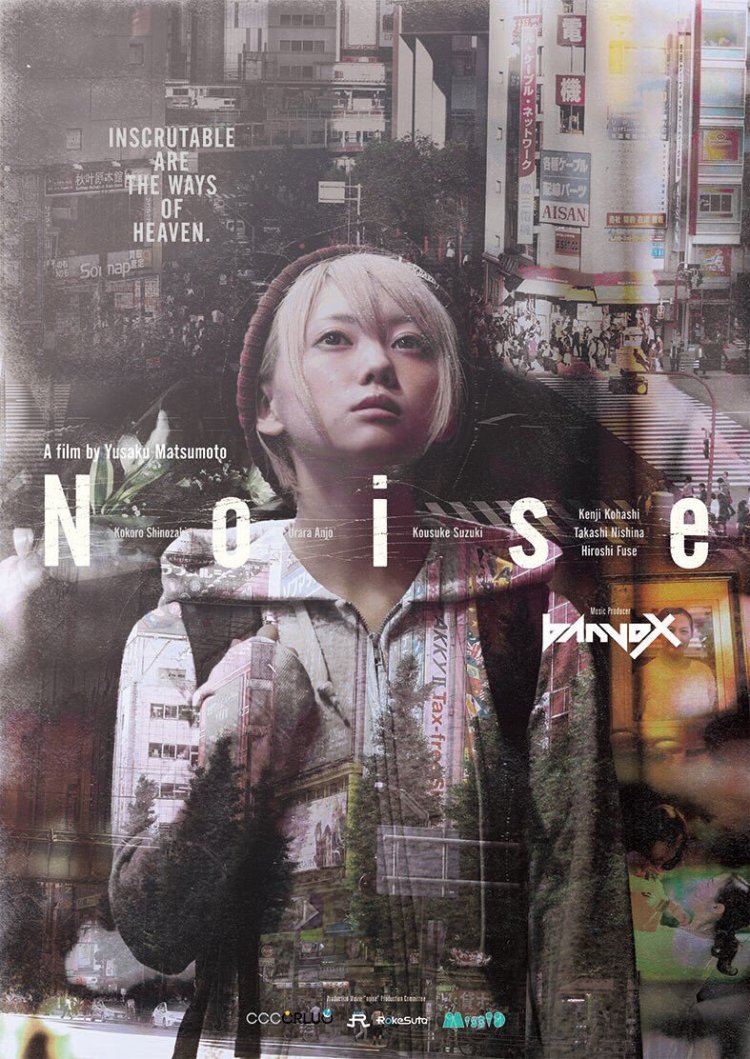
noise posterWhat makes someone take off on a homicidal rampage? First time director Yusaku Matsumoto attempts to find out by examining the down and dirty backstreets of Akihabara eight years after a mass killing shook the nation. Dealing with trauma, the death of the family, the precarious position of vulnerable young women pulled into an industry they don’t quite understand, economic insecurity, underground idols, and general nihilistic hopelessness Matsumoto has certainly conjured enough noise to drive even the most level of heads to distraction but once again, it is the city itself which eats its young in the indifferent frenzy of modern life.

Eight years ago, Misa’s mother was one of several people murdered by a lone assailant who drove a truck into a busy pedestrian intersection in Akihabara before getting out and stabbing random passersby. Misa is now making a go of it as an “underground idol” – young girls who sing and dance in clubs in Akihabara but don’t have recording contracts or big studios behind them. When not performing on stage she makes ends meet by working in the “massage parlour’ attached to the studio where she provides sexualised services but not actual sex to met who pay a flat rate on the door and then pick their particular activities off the menu inside.

Meanwhile, delivery driver Ken lives a lonely and miserable existence with his hedonistic mother who rolls in drunk early in the morning and constantly badgers her son for money. Ken would like to better himself and escape his dreadful living conditions, but his mother disagrees and disapproves of him spending his money on online courses rather than giving it all to her. Ken’s mother is also in trouble with the same loanshark gangsters which (secretly) run Misa’s club.

The third plot strand follows high school girl Rie and her lonely father who looks after grandpa at home and tries to reconnect with his daughter but can’t seem to get through to her. Rie chases a delinquent boyfriend she fantasises about trapping through pregnancy before getting herself mixed up with gangsters and embroiled in the same world as Misa but with no one looking out for her.

The strongest theme which runs through the film is that of familial breakdown. All of the protagonists come from one parent families in which the remaining parent has largely failed in their responsibilities. Though this seemingly deliberate approach is unfortunate in playing into the stigma surrounding atypical families, it is certainly true that none of the young people has any access to support from the older generation. Misa’s father had long been abusive even before her mother died, gambling the family money away betting on the horses and spending his life at home drinking. Now seemingly reformed (though not perhaps free of gambling), he wants to try again but it may already be too late.

Similarly, Rie’s father does his best – coming home from work on time, cooking proper meals, and trying to take an interest but he can’t get through to his angry teenage daughter and is also preoccupied by the need to care for his aged, bedridden father. In a strange coincidence he ends up visiting Misa’s underground idol bar where he takes a liking to Misa precisely because she looks a little bit like Rie. Nicknamed Yama-chan by the girls, Rie’s father’s attempts to forge a connection with a look-a-like of his own daughter take on a painfully tender quality of muddled, misdirected affection but a quick look around the rest of the club makes plain it’s not so far removed from the massage parlour as one might think. One of the other regular patrons is a colleague of Ken’s who seems to have little else in his life apart from underground idols, spending his life in the club buying false connection through Polaroid photos and handshakes. What the girls are selling isn’t sex but (false) kindness, providing a facsimile of the love each of these disconnected men is seeking but either thinks themselves unworthy of or is unable to find out in the “real” world.

Ken looks down on these men, he doesn’t understand why they waste their lives in vacuous pursuits of empty pleasure, but his own life, which has been more or less ruined by his irresponsible mother, holds little pleasure of its own. Reading books about mass killings and inspired by the 2008 mass murder, Ken repeatedly makes nuisance phone calls to the police station which arrested the killer threatening to commit a similar crime himself. Flat broke, abandoned, evicted, and with no future possibilities it’s little wonder he feels as backed into a corner as he does but Ken’s final, raw phone call in which the policeman on the other end tries to reassure him that hope does exist proves the last straw in his ever fracturing mental state.

In trying to answer the question why someone might want to kill others, Matsumoto does indeed blame noise. Misa, in giving a painful to camera interview looking back on the massacre reveals that she took all of her anger and internalised it, hurting herself rather than others. Ken, by contrast, seems to burn with rage permanently on the brink of explosion. Rie tries to find the peace she couldn’t find in her own family by starting a new one but is extremely deluded by her choice of mate and then deluded once again by a man faking kindness but thinking only of commerce. All of this desperation – the exploitation, the gangsters, the dire economic prospects of neglected children, conspire to push the already strained closer to the edge, believing that harming others will make them feel better through a strange kind of social revenge. Matsumoto’s Akihabara pulses to beat of synth strings and idol pop, though its soundscape is not one of freedom and joy but anxiety and depression as the city’s disenfranchised youth marches towards its dead end future with no hope in sight.


Screened at Raindance 2017

Original trailer (no subtitles)

Oh Lucy! (オー・ルーシー!, Atsuko Hirayanagi, 2017)

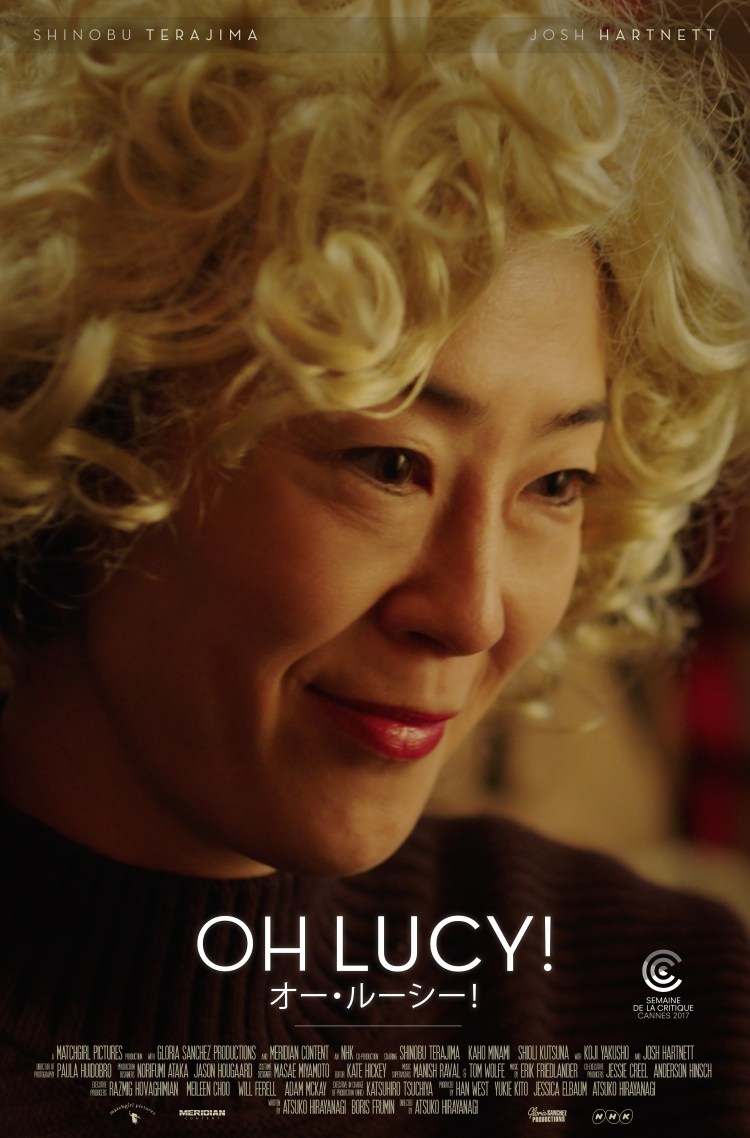
Oh Lucy! posterDespite its rich dramatic seam, the fate of the lonely, long serving Japanese office lady approaching the end of the career she either sacrificed everything for or ended up with by default has mostly been relegated to a melancholy subplot – usually placing her as the unrequited love interest of her oblivious soon to be retiring bachelor/widower boss. Daihachi Yoshida’s Pale Moon was perhaps the best recent attempt to bring this story centre stage in its neat contrasting of the loyal employee about to be forcibly retired by her unforgiving bosses and the slightly younger woman who decides she’ll have her freedom even if she has to do something crazy to get it, but Atsuko Hirayanagi’s Oh Lucy! (オー・ルーシー!) is a more straightforward tale of living with disappointment and temporarily deluding oneself into thinking there might be an easier way out than simply facing yourself head on.

Middle-aged office lady Setsuko (Shinobu Terajima) is the office old bag. Unpopular, she keeps herself aloof from her colleagues, refusing the sweets a lovely older lady (herself somewhat unpopular but for the opposite reasons) regularly brings into the office, and bailing on after hours get togethers. Her life changes one day when the man behind her on a crowded station platform grabs Setsuko’s chest and says goodbye before hurling himself in front of the train. Such is life.

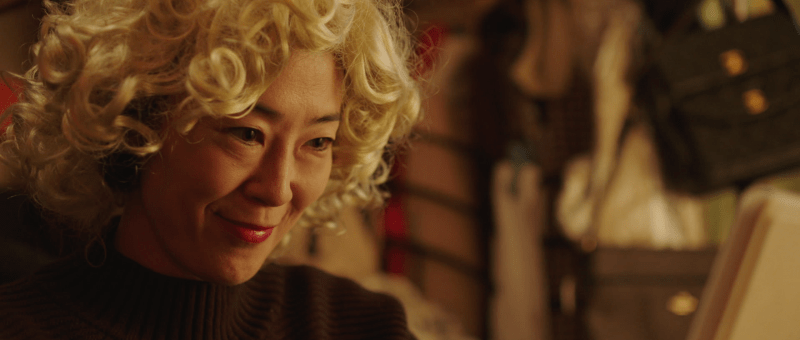
Taking some time off work she gets a call from her niece, Mika (Shioli Kutsuna) to meet her in the dodgy maid cafe in which she has been working. Mika has a proposition for her – having recently signed up for a year’s worth of non-refundable English classes, Mika would rather do something else with the money and wonders if she could “transfer” the remainder onto Setsuko. Despite her tough exterior Setsuko is something of a soft touch and agrees but is surprised to find the “English School” seems to be located in room 301 of a very specific brothel. John (Josh Hartnett), her new teacher, who has a strict English only policy, begins by giving Setsuko a large hug before issuing her a blonde wig and rechristening her “Lucy”. Through her English lesson, “Lucy” also meets another man in the same position “Tom” (Koji Yakusho) – a recently widowed, retired detective now working as a security consultant. Setsuko is quite taken with her strange new hobby, and is heartbroken to realise Mika and John are an item and they’ve both run off to America.

Setsuko’s journey takes her all the way to LA with her sister, Ayako (Kaho Minami), desperate to sort her wayward daughter out once and for all. As different as they are, Ayako and Setsuko share something of the same spikiness though Setsuko’s cruel streak is one she deeply regrets and only allows out in moments of extreme desperation whereas a prim sort of bossiness appears to be Ayako’s default. Setsuko’s Tokyo life is one of embittered repression, having been disappointed in love she keeps herself isolated, afraid of new connections and contemptuous of her colleagues with their superficial attitudes and insincere commitment to interoffice politeness. Suicide haunts her from that first train station shocker to the all too common “delays caused by an incident on the line” and the sudden impulsive decision caused by unkind words offered at the wrong moment.

“Lucy” the “relaxed” American blonde releases Setsuko’s better nature which had been only glimpsed in her softhearted agreeing to Mika’s proposal and decision to allow Ayako to share her foreign adventure. John’s hug kickstarted something of an addiction, a yearning for connection seemingly severed in Setsuko’s formative years but if “Lucy” sees John as a symbol of American freedoms – big, open, filled with possibilities, his homeland persona turns out to be a disappointment. Just like the maid’s outfit Setsuko finds in John’s wardrobe, John’s smartly bespectacled English teacher is just a persona adopted in a foreign land designed to part fools from their money. Still, Setsuko cannot let her delusion die and continues to see him as something of a saviour, enjoying her American adventure with girlish glee until it all gets a bit a nasty, desperate, and ultimately humiliating.

Having believed herself to have only two paths to the future – being “retired” like the office grandma, pitied by the younger women who swear they’ll never end up like her (much as Setsuko might have herself), or making a swift exit from a world which has no place for older single women, Setsuko thought she’d found a way out only to have all of her illusions shattered all at once. “Lucy” showed her who she really was, and it wasn’t very pretty. Still, even at this late stage Setsuko can appreciate the irony of her situation. That first hug that seemed so forced and awkward, an insincere barrier to true connection, suddenly finds its rightful destination and it looks like Setsuko’s train may finally have come in.


Screened at Raindance 2017

Expanded from Atsuko Hirayanagi’s 2014 short which starred Kaori Momoi.

Clip (English subtitles)