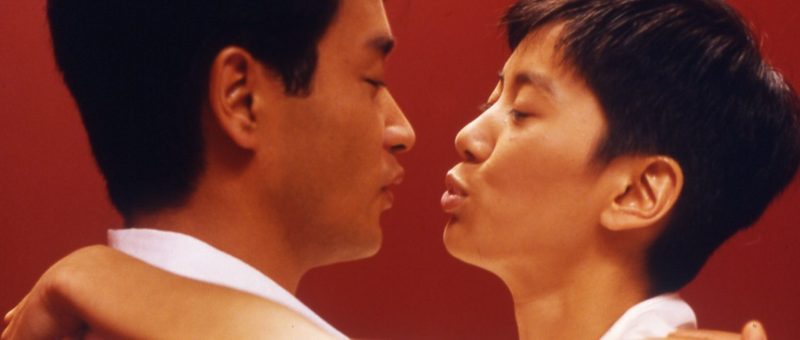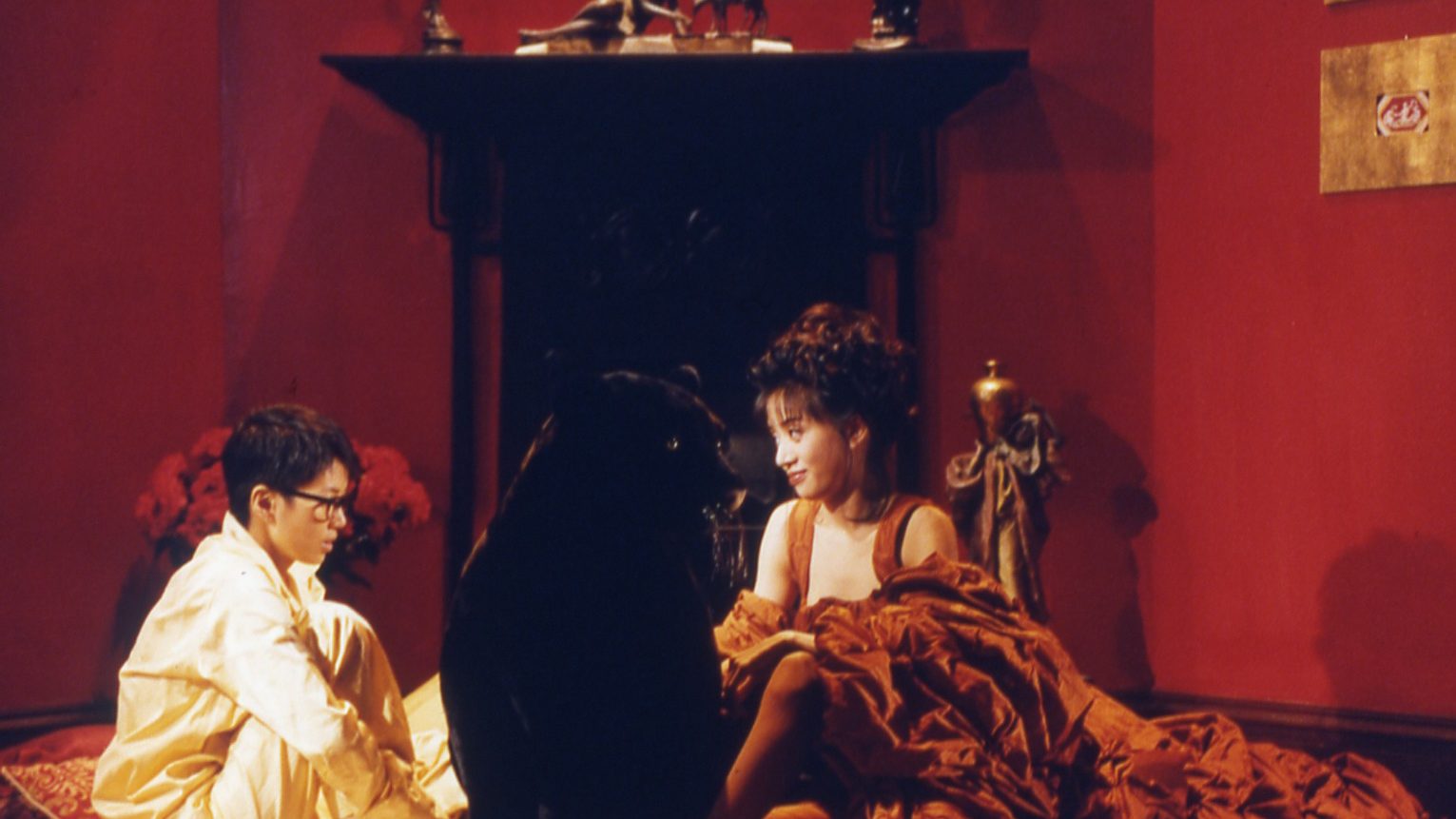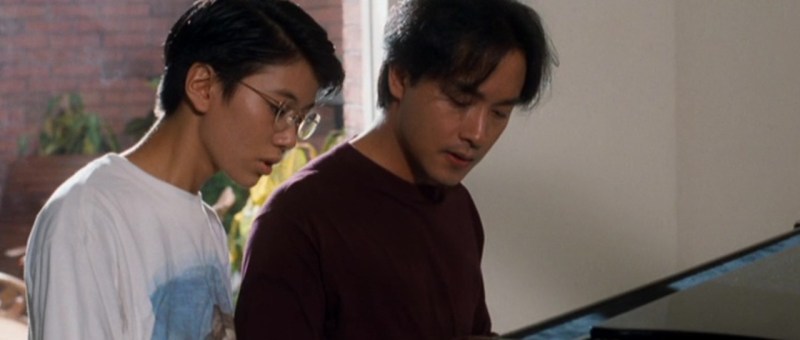
The Phantom Lover (夜半歌聲, Ronny Yu, 1995)

For his last film in Hong Kong before decamping to Hollywood, Ronny Yu looked back to a lost classic in loosely remaking 1937’s Song at Midnight, itself loosely based on Gaston Leroux’s The Phantom of the Opera. A Hong Kong/Singapore co-production, the film was, perhaps surprisingly, shot entirely in Beijing where Yu constructed an opulent set including a full-scale replica of the theatre which he then burnt down for real during the legendary climax of the classic story. 

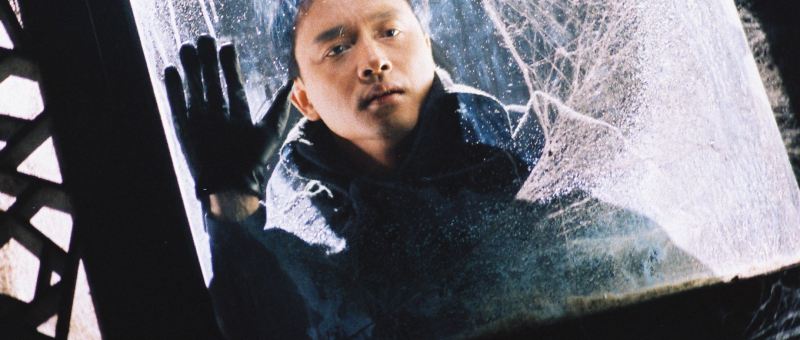
Set in 1936 (one year before the release of A Song at Midnight and the intensification of the Sino-Japanese war), the film opens with a gothic scene of carriages racing through the fog. A troupe of left-wing actors has come to make use of a ruined theatre to put on their revolutionary play. On arrival, the troupe’s leading man Wei Qing (Lei Huang), who is in a relationship with leading lady Landie (Liu Lin) but claims he is too poor to marry so they will have to wait until he’s famous, is captivated by the auditorium, convinced he can hear strange sounds of a woman singing. The strangeness of the surroundings continues to bother him until he finally decides to ask creepy caretaker Uncle Ma (Cheung Ching-Yuen)to disclose what he knows of the fire which destroyed the theatre 10 years previously. 

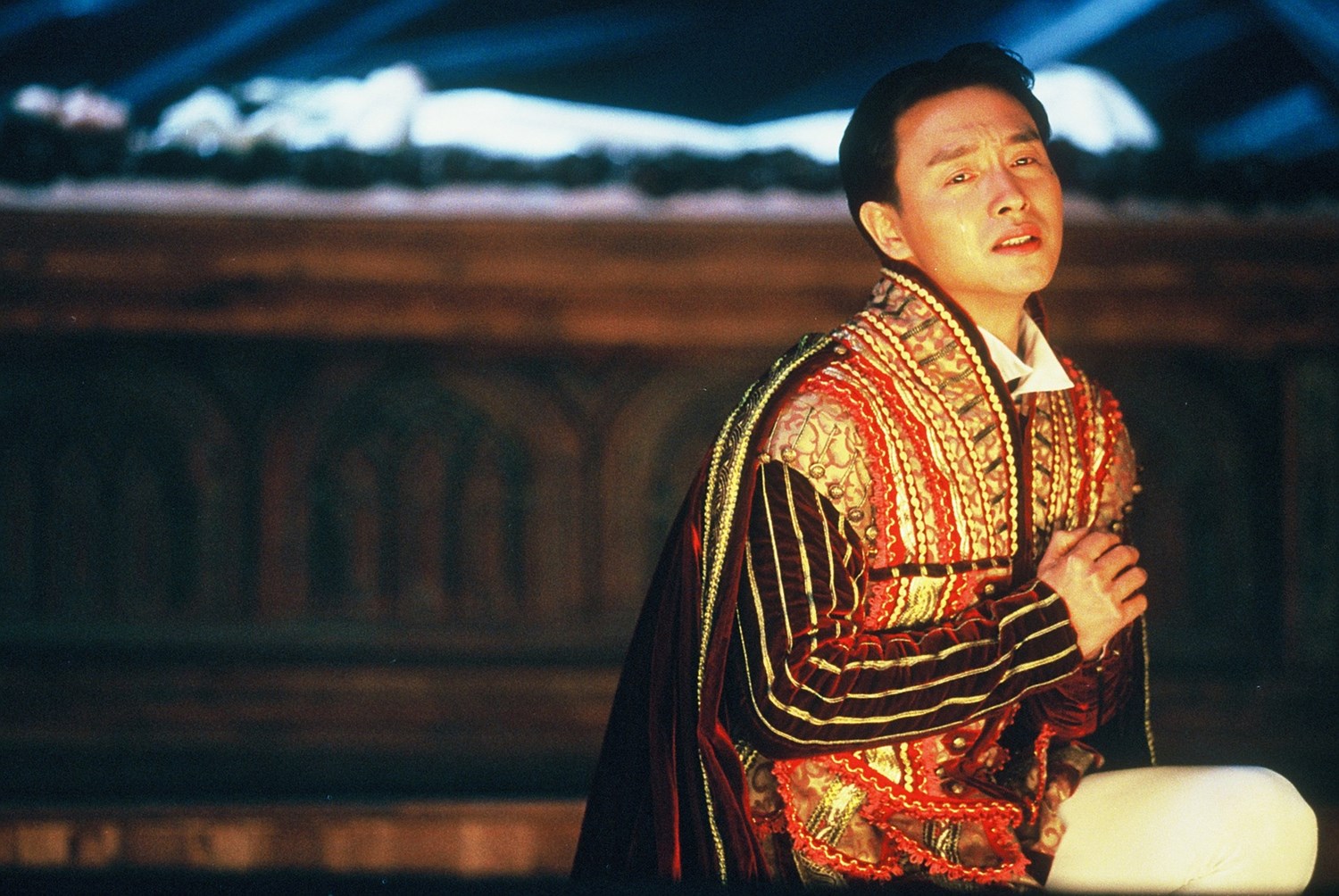
Counter-intuitively, Yu shoots the ‘30s sequence in a washed-out sepia with occasional flashes of colour almost like hand-tinted photographs. As Ma spins his story, we transition into a sumptuous world of reds and golds in the old opera house designed, as we’re told, by the famous actor Song Danping (Leslie Cheung Kwok-Wing) who is said to have perished along with it in the fire. Danping, to whom Wei Qing is constantly likened, was the greatest actor of the age famous for his performances in Western theatre, such as the Mandarin musical adaptation of Romeo and Juliet in which he was performing immediately before his death. In a case of life imitating art, Danping had fallen in love with the daughter of a wealthy family, Yuyan (Geng Xiao-Lin), and wished to marry her, but actors belong to an undesirable underclass and in any case, Yuyan’s father had already arranged her marriage to the idiot son of a powerful politician, Zhao (Bao Fang), in exchange for smoothing the path for his new factory enterprise. 

In a direct reversal of the 1937 film, it is Wei Qing who is the left-wing revolutionary proudly singing communist songs about the “national humiliation” which, it seems, partly accounts for their low audience numbers, while Danping is the reactionary libertine performing in “decadent” Western theatre which seemingly has no political import other than its capacity to cause annoyance to the conservative older generation extremely concerned about Danping’s effect on the local young women. With that in mind, it seems strange that Wei Qing is so quick to accept Danping’s offer once he finally reveals himself and drops the playbook for Romeo and Juliet into his hands. Nevertheless he is content to accept the older man’s tutelage, hoping that the increased revenue will save the troupe and, as implied earlier, he doesn’t actually seem to be very invested in the idea of revolution so much becoming famous. 

Nevertheless, it turns out that he does indeed have integrity. To gain additional funding, the troupe’s leaders end up schmoozing with none other than Zhao, the man who eventually married Yuyan after the fire but quickly discarded her on learning she was not a virgin. Now apparently having risen in politics in Shanghai, Zhao is a misogynistic bully carrying a grudge towards women because of his humiliation by Yuyan. In the scene in which we re-meet him, no longer quite so moronic but definitely nastier, he forces his dining companion to eat 60 meat buns because she had the temerity to declare herself full and try to leave the table. When Wei Qing snaps at him he takes a liking to Landie who is more or less pimped out by the impresario in the same way that Yuyan was sold by her father to the Zhaos in order to further his business interests. On discovering Yuyan, who has since descended into madness, wandering the streets, he stops his carriage to give her a public whipping, ranting about how he had her 10 years preciously but she turned out to be a “slut” who’d already slept with the famous actor Song Danping which seems like a curious thing to announce in the public square. 

Then again, these fascist stooges have an odd approach to public humiliation, stopping Danping’s play mid-performance to call out Yuyan which seems like a counter-intuitive and extremely embarrassing move when they could simply have dragged her out of her box. Danping strikes a minor victory for art when he get the goons ejected from the theatre by the irate audience who, he points out, have had their evening spoiled by officials misusing their authority for a spot of personal pettiness. The intervention is mirrored in the film’s conclusion with the “villains” effectively put on trial in the theatre, as theatre, with an appeal made to law enforcement which is eventually successful as the police commander affirms his intention to act for the public good (though in this case is also serving his own while ironically giving justification to mob rule). 

Despite all of that, however, the major stumbling block to the tragic romance turns out to narcissistic vanity on the part of former matinee idol Danping who has been hiding himself away even though he knows Yuyan has gone mad in love for him simply because his face was ruined when Zhao’s goons threw acid at it and then locked him in the burning theatre. He contents himself with singing on nights when the moon is full knowing that hearing his voice on such occasions is the only thing keeping her going. On learning of his mentor’s true purpose to make Yuyan think he, the handsome young actor, is the Danping of old, Wei Qing is extremely conflicted, unable to understand why the now ghoulish Danping would put Yuyan through so much grief when he could simply have revealed himself a decade ago. Nevertheless, realising the intensity of the romantic suffering all around him perhaps pushes him towards ”forgiving” Landie for having schmoozed with Zhao. 

Full on gothic melodrama, Yu’s adaptation of the classic story is all fog and cobwebs, situating itself in a world which is already falling apart. In photographing the 30s in washed-out greys, he perhaps suggests that something has already faded, or at least become numb, in comparison with the life and colour of mid-20s Shanghai in all its art deco glory. Yet even in giving us a superficially happy ending in which justice, moral and romantic, appears to have been served Yu denies us the resolution we may be seeking with a melancholy title card reminding us that happiness in the China of 1936 may be a short-lived prospect.


The 7 Grandmasters (虎豹龍蛇鷹, Joseph Kuo, 1977)

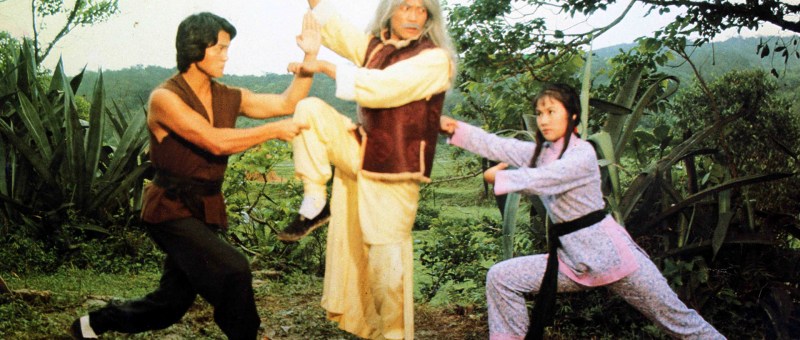
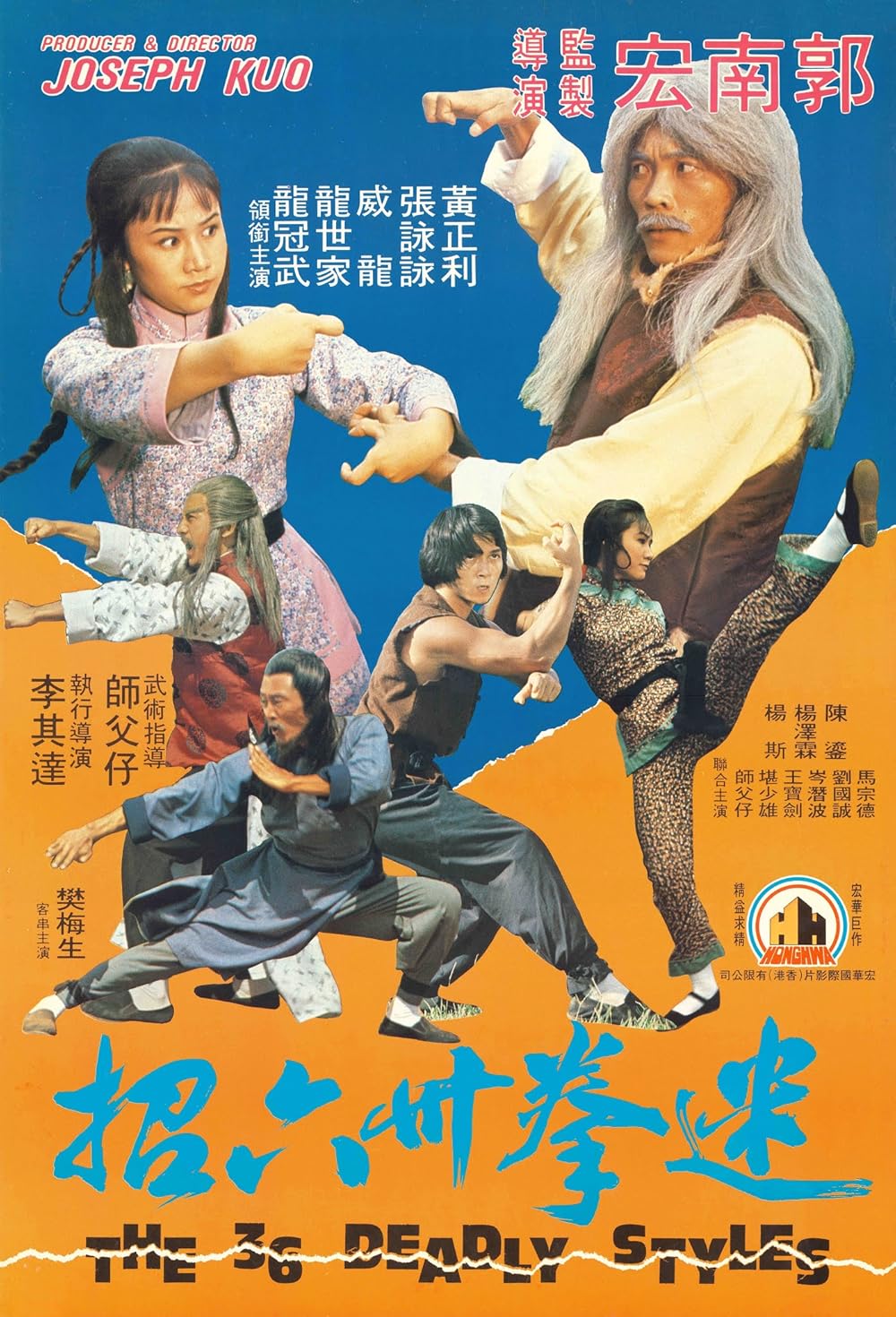
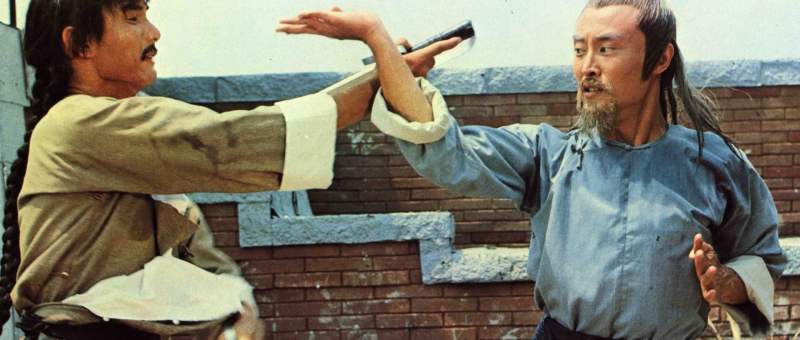
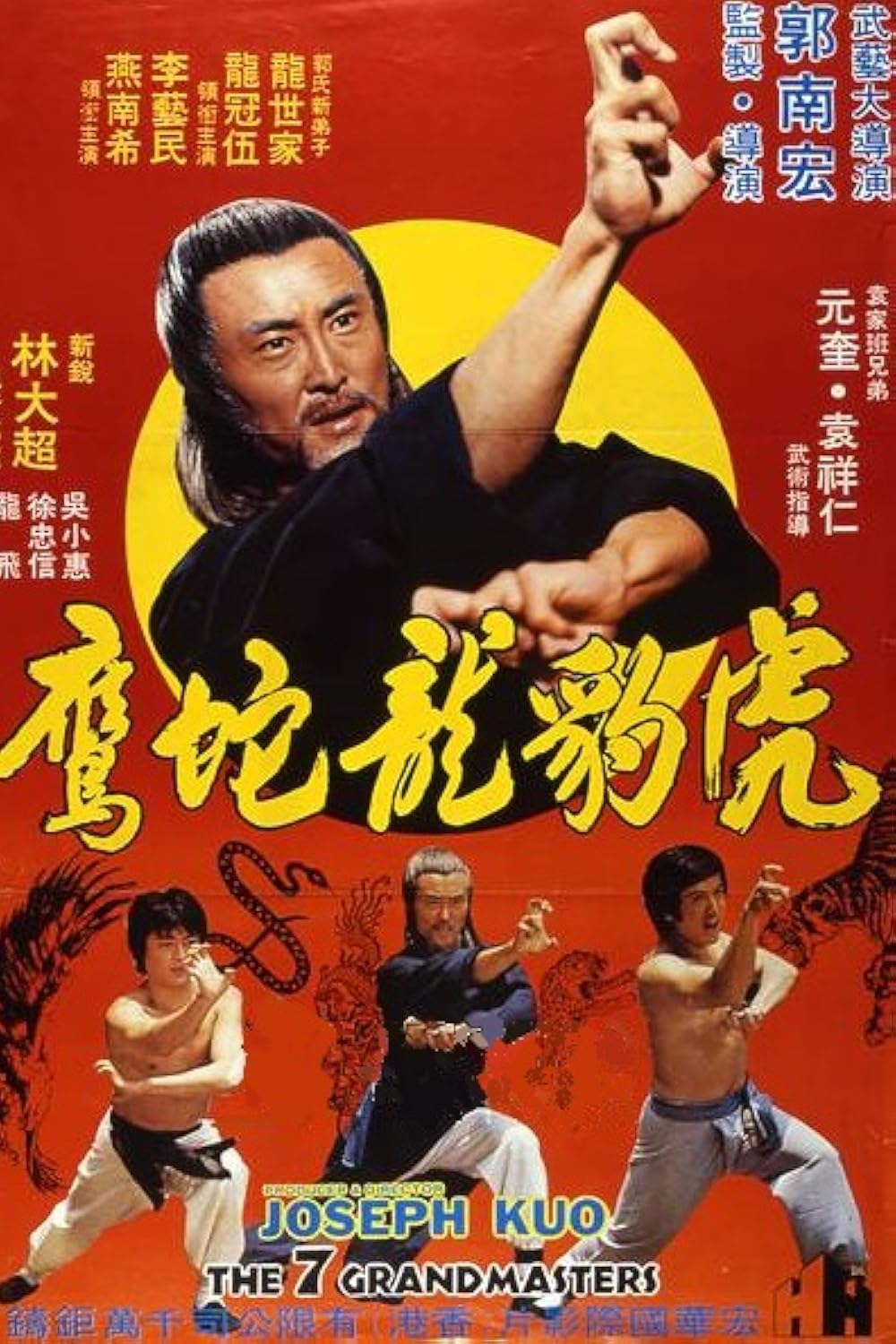
“The way of kung fu, no one is invincible. A fighter shouldn’t be arrogant and bully others,” according to one of the mini lessons given by the ageing champion at the centre of Joseph Kuo’s 7 Grandmasters (虎豹龍蛇鷹), though it has to be said there is a fair amount of cockiness in play while bullying does seem to be a part of his training programme. Arrogance is in fact what he has himself been accused of at the ceremony at which he has been honoured by the emperor and after which he planned to retire if he had not received a rude note telling him he is not a real champion and shouldn’t lay claim to the title until he’s defeated all of the other regional champions in each of their signature fighting styles. 

A 30-year veteran of the local martial arts scene, Zhang Shenguang (Jack Long) is tired and ready to pass his school on to the next generation but feels he cannot retire until he’s proved once and for all that he is the greatest kung fu master. Setting out with his daughter and three pupils, he roams around the land easily defeating his rivals and teaching them a lesson to boot. Unfortunately, however, his first target, Sha (Wong Fei-lung), ends up dying while he’s also being followed around by an over-earnest boy, Shao Ying (Li Yi Min), who insists on becoming his pupil, though Zhang is unwilling to take him on because his own master was betrayed by a bad faith student who stole the final three pages of the book he’d been given to safeguard outlining the 12 Bai Mei strikes.

Zhang is definitely all about righteousness, constantly reminding everyone about the responsibilities that come with kung fu but his own students are fairly merciless to Shao Ying firstly mocking him as he trails along behind them like a stray puppy and then continuing to bully him until he finally surpasses their own abilities. They are all also supremely confident and often resort to cocky banter during fights which it has to be admitted they usually win. The film is structured around Zhang’s quest abruptly shifting from one expertly choreographed fight sequence to another, each showing off a different style and the ways in which Zhang can overcome it while some of his opponents accept defeat gracefully and others not. In one town they are ambushed by goons working for the local master who wanted to avoid potentially losing his title by underhandedly taking Zhang out first but as Zhang puts it losing his good name instead. The final challenger meanwhile refuses to Zhang directly because he can see Zhang is already ill and it wouldn’t be fair so has their students square off instead. 

Nevertheless, Zhang is not permitted to exit the world of kung fu until dealing with the left over baggage of the three missing strikes of Bai Mei, Shao Ying eventually becoming its inheritor after a twist of fate connects him with Zhang’s past while causing him a paradoxical dilemma in temporarily becoming Zhang’s enemy in order to avenge the death of his father as his code dictates. Like Zhang however he is perhaps only trying to make a point, never intending to harm his former mentor, at least physically, but only to close the cycle through symbolic revenge, later returning to Zhang’s side on realising he’s been used and deceived. 

Featuring top choreography from Hong Kong’s Yuen Kwai and Yuen Cheung Yan, Kuo’s low budget indie kung fu drama is pure fight fest less interested in the emotional conflicts between the men than the physical which might explain its incredibly abrupt conclusion which largely implodes the moment of catharsis achieved in the villain’s defeat. Even so, it succeeds in showcasing a series of fighting styles as Zhang continues with his quest to prove himself the ultimate grandmaster so he can finally retire while throwing in some comic relief thanks to Shao Ying’s dogged determination to become one of the gang before finally proving himself the most talented of all the students, not least because of his perseverance and willingness to learn. Shooting mainly in the open air to avoid the expense of sets, Kuo’s approach is unfussy but to the point of removing all distractions in order to showcase the immense abilities of his performers in an otherwise generic tale of rivalry and revenge. 


Who’s the Woman, Who’s the Man? (金枝玉葉 2, Peter Chan, 1996)

“I don’t care if you’re a man or a woman, all I know is that I love you,” the hero had finally accepted after the heroine’s madcap dash across town in the closing scenes of Peter Chan’s 1994 rom-com, He’s a Woman, She’s a Man. But as it turns out, it isn’t quite that simple. Inverting the structure of the first film, sequel Who’s the Man, Who’s the Woman? finds the heroine romantically confused as her “masculine” persona increasingly interferes in her relationship with the still conflicted Sam (Leslie Cheung).

It certainly hasn’t been plain sailing for anyone as Wing (Anita Yuen) agrees to move in to Sam’s luxury flat but refuses to live downstairs as Rose (Carina Lau) had done, instead insisting on sharing his life and his bed in their entirety. For his part, Sam’s reluctance to share his space is reflective of his fears of intimacy while he resents Wing’s immediate attempts to install herself by remodelling the apartment to her own taste. Meanwhile, the old problem has resurfaced in that now he’s got Wing he’s not all that interested in her and hasn’t written any songs in months. In an attempt to manage her interference in his life, Sam suggests resurrecting Wing’s pop career as a male idol but proves a victim of his own success as she quickly begins earning much more money than him and gains the upper hand in the relationship. 

Wing’s increasing masculinity leaves Sam feeling somewhat emasculated while forced into the “feminine” role previously occupied by Rose. Suddenly successful, Wing is offering to pay large sums of money to help Sam fulfil his dreams which only deepens his sense of shame in his inability to earn money for himself. Wing had insisted on living together in the main apartment, but now that she’s so busy suggests moving into Rose’s old flat downstairs so that they can, after all, have their own space. Sam had wanted it that way before, but now that it’s Wing who suggests it, he’s romantically anxious while simultaneously conflicted because he cannot acknowledge their relationship publicly as he is still uncomfortable with people assuming he is “gay”.

All of which is doubly confusing for Wing who is under increasing strain trying to straddle a gender binary. Not only is she trying to deal with Sam’s contradictory behaviour and resentment of his emasculation, but in growing into her masculine role finds herself questioning her sexuality in experiencing unexpected attraction towards other women and in particular the captivating Fan Fan (Anita Mui), a mysterious former pop star who has moved into the downstairs flat after spending many years abroad. Just as Sam had in the previous film, Wing struggles to accept her desires unable to reconcile falling in love with Fan Fan with her love for Sam while Fan Fan in turn falls for her mainly in her femininity in claiming that she has been looking for something kind and innocent that she no longer believed existed in the world. 

“Love can’t be explained,” Sam admits when talking to his decorators, a gay couple who ironically tell him how much it means to them to see a same-sex couple in the public eye, though Sam still refuses to acknowledge the relationship because he doesn’t want to be seen as “gay” and Wing is in any case a woman. Mirroring Sam’s relationship with the openly gay Auntie (Eric Tsang), Fan Fan’s assistant O (Theresa Lee) is a lesbian who is relentlessly courted by Fish (Jordan Chan) despite her constant rejections of him. He tries to present himself as female by shaving his legs and later crossdressing in order to win her heart, only to end up reaffirming O’s avowed homosexuality. For Wing, however, she has only a dilemma in being faced with a choice between her love for Fan Fan and that for Sam which seems as if it may have run its course just Sam’s love for Rose once did. 

Sam only really begins to understand his himself after a more mature discussion with Rose regarding the realities of their relationship, while Fan Fan effectively plays a similar role in sacrificing her own desire believing that Wing belongs with Sam but taking the new hope their love has given her back out into the world. Neatly inverting the first film’s conclusion, it’s Sam who has to make an active choice about what it is he wants though the ironic ending may suggest he doesn’t have much control over his destination either even if discovering he already has what he was looking for.


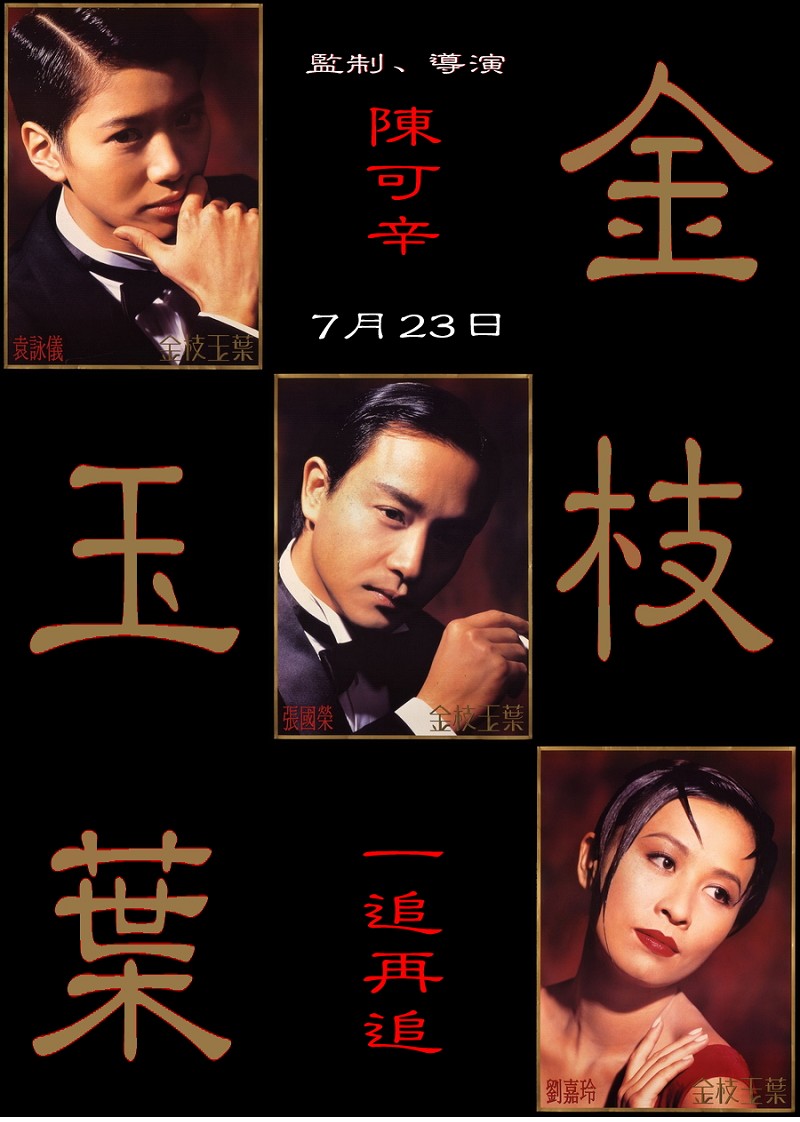
He’s a Woman, She’s a Man (金枝玉葉, Peter Chan, 1994)

A frustrated composer in a moribund relationship with his former muse experiences a moment of existential confusion on feeling an unexpected attraction to his latest prospect whom he assumes to be male in Peter Chan’s hilarious meta comedy, He’s a Woman She’s a Man (金枝玉葉). Broadly progressive in its views of gender and sexuality, the film also takes aim at a growing obsession with celebrity in an increasingly consumerist culture. 

The heroine, Wing (Anita Yuen), is a case in point. She’s completely obsessed with the singer May Rose (Carina Lau) to the point that she almost lives her life vicariously through her. Rose’s successes are her successes, while she earns a few extra pennies peddling celebrity tat like Aaron Kwok’s used tissues. Rose meanwhile is riding high professionally by winning yet another reward, but her relationship with songwriter/manager Sam (Leslie Cheung) has clearly run its course. He’s become bored with the “celebrity” lifestyle and hasn’t written anything new in some time while unwilling to admit that he’s fallen out of love with Rose, refusing to take on new proteges because of his habit of falling in love with them.

That’s one reason he finally agrees to take on a male star, assuming there will be no danger of romantic conflict and intending to kick back against celebrity culture if ironically by creating an “everyman” sensation. But unbeknownst to him, Wing has had a male makeover and decided to enter the auditions in the hope of meeting her idols. Unexpectedly picked up for a recording contract during a spat between Rose and Sam, Wing finds herself having to keep up the act but is conflicted on fearing her presence is only deepening the rift between the “perfect couple” whose wedding it is her life goal to witness. 

Even before her makeover, Wing makes repeated references to her atypical gender presentation in lamenting her flat chest, especially in contrast with a rival celebrity hunter she nicknames “big boobs”. She takes lessons in performative masculinity from her roommate and best friend since primary school Yuri (Jordan Chan), who appears to have no romantic interest in her, and stuffs glow sticks down her trousers to make herself feel more “complete”. Yet despite all that, she is always forced to deny her seeming femininity with several people directly asking her if she is “gay” which is a more complicated question than it seems given that she’s a straight woman but currently living as a man. To find out for sure, Rose tries to seduce her in an attempt which is admittedly predatory and ends in a chase around the bed with Wing desperately trying to avoid being accidentally “outed” in an amorous moment. 

Nevertheless, there is a degree of romantic attraction in Wing’s obsession with Rose which is also a reflection of her internalised sense of shame in her atypical femininity as seen in her wide-eyed observation of Rose’s shadow dance as she slips into something more comfortable along with her admission that she always wanted to know what it felt like to touch a breast (because she feels she has none of her own). Even so, she begins to fall for Sam who is slowly being driven out of his mind with romantic confusion in being unable to reconcile his attraction to Wing with his heterosexuality. One of Wing’s closest associates whom he refers to as “Auntie” (Eric Tsang) is an openly gay man who asks him the all important question of whether of what’s really bothering him isn’t Wing’s ambiguous sexuality but his own. The question takes on a meta dimension in the knowledge that Cheung was himself bisexual but at that point not openly. Much as Sam explains, he might personally not have a problem with it but some people in the industry are very “sensitive about this kind of thing”.

Sam doesn’t know that Wing is “really” a woman, which might neatly explain his inexplicable attraction to her, but cannot begin to reconcile himself until he accepts that it “doesn’t matter what you are” because the fact remains that he loves her. Wing might make her final dash in more stereotypically female attire, but she does so in a voluminous white dress which, aside from its matrimonial connotations, further emphasises her lack of conventional femininity in her literal inability to manage it as she attempts to run while trying not to trip over herself. “Too much reality can really get up your nose,” Rose had complained in trying to keep her fantasy of a fairytale romance alive while internally accepting she can no longer be the “ordinary” girl Sam is looking for in a world of celebrity miasma and consumerist aspiration, finally reaching her own moment of self-acceptance just as Wing decides to shoot her shot right into Sam’s tender heart.

Trailer

The System (行規, Peter Yung Wai-Chuen, 1979)

“How else can people like me survive?” a unwilling informant ironically asks in Peter Yung Wai-Chuen’s New Wave cops and robbers thriller The System (行規), while Inspector Chan (Pai Ying) is already far too aware of the ironic symbiosis of law enforcement and crime. He’s dependent on informants to be able to do his job and catch the kingpins, but that means the informants continue to perpetuate crime. Even when they manage to make an arrest, they have to let the suspect go because it turns out that they’re already cooperating with another officer. The police aren’t so much solving crimes as, at best, managing, if not actually enabling them.

Director Peter Yung drew on research he’d done for a documentary to depict police work and the realities of drugs in late British Colonial Hong Kong in a more authentic way, often using held camera and shooting on location out in the streets. Chan is seen as something of a zealot, an idealistic cop too pure-hearted to understand his colleagues’ dirty jokes and with a penchant for retreating to Lantau Island to go bird-watching, even if his address to his officers is a little on the crude side. Nevertheless, even if he hates police corruption, he’s not above playing this game and is keen to recruit exclusive informants of his own, essentially by blackmailing them, finding evidence of crimes they’ve committed and promising to overlook it if they agree to feed him information. 

That’s how he recruits Tam (Sek Kin), a drug user with a gambling problem working for a syndicate run by Hung (Nick Lam Wai-Kei), the kingpin Chan has been trying to catch for a decade. But at the same time, Tam appears to keep his life of crime separate from that as a family man with two children and an ailing mother. He doesn’t really want to help Chan because he fears retribution from Hung, but he doesn’t want to go to prison for 36 years and leave his family destitute, either. Tam may be carrying on with underworld figure Third Auntie (Lisa Chiao Chiao) who runs the domino parlour which acts as a hub for the gang, but he’s not necessarily bad or dangerous, just someone trying to live under this oppressive system.

For those reasons, the relationship between the two men is tense and fraught with danger and resentment. The first operation ends up going wrong when Customs interferes, arresting Third Auntie which is a huge problem for Tam as is the fact they seized the drugs, which is a problem for Hung. But even Hung knows how this game works. He knows Tam betrayed him by working with the police, but he doesn’t necessarily blame him. He just asks for the money he assumes the police paid him in exchange for the lost drugs, and also has Tam beaten up for good measure. The beating in particular causes Tam to resent Chan and plot revenge by framing him as corrupt. That doesn’t go to plan either, but even though Tam constantly betrays him, Chan remains loyal and defends Tam to his increasingly irate bosses in the hope he’ll finally lead them to Hung.

It’s this aspect of police corruption that really hangs over the film. Even Customs take a position of the drugs they seize for themselves, which is how Chan is able to convince them to release Third Auntie. The operation is nearly derailed by a corrupt cop who frequents Third Auntie’s domino parlour, trying to bet with his gun when he runs out of money and then following her to demand a payoff for not reporting the drugs. Chan makes reference to the fact that the drug dealers think nothing of paying off police because the profits they can make selling drugs in Hong Kong are so vast, but, thankfully, it doesn’t happen so much any more because of the institution of ICAC. ICAC is held up as a kind of threat even if Chan suggests that it’s already cleaned up the police force and ushered in a new culture of earnest policing, though even he says that it’s caused a drop in morale that might be improved if they can catch a big fish like Hung.

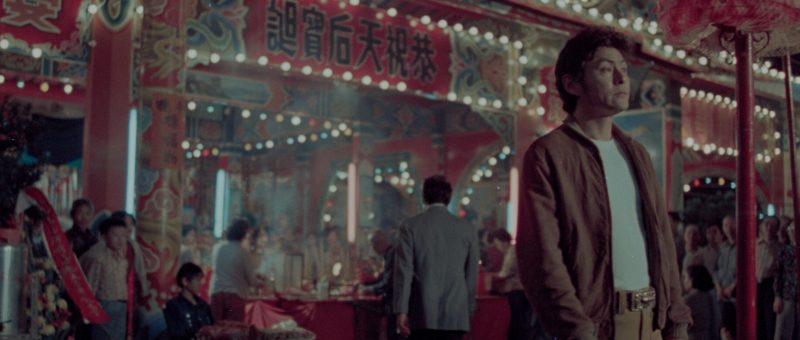
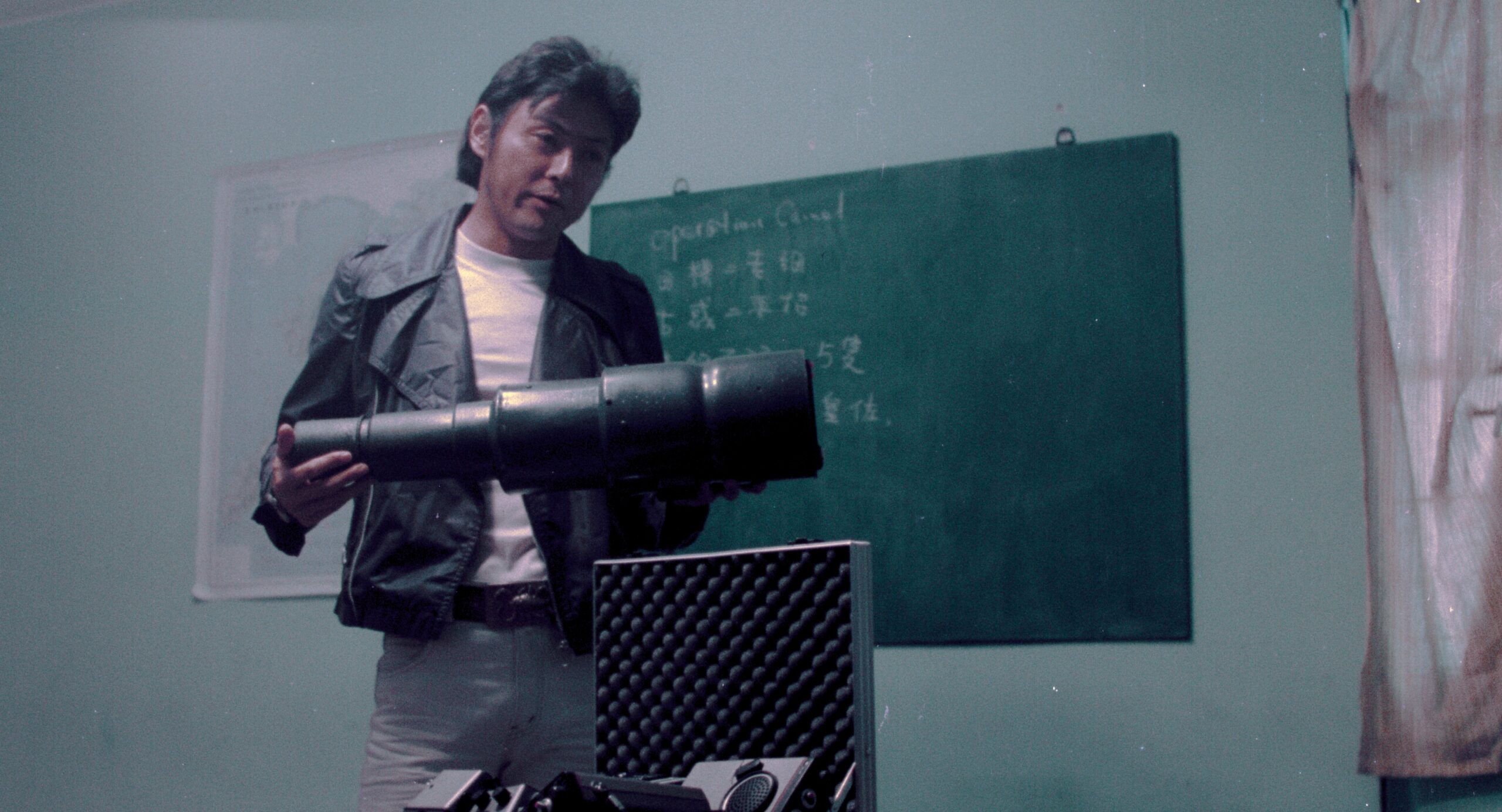
Chan’s bosses are British, while he later ends up working with an American DEA officer who gives them even more new technology like radio mics, though Chan was already keen to show off their modern policing methods, which include things like hidden cameras, secret recordings, and a massive telephoto lens. “We’re just using each other,” the corrupt cop says when his partner asks him if he’s not pushing his luck by going back to ask Third Auntie for more money after noticing how big her haul is knowing that she can’t really do anything about it without exposing herself. In the end, they are all trapped by this ridiculous system of symbiotic crime that leads only to destruction.


The System screens as part of this year’s San Diego Asian Film Festival.

Remember What I Forgot (曾經擁有, Keian Chui, 2022)

Shot in 2017 and held back until recently, Remember What I Forgot (曾經擁有) is one of series of films that suggest Hong Kong cinema is becoming a thing of a bygone era. The conceit is that the hero literally cannot remember as he has early-onset dementia and is to some extent stuck in the past or at least using Hong Kong cinema as a means of anchoring himself in a society that’s constantly changing as demonstrated by his quest to find a copy of Perter Chan’s 1996 film Double the Trouble which has gone out of print. 

Kim (Philip Keung Hiu-Man) lives with his cousin, Wan, who is also afraid to move on because he’s worried Kim won’t be able to find his way home if they leave his moribund repair shop. Kim otherwise spends his time hanging out on film sets and watching movies at the cinema and at home which is what has convinced Ginger Keung (Fish Liew), a journalist working for a trashy TV expose show, that Kim maybe the so-called “Prince of Darkness”, a film reviewer who posts scathing takes on movies on his blog and has become the enemy of all Hong Kong film producers. 

It’s surprising they afford him so much power, but it does seem that love or loathe it his writing is eagerly awaited. Ginger tries to befriend Kim in order to exploit him by exposing him as the prince of darkness on her TV show though finds herself conflicted on realising his condition. Kim is also the only one who remembers Ginger as a screenwriter and apparently liked her film, The Movie Exorcist, which he described as “nonsensical” and having “no commercial value” but also the most fun he’s ever had at the movies. A dark satire of the death of the film business in which ghosts buy tickets in a haunted cinema, the film had been an expression of the frustration Ginger felt graduating film school but being unable to find any work. This is perhaps why she’s become cynical about Hong Kong cinema which she describes as lacking in passion. 

Having regained some of the memory he’d lost, Kim laments that he just wants to remember everything about Hong Kong cinema and doesn’t understand why no one else seems to care. Given his condition, his mind sometimes “remembers” scenes from classic movies such as Infernal Affairs and Comrades Almost a Love Story as if they had actually happened to him, which in a way they have because they’re a part of the history of Hong Kong of which he has now become a sole guardian. Poignantly, it seems that the reason he always goes to the same cinema and books the same seat is that he’s waiting for someone, but has also forgotten all about it and no longer remembers why he goes there except for his intense love of Hong Kong film.

Ironically, Kim’s becoming a movie star too in that Ginger is intent on filming him for her show while simultaneously feeling guilty for taking advantage of him and wondering if she really has what it takes to be this kind of ruthless “journalist” ready to upend someone’s life and expose them to censure and ridicule for view numbers. Maybe it was easier when she thought he was a snarky bastard trashing Hong Kong films for clicks in much the same way her show trash talks people’s “dirty laundry,” than when she realised he may be being exploited by someone else and in any case just has high standards because he loves Hong Kong cinema so much that he wants it to be better. Having remembered something, Kim tries to revisit an old cinema to keep an appointment, but it’s already been closed down as there’s no way back to that moment. Kim cannot find his way home except in the movies because that Hong Kong no longer exists anywhere else. Nevertheless, he seems determined to reclaim and preserve as much of it as he can while righting old wrongs and keeping that appointment even if the person he’s waiting for likely won’t arrive. It’s his enthusiasm that guides Ginger back from her cynicism, causing Ginger to rediscover her own love for Hong Kong films and re-evaluate her current line of work while helping Kim to achieve his dreams of keeping it alive.


Trailer (Traditional Chinese & English subtitles)

The Killer (喋血雙雄, John Woo, 1989)

“We’re outmoded characters,” a dying man laments, having previously advanced that “nostalgia is one of our saving graces.” The heroes of The Killer (喋血雙雄) are indeed remnants of an earlier time, out of place amid the modern city and adhering to a code that has long since fallen by the wayside. “Our world is changing so fast,” hitman Jeff (Chow Yun-fat) exclaims of a Hong Kong hurtling not only towards the Handover but an increasingly amoral capitalism in which friendship and brotherhood no longer have any currency.

We can tell this straightaway from the fact that the man who ordered the hit on the drug lord Jeff took out at the dragon boat races was his own nephew, Weng (Shing Fui-on). To tie up loose ends, Weng also sends his own hitmen to take out Jeff, who can’t be sure if his handler and best friend Sidney (Chu Kong) is involved in the plot to knock him off. Later in the film, Inspector Li (Danny Lee) asks what Jeff will do if Sidney betrays him, but he merely says that he will still treat him as a friend because he has been good to him in the past. Jeff says this in an abandoned church, echoing not only the codes of jianghu brotherhood now largely absent in the contemporary society but Christianising notions of forgiveness and acceptance. 

Jeff claims that he isn’t a religious man but appreciates the tranquillity of the disused chapel. Inspector Li meanwhile is often pictured next a statue of the Buddhist god of war and dressed in black in opposition to Jeff’s white, but what emerges is that the two men are effectively the same and somewhat interchangeable. Jennie (Sally Yeh), the nightclub singer Jeff accidentally blinded during a a chaotic hit and subsequently falls in love with, first mistakes Li for Jeff while Woo also pictures him sitting in Jeff’s chair and pulling a gun on his partner in much the same way Jeff cooly dispatched an assassin sent by Weng. Chang had told Li that he looked exactly like what he was, an undercover policeman, which is obviously a problem, but Jeff remarks that he is a “very unusual cop,”while Li agrees he’s a very unusual killer. 

In some senses, Li will also become the killer of the film’s title in the closing moments, a man who believes in justice but is not himself believed and knows that there will be no real justice for a man like Weng. Both men share a code which is essentially the same, a more primal kind of morality largely incompatible with the modern society and in many ways rightly so. Li even says that Jeff does not look like a killer, that there’s something “heroic” about him, and that his eyes are full of passion as if he had a dream. His words have a kind of irony to them, but Jeff does indeed have a dream in the desire to gain redemption for himself by restoring Jennie’s eyesight, which is the reason for his last big job having now been reformed by her no longer believing that the people he killed deserved to die but that everyone has a right to live.

Despite the triangular relationship with Jennie, there is an undeniably homoerotic tension in the connection between Li and Jeff even if they are also two sides of the same coin. They train their guns on each other and lock eyes, but unexpectedly find a kindred spirit in a man who should be an enemy. “The only person who really knows me turns out to be a cop,” Jeff chuckles but has an equally deep relationship with handler Sidney just as Li has with parter Chang (Kenneth Tsang) while the homosociality that defines their world is subverted by Weng who simply shoots his own underling when he becomes inconvenient to him. 

Both Li and Jeff are effectively men left with “no way out” and “nowhere to go” because their code of brotherhood is no longer understood by the contemporary society. Jennie’s progressive loss of sight also echoes their dwindling futures as if the light were going out of their world long before Woo shatters the statue of the Virgin Mary and unleashes the doves of futility inside the no longer quite so tranquil church that becomes the final resting place of manly honour and brotherly love. “Perhaps we are too nostalgic,” Jeff sighs but nostalgia is indeed his saving grace in a world in which honour and friendship exist only in a mythologised past or may never have really existed at all.


Trailer (no subtitles)

Good Game (觸電, Dickson Leung Kwok-Fai, 2025) [Fantasia 2025]

Maybe esports don’t sound that intense, but it turns out that they require a good deal of physical training and stamina. Which is to say that like many other athletic pursuits, there’s an invisible age cap in which players are often written off at a comparatively youthful age because their reaction times might be slower or they might struggle to pick up on new strategies or ways of playing the game. But that’s only part of Solo’s problem. He’s never exactly been a team player, but esports is all he’s ever known and he’s fiercely resentful of being edged out by a bunch of 20 year olds.

Dickson Leung Kwok-Fai’s Good Game (觸電) is really in part about how one is never really “too old” to make a go of something. But also about growing up, which doesn’t necessarily mean abandoning your dreams, but perhaps becoming a little more aware of the reality along with gaining self-awareness about the self-sabotaging effects of your behaviour. Meanwhile, Hong Kong is changing too, but is clinging on to the past really the best thing you can do?

Nowhere more is this change being felt than in Tai’s internet cafe. As is pointed out to him, kids play games on their phones these days, so establishments like his no longer have as much to offer. His bright idea is entering an esports tournament, not only for the prize money but to advertise the cafe and bring the customers back. But the problem is that his best customers are an elderly couple who’ve ironically started coming to the cafe for stimulation because the games help stave off Auntie Lan’s dementia, while her husband, Golden Arm, turns out to be actually quite good at them. 

To win, he wants to recruit Solo, a formerly successful esports player. His team has just been disbanded after losing a championship, but Solo doesn’t want to give up yet. He refuses to believe that his esports career is over just because he’s nearly 30, but also doesn’t want to lower himself to playing with the oldies on the Happy Hour team even though no one else he called wanted to join in because they all moved on from esports ages ago or just don’t want to deal with his drama. As his name suggests, Solo is somewhat egotistical and hasn’t figured out the reason his team kept losing was because of a lack of teamwork and trust. 

As his friend points out to him, Solo can only devote himself to esports because his parents are still supporting him financially, whereas he had to do two part-time jobs just to make ends meet because the economy’s rubbish and unemployment is sky high. Esports is not viable nor long-term career choice, but it is a lifeline for people like Tai, Golden Arm, and Auntie Lan who can find purpose and community in gaming that allows them to carry on fighting even when their problems seem insurmountable. 

With an inevitable rent hike looming, Tai is urged to look for smaller premises but stubbornly tries to hang on. Yet like many recent Hong Kong films, Good Game seems to say that it’s alright to let go of a fading Hong Kong or at least to try to grab on to the parts that matter most and take with you what you can carry while embracing the community around you. Tai’s daughter Fay’s inability to stick at her jobs hints at this sense of restlessness, but also a changing dynamic in the younger generation that won’t be satisfied with a dull but steady job that pays the bills but nothing more. Though Solo’s former teammate gets a regular job selling insurance to try to gain some kind of financial stability, he still returns to coach the team and is then offered another job doing the same. Winning or losing don’t really matter as much as playing a “good game”, which means learning to work as a team and make the most of everyone’s unique skills while trusting them to do their best and have your back. Leaning in to video aesthetics in interesting ways, the film creates a sense of immersion in its virtual world but equally a sense of warmth and solidarity in the real one as the rag tag team band together to fight for their right to continue fighting. 


Good Game screened as part of this year’s Fantasia International Film Festival.

Trailer (Traditional Chinese / English subtitles)

Montages of a Modern Motherhood (虎毒不, Oliver Chan Siu-kuen, 2024)

A title card at the end of Oliver Chan’s Montages of a Modern Motherhood (虎毒不) dedicates the film to all women who chose not to become mothers, and it’s true enough that the picture it paints of contemporary child rearing is relentlessly bleak. Governments in much of the developed world are fiercely trying to encourage more couples to have children, but few are really addressing the reasons why they aren’t while the ways people live their lives have undeniably changed rendering commonly held notions about parenting incompatible with the contemporary reality.

A case in point, Jing (Hedwig Tam) lives a long way from her birth family and is not surrounded by a supportive community network of other women in similar positions. Though her mother-in-law lives next-door and offers to help with the baby, it soon proves more trouble than it’s worth as she more or less takes over and runs Jing down in the process. Jing describes her to friends as “conservative,” and it’s clear that she disagrees with Jing’s parenting choices while also trying to exclude her from the family as if the baby were only her and her son’s. Ching, a fussy newborn who cries nonstop from morning to night, isn’t gaining weight and the mother-in-law immediately jumps straight to the conclusion that it’s because Jing’s milk isn’t good enough. According to her she doesn’t eat right, and going back to work may also have somehow caused a problem. Her unilateral decision to switch formula milk, tipping away all the breast milk Jing has been painstakingly expressing, without telling either of the parents is a huge overstepping of the boundaries and a betrayal of the trust Jing placed in her to look after her child, though of course the mother-in-law insists that she was only trying to do what’s best for the baby despite also having bathed her in burnt sutras.

The problem is compounded by the fact the in-laws seem to own the apartment they live in, which is why her husband, Wai, is reluctant to move closer to her family when she suggests it. As the oldest son, he is also supposed to be caring for his parents though in reality this of course also falls to Jing. As Ching’s crying is so loud and piercing, they begin receiving complaints from neighbours which eventually leaves Jing forced to take the baby outside in the middle of the night. This might not have been so much of a problem in the past before urban living environments became so cramped and people began having less children making the noise more obvious, but it’s nevertheless an unavoidable obstacle for the new parents who find themselves additionally pressured by the necessity of maintaining good relationships with their neighbours. 

To make matters worse, Jing’s husband Wai pats himself on the back for “helping” with the baby, which is after all also his responsibility so he should be doing his fair share. He still seems to operate with a patriarchal mindset that tells him the home and flat are Jing’s to take care of while his job is to earn the money. Both he and his mother seem to hold it against Jing that their baby is a girl. She asks him for more help, but he responds by getting a job that pays more but requires further hours. He spends evenings out with his friends and repeatedly fails to get the breast milk pump fixed despite frequent reminders before accusing her of “whining” too much when she tries to tell him how difficult it’s been for her stuck at home all day with the baby. Like his mother, his ideal solution is for her to give up work and devote herself to their home because they don’t “need” her money and her working is perhaps a suggestion that they might which offends his sense of masculinity.

But Jing wants to work for reasons of personal fulfilment and safety. As other women remind her, you need your own money in case there comes a time you need to leave, but also because some men keep a tight grip on the purse strings and often won’t give their wives enough housekeeping money. Jing was paying for a lot of the baby stuff herself out of the money from her job at a bakery, but after she loses it and her savings run out she has to ask Wai who isn’t keen to chip in. Ironically, her boss chooses to make her redundant when the bakery hits a bad patch because her colleague is single and at least she has her husband’s wage to rely on. Jing continues applying for similar jobs, but they all fall through when she reveals she is married with a newborn child. In the end, she lies that she’s single but the job only offers night work which is obviously no good for her situation.  

Her job was the last thing that Jing felt connected her to her old self. With no one to talk to but the baby, she fears the erasure of her identity and tells her mother that she misses the time that she was a daughter rather than a mother. She gets some support from a kind retired lady who looks after Ching and tries to encourage her, reminding her that it was different for their generation because they could just leave the kids in the house and ask a neighbour to check in on them and no one thought anything of it. But Jing still feels herself inadequate, as if she’s failing at motherhood or breaking a taboo by asking to have some sort of life for herself without being completely subsumed by the image of “motherhood”. The in-laws keep a little bird in a cage with which Jing seems to identify, even as its chirping adds to the noise and the constant thrumming of the breast pump raises her stress levels. Left with no real support, there is only really one way that Jing can escape from a world of sleeplessness and anxiety as she tries to find the smallest moment of peace and tranquility free of social expectation and the crushing guilt of maternity.


Montages of a Modern Motherhood screened as part of this year’s New York Asian Film Festival.

Trailer (Traditional Chinese / English subtitles)

Smashing Frank (搗破法蘭克, Trevor Choi, 2025)

Youth’s attempt to televise its revolution results in unforeseen consequences in Trevor Choi’s crime thriller Smashing Frank (搗破法蘭克). Giving Hong Kong a kind of comic book gloss, Choi locates the source of corruption in a thuggish gangster posing as a businessman and laundering his ill-gotten gains through a fake church all while claiming to be working for the prosperity of the city. Fed up with a world so obviously corrupt, Ayla (Hedwig Tam) and her friends attempt to fight back through theft and their mission of becoming robbery influencers in social media. 

It later becomes apparent that Ayla is doing most of this as a kind of revenge. Her sister took her own life after being sexually assaulted and becoming pregnant, while Ayla sacrificed her own bright future by assaulting a “rich pervert”. Despite having gained a first-class degree and being on track for a job as a hotel manager, Ayla now appears to have gone rogue and has lost faith in mainstream society and law enforcement which turns a blind eye to certain crimes to keep the peace. After being sentenced to community service, she teams up with childhood friend Hugo (Locker Lam) and Tao Chun (Kaki Sham), a man convicted of voyeurism who becomes their getaway driver, to do crime she describes as a kind of performance art.

Yet Ayla claims she’s no kind of Robin Hood and mainly in this for herself and the glory, explaining that she uploads the videos for “fun”. Nevertheless, she eventually realises that everything links back to the Unity Haven Church and its shady CEO, Ho (Ben Yuen). Ho has already been featured in the news having been accused of misusing church funds and as the gang discover may have links to human trafficking and child exploitation. But he’s also pretty well entrenched within the infrastructure of the city and otherwise untouchable. As such, he comes to represent the corrupt authoritarianism of the contemporary society while Ayla and Frank echo the protestors of recent years. Given the opportunity for a giant payout, Ayla tells Ho where to go and explains that her generation never got to have nice things, so the reason she robbed his jewellery shop was to show them that luxurious mansions were being built in the slums. 

He may be one of the old men that’s ruining the world, but despite herself, Ayla seems to be consumed with a sense of injustice that the rich get away with their crimes while people like her sister and grandmother are left to suffer. Through her influencer revolution, she intends Frank to become a kind of militia resisting the hyper capitalistic society on behalf of the youth it has betrayed. As Hugo says, if he had a regular job he’d never be able to buy a house anyway while others seem equally fed up with disappointing corporate existences that no longer provide a decent quality of life. Ho may be all about making the city prosper, but it’s mostly for himself and his friends rather than the wider society. 

Chelsea (Renci Yeung), Chun’s former associate running badger games, even says that they didn’t really care that she blackmailed them because they had bigger things to worry about. There is then a kind of solidarity that exists between the team in their shared victimisation under men like Ho and desire for the liberation of those like them that gives their mission a weight beyond simple rebellion, even if the constant flirtation between Chelsea and Ayla dangles like an unresolved plot thread. Even so, Ayla’s recklessness reeks of desperation as Hugo points out they may all die the following day but perhaps it wouldn’t be so bad as continuing to live like this. The nihilism that colours their lives is all pervasive, and perhaps a reaction to the imposition of authoritarianism and failure of the protest movement that causes Ayla to launch her revolution in the distinctly youthful space of the internet and spread the word through social media which those like Ho cannot fully control. Hong Kong media does not, she claims, report on certain crimes in the interests of making the city feel safe and stable for men like Ho which is why she had to televise her revolution herself. It may be a forlorn hope, but it’s all she appears to have while otherwise trapped in a world of constant corruption.


Smashing Frank screened as part of this year’s New York Asian Film Festival.

Trailer (Traditional Chinese / English subtitles)