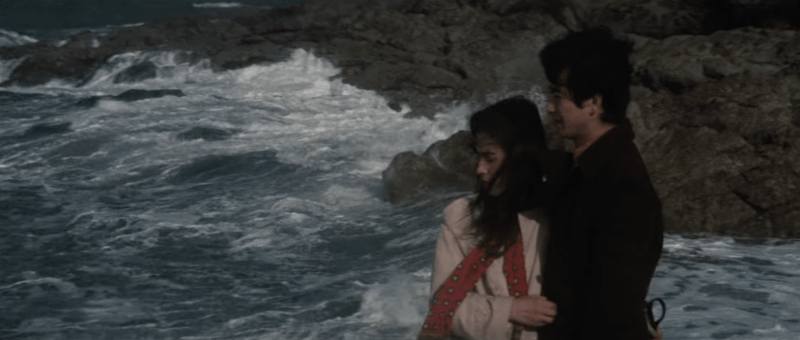
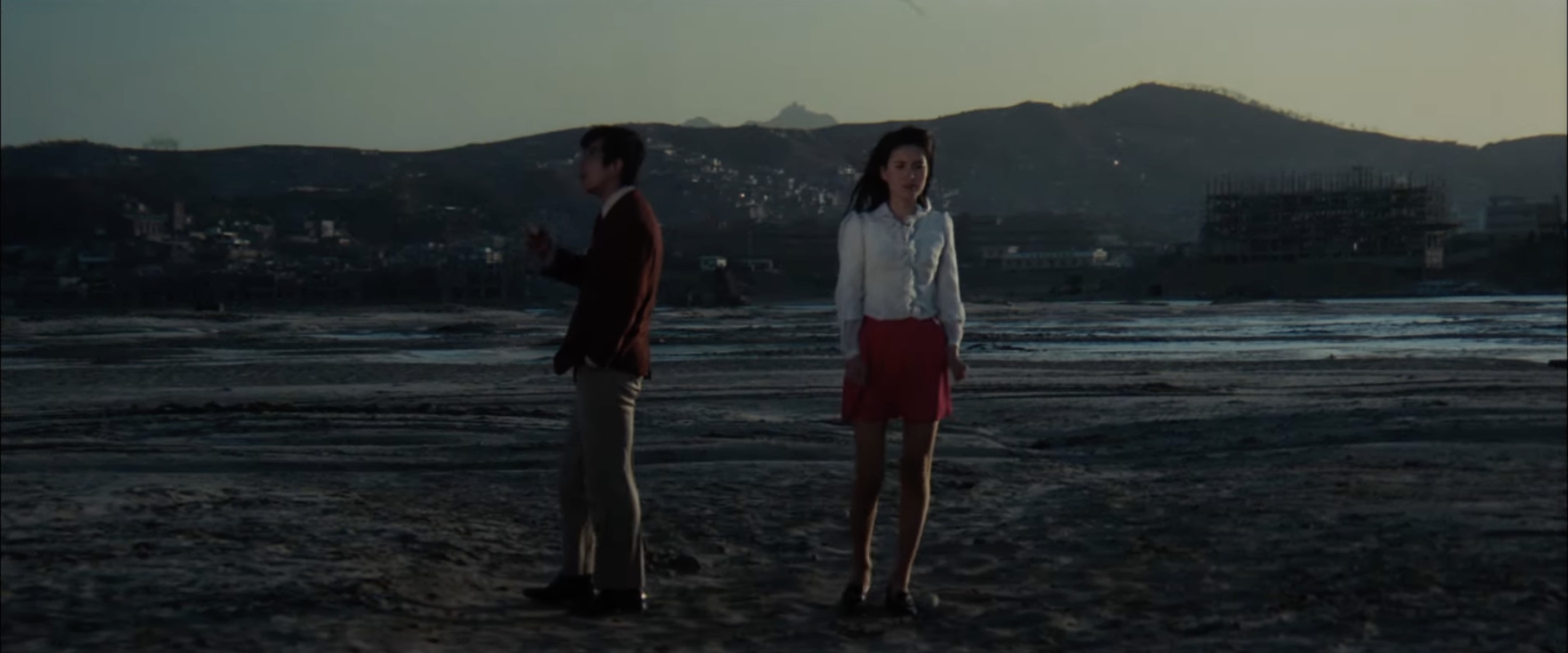
Full Ship (滿船 / 만선, Kim Soo-yong, 1967)

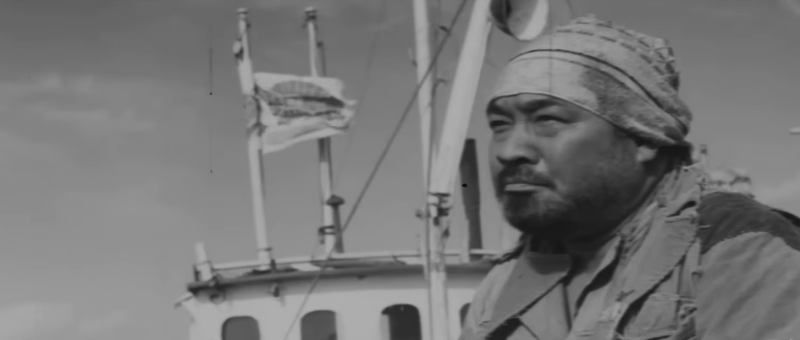
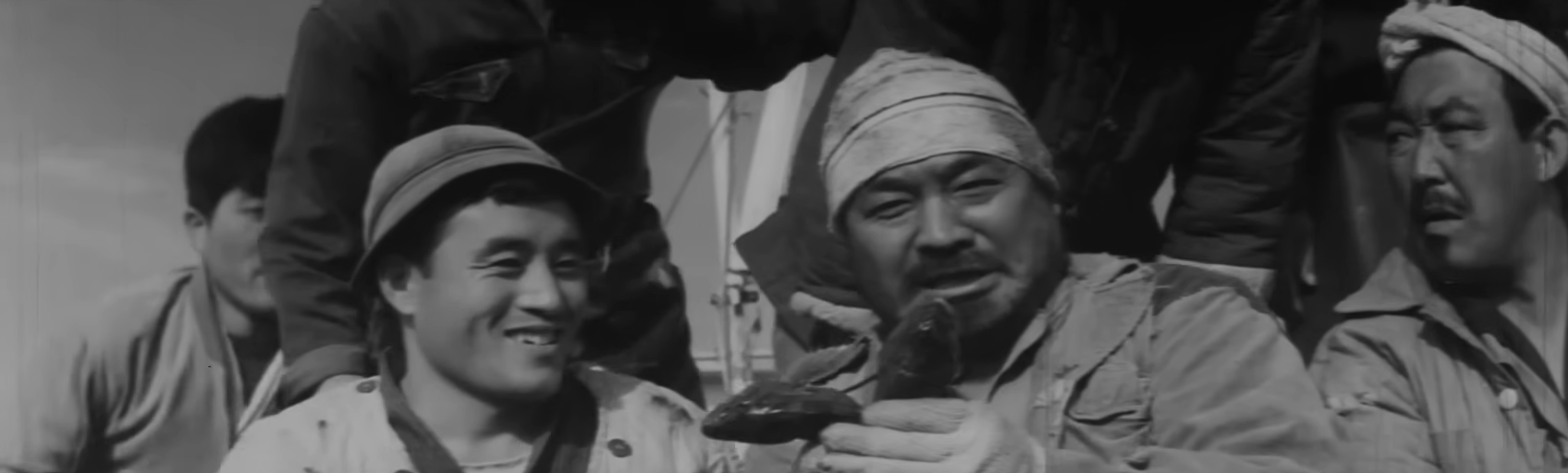
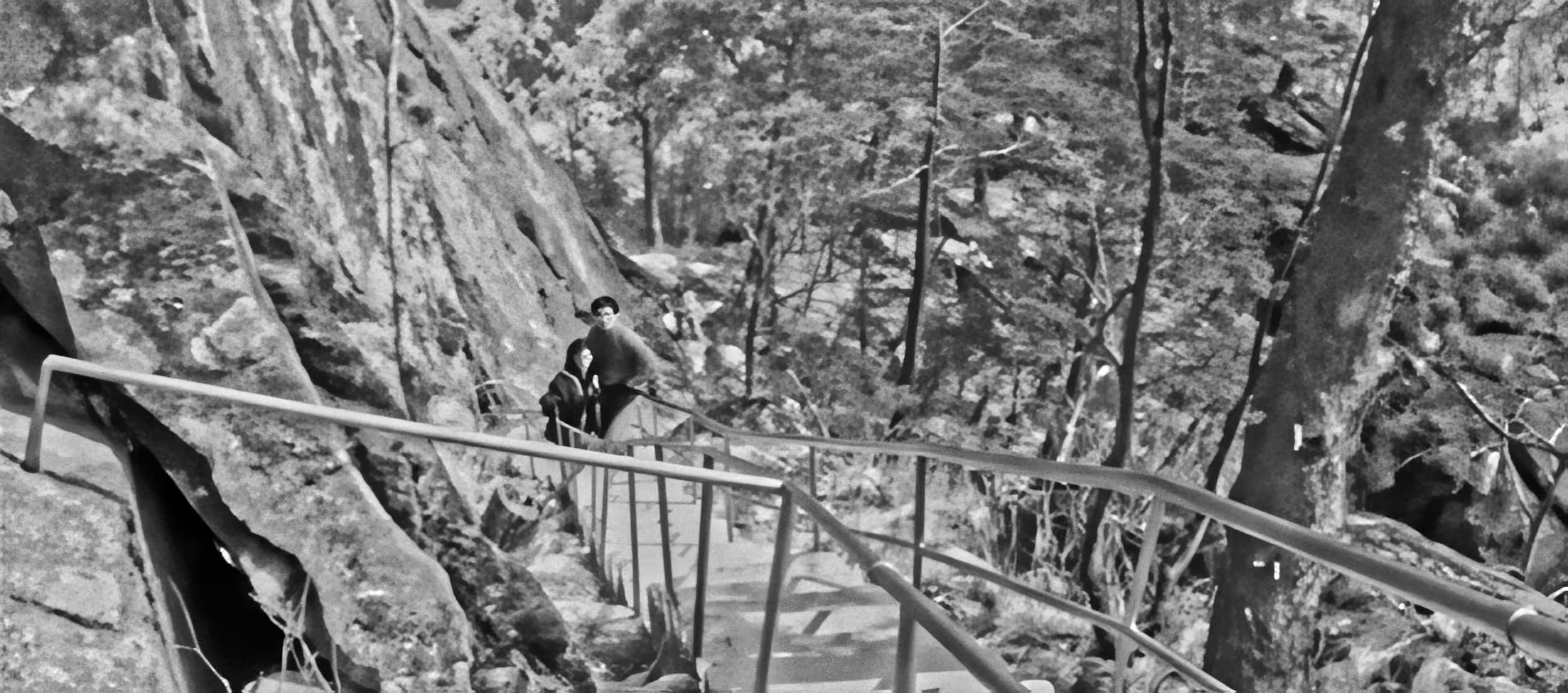
Released two years earlier, Kim Soo-Yong’s The Seashore Village had focused on the lives of women left behind while their husbands went to sea. Full Ship (滿船 / 만선, Manseon), meanwhile, more closely examines the lives of the men themselves along with the increasing pull towards modernity as this very traditional way of life becomes ever more precarious. Based on a play and another of Kim’s literary films, it nevertheless flies close to the wind in subtly challenging the effect that feudalistic capitalism has on each of these men’s lives as they find themselves dependent on the whims of the shipowner.

As Gom-chi (Kim Seung-ho) says, he’s fifty years old and he’s spent his life captaining someone else’s boat. Yet, he’s spent a lot of it toadying for the shipowner and justifying his reluctance to pay the fisherman by citing the shipowner’s expenses which include fuel for the boat, paying the union, and mending nets. The shipowner claims that he lives off debts and the fishermen actually owe him because he’s been lending them money and expects them to pay him back. Some of the other men suggest holding a gut ritual in his honour, but it’s unclear whether the shipowner is really as strapped as he says or merely hoarding all the money for himself. He dresses in fancy hanbok and looks more like a feudal lord than a contemporary business owner. When the fishermen do indeed come in with full boats and expect they’ll finally be getting what they’re owned, they receive only sacks of rotten hulled barely rather than rice. Still, most of them feel they have no choice than to suck up to the shipowner with even Gom-chi agreeing there are expenses to pay while drunkenly letting slip that he has savings and plans to buy his own boat only for the shipowner to find out and ban him from going to sea until he pays up what he owes.

Which is all to say, they’re between a rock and a hard place though “sea-crazy” Gom-chi holds tight to this way of life and has become estranged from his oldest surviving son Do-sam (Namkoong Won) who refuses to become a fisherman while Gom-chi’s wife, who has just given birth to a late baby though already in middle age, is opposed to letting their newborn grow up to go sea. They’ve already lost two sons to the waves, while Gom-chi’s father and grandfather were taken by the waters. To his mind, a fisherman dying at sea is merely going home and Do-sam is a failure and a coward for not following the tradition. 

He blames this on the fact that Do-sam left the island to do his military service and has become corrupted after seeing a different way of life on land. Another man who escaped the island, Beom-soe (Park Noh-sik), has returned wearing a suit and looking like a successful businessman, though as we later discover he’s on the run for a crime committed in the city, symbolising what the end results of this urban corruption may be. Seul-seul (Nam Jeong-im), Gom-chi’s daughter, is also tempted by the city while travelling there to sell goods though almost run over by a bicyclist on her arrival demonstrating its many dangers. People stare and laugh at them, as if the island women with their old-fashioned hanbok had emerged from another world. They laugh at Seul-seul too when she gives in to temptation and gets her hair set and styled into a beehive paid for by her boyfriend Yeon-cheol (Shin Young-kyun) who has also resisted the sea in favour of starting an innovative pearl farming business which is starting to pay off, though Gom-chi still seems resistant to their marriage. Beom-soe is taken with Seul-seul’s island innocence and tries to convince her to come with him with fancy presents from the city of soaps, perfumes, and silk, but she continues to resist him as if sensing that his urban success is not to be trusted. 

But, on the other hand, some seem to think it would be better to take their chances on land than continue with this harsh way of life. The film opens with a funeral in which a half-crazed old woman asks why they’re burying her son when he told her in a dream that he was alive just lost at sea. After a storm, Gom-chi comes back shouting of full boats, but they’re full of dead men drowned by the shipowner’s greed though he only complains about the damage to his vessel. Even the shamaness is a little bit corrupt, telling Do-sam’s mother that it would be inauspicious for him to marry because she’s having an affair with him herself, though prayers and rituals to the Dragon King are all they really have to protect them. Trapped between the sea and encroaching modernity that promises only more exploitation and misery, they have, as the poetic bookending narration suggests, only the life-giving, life-taking waters to turn to.


The Hut (피막, Lee Doo-yong, 1981)

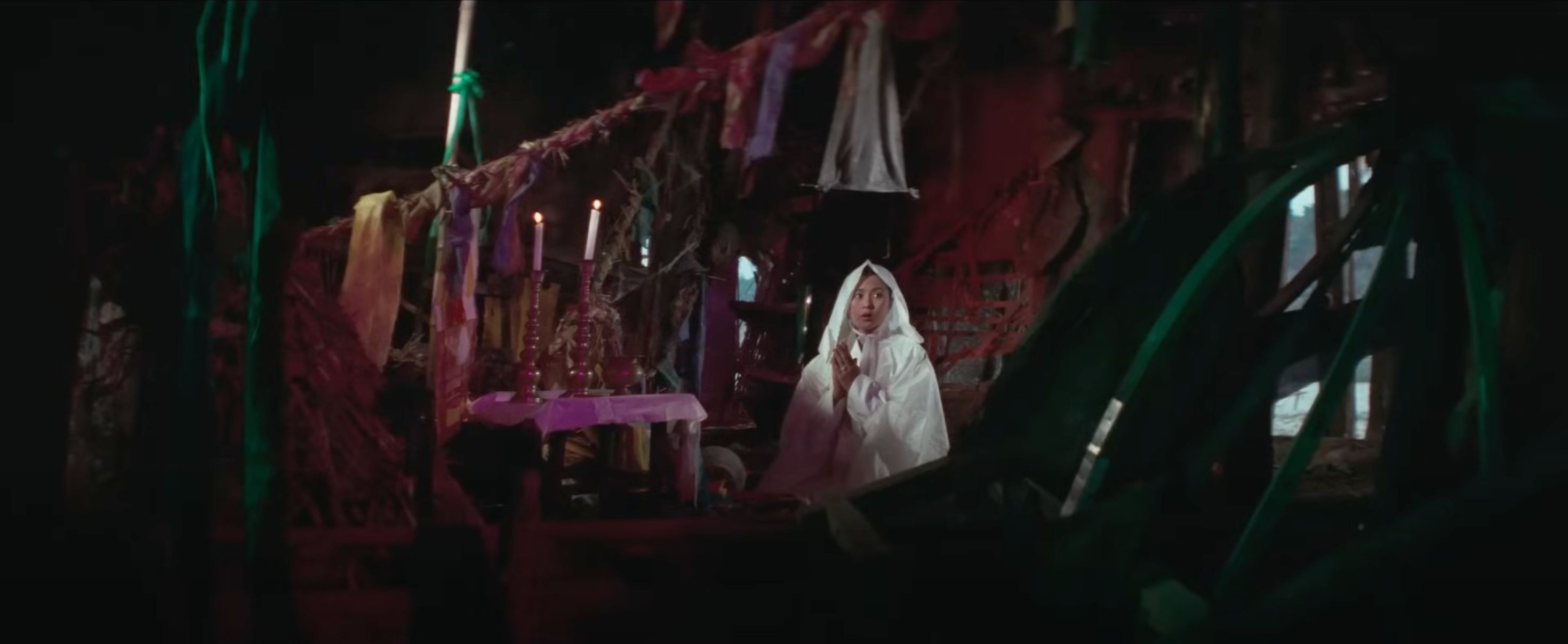
We’re told that the titular hut in Lee Doo-yong’s 1981 shamanism drama (피막, Pimak) is a like a stopping place between this world and the other. Babies are born there, but more usually it’s a place where the dying are sent to expire. Located in a more literal liminal space on the outskirts of the village, it presents a borderline that keeps the villagers safe from the taboo of death. They say the souls of those who die there cannot return to haunt the village, which is to say the village is a place free of death and also of the grudges of the past.

That is, however, not quite true. During the colonial era, the heir to noble house, Seongmin, has fallen ill and is likely to die but is being cared for at home by his desperate family who have invited shamans from all over the county in an attempt to cure him. This has obviously annoyed the village’s resident shamaness who is forever telling them they’ve made things much worse for themselves by sidelining her and shunning the local goddess, but the cause of the boy’s illness is quickly rooted out by Okhwa (Yu Ji-in), a powerful shamaness who leads the family to a buried vase in the woods which has been broken allowing the trapped should of Samdol (Nam Koong-won), the former keeper of the hut, to escape.

The Old Madam (Hwang Jung-seun) immediately admits that she was the one who put him in there, though she did not know where the vase was buried. The Gang family has a curse on it which results in many of their sons dying young before they could father sons of their own and leaving behind young widows which are perennial problem in the rigidly Confucianist, patriarchal society that some may argue continues into the present day but is certainly in the ascendent in the 1920s and 30s. As in many films of this kind, managing the sexual desires of young women, which are acknowledged as normal and natural, under such an oppressive system presents a key challenge to the social order. Given the taboo against second marriages, the family’s large collection of widowed daughters are seen resort to acts of self-harm in order to quell their desires in the absence of men. When the second daughter-in-law falls ill after stabbing herself in the thigh with a silver dagger, the Old Madam is sympathetic but believing she cannot be saved sends her to the hut to die. But before she does, the Old Madam also orders Samdol to sleep with her on pain of death so that she won’t pass into the afterlife with her needs unmet. The Old Madam is after all a widow herself, if an older one, and understands the frustration and desperation the younger woman feels. 

But the decision she makes breaks another taboo for as he points out himself, Samdol is the lowest of the low, a commoner who deals with the dead. Not only is the sex itself non-consensual, but threatens the social order in its transgressive qualities, crossing a class divide while also occurring outside of a marriage. Of course, it takes place in the liminal space of the hut where such borders meet. Described as quiet, honest, and reliable, Samdol is a kind man who also patiently nurtures the daughter-in-law back to health with medical herbs from his garden and eventually reveals to her what he was forced to do by the Old Madam but the two later fall in love and conceive a child which of course means they must both die in order to preserve the social order. 

Okhwa arrives as a kind of inspector exposing the poisonous past of Gang family which after all probably did do something untoward in order to become prosperous which is why there’s a curse on it. We get the impression that she may have ulterior motives and almost certainly knows more than she’s letting on while otherwise looking for information. She is not in fact a shaman, though her mother was and a fairly legendary figure at that, but later becomes one and with it a kind of avenger mainly for women who suffer under this system but also for men like Samdol abused by the feudal class order and forever at its mercy. The shamaness is also of course a liminal figure who lives outside of conventional society which views her with suspicion as a woman with both power and independence.

But even Okwha is subject to the unwanted attentions of men who despite their insistence on a woman’s chastity believe themselves entitled to her body, not only the head of the Gang family (who is actually elderly and presumably survived the curse), but men in Western dress who snatch and rape her. Thus the hut also exists at the nexus of tradition and a seemingly destructive modernity ushered in by Japanese imperialism. After recovering from his illness following Okhwa’s guk exorcism, Seongmin insists he just got better on his own and there’s no such thing as ghosts. We’re told he studied abroad in Tokyo and in fact dresses in a Japanese-style student’s uniform complete with cape. He tells his mother that they’re making scientific advances in Japan and that it’s ridiculous to think a ghost could have killed the Old Madam and the head of the family who died in odd circumstances during the guk along with his uncle in Western dress who had raped Okhwa. He proves to her scientifically that someone could have merely set traps for each of them and points the finger at Okhwa as a likely murderess rather than a gifted spirit medium.

Perhaps we more “rational”, modern people might agree with him but the film seems certain that there are indeed vengeful spirits haunting the landscape, those who fell victim to the hut mentality and were deliberately cast out and left to die by their society who effectively exiled them in their death. Okhwa can’t exorcise the evil ghosts of patriarchy, classism, feudalism, or sexual repression but she can perhaps in part symbolically end their tyranny by dissolving the border and burning the whole thing down. 


A Water Mill (물레방아, Lee Man-hee, 1966)

It’s not every day you wander into your own funeral. Or to be more precise, the death rite that Bong-won (Shin Young-kyun) unwittingly intrudes on in Lee Man-Hee’s feudal era fable A Water Mill (물레방아, Mullebanga) is for someone who died in a time no can remember. The old lady who explains it to him says that it happened long before she was born, implying at least the villagers have been enacting this ritual since time immemorial yet it’s almost as if Bong-won were walking towards a point of origin, drawn inexorably by forces beyond his control to play his part in this immortal ritual dance.

To that extent, Bong-won becomes a kind of “everyman” in this cautionary tale by virtue of the fact that he is nameless. Asked for his surname, he says he isn’t sure. It might be Kim or Park, later someone else says Lee which fills out the triumvirate of Korea’s most common family names. He says at one point that he doesn’t remember his mother, but thinks that she may have been a sex worker and his father a man who didn’t pay. But the fact he has no last name places him firmly at the bottom of the feudal hierarchy and most at the mercy of its hypocrisies and contradictions. He was on his way somewhere else when he fatefully found a sock floating the river that seems to flow towards him from his own future but that he will later gift perhaps to its original owner, the mysterious Geum-boon (Ko Eun-ah) with whom he falls in a deep, obsessive love that takes over the whole of his life.

Others in the village tell him that there is no such woman. An old man assures him she must have been some kind of ghost or supernatural creature come to trick him and Geum-boon does indeed take on a kind of eeriness. After deciding to stay in the village and look for her, Bong-won catches sight of Geum-boon in a forest glade bathing naked in a pool as the bright summer sun beats down on her but when he eventually makes his way down the mountain she has already disappeared. In chasing Geum-boon, he chases death but most evidently in the ways his obsession with her causes him to contravene the feudal order. He rebels against the landlord he was working for in refusing to collect her debt, then contracts himself to another in order to pay it so that he might marry her.

But ghost or not, Geum-boon is herself constrained by feudalism’s aggressive patriarchy. Force married to an invalid, she cared for him for three years until his death and then is pressed for his debts by the local landlord who wields them against her in order to claim her body. Married to Bong-won who has become an indentured servant, she is once again pursued by a landlord insistent on his droit du seigneur who exiles Bong-won to the pottery fields to get him out of the way. Geum-boon’s ambivalence does seem to give her a sometimes demonic quality as she laughs in the face of the landlord like something possessed and though she at first seems to like Bong-won and fear the attentions of the landlord she is also intrigued by the frankness of his current mistress who sees in her relationship with him the possibilities of transgressing class boundaries not to mention escaping a dull husband who will never be anything other than a servant. 

The film seems to suggest that Bong-won is powerless, while Geum-boon does at least have some power to wield. Even the landlord tells her that he has nothing to offer other than his money and power and even if becoming lady of the manor is a little far-fetched it seems unreasonable to criticise her if she did decide to become the landlord’s mistress as the path towards overcoming her circumstances lies in trading her body for influence. One could argue Bong-won does the same in leveraging his strength and his labour, but all it buys him is further exploitation and the eventual humiliation of knowing the landlord has been sleeping with his wife. 

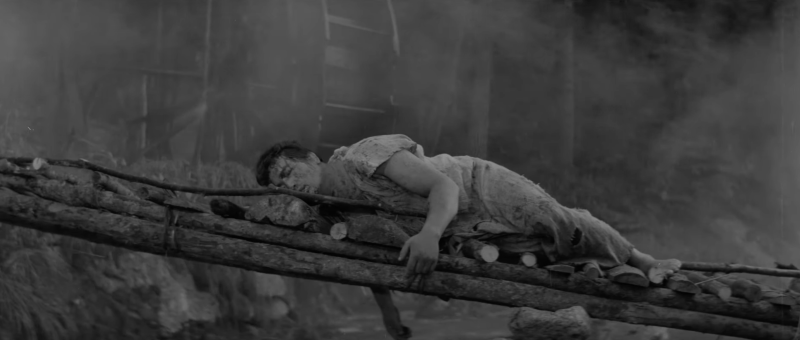
Feudalism therefore destroys natural human emotions such as love when all life is transactional in a constant, and largely futile, struggle for survival. Bong-won turns to the spiritual realm for help, asking a shaman how he can win back his wife but she gives him the rather bizarre instructions to steal three sets of underwear and throw them in the river on 3rd August while bowing to the west. Needless to say, that doesn’t work out very well for him. The fates truly do seem to be against Bong-won. Lee adds a touch of supernatural dread as Bong-won finds himself surrounded by howling winds as he fatefully makes his way towards the water mill and his destiny. The ritual dance is perfectly recreated as Bong-won and Geum-boon retake their roles in the play, their actions matching those of the masked players as Bong-won collapses on the bridge just as the demon had though there is no positive resolution in what is now both reality and fable. What we’re left with is the tragedy of feudalism, but also the maddening futility of obsessive desire for that which is and has always been ever so slightly out of reach.


A Fine, Windy Day (바람 불어 좋은 날, Lee Jang-ho, 1980)

Lee Jang-ho returned to filmmaking after a short hiatus having been temporarily banned for the possession of marijuana in 1980 with a fresh new approach focussing on the social issues of the day as Korea found itself in the midst of confusion following the assassination of president Park Chung-hee. Though many hoped for a new era of long-awaited democratisation, those hopes were soon dashed by another military coup and the continuation of oppressive dictatorship under Chun Doo-hwan. During his time away from the film industry, Lee had run a bar with his mother and it was there that he became more acquainted with the struggles of ordinary people.

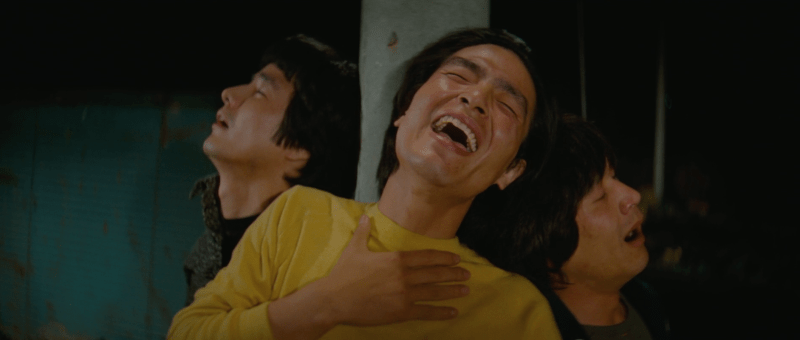
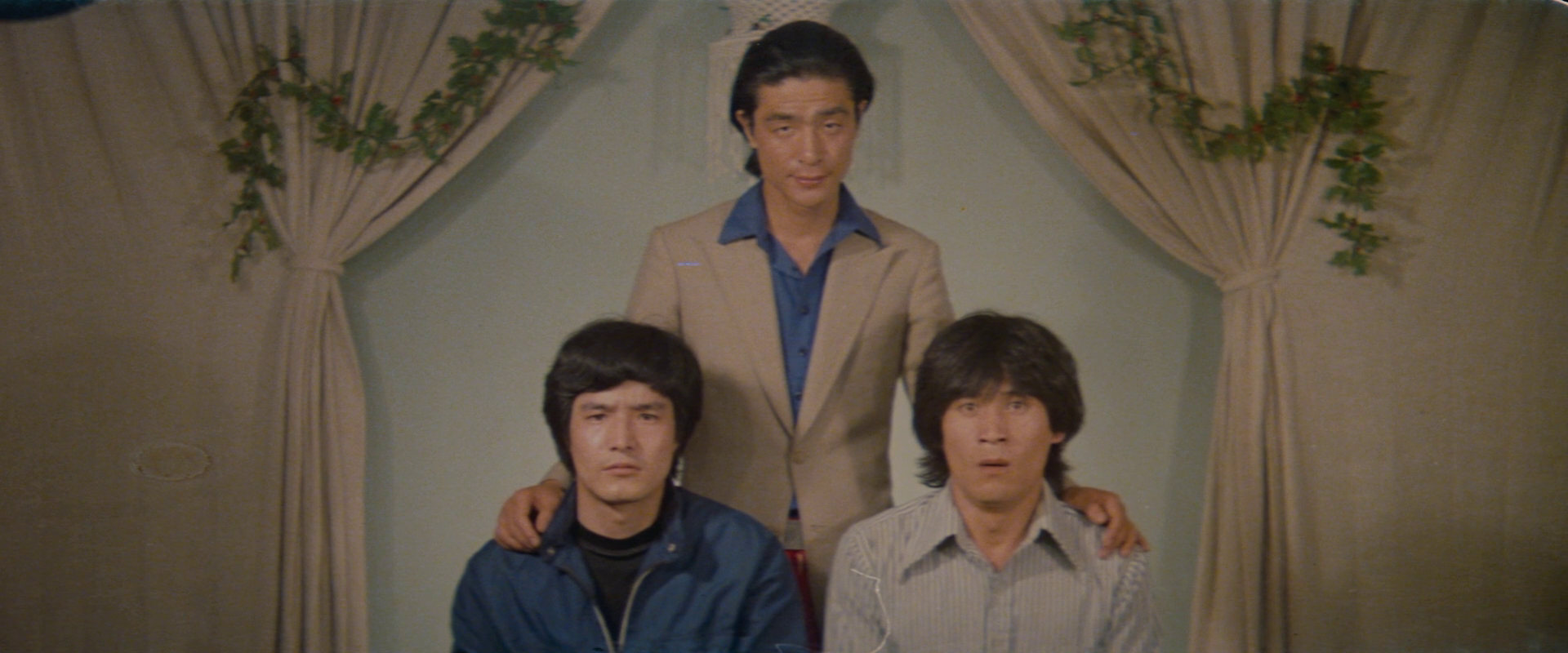
Adapted from a novel by Choi In-name, A Fine, Windy Day (바람 불어 좋은 날, Barambuleo Joheun Nal) follows three young men who have migrated from the countryside to Seoul in wider movement of urban migration. The sister of one of the men who later joins them remarks that there are no young people left in the countryside and her brother agrees that there is no longer any future in farming. Yet as the opening of the film makes clear in its idealised vision of pastoral life, it is really the expansion of the cities which has displaced the men and destroyed the natural habitats they once inhabited. The film often aligns the three with stray dogs who’ve come scavenging in the city because they can no longer survive in their rural hometowns. 

“It’s as if I’ve been taking a beating for two years straight from some invisible person” delivery boy Deokbae (Ahn Sung-ki) remarks during the film’s conclusion of his life in Seoul which does indeed seem to have been one long and bloody battle that had forced him into submission. As he tells equally naive country boy Suntae, he never stuttered before he came to the city but is now cowed and anxious all too aware of how the native Seoulites treat men like him. Daughter of a wealthy family, Myung-hee (Yu Ji-in) drives her own car around town, knocking over school children and not even bothering to stop until challenged by Deokbae for ruining the food he was currently in the middle of delivering. He later gets a telling off from his boss and his pay docked while she wraps her expensive scarf around his neck and promises to send compensation money to the restaurant where he works. 

Deokbae knows that Myung-hee is merely playing with him, her strangely childish glee like a little boy pulling the wings off a fly, yet he continues to associate with her. She laughs at him when he sits on the floor instead of the sofa after she ordered from the restaurant to get him to come to her house, and then tries to kiss him before becoming angry and pushing him away. Her posh friends later invade the restaurant and are drunk and rowdy, refusing to leave until a fight develops and they’re all carted off to the police.

But it’s only one of several degradations the men suffer at the hands of a new aristocracy not so different from the feudal elite. Chunsik (Lee Yeong-ho) works at a hairdresser’s where he is smitten with the pretty stylish Miss Yu (Kim Bo-yeon) who is being more or less sold by her ambitious boss and thereafter coerced into a compensated relationship with a sleazy businessman, Mr Kim, who was himself once a country boy but got rich quick through property speculation having cheated the old man who appeared in the film’s opening out of his ancestral land which has since been turned into the half-built slum inhabited by the three men. He is about to open a new shopping centre where the barber hopes to gain a prime position thanks to providing access to Miss Yu. The old man rails around the town demanding the return of his land, decrying that heaven will punish Mr Kim for what he’s done, and finally commits suicide in the newly completed building almost as it he were cursing it. 

The old man’s body is laid out on the last remaining stretched field where a shamanistic funeral song plays as a lament for the now ruined pastoral idyll which has been taken from each of the men and replaced with internecine capitalism in which wealth comes at the exchange of humanity. At the Chinese restaurant where Deokbae works, the wife of the dying boss had been carrying on an affair with the manager whom she hopes to marry once her husband has gone, while he expects to take over the shop though as is later revealed he is already married with children and technically performing a long con on her. The third man, Gilnam (Kim Seong-chan), works in a motel while saving money to open a hotel of his own but unwisely gives his savings to his girlfriend who runs off with them leaving him with nothing. He is then drafted for military service, receiving another blow from the contemporary Korea.

The man who spars with Deokbae who takes up boxing after his altercation with the rich kids is also wearing a shirt that reads “Korea” on the back and we watch as he is mercilessly beaten but this time refusing to give up reflecting only that he’s learned how to take a hit which is it seems the only way to survive in the Seoul of the early 1980s. The tone that Lee lands on is however one of playful irony, particularly in the meta-quality of the closing narration along with its victory in defeat motif as Deokbae acknowledges the need to roll with the punches which is also a subversive admission of the futility of his situation in which it is simply impossible to resist the system. A lighthearted but also melancholy chronicle of the feudal legacy repurposed for a capitalist era the film encapsulates itself in its bizarre disco scene as a confused Deokbae dances like a shaman, forever a country boy lost in an increasingly soulless and capitalistic society.


A Bloodthirsty Killer (殺人魔 / 살인마, Lee Yong-min, 1965)

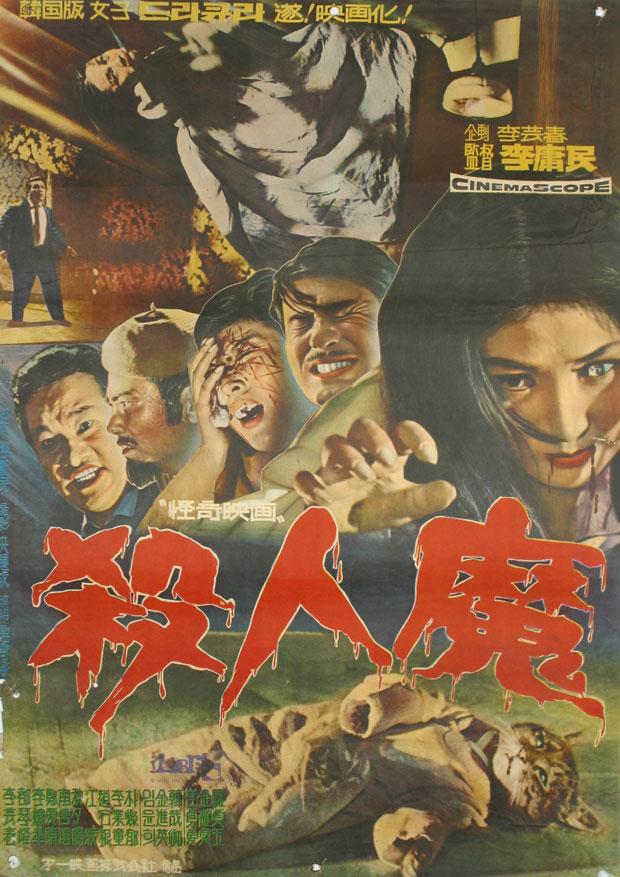
Clearly influenced by the classic Japanese ghost cat movie and the work of Nobuo Nakagawa, Lee Yong-min’s nightmarish slice of gothic horror The Bloodthirsty Killer (殺人魔 / 살인마, Salinma) winds a tale of female revenge though somewhat incongrusouly positioning the vengeful spirit’s oblivious husband as the hero who must attempt to save his family by exposing the corruption at its centre. That corruption is intensely and exclusively female but informed mainly by entrenched patriarchy along with growing anxieties amid increasing wealth disparity. 

As in Nakagawa’s The Lady Vampire, a woman makes a surprise reappearance 10 years after being declared dead looking exactly as she had the last time her husband saw her while also featuring in a painting though this time not in the nude but melting as soon as the confused hero, Simok (Lee Ye-chun), picks it up for a closer look. Lee opens with an incredibly gothic, dreamlike sequence in which a creepy man watches Simok walking in the rain before taking him to a gallery that turns out to be entirely empty. A security guard informs him that the exhibition is over, the painting of Aeja (Do Kum-bong) the only one remaining. It also transpires that Simok has made his trip on the one day a year ghosts roam the earth, as the creepy taxi driver points out gesturing towards a field which appears to be full of white-clothed figures. Eventually he arrives at an eerie house in the woods where he meets the main who painted the portrait only to see him murdered by Aeja while the painter survives long enough to hand him the painting and explain that it contains “a secret”.

This secret will relate closely to Simok’s family which on his return home we can see is affluent and apparently happy. Simok lives in a large, Western-style house that is perfectly primed for gothic horror. When he tries to explain to his wife, Hyesuk (Lee Bin-hwa), what he thinks has happened, a cabinet door mysteriously opens on its own before the couple begin hearing the screams of Simok’s mother who claims a ghost tried to strangle her in her room. All things considered, it does not actually take them very long to agree that ghosts are real and they’re being targeted by one though the reason remains obscure to all, or perhaps to all but Hyesuk whose demeanour immediately changes. Despite having gone into a frenzy when her eldest daughter Mihwa was snatched by the ghost, she quickly makes her way to her hidden stash exclaiming that she’s still “young and rich” and plans to enjoy the rest of her life. The ghost can take her kids, but it won’t get her. 

This is of course entirely contrary to contemporary codes of motherhood especially as we realise that one of the causes of Aeja’s downfall was her childlessness. Three years into her marriage with Simok, she had born no children and earned the animosity of her mother-in-law (Jeong Ae-ran) who it seems did not really like her and felt that she did not live up to her traditional ideas of idealised femininity. Perhaps partly for aesthetic reasons seeing as she is a ghost, Aeja dresses exlcuvely in hanbok in contrast to Hyesuk who in flashbacks is seen in only Western clothing and declares herself jealous and resentful not only of the couple’s material comfort but of how happy they seem to be. A kind of poor relation, Hyesuk plots revenge on societal unfairness in wilfully disrupting Simok’s household by manipulating patriarchal social codes in causing Simok to believe Aeja has been having an affair during his lengthy business trips to Japan.

By the same token, she also takes advantage of the grandmother’s affair with a married doctor (Namkoong Won) which is taboo on several levels the first simply being the existence of sexual desire in a middle-aged woman. Later, once she has been possessed by the ghost cat, Simok’s mother will similarly manipulate him in claiming that she has spent all her life in his service clinging to the memory of her dead husband who left her widowed at 30 as an advocation of idealised womanhood. Though Simok has realised that she was no longer his mother but a ghost cat on catching sight of her reflection, he was unable to kill her because of all her reminders about her maternal suffering. It’s the desire to maintain this facade that encourages her to reject Aeja after Hyesuk engineers her walking in on her mother-in-law and the doctor, insisting that Hyesuk, who is pandering to her, would make a much better daughter-in-law than the righteous and wronged Aeja. 

Aeja’s revenge is also against all of these oppressive social codes that have contributed to her demise though it was other women who eventually brought it about in their enforcement and manipulation of the codes of femininity. Recalling a moment from Hajime Sato’s Ghost of the Hunchback in a which a shamaness drops in having spotted all the evil emanating from the house, another woman later turns up and seems to want to help giving Simok a magic talisman he eventually uses to save his kids who have been imprisoned, perhaps for their own safety, inside some Buddhist statues. In contrast to Aeja’s rage, Hyesuk’s greed, and the mother-in-law’s shame, the mysterious woman is gentle and self-assured if a little eerie. Just as a cross can stop a vampire, so a Buddhist rosary can fend off a ghost cat while it’s an appeal to Buddha that eventually helps to break the curse transforming the portrait into a lotus instead. 

In any case, Lee adds a playful irony to the genre as the grandmother in particular begins to take on feline mannerisms, hissing and pawing at the Buddhist statues while licking her granddaughter’s face in a way even her grandson Woong realises is “disgusting” and not something his grandmother was usually accustomed to doing. In a nod to Yotsuya Kaidan, Aeja’s metamorphosis into a vengeful ghost is accompanied by a loss of her hair, symbolising her loss of femininity, along with a large disfigurement over her eye that has become closely associated with that of Oiwa. Then again, he also has fun with a transformation scene as the grandmother is defeated and turns back into a cat complete with a tiny dress that shrinks with her. What he otherwise conjures is however an eerie sense of dread hanging over a superficially happy home with a terrifying secret at its centre, though what it does in the end suggest with its ambiguous messaging is that the father will eventually have to take responsibility for his family and play an active role in the domestic space if he is to escape this very particular curse of familial corruption.


The Starting Point (원점, Lee Man-hee, 1967)

A hired thug and a sex worker dreaming of a new life are set on a collision course at mountain retreat in Lee Man-hee’s noirish thriller, Starting Point (원점, Wonjeom). A melancholy existential drama, the film nevertheless has a darkly comic absurdity and becomes for a time almost a satire of changing sexual mores and the anxiety surrounding the post-war population explosion while simultaneously hinting at corporate corruption in economically straitened times. 

Played in near total silence, the opening pre-credits scenes find the otherwise unnamed (the name given in the promotional material is never spoken) lackey (Shin Seong-il) raiding an office building with the intention of retrieving some mysterious documents the people who hire him later claim threaten to expose their “seven-year-secret”. The Lackey takes time to smoke a cigarette and read through some of the papers before putting them into a briefcase to make his escape but is soon met by a man with a rifle who challenges him. A fight ensues on the staircase from which the Lackey is able to escape, activating a rolling gate to get out of the building. But the other man keeps coming after him, managing to cling on the briefcase while his neck is crushed by the unstoppable motion of the shutter. 

Mirroring him, the unnamed Sex Worker (Moon Hee) is also intruded in a wordless sequence shot with the kind of realism seen in American independent and European arthouse cinema as she stares forlornly at the pretty dresses behind the glass in a small boutique before sadly making her way towards a streetlight near the Choseon Hotel where she wordlessly picks up a customer through suggestive looks and gestures. 

The Lackey knows too much, which is why his bosses want to take him out but for unclear reasons Mr Choi comes up with a bizarre and convoluted scheme which involves hiring the Sex Worker to pose as the Lackey’s wife during a honeymoon getaway to Mt. Seorak. What the Lackey thinks is going on or why the mountain is important is never really explained just like the nature of the seven-year-secret, but once there the film changes tack becoming a kind of ensemble mystery as the various guests each become suspicious of one another while the Lackey and the Sex Worker slowly fall in love for real perhaps bonding their mutual sense of existential peril and outsider status. 

In the liminal space of the mountain, both fear rejection by those around them who come to represent mainstream society, the Lackey because he has killed and Sex Worker because of her profession. Ironically, one of the other guests is a dodgy gynaecologist who makes a point of saying that most of his clients are sex workers from around the Choseon Hotel at least implying that he regularly performs abortions. He recognises the Sex Worker as a previous patient and tries to take advantage of her sexually but commits a breach of medical ethics by leaking her profession to the rest of the group who then shun her. When the planned camping trip encounters a snag seeing as only two tents have been provided and the obvious solution is for men to take one and the women the other, the women all immediately leave on the Sex Worker’s arrival refusing a share a space with a “fallen woman” in case they are somehow tainted by her shame. 

But then, the goings on at the mountain inn are strange in themselves. A middle-aged man who inexplicably doesn’t seem to have encountered a transistor radio before accidentally tunes into a news broadcast discussing the effectiveness of the contraceptive pill while the young people dance with wild abandon to music they don’t really understand. Meanwhile, the gynaecologist wades in when another of the women experiences terrible stomach pains insisting that he is “familiar with women’s issues” and informs the husband that his wife is pregnant which is confuses him because they only married the day before and he’s been a good boy so the news is perplexing. He spends the rest of the film counting dates on his fingers and at one point attempts to hang himself certain that his wife must have slept with another man before their wedding instead of maybe considering that the dodgy gynaecologist may be mistaken.  

When the couples are divided into separate tents, one guest quips that it’ll be good for keeping the birth rate down hinting at an anxiety about a new sexual freedom among the young coupled with the impact of the ongoing baby boom and its economic implications. The gynaecologist’s wife is the first to join in with the youngsters, but she’s also a rabid penny pincher making sure the newlywed husband pays for her husband’s treatment of his wife while intensely jealous constantly trying to keep the randy doctor’s attention off the other women. The sense of economic anxiety is echoed in the Sex Worker’s melancholy longing onto looking into the shop window while dreaming of opening her own hair salon though sex work is the only way she can support herself and leaves her with intense shame that like the Lackey exiles her from mainstream society. 

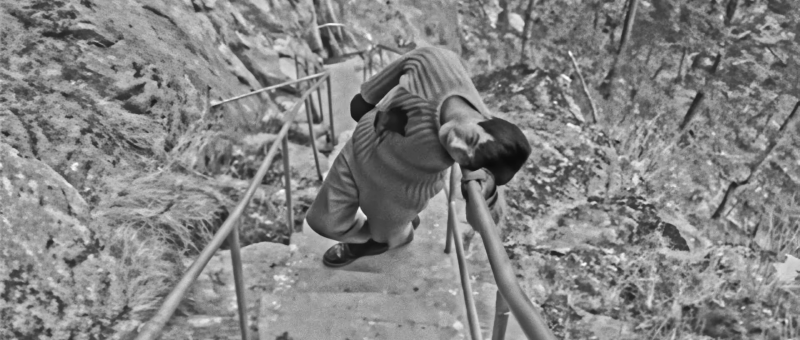
As she says while embracing her covert identity as a cheerful newlywed, she’s been looking up all her life and would like to look down for once which she ironically does atop the stairway on which the Lackey fights his existential battle with Choi and his minions. They each want to find a way to get off the mountain and return to the world, but are prevented from doing so by the forces that pursue them and will not let them go. Finally questioned, the Sex Worker is forced to admit that she knows nothing about the Lackey, not his name or where he lived or what he did for a living, only that he did not hate her which is as close to a declaration of love as it might be possible to get in this cold and dark world of exploitation and violence. Lee films with a noirish intensity and melancholy fatalism as the pair attempt to fight back against the forces which constrain them with the pureness of their love but later discover that, as they feared, all that is left to them are painful memories of momentary happiness. 


The Man with Three Coffins (나그네는 길에서도 쉬지 않는다, Lee Jang-ho, 1987)

“What a piteous soul who wanders around with sorrow.” The echoes of a funeral song haunt the melancholy hero of Lee Jang-ho’s Division Film, The Man With Three Coffins (나그네는 길에서도 쉬지 않는다, Nageuneneun kileseodo swiji anhneunda). Adapting a novel by Lee Je-ha, Lee Jang-ho positions the divided nation as a more literal kind of limbo filled with wandering ghosts and souls who no longer have a home to return to in which the echoes of shamanism ring with fatalistic intensity.

In Lee’s elliptical screenplay, moments replay and reverberate in a stream of memory that echoes the protagonist’s fractured state of being. What eventually becomes apparent is that he is on a quest to return his wife’s ashes to her hometown, the problem is that she was one of many displaced by the Korean War. She became separated from her parents and no longer knew where her hometown was except somewhere in the North. The man who is being discussed in the opening sequence, Mr Kim, is also on a quest to return to his hometown but like that of Sun-seok’s wife (Lee Bo-hee) it lies in the North and it is unlikely he can reach it. The old man tightly grips a photograph of his family before the war, finally releasing it only when some henchman working for his son who only sees the South as his home come to retrieve him and destroy his hopes of dying in the place where he was born.

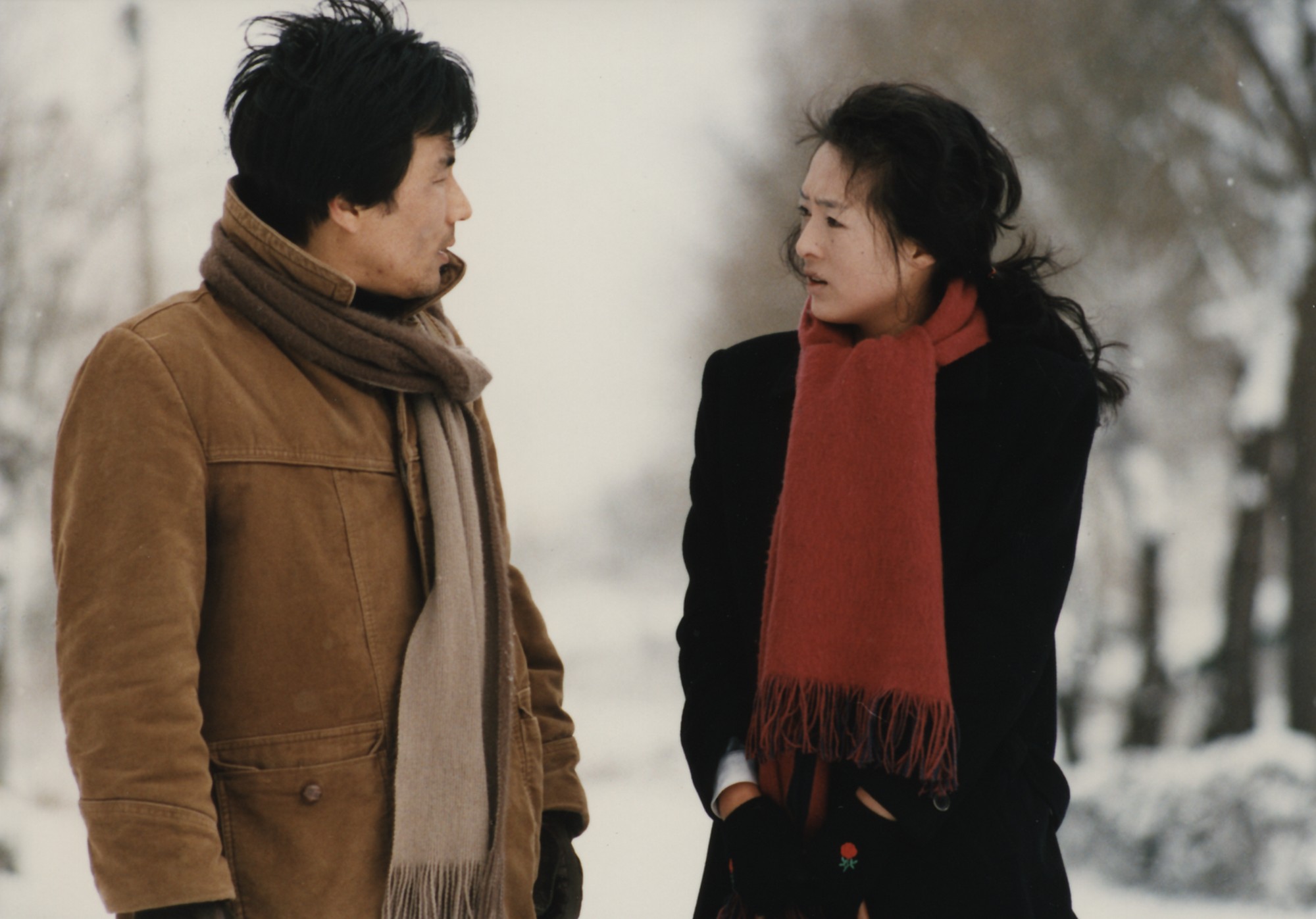
During his journey, Sun-seok (Kim Myung-gon) passes a sign which reads “Road to Reunification” but the bridge alongside it has been removed with only the supports remaining like thorns embedded in the landscape. Another sign reads “Restricted Area” marking the line beyond which Sun-seok cannot pass, like the man in the funeral song unable to pass through mountain or water. As he nears his destination, Sun-seok’s paths are blocked by snow preventing him from moving on or from returning to his ordinary life in Seoul. He is in more ways than one a purgatorial figure, a man already dead but trapped in the mortal realm even as the shamans attempt to guide him towards his rightful direction, a direction which Sun-seok may finally realise only on witnessing a woman with whom he may have fallen in love join in with the shamanistic dance though she two had been as soulless as he was and it may be impossible to say which of them is bound for the land of the dead. 

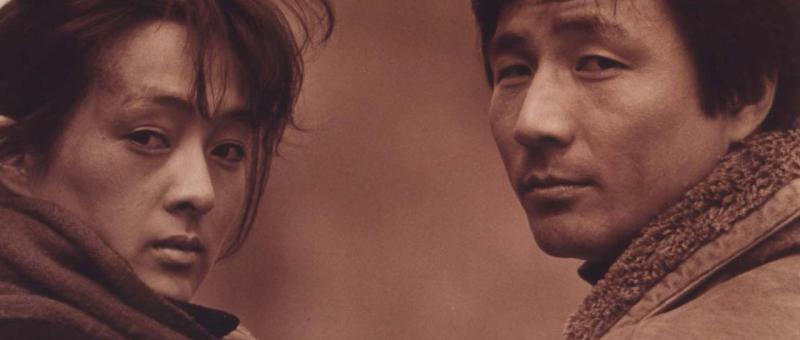
Mrs. Choi (Lee Bo-hee), the only woman given a name, remarks that a shaman had told her that at 30 she would meet a man by a river who was carrying three coffins and that this man was her husband in a previous life. This might explain why all of Sun-seok’s women are played by the same actress, as if they are all echoes of the same soul though equally it could reflect Sun-seok’s myopic view in which there is only ever really one woman. In any case, their connection seems both fated and frustrated because in this divided world there are only ever partings. Unable to reach his destination, Sun-seok scatters his wife’s ashes in the closest town to the DMZ, the same town where Mrs Choi and Mr Kim are also prevented from moving forward though in this case pulled back towards the soulless capitalism of the contemporary South as symbolised by Mr Kim’s son and his political ambitions. 

The implication is that is the division itself which caused the death of Sun-seok’s wife, ultimately unable to reconcile the division within herself and eventually consumed by it. Her death is echoed in that of a sex worker who dies gripping her throat and foaming at the mouth shortly after an encounter with Sun-seok, while a sex worker he meets in another town suffers a similar fate as if he were somehow spreading death along his way bringing him to his three coffins, which are in a way one and also four including perhaps his own. The washed out red of Lee’s distinctive colour palate lends the dusty land a hellish glow while the unusual camera techniques, a copulating couple superimposed on Sun-seok’s playing cards and a giant hand suddenly appearing in the sky for example, add a sense of ominous dread enhanced by the constant intrusions of shamanic ritual. It seems that as the song says, a funeral lament for a boy who disappeared feared drowned but also for Sun-seok himself, he really can’t go anywhere and is condemned to wander, a lost soul in a divided land who cannot any longer return to his home.


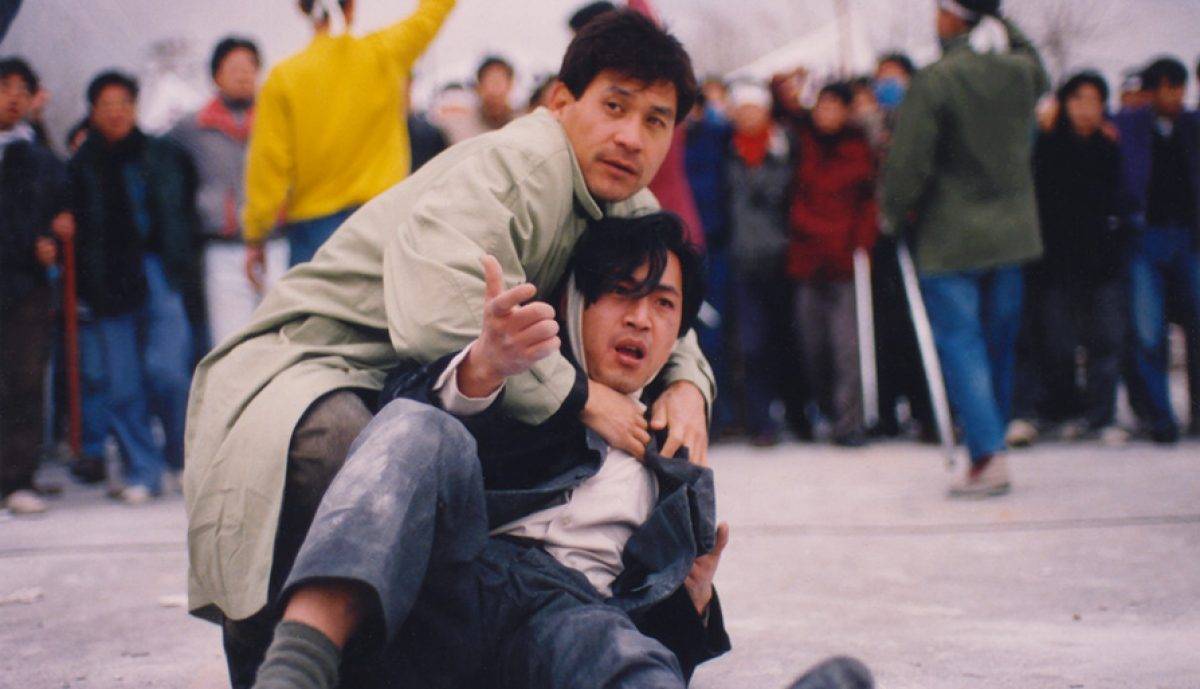
White Badge (하얀 전쟁, Chung Ji-young, 1992)

Change was in the air in the Korea of 1979. Park Chung-hee, who had seized power in 1962 by means of military coup and thereafter ruled as a repressive dictator, was assassinated by the head of the KCIA for reasons which remain unclear. A brief window of possible democratic reform presented itself but was quickly shutdown by a second military coup by general Chun Doo-hwan who doubled down on Park’s repression until finally forced out of office in the late ‘80s. It’s into brief moment that Chung Ji-young’s White Badge (하얀 전쟁, Hayan Jeonjaeng) drops us as a traumatised reporter finds he is being given permission revisit the painful past now that they are finally “free” to speak their minds, but remains personally reluctant to open old wounds. 

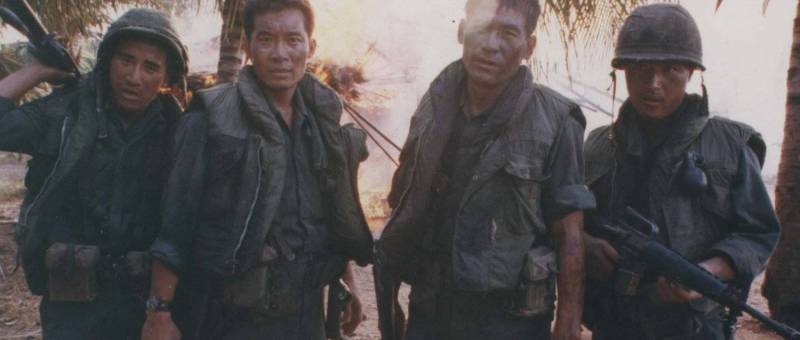
Han Gi-ju (Ahn Sung-ki) is a functioning alcoholic whose wife has left him and remarried though he still spends time with his small son who appears to adore his dad. In the wake of Park’s assassination, his boss wants him to write the true story of his experiences as a soldier in Vietnam, but Gi-ju is not convinced. He’s still haunted by nightmares of his time in the army and has no desire to go delving into his own painful memories even if it is perhaps the right time to let the people know how it really was. A little while later, however, he starts getting nuisance phone calls which turn out to be from an old war buddy, Byeon Jin-su (Lee Geung-young), who remains too shy to get in touch but later sends him a collection of photos and, somewhat worryingly, a pistol taken as a war trophy from the Viet Cong. 

We only come to realise the significance of the pistol’s passing at the film’s conclusion, but the fact remains that both men have been permanently changed, perhaps damaged, by their experiences in Vietnam only in different ways. Displaying obvious symptoms of PTSD, Jin-su has reverted to a childlike state, somewhat unsteady in his mind, and quickly flying into a panic on hearing loud noises such as helicopters or fireworks which return him to the battlefields and the terrible things he saw there. Gi-ju, meanwhile, is brooding and introverted. He drinks himself to sleep but is woken by nightmares. His marriage has failed and his only friendship seems to be with his editor who drags him to a karaoke box to schmooze a wealthy friend from school who, somewhat ironically, made most of his money manufacturing weapons used in Vietnam while never having to serve himself. “What’s wrong with that?” he asks, “We made money thanks to President Park. When President Park died, my dad cried.” unwittingly outlining the entire problem and in fact embodying it as he continues throwing his money about with the excuse that the only thing to do with dirty money is spend it dirtily. 

Prior to that, he’d criticised Gi-ju’s manhood by betting that he’d never actually killed a Viet Cong soldier. Gi-ju laments that all anyone ever wanted to know about Vietnam was how much money he made and whether he bedded any Viet Cong women. They never wanted to know the reality of it, that he found himself increasingly disillusioned not just with his country and the war but with “human values and history”. While in Vietnam he witnesses street children chasing soldiers for candy and flashes back to his own days as a street orphan after the Korean War tugging on the sleeves on American GIs who crudely threw him only empty packets of cigarettes. The colonised is now a coloniser and it’s an uncomfortable feeling. On a long march, Gi-ju and another soldier pass an old man along the wayside who keeps shouting “pointless” and explains to them that in his 70 years he’s seen many people walk along this road. First it was the Chinese, and then the French, the Japanese, the Americans, and now the Koreans. If you truly want to help, he says, go home and leave us in peace. “We don’t care who wins, we just want to farm and nothing else. So please leave us alone”. 

The utter senselessness of their presence is further brought home to Gi-ju when his unit panics and fires on what it thinks is a huge unit of Viet Cong soldiers, but actually turns out to be a field full of cows. The locals are obviously upset, demanding compensation, but his Staff Sergeant is unrepentant, little caring that they’ve just destroyed the local economy and the ability of these ordinary people to feed themselves in their panic and incompetence. Yet in his first few pieces for the paper, Gi-jun recounts that the first six months were ones of ambivalent tedium in which they mostly dug ditches and bonded over beer. They were torn, hoping it might stay this way but also embarrassed by the thought of going home with no combat experience. 

As time goes on, however, they find themselves on ever more dangerous missions only to discover that they have been used as decoys, their heavy casualties dismissed as “small sacrifices of war”. Betrayed by their country, these men were also forced to betray themselves. After firing on civilians in panic, the Staff Sargeant orders his men to kill the survivors to cover up his mistake, threatening them at gun point. One is never quite the same again, and the other finally kills his superior to avenge his transgression. Gi-ju is not witness to these events, only to their effects, but is obviously aware of the cruelty that his service entails. 

Dissatisfied with his first manuscript recounting a humorous episode from the early days, Gi-ju’s boss tries to curate his memories, asking him for a cliched anti-war tract about how combat turns intellectuals into cowards while the ignorant are reborn as heroes. Something much the same happens with a documentary crew on the ground who actively ask the soldiers to re-stage the action for the camera. Everyone has their Vietnam narrative, and no one is quite interested in the full horror or the present pain of these wounded men. Reuniting with Jin-su whose mental state is rapidly declining, the pair are caught up in a democracy protest by students who actively resist the draft and the militarisation of education, ironically on the other side, targeted by men like they once were. Abandoned by a country which essentially sold them as mercenaries to curry favour with the Americans, Jin-su and Gi-ju struggle to gain a foothold in this strange moment of hope in which martial law, the force which dictated the course of their lives, may be about to fall. That was not to be, but for the two men at least, something has perhaps been put to rest if only with the terrible inevitability of a bullet finally hitting its target.


White Badge screens 22nd October as part of this year’s London East Asia Film Festival

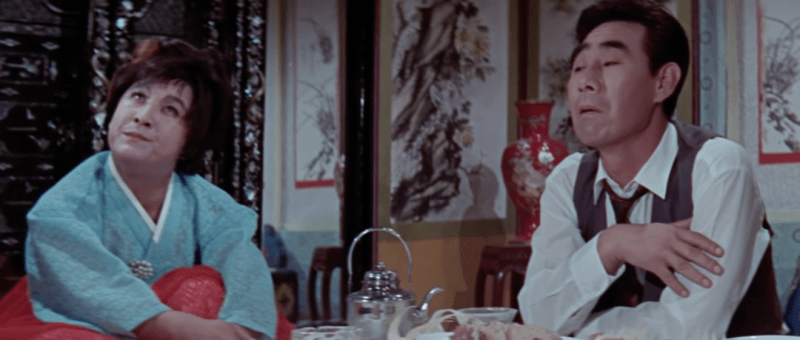
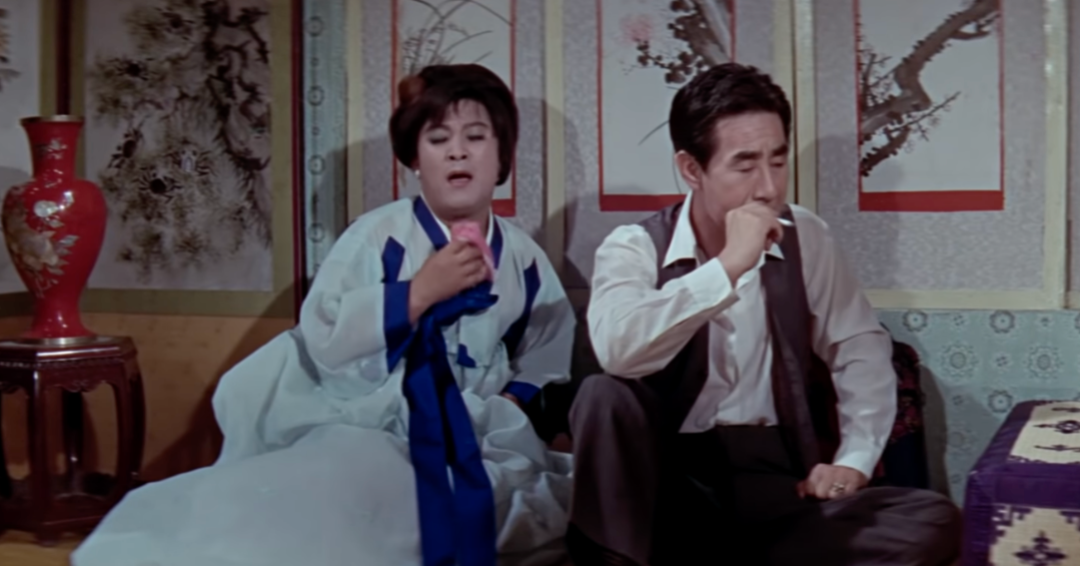
A Man and a Gisaeng (남자와 기생, Shim Wu-seob, 1969)

Under the authoritarian regime of Park Chung-hee, Korean Cinema was subject to increasingly stringent censorship and film was seen as an important means of moral instruction. The central message behind Shim Wu-seob’s raucous comedy A Man and a Gisaeng (남자와 기생, Namjawa Gisaeng) is that a man should be faithful to his family and avoid the double betrayal represented by drinking in the company of women which fritters away financial security and endangers his relationship with his wife. Yet the film is also subversive despite the underlying conservative message in making a mockery of so-called “traditional” gender roles.

Indeed, the film’s very thesis is that men are weak and women are strong. The men visit who gisaeng appear to have done so to reaffirm their dominant masculinity through their financial power in essentially paying women to be subservient towards them. Yet the gisaeng themselves are fully in control of the game they are playing as one makes clear when she tells a drunken businessman off after he gets handsy with her. She reminds him that a gisaeng is a person too, not a doll to be played with, and when he doesn’t listen she gets up and leaves proving who it is that has the upper hand in this situation. All the businessman can do is splutter and threaten the otherwise mild-mannered male manager. 

The hero’s boss, Heo (Heo Jang-gang), is a henpecked husband who visits gisaeng as a means of escape from his domineering wife (Do Kum-bong) who punishes him like a child. He asks Tae-ho (Gu Bong-Seo) to resign after catching him sitting at his desk darning socks to earn extra money and though it might be perfectly reasonable to fire an employee for brazenly doing another job on company time, Heo mainly lets him go because of his unmanliness. Tae-ho is a fully domesticated man who does work traditionally regarded as “feminine” in taking in sewing and looking after all of the domestic tasks such as cooking and cleaning as a “maternal” figure to his younger sister Tae-suk (Kim Chung-ja) who is then depicted as “manly” in her mastery of martial arts. 

It quickly becomes clear that the “effeminate” man Tae-ho is the film’s strongest character and the only one largely in control of his circumstances. He agrees to become a gisaeng partly because he needs to earn money after being fired, but also he claims as a “joke” before committing himself to punishing men who neglect their duty to their families by shaming them into changing their behaviour as he largely does with Heo who, bizarrely, develops a fascination with Tae-ho’s gisaeng persona San-wol as she apparently reminds him of the first love he was prevented from marrying because of her family’s disapproval. 

The gender subversion is in essence the joke, but there are also constant hints that it might not be and Tae-ho’s female persona is also authentic, not least among them the music cues which are extremely ironic. For example, the melody of “Don’t Fence Me In” plays over Tae-ho at the house of gisaeng, as do the strains of “Nature Boy” which also hint at a validation of Tae-ho’s expression of femininity. Before being fired, Tae-ho tells Heo that he’s repressing himself and it isn’t good for him, and there is a (joking) suggestion in the final scenes that Heo’s attraction to San-wol is partly born of her seeming masculinity. He did indeed unwittingly appreciate a drag performance from Tae-ho’s queer-coded musician friend, after all.

It’s also possible to read Heo’s reunion with his wife as a new appreciation for her own “masculine” qualities in her capacity to dominate him even if the film simultaneously suggests that the role of a “good wife” is to offer “affection” to her husband and if the husband visits gisaeng it’s the wife’s fault for not giving it to him. Even so, what the film’s conclusion implies is closer to a rebalancing than might be expected in allowing Jeong-mi, the gisaeng with whom Tae-ho falls in love to counter any suggestion of queerness, to open her own shop as an independent woman pursuing a relationship with Tae-ho who is then a travelling salesmen selling cosmetics. Jeong-mi asks Tae-ho to give up “knitting” before they get married which would signal a remasculinisation, but Tae-suk, though dressing in a more feminine fashion to meet her in-laws, is not directly asked to give up Taekwondo and it seems that her fiancé appreciates her feistiness rather than seeking to soften it. Even Heo’s wife if seeming more cheerful has not given up control in their marriage despite her own drag experience in the gisaeng house yet their relationship is now considered “repaired”. “Traditional” gender roles have ostensibly been reaffirmed, Heo’s marriage is saved and both Tae-ho and his sister are about to marry, but they’ve also been subverted and redefined in unexpected ways. Some of this may only be possible because A Man and a Gisaeng is an absurd comedy of the kind Shim was known for, but it nevertheless hints at an underlying plea for greater social freedom in an authoritarian era. 


A Man and a Gisaeng screened as part of this year’s Queer East .

The Surrogate Woman (씨받이, Im Kwon-taek, 1986)

“They seem to live for honouring the dead” the bemused heroine of Im Kwon-taek’s Surrogate Woman (씨받이, Ssibaji) explains to her visiting mother of the noble society she has been unwittingly plunged into but still struggles to understand. A condemnation both of a society which continues to value sons over daughters and of the absurdity of ancestral rites along with the hierarchies of the feudal order, Kwon’s impassioned historical drama speaks directly to the contemporary era in which in many ways nothing has changed.

In any case, Ok-nyeo (Kang Soo-yeon) is fated to become a surrogate woman. As the woman who seems to be in charge in a small community ensconced in a valley which from a certain vantage point seems to resemble female genitalia explains, surrogate mothers who bear daughters are expected to raise them themselves but the children are considered undesirable for marriage and generally end up becoming surrogate mothers themselves. Ok-nyeo’s mother had not wanted such a fate for her daughter, but is in the end powerless to prevent it especially given the allure of the generous payment promised on the birth of a male child. Ok-nyeo thinks she can endure anything for the promise of a comfortable life afterwards but is simply too young and naive to understand the emotional consequences of her decision, that her child will be removed from her seconds after birth and handed to another woman to raise. 

The situation is not much better for the wife who is made to feel as if she has failed in not having conceived a child during her 12 years of marriage. Both she and the grandmother who is so insistent on ensuring the existence of a male heir now that her husband has died and their only son is childless, express anxiety about Ok-nyeo’s youth, as did the women in the village, fearing that at 17 she is not yet physically or emotionally mature enough to bear a healthy child. The man they sent to select her seems to have done so out of personal preference, explaining that of all the women he picked a virgin though this raises several practical issues given the nature of surrogacy. Even so there is something quite perverse in the fact that it is the grandmother, the wife of a noble family of Confucianist scholars, who is actively participating in this system that renders women little more than wandering wombs now that she has the only real power that she will ever experience in her life as a widow turned head of household. 

On the other hand, it’s clear that this isn’t an ideal arrangement for the man either. The husband, Sang-kyu, is reluctant. He thinks it’s morally wrong and against his Confucianist philosophy while he is also attached to his wife and has no desire to sleep with other women. Nevertheless, he becomes attached to Ok-nyeo to a degree that is regarded as inappropriate by his family members and advisors, sneaking out to sleep with her for reasons other than conceiving an heir. When Ok-nyeo becomes pregnant they send him away to a temple in an attempt to sever their emotional connection, though he immediately sleeps with her again on his return despite the fact that she is already pregnant. For this transgression, Ok-nyeo’s mother is beaten while Ok-nyeo herself had earlier been punished for seducing him though she is completely confined to a single room for the entirety of her stay at the house lest anyone find out the embarrassing secret that the family have hired a surrogate. 

While Ok-nyeo and Sang-kyu make love in the bushes, drunken men from the party he’d been attending have a dull conversation about the nature of ancestral rites which is in its own way transgressive as they ask themselves where these ancestral spirits actually are, trying to make sense of what the rituals are for and what they mean but emerging with only confusion for they are largely meaningless. They praise women for rescuing the ancestral tablets at the expense of their children and constantly incur vast expense sacrificing food for those who can no longer eat. As someone remarks, the dead dislike their world and long to stay in ours but the living hardly live at all and spend all their time in service of those who are no longer here. All of it, this vast system that traps women like Ok-nyeo along with men like Sang-kyu the Confucian scholar, stems from this desire to placate departed souls at the expense of those still breathing. 

Yet Ok-nyeo is almost like a ghost herself, an invisible presence locked up in a backroom concealed as a dirty secret. Her mother reminds her that Sang-kyu is an aristocrat and she is not, they do not really regard her as human and what she is is stabled like a horse brought for mating to be taken home once the foal is born. They snuck her in by night and will insist that she leaves in darkness mere hours after her son’s birth. Meanwhile, she will be tortured by her captors who burn her stomach and force her to drink strange potions in the name of having a son. Sang-kyu too is forced to drink deer blood to improve his manliness while Ok-nyeo is advised to stare at the moon to the point of dizziness. She perhaps falls for Sang-kyu because he is her only real human contact though it appears they never actually speak to each other, while he discovers a kind of liberation in the permission to dispense with the sublimation of his sexual desire normally demanded by his Confucianist teachings. 

But few of them acknowledge the cruelty with which Ok-nyeo and the surrogate women are treated, the pain and despair her mother had tried to warn her of. Ok-nyeo had said anything was worth the price of 10 fields, but soon cries out that she’d give them all up for her son unable to accept that the boy will never be hers for to be a surrogate woman is to be denied one’s own existence. Caught in the night, she can only stare back through the fog as the carriage departs forever separating her from her child and the man she had unwisely come to love. As the closing titles explain, returning to the funereal scenes with which the film had opened, Ok-nyeo has become a victim of a society that prizes sons over daughters as have so many women like her even centuries later in which enlightenment has brought little freedom for those oppressed by class and patriarchy.


The Surrogate Woman screened as part of this year’s London Korean Film Festival.

Trailer (no subtitles)