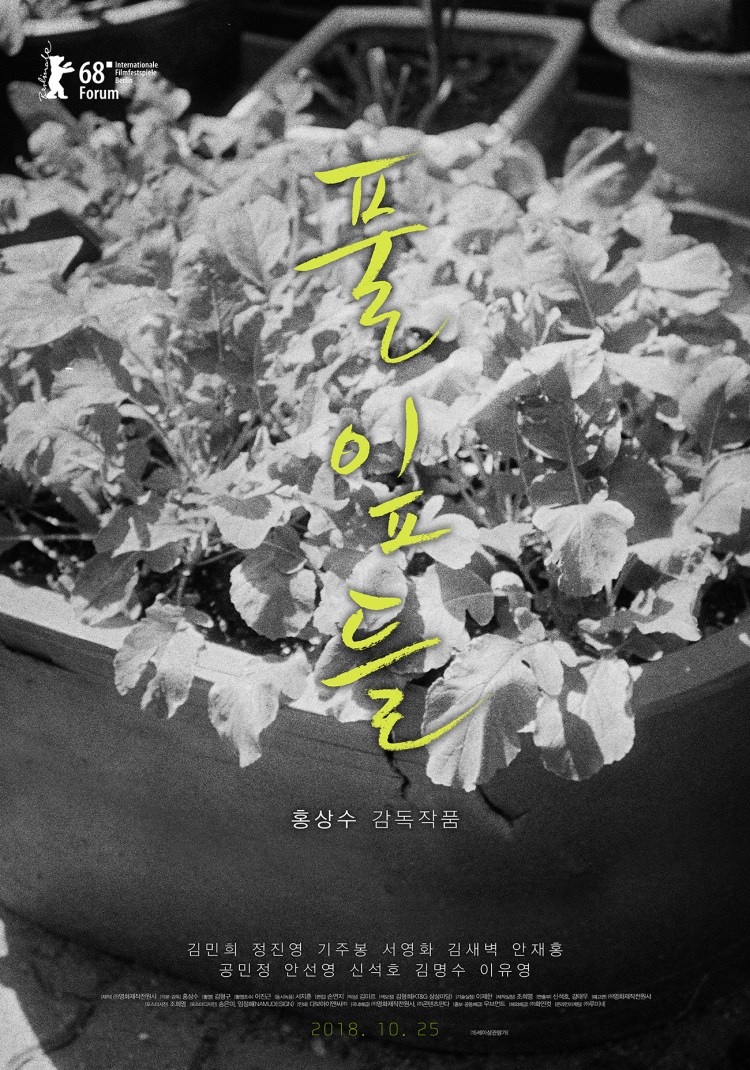
Grass (풀잎들, Hong Sang-soo, 2018)

Grass poster 1You don’t meet nice girls in coffee shops, at least according to the melancholy narrator of a Tom Waits song recalling the flighty lover too free spirited for his wholesome hometown. Like one of the rundown dive bars in Waits’ conceptual universe, the cafe at the centre of Hong Sang-soo’s Grass (풀잎들, Pul-ip-deul) attracts its fair share of lonely drinkers looking for somewhere quiet to pour out their sorrows. Ostensibly a tale of simple eavesdropping abetted by the presence of a laptop, Hong’s narrative is at his most defiantly reflexive as it forces us to question the order of its reality and, in passing, our own.

Unnamed until the closing credits, Areum (Kim Min-hee) sits in a quiet cafe, tucked away in a corner tapping on her laptop and convincing herself she is an invisible observer of the world around her. Listening in on the various conversations of the other customers, she waxes philosophical on life, love, death, and distance by means of a beautifully poetic interior monologue but tells a fellow patron that she is not a writer, only writing, sort of a diary, but not a diary, something unusual for now. The irony is that though Areum feels herself to be far removed from those she is observing, they often complain that they feel “watched” or at any rate anxious under her intense yet abstracted gaze, sometimes challenging her but backing down when faced with her almost total lack of interest in interaction.

The patrons, almost echoes of themselves, are comprised of three couples – one in youth, one middle-age, and one approaching their twilight years. The men drink something cold in a tall glass with a straw, and the women something warm from a pleasantly round cup and saucer. Each of the men is an actor, while at least one of the women is a writer, though all of their conversations have their particular quality of awkwardness with the men largely trying to extract something from the women be it love, or forgiveness, or relief.

Finding herself in an awkward situation familiar to any woman who’s ever tried to work in a coffee shop on her own, Areum is approached by the middle-aged actor (Jung Jin-young) apparently trying to write a screenplay, and propositioned for advice. Having tried and failed to lure his wily writer friend (Kim Sae-byuk) on a 10 day retreat to “collaborate”, he asks Areum if he can come and “observe” her. She turns him down by saying she has a boyfriend, only for the actor to ask to talk to him for his permission, to prove he’s “not some kind of strange guy”.

The older actor (Gi Ju-bong), meanwhile, casually tells his companion (Seo Young-hwa) that he’s recently come out of hospital following a suicide attempt after trying to kill himself for love. Trying to move the conversation on, she tells him that she’s recently moved to a small house near the mountains, but realises her mistake when he fixates on the incidental detail that she’s got a spare room. Brushing off her reticence about a roommate, he repeatedly states that he’s got nowhere else to go in the hope that, as Areum says in her caustic voiceover, she will take pity on him and allow him to live the life of Riley on her dime. The friend is clearly distressed, she doesn’t want this man in her house (her equally strained looks when someone else tries to offer him a room suggest she’s reason to believe he’s trouble) but feels obliged to keep apologising for her refusal to acquiesce to his quite unreasonable request.

According to the maybe fiancée of Areum’s brother, men are cowards when it comes to pain or the need to end things. Areum seems to agree, but has a fairly cynical view on the entirety of human relationships, berating the pair for irresponsibly intending to marry on “love” alone. “We only loved each other” another sad young woman insists while harangued by a drunk middle-aged man intent on blaming her for the suicide of her late lover, neatly reversing the dynamics of the young couple from the cafe arguing about their shared sense of guilt over the death of a friend.

Areum wonders if it’s possible to fall in love with an innocent heart if you’re carrying the weight of someone else’s death. “You insignificant things” she warns the youngsters newly in love “you’ll die someday”, neatly ignoring the fact that so will she. Or perhaps this world will die with her. We begin to wonder if any of this is real or merely a series of manifestations of Areum’s cafe musings, reconstructions of the lives of others imagined from snippets overheard from adjacent tables. Adjacent tables is where Areum’s preferred to be, observing not partaking, a lonely ghost in this haunted cafe where lost souls come to ease their burdens. Yet, finally her resistance crumbles. She accepts an offer of soju and joins the gathering, abandoning her lofty pretensions of distance for a taste of togetherness. “In the end people are emotions…And I long for them now” she realises. “Is it real? It would be nice if it were”.


Grass was screened as part of the 2019 London Korean Film Festival.

Original trailer (English subtitles)

Peppermint Candy (박하사탕, Lee Chang-dong, 1999)

Peppermint Candy 4K posterA wise man once said that the tragedy of life is that you have to live it forwards but it can only be understood in reverse. Lee Chang-dong’s second feature, the poignantly titled Peppermint Candy (박하사탕, Bakha Satang), lays bare the wounded innocence of 20th century Korea through the story of one man betrayed by the world in which he lived, eventually destroying himself in a protracted act of self-harm intended as a perverse attempt either at atonement or grudging conformity with a society he could not resist.

Beginning and ending with a picnic, Lee opens in 1999 as a hopelessly drunk Yong-ho (Sol Kyung-gu) crashes a reunion party he wasn’t technically invited to held to mark 20 years of friendship among former factory workers now approaching middle age. Dressed in a suit which looks somehow wrong on him, Yong-ho hogs the karaoke mic to sing a maudlin song about failed love, dances wildly, and sobs with the crushing hopelessness of a man entirely alone in the world. While his old friends try to reclaim the cheerful atmosphere, he climbs up to a nearby railway bridge where he waits for a train with outstretched arms, screaming “I’m going back” as he prepares to greet it.

Yong-ho does indeed “go back” as the train bears us ceaselessly back into the past, showing us the moments of Yong-ho’s life which struck him like a hammer to the soul and turned him into the defeated figure on the railway bridge, howling into the wind. At 40, Yong-ho is a hollowed out shell of a man, divorced and living in a greenhouse after falling foul of the volatile late ‘90s stock market, subsequently cheated out of all his money and the possibility of a new start by a man he thought was his friend. Given what we later learn about the middle-aged Yong-ho, it’s difficult to believe he had any kind of friends at all, and even if we’re conditioned to pity him as a man already dead he does nothing to earn our sympathy, cheating a poor roadside coffee seller out of a few pennies and then quietly smirking to himself in the safety of his car.

Yet, he begins to soften when a kindly man shows up and tells him that his first love, Sun-im (Moon So-ri) – now apparently this good man’s wife, is close to death and wants to see him one last time never having given up on the man he once was. Given the suit which doesn’t suit him by Sun-Im’s husband so that she won’t realise Yong-ho has made a mess of his life and be upset, Yong-ho stops to pick up a small jar filled with the titular “peppermint candy”, suddenly revealing that perhaps he never quite gave up on that man either and that may be his tragedy.

Before he was an arch capitalist making a few shady bucks in the pre-financial crisis economic boomtown of the newly democratised Korea, Yong-ho was a policeman working for the authoritarian government brutally torturing teenage democracy activists during the dying days of the regime. As a young rookie we see him squeamishly try to resist, only to be pressured into violence and then snap. The suspect fouls Yong-ho’s hand with the kind of smell that never really washes off, but it’s just one more stop on Yong-ho’s journey to spiritual ruination. Finally we reach his breaking point, in Gwangju in 1980, where his soul is forever soiled.

The Gwangju Massacre, in the story of Yong-ho’s life which is also the story of Korea, is the great festering wound which can never be healed. He carries it with him in an intermittent limp that resurfaces at times of emotional difficulty, and convinces himself that he is unworthy of everything good or innocent in the world. He breaks with Sun-im, cruelly betraying her faith in him with a crude gesture that wounds them both equally, mutually understood as a perverse act of kindness. Becoming what he thinks he’s supposed to be, what this society has made him, he wilfully destroys himself in a decades-long act of self harm that leads only back to the train which haunts him throughout all of his encounters, so painfully central to the arc of his life. Literally railroaded by an inexorable fate, Yong-ho lacks the will to resist believing he is no better than the hand he has been dealt but consumed by self-loathing and infinite regret. There is no way back, only forward, but for Yong-ho, and perhaps for Korea, Lee sees only one way out and the soft of heart will not survive it.


Peppermint Candy was screened as part of the 2019 London Korean Film Festival.

Trailer (English subtitles)

The Contact (접속, Chang Yoon-hyun, 1997)

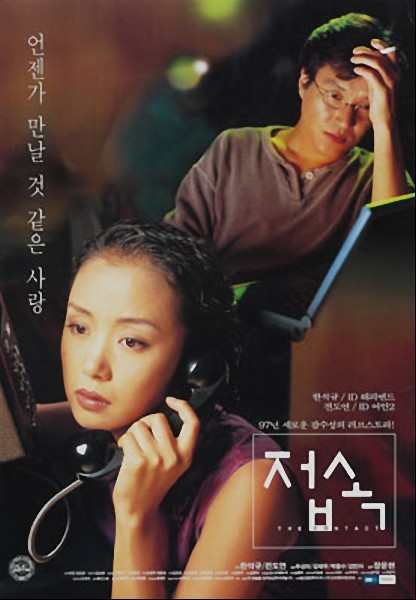
The Contact poster 1Even in 1997, it was supposedly much easier than ever before to make contact with pretty much anyone anywhere in the world, yet most of use chose not to. Twenty years later, perhaps not much has changed as we remain increasingly disconnected in an evermore connected world. Sometimes, however, as a radio host’s opening monologue reminds us, life has you take the long way round and it’s not until you hit a bump in the road that you start to think about what’s really important. The melancholy heroes of Chang Yoon-hyun’s The Contact (접속, Jeopsok) are each reeling from romantic disappointment, but brought together by a series of coincidences eventually find an outlet for their woes in the newfangled world of online chat.

Dong-hyeon (Han Suk-kyu) is the producer of a successful radio show but constantly in trouble with the suits for his uncommercial music choices. When someone anonymously sends in a battered copy of The Velvet Underground’s self titled album, he decides to switch up the order and play Pale Blue Eyes partly out of a sense of nostalgia and partly because he is hoping the woman he suspects may have sent it will be listening.

Meanwhile, across town, Soo-hyeon (Jeon Do-yeon) is sharing a moment with a cheerful young man, Ki-cheol (Choi Cheol-ho), who turns out not to be her boyfriend, but that of her roommate. To get away from the pain of seeing them cosied up together, she goes out for a drive and turns the radio on for company just as Dong-hyeon drops the needle on Pale Blue Eyes. So moved by the song that she only narrowly escapes a multi-car pileup, Soo-hyeon writes in to request it again which leads Dong-hyeon to wonder if she’s his old flame using an alias. Obviously, she isn’t, but excited to get an email from a radio show producer and not wanting to disappoint him she lies and says the request was for her friend who might be the one he’s looking for.

A pair of brokenhearted romantics, Dong-hyeon and Soo-hyeon are old souls who like rainy days and going to the movies in the afternoon but they’re also intensely online and attuned to the possibilities of indirect communication. Despite the “instant” nature of modern technology, the pair send intermittent emails, leave messages on answerphones, and fax each other, only sometimes replying in the moment via IRC but communicating on a much deeper level than they might have meeting face to face. Because they live in a city and have much more than they know in common, they unwittingly slip past each other with improbable frequency but would likely never meet, the act of making “contact” in person all but an impossibility.

The curiously analogue, nostalgia-laden, and above all physical device of the LP brings the pair together through a shared sense of loneliness born of frustrated love as they attempt to support each other through differing stages of romantic grief. While Dong-hyeon remains wilfully trapped in the past, mooning over an old flame while blaming himself for possibly coming between the woman he knew did not love him and the man she did, Soo-hyeon is in the thick of it struggling with her feelings for her roommate’s boyfriend. Calling himself “Happy End” because he’s read about them in books but doesn’t believe they exist in the “real” world, Dong-hyeon gives Soo-hyeon contradictory advice while making an ill-advised romantic overture to straightforward writer Eun-hee (Chu Sang-mi) who, unlike Dong-hyeon and Soo-hyeon, knows exactly what she wants and isn’t afraid to state it directly. “Why can’t you be honest with your feelings?” she repeatedly asks Dong-hyeon, but predictably gets no reply.

Soo-hyeon meanwhile has given herself the rather depressing name of “female 2” online, apparently inspired by a series of walk-on parts in plays, but perhaps hinting at her categorisation of herself as an invisible face in the crowd while also ironically pointing at her awkward position as the third wheel in her friend’s relationship. Berated for his emotional diffidence by Eun-hee, Dong-hyeon nevertheless tells Soo-hyeon she’s better off to forget Ki-cheol if she can’t find the courage to tell him how she really feels but as good as his advice sounds it’s primed to backfire, potentially costing not just one but two friendships and seeing Ki-cheol disappear from her life forever. Braver than Dong-hyeon, she resolves to give it a go and whatever happens it will at least answer a question, putting an end to the continued suffering of being merely friends with the man she loves.

Perhaps out of a sense of guilt for having selfishly prioritised his own feelings with tragic consequences, Dong-hyeon has decided to keep them to himself, but if so it’s also made him casually cruel and infinitely insensitive. Giving up on his romantic dream, he contemplates running away and starting a new life abroad, while Soo-hyeon risks everything in pursuit of love. Not knowing how to connect with her in the offline world, Dong-hyeon once again resorts to the physical in order to make contact, waving a tiny document like a one-way passport to love in order prove his identity and romantic destination. Finally finding the strength to let go of lost love and take a chance on new ones, the pair shift their relationship from digital to analogue as they, ironically, resolve to leave the past behind for more connected future.


The Contact was screened as part of the 2019 London Korean Film Festival.

Nambugun: North Korean Partisan in South Korea (南部軍 / 남부군, Chung Ji-young, 1990)

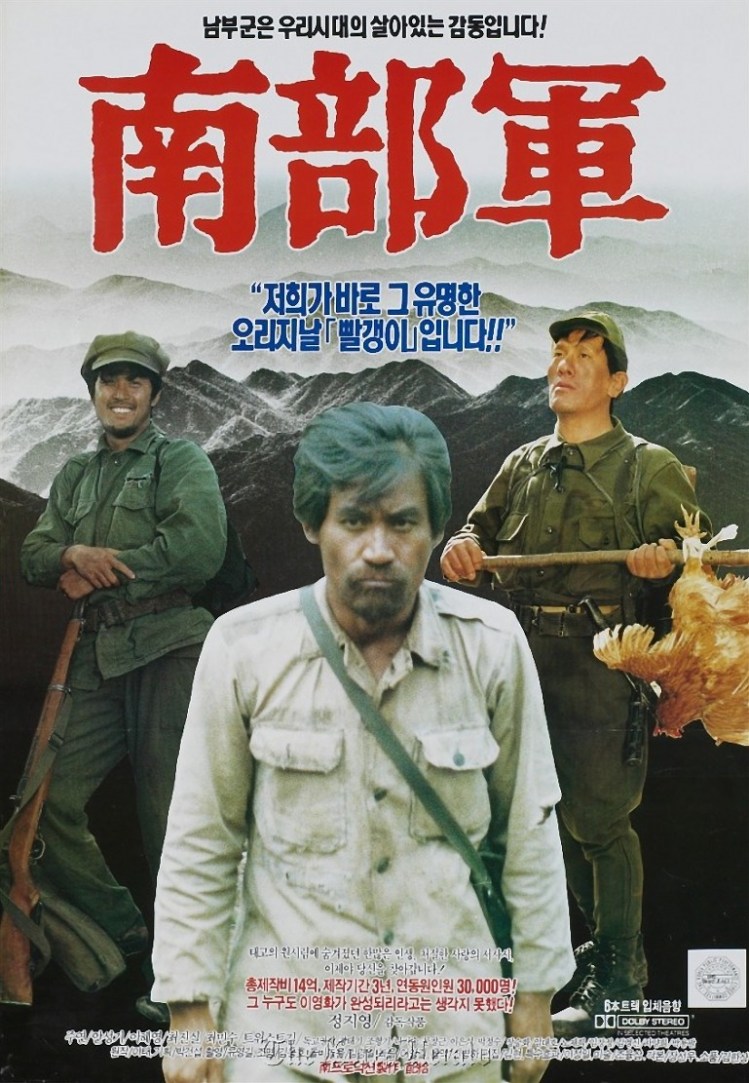
North Korean Partisan in South Korea poster 1Under the intense censorship of South Korea’s military dictatorships, “anti-communism” had become the single most important cultural signifier to the extent that all films were in some sense “anti-communist” even if some were more obviously anti-communist than others. As power shifted away from the dictators and towards a new era of democratic freedom, a more nuanced view of the recent past became possible with the “division film” taking the place of the old-fashioned anti-communist drama. Rather than demonise the North, the division film emphasised the tragedy of partition, painting the two Koreas as equal victims of geopolitical finagling.

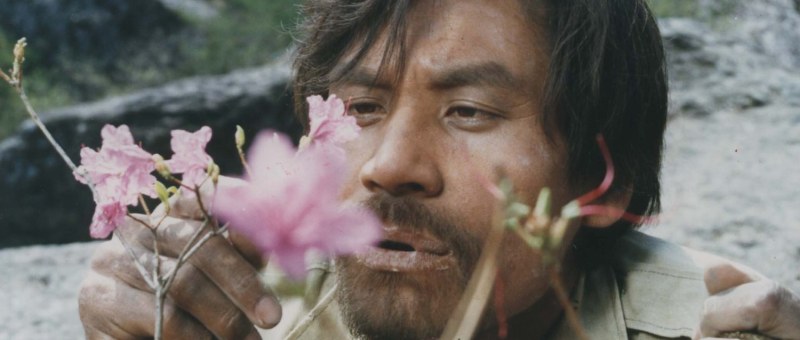
Arriving in 1990 shortly after Korea’s democratisation, Chung Ji-young’s Nambugun: North Korean Partisan in South Korea (南部軍 / 남부군, Nambugun) is among the first to directly address the subject of the Korean War from the perspective of the North Korean partisans, albeit obviously from those who eventually came South. Adapting the memoirs of war correspondent Lee Tae, Chung ignores ideology in order to explore the gruelling experience of guerrilla warfare largely being fought by ordinary people with strong convictions rather than by career soldiers or committed revolutionaries.

Lee Tae (Ahn Sung-ki) himself is an “intellectual” North Korean newspaper reporter working as a correspondent in Jeonju which is currently in North Korean occupied territory. When they get word that the Americans and South Korean forces are on their way, the newspaper staff evacuates and eventually ends up heading into the mountains to join the partisans. As he has previous experience, Lee Tae is given command of a platoon and the instruction to try and make up for his bourgeois intellectualism with hard work on the job. To keep them all in one place, Lee is assigned a series of other “intellectual” recruits including conflicted student Kim (Choi Min-soo) who joined the fight to figure out what this “inhuman” war was all about.

One of the reasons Kim is so conflicted is that he brought his hometown, high school-age girlfriend with him and wonders if that was a very responsible thing to do, especially when they are eventually separated by the command chain who decide to send her to headquarters while Kim stays with the troops. Though we are shown that the North Korean soldiers are just ordinary men and women who call each other comrade, the regime itself still comes in for subtle criticism for its oppressive hardline austerity. On the run and separated from his unit, a wounded Lee is accompanied by an earnest nurse, Min-ja (Choi Jin-sil), with whom he falls in love, but when the romance is discovered by a superior officer Lee is taken aside and reminded that here there can be no love, only revolution. He must give all of himself to the cause, reserving nothing for such bourgeois affections as romance. Both Lee and Kim spend the rest of the picture trying and failing to reconnect with their respective women while fantasising about a different kind of life in which they would not have been kept apart.

Yet, despite the fact that we clearly see a world of near total equality among the partisans, it is clear that Lee’s own thinking at least is not quite as progressive as one might assume. Bonding with Min-ja and dreaming of the future, he envisages a life for himself as a reporter in Seoul at which point she asks what she’s supposed to do and receives the answer “have dinner ready for me”.  Min-ja, apparently an orphan whose brother was killed fighting for the South, found herself becoming a field nurse for the North and perhaps has a lower ideological consciousness as a result, freely offering her medical knowledge to anyone who might be in need of it. “Why is it that we’re fighting?” she asks Lee, “you both need me”, embodying the wounded innocence of the one Korea unfairly torn apart by forces beyond its control.

All gusto and determination, Lee and the others start out with pluck and positivity but gradual disillusionment accompanies the shift from the warmth of spring to the dead of winter as the partisans find themselves starving to death on a frozen mountain. Win or lose, the victory belongs to the US or USSR, one particularly dejected soldier intones laying bare his loss of faith in the primacy of North Korean communism and accepting that they are all playthings in a proxy war being fought by Koreans on Korean soil. Kim fails to find “meaning” in conflict and emerges only with shame and regret while others clutch at pamphlets dropped by the Americans promising an amnesty for those who surrender willingly. Lee trudges on alone, frostbitten and starving, encountering only the dead and finally contemplating suicide only to be given one last source of hope and to have that too crushed. Chung humanises the communists, but still they have to lose in the spiritual as well as the literal sense. Ending on a howl of existential despair, the film dedicates itself to all those on both sides who fell on Jirisan or sacrificed their lives for a vision of a better world but does so with pity more than admiration for all that they suffered as victims of their times.


Nambugun: North Korean Partisan in South Korea was screened as part of the 2019 London Korean Film Festival.

Astro Gardener (별의 정원, Won Jong-shik, 2019)

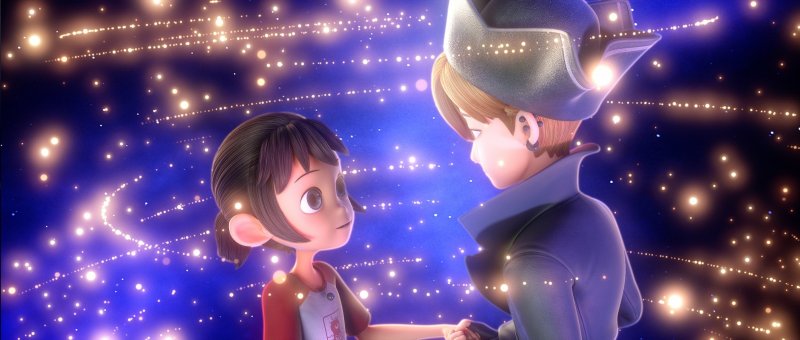
Astro Gardener poster 1Korean cinema is sometimes criticised for its bleakness. Happy endings are indeed something of a rarity, though not entirely absent and, ironically, often rejected for their sentimentality. Cinema for children might be a notable exception with the desire to cushion young viewers from the world’s harshness as a high priority even if it never shies away from the fact that life is sometimes hard and there will be times when you are sad or afraid or lonely. Astro Gardener (별의 정원, byeol-eui jeongwon), a colourful tale of strange creatures making sure the stars still shine, is a film about just those times which makes the very important and always relevant point that there is no light without darkness and that it’s OK to feel sad, or afraid, or alone because your darkness is also a part of you.

12-year-old Suha (Kim Yeon-woo) is excited that her parents are going to leave her alone in the apartment overnight for the first time while they go on a fishing trip. Before he leaves, Suha’s dad gives her a precious necklace which she is not very impressed with because all she wants is a dog. Suha’s dad is broadly in favour of the puppy idea, especially as grandma’s dog is currently pregnant so it would be very easy to adopt one once it’s born. Mum is less convinced, both fearing that she will end up looking after it and worrying that it will be sad when the dog inevitably passes away. While they’re busy discussing all that on the way to the campsite, the car swerves to avoid an oncoming truck and they get into an accident during which Suha’s dad is killed.

A year later, Suha’s mum takes her to stay with grandma during the holidays while she has to get back to work. Suha isn’t very happy about it, but the blow is softened by the fact she’s finally getting a little dog named “Night” who is the last of grandma’s puppies seeing as her own dog passed away shortly after giving birth. Playing on the beach, Suha is drawn to a strange stone and takes it home only for a weird little man with a star on his head to break into her room and steal it. The man, who turns out to be called Om (Jeon Tae-yeol), is an “Astro Gardener” charged with looking after the darkness to ensure that the stars can stay in the sky. It turns out that the planet Pluto (Shin Yong-woo) has gone rogue and left its orbit to become a space pirate hellbent on destroying the darkness to create a universe of light born of the destruction of hundreds of stars.

A universe of light in which there is no more loneliness or pain might sound very attractive, but where there’s no sorrow there can be no joy. Since her father’s death, Suha has been deathly afraid of “the dark”, sleeping with the light on and only venturing out in the middle of the night when her dog chases out after Om, which is how she winds up discovering the Astro Garden. She isn’t terribly invested in the quest to save the darkness but finds herself swept into it when Pluto’s minions show up and kidnap Night’s shadow which means she has to go and get it back or risk loosing him because, as the repeated metaphor points out, you can’t live as light alone. 

Om warns Suha that Pluto is a no-good rebel out to destroy the universe but because she loses a lot of her memory on his ship, Suha is instantly smitten seeing as it just so happens that Pluto looks exactly like the handsome K-pop idol we see on the poster in her bedroom. Realising that the necklace Suha received from her father is the All-Energy capable of controlling all the darkness in the universe (what teenage girl doesn’t think she can do the same?), Pluto sets out to take it but the snag is that the power can only be transmitted to someone you truly love which is the real gift her father was trying to give her.

Learning to remember her father’s love rather than his loss, Suha rediscovers her sense of confidence and is no longer so afraid of “the dark”. Resolving to be kinder to her mother, she can appreciate life’s light and shade but makes sure to keep in touch with her old friends at the Astro Garden to go tend to her darkness to make sure she can still see the stars. A cheerfully animated tale of a little girl figuring out how to live with grief while becoming embroiled in an interstellar battle to save the universe, Astro Gardner is a surprisingly deep meditation on depression and anxiety in which the heroine rediscovers her sense of self while finding the will to fight for others.


Astro Gardener screens on 2nd November as part of the 2019 London Korean Film Festival.

International trailer (English subtitles)

Long Live the King (롱 리브 더 킹: 목포 영웅, Kang Yoon-sung, 2019)

long live the king poster 1Back in the good old days, gangsters used to make a case for themselves that they were standing up for the little guy and protecting those who couldn’t protect themselves. Of course that wasn’t quite the truth, but one can’t deny how closely small town thuggery and political office can resemble one another. Following his breakout hit The Outlaws, Kang Yoon-sung returns with web comic adaptation Long Live the King (롱 리브 더 킹: 목포 영웅, Long Live the King: Mokpo Yeongwoong), another unconventional comedy in which a surprisingly loveable rogue rediscovers his national pride and finds a more positive direction in which to channel his desire to be helpful.

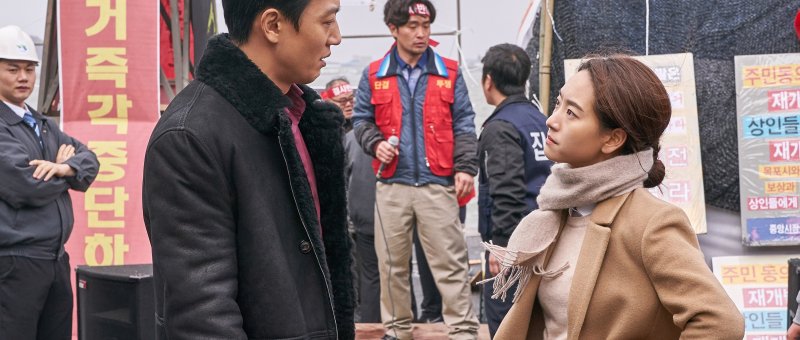
Se-chool (Kim Rae-won) is a notorious thug with a traumatic past currently working with a local gang hired to clear a small protest of stall owners trying to cling on to a traditional market space in working class Mokpo where a developer wants to build a theme park and upscale skyscraper. A feisty young lawyer, So-hyun (Won Jin-a), is working with the protesters on their case and has no problem telling the gangsters where to get off. Impressed, Se-chool is smitten and starts to wonder if he’s on the wrong side but his attempts to get So-hyun’s attention – being strangely nice to the protestors, buying everyone lunch etc, spectacularly backfire. Only when he hears about another man, Hwang-bo (Choi Moo-sung), who used to be a gangster but has now reformed and become a social justice campaigner running a small not-for-profit cafe serving meals to the vulnerable, does he begin to see an opening, vowing to give up the gangster life and commit himself to serving the people of Mokpo.

The irony is that everyone seems to think that Se-chool has a hidden agenda, but his only agenda is the obvious one in that he wants to win So-hyun’s heart even if that means he has to shape up and learn to become a decent person rather than a heartless gangster thug. Known as the king of the nightlife, Se-chool is regarded as a slightly eccentric, good time guy, so his sudden desire to go “legit” is met with bemusement rather than surprise, but old habits are hard to shake and it takes a while for him to realise that trying to help people with his fists is not the best way to go about it. Punching out some punks making trouble in a cafe gets him an earful from the proprietress who explains that she owes a lot of money to the guys’ gang so Se-chool’s chivalry has probably caused her a series of potentially serious problems she assumes he won’t be on hand to help her out with. Nevertheless, he retains his desire to wade in and do his bit, becoming a surprise local hero when he puts himself in danger to ensure the unconscious driver of a crashed bus gets out safely while the other passengers make their escape.

Meanwhile, local politics is starting to heat up. Venal politician Choi Man-su (Choi Gwi-hwa) is up for re-election and running on a platform of making Mokpo great again. It comes as no surprise that Man-su is deep into the corrupt theme park project and outsourcing general thuggery to Se-chool’s arch-enemy which eventually includes taking out potential rivals like Hwang-bo whose approval ratings are soaring while voters are becoming tired of Man-su’s big money tactics and insincere messaging. Soon enough, Se-chool is persuaded to enter the race seeing as his “local hero” persona puts him in good stead to oppose Man-su’s establishment credentials. But, in order to get elected and convince So-hyun he’s really changed, he’ll have to finally face his traumatic gangster past while learning to be open and honest with his feelings.

Kang goes in hard for the business of politics, taking pot-shots not only at corrupt establishment figures in so tight with organised crime that they’re little more than jumped up gangsters, but also at ambitious party hoppers, and misguided mobsters who think they’re onto the big ticket by hooking up with “legitimate” power. Poor Se-chool, meanwhile, actually thought he was doing “proper business” in his persona as a besuited gangster of the new, corporatised school little thinking about the little guy as he unwittingly went about his ultra-capitalist agenda. Heading for broad comedy, Long Live the King misses an opportunity for serious satire but has undeniable heart as the misused hero learns to accept himself in being accepted by others, falling in love not only with a feisty activist lawyer but with community spirit and progressive politics as he vows to fight for a better future for the people of Mokpo while opposing the inherent corruption in the system embodied by men like Man-su who feel themselves entitled to exploit solely by virtue of their own superiority.


Long Live the King was screened as part of the 2019 London East Asia Film Festival.

International trailer (English subtitles)

The Battle: Roar to Victory (봉오동 전투, Won Shin-yeon, 2019)

The Battle roar to voctory poster 1Besides seeing the birth of Korean cinema, 1919 was something of a flashpoint in the nation’s 20th century history. Japan had annexed Korea in 1910, thereafter instituting an increasingly brutal colonialist regime. On March 1, 1919 the people rose up in an act of mass protest inspired by the provision for “Self-Determination” included in US president Woodrow Wilson’s 14 Points speech outlining a path towards enduring peace. Though the protest was peaceful, it was quickly suppressed by Japanese troops resulting in thousands of deaths and mass incarcerations.

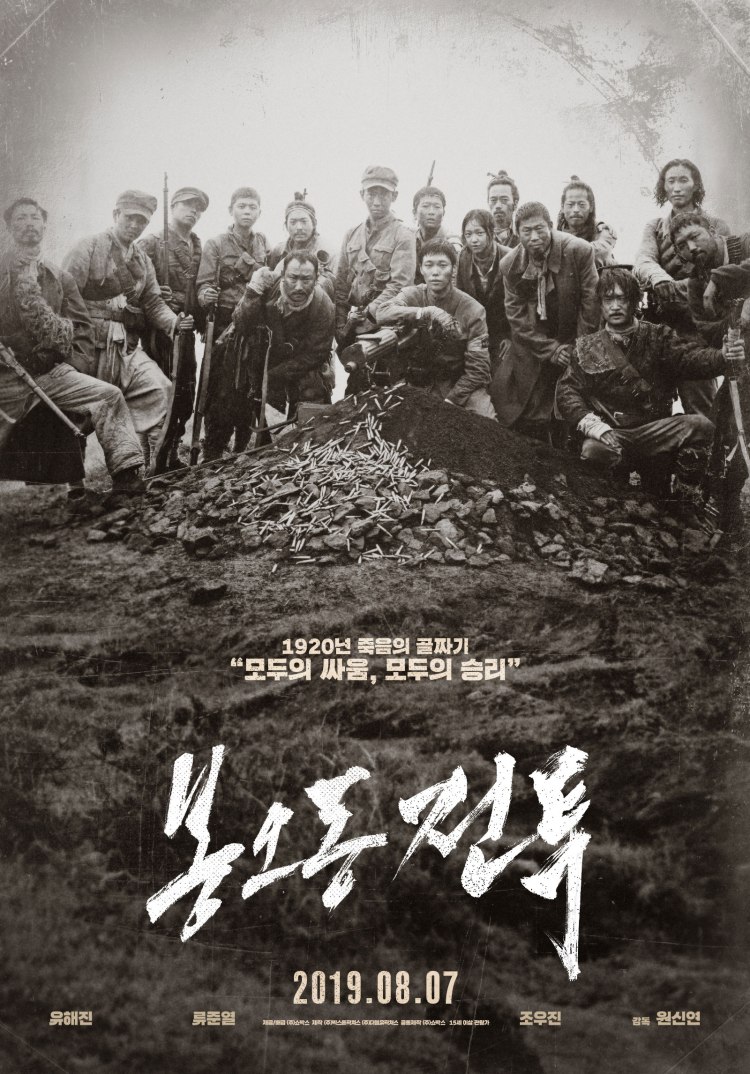
The Battle: Roar to Victory (봉오동 전투, Bongodong Jeontoo) situates itself a year after the protest as the Independence Movement began to intensify, and is inspired by real life events apparently often absent from the textbooks in which several factions eventually came together to wipe out an “elite’ squad of Japanese troops which had been put together to take down guerrilla Resistance fighters. Our heroes have been charged with collecting money from a fundraiser and conveying it to the Independence Movement in exile in Shanghai but are drawn into a wider battle against Japanese brutality on their way.

The Japanese colonial forces are indeed brutal, if often cowardly. When we first meet crazed commander Yasukawa (Kazuki Kitamura), he’s butchering a tiger in some kind of symbolic act of intense barbarity. To smoke out the Resistance fundraiser, the Japanese military begin razing villages, killing the men and raping the women, even going so far as to shoot small children for sport. When veteran Resistance fighter Hae-cheol (Yoo Hae-jin) raids a command post, he makes a point of taking a hostage who himself seems to be a teenage recruit. Hae-cheol lets the boy live not only out of a sense of compassion, but also because he wants him to take what he’s seen back to Japan, including the aftermath of a Japanese assault on an ordinary Korean village.

Yukio (Kotaro Daigo), as the boy later gives his name, is, unlike his fellow officers, conflicted and confused. Apparently a member of the elite himself, the son of a prominent military figure, Yukio gave up a bright academic future to join the army and find out what it is that Japan does with its advanced weaponry. Asked what he thinks now that he’s seen for himself, he says that he’s ashamed, that his worst fears have been confirmed. According to Yukio, his nation is suffering from an intense inferiority complex which is leading it to commit acts of extreme barbarity in order convince itself it is equal to any other imperial power.

The Japanese officers veer from the crazed, bloodthirsty Yasukawa who views his mission as some kind of hunting expedition, to the merely weak and cowardly. The Independence fighters, however, come from all over Korea speaking many dialects (some less mutually intelligible than others) and with many different motivations but all with the desire to free their country from Japanese oppression. Ace captain Jang-ha (Ryu Jun-yeol) is a born soldier, but those who support him are largely street fighters and “bandits” not always welcomed into the movement by the so-called intellectual “nobles” running the show from a position of social superiority. Then again, as Hae-cheol puts it, no one can be sure how many guerrilla soldiers there are because any farmer is a potential sleeper agent.

In any case, the Resistance fighters pursue their mission selflessly, manipulating the complacent Japanese troops to lure them into a mass ambush while trying to ensure the money still makes its way to Shanghai to preserve the movement. Despite the “Roar to Victory” subtitle, it’s important to note that the Independence Movement was still in a nascent state and would continue opposing Japanese oppression until Korea’s liberation at the end of the war. Covering the legendary battle of Battle of Fengwudong, the film ends with forward motion as the Resistance commander (a late and great cameo from a giant of Korean cinema) points ahead towards the next target, the well known Battle of Cheongsanri, in which the Japanese military reportedly suffered over 1200 casualties at the hands of Independence forces. Overly gory and lacking in subtlety, The Battle: Roar to Victory is unabashedly patriotic but does its best to suggest the costs and compromises of guerrilla warfare as its selfless heroes put aside their differences to fight for a better Korea.


The Battle: Roar to Victory was screened as part of the 2019 London East Asia Film Festival.

Original trailer (English subtitles)

EXIT (엑시트, Lee Sang-geun, 2019)

Exit poster 2“Hell Joseon” manifests as “toxic gas” in Lee Sang-geun’s Exit (엑시트). Millennial “slackers” losing out in Korea’s increasingly cutthroat economy find themselves consumed by their own sense of failure while those around them only compound the problem by branding them useless, no-good layabouts, writing off the current generation as lazy rather than acknowledging that the society they have created is often cruel and unforgiving. Yet, oftentimes those “useless” skills learned while having fun are more transferable than one might think and the ability to find innovative solutions to complex problems something not often found in the world of hierarchical corporate drudgery.

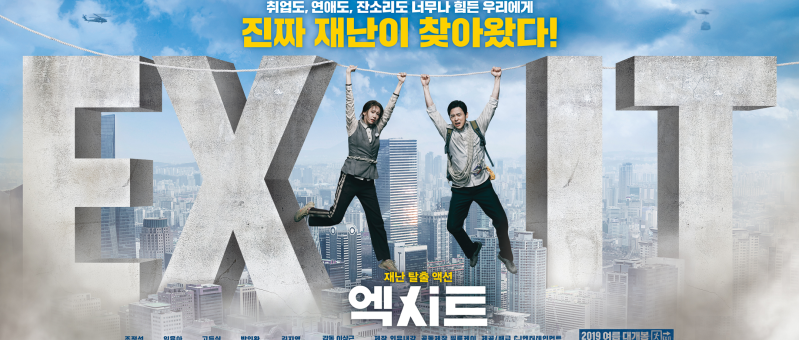
30-something Yong-nam (Jo Jung-suk) spends his days in the park surrounded by grannies and has earned the nickname “IBM” – Iron Bar Man, for his athletic pursuits. The local kids have even come up with an origin story for him that his girlfriend must have died after falling off one and so now Yong-nam is some kind of “village idiot” with an overwhelming need to master the monkey bars. The truth is, however, that Yong-nam has nothing much of anything else in his life. His continual failures to find employment are an embarrassment to his family, and even his little nephew (Kim Kang-hoon) is so ashamed of him that he routinely blanks Young-nam in the street. With mum’s (Go Doo-shim) 70th coming up, everyone is very keen that Yong-nam look the part and try not to embarrass them.

Yong-nam is also quite invested in not being an embarrassment because the only reason he booked this fancy restaurant that’s a two hour drive away is that he’s heard his university crush Eui-ju (Im Yoon-ah) works there. Back in uni when they were both members of the rock climbing club, Yong-nam asked Eui-ju out but she was only interested in friendship so he started avoiding her out of embarrassment. Not really any more mature, he lies that he’s a high flying hedge fund manager rather than admit that his life has not been going well. Eui-ju, meanwhile, is the vice-manager of this events centre but shrugs the job off as not much better than part-time when in reality she’s really running the place while her sleazy boss (Kang Ki-young) who’s only in the position because it’s his dad’s company constantly sexually harasses her and shows no signs of taking no for an answer.

When toxic gas floods the city, however, the pair are instantly in their element. They know how to conjure makeshift stretchers from stuff that’s lying around and how to try and draw attention to yourself when you’re in need of rescue, but find their ideas dismissed by Yong-nam’s confused, conventional family members well used to ignoring crazy uncle Yong-nam. To survive they’ll have to trust him and his rock climbing prowess as he shins his way to the top of the building where salvation seems more of a possibility.

Crisis aside, Yong-nam lives in a world of constant anxiety where he’s forever receiving disaster alerts on his phone for things he never thought he’d have to worry about, and his mother spends her evenings diligently copying down ways to prevent cancer from TV documentaries. Yong-nam’s dad (Park In-hwan) would rather chill out with some soap operas, but it seems you can’t drown out existential dread with vicarious drama. Having more or less given up, Young-nam hasn’t even been going to his climbing club. After all, if you can’t get a foot on the ladder, what use is the ability to climb? “Our lives are the disaster” Yong-nam’s similarly troubled friend exclaims, but the sudden threat of toxic gas does at least give the dejected young man motivation to prove himself in demonstrating that his skills are useful, even essential, rather than frivolous or eccentric as his family members previously believed them to be.

Eui-ju, meanwhile, is kept in her place by a combination of sexism and the demands of a hierarchical society which prevent her from fulfilling her true potential by convincing her that she has to be polite to her odious boss. Teaming up with Young-nam, the pair work as equals and support each other as they try to find ways to survive. No damsel in distress, Eui-ju is finally able to take an active role in her own destiny while also making sure to save other people along the way, often at the expense of the pair’s own chance to escape.

In a loose moment, Yong-nam declares that he’s only applying for jobs in one of the shiny skyscrapers from now on because those guys probably got saved first, but in the end it’s their plucky never say die spirit which saves them, in more ways than one, as their exploits go viral with their millennial brethren who eventually motivate the drone squad to try and keep them safe. There may be no exit from Hell Joseon, but as Yong-nam and Eui-ju discover, you don’t have to listen when people tell you there’s no way out because the only way is up and you won’t know unless you go.


EXIT was screened as the opening night gala of the 2019 London East Asia Film Festival.

Original trailer (English subtitles)
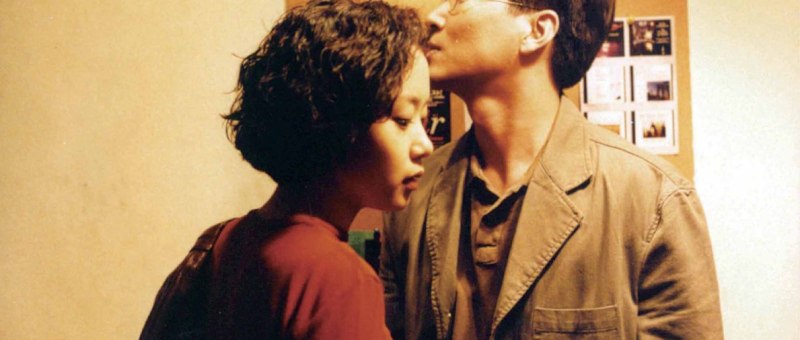
Heart (하트, Jeong Ga-young, 2019)

Heart Still 2Director Jeong Ga-young has begun to make a name for herself as the female Hong Sang-soo since her indie breakout debut Bitch on the Beach. Unlike Hong, Jeong also stars, taking her meta concepts to a whole new level in her leading role as a typically Hongian feckless filmmaker on the prowl. Where Bitch on the Beach, a monochrome two-hander, found her toying with an ex, Hit the Night saw her experiment with role reversal as a skeevy director “interviewing” her crush about inappropriate topics under the guise of research for a screenplay. In Heart (하트), her latest awkward self-confession, she neatly brings the two together as a conflicted movie director turns to a married man she once had a short affair with to get advice about her crush on another man who is also married.

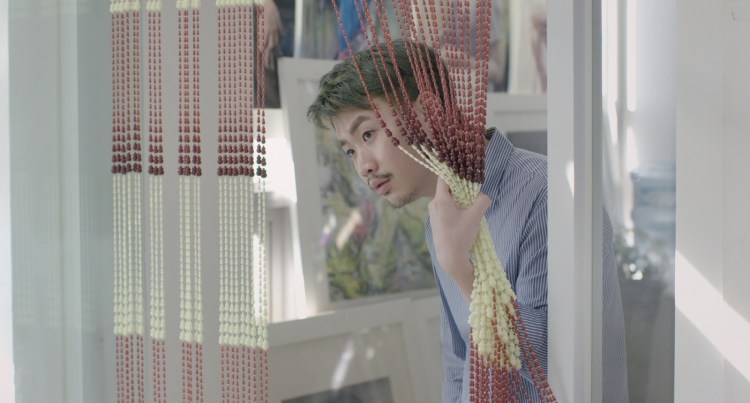
Ga-young, a 30-ish film director, suddenly shows up at the studio of artist Seong-bum after six months looking for a shoulder to cry on. Some time previously, the pair had a short affair in which Seong-bum slept with Ga-young on the very day that his wife gave birth to their son. Now Ga-young has come looking for someone to talk to about her ambiguous relationship with another married man who has just become a father. Seong-bum is not particularly happy to be consulted on this topic as if he were some sort of expert, but finds himself going along with Ga-young’s whims until they eventually end up having sex on the studio couch.

Ga-young (like the protagonists of Jeong’s previous films) essentially regards men as pathetic and faithless, willing to betray their wives and girlfriends with another woman with nary a second thought. Manipulating them is, partly, a kind of revenge though one that often seems to backfire. Later, talking to an actor about her script which forms the basis of the conversational scenes with Seong-bum, Ga-young outlines her desire to destigmatise affairs with married men. Taking an obvious soap opera scenario but lending it realism and relatability she hopes to open a dialogue for people to talk seriously and without judgement about something that really happens every day. The dialogue is, however, immediately hijacked by the actor who judges her on realising the screenplay is partly (well, largely?) autobiographical in that Ga-young herself has really had relationships with married men. After all, married men Ga-young says, like the Cannes film festival, are apparently something you do so you can tell people that you tried it and it wasn’t all it was cracked up to be.

Ga-young seems to have fallen into the same trap as the director in Hit the Night in assuming the hot young actor would be an idiot but quickly finding herself out of her depth when he begins turning the tables and asking her awkward questions about her screenplay. Talking to Seong-bum about her relationship with the other married man, she tells him that her attraction is largely based on her perception of him as the sexiest man alive along with his persistent vanity in constantly asking Ga-young to tell him that she likes him. Seong-bum thinks the other guy is a jerk for cheating on his wife while they have a newborn baby, conveniently forgetting that he did exactly the same thing himself, later offering only the excuse that his circumstances were “different” when Ga-young reminds him.

In an odd relationship analogy, Ga-young outlines a scenario in which couples are cosmically paired off on separate islands but professes admiration for those who actively defy their romantic destiny to chase love of their own choosing. Probed, however, she proclaims that she herself is waiting on her island for her lover to arrive. Lamenting to Seong-bum that her heart hurts because of all the leftover feelings she doesn’t know what to do with, Ga-young remains passive, allowing herself to be dominated by the judgemental actor while casting herself in the opposite role wilfully manipulating Seong-bum in her screenplay. Yet even within the constructed narrative of the conversations, she undercuts herself by inserting a Korean drama-esque sequence of herself and her married crush accompanied by a swooning K-pop power ballad. The actor sniffily tells her that he doesn’t get the point of making a film like this, that he simply doesn’t see the meaning. That he doesn’t get it might in itself be the point. Ga-young lets her heart lead her where it may and despite herself there is a kind of truth in that, even if its meaning is hard to discern.


Heart was screened as part of the 2019 BFI London Film Festival.

Clip (Englis subtitles)

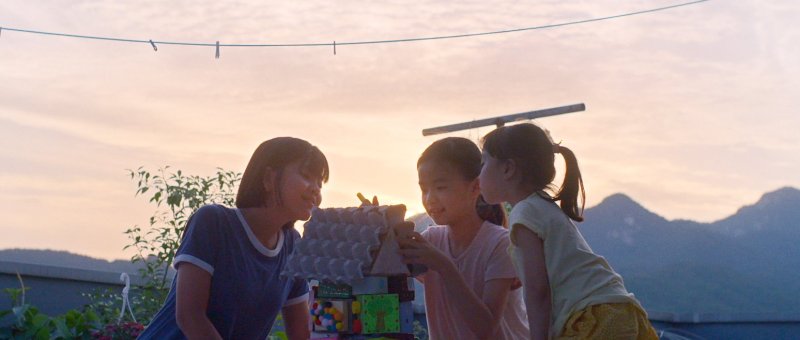
The House of Us (우리집, Yoon Ga-eun, 2019)

The world of us poster 2“People should eat with their families” a little girl points out dutifully declining an invitation to dinner, only to return home and dine alone. Hana (Kim Na-yeon), the heroine of Yoon Ga-eun’s The House of Us (우리집, Ulijib), is still young enough to think she can bend the world to her will but is about to discover that some things can’t, or perhaps shouldn’t, be changed only accepted. Meditating on the meaning of family in a changing society, Yoon’s World of Us followup finds its earnest heroine trying to escape familial disappointment through forging a home of her own but eventually realising home is not a house.

11-year-old Hana has just won the best classmate prize, but no one at home seems to be very excited for her, nor (perhaps strangely) does she seem to have many friends. In fact, despite her caring nature, she’s feeling intensely insecure because her family life is in disarray. Mum and dad are both busy and rarely home, but when they are they’re having blazing rows about how dissatisfying they each are as spouses while even going so far as to have retroactive arguments about the decision to have children while their kids are still in earshot. Hana can see her mum’s busy and she wants to help so she offers to do some of the cooking as part of her summer holiday “recipe book” project, but is flatly refused. Fearing that her parents are on the brink of divorce and longing to return to happier days, she pesters them about going on a trip, believing that would be enough to repair her fracturing family.

Wistfully staring at happy families wherever she goes, Hana ends up running into two little girls, nine-year-old Yoo-mi (Kim Shi-a) and her sister seven-year-old Yoo-jin (Joo Ye-rim), who are living more or less on their own while their parents are working away (an uncle checks in on them every now and then). Lonely as she is, Hana starts hanging out with the equally lonely sisters but takes on an oddly maternal rather than sisterly role, delighting in cooking for them the way her mother rarely does for her and would not allow her to do for their family. Generating an easy bond, the girls decide to build “the house of us” out of discarded cardboard boxes, declaring they’ll build it as high as they can.

Yet Hana, still a child herself, struggles with what it means to assume a parental role. She does to Yoo-mi and Yoo-jin the exact things that she most resented about her own parents – withholding information and making decisions which affect everyone without consulting anyone. Having moved around a lot, Yoo-mi and Yoo-jin are most anxious that their landlady says they’ll be moving but their parents haven’t told them anything. Hana vows to help them save their house while protecting her own home, but in reality she can do neither. The girls resort to a series of childish tricks to prevent prospective tenants from choosing to rent Yoo-mi and Yoo-jin’s apartment in the belief that that they could stay if no one wanted to move in, approaching the problem with innocent logic that makes perfect sense to a child but is little more than silliness to an adult.

Meanwhile, Hana struggles with twin discoveries of parental betrayal in finding her mother’s application for a transfer to Germany, and accidentally answering a call from a woman on her father’s phone that perhaps embarrasses her as she realises despite her young age that he has done something potentially destructive to their family. The less control she has in her family home, the more time she spends with Yoo-mi and Yoo-jin making a new one and trying to do it better. The sisters begin to look up to her as a little more than a big sister figure, allowing her to lead and expecting that she will know what to do even when she fails them.

Through her own failures, Hana begins to realise that her parents aren’t perfect and adults don’t always know what to do either. The girls accept that they belong to different families and can’t stay together, but discover that the “house” wasn’t what was important and that they’ll always be connected even if they’re far apart. No longer so insecure, Hana steps into herself and understands that her parents’ marriage is something they’ll sort out for themselves and if the family is scattered it’ll still be her family. A warm and empathetic, if melancholy, exploration of coming to terms with life’s disappointments, The House of Us finds serenity in the act of letting go as its heroine finds the strength to look forward rather than back towards a happy independence supported but not constrained by imperfect family.


The House of Us was screened as part of the 2019 BFI London Film Festival.

International trailer (English subtitles)