People in the Slum (꼬방동네 사람들, Bae Chang-ho, 1982)

People in the slum still 2The Korea of the early ‘80s was not an altogether happy place. One dictator fell in 1979, but hopes of returning to democracy were dashed when general Chun Doo-hwan staged a coup and instigated martial law, brutally suppressing a large scale democracy protest in Gwangju in 1980 (though the news of the incident was also suppressed at the time it took place). People in the Slums (꼬방동네 사람들, Kkobangdongne Salamdeul), adapted from the best selling novel by Lee Dong-cheol, is not an overtly political film but takes as its heroes those who have lost out in the nation’s bold forward march into the capitalist future. Opening with a voice over from the author himself, the film dedicates itself to “the memory of neighbours of bygone days”, remembering both the hardships but also the fierce sense of community and warmth to be found among those living at the bottom of the heap.

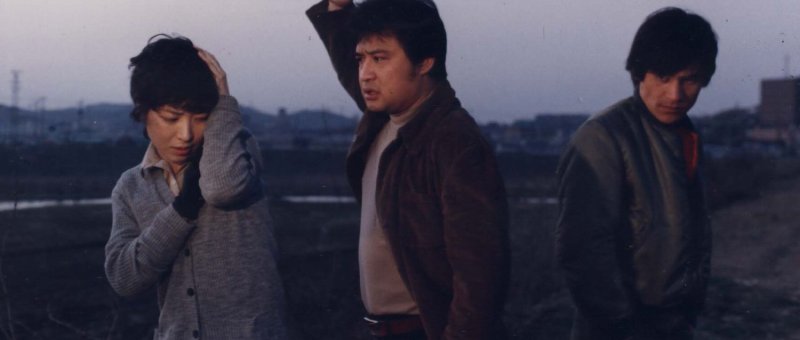
Myeong-suk (Kim Bo-yeon), a still young-ish woman with a young son, lives in a slum outside of the city with her second husband, Tae-sub (kim Hee-ra). Nicknamed “Black Glove” because of the glove she always wears on her right hand, Myeong-suk is about to open her own business – a small grocery store serving the local residents, but her happiness is tempered with anxiety. Tae-sub, despite his promises, steals money from Myeong-suk to go drinking and gambling, is occasionally violent, and does not get on with her son, Jun-il, who refers to him as Mr. Piggy. Jun-il is also a constant worry because he’s picked up a habit of stealing things and generally causing trouble around the neighbourhood. When Myeong-suk’s former husband and the father of Jun-il, Ju-seok (Ahn Sung-ki), catches sight of her by chance one day, the past threatens to eclipse the small hope of her future.

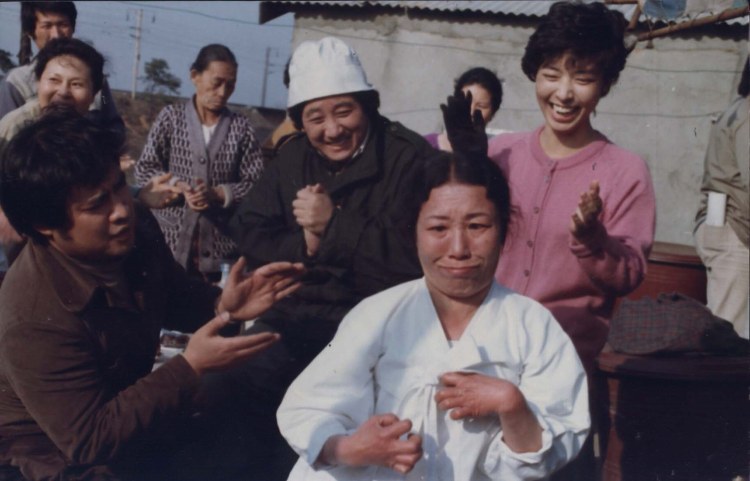
Life in the slums is not easy. There are few resources, few people are working and there are lots of children with no money to feed and clothe them. Fights are frequent but often unserious. The community pull together to support each other, turning out in force for the grand opening of Myeong-suk’s shop or the 60th birthday celebration of a fellow resident. Besides Myeong-suk, her second husband, and son, the slum is home to a collection of unusual characters from a widow who dresses in white and does strange dances to entertain the locals, to the pastor who does his best to help where he can. A poor drunken woman makes a fool of herself all over town, nursing a crush on the pastor but seemingly unable to move past her dependency on alcohol and whatever it is that caused it and landed her in the slum.

Myeong-suk’s early life would not have suggested her current trajectory, as Bae reveals in Ju-seok’s flashbacks of his courtship to the woman who would become his wife. Ju-seok, a pickpocket, spotted Myeong-suk on a bus and it was love at first sight. Eventually he married her but never revealed his illicit occupation until he was finally arrested. For the sake of his wife and child, Ju-seok attempts to go straight but his efforts are frustrated by bad luck, temptation, and unforgiving policemen. No matter how hard Ju-seok tries to be a decent, hardworking, family man, the economic instability of late ‘70s Korea will not allow him to do it.

Myeong-suk waits for him, but there comes a point she cannot wait anymore. Her second husband is no better than her first and, just like Ju-seok, is hiding something from her. Tae-sub is a bully and a bruiser who is only using Myeong-suk as a convenient place to hide. She cannot rely on him for affection, protection, or financial stability. Ju-seok, at least, did love Myeong-suk even if that love was the very thing which kept leading him back into a life of crime which then took him away from her. Once again love is a luxury the poor cannot afford .

Where the general atmosphere may seem destined for a tragedy for the resilient, suffering Myeong-suk, her damaged son, and reformed taxi-driver former husband, Bae gives them hope for a warmer, if not a better, future. As Myeong-suk prepares to leave the slum, the pastor, encircled by the residents, reads out a passage reminding the locals that a neighbour’s suffering is one’s own suffering while the drunken woman who previously hated children appears to have sobered up and happily hugs a child. Myeong-suk makes a selfless gesture of atonement and solidarity in giving the money from selling her shop to another single mother whose youngest three all have different fathers, perhaps indicating the difficulty of her life since the father of her eldest passed away. Tae-sub too reforms, decides to face the past he’s been running from and make amends for his former life, facilitating a possible reunion for the star-crossed lovers Myeong-suk and Ju-seok. The future suddenly looks brighter, but it remains uncertain and who knows if love and a taxi-driver’s salary will be enough to keep Ju-seok on the straight and narrow as a responsible husband and father in turbulent ‘80s Korea.


People in the Slum screens as part of the London Korean Film Festival 2017 which is hosting a mini Bae Chang-ho retrospective of three films at each of which the director will be present for a Q&A.

The film was also recently released on all regions blu-ray courtesy of the Korean Film Archive. In addition to English subtitles on the main feature, the blu-ray also includes English subtitles for the commentary track by Bae Chang-ho and film critic Kim Sungwook, and comes with a bilingual booklet featuring essays by Jang Byung-won (programmer for Jeonju International Film Festival), Lee Yong-cheol (film critic), and Chris Berry (King’s College London).

You can also watch the entirety of the film legally and for free courtesy of the Korean Film Archive’s YouTube Channel.

A Confession Expecting a Rejection (거절을 기대하는 고백, Park Jeong-hoon, 2017)

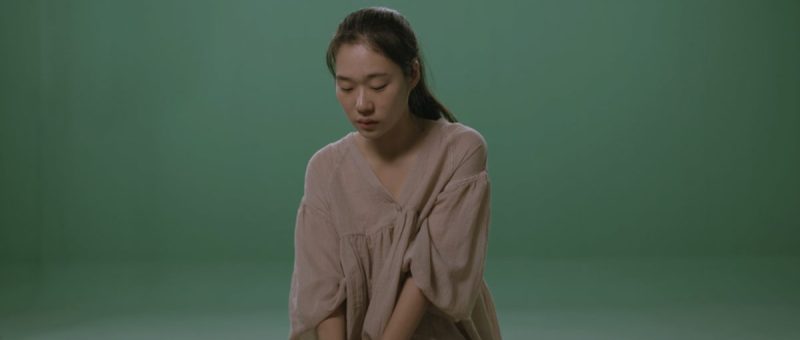
Confession Expecting a Rejection still 1“You’re not going to put this on the internet, right?” – a question asked by each of the interviewees in Park Jeong-hoon’s minimal yet riveting exploration modern mores A Confession Expecting a Rejection (거절을 기대하는 고백, geojeol-eul gidaehaneun gobaeg). Shot against green screen with a static camera and under a one take conceit, Confession interrogates everything from cinema as an art form and objective and subjective realities to social media, revenge porn, and romance among the young. Despite, or perhaps because of, the almost hypnotic lack of motion, Park’s meditations take on a surreal, almost mythic quality as interviewee and interviewer (seen or unseen) unwittingly dissect themselves before the passive lens of a seemingly unrecording camera.

The film opens with the camera “running” as its two operators chat amongst themselves whilst waiting for their interviewee. These interviews seem to be conducted weekly and are something to do with a university film club whose “director” is apparently somewhat pretentious and too much of a self-centred perfectionist to survive in less tolerant industries. Anyway, the first interviewee, Kyung-woo, joined the film group a few weeks ago and is, in the opinion of the men behind the camera, “a bit weird”.

Kyung-woo arrives and sits on a stool we can’t actually see because of the green screen. He seems nice enough – large round glasses, floppy hair, loose beige T-shirt. He starts chatting, introduces himself and reveals the unusual fact that he is already married. The interviewers are surprised and question him further, discovering Kyung-woo’s wife is currently living abroad, they had no wedding ceremony, and did not register their union with the government. At this point Kyung-woo’s demeanour changes, he seems spaced out but also intense as he begins to explain about meeting his wife at a “religious gathering” and how “the ancestors” that other people can’t see tell him who might be a good person to try “recruiting”.

During the short pause after Kyung-woo’s strange story, the guys behind the camera have a brief discussion about social media and a sex tape which has just gone viral – presumably an act of revenge porn. The next interviewee, Da-jeong, rushes in and ends their discussion. Unlike with Kyung-woo, one of the interviewers asks if Da-jeong would like a mirror to check her appearance before they start recording to which she seems surprised and laughingly declines – “it’s not as if I’ve come here to look pretty” she says. The same interviewer chit-chats about her part-time job as a tutor but is stunned into silence to realise she’s been tutoring a young man rather than a little girl. Unsurprisingly, interviewer 1, Han, will try and confess his love to her while interviewer 2, Jeong-gong, is out of the room.

Jeong-gong is, in fact, the boyfriend of Da-jeong whose previously cheerful demeanour dissipates just as Kyung-woo’s had only this time when faced with the increasingly intimidating presence of Jeong-gong. Da-jeong is trying to break up with Jeong-gong, but he refuses to listen. Explaining how “worried” it makes him when she doesn’t immediately answer her phone, Jeong-gong goes on to explain about a date but Da-jeong cuts him off – she won’t be coming, she doesn’t want to see him anymore. Jeong-gong ignores her, says she’s just in a mood and will change her mind after they get something to eat the next day. The implication is that Da-jeong has tried to do this before but has always backed down and intends today to be different. Unlike Kyung-woo’s rather strange tale of cults and early “marriage”, Da-jeong’s segment descends into brutal relationship drama as Jeong-gong’s increasingly manipulative behaviour keeps her from just up and leaving.

Park plays with the medium expertly. Making fantastic use of sound design to create a literally “unseen” world behind the camera, Confession allows its two interviewers to bicker irritatedly about their film course which teaches how to “see” in “layers”, picking up “emotional evidence” that the casual viewer might miss. Discussing the seen and the unseen along with the various “ranks” of student, the boys are beginning to sound just as surreal as Kyung-woo’s batty cultism. Talk of social media also smacks of cult with its “followers”, rituals, and precisely defined social codes but the conversations are essentially elliptical ending with a brief coda which returns us to origin as Da-jeong meets Jeong-gong and flicks the camera’s on switch herself, making a confession of love that ends in a promise we know will be broken.


Screened at the London Korean Film Festival 2017.


Come, Together (컴, 투게더, Shin Dong-il, 2017)

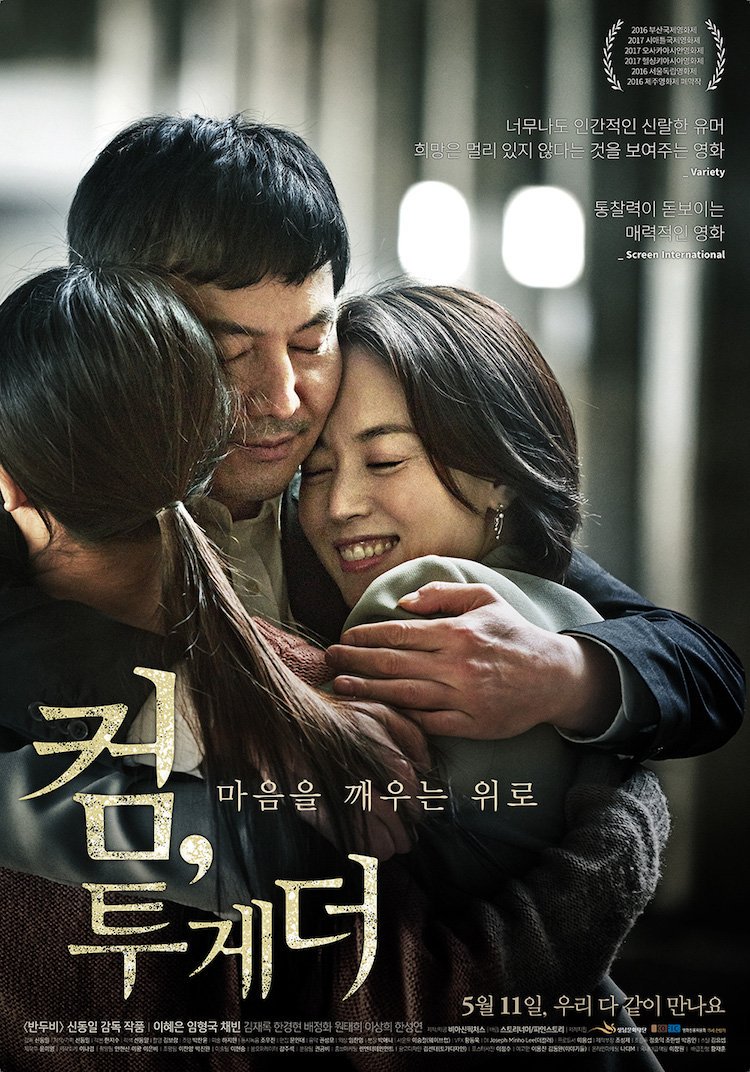
come, together posterToo fast, too loud, too bright. The pressure cooker society threatens to explode in Shin Dong-il’s sympathetic portrayal of one family’s period of crisis in Come, Together (컴, 투게더). When sorrows come they come not single spies but in battalions – redundancy (of several kinds), betrayal, anxieties academic and financial, the Parks have more than their fare share to deal with but the cumulative effect of their individual troubles quickly overwhelms their ordinary, middle-class existence, exposing the tiny fractures in its foundation hitherto papered over by chasing the dream of materialism.

From the outside the Parks are just like any typical middle-class family. They live in a nice apartment with a greenhouse balcony and plenty of space for three. Dad Beom-goo (Lim Hyung-guk) is a moderately successful salaryman, but his world collapses when he’s abruptly let go in the most insensitive of ways by his slimy boss. Mum Mi-yeong (Lee Hye-eun) is a credit card saleswoman who earns by commission and is well used to the hard sell. Teenage daughter Han-na (Chae Bin) has taken a year out to retake her university entrance exams but is now in limbo after not doing well enough to be accepted but having been ranked 18th on the waiting list, anxiously waiting to find out if enough people decide to decline the place she is so desperate to win.

Beom-goo losing his job of 18 years is not just humiliating and embarrassing, but as the family are already in huge debt it is also extremely worrying. As a middle-aged man, it’s unlikely Beom-goo is going to be able to find a comparable position in Korea’s competitive labour market where switching companies is still not the norm and most employees are hired right out of college. Having spent the last 18 years debasing himself to flatter his bosses, it’s galling in the least to realise he’s simply been replaced with a younger, cheaper employee he himself helped learn the ropes. Deprived of his breadwinner status, Beom-goo is supposed to be doing the housework but the boredom quickly gets to him and he spends most days lounging around in his pants lamenting his sorry state. That is until he meets the man from upstairs (Kim Jae-rok) who happens to be in a similar position and begins to lead Beom-goo astray before hinting at a much darker course for himself than the one he’s set Beom-goo on.

Mi-yeong is now the sole provider but her work is extremely stressful – not just the high pressure world of sales, but the bitchy, backstabbing atmosphere in the mostly female office. The job is to get people to sign up for credit cards they don’t really need and probably can’t afford, adding to the pressures of the consumerist society which have already landed the Parks in financial difficulty themselves. Mi-yeong is good at her job, she knows how to get people to sign on the dotted line but she’s also desperate enough to risk breaking the rules. When she’s undercut by a colleague whose situation she has misread, Mi-yeong takes it extremely personally, vowing revenge not just on the colleague but on the boss who refused to back her up and the client who betrayed her.

Mi-yeong’s rage and resentment are to have tragic, unforeseen consequences, threatening to deliver everything she’d dreamed of but at a terrible price. Han-na faces a similar dilemma as she finds herself staring at the list of 17 people in the queue in front of her and silently hoping some of them get hit by busses. The tense atmosphere at home only adds to Han-na’s stress levels as Beom-goo’s increasing impotence finds him playing father of the house like never before and deliberately undermining her sense of self esteem by repeatedly bringing up her failure to get into college. Unlike either of her parents, Han-na does at least have a positive influence in her life in the form of friend Yoo-gyeong (Lee Sang-hee), whom both her parents disapprove of because of her deliberate choice to live outside the mainstream.

Yoo-gyeong, though only in her early ‘20s, owns her own store selling leather bracelets and uses the proceeds to fund her free spirited lifestyle of taking off backpacking across whichever land takes her fancy. When Han-na says she wishes she could live like Yoo-gyeong, Yoo-gyeong bristles, insisting that she’d support whichever decision Han-na makes but that she ought to live her own life the way she wants rather than emulating someone else. Also, by way of an aside, she points out that people seem to assume she does exactly as she pleases but that’s not quite the case. In fact, it may be that Yoo-gyeong is, in a sense, forced to live a life outside of the mainstream simply by virtue of who she is and that her frequent flights to pastures new are a kind of escape or of running away from various social pressures at home.

Irrespective of whether or not they get what they thought it was they wanted, each is forced to reassess their way of living, realising that their relentless pursuit of material gain and the socially accepted definition of success has only made them miserable. Rather than continuing down the road to ruin, the Parks decide to choose happiness by simply dropping out, resetting their lives with the intention of doing what it is they want to do rather than what it is they think they’re supposed to. Waking up from a conformist delusion reawakens the freedom to embrace individual desires but it also restores the family to its previously happy state, released from the strain of modern life in favour of simpler, more essential pleasures.


Screened at the London Korean Film Festival 2017.

Original trailer (select English subtitles from captions menu)

The Outlaws (범죄도시, Kang Yoon-sung, 2017)

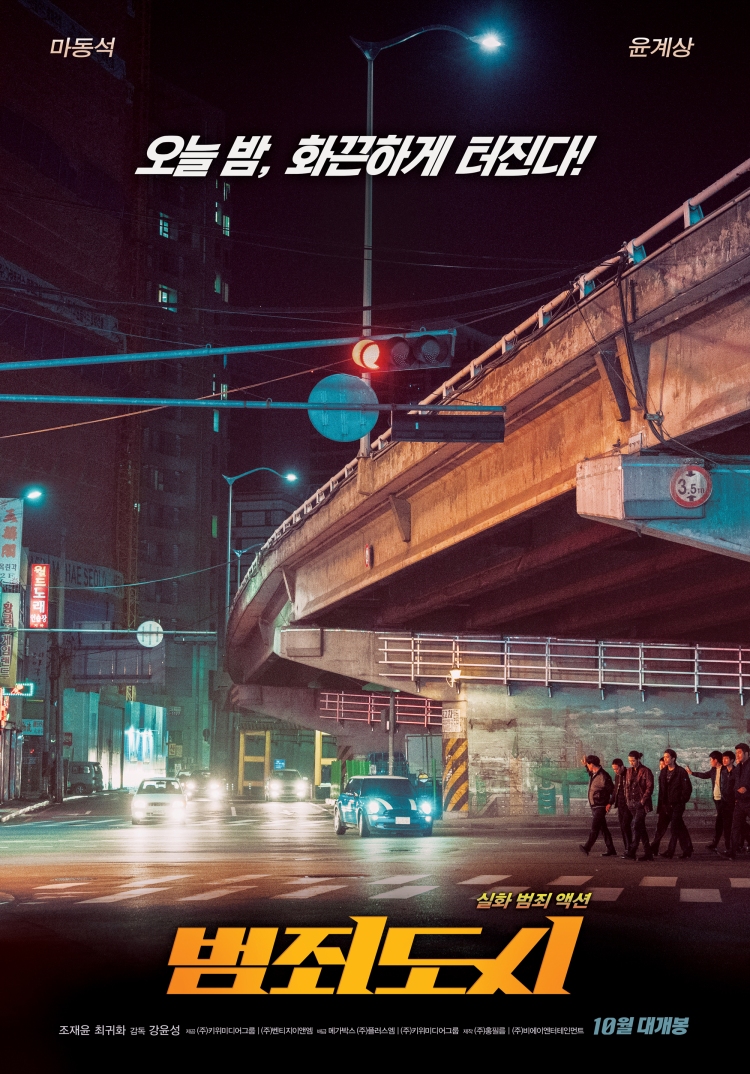
The outlaws posterBack in 2004, a hero cop made the headlines by cleaning up Chinatown when he took into custody 32 known gang members in Seoul’s Garibong district. Based on the real life case, The Outlaws (범죄도시, BumJoedoshi, AKA Crime City), is the debut feature from Kang Yoon-sung in which Ma Dong-seok adds goodhearted yet compromised policeman to his list of increasingly impressive leading performances. Truth be told the role does little to stretch his current range but fits comfortably into Ma’s well worn persona of noble bruiser as he plays fatherly commander to his fiercely loyal team and avuncular mentor to a brave boy in the district who wants to help free the area from the dangerous gang violence which leaves not just businesses but lives under threat.

Ma Seok-do (Ma Dong-seok) is the only force stopping Garibong from descending into a hellish war zone of gang violence and destruction. A local resident, Ma is well respected in the area and knows the territory well enough to navigate its various challenges. Rather than take on the gangs wholesale he attempts to placate them, brokering an uneasy equilibrium which keeps the violence contained and helps to protect ordinary people from its effects. All of that goes out the window when a new threat arrives in the form of vicious gangster Jang Chen (Yoon Kye-sang) and his two minions whose methods are unsubtle in the extreme, ending with rival gang bosses chopped up and placed inside suitcases over nothing more than a trifling gambling debt.

Jang is a new and terrifying threat because he sees no need to play by the “rules”. A peace cannot be brokered with him and he cannot be reasoned with. Ma knows the time has come for action but even with police resources behind him is ill equipped to become, in effect, Garibong’s latest gang leader. To this end he makes a surprising decision – asking the residents for help. The residents, however, remain terrified. How can he ask them to inform on gangsters to whom they’re still paying protection money? Ma’s promise is a big one – to do what no one thought could be done in neutralising the organised crime threat by conducting a mass arrest of foot soldiers from across the gangland spectrum.

Ma Dong-seok makes fantastic use of his trademark sarcasm as the regular neighbourhood guy who also happens to be a top cop. Kang mixes a fair amount of humour into an otherwise dark and violent tale such as the recurrent presence of two lowly pamphleteers who are eventually pressed into more serious service for Ma, his trickery and manipulation of a suspect (which is also a way to save him from a death sentence on being sent back to China), and Ma’s love of drunken karaoke and lamb skewers with the boys. Ma thinks nothing of arming a gangster with a stab vest, setting up another in a public bath, or playing gangland politics for all they’re worth, but when it really counts he’s as straight as they come, protecting the residents of Garibong like the lone sheriff of some outpost town, equal parts officer of the law and disappointed dad.

The incongruously comical tone harks back to the ‘70s maverick cop golden age in which the lines between law breaker and law enforcer were always blurred but you knew who the good guys were because they had all the best lines. If Kang is aiming for this branded mix of grit and humour he doesn’t quite find it and the comedy sometimes undercuts his more serious intentions but it is undeniably good fun all the same. Ma Dong-seok’s warmhearted maverick is quite rightly the star of the show, but his rivalry with Yoon Kye-chang’s Jang Chen fails to ignite with Chen never quite seeming as menacing as intended. Nevertheless even if Kang’s gangland action comedy has little to add to an already crowded arena, it does at least provide a fitting showcase for Ma’s talents in its sarcastic, world weary policeman who may have one foot on the wrong side of the law but always acts in the name of justice.


Screened at the London Korean Film Festival 2017.

Original trailer (English subtitles)


The Day After (그 후, Hong Sang-soo, 2017)

The day after posterHong Sang-soo, perpetually introspective, is having an especially reflective 2017. Releasing three films in quick succession, each of which star new muse Kim Min-hee, Hong seems unusually keen to turn the camera directly on himself and not least in his choice of star. In On the Beach at Night Alone, Kim played an actress in flight from the fallout of a destructive affair with a married director (a stand-in for Hong who never appears on screen), but in The Day After (그 후, Geu Hu), she plays an aspiring writer and free spirited bystander to an equally messy affair between a married publisher and his younger female assistant. Like many of Hong’s heroes (which often seem to be stand-ins for himself), Bongwan (Kwon Hae-hyo) is a cowardly, deluded womaniser who refuses to face his self-involved disaffection in favour of burying himself in youth and prettiness.

Bongwan has developed a habit of getting up early and leaving the house as soon as possible. His wife (Jo Yoon-hee) finds this odd after a couple of decades of married life and decides to ask him about it over a hurried breakfast. She is patient and half playful, but Bongwan is anxious and embarrassed. He refuses to answer, laughing the questioning off until his wife later texts him to apologise for her “overreaction.” Overreacting is something she will get to later, but for now Bongwan is about to have an informal meeting with a potential new assistant. His wife was not wrong after all, Bongwan had been having an affair with a girl from work, Chang-sook (Kim Sae-byuk), who has now left in order to move on with her life after realising Bongwan is too spineless to ever leave his family.

New girl Areum (Kim Min-hee) is an aspiring writer with good credentials who comes highly recommended by a Professor Bongwan has huge respect for but that’s not why he hires her. He hires her because she fits neatly in the space vacated by absent lover Changsook, is quite pretty, and strokes his vanity by expressing her admiration for his writing even though he mainly does criticism rather than “real” writing these days. Bongwan’s lascivious ways are immediately obvious in his first conversation with Areum which shifts from relaxed interview to personal chit-chat in which he asks her slightly insensitive questions about her family history, grasps her hand without warning and then later stops to remark on just how lovely he thinks her hands are. They change registers from the formal to the informal right away as Bongwan instructs Areum not to refer to him as the president but as a boss (they’re equals, but he’s in charge). He buys her dinner, pushes her to drink, and flirts with her, but Areum is ahead of him and neatly deflects his growing interest.

Areum moves the conversation to a higher level by asking Bong-wan exactly why it is he’s alive. Bongwan, not as much of the contemplative sort as he seems, waffles on for a bit but doesn’t really know, he was born after all and then…. “And then” is the English title of the Japanese novel, Sorekara by Natsume Soseki (adapted into a fine film by Yoshimitsu Morita in 1985), from which the film draws its Korean title. The hero of Soseki’s novel, Daisuke, is the son of a wealthy family whose ennui is so deep that he finds himself needing to place a hand on his chest to check that his heart is still beating. Daisuke had been in love in his youth but never said anything, telling himself it was out of a sense of chivalry towards a friend in love with the same girl. Years later he realises his notions of “chivalry” were all affectation, a deluded way of papering over his cowardice and fear of rejection. That Bongwan eventually decides to give this particular book to Areum is quite telling in his obvious identification with Daisuke who also failed to speak his heart and faced a difficult decision in considering whether to abandon the life of comfort he had always known to strike out on his own in the name of love.

Bongwan wheedles and defers, squirming like a child caught with chocolate round his mouth yet claiming to know nothing about the missing biscuits. His long suffering wife, finding evidence of a possible attachment to another woman, “overreacts” in grand style by physically abusing Areum, assuming her to be the missing Changsook. Hong plays his usual game with timelines, keeping the present uncertain as Changsook repeatedly reappears in life or in memory. It’s clear that for Bongwan these three women are almost interchangeable, no matter what he might say as regards his grand romance with his much younger female assistant who quite rightly points out his extreme moral cowardice in an emotional outburst over an awkward dinner. In a typically Hong-ian touch of meta-comedy, Bongwan may even have forgotten the entirety of the strange day he spent with Areum who later echoes his wife’s words to the effect that his “face looks different”. Areum, however, like most of the characters Kim has played for Hong, eventually wins out in her free spirited sunniness, taking her great belief in the world’s beauty with her, leaving Bongwan to enjoy his black-bean noodles of misery inside in the prison of his own making.


Screened as the opening night gala of the London Korean Film Festival 2017.

Original trailer (English subtitles)

V.I.P. (브이아이피, Park Hoon-jung, 2017)

V.I.P. posterIn New World, Park Hoon-jung provided a bleak overview of creeping corruption with the absolute certainty that the forces of darkness will always win over those of the light, but with V.I.P. (브이아이피) he turns his attentions away from South Korea’s hellish gangland society to examine the effect of geopolitical concerns on the lives of ordinary citizens. He does this by positioning South Korea’s two biggest international concerns – America and The North, as twin manipulators with his home nation caught in the middle, trapped between the need to preserve allies and defend against enemies. The “enemy” here is a sociopathic serial killer allowed to get away with his crimes at home because of his elite status and then again abroad as a key informant of the American intelligence services.

Beginning at the end with a weary man accepting a gun and striding into a rundown building in Hong Kong, Park jumps back a few years to North Korea where an innocent schoolgirl is grabbed by a gang of three boys on a peaceful country road. Not only do they brutally rape and kill the girl, but they even go so far as to massacre her entire family. Police Chief Lee (Park Hee-Soon) identifies the killer as Kim Gwang-il (Lee Jong-Suk), son of a high ranking official. His boss closes the case; Gwang-il is untouchable. Lee is demoted and sent to a fertiliser plant.

A couple of years later similar crimes begin occurring in the South and maverick policeman Chae (Kim Myung-min), temporarily reinstated after being suspended for his violent ways, is handed the case after his superior apparently “commits suicide”. Like Lee, who eventually makes contact with Chae having followed his quarry to the South, Chae identifies Gwang-il and is prevented from arresting him but this time by South Korean intelligence services who were partly responsible for Gwang-il’s defection working closely with America’s CIA and the very greasy Agent Gray (Peter Stormare).

Like many Korean films of recent times the central point of concern is in the ability of the rich and powerful to do whatever they please and get away with it because their special status makes them untouchable. Park scores a double a whammy when he casts his villain both as an elitist and as a North Korean though he draws no connection between life in a brutalising regime and the desire to inflict violence.

This is a violent tale and the violence on show is sickening, often needlessly so. After showing us the aftermath of what happened to the innocent teenage girl in the prologue and then to her entire family including a five year old brother, there was really no need to go into detail but Park eventually includes a horrifying scene of Gwang-il garrotting his victim in an elegant drawing room right underneath the portraits of the Kims hanging proudly on the wall. The scene is problematic for several reasons but the biggest of them is in the depiction of the naked female body covered in blood and bruises while Park’s minions stand naked around her, pale and unstained by her blood, each of the actors carefully hiding their genitals from the camera. The victim, who has no lines other than a final plea not to kill her, is the only real female presence in the film save for one female police officer who is seen briefly and only appears to become another potential victim for Gwang-il.

The real ire is saved not for Gwang-il but for the intelligence services who lack the backbone to stop him. The Americans, or more precisely a need to placate them, are the major motivator – a fact which takes on additional irony considering Gwang-il is the North Korean threat the US is supposed to be helping to mitigate. It remains unclear why the CIA would be allowing Gwang-il free reign to live as a regular citizen given that he supposedly has important information regarding North Korean finances which is the reason the Americans are helping him defect, rather than keeping him safely contained and preventing him from committing heinous crimes all over the world which, apart from anything else, threaten to cause huge embarrassment to everyone involved. Still, Agent Gray lives up to his name in his general sleaziness and the intense implication that he is playing his own long game which may have nothing to do with country or protocol.

Park’s decision to structure the film in several chapters each with a different title card often works against him, taking the momentum of his procedural and occasionally proving confusing. Loosely, Park ties the stories of three men together – the idealistic North Korean officer who wants to see justice done, the grizzled cop with a noble heart, and the conflicted NIS officer realising the unforeseen consequences of his attempts to play politics for career advancement, but he fails to weave their fates into anything more than an extremely pessimistic exploration of hidden geopolitical oppression. Final shootout aside, V.I.P. is a grimy, politically questionable thriller which irritates in its narrative sluggishness and leaves a sour taste in the mouth in its own indifference to its villains’ crimes in favour of his V.I.P. status as the representative of an entirely different existential threat.


Screened at the London East Asia Film Festival 2017.

Original trailer (no subtitles)

Anarchist from Colony (박열, Lee Joon-ik, 2017)

anarchist from colony posterLee Joon-ik follows his poetical mediation on the Korean independence movement, Dong-ju, with an equally philosophical, if not quite as rigorous, tale of rebellion and tragedy inspired by real life revolutionary anarchist, Park Yeol. Where Dong-ju was a tale of a world in in black and white, Anarchist from Colony (박열, Park Yeol) is one of glorious colour and the strange joy of pithily rejecting an oppressor’s authority. The oppressor’s authority is, however, infinite and no amount of anarchy will be enough to evade it even if there may be long term advantages in losing a battle in grand style.

Park Yeol (Lee Je-hoon) is a Korean left wing agitator living in Tokyo and earning a living as a rickshaw driver. He is also a hero to local Koreans and has gained a lot of fans (many of them female) thanks to his poetry including his latest entitled “Damn Dog” which laments his lowly status as an oppressed Korean man. One of his many fans, Fumiko Kaneko (Choi Hee-seo) – a Japanese woman who spent some time in Korea as a child, manages to work her way into his heart and becomes both a lover and an integral part of his revolutionary movement known as The Revolt.

In 1923, The Great Kanto Earthquake caused wide scale destruction and general chaos in the capital. Martial law was instituted, but a rumour soon spread that Korean insurrectionists were using the confusion to fuel their revolutionary ambitions, poisoning wells, committing arson, and plotting to assassinate the Emperor and his son. Of course, the rumours were baseless but led to a citywide pogrom in which around 6000 Koreans are thought to have been murdered both by ordinary people and by the army. Hoping to avoid the violence, Park decides he might be better off turning himself in to the police, but even police cells are not free of vigilante justice.

Unlike many recent films set during the colonial period, Anarchist from Colony is not particularly interested in demonising the Japanese. Generally speaking, the Japanese government are depicted as a collection of buffoons ill equipped to deal with the unexpected disaster of the earthquake and obsessed with rules, protocol, and Emperor worship. The major antagonist is a moustache twirling idiot and committed racist nursing a grudge against Koreans over a career setback to do with the suppression of the March 1, 1919  protest which kickstarted the Korean Independence Movement. The other officials mostly regard Mizuno (Kim In-woo) as an embarrassment, calling him out on his obvious racism and attempting to circumvent his machinations but more often than not failing to successfully outmanoeuvre him.

Having been partly responsible for the massacre in failing to stop the racist rantings of Mizuno and co, the government are eager to suppress all knowledge of it and distance themselves from anything that could make them look bad on the international stage. In this Mizuno makes a serious miscalculation when he decides to fit up the most popular Korean political activist he can get his hands on as a “traitor” and have him tried and executed as an example to the others. Park is wise to this scheme right away and decides to play along even if he knows it may eventually cost him his life. In fact, he almost hopes it will because not only will he lend weight to the cause of independence through his own martyrdom, but it will be much harder for the government to suppress news of the massacre with him on trial for his supposed terrorist activities which are being touted as its cause.

Yet the tale is framed not so much as suppressed revolution but ill fated love in the tragic romance of Park and Kaneko. The mini band of anarchists are a surprisingly cheerful bunch for hardline leftists, and Park and Kanenko’s intense bond is one of both political solidarity and true affection. Being anarchists through and through, they do not believe in marriage but agree to live together after signing a contract of cohabitation in which they mutually affirm their loyalty to each other and their cause. When Park is arrested, Kaneko turns herself in and follows him despite his pleas with her not to. The couple remain fiercely together to the end presenting a united front delighting in mocking their joint show trial even knowing they may soon be heading for the gallows.

This strange kind of lightness and dada-esque surrealism is an odd fit for the grim tale at hand. Lee mostly glosses over the wider implications of the massacre aside from minor references to longstanding prejudices such as Park’s beating by a customer who has short changed him and the vigilante gang’s repeated use of a particular phrase to flag up Korean accents. The overriding sense of flippancy undercuts the seriousness of Park’s plight and ultimately robs it of its power as his struggle is played for broad comedy rather than subtle satire. Perhaps overly ambitious, Lee’s reframing of of Park’s story as surrealist vaudeville romance never quite takes off, sacrificing passion for laughs but finding that they ring hollow surrounded by so much suppressed terror.


Screened at the London East Asia Film Festival 2017.

International trailer (English subtitles)

On the Beach at Night Alone (밤의 해변에서 혼자, Hong Sang-soo, 2017)

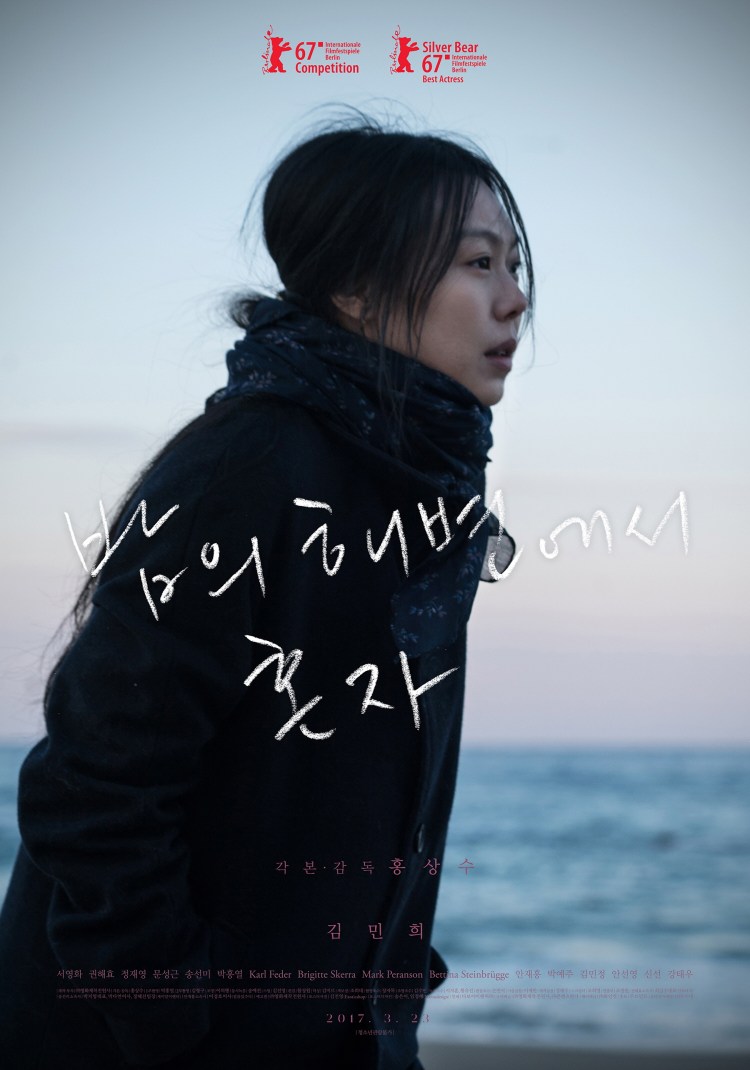
on the beach at night alone posterIt might be unkind to suggest that Hong Sang-soo has essentially been remaking the same film for much of his career, but then again his most characteristic approach is one of re-examination, taking one event and turning it around to see how things might have played out differently if fate had only been kinder. On the Beach at Night Alone (밤의 해변에서 혼자, Bamui Haebyunaeseo Honja) eschews Hong’s usual repetitions, but zooms in deeper on its protagonist’s agonising emotional crisis as she attempts to deal with the fallout from a passionate yet inadvisable affair with a married director which threatens to destroy not only her personal life but also the professional in conservative Korean society. The elephant in the room is, of course, that lead actress Kim Min-hee and the film’s director Hong Sang-soo were themselves involved in a messy affair which scandalised their home nation, forcing the lovers abroad and away from media speculation but perhaps not from the uncomfortable questions surrounding their relationship.

Divided into two parts shot by different cinematographers, the film begins in Hamburg where well known actress Young-hee (Kim Min-hee) has travelled to visit a friend, Jee-young (Seo Young-hwa), to clear her head and get away from all the fuss at home. Jee-young has been living in the city for a few years since her own marriage ended – like Young-hee she came to visit a friend and subsequently decided to stay. Young-hee thinks perhaps she could do the same but is surprised when her friend reacts negatively to the idea of her moving in. The two women chat and try to talk out Young-hee’s ongoing indecision and emotional turmoil while she waits to see if her married film director lover will really come to Hamburg to meet her as he says he will or lose his nerve at the last moment.

The second half picks up some time later with Young-hee (presumably the same Young-hee or at least a woman with a very similar backstory) in a cinema watching a film. She’s gone home to Korea and to her tiny seaside hometown rather than the harsh streets of Seoul. Whilst there she runs into a series of old friends, many of whom have also boomeranged back from the big city, finding it relentless and unforgiving in its unrealistic expectations of their desire for success. Young-hee is just as mixed-up as she was in Hamburg, but her collection of friends prove less reliable sounding boards than the world weary yet perceptive Jee-young.

Hong’s films have often revolved around self-centred, neurotic men who treat women badly while the women remain exasperated yet resigned and only occasionally hurt. Digging deep, Hong makes an effort to look at something from the other side in painting a picture of the real emotional damage done by the kinds of affairs his usual protagonist may engage in (though to be fair most of protagonists are eventually rebuffed by their objects of affection). Kim’s nuanced performance is raw and painful. Hurt and brokenhearted, Young-hee is angry with her former lover but still, she misses him, wonders how he is, hopes he’ll be alright but also, in a way, that he won’t.

Young-hee is a mess of contradictions – she says she won’t wait and then she waits, she says she won’t drink and then she does (to excess), she says she’s overly direct yet she consistently avoids speaking directly, she says harasses people and messes everything up but all she seems to do is isolate herself and avoid connection, she goes to Hamburg to escape and then feels trapped. Jee-young, a little older, seems to have pinned herself down but says she feels somewhat jealous of Young-hee’s youth, her confidence and capacity for desire. There is a melancholy quality to Jee-young’s conviction that she is “the kind of person who lives alone”, but she harbours no resentment towards her former husband, only a mild sense of regret in having wasted his time. Young-hee may be filled with desire, but has no idea what for.

On the Beach at Night Alone shares its title with a poem by Walt Whitman which, like many of Whitman’s poems, is essentially about the interconnectedness of all things and overwhelming sensation of suddenly feeling a part of a great confluence of existence. It is in that sense ironic as Young-hee and many of her friends continue to feel isolated and alone, playing it safe and avoiding the risk of true connection only to find settling for the sure thing more painful than the emotional implosion of Young-hee’s daringly bold affair of the heart. A night on a beach alone affords her the opportunity of sorting things out, if only in her head, finally learning to stand up and walk away towards an uncertain, but hopefully self-determined, future.


Screened at the BFI London Film Festival 2017.

Trailer (English subtitles)

Memoir of a Murderer (살인자의 기억법, Won Shin-yeon, 2017)

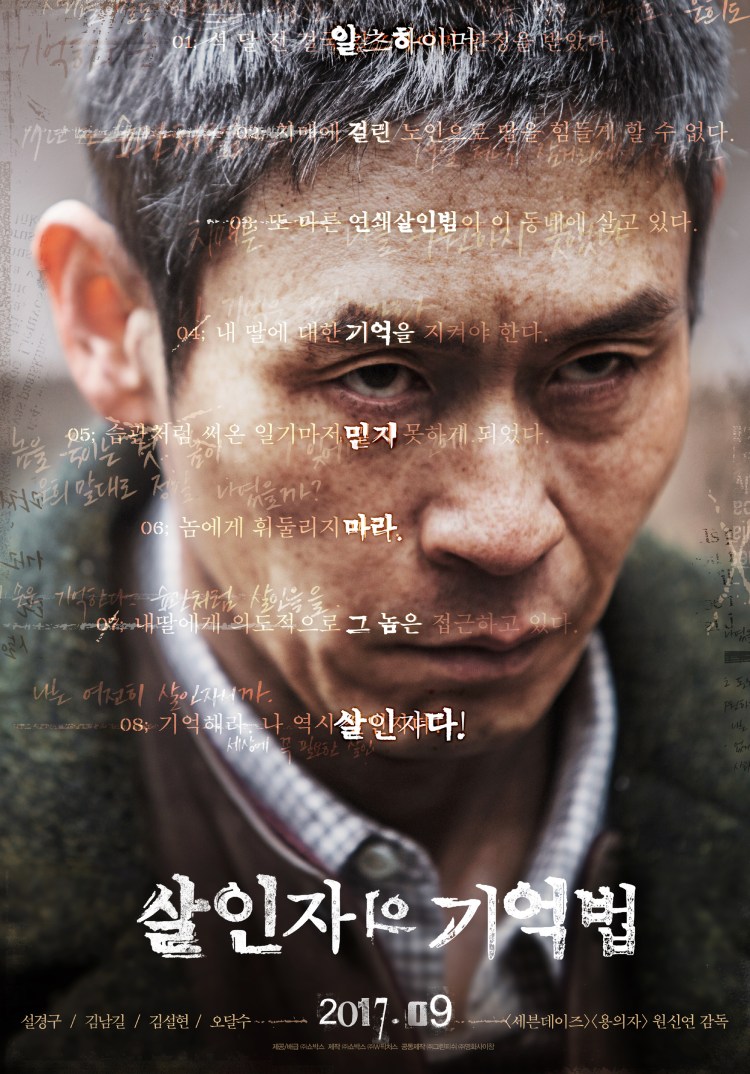
memoir of a murderer posterMemory, particularly traumatic memory, coupled with the inability to overcome painful truths through the act of forgetting, has a become an essential part of Korean cinema. The “hero” at the centre of Won Shin-yeon’s Memoir of a Murderer (살인자의 기억법, Salinjaui Gieokbeob), adapted from the novel by Kim Young-Ha, literally cannot remember his past crimes – he is suffering from dementia possibly brought on by brain damage sustained in an accident 17 years previously. The inability to remember is not the same as forgetting, and forgetting is not the same as ignoring, but there are some truths so essential that a superficial inability to recall them does not destroy their power.

Byung-su (Sol Kyung-gu) was once a serial killer. That is to say, he was the “noble” kind of serial killer who only killed “bad” people (in his own moral judgment) such as instigators of domestic violence, heartless loan sharks, or people who harm animals. These days Byung-su is a successful vet living with his grown-up daughter, Eun-hee (Seol Hyun). Having recently confirmed that he has Alzheimer’s, the doctor says possibly a result of trauma from that earlier car crash, Byung-su does not know what to do for the best seeing as he’ll have to give up work. An unexpected collision with a young man in a swanky silver car, Min Tae-ju (Kim Nam-Gil), gives Byung-su something else to think about when he notices what looks like blood dripping from the boot. Locking eyes with the man in question, Byun-su knows instantly that Tae-ju is just like him – a killer, probably the man behind a series of unsolved murders. Byung-su might have let this go as a matter of professional courtesy were it not for a few nagging doubts – did Tae-ju see in him what he saw in Tae-ju, and if he did will Eun-hee, who is a perfect match with the currently known victims in the unsolved serial killing case, be in additional danger due to her father’s accidental encounter?

Then again, did any of that actually happen? Byung-su’s rapidly deteriorating memory cannot be relied upon. Perhaps there was no crash, perhaps there was no body or the body was that of a deer, perhaps Byung-su is simply mixing up his original car crash with something more metaphorical. In an effort to help him remember where he is, Eun-hee has given her father a dictaphone so he can leave himself messages of things he might forget – when he took his medication, places he needs to go, the names of people he met but can’t remember. Unbeknownst to her, Byung-su has already engaged himself in a wider program of remembering by trying to write down his own life story, including all the grisly details of his serial killing past, in a kind of memoir on his computer. Though Byung-su struggles to remember details or ensure he has everything clearly the way it really happened, muscle memory speaks for itself and his body will never forget its murderous past. Freed from the moderating force of Byung-su’s remaining humanity, Byung-su worries what his body may do on his behalf while his mind is absent.

Byung-su positions himself as morally good, believing that his mission of killing “bad” people is a kind of service to humanity. When he begins to doubt himself, that perhaps he is both the old serial killer and the new but has “forgotten” his most recent victims, his justification starts to fall apart. Almost a father and son, Byung-su and his suspect come from different generations and grew up in very different political and social circumstances, yet both carry the scars of domestic violence. Violent fathers beget violent sons yet Byung-su, he believes, has chosen a better path in ridding the world of bullies whereas his opposing number has chosen to blame the victim in preying on the weak.

Alzheimer’s leaves Byung-su permanently vulnerable, not least to self betrayal, rendering him unable to even recognise his enemy or remember why it was he seems to suspect him. Despite the inability to remember, Byung-su retains his instinctive suspicion of Tae-ju, but is unable to evade the possibility that his misgivings are a mix of self-projection and a more natural paternal wariness. His world is in constant shift between realities founded on imperfect memory. Not until he has faced the truth in all its ugliness can he hope to reorder his existence. The act of forgetting cannot solve all one’s problems – the absence of superficial pain merely provokes a kind of numbness while the root causes remain. Byung-su cannot kill the killer in himself, and is condemned to chase his own ghost through various unrealities until it finally catches up with him. Filled with (extremely) dark humour and oddly warm naturalistic detail, Memoir of a Murderer operates on a deeper level than it first might appear, stepping away from literal truths in favour of metaphorical ones but finding little of either.


Screened at the BFI London Film Festival 2017.

International trailer (English subtitles)

Bamseom Pirates Seoul Inferno (밤섬해적단 서울불바다, Jung Yoon-suk, 2017)

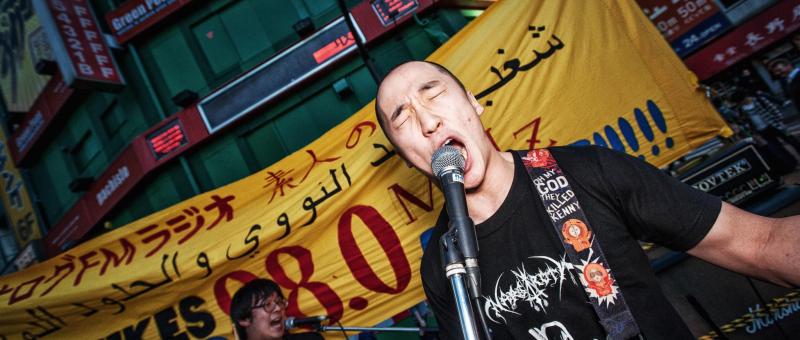
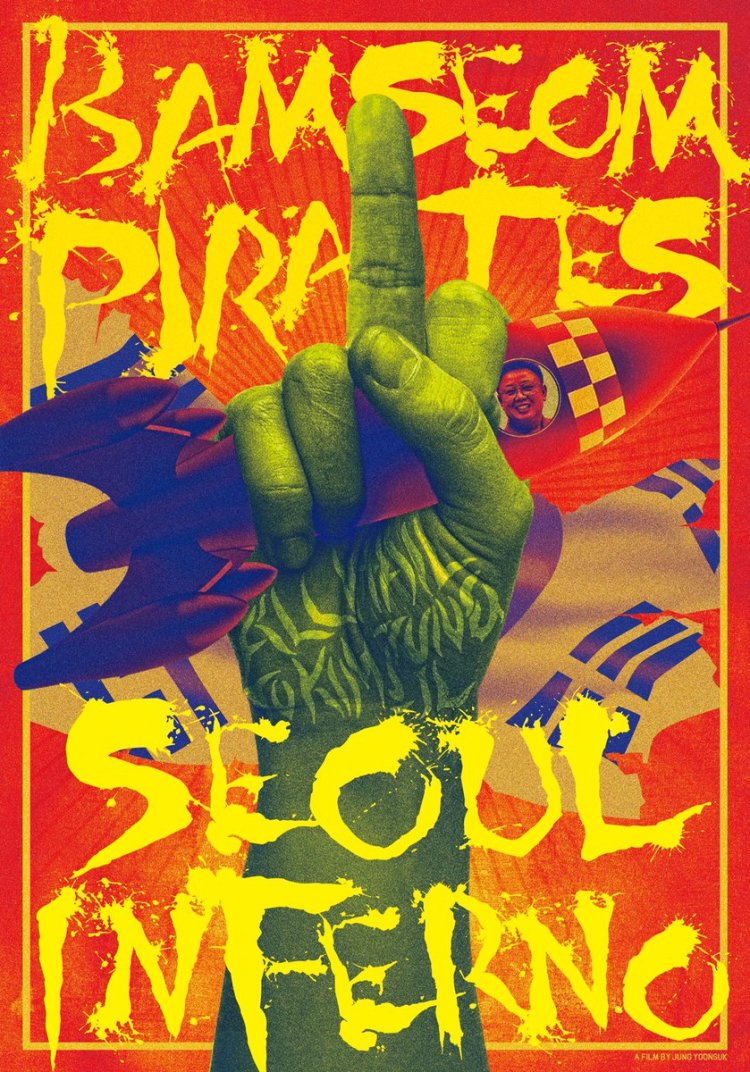
Bamseom Pirates posterGiven its long and turbulent political history, Korea has become good at the art of the peaceful protest. Bamseom Pirates Seoul Inferno (밤섬해적단 서울불바다, beomseom Haejeok-dan seoul bulbada) arrives just after another political storm has passed, but trouble once again hovers on the horizon courtesy of noisy neighbours. Yet it’s not so much the literal threat of the Kims in the North that’s the problem, but the way that fear is used and abused to serve certain needs – this is where avant-garde punk duo Bamseom Pirates aim their carefully crafted arrows. Unfortunately for them, they are too clever for their own good and their reliance on sarcasm leaves them frequently misunderstood.

The Bamseom Pirates are drummer Kwon Yong-man and bassist Jang Sung-geon – two young men living the life of starving artists in Korea’s underground music scene. As Jang points out, other bands smash expensive guitars but Bamseom Pirates smash rubbish picked up from around the derelict buildings where they play their shows to small crowds of likeminded youngsters. Though violence is often an integral part of many “punk” scenes, the clashes here are not born of over exuberance or warring factions of bands and their followers but of hired thugs deliberately sent in to make trouble, limiting freedoms of assembly and expression.

Kwon’s lyrics are deliberately incendiary but violence is not in the band’s agenda. Filmed over several years, Jung Yoon-suk’s documentary finds the pair performing at several protests and rallies usually in support of progressive causes including opposing privatisation, and labour reform. Though he is repeatedly pressed to explain himself, Kwon refuses to pin his convictions to the mast of any recognisable political faction, nervously aligning himself with the defunct Progressive Party and then only vaguely in citing an agreement with their progressive causes. This refusal is key to Kwon’s artistic statement as he finds himself attacked from all sides – the left, who might be assumed to be his allies, tear him down for his bourgeois upbringing and education at an elite university, but on the other hand one can’t say anything that sounds too lefty lest one be accused of being a “communist” and therefore North Korean sympathiser.

Bamseom Pirates rely heavily on irony and so they can’t resist pushing this central dichotomy to its natural limit. Thus Kwon’s signature song is called “All Hail Kim Jong-il!”, but as it turns out the song isn’t about that Kim Jong-il at all, but all the other unfortunate people throughout history who share his not particularly uncommon name and are now tainted by association. North Korea being the most taboo issue of the day, it comes up frequently in the band’s songs in which they often point out the uncomfortable truths about their neighbour – in particular, the theoretical benefits of socialism such as workers rights and a welfare state that should be (but aren’t) in place in North Korea but can’t be adopted into the South because of persistent fear of “Communism”. The fear of “Communism” has become a stick with which to beat the progressive cause or really any cause the conservative society does not want to engage with, shutting down all debate and undermining the “democracy” the previous generation fought so hard to win.

This all comes to a head when the band’s manager finds himself falling foul of Korea’s longstanding censorship laws regarding North Korea designed to prevent “acts which benefit the enemy”. Park, a high school friend of Kwon, and a jack of all trades who runs a small indie record label printing CDs for underground bands, is just as acerbic as the boys and frequently makes ironic comments about North Korea on his Twitter account, even once asking the Dear Leader to buy him some chocolate. Nevertheless, when he retweets a North Korean account he’s immediately arrested and brought in for questioning as a possible North Korean sympathiser. His brand of sarcasm is just too subtle for the censor, and he finds himself on the receiving end of an extremely harsh punishment which is in no way helped by Kwon’s honest testimony clarifying their stance on the North.

Park faces prison for making a stupid joke on Twitter while his lawyer sensibly points out that if he had said the same thing in North Korea, he’d already be dead. He would not last five seconds on North Korean soil and clearly has no desire to go there. Rather than simply capture events, Jung leans in on the central irony of the situation in its suggestion that perhaps there’s not as much difference between the democratic South and the despotic North as might be hoped when it comes to encouraging a full and frank freedom of expression.

Yet despite the satirical content of their music, Bamseom Pirates remain refreshingly unpretentious and keen to make fun of themselves as well the current political crisis of the day. There’s no posturing or claim of a great masterplan to change society through the power of punk. The boys just want to play their music to likeminded people and have fun while doing it. This self effacing charm makes their extremely loud and energetic performances a joy to watch, though Jung also captures their anarchic spirit in several music videos accompanied by garish onscreen captions featuring the lyrics plus the explanation that the sound balance has been “deliberately” miscaptured to represent the “imbalances” in modern Korean society and that the band’s various musical mistakes have also been left in in testament to their artistic integrity. Bamseom Pirates do not claim to speak for their generation, but they do all the same as the young fight back against the “mainstream” of a conservative society, refusing to accept the gradual erosions of the freedoms the preceding generation fought so hard for but have failed to protect.


Screened at BFI London Film Festival 2017.

Also screening as part of the London Korean Film Festival 2017 on 5th November at Close-up Film Centre.

Original trailer (English subtitles)