A Water Mill (물레방아, Lee Man-hee, 1966)

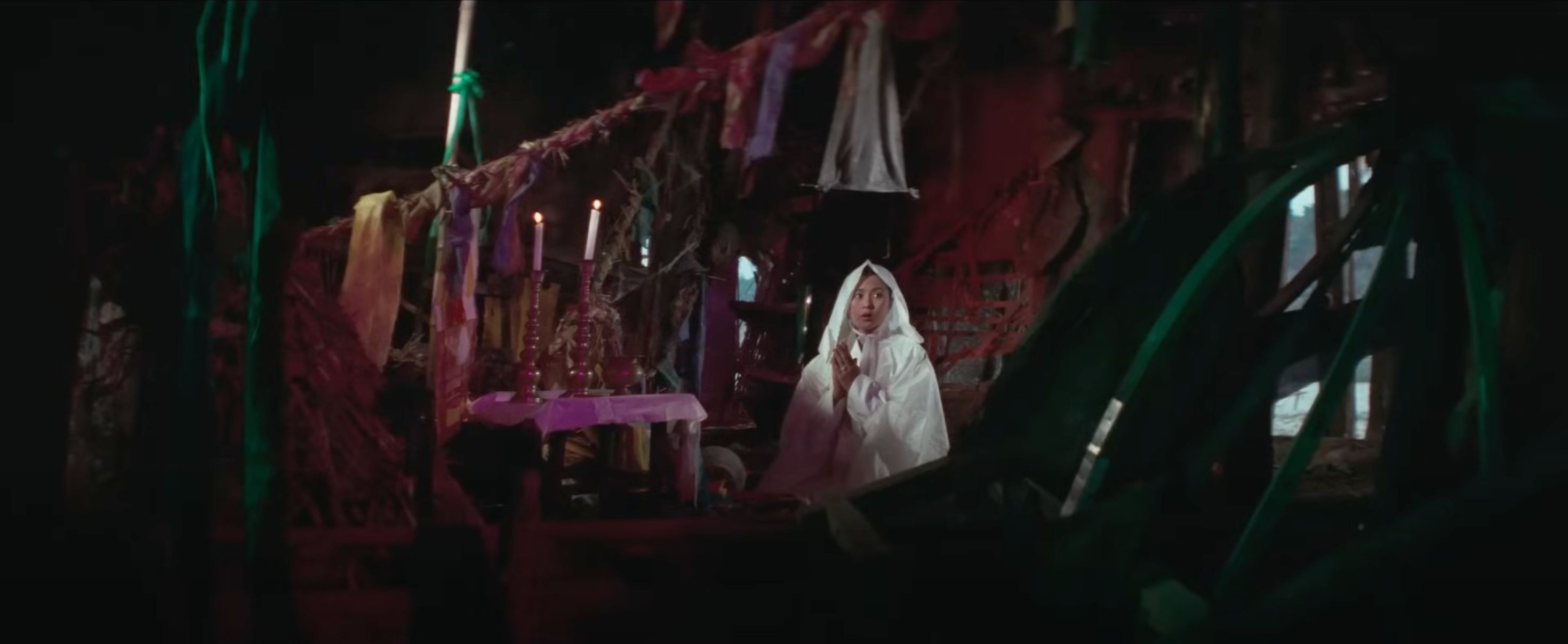
It’s not every day you wander into your own funeral. Or to be more precise, the death rite that Bong-won (Shin Young-kyun) unwittingly intrudes on in Lee Man-Hee’s feudal era fable A Water Mill (물레방아, Mullebanga) is for someone who died in a time no can remember. The old lady who explains it to him says that it happened long before she was born, implying at least the villagers have been enacting this ritual since time immemorial yet it’s almost as if Bong-won were walking towards a point of origin, drawn inexorably by forces beyond his control to play his part in this immortal ritual dance.

To that extent, Bong-won becomes a kind of “everyman” in this cautionary tale by virtue of the fact that he is nameless. Asked for his surname, he says he isn’t sure. It might be Kim or Park, later someone else says Lee which fills out the triumvirate of Korea’s most common family names. He says at one point that he doesn’t remember his mother, but thinks that she may have been a sex worker and his father a man who didn’t pay. But the fact he has no last name places him firmly at the bottom of the feudal hierarchy and most at the mercy of its hypocrisies and contradictions. He was on his way somewhere else when he fatefully found a sock floating the river that seems to flow towards him from his own future but that he will later gift perhaps to its original owner, the mysterious Geum-boon (Ko Eun-ah) with whom he falls in a deep, obsessive love that takes over the whole of his life.

Others in the village tell him that there is no such woman. An old man assures him she must have been some kind of ghost or supernatural creature come to trick him and Geum-boon does indeed take on a kind of eeriness. After deciding to stay in the village and look for her, Bong-won catches sight of Geum-boon in a forest glade bathing naked in a pool as the bright summer sun beats down on her but when he eventually makes his way down the mountain she has already disappeared. In chasing Geum-boon, he chases death but most evidently in the ways his obsession with her causes him to contravene the feudal order. He rebels against the landlord he was working for in refusing to collect her debt, then contracts himself to another in order to pay it so that he might marry her.

But ghost or not, Geum-boon is herself constrained by feudalism’s aggressive patriarchy. Force married to an invalid, she cared for him for three years until his death and then is pressed for his debts by the local landlord who wields them against her in order to claim her body. Married to Bong-won who has become an indentured servant, she is once again pursued by a landlord insistent on his droit du seigneur who exiles Bong-won to the pottery fields to get him out of the way. Geum-boon’s ambivalence does seem to give her a sometimes demonic quality as she laughs in the face of the landlord like something possessed and though she at first seems to like Bong-won and fear the attentions of the landlord she is also intrigued by the frankness of his current mistress who sees in her relationship with him the possibilities of transgressing class boundaries not to mention escaping a dull husband who will never be anything other than a servant. 

The film seems to suggest that Bong-won is powerless, while Geum-boon does at least have some power to wield. Even the landlord tells her that he has nothing to offer other than his money and power and even if becoming lady of the manor is a little far-fetched it seems unreasonable to criticise her if she did decide to become the landlord’s mistress as the path towards overcoming her circumstances lies in trading her body for influence. One could argue Bong-won does the same in leveraging his strength and his labour, but all it buys him is further exploitation and the eventual humiliation of knowing the landlord has been sleeping with his wife. 

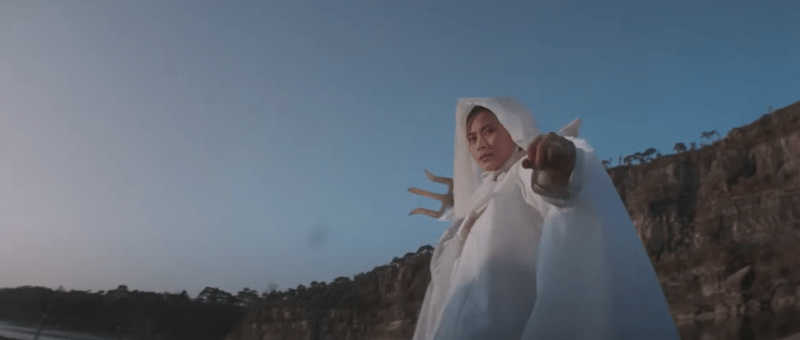
Feudalism therefore destroys natural human emotions such as love when all life is transactional in a constant, and largely futile, struggle for survival. Bong-won turns to the spiritual realm for help, asking a shaman how he can win back his wife but she gives him the rather bizarre instructions to steal three sets of underwear and throw them in the river on 3rd August while bowing to the west. Needless to say, that doesn’t work out very well for him. The fates truly do seem to be against Bong-won. Lee adds a touch of supernatural dread as Bong-won finds himself surrounded by howling winds as he fatefully makes his way towards the water mill and his destiny. The ritual dance is perfectly recreated as Bong-won and Geum-boon retake their roles in the play, their actions matching those of the masked players as Bong-won collapses on the bridge just as the demon had though there is no positive resolution in what is now both reality and fable. What we’re left with is the tragedy of feudalism, but also the maddening futility of obsessive desire for that which is and has always been ever so slightly out of reach.


General’s Son 3 (將軍의 아들 3 / 장군의 아들 3, Im Kwon-taek, 1992)

The third and final instalment in the General’s Son trilogy picks up some time after the events of the previous film, not with Doo-han (Park Sang-min) being released from prison but emerging from hiding. After his showdown with Kunimoto, he’d been lying low in a temple but is now on the run, heroically jumping off a train to avoid the police and thereafter making his way to Wonsan and seeking asylum with an affiliated gang. By this time, Doo-han’s role as the son of a legendary general who was murdered by communist traitors while fighting bravely for independence seems to have been forgotten as he wanders around trying to evade the colonial net. 

In Wonsan, he immediately starts causing trouble by objecting to gang leader Shirai’s treatment of an aspiring singer, Eun-sil (Oh Yeon-soo), whom he has more or less imprisoned until she agrees to sleep with him. Doo-han helps her to escape and encourages her to continue pursuing her dreams of stardom, but motions toward romance create an ongoing instability which indirectly echoes throughout the rest of the film as he tries to balance his desire for Eun-sil with the ongoing battle for Jongno and resistance against the Japanese. 

For her part, Eun-sil falls for Doo-han as the man who saved her from Shirai and restored her freedom but still finds herself at the mercy of the Japanese as otherwise sympathetic lieutenant Gondo (Dokgo Young-jae) takes a liking to her after being struck by her singing talent which he apparently did not expect seeing as she is a mere Korean. Later Gondo and Doo-han become accidental rivals when Eun-sil is arrested because of her associations with Doo-han and they have to work together to get her out. Gondo is fiercely critical of their relationship, not only out of romantic jealously but because he finds the Korean approach to romance vulgar. Despite her later agency which sees her primed to reject both men in order to pursue her career, Eun-sil is also a mere device to emphasise Doo-han’s virility as the entire neighbourhood is kept awake by her moans of ecstasy even after Doo-han has been badly injured in a fight, is covered in bandages, and has been told he will need to stay in bed for the next month to recover. 

Gondo meanwhile, in a slightly symbolic gesture, tries to force Eun-sil to marry him by laying his sword on the table and making it plain that if she refuses he will kill her and then himself. Perhaps in a more romantic tale, he might have threatened Doo-han and asked her to make a sacrifice, but in any case Doo-han tries something much the same on hearing the news, having a kitchen knife brought to him and thrusting it into the table. Eun-sil merely seems amused, or perhaps worryingly pleased at open show of romantic jealousy as proof of love, knowing that it is quite unlikely Doo-han is actually going to hurt her (the same cannot be said for Gondo). He still however tries to command her to stay and marry him, refusing to let her leave because she is “his”, but in the end of course it’s bluster and if she chooses to leave he cannot stop her because he is not a man like Shirai or Gondo who would willingly restrict another’s freedom. He is still “fighting for our liberty” after all. 

Meanwhile, he undergoes a parallel “romance” with Dong-hae (Lee Il-jae) who left alone for Manchuria after renouncing the gangster life but has apparently left the Independence Movement because it was too socialist when what he seems to want is individual capitalist prosperity which is why he’s got mixed up in the opium trade. Still on the run, Doo-han seeks out Double Blade, the street thug mentor who brought him into the gang all those years ago. Unfortunately he makes a lot of trouble for Double Blade in annoying one of his underlings who runs a local Chinese gang and then starting a turf war after getting himself into trouble with the bandits who run the drugs trade. He and Dong-hae are eventually separated in the escape from the bandits but reunite when Hayashi (Shin Hyun-joon), who is still nominally running the yakuza but has delegated Jongno to his sadistic brother-in-law Uda, tries to use him in a plot to take out Doo-han once and for all. 

Throughout the series, Doo-han has been a mythic, comic book-style hero who is respected for the integrity of his fists, refusing to use weapons and leaving his opponents beaten but breathing so that they can verbally concede the victory. The previous film had seen him enact a more serious kind of violence, but even so his rival apparently survived only permanently changed. His final confrontation with Hayashi, by contrast, sees him kill for the first time by picking up a blade and then a gun. Nevertheless, he is perhaps the General’s Son after all. According to his gang members, scattered after he left, he is the only force with can keep Jongno free, without him they fell apart and let the Japanese take their streets from them. The final instalment in Doo-han’s story ends on a moment of tempered victory which avenges his gangster honour but places him firmly in the arms of his brother Dong-hae as they temporarily retreat from the battlefield towards an increasingly unstable future. 


General’s Son 2 (將軍의 아들 2 / 장군의 아들 2, Im Kwon-taek, 1991)

A year after General’s Son struck box office gold, Im Kwon-taek returns to colonial Korea picking up pretty much where he left off with Doo-han (Park Sang-min) once again getting released from prison only this time to a hero’s welcome. Pushing deeper into the colonial era, The General’s Son 2 (將軍의 아들 2 / 장군의 아들 2, Janggunui adeul 2) takes place in increasingly straitened times in which the Japanese are both in control and on the offensive, using the colonial base to strike further into Manchuria while Doo-han discovers a little more about his legendary father and the fate of the Independence Movement in exile. 

Like the first film, the sequel largely consists of a series of episodes in which Doo-han fights and defeats his various rivals. The major change this time is that he begins in defeat as the early celebrations of his return give way to a dawn raid by Hayashi’s yakuza after which Doo-han is dragged into the town square and forced into submission. When Doo-han’s mentor Ki-hwan (Min Eung-shik) is also released from prison, the gang opts for a truce, but Ki-hwan then absents himself after realising Hayashi has tricked him leaving Doo-han in charge. 

During the first film Doo-han’s Korean gangsters had been presented as unambiguously good, standing between the ordinary people and Japanese oppression. While Doo-han was away, however, things have changed. The Japanese have infiltrated Jongno and the Jongno gang has lost the support of the merchants through pressing them too hard for collection money. Doo-han’s first task is then to get the smaller Korean gangs back on side, fighting the local Mokpo kingpin to ensure he resumes sending taxation payments back to Jongno. His main source conflict, however, is still with Dong-hae (Lee Il-jae), the Korean fighter working for the yakuza whom he defeated at the end of the previous film but who got his own back by getting the jump on him at the beginning of this one. 

As a defender of Korean liberty, Doo-han’s side mission is to win back Dong-hae to the side of right, reminded of their childhood meeting by a repeat of the flashback in which he helps a starving Dong-hae cadge a meal by teaching him how to dine and dash. The Dong-hae dilemma is compounded by Doo-han’s increasingly complicated love life which begins with a brief flirtation with Setsuko, a half-Korean Japanese woman working at a gangster-friendly bar who seems to have taken a liking to him, but then later transfers to Chae-hwan (Song Chae-Hwan), a new gisaeng at his regular hangout who is sweet on Dong-hae and is also carrying baggage because her late husband was stoned to death as a traitor when the Japanese discarded him. 

Through Chae-hwan, Doo-han gets to know a dissident author, Park Gye-ju, whose novel Pure Love he pays two high school students to read aloud to him because he is still illiterate. According to Gye-ju, Doo-han’s general father is dead, assassinated by communist traitors among his men including such esteemed names as Kim Il-sung, placing Doo-han at a peculiar intersection of anti-communist and anti-Japanese ideology. Despite that however, Doo-han is warned off associating with Gye-ju because of his “suspicious ideology” by his arch nemesis, Kunimoto, formerly “Lee” the Korean detective working for the Japanese who arrested him all the way back at the beginning of his journey in the first movie.

Traitorous Koreans rather than the Japanese are the main antagonists with Kunimoto first among them, but then as Chae-hwan puts it it’s not the fault of the world only the Japanese whose continuing oppression has placed them all into these perilous positions. Dong-hae weighs up his options, persuaded to end his problematic associations with Hayashi despite his previous assertion that he didn’t care where the money came from he only wanted to survive. The world abandoned us first, he explains, what else was there to do? Chae-hwan criticises Doo-han, suggesting that he’s using his fists not for the people of Korea but for himself, convincing Dong-hae that he can be “saved” if he leaves the gangster world behind. Like his nation, he decides he wants “independence”, eating his own food bought with his own money, rather than remaining at the mercy of a higher authority be that Hayashi or Doo-han. 

The Japanese army, however, believe themselves above the law and answer only to the emperor. Dong-hae’s decision brings him further into conflict with Doo-han, rejecting not just the law of the street but provoking romantic jealousy. As Chae-hwan points out love isn’t a fight you win or lose, but it’s still at the mercy of the various political forces in play and in not in any way helped by Doo-han’s childish provocation of Japanese soldiers at Setsuko’s bar. In any case, Doo-han remains a folk hero, concluding his final showdown with his first show of real violence with active consequences, but in the end protected by the people of Jongno as they offer themselves as human shields holding back the forces of oppression while Doo-han remains trapped in a world of pointless gangster violence. 


General’s Son (將軍의 아들 / 장군의 아들, Im Kwon-taek, 1990)

Im Kwon-taek may have been among the first Korean film directors to secure a spot on the international festival circuit, but his long and meandering career began with action cinema which is where his early ‘90s blockbuster trilogy General’s Son (將軍의 아들 / 장군의 아들, Jangguneui Adeul) returns him. Quite clearly influenced by recent Hong Kong martial arts movies, ninkyo eiga yakuza dramas from Japan, and episodic fighting comics, General’s Son creates legend from recent history in further mythologising a real life street king who eventually shifted into politics in the 1950s which might be one shift too far in terms of the film’s complicated politics. 

This first instalment in the trilogy opens with Doo-han (Park Sang-min) being released from prison after apparently having been picked up for sneaking into a Japanese cinema and getting into some kind of fight. An orphan, Doo-han has spent his life on the streets as a beggar but also has a deep love of the movies and is determined to get a job at the cinema, eventually landing one as a sandwich board/announcements guy parading through the streets shouting about what’s currently on for which he gets two tickets on top of his pay. The tickets become a bone of contention when some lowlife punks try to cheat him out of them, but Doo-han is a handy boy and so he manages to beat the guys up and get the tickets back despite being stabbed in the thigh. The altercation brings him to the attention of a local gang boss who decides to recruit him because he’s in need of street muscle and even helps him get a job at the cinema which turns out to be a hub for the local organised crime community. 

The complication is that this small area of Jongno which is ruled by the gangs is also the last remaining outpost of a “free” Korea where Japanese interference is apparently minimal. There is, however, a Japanese gang presence in the form of traditional yakuza led by the youthful and handsome Hayashi (Shin Hyun-joon), who becomes the central if not direct villain. In typical gangster origin fashion, Doo-han climbs the ranks by using his fists, taking down one big boss after another but, crucially, only while his own guys collectively decide to make way for him. As one after the other is killed or arrested, they each affirm that their era has passed, they’ve been beaten, and it’s all up to Doo-han now. In fact, in this highly ritualised setting, most fights ends with the defeated party solemnly admitting that they have lost and will politely leave Jongno at their earliest opportunity. 

As for Doo-han himself, he belongs to the noble brand of gangster and becomes something of a folk hero for his spirited defence of the ordinary man in the face of “Japanese tyranny”. Of course, that ignores all the ways in which the gangsters themselves could be quite oppressive and the film does indeed resist any mention of how they make their money other than a veiled allusion to collecting protection from the market traders in order to keep them safe from harassment by the Japanese.

At the end of the film, Doo-han receives an explanation for all the crytic hints to the film’s title to the effect that he is the son of a legendary general in the Independence Movement. His role is, in effect, to be the general in Jongno holding back the Japanese incursion and saving the soul of Korea from being despoiled by colonisers intent on erasing its essential culture. Just as his father is fighting in Manchuria, Doo-han is “fighting for our liberty” on the streets of Jongno while standing up for the oppressed wherever he finds them, including the gisaeng one of whom he saves from being sold into a Chinese brothel by her father by robbing wealthy Japanese officials to pay her debt. What he’s mostly doing, however, is fighting with fellow gangsters, proving himself in tests of strength which leave his opponents breathing but humiliated and thereafter removing themselves from the game in graceful defeat. It’s unlikely the Japanese will do the same, but Doo-han will be monitoring the streets until they do.


The 12th Suspect (열두 번째 용의자, Ko Myoung-sung, 2019)

An inspector calls on a small group of artists in the immediate aftermath of the Korean War in Ko Myoung-sung’s taut psychological thriller, The 12th Suspect (열두 번째 용의자, Yeoldu beonjjae Yonguija). Set almost entirely within a tiny tea house, Ko’s steely drama lays bare the contradictions of the new society in slide towards authoritarianism which is itself a product of the failure to deal with the legacy of the colonial past while preoccupied about the “communist” threat in the quite literally divided nation. 

The Oriental Teahouse is home to a collection of poets, painters, and Bohemians seeking refuge from the everyday difficulties of life in the post-war city. Their peaceful idyll is rocked by the revelations that one of their number, Doo-hwan, died on a mountain the previous evening most likely murdered. As it turns out, no one seems to have liked Doo-hwan very much. He was “hateful and ignorant” not to mention a bad poet though many are sceptical of the story wondering if he might simply have had an accident. In any case, the newcomer to the cafe turns out to be a policeman, Ki-chae (Kim Sang-kyung), who confirms that Doo-hwan died of a gunshot wound and sets about asking a series of increasingly intense questions about his relations with the cafe’s denizens. 

To begin with, Ki-chae seems to be a Columbo-like avuncular detective, polite and sympathetic in his questioning until revealing his true purpose at which he turns into something of a firebreathing demon with a very particular vision of “justice”, hunting down “communist spies” in order to keep the South safe. As the murder weapon appears to be a Soviet-issue pistol, he assumes the killer(s) may be linked to the North accusing one of the patrons of having aided and abetted a cousin who was on the other side while throwing a book on Stalin at a university professor who desperately tries to explain that he’s had it since studying in Russia in his youth when times were different. 

Meanwhile, the policeman’s authoritarian sense of justice is gradually exposed as a kind of fascim born of his experiences under Japanese colonial rule. Doo-hwan may have died because of his actions during in the war when he collaborated with Japanese officers agreeing to send young men from his village as conscript soldiers to die for Japan on the frontlines or else as exploited slave labour in the coal mines. Ki-chae is hiding his own dark past while his quest for justice is riddled with corruption masked as patriotism as he vows to wipe out the “communist” threat in order to build a more secure Korea. “The existence of communists is a great misfortune to this country and also a danger” he adds before descending into a violent rage stamping on the face of his interviewee. 

His almost hysterical anti-communism is manifested in a general hatred for the kind of people who frequent the Oriental Teahouse, firstly taking them to task for their lifestyles in a time of chaos and privation while later viewing them as cowardly shirkers evading their duty to go to war. “I won’t let you ruin our country” he snarls while simultaneously embarking on an ill thought through argument that the communists are unfairly benefitting from the dire economic situation to “provoke good people”. He justifies his actions in insisting that everything he does is in order to prevent another “horrible war” while continuing to intimidate them into some kind of confession. His questioning reveals the petty jealousies and minor tensions between the artists along with the unreliability of their testimony while eventually exposing their small acts of resistance, cafe owner Suk-hyeon (Heo Sung-tae) determined to stand up to authoritarianism rather than forever be oppressed by it though others it seems are frightened enough by the potential dangers of rebellion to consider turning on their friends and allies. Locked in the tiny cafe with two soldiers blocking the exit, the artists are cornered and terrified as Ki-chae pits one against the other while all around them the prognosis looks bleak in a society in which men like Ki-chae wield ultimate power controlling the future through burying the past.


Original trailer (English subtitles)

May 18 (화려한 휴가, Kim Ji-hoon, 2007)

Following the assassination of president Park Chung-hee in 1979, many assumed that democracy would return and that the society would be liberated from its authoritarian past. That did not, however, come to pass. While the government floundered, general Chun Doo-hwan launched a coup that led to nothing other than a second military dictatorship. Citizens continued to press for democratisation and the lifting of the martial law that had been declared in the wake of Park’s death. In order to cement his authoritarian rule, Chun embarked on an oppressive crackdown of resistance activity, actually expanding martial law and sending troops to monitor universities where the majority of protests were taking place.  

It’s against this backdrop that Kim Ji-hoon’s May 18 (화려한 휴가, Hwaryeohan hyuga) unfolds, so named for the first day of Gwangju Uprising in which citizens of the small provincial city were subject to beatings, torture, rape and murder at the hands of military forces. He opens however with pleasant scenes of the local countryside as taxi driver Min-woo (Kim Sang-kyung) heads back into the city eventually arriving to pick up his younger brother Jin-woo (Lee Joon-gi) from high school and deliver him to the local church. Min-woo also has a crush on mutual friend and fellow attendee, Shin-ae (Lee Yo-won), who works as a nurse at the local hospital. For some reason even though this is a fairly small place, Min-woo also seems to be unaware that Shin-ae is the daughter of his boss Heung-su (Ahn Sung-ki ), a former army captain now retired and running a taxi firm. 

In an attempt to make the political personal, Kim spends the first hour on Min-woo’s awkward romance which by modern standards is quite problematic in that he basically ends up following Shin-ae around and offering to give her free lifts even though she seems annoyed to see him and isn’t keen on him effectively deciding where she doesn’t and doesn’t go. Meanwhile, as he and his brother are orphaned he’s adopted a paternal role towards Jin-woo who is bright and studying hard with the aim of getting into Seoul University to study law while Min-woo most likely had to give up school to drive the taxi so he could support them both. This is also in its way a little uncomfortable in its emphasis on Jin-woo’s bright future which is about to be destroyed by the uprising as if his life is worth more because of all the ruined potential rather than just because he was an ordinary human betrayed by his government and trapped by hellish atrocity. Even so, it hints at a conflict within Min-woo as he wants to keep his brother safe but also has a natural desire to resist injustice and is moved when Jin-woo explains that one of his best friends has been murdered by state violence. 

Then again, the film’s framing is also in a sense reactionary in Jin-woo’s intense offence against being branded as a “rebel” or a “communist” rather refocusing on the fact the military’s actions are inhuman and the their attempt to slur the local people only a means of justification. As the local priest accurately suggests, the military provokes them in order to have an excuse to crack down with extreme prejudice ensuring that there will be no further resistance to increasing authoritarianism. Some army officers begin to ask questions but are quickly shut down by their overzealous commander who claims the North may be on its way to link up with these “communists” and is quite clearly prepared to wipe out the entire town rather than back down and risk a further escalation of their resistance. 

While the soldiers are faceless and implacable, the townspeople are sometimes depicted as naive bumblers with significant time spent on a “loudmouth” comic relief character who is nevertheless one of the first to pick up a gun and join the town’s civilian army led by Heung-su who like the priest is under no illusions and assumes troops will soon storm the town. The comedic tone and melodramatic undercurrent often undercut Kim’s attempts to depict the horror of the massacre even in the irony of their juxtaposition as bullets suddenly rip into a cheerful crowd which had been laughing and joking only seconds before. The closing scenes in which a man refuses to surrender and is killed are framed as heroic but in the end seem futile, as if he’s thrown his life away for no reason. Even so there is something Shin-ae’s loudspeaker pleas to remember the citizens of Gwangju who stayed strong and resisted to the last rather than consent to their oppression even if she is in a sense condemned to be the storyteller bearing the horror of it all alone along with the loss of her own happy future crushed under the boots of violent authoritarianism.


International trailer (English subtitles)

Mash Ville (매쉬빌, Hwang Wook, 2024) [Fantasia 2024]

The Hwaseong of Mashville (매쉬빌), a far out rural backwater, is a kind frontier town drenched in moonshine and melancholy where the local pastime is loneliness. You can almost see what attracted the murderous cultists at the film’s centre to their strange conviction that a convoluted ritual will save a world that’s fallen into chaos with “pure love”, were it not that one of them also remarks on how foolish he feels remembering himself as man who once believed all were equal before the law. 

The law in these parts is a laughing policeman who doesn’t like it when things happen outside of his jurisdiction, but actually does not very much at all to prosecute the “pseudo-religion” he later tells a colleague he’s been tracking while arriving to clear up their mess. Otherwise, there are two other concurrent crimes that should probably be pressing on his time including the deadly moonshine pedalled by liquor entrepreneur Se-jeong and his two bearded brothers, and the strange case of a young woman charged with acquiring a fake zombie corpse for a movie shoot only to turn up with what she suspects is an actual dead body. A rather strange set of events brings them all into the same orbit while preventing them from leaving Hwaseong where the cultists, who are all male but dress in female hanbok for otherwise unexplained reasons, are still on the prowl looking to complete their zodiac of sacrificial victims. 

Then again, the cultists may be victims too. Their former leader soon turns up in town apparently regretting his life’s work while explaining cryptically that the darkness is in his bag, which turns out to be full of money. We sees the eyes flash of Hyun-man, a local man, when he opens it as if he were corrupted in one instant though this day of being targeted by religious extremists already seems to have taken its toll on him. In the opening sequence, he’d celebrated a kind of birthday with two friends, asking only for a hug but both men refused him. He’s also one of the few villagers that didn’t leave on a trip to the hot springs which lends Hwaseong a lonelier air than it might otherwise have had. 

Even the brothers are longing for someone, yearning for the return of their mother who abandoned them many years ago and if Se-jeong’s dream is to be believed sending them the incredibly inappropriate gift of Wild Turkey whiskey when they were just kids waiting for her to come home. Se-jeong feels he can’t leave Hwaseong because a part of him’s waiting for his mother to come back, but the other half is perhaps just afraid to do so. In any case, a mistake by his strange brothers seems to have turned his whiskey into poison, so his hand’s been forced even if it weren’t for all the other weird goings on.

The irony maybe that pure love really does save the world, Se-jeong reflecting that he might have been in love for the first time in his life while finally gaining the courage to move on from Hwaseong in acceptance of the fact his mother likely won’t be returning anyway. His brothers almost got inducted into the cult, mistaken as fellow priests and strangely captivated by the weird ritual movements the killers perform of over the bodies acknowledging that there is something relaxing in thrusting their hands up into the air while curious enough about the ritual to see it through despite its grimness and moral indefensibility. 

Like the cult’s beliefs, not much makes a lot of sense though Hwang lends his strange small town enough crazy vibes to make it all hang together in a place in which whiskey itself appears to be close to a religion and as much of a salve for the world’s unkindness as anything else. “You need to quit drinking,” one his brothers ironically tells Se-jeong when he tries tell him about his recent emotional experiences though in another way he may actually have been saved by an unexpected miracle provoked by the ritual which didn’t work in the way it was intended but may have banished darkness from Se-jeong’s life at least, freeing him from a life in “mash ville” and the kind of the liquor that causes the dead to rise.


Mash Ville screened as part of this year’s Fantasia International Film Festival.

Trailer (English subtitles)

Pilot (파일럿, Kim Han-gyul, 2024)

“You can’t say things like that anymore,” the men of Pilot (파일럿) are fond of chuckling but still they think them and on a baseline level are unable to understand what’s wrong with what they see as merely offering a compliment. Adapted from the 2012 Swedish film Cockpit, Kim Han-gyul’s non-romcom takes its cues from films like Tootsie and Mrs Doubtfire to explore the inherent sexism and misogyny at the heart of contemporary Korean society if perhaps problematically doing so through the means of a male redemption story.

In any case, Han Jung-woo (Jo Jung-suk) is mindless more than anything else later claiming that sometimes it’s better “to say yes and go with the flow” than risk creating unpleasantness. Seemingly excelling at everything, he graduated top his class at the Korean Air Force Academy and was fought over by several large airlines becoming a minor celebrity and apparent pilot influencer. But behind the scenes, he’s somewhat false and self-involved as evidenced by his attempt to show off a video of himself tearfully paying tribute to his mother for raising him and his sister alone but refusing to answer a telephone call from her at the same time. His celebrity fame comes back to bite him when a video of team dinner in which he rejected his boss’ comment about the new intake of stewardesses not being pretty enough by referring to them as a beautiful bouquet is leaked online. The clip goes viral with his boss getting the brunt of the abuse and while he is not visible many are able to identify him by his voice. The airline soon goes bust and unsurprisingly no one else is willing to hire him. 

The issue is that neither his boss nor Jung-woo understand what was wrong with what they said. They just parrot back that what they said was nice so they can’t see the problem with it but fail to understand that their comments are demeaning because they belittle women’s talents and reduce them to objects for male appreciation. Hyun-seok (Shin Seung-ho), who attended the Air Force Academy with Jung-woo, gets him an interview at his airline but it’s run by a female CEO (Seo Jae-hee) who happens to be the sister of his old boss and is apparently on a mission to make her company more egalitarian by having at least 50% female pilots so she’s only hiring women. Nevertheless, she also asks sexist questions at the interview looking closely at a female candidate’s age and asking her if she is married or in a relationship, whether she intends to have children and when. The female candidate fires back a pre-prepared speech that she’s uninterested in marriage and is not planning to have her eggs frozen or anything like that so she can devote herself fully to the job. 

Hyun-seok expresses sympathy, echoing Jung-woo’s earlier comment that all that matters in flying is skill and people should be hired for their merits not their gender. But it’s impossible not to read into his words that he thinks women are inherently not as capable as men and wouldn’t be getting the job at all if it weren’t for this affirmative action, which is to say it’s all about gender after all and only men are suited to the job. He says as much later on when the plane he’s piloting runs into trouble while he’s unwittingly co-piloted by Jung-woo in his female persona Jung-mi, having posed as a woman in order to pass the interview. “Men should step up during times of emergency, not women,” he screams while losing the plot as the plane plunges and refusing to hand over the controls to his female co-pilot until Jung-woo takes them by force. 

Despite being slightly younger and believing himself to be a modern man, Hyun-seok is still incredibly sexist and openly flirts with Jung-mi to the point of sexual harassment even while she bluntly tells him that she isn’t interested. Jung-woo had been flattered and overjoyed the first time someone called him “miss” on the street and alluded to his unconventional, broad-shouldered beauty but quickly discovers that that gets old and becomes aware of how “annoying” or even scary some men can be in their entitled treatment of women, and by extension the various ways in which his own treatment of women may not have been appropriate. Becoming Jung-mi allows him to become himself, rediscovering his love of flying no longer so hung up on the external validation of internet fame and more interested in and considerate of those around him in the absence of the kind of toxic masculinity that infects men like Hyun-seok.

Though his wife divorces him when he loses his job if more because of his persistent emotional neglect than disappointment or financial worry, he becomes more aware of and sympathetic towards his son who, just as he had says yes and goes with the flow by saying a toy aeroplane was fine despite having been engrossed in the Barbie aisle seconds before but presumably afraid of disappointing his father if he told him he’d rather have a doll instead. Nevertheless, the film strangely refuses to engage with ideas of gender and sexuality and becoming Jung-mi does not really unlock Jung-woo’s femininity even if it evidently makes him a better and more considerate person, while his sometime love interest Seul-gi (Lee Ju-myoung) is more or less queer coded and her attempts to stand up for herself as a woman and an equal are not always well respected by the film. Even so the betrayal of CEO Noh who is revealed to be a ruthless businesswomen perfectly willing to exploit other women and throw them under the bus if necessary highlights the ways in which entrenched patriarchy pits women against each other. 

Thus the underlying misogyny of the present society is fully exposed, if ironically by a man experiencing what it is really like to live as a woman which is to be ignored and disrespected, judged by appealingness to men and obedient temperament while skills go undervalued or worse are viewed as a threat to often fragile masculinity. Though the film largely avoids making Jung-woo’s cross-dressing a joke in itself, it does find humour in the absurdity of the demands of performative femininity in a rigid and conformist society in which a woman is rarely permitted to sit in the cockpit of her own life.


International trailer (Simplified Chinese & English subtitles)

Between the Knees (무릎과 무릎 사이, Lee Jang-ho, 1984)

“We are all suffering from this Westernised lifestyle and way of thinking. They are not really meant for us,” according to a sympathetic doctor, played by the director himself, at the end of Lee Jang-ho’s erotic melodrama, Between the Knees (무릎과 무릎 사이, Muleupgwa muleupsai). The heroine does indeed find herself trapped between the Korea of the past and the modern society, but the film often seems confused in its central messages in its own use of the woman’s body as metaphor for that of the nation despoiled by foreign influence. 

This is most obviously the implication of Ja-young’s (Lee Bo-hee) flashbacks in which she is quite clearly molested by her flute teacher who is a bearded white man. When her mother walks in on the abuse, she blames Ja-young beating her and shouting what we would assume to be unpleasant words branding her as a seductress though she is a clearly a child. As is later explained, Ja-young’s mother is carrying her own baggage in that her own mother was the mistress of a married man and fearful of the same fate befalling her daughter, she has brought her up with problematic notions of bodily purity that have caused Ja-young to develop a complex surrounding her sexuality in which she is unable to process her desires as a young woman. 

She later says that through her “immoral behaviour and desire to sin” she has found “freedom” as if sexuality was her way of rebelling not only against her mother’s tyranny but social conservatism in general. However, she also characterises it as the extreme opposite, blaming her mother in insisting that her treatment of her has left her with no control at all over her sexuality. In the film’s problematic framing, she essentially allows herself to be raped by a series of men partly as an act of self-harm, partly as rebellion, and partly because she has no other way of permitting herself to satisfy her sexual desires. This is of course dangerous, portraying a woman who says no as one who is really saying yes but resisting out of shame, but there is also a completely paradoxical criticism of Korean men all of whom are rapists except for Ja-young’s sort of boyfriend Jo-bin (Ahn Sung-ki) who is so obsessed with traditional Korean culture that he has earned the nickname “antique”.

Jo-bin lives in a Korean-style home and spends his time playing the flute, training in traditional martial arts, and watching pansori in comparison to the pursuits of other young people such as Ja-young’s brother Ji-cheol who mimics Michael Jackson and spends all his time in discos. Towards the beginning of the film is seems that Ja-young will be torn between Jo-bin to whom she originally says “if you’re so old-fashioned I may have to run away with you” and an incredibly unpleasant fellow student who refuses to take no for an answer and in fact eventually rapes her during an expressionist rainstorm that violently awakens her sexuality. The battle then really becomes whether or not Ja-young will be able to accept it, despite the realisation that she is “no longer the kind of virtuous bride that Korean men expect.”

This hints at the pernicious double standard of the contemporary society in which men largely behave like animals, treating women like trophies to be conquered and then discarded while insisting on a “pure woman” for a wife. The discord in Ja-young’s home stems from patriarchal failure, not only that of the man that made her grandmother a mistress and not a wife, but her father’s in having fathered a child with a 17-year-old Korean War orphan he took into his home. Resentment over his betrayal has further embittered Ja-young’s mother and caused her to double down on her sexual conservatism while fiercely resenting her husband’s other daughter. Yet in the film’s final stretches, a degree of female solidarity arises between the women that largely excludes the father with Ja-young’s mother accepting Bo-young as another daughter and inviting her to live in their home now her still young mother has remarried. 

Violent male sexuality also rears its head in a subplot in which a mute man who had developed feelings for Bo-young’s mother while they were being raised in the same orphanage attacks Ja-young’s father for ruining her life, as he undoubtedly did even if he tried to take at least some responsibility for his transgression. Bo-young later says that her mother hated the mute man and did not want to be in a relationship with him anyway, though he too it seems could not take no for an answer. In any case, it is only the traditionalist, Jo-bin, who is willing to accept Ja-young for who she is. He knows all of her ordeal and does not reject her for her sexually active past, rather scoffing when she had described sex as being a sin with the perhaps mistaken implication that such things were not regarded as taboo in the Korea of the past even as, paradoxically, it appears that Jo-bin is drawn to Ja-young’s old-fashioned modernity in rejecting his mother’s constant attempts to set him up with an arranged marriage. 

Of course, all of this is also very much informed by the climate of contemporary Korean cinema which had descended into an era of softcore pornography deliberately supported by the Chun regime as part of a bread and circuses social policy designed to distract the people from their democratic desires. Lee opens with sexually charged closeup of Ja-young’s lips on her flute, a phallic symbol also present in Ja-young’s forbidden fantasises as she idly fondles it after hearing heavy breathing on the telephone and experiences another moment of sexual crisis. Perhaps that’s paradoxical itself in that it’s learning to play this Western instrument that has led to her corruption in an allegory for a nation’s pollution by Western culture. In any case, Lee seems to imply that sexuality can be an act of resistance towards oppressive social codes but is otherwise unsure if that represents liberation or merely another form of oppressing one’s self.


Brave Citizen (용감한 시민, Park Jin-pyo, 2023) [Fantasia 2024]

There’s an intentional irony in the mantra teacher Si-min (Shin Hae-Sun) is fond of repeating that “If you do nothing, nothing will happen,” in that on the one hand it means that until people decide to act a dissatisfying status quo will continue, but on the other it may also seem threatening implying that if only you keep quiet nothing will happen to you. The main thrust of Park Jin-pyo’s webtoon adaptation Brave Citizen (용감한 시민) does seem to be that abuses of power take place because so few people are willing to challenge them or indeed to stand up for those who cannot stand up for themselves.

That’s something Si-min discovers when a student comes to her and says he’s being harassed by notorious bully Su-kang (Lee Jun-Young). A former boxer/martial artist, Si-min is on a temp contract and evidently waited quite some time to be offered a position so takes it to heart when her boss, Mrs Lee (Cha Chung-Hwa), warns her not make waves and jeopardise her hopes of being hired full-time. Somewhat cynical she tries to talk herself out of standing up for him, talking herself into turning a blind eye to injustice as nothing to do with her but at the end of the day she isn’t someone who can just sit by and take it nor watch as others are harmed while Su-kang goes unchallenged. 

He’s unchallenged largely due to the socio-economic conditions of contemporary Korea in which the wealthy and well-connected are able to live above the law. When one of Su-kang’s victims tries to report him to the police, they are the ones who end up accused of making a false report while Su-kang gets off scot free because he counts judges and prosecutors among his relatives while his mother is a prominent lawyer. His family apparently also donate large amounts of money to the school, which has won a series of “anti-bullying awards,” which is why he can’t be expelled. Si-min’s predecessor took her own life because of Su-kang’s bullying while pretty much everyone is scared stiff of him.

It’s for these reasons that Si-min turns to violence in the hope of giving Su-kan a little “off-site education” and perhaps you can’t blame her when faced with such intransigence from compromised authority. Yet standing up for the students is also a way of learning to stand up for herself, not to succumb to turning a blind eye to injustice simply because it’s more convenient. It’s this wilful suppression of one’s rage towards the persistent injustices of society that ends up spreading them, a continuous chain of abuse in which people take out their frustrations on those unable to defend themselves like the drunk man who yells at Si-min in the street and comes to realise he’s picked on the wrong person. 

Then again, when questioned why he behaves this way Su-kang only answers that “it’s fun”. It’s difficult to believe he would be insecure in his status, yet he persistently mocks those he sees as socially inferior, “nobodies” and ”hobos”, as opposed to elites like himself. The suggestion is that he and his friends have become this way because of a lack of boundaries and a sense of invincibility, which is partly what annoys him so much about an intervention from an authoritarian figure such as Si-min over whom he has no authority because she has decided not to grant it to him. 

This might be what makes her a “brave citizen,” the name of an award granted to ordinary people working in favour of justice that her father had once won after otherwise ruining his life through unwisely guaranteeing a loan and being left on the hook for paying it back. Embracing the absurdity of the webtoon, Park goes big and bold painting the inequalities of the contemporary society in stark relief while injecting a sense of catharsis into Si-min’s attempts to smack some sense into the bullies while rediscovering her own desire to challenge injustice rather than remain complicit with it even if it is personally inconvenient. Her rebellion encourages others to do the same while robbing the bullies of their privileged position and exposing them to the consequences of their actions. Of course, fighting violence with violence may not be the best solution but does at least allow Si-min to make the most of what she has and to recover the self that had been beaten down and defeated but is now capable of fighting back both for herself and others.


Brave Citizen screened as part of this year’s Fantasia International Film Festival.

International trailer (English subtitles)