My Heavenly City (我的天堂城市, Yu Sen-I, 2023)

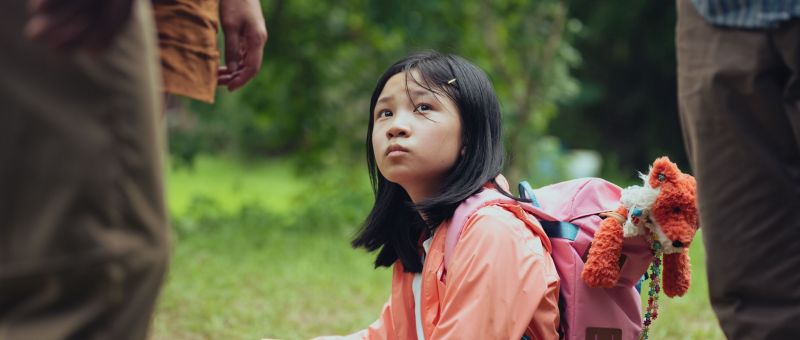
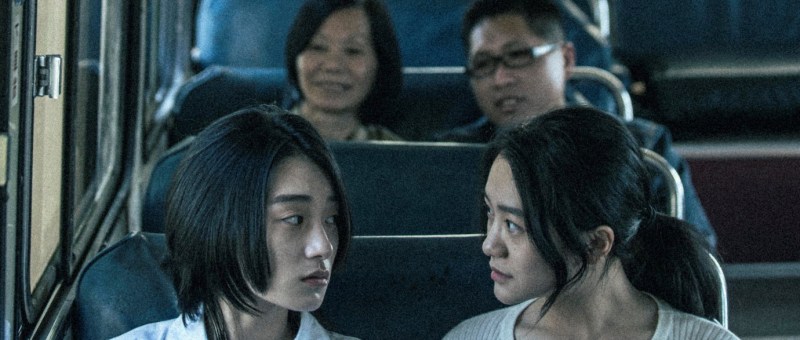
After taking a job as an interpreter working with the social and courts systems, overseas student Mavis (Vivian Sung) sits under a sign at centre for teens reading “you are not alone.” As she reveals to her client, alone is something she’s often felt while living in New York where everyone has “people to see, things to do, and homes to go to” while she feels herself in limbo with nothing and no one to turn to for support. Inspired by her own experiences, director Yu Sen-i’s My Heavenly City (我的天堂城市, wǒ de tiāntáng chéngshì) explores both the freedom and loneliness that can come with living abroad through the stories of three Taiwanese migrants who share unknown connections. 

Mavis is nursing heartbreak and finding it difficult to concentrate on her studies while her money runs out and she feels as if she isn’t getting anywhere. When an opportunity teaching Mandarin to the son of a Taiwanese-American couple falls through, she applies for a job as an interpreter but soon discovers that it requires more than language skills not least because many of the cases she’s called in on are emotionally difficult. Though reminded that an interpreter should maintain a professional distance and avoid becoming friends with a client, she can’t help bonding with 16-year-old Xiao Jian. Suspected of having come to the US undocumented, Xiao Jian was found wandering around alone in Bryant Park and is refusing to speak. 

What Mavis discovers is that she can’t really help him and no one wants to hear what he’s got to say anyway but in any case she comes to see him as a mirror for herself, another lost soul struggling to find a footing in the city. The same is true of street dancer Jack (Keung To) who is conned out of money by duplicitous locals but bonds with a young woman from Singapore, Lulu (Jessica Lee), who hoped that she’d find herself in New York but discovers only more lonely rootlessness and uncertainty. Even her connection with Jack is threatened by looming visa issues. Even so, in New York, Jack discovers greater freedom to be himself in embracing his love of dance if fulfilling parental expectation by continuing to study computer science.

Jack describes his mother’s micromanaging as oppressive, and is relieved to be if not freed from it that at least at a greater distance. These differing ideas of parenthood are also beginning to erode the relationship between successful architect Jason (Jack Yao), who came to the US 20 years previously, and his Taiwanese-American wife Clare (Mandy Wei) who struggles to deal with her own fiercely authoritarian father. The couple have a son, Jasper, who is autistic and also has emotional problems that have resulted in problematic violence that echoes a case that Mavis was brought in on of domestic abuse. Only nine years old, Jasper explains that he gets “very, very angry” when frustrated and it seems that he may not be well suited to busy city life. Clare’s father doesn’t believe in mental illness and assumes it’s discipline issue, believing that Clare and Jason are at fault for spoiling him rather than correcting his behaviour.

The conflict may echo a cultural divide between the authoritarian patriarchy of traditional culture and the aspirations of Clare who says she wants to try a new parenting style founded on love, but the fundamental problem for the family is in effect and absence of the father. The economic demands of living in an expensive city have forced Jason to abandon his family while he also seems unprepared to deal with Jasper’s complex needs and leaves everything to Clare who is then overburdened on the brink of burn out. Jasper’s increasing volatility and its effects on his mother finally convince Jason that he must find a way to rebalance his commitments and be emotionally, rather than just financially, present in the family and in his relationship with Clare.

A final visit to a lost and found office echoes the sense of displacement each of them feel but also what they discover in the city and the connections they make there whether they plan to stay or not. Though it may sound bleak in its exploration of the difficulties of living in an unfamiliar culture, the film discovers a sense of serenity in the improbably sunny city that cuts through its shadows and offers an unexpected of connection between its melancholy exiles. 


My Heavenly City opens in UK cinemas on 10th November courtesy of CineAsia.

Original trailer (Traditional Chinese & English subtitles)

Little Blue (小藍, Lee Yi Fang, 2022)

Mother and daughter find themselves in eerily similar situations when dealing with a social double standard in Lee Yi Fang’s pointed drama, Little Blue (小藍). At heart refreshingly sex positive, the film nevertheless asks why some people seem to be hung up on what is a perfectly normal part of life while simultaneously exploring how sexuality can be misused or exploited and mostly particularly that of the young and naive. “I sometimes feel like my body’s not mine,” the titular Xiaolan (Wang Yu-xuan) confesses to a befuddled teacher who explains to her that she’s gone “astray”, while she might as it happens have a point. 

The opening sequence is witness to the transformation Xiaolan subsequently undergoes. Describing herself as incredibly confused, unable to understand what the teacher is getting at when he asks her why she didn’t come to him when it started, this Xiaolan is wearing makeup and has a fashionable hairstyle. But flashing back a few weeks, the Xiaolan we then encounter is shy and mousy. She has long, lank hair and glasses in contrast to her more glamorous friend Kyueiyu who needles her about hair removal techniques and the realities of contemporary dating. 

This Xiaolan is mildly resentful of her mother whom the other kids brand as “hot” when she turns up with a lunch box Xiaolan had forgotten. Vivi (Helena Hsu) is an estate agent who works late and leaves Xiaolan to get her own dinner but also has a very active sex life and an annoying boyfriend who keeps sexting her and sending videos of questionable taste at inappropriate moments. There’s probably something in the fact that aside from Xiaolan’s high school boyfriend Wu Miao (Ye Ting-qi), the otherwise unavailable men all have Western names. Vivi’s sleazy boyfriend goes by Matt, while she later starts an affair with a married client, Kris, and Xiaolan finds herself drawn to a slightly older guy she hooks up with on a dating app who tells her that he has a girlfriend and his name is “Tim” (Roy Chang). 

Just as Wu Miao had after seducing her on a beach, Tim soon starts ignoring Xiaolan’s messages. After all, he has a girlfriend and probably doesn’t want to be bothered by a genuine connection with a dating app hook up. Xiaolan experiences a kind of breakdown after handsome footballer Wu Miao shares an explicit photo of her with a friend who then “accidentally” posts it on the class chat if only to delete it seconds later. Wu Miao isn’t visible in the photo even if everyone knows he’s on the other side of it, but in any case it’s only Xiaolan who suffers a repetitional loss and is shamed by her classmates. It’s in the wake of his shunning that Xiaolan turns to dating apps, hoping to satiate her curiosity and desire but in the end discovering only more loneliness. Taking her to task, Vivi claps back that at least she gets a “thrill” from her otherwise painful love affairs whereas Xiaolan doesn’t seem very happy at all and gives the impression that her dating app odyssey is at least in part an act of self harm. 

Nevertheless, mother and daughter eventually begin to bond over the irony of their parallel crircumstances if only in the knowledge that it doesn’t really get any better and in the end female solidarity may be all there really is. Lee shoots the changing Xiaolan in melancholy shades of blue that of course eco her name but also lend her world an isolating quality that traps her within her own shame and uncertainty. Even the teacher who attempts to talk to her about her waywardness ends up becoming inappropriately aroused. Xiaolan tells him that he’s “very normal” and hasn’t done anything wrong in a moment that seems both a mic drop and somehow transgressive, allowing Xiaolan to offer the sex positive message she should have received while ironically highlighting that the teacher’s response, as unconscious as it may have been, is necessarily problematic. 

In any case, Xiaolan is finally able to reclaim herself and sexuality as perhaps is Vivi as something that belongs to her alone rather than for others. She’d begun to change herself to be accepted, getting contacts, stealing her mum’s makeup and following her friend’s beauty techniques but still found herself rejected and reduced to a mere body much as Vivi is described as a spare time girl realising that Kris only sees her as a temporary escape from his familial responsibilities. Maybe Vivi saw it the same way, too wrapped up in her own problems to deal with her daughter’s, but what emerges between them seems to be healthier kind of emotional honesty that, ironically, neither found in the arms of their duplicitous men. 


Little Blue screened as part of this year’s London East Asia Film Festival.

Original trailer (Traditional Chinese / English subtitles)

Coo-Coo 043 (一家子兒咕咕叫, Chan Ching-lin, 2022)

Why would a pigeon, or a child, return to you if you failed to make them a home? The enigmatic title of Chan Ching-lin’s gritty familial drama Coo-Coo 043 (一家子兒咕咕叫, yījiāzi ér gū jiào) refers to a homing pigeon that unexpectedly arrives seven years late but bringing with it less joy than an unwelcome confrontation with the unresolved past. A tale largely of male, patriarchal failure the film revolves around the taciturn figure of a middle-aged man obsessed with pigeon racing who attempts to build a coop an in abandoned field for the birds he no longer has means to care for even as his own home crumbles.

Old Ching (Yu An-shun) appears to be a broken man who’s never quite recovered from the massive success of having won a lot of money on a pigeon race several years previously though most of his birds since have never returned at all. Gambling is technically illegal in Taiwan, and the sport of pigeon racing is itself a little taboo though popular enough at least in the small town where Ching lives. It appears the family is mostly supported financially by his second wife Ming’s (Yang Li-yin) banana farm, while ironically enough his daughter Lulu (Rimong Ihwar) dreams only of flying the coop for a less depressing life somewhere else. Part of the reason for the difficult atmosphere in the family home is the sense of absence left by Shih, Ching’s son from his first marriage who disappeared on his way to school aged 12 more than a decade earlier.

Ching continually blames Ming for Shih’s disappearance because on that day she did not drive him to school as usual, ignoring the fact that she stayed to clean up the house after he trashed it in a violent fit after losing at gambling and told the boy to walk. Ching’s irony is that he is always waiting for something to come back to him, but never gives any reason why it should. Though he is often seen tenderly caring for his pigeons, he treats his family members with coldness and contempt and is on occasion violent towards Ming who has a sideline working as part of a troupe conducting death rituals and is considering leaving him. She takes pigeon 043’s miraculous return after seven years as a sign that they should look into having Shih declared legally dead to help them accept he won’t come back but Ching refuses to do so and continues to wallow in his own violent and angry grief unable to see that it may be him that drove his son, and later his daughter, away.

His limp also hints at a violent past as do his ties to a group of local gangsters who seem to be well into the pigeon racing scene, while gang young toughs make a living kidnapping birds and ransoming them back to their owners or else killing them for fun if they don’t pay. Ching finds a surrogate son in the orphaned Tig (Hu Jhih-ciang), Lulu’s sometime pigeon-catcher boyfriend, but fails to see him as such until it’s too late. Unlike Lulu, Tig is a man looking for a coop. He slides into the vacant space in the family longing to be accepted, but finds only coldness and abandonment left behind while everyone else flies away in search of a better life. 

Often captured behind bars, the two men are just as caged as the pigeons though the kind that don’t fly away when the doors are opened. Some of those who leave do so for the after life, no longer seeing any point in continuing this miserable existence which shows no sign of improvement and unable to envisage any other kind of escape. Even Lulu’s flight to the city to become a nightclub dancer seems as if it may just be another kind of cage from which she cannot fly. Ching’s pigeon coop is eventually ruined by a more literal kind of storm, but mainly because he failed to protect it unable to look past his personal despair and indifferent to the vulnerabilities of his home. Bleak in the extreme, Chan paints a grim picture of life on the margins in rural Taiwan in which the wings of all have long been clipped and those who return do so only because they have nowhere else to go.


Coo-Coo 043 screened as part of this year’s London East Asia Film Festival.

Original trailer (English subtitles)

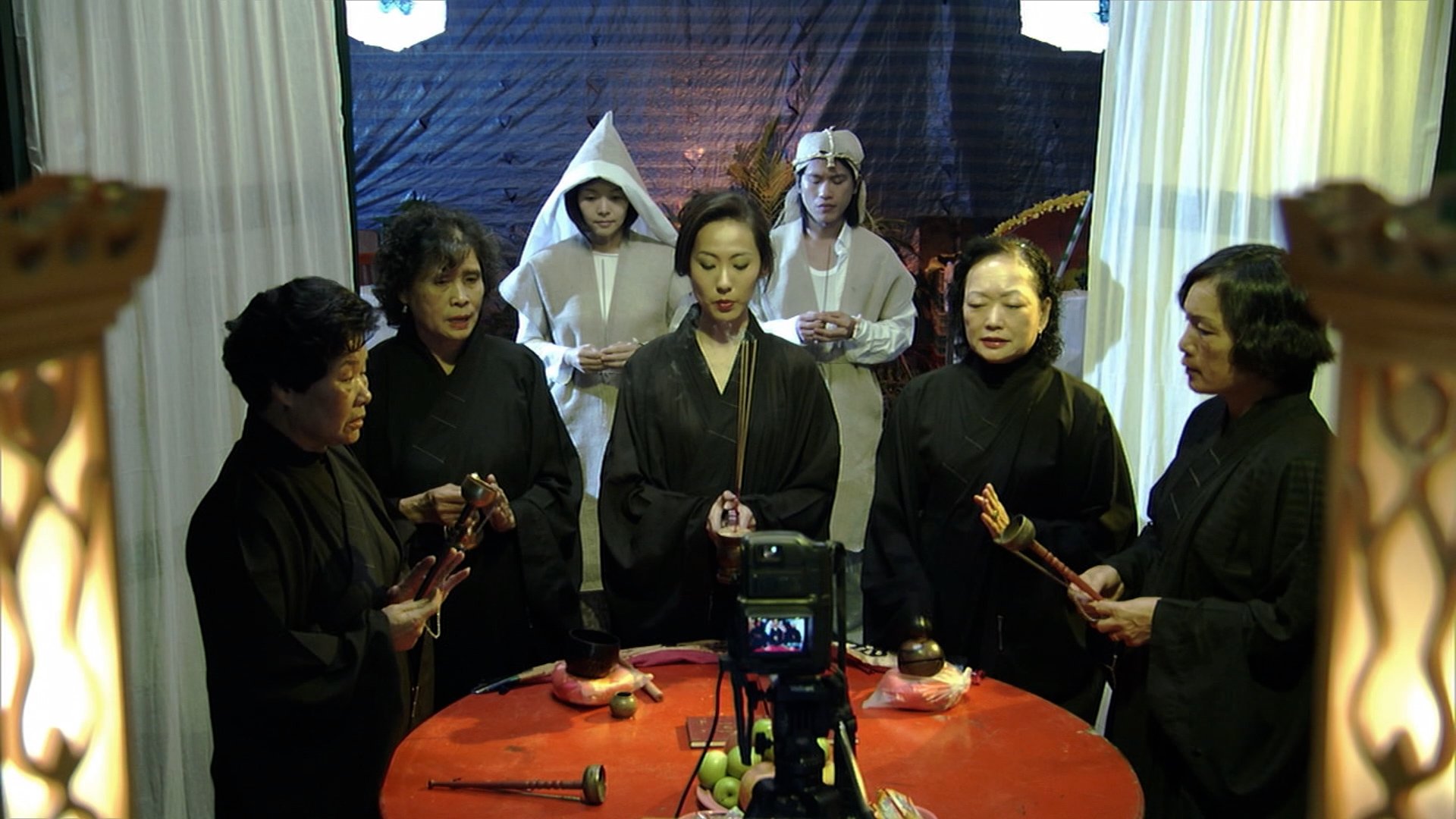
Seven Days in Heaven (父後七日, Essay Liu & Wang Yu-Lin, 2010)

A young woman embarks on what she describes as the most ridiculous journey of her life after her father passes away and she must return to her hometown for a series of incredibly involved traditional funeral rites in Essay Liu and Wang Yu-Lin ’s lighthearted drama Seven Days in Heaven (父後七日, fù hòu qī rì). Perhaps the intent is more to keep the mourners occupied in a slow burn dissolve of their grief than it is to console a parting soul but in any case Mei finds herself meditating on the past and her already fading memories of her late father. 

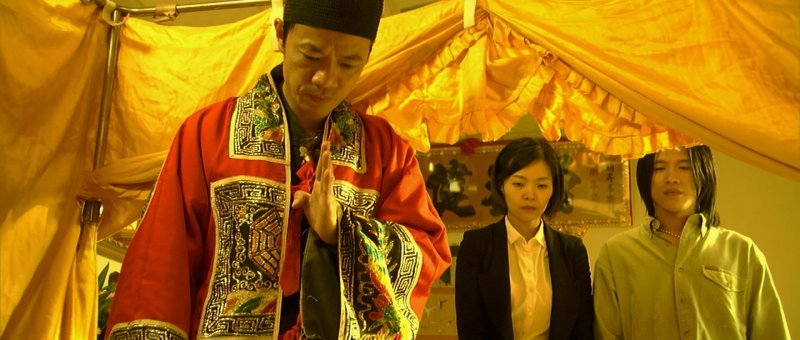
The strangeness begins at the hospital where Mei (Wang Li-Wen) and her brother Da-zhi (Chen Cha-Shiang) are repeatedly asked to explain to their father, who has just died, that they are taking him home. In the transport ambulance they ask if the family is Buddhist or Christian, and then simplify the question to whether they use incense sticks when a confused Mei is uncertain how to answer though as it turns out the rites they will be performing are largely Taoist. Anyway, the driver accidentally puts in the wrong tape and they get a blast of the Hallelujah chorus before he switches over to a series of sutras instead. A similar confusion sets in once they arrive back at the house where the funeral is being managed by a distant relative who works as a Taoist priest performing rituals largely concerned with death. 

A running gag sees these familial relationships so tangled that they need lengthy explanations, Yi (Wu Peng-Fong) the priest explaining to Mei’s cousin Zhuang (Chen Tai-hua) that he should have been calling him “brother” and not “uncle” while as it turns out Yi still carries a torch for Zhuang’s mother, Feng (Angie Wang), who left him to work in another town and married a wealthy man. Currently in Paris, she does not return for her father’s funeral and sends her son instead who is equally mystified by these strange rituals and decides to film them as part of a university project. 

Yi consults some religious calendars and schedules the days of the funeral accordingly from when they close the coffin to when they conduct the final rites with Mei and Da-zhi merely expected to keep up. A detached Mei explains that as the daughter she’s explicitly instructed when to cry and when not to, forced to run in and wail by the coffin on cue. Yi’s partner, Chin (Chang Shih-Ying), herself works as a professional mourner wailing on the behalf of others merely altering the identity of the deceased but in this case the siblings are alternately bored and run ragged, possibly too exhausted by the process of mourning to fully process their grief. 

Zhuang’s film exposes the labour involved as he closes in Da-zhi explaining that he has to sweep up the ashes from the burning of ghost money. He asks him how he feels about his father’s death which might in itself be a little insensitive especially while pointing a camera in his face and he snaps back that he doesn’t know. Mei meanwhile is repeatedly drawn back to memories of her father, picking out a picture of him singing karaoke for the altar only to be told off by the older relatives. Zhuang eventually photoshops it to replace the mic with flowers and the background with a more appropriate scene of mountains and rivers. She doesn’t tell her friends her father passed away until months later and still finds herself forgetting, brought to tears on accidentally reminding herself to pick up some “longevity” cigarettes for him on a trip back from abroad only to realise there’s no need anymore. “Please stow your emotions” she imagines hearing the captain say in her father’s voice as she strives to accommodate her grief. 

Filled with a series of humorous digressions from Yi’s love life and their late father’s ability to charm his nurses even at death’s door, the film paints a warm and nostalgic portrait of small-town life and the various rituals that go along with it, including a small tangent on political corruption as a host of politicians are obliged to attend the funeral, because of the aforementioned ill-defined familial relationships, and send elaborate gifts including a large tower of beer cans that later collapses and requires even more tiding up. Finally the siblings must burn their mourning clothes as if symbolically moving on from their seven says in “heaven” and returning to their everyday lives but discover perhaps that grief is an ongoing process the rituals of which may continue long after the funeral is finished.


Seven Days in Heaven is available to stream in the US Sept. 25 to Oct.1 as part of the 17th season of Asian Pop-Up Cinema.

Trailer (English subtitles)

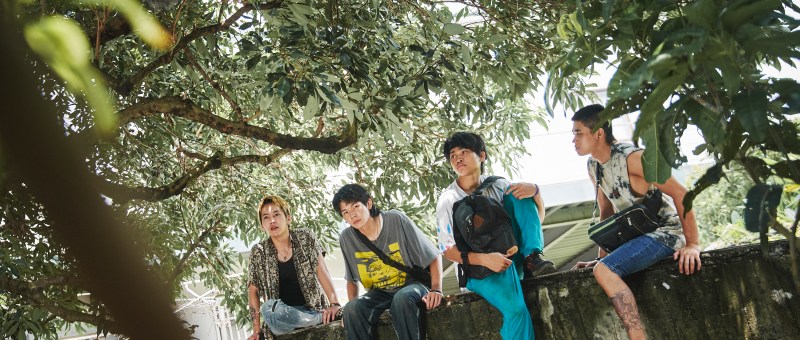
Bad Education (黑的教育, Kai Ko, 2022)

According to a jaded policeman in Kai Ko’s directorial debut Bad Education (黑的教育, Hēi de Jiàoyù), only 10% of people are good and 10% bad with 80% somewhere in the middle depending on the circumstances. As another person puts, even bad people have principles and in an odd way it’s a sadistic gangster who becomes a moral authority teaching the trio at the film’s centre a few valuable lessons in just how far south something can go when you allow yourself to be swayed by peer pressure and adolescent bravado. 

Perhaps intended as a graduation prank, Chang (Berant Zhu) suggests he and his friends Han (Edison Song) and Wang (Kent Tsai) exchange otherwise unspeakable secrets to cement their ongoing friendship through the threat of blackmail and exposure. Chang tells a frankly disgusting story that he raped and impregnated a young woman with learning difficulties while Han claims that he bludgeoned a homeless man to death but no one noticed. The only one to be going on to university, Wang does not have any particularly dark secrets to share. All he can come up with is that he once read his father’s texts and found out he’s having an affair, while otherwise confessing to having stolen the answer sheet to a test. As expected, Chang and Han don’t like his answers and begin to threaten him, pushing Wang back towards the edge of the roof as if they meant to kill him so wouldn’t spill the beans. 

Chan and Han were of course bullshitting, they haven’t done anything of the sort, but they manage to persuade Wang that he’ll have to do something similar to complete the pact. They challenge him to throw paint at a gangster which turns out to be an incredibly bad mistake though to be fair to them, Chan and Han may not have expected Wang to actually do it. It’s only then that they start to realise they aren’t children any more. Actions will have consequences and even if, as Mr. Hsing (Leon Dai) the gangster boss later says, they haven’t done “anything wrong” they’ve gone about everything in the wrong way and will eventually have to pay. Chan looks up at him pleadingly and answers like a child that he’s sorry and won’t do it again, but Mr. Hsing points out that whether he does it again or not is of no interest to him. It’s not what this is about. 

What it’s about is perhaps a different kind of “graduation”, leaving the innocence and naivety of childhood behind for the cynicism of adulthood and the moral greyness of grownup society. Then again, they weren’t all that innocent to begin with that they could come up with heinous crimes to confess and imagine that their friendship would survive it. The policeman says that 80% of people could go either way in most situations, himself included it seems, painting a fairly bleak picture of the contemporary society. Chased through the city by Hsing’s foot soldiers, Chan and Wang end up stealing a taxi from a taxi driver who had just raped the young woman passed out drunk in his car though no one makes much of an effort to help her as each remains fixated on their personal goals such as escaping and fleeing the city. 

In the opening scenes, a lobster had been plucked from a tank and had its legs cut off in a moment of foreshadowing while customers in Mr Hsing’s seafood restaurant with greasy mouths suck on shrimp whose corpses they soon spit out and discard. Something quite similar happens to the boys as the cracks in their friendship are further exposed. Even back on the rooftop, they’d reflected on the class difference between them with Wang, whose father owns a factory he is expected to take over, the only one going to college, while Chan jokes about becoming his driver and Han remarks that he’d like to drive a Maserati (one stands across from him as he’s viciously beaten in his underwear by Hsing’s goons). 

Figuring out they have no underworld connections, Hsing asks for money and the boys immediately look to rich kid Wang only he refuses because it’s too embarrassing to ask his dad for that amount of cash. Engaged in some kind of sadistic power play, Hsing tries to get them to cut each other’s pinkies off with the guys each turning on and blaming each other. Chan too tries to argue that they came back to save Han so he owes them (only they didn’t), while later blaming Wang for going ahead with the dare rather than himself for setting up this stupid prank as a means of having something to remember in their old age. Later he admits his insecurity, uncertain of his own future and frightened that his friends will leave him behind but it’s already too late. Wang ironically fulfils the pact, his graduate rosette fluttering as he does so as if to remind us that he’s now “graduated” from childhood innocence, but ironically destroys rather than cements the boys’ friendship with one chaotic night of violence and terror. Incredibly dark with moments of bleak humour, Bad Education offers a lesson in retribution and the costs of peer pressure and bravado and leaves each of its heroes changed, if not slightly broken, by the realities of a duplicitous adulthood. 


Bad Education screened as part of this year’s New York Asian Film Festival

Teaser trailer (Traditional Chinese / English subtitles)

Miss Shampoo (請問,還有哪裡需要加強, Giddens Ko, 2023)

A ruthless gangster’s quest for vengeance is put on hold when he falls for a cutesy hairdresser who hides him from the bad guys who knifed his treacherous boss in Giddens Ko’s adaptation of his own short story Miss Shampoo (請問,還有哪裡需要加強, qǐngwèn, háiyǒu nǎlǐ xūyào jiāqiáng). Part gangland drama part zany Taiwanese rom-com, the film nevertheless hints at institutionalised corruption in local politics while simultaneously mocking the awkward positioning of the “gangster” in the contemporary imagination as both a romanticised outlaw and despised member of society. 

Bruiser Tai becomes the head of his gang when his boss, Hsing, is murdered by Thai assassins presumably hired by one of the other local bosses in a dispute over urban development contracts that may also threaten an upcoming election. Tai doesn’t seem to know a lot about that or how seriously he should take advice from one of the other bosses that he should look inside his own organisation when considering who might have wanted Hsing dead. In any case, at the present time all he can think about is innocent hairdresser, Fen (Vivian Sung), who hid him in the back of the salon when he was trying to escape the assassins. It’s not long before he’s deciding that he needs a haircut, as do several of his men who more or less take the salon over as the gangsters’ coiffeur of choice. 

Fen is not actually a fully trained hairdresser and had been mainly handling the shampoo which might explain some of her more avantgarde efforts even if she later seems to find a groove in giving the gangsters the kind of hairstyles they wanted but didn’t know how to ask for. The effect may be short lived leaving Tai with ridiculous blond dreadlocks for the rest of the film but perhaps nothing says love more than being willing to look like a complete idiot to avoid hurting your crush’s feelings. A baseball obsessive, Fen is herself somewhat on the margins and currently dating a graduate student who looks down on her and doesn’t take the relationship seriously. Even her mother tells her he’s too good for her, suggesting they should continue placating him because he’s “better” than they are while she remains unable to stand up for herself. 

Perhaps surprisingly, the family are later family acceptive of Tai’s attempts at courtship despite knowing that he’s a “gangster” with only the worry that he may turn into a “scary ex” if Fen eventually decides to break up with him. But the relationship does however place a strain on the gang with some members frustrated by Tai’s lovelorn indifference to the gangster code as he continues to neglect avenging the boss’ death in favour of pursuing a romance with Fen. While his friend flirts (almost literally) with betrayal in chasing a new cryptocurrency future with a similarly fed up underling from a rival gang, Tai starts to wonder if he’ll have to make a choice between his life an underworld high roller and his love for the civilian Fen while slowly coming to the conclusion that being the boss might not be all it’s cracked up to be. 

A recurrent baseball subplot hints at another kind of justice built on teamwork and mutual feeling that eventually comes to the rescue both romantically and physically as Tai deals with his gangster drama and Fen with her romantic doubt after realising that Tai is a gangster after all and underworld betting is destroying the game she loves so much, while otherwise playing into the message of new beginnings as Fen continues to support her longtime baseball idol as he prepares to transfer to a Japanese team at the comparatively late age of 30. Ko plays with meta humour in the final assurances that this is a New Year Movie (though it wasn’t) so must have a happy ending while otherwise indulging in zany gags like invisible guns as a repeated gimmick to get names out of people who didn’t want to give them, aside from all the ridiculous hairstyles Fen accidentally gives her customers while trying to capture their true essence. Nevertheless, the sleazy atmosphere and vulgarity often sit uncomfortably with the sweetness of the central love story in what is otherwise an ironic take on the quirky rom-com.


Miss Shampoo screened as part of this year’s New York Asian Film Festival.

Original trailer (Traditional Chinese / English subtitles)

The Abandoned (查無此心, Tseng Ying-ting, 2022)

Just about everyone in Tseng Ying-ting’s psychological thriller The Abandoned (查無此心, Chá wú cǐ xīn) has been in some way left behind. The title most obviously refers to the body of a murdered woman unceremoniously dumped in a local river though as we later discover she wasn’t so much abandoned as returned, but the investigating officer is also battling her grief in feeling abandoned by her husband who took his own life and it could as well apply to the liminal status of migrant workers in Taiwan who have been largely abandoned by a society that is increasingly dependent on their labour. 

As policewoman Wu Jie (Janine Chang Chun-ning) points out to rookie Wei-shin, if she found a body she’d obviously call the police but if you can’t call the police because you’re afraid they’ll deport you you might have no other option than to make it go away. But the strange thing is that Waree’s body was left where it would be found and Jie will later claim that it is in a sense Waree who “saved” her by unwittingly frustrating her attempt to take her own life while consumed by grief and guilt over her husband’s death. Later it seems as if the killer of these women, each of whom has their heart and ring finger removed, intended to send the bodies back to their exploitative employers making a grim a point while leaving them with an impossible choice knowing that they can’t very well go to the police and risk undermining their entire business enterprise which relies on the labour of workers of who’ve either left the positions the visas they were granted were originally for or never had any in the first place.

Waree’s former boyfriend You-sheng (Ethan Juan) is left with just such a dilemma when the body of another woman, Yeti, is delivered to their factory calming the worried workers while secretly burying her himself in the mountains little knowing that a similar fate has befallen Waree whom he’s been looking for ever since she dropped out of contact as has her sister Saipin, also an undocumented worker from Thailand. The killer seems to target these women because he knows it’s unlikely anyone will look for them though they also have personal motives in their own sense of abandonment, resentful in feeling as if they’ve been deceived in love while unable to see how the other party may have felt trapped and exploited while their passport was held captive depriving them of the free choice to leave. 

As it turns out, the person who left Waree’s body in the water did it because they were worried she wouldn’t be able to return home, not wanting her to be disappeared in the way their employer might have wished her death hushed up like so many other anonymous workers whose families never hear of them again but at least acknowledged. Wu Jie is also unable to return home, mostly sleeping in the car directly below the bloodstained bullet hole under which her husband shot himself. Her boss ironically tells that if her heart remains in the car she’ll never escape, echoing the missing hearts of the murdered women taken as grim trophies by the heartless killer. 

Ironically enough, to solve the case Wu Jie must regain the desire to live finally facing her abandonment along with her grief and guilt for her inability to save her husband while working with the conflicted You-sheng who similarly feels both abandoned and guilty in the failure of his relationship with Waree whom he was reluctant to marry and might have saved if he had. Tseng aptly demonstrates the precarious position of undocumented migrant workers in Taiwan who are often exploited by their employers and rendered invisible by a society which largely treats them with disdain while left vulnerable to crime and violence in being unable to turn to the authorities for help. He also hints at a degree of misogyny present in the police force as Jie is at one point asked to leave the case as the higher ups don’t like the idea of two women working together while Jie simultaneously feels pressured to stay knowing that the situation is too complicated for an earnest rookie to manage on her own. Exploring the grimy underbelly of an otherwise prosperous nation, the film has only sympathy for those have in one way another been abandoned and can see little prospect of escape from their fear and loneliness. 


The Abandoned screens July 26 as part of this year’s New York Asian Film Festival.

Original trailer (Traditional Chinese / English subtitles)

Images: @Renaissance Films Limited. Love Me Tender Production Company

Rebels of the Neon God (青少年哪吒, Tsai Ming-Liang, 1992)

Towards the end of Tsai Ming-liangs’s Rebels of the Neon God (青少年哪吒, Qīngshàonián Nézhā), a young man exasperatingly stuffs a series of rags into the busted drain in his kitchen which has been relentlessly leaking water all over the apartment. In many ways it’s a kind of metaphor for his life as he attempts to staunch the flow of “bad luck” he’s been experiencing over the last few days, but like so many things for him it does not quite go to plan. 

As to why, it’s not exactly clear except that A-tze (Chen Chao-jung) is a kind of outcast beneath the neon skies of a changing Taipei. He and his friend A-ping (Jen Chang-bin) earn their money breaking into telephone boxes and vending machines for loose change before at one point stealing the motherboards from arcade consoles and unsuccessfully trying to sell them back to the person they stole them from. All they get for their pain is a literal battering while A-tze’s frustrated romance with sometime girlfriend Mei-kuei (Wang Yu-wen) similarly flounders in the wake of his ennui. 

The karmic debt he bears is however mainly down to a random act of pointless violence in knocking the wing mirror off a taxi driver’s car for no real reason save momentary impulse. Even so, the taxi driver’s son Xiao-Kang (Lee Kang-sheng) had already been watching him and soon discovers a fascination with the rebellious young man that is ambiguous in quality. What becomes obvious is that Hsiao-kang is at odds with the world in which he lives. His mother (Lu Yi-ching) reveals that a fortune teller told her he is the reincarnation of “Neon God” Nezha, a chaotic child who later killed the authoritarian father with whom he could not get along. Hsiao-kang’s mother tells this to her husband (Miao Tien) as a kind of warning, advising that his authoritarian parenting style is doing his son no good, but Mr. Lee isn’t minded to listen. Finding out that Hsiao-kang has dropped out of cram school and kept the refunded tuition money for himself, Mr. Lee throws him out which of course leaves him free to follow A-tze all around Taipei day and night before childishly damaging his motorcycle. 

In disabling the bike, Hsiao-kang perhaps hoped to ruin A-tze’s freedom, symbolically taking from him independence and a sense of possibility. Then again, perhaps in another way he hoped to engineer a friendship. Riding around on his own scooter, he draws up behind A-tze pushing his to a garage and offers help but A-tze tells him to buzz off. In fact, A-tze never acknowledges Hsiao-kang. He never recognises him or realises that he’s being followed though he does later remember Mr. Lee and is struck by guilty futility not really knowing why he decided to arbitrarily ruin someone’s day while reflecting that all his days are ruined. The water in his apartment continues to rise all around him as if emphasising his mounting sense of despair. Mei-kuei tries to break up with A-tze before asking him to go away with her. They ask each other where they would go, but neither has any answer. 

A remorseful Mr. Lee later comes home and makes the point of leaving the front door ajar, symbolically open to his son’s return while Hsiao-kang remains lost. He visits a telephone dating service having heard Mei-kuei moonlight by answering one while working at the ice rink, but in the end cannot even pick up the phone. Staring at a picture of James Dean, he longs for the sense of rebellion he is drawn to in A-tze but is still the chaotic boy, dancing wildly like a wheelless Nezha and seemingly with no further sense of direction. In the end, it’s the city of Taipei which is the “neon god” of the title, arbitrarily ruling over each of the boy’s lives even as it ironically emerges from the authoritarian past into hypermodern urbanity. Hsiao-kang is little better off than the cockroach he ironically skewers on the point of his compass, and A-tze little than that which circles his overflowing drain carried inexorably on the current on a circular journey towards nowhere in particular. Many of Tsai’s key themes are already here, urban alienation, loneliness, futility, and the crushing sense of emptiness of life in the contemporary era even as he turns his gaze to the overcast skies of a city lit only by despair.


Rebels of the Neon God screened as part of this year’s Queer East .

Trailer (Traditional Chinese / English subtitles)

Lost in Forest (山中森林, Johnny Chiang, 2022)

History repeats itself for a former gangster recently released from prison in Johnny Chiang’s melancholy neo-noir, Lost in Forest (山中森林, Shān Zhōng Senlín). Set in a neon-lit Taipei, Chiang’s moody crime drama finds its hero displaced in the modern society unable to look either forward or back while meditating on all he’s lost and another less corrupt vision of his home city as symbolised by his late father’s missing sausage bike and the changing back streets where it was once parked.

This Taipei is however a less wholesome place as suggested by Chiang’s frequent cuts to Christian churches and the giant neon crosses that sit above them as if looming in judgement on the chaos below. 12 years previously, Sheng (Lee Kang-sheng) opened fire on rival gang members who’d kidnapped his best friend and comrade Seagull (Angus Hsieh) who has now taken over the outfit while he’s been inside. Customarily, Seagull should have had someone come to meet him on his release, but Sheng exits the prison alone and is given a lift back into the city by the entourage collecting his prison buddy Ji despite the fact they are headed to an entirely different part of the country. Without a phone and not knowing where the gang even is anymore, all Sheng can do is hole up in a hotel until he finds out what’s going on. All of which suggests that despite his sacrifice, Seagull may not be particularly glad to reunite with him.

The conflict exists on three levels. Sheng must necessarily doubt his old friend Seagull, especially on realising that his new business model involves exploiting vulnerable women by pressing them into debt via high interest loans and then forcing them into sex work, while simultaneously worried about his guys who claim they have not been well treated while Sheng was away. But then it also becomes clear that much like many contemporary Taiwanese crime dramas, the real villain is institutional corruption as Seagull’s alliances with corrupt politicians and shady businessmen continue to destabilise the underground society thanks to the machinations of anarchic street punk Monkey (Sean Huang) who engineers a gang war by giving the businessman’s son a kicking as leverage in a dodgy land deal. 

On the one hand, Sheng watches history repeat itself as a handsome foot soldier, Chenghao (Prince Chiu), vacillates over leaving the gang for his respectable girlfriend Alice (Puff Kuo), while on the other Sheng becomes attached to sex worker Jing (Lee Chien-na), one of Seagull’s exploited women working for him to pay for her father’s medical bills. Sheng’s former lover tells him that if he really cared about her, he shouldn’t have sacrificed himself for Seagull just as Chenghao shouldn’t put himself in harm’s way out of a pointless sense of loyalty for a gang that has no real loyalty to him. Before his release, the prison warden had advised Sheng not to let his sense of loyalty get the best of him, but as he says Sheng no longer has much of anything else. His parents died while he was inside, the woman he loved married someone else, and Seagull can’t even remember what he did with Sheng’s dad’s sausage bike which is his only path back to a more wholesome existence. 

In a certain sense he’s powerless, unable to escape the inexorable pull of gangland karma until finally forced to reckon with the destabilising force that is Monkey to restore some kind of order and undermine the system of corruption that has arisen between underworld thuggery, local politics, and big business. The warden had also pointed at the fish in his tank and asked Sheng if it was happier in there or back in the sea but Sheng had merely said that it’s up to the fish to decide, hinting that in a certain sense it’s all the same and it’s just that one prison is bigger than another. At least the fish gets fed and is kept safe from predators even in its lonely isolation, which might be more than can be said for Sheng who can never truly escape his past even as he tries to free Chenghao and Jing from a similar fate. A melancholy mood piece, Chiang shoots night-time Taipei as a land of neon emptiness set against a classic jazz score that echoes Sheng’s deadpan ennui in a modern world of electronic smoke and rueful nihilism in which there is no escape from karmic retribution. 


Lost in Forest screens in Chicago April 16 as part of the 16th season of Asian Pop-Up Cinema.

Original trailer (Traditional Chinese / English subtitles)

Day Off (本日公休, Fu Tien-Yu, 2023)

The wholesome small-town values of an ageing hairdresser place her increasingly at odds with her cynical consumerist kids in Fu Tien-Yu’s poignant tale of changing times, yet as she’s fond saying children have their own lives and all that really matters is that you’re satisfied with what you have. Day Off (本日公休, běnrì gōngxiū) is partly a lament for the things we’ve thrown away in the name of convenience but also a celebration of human connection brokered by something as simple and routine as a haircut.

A Rui (Lu Hsiao-fen) has toiled away in her family-run barbershop for most of her adult life and the business has changed little in the time she’s been running it. Old men and their sons have been coming to get a haircut and a shave for the last few decades because as someone else later puts it, men are largely creatures of habit and a hairdresser like a wife is hard to switch. A Rui’s daughter Ling is also a hairdresser but works in a much more modern salon and is planning to open a supercuts-style express service aiming to get people in and out in a short amount of time for a small amount of money. Ling’s philosophy is contrary to everything A Rui was taught, advised by her mentor to take her time and work with precision. He told her that if she provided a good service she’d always have custom and does that does seem to have been the case. 

Then again perhaps times aren’t so different as they seem. Ling is unpopular at her salon because she has poor customer service skills and doesn’t seem to be particularly well suited to the social nature of the job. Her boss always gets all the best clients and that’s largely because he treats them just like A Rui treats hers even if his care and attention is a little more cynical than heartfelt. Ling has also divorced her husband, Chuan, essentially for being too nice after he lent money they were saving for a new flat to a friend in need. A Rui can’t understand why she’d split up with a perfectly good man when they have a small child together, but Ling is an ambitious ultramodernist who values change above all else and looks down on small-town values of community and reciprocity seeing her former husband and mother as merely foolish and living in the past. She can’t understand why her mother bothers to ring up her elderly regulars to remind them they’re due a haircut when she could just set up an automated system to take care of it for her, nor can she get her head round it when A Rui says she’s going to travel to a faraway town to cut the hair of an elderly gentlemen who can’t make it to the shop without even asking for expenses. 

But to A Rui it’s just the right thing to do and an appropriate act of reciprocity for decades of custom. Chuan feels much the same, always willing to put his life on hold to offer roadside assistance and understanding if a client can’t pay him right away knowing that they can’t get the money if they can’t work so it’s better to just fix the car. A Rui worries about her other daughter living with a boyfriend and a dog in a rented flat in Taipei, and about her son who seems to have several failed entrepreneurial projects behind him, but encounters on the road another man who gave up a job as a scientist to become a farmer and seems to be happy with his choice. In the end it might not be that one is better than the other, the only thing that matters being whether or not you’re satisfied with what you have.

There’s a certain poignancy in the disappearing quality of A Rui’s way of life, the hair on one of her customer’s heads slowly turning from black to grey as if she were literally shaving the years off him. “Time flies” she often remarks, realising that she’s known some of her customers all their lives and has become a kind of community hub that they can always return to even if they move away. The knees she once practiced her shaving on are now old and worn from years of standing, but as her customers remind her she can’t retire because no one knows their heads like she does and then where will they get their hair cut? Bittersweet and elegiac, Day Off ends on a note of moving on as A Rui gives the baby of a second generation client their first haircut and prepares to say goodbye to a much a loved friend seeking a more satisfying future while resolving to carry on doing what she does best in providing the best possible service to her regulars and to the world around her.


Day Off screens in Chicago April 15 as part of the 16th season of Asian Pop-Up Cinema.

Original trailer (Traditional Chinese / English subtitles)