Border Line (Lee Sang-il, 2002)

border lineThroughout his career Lee Sang-il has shown himself adept at creating ensemble character dramas but nowhere is this as much in evidence as in his well crafted debut, Border Line. Focussing on the unlikely overlapping stories of a number of people who each find themselves crossing a threshold of a more spiritual nature, Border Line traces back each of the fractures in contemporary society to the broken cord of the parental bond.

We begin with teenage technical school student Matsuda (Sawaki Tetsu) who’s been in trouble for refusing to wear the required overalls. Later he runs away after his father is murdered only to be knocked down by drunken taxi driver Kurosawa (Murakami Jun) who ends up driving him half way to Hokkaido which is where he said he was from. Meanwhile, housewife Aikawa (Aso Yumi) has just started a new job at the combini but her son keeps skipping school and she soon realises it’s down to aggressive bullying. If that wasn’t enough, her husband has gone incommunicado after abruptly revealing via telephone that he lost his job a month ago and hasn’t found another one. Taking a step down to the underworld, we also meet low life gangster Miyaji (Mitsuishi Ken) who’s having a very bad as his partner ran off with the takings from a pachinko parlour to pay for expensive medical treatment for his daughter.

These are the lives of ordinary modern day people each facing extreme stress from all angles be they financial, societal, or existential. Matsuda is a young man and it’s only natural that he rebels a little to try and figure out who he is but it seems there may have been more going on in his life than just not wanting to wear a uniform. His mother left when he was a child and we don’t find out much about his relationship with his father but he spends the rest of the film looking for parental figures to essentially give him the permission to become an adult. The first of these is the taxi driver, Kurosawa, who, for various reasons isn’t able to help him (and only really decides he wanted to when it was too late). Finally, after a series of coincidences, he runs into Miyaji who is still grieving over having lost contact with his daughter after running out on his suicidal wife. Miyaji is not a great role model in many ways but still has some wisdom to impart to the younger man which may save his life in ways both literal and figural.

Miyaji and Aikawa are both coming from the other direction but struggling with their parental responsibilities. Aikawa has taken the job at the combini to help pay their mortgage – the house is very important to her as she was always ashamed of the modest home she grew up in with her parents. Like Miyaji, her husband seems to have more or less abandoned his family in his shame over losing his job, leaving Aikawa to bear all the responsibility for herself and her son. Eventually the pressure becomes so intense that Aikawa’s typical Japanese housewife persona starts to crumble resulting firstly in fantasies of violence before a crime filled rampage and kidnapping plot threaten to destroy what’s left of her life.

Back with the kids, another coincidence turns up Miyaji’s estranged high school aged daughter now also orphaned following the death of her mother leaving her with no other option than visiting hotel rooms with dodgy businessmen. Shunned at school and alone at home, hers is a lonely life marred by the failure of her parents. Both she and Matsuda, whom she eventually meets through another set of random coincidences, have had their futures ruined by poor parenting but, ironically, it maybe Miyaji who is able to help them even in his continued absence.

For a debut film, Border Line is a remarkably assured affair. Elegantly shot with decent production values, it handles its complicated set up with ease affording each of its distressed protagonists a degree of sympathy and understanding without the necessity of moral judgement. However, Lee does seem to want to lay the ills of modern society at the feet of the crumbling family unit only to present his younger protagonists with the idea of salvation as self actualisation. Decidedly low key, Lee’s debut film has a less commercial, deeper sensitivity than his subsequent efforts but still offers the compassionate sense of humanity which continues to inform his filmmaking.


Together (和你在一起, Chen Kaige, 2002)

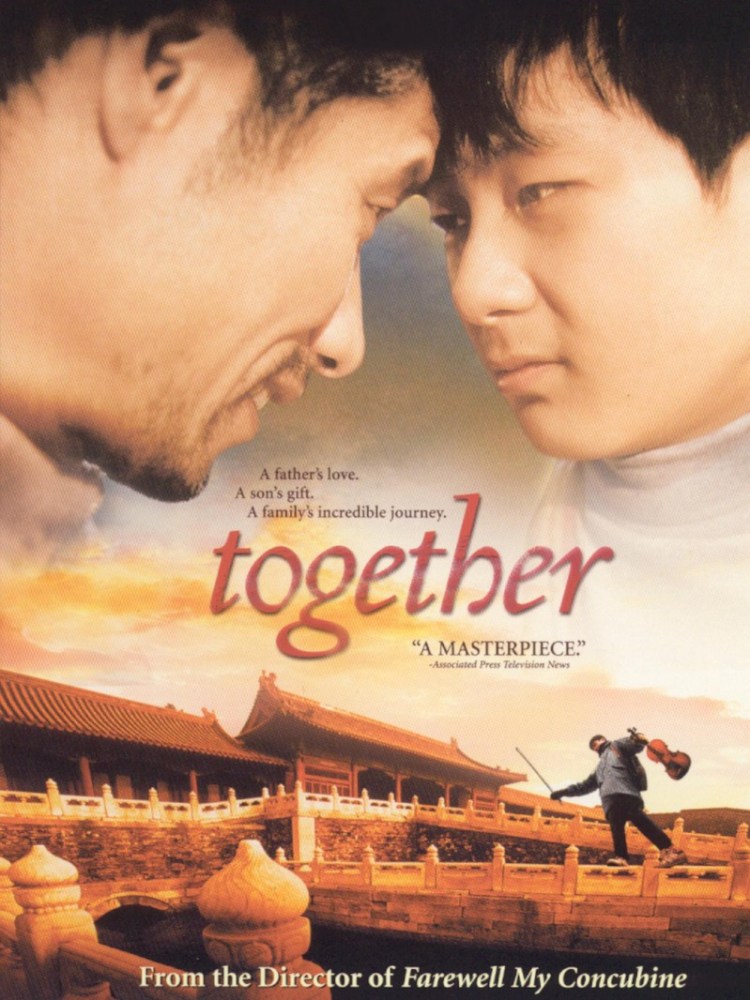
together engIt’s a sad truth, but talent isn’t enough to see you succeed in the wider world. In fact, all having talent means is that unscrupulous people will seek to harness themselves to you in the hope of achieving the kind of success which they are incapable of obtaining for themselves. 13 year old Xiaochun is about a learn a series of difficult life lessons in Chen Kaige’s Together (和你在一起, Hé nǐ zài yīqǐ), not least of them what true fatherhood means and whether the pursuit of fame and fortune is worth sacrificing the very passion that brought you success in the first place.
Xiaochun lives with his father Liu Cheng in a small rural town where he is known for his prowess with the fiddle. In fact, he even gets called in to play some calming violin music at the birth of a local bigwig’s child. After a little boy emerges safely into the world, the bigwig tries to give Liu some money which he refuses but Xiaochun later takes. The big wig congratulates Xiaochun on his understanding of how the world works, unlike his honest and sentimental father.

However, what Liu wants for his son is success so he takes the boy to the big city and enters him in a violin contest. He comes fifth but the contest is rigged in favour of donors to the school and no one wants to take on a poor country bumpkin for a pupil. Eventually Liu convinces an eccentric, lonely professor, Jiang, to give Xiaochun lessons and the pair start to build up a paternal relationship. Xiaochun also makes friends with the beautiful but equally eccentric woman from upstairs, Lili, while his father tries to find work to pay for all these lessons. Eventually Liu ends up at a swanky recital and tries to get Xiaochun to switch to the more successful professor Yu who’s all cold calculation and designer sweaters. This sudden bid for mainstream success drives a wedge between father and son who have very different ideas of what it means to be a “successful” person.

Together isn’t quite the film it seems to set out to be. You’d expect professor Jiang’s broken heart to take more of a centre stage but no sooner have we invested our time in Jiang’s back story of tragic romance than Xiaochun is swept away to the corporate music factory that is Yu’s upscale apartment. We’ve already seen how money and status are everything in this game, donate big bucks to the school and your kid gets the shiny trophy regardless of their actual talent. A depressingly realistic scene right after the contest sees Jiang trying to give a lesson to a clearly disinterested boy while his trashily dressed mother yells at someone on a blinged up cellphone from the other room. When the pair angrily declare they won’t be coming back, the boy is strangely grateful to Jian for “letting him quit” this annoying hobby that his mum obviously made him practice as a kind of status symbol despite the fact he has no ear for music.

Liu is just too bumpkinish for Beijing life, he’s simple and honest which are not good qualities to have in a big city. He insists on wearing a big red hat all the time which screams “not local”, and he even keeps his money in it so, of course, it gets stolen. That said, it’s Liu who wants his son to have the big bucks and a secure life of the kind that Yu can offer him. He sincerely wants this for Xiaochun and is prepared to get out of his way if necessary. Jiang wanted to teach him music and would have done it for free. Yu wants to use him to bolster his own success and is prepared to manipulate him in extremely cruel ways in order to get what he wants out of him. Tellingly, Yu already had a prize pupil living his apartment who is now forced to compete with Xiaochun for Yu’s attention. Now there’s a better prospect on the table, she is being abandoned despite a host of promises and all her hard work. Yu is a businessman, Jiang is an artist.

Now the boy has to choose between three fathers and three futures as he considers just giving up and going home with his father, giving in to Yu’s corporate demands and losing the love he had for playing his instrument in a simple and heartfelt way, or following Jiang’s teachings which, ironically, are all about following the heart. After an extremely late and cruelly presented revelation, Xiaochun has even more to think about with this question but ultimately what matters is heart more than money as a hand knitted sweater proves warmer than an expensive fur coat.

Together has a number of structural problems that frustrate its passage either as a Hollywood influenced feel good tale of a poor boy and his violin or a gritty indie movie about how talent doesn’t matter in a world ruled by social status and reputation (which is sort of like a futures market in an odd way, everyone buying into something which doesn’t quite exist). Liu and Xiaochun meet a lot of nice “salt of the Earth” people in the big city (except for Yu) but are perpetually locked out of the next stage of the game through not having the right connections. Liu, in his simple and honest way, doesn’t understand this so he’s able to pressure right through it but his son who is more pure hearted but also practical finds navigating its series of traps and temptations endlessly confusing. Edging into sentimentality in the final third, Chen can’t quite bring his sonata to the crescendo he seems to be aiming for but still finishes with a warmly received round of applause.


Together was released in the UK by Momentum under the title Together with You (presumably to avoid confusion with Lukas Moodyson’s film of the same title released not long before) which is a more literal, if slightly awkward, translation of the original Chinese. The disc itself and menu screen both remain “Together”. The UK disc may be technically OOP but the film is also available in the US from MGM.

Rock’n’Roll Mishin (ロックンロールミシン, Isao Yukisada, 2002)

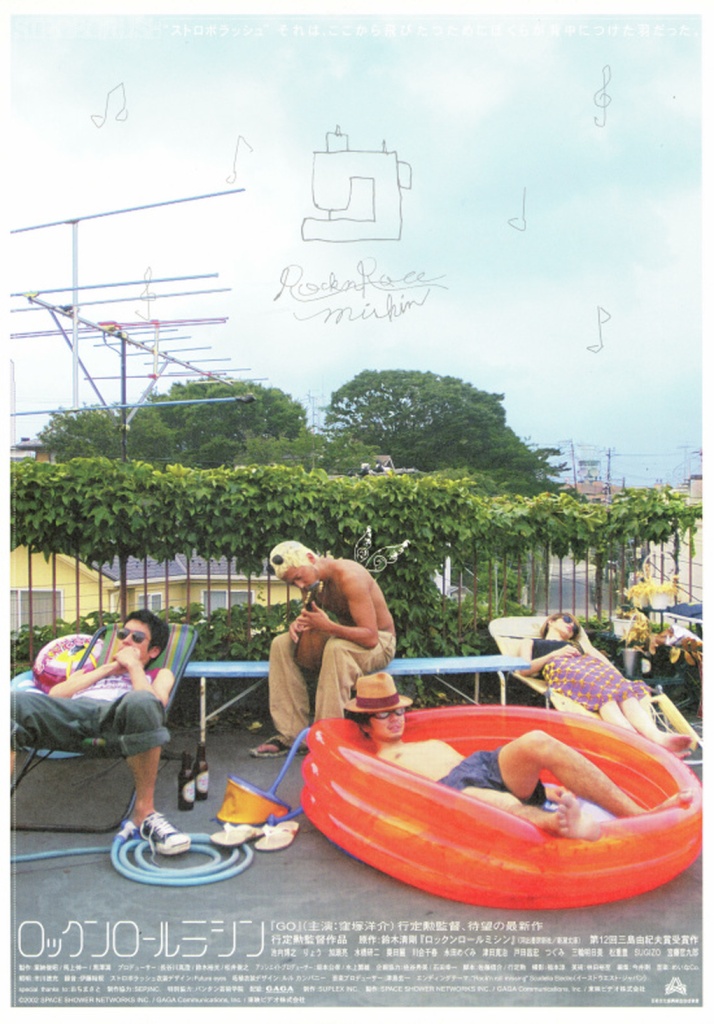
rock'n'roll misshinYou know how it is, you’ve left college and got yourself a pretty good job (that you don’t like very much but it pays the bills) and even a steady girlfriend too (not sure if you like her that much either) but somehow everything starts to feel vaguely dissatisfying. This is where we find Kenji (Ryo Kase) at the beginning of Isao Yukisada’s sewing bee of a movie, Rock ’n’ Roll Mishin (ロックンロールミシン). However, this is not exactly the story of a salaryman risking all and becoming a great artist so much as a man taking a brief bohemian holiday from a humdrum everyday existence.

Kenji’s life probably would have continued down a path of corporate serfdom uninterrupted if he had not run into old schoolfriend Ryoichi (Hiroyuki Ikeuchi) who, he learns, is setting up an indie fashion label with some of his friends. Ryoichi has to leave pretty quickly but he pastes a note on the outside of the restaurant window with his contact details so Kenji can find him again.

At work the next day Kenji “enjoys” some “banter” with an extremely unpleasant corporate stooge colleague who seems to be under the mistaken impression that he and Kenji are friends. After making some misogynistic comments about how Kenji is too much of a pushover and should “knock some sense” (literally) into his girlfriend, his colleague sets in on some typical salaryman careerist chat which is exactly the kind of thing Kenji is becoming disillusioned with.

Having failed to meet her at the restaurant, Kenji returns home one evening to find his girlfriend waiting outside his flat. She comes in and immediately takes off her clothes and gets into bed all without saying anything at all. When her T-shirt accidentally blows off the washing line and gets caught on some cabling below, Kenji remembers about his friend’s fashion company and decides to pay them a visit. Kenji is taken in by the sense of freedom and individual enterprise he finds in the workshop in contrast to his corporate drone office job. Eventually Kenji quits and joins the fashion gang full-time though he quickly finds that making a dream come true is surprisingly uphill work.

Unlike other films of this nature, there’s very little inspirational content to be found in Rock ’n’ Roll Mishin. The “mishin” of the title means a sewing machine and early on Ryoichi teases Kenji by telling him that his is a “rock and roll” machine because it beats out 8 stitches a second and if you really step on it it goes up to 16. Ryoichi’s teacher and mentor, Megumi (Ryo) lets Kenji in on the joke by explaining that it’s really called a “lock” machine because it holds the fabric in place for you. The other member of the team is a fashionista, Katsuo (Kenji Mizuhashi), who wants to create fashion that makes a sun of your heart so that you shine forth with an inner light. Needless to say, though the original three all have fashion skills from Ryoichi who’s the designer to Megumi who is a fashion teacher and Katsuo who studied fashion in London, nobody has any kind of business sense or a real business plan for this fledgling business.

In another film this might be where Kenji’s salaryman experience plays in, completing a missing element of the group which will enable them to triumph over adversity. However, Kenji’s experience is also fairly limited but the sensible economic advice he has to offer largely falls on deaf ears with his more creatively orientated teammates. They may understand the business on some level – at least enough to know what they can realistically expect to charge for their wares but are completely clueless about how they can go about managing their costs and maximising their profits. They also don’t really seem to know how to promote their business in anything other than a grungy, underground way which might be cool but is unlikely to take off without a serious amount of cynical marketing gimmickry which Ryoichi isn’t prepared to go for.

What Rock ’n’ Roll Mishin has to say about the youth of today isn’t very encouraging. It paints them as a group of unrealistic dreamers unwilling to put the work in to achieve anything. They might start to go for it in the beginning, but as soon as things start to look up they get scared and childishly run away rather than following through. Ryoichi is very much the tortured artist type, so fixated on maintaining his own image of artistic integrity that he’s completely unable to commercialise to work in any effective kind of way. Kenji is sucked in by the atmosphere of creative freedom but ultimately he has very little to offer and even if he is the one most affected by this new, bohemian lifestyle he’s also the best placed to recognise that you can’t live on dreams alone.

It’s tempting to read Rock ’n’ Roll Mishin as an ultra conservative, stick to the path message movie. It almost wants to say that it’s just not worth trying anything new because you’ll never see it through and you’ll be heading back to your old life with your tail between your legs quicker than you can say haute couture. However, even if the typical underdog triumphs against the odds narrative doesn’t materialise, Kenji at least comes to view his time in the fashion business in a broadly positive light. What he values is the time spent with friends, and, even if it didn’t work out quite the way they would have liked they still created something that was a success on its own terms and was ultimately appreciated by fellow travellers along the same path which, in the end, is what it’s all about.


Not exactly a trailer but this music video for one of the songs used in the film, Rock ‘n’ Roll Missing by Scudelia Electro, contains some footage from the film (lyrics in English)

Dolls (ドールズ, Takeshi Kitano, 2002)

dolls posterOutside of Japan where he is still primarily thought of as a TV comedian and celebrity figure, Takeshi Kitano is most closely associated with his often melancholy yet insistently violent existential gangster tales. His filmography, however, is one of the most diverse of all the Japanese “auteurs” and encompasses not only the aforementioned theatre of violence but also pure comedy and even coming of age drama. Dolls is not quite the anomaly that it might at first seem but perhaps few would have expected Kitano to direct such a beautifully colourful film inspired by one of Japan’s most traditional, if most obscure, art forms – bunraku puppet theatre.

After opening with a bunraku performance featuring an excerpt from the Chikamatsu play Courier For Hell, Kitano moves on to his overarching narrative which connects the tripartite structure in a tale inspired by the classic story The Bound Beggars. This first pair of lovers, Sawako and Matsumoto, wander blankly through the ever changing landscape tied together with a long red rope. The two had previously been a young couple, very much in love, but Matsumoto was pressured into abandoning Sawako to accept a semi-arranged marriage to his boss’ daughter. Distraught, Sawako attempts suicide only to survive but in an almost catatonic state.

The second pair of doomed romantics consists of an ageing yakuza who looks back on his life which has forced him to act in a way that he is not always proud of and now finds himself remembering the girlfriend he parted with thirty years ago after fearing he was about to lose his job. She promised to wait for him, he promised to return a fine man but he became a yakuza and never saw her again. All these years later, she’s still exactly where she said she’d be, waiting.

Story three is strange tale of modern love as a young man becomes obsessed with an idol star who only ever notices his rival. After she is injured in a car accident and decides to retire, the young man takes drastic action to be able to meet with her on what he sees as a more equal footing.

Fools for love, each and every one of them. Love has ruined them, removed rational choice from their field of vision, yet there’s something noble and beautiful in the way in which it has penetrated each of their lives. They love as if possessed by an incurable madness, Sawako tries to kill herself because her heart is broken, a woman grows old spending each Saturday lunch time sitting on a bench with a second lunch box which is going to go to waste, and a young man maims himself to finally get his love’s attention. Was it worth it, in the end? Perhaps not if the desperately sad outcomes of each of these stories is anything to go by.

Kitano rejects his idiosyncratic blue colour palate for a world of vibrant colours. Travelling through a year we move along the seasons as punctuated by their symbolic scenery from cherry blossoms to green verdant landscapes, the overwhelming redness of autumn leaves and finally the purity of the winter snow. We travel one way, but also in circles as we navigate the story of love as it too changes with its seasons yet remains unchanged in essence. Each of the lovers is no more free than a bunraku puppet, manipulated by forces outside of their control and forced into a desperate unhappiness that is in part vindicated by their romantic bonds.

Love is tender, love is cruel. Each of the men, in particular, makes terrible choices which cause only pain to the women they supposedly love and, in their pride and arrogance, they fail to realise the consequences of their actions until it is far too late. The tragic inevitability of life’s suffering and the inability to escape it are the foundation stones of Chikamatsu’s world.

Working with fashion designer Yohji Yamamoto Kitano has created a beautiful, theatrical world of hyper realistic colour and life. Like much of Kitano’s work, Dolls amounts to a sad collection of tales coloured by melancholy and a resignation to the pain and suffering inherent in being alive. The lovers are inexorably bound to each other for all eternity because of the suffering they have each endured at the other’s hand. This is a sad world, but it’s a beautiful one too and even if hurts one must try to live.


Dolls is re-released in the UK on blu-ray courtesy of Third Window films.

(This is an original release trailer and does not reflect the quality upgrade of Third Window Films’ blu-ray release)

I first saw this film I guess almost fifteen years ago (!) and I still occassionally get this song stuck in my head:

Review of Takeshi Kitano’s Dolls (ドールズ) – first published by UK Anime Network.


Parco Fiction (パルコ フィクション, Takuji Suzuki & Shinobu Yaguchi, 2002)

1000x1500sr

Since making 2002’s Parco Fiction, directors Shinobu Yaguchi and Takuji Suzuki have both gone on to bigger and better things but for this under seen portmanteau movie, they found themselves uniting to create something which seems to be a strange advert for the Parco department store in Tokyo’s trendy Shibuya district. The film is divided into five different short episodes loosely connected to the department store plus opening, closing and linking segments each filled with the kind of whimsical, absurd humour usually found in these kinds of films.

Opening with a planning meeting for the building of the department store in which its unusual name is decided after the chain smoking consultant finds it written on his scarred lungs after a medical emergency, the story moves on to a young lady who is undergoing an interview for a job at the store. Unfortunately, the young man being interviewed alongside her is an ideal candidate – a Tokyo university graduate who seems to have completely charmed the panel. However, the girl is given a job with the instruction not to open the envelope she’s been given but she can’t resist and finds herself setting off on a strange quest.

This only continues in part two as we come into contact with a soon to be middle school girl who has the misfortune of having a slightly dotty grandma by the name of “Harco”. Every time the Parco ad comes on, grandma gets very excited because she thinks someone’s calling her name even though the last person to call her “Harco” died, years ago. The little girl sets off to solve this problem by stopping grandma seeing the ads, but then something even stranger happens.

Tale three is set during a sale in which a young woman has her heart set on a particular dress and will stop at nothing to get it. This introduces us to the security guard at the Parco who takes us into story five as a shop worker has an unusual medical problem which prevents her from looking up. The security guard has a crush on the shopgirl, but he’s on the taller side so all he can do is stay close by and prepare to catch her every time she’s about to swoon after slightly raising her head. The film then closes with another mini sequence featuring the “standing room only” screening of Parco Fiction at a public cinema.

As is common with these kinds of films, some of the segments are more successful than others. The first perhaps goes on too long and the episode with the little girl and her grandma gets a little too surreal for its own good but the overall tone is zany, quirky humour. Sometimes very off the wall and filled with a good deal of slapstick too, Parco Fiction feels like a fairly low-key, frivolous effort but none the less enjoyable for it. Having said that, the entire duration of the film lasts only 65 minutes, and, truthfully, feels a little long despite the variation of stories involved.

Not a landmark film by any means, Parco Fiction still has plenty to offer particularly as a fairly early effort from these two directors who’ve since gone on to carve out fairly interesting careers. Sure to interest fans of quirky comedies, each of the segments has a zany, studenty humour vibe that often proves extremely funny. The film is undoubtedly low budget (and obviously filled with references to the Parco department store) but earnest enough and filmed in an accomplished and interesting manner.


This is another one you can randomly buy on UK iTunes with English subtitles.

Unsubbed trailer: