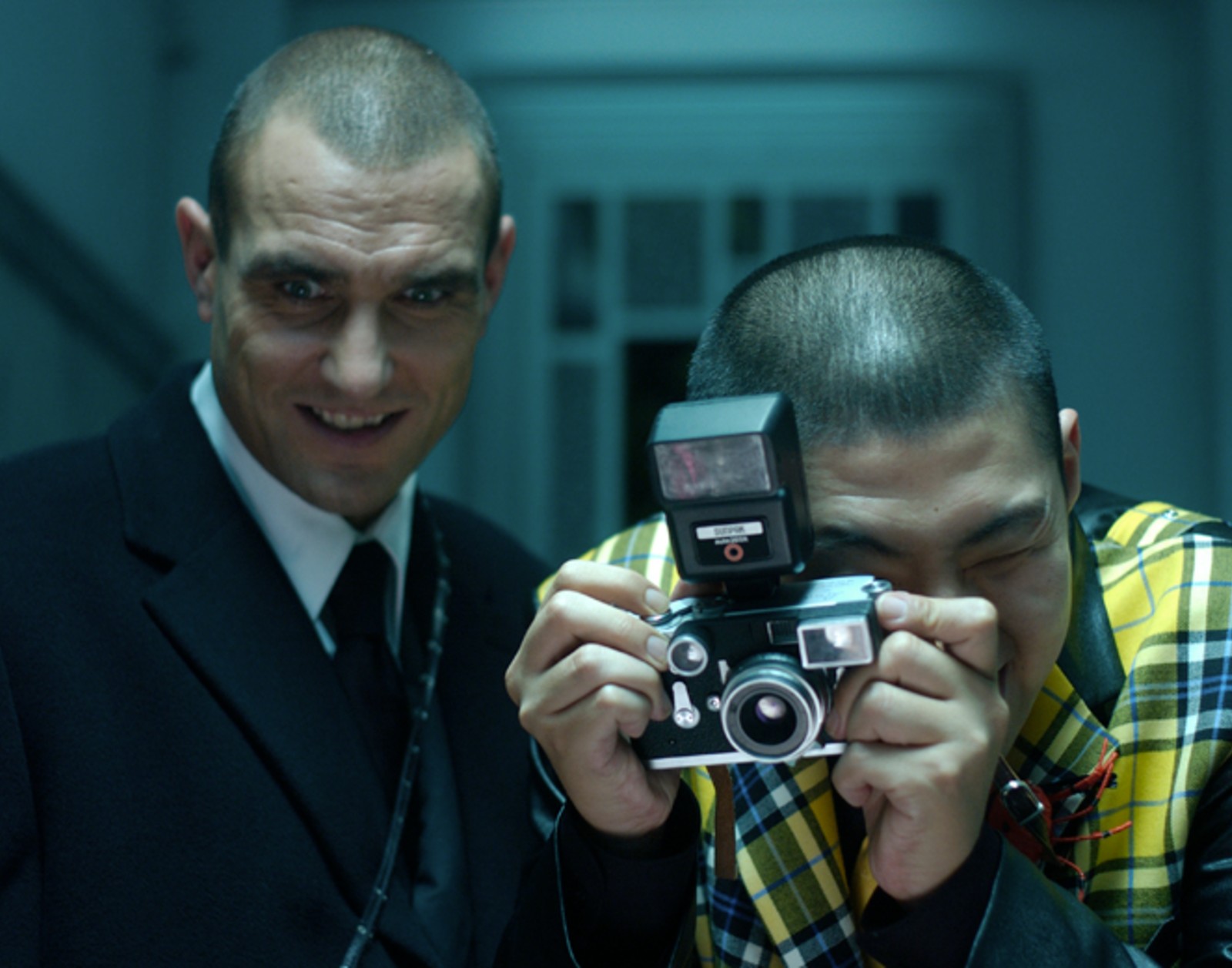
Survive Style 5+ (Gen Sekiguchi, 2004)

“What is your function in life?” It is, after all, quite a difficult question as an air stewardess (Tae Kimura) points out when interrogated by an irate British hitman (Vinnie Jones), and perhaps one that most people never really think about. Indeed, many of those questioned struggle with the meaning of “function”, replying with the most obvious answer of their occupation or job title without really considering any deeper implications or whether their existence is really meaningful. The hitman seems to have a secondary mission of eliminating those whom he deems “unnecessary”, while simultaneously giving his only sign of approval to a man who straightforwardly tells him that he doesn’t have one.

Gen Sekiguchi’s Survive Style 5+ is full of this kind of questioning but ultimately a tale of how one learns to survive in an often absurd world. Like many films from the mid-2000s, it cuts between several interwoven plot threads that at first seem nonsensical but finally coalesce into a complete whole. An artist (Tadanobu Asano) repeatedly kills his wife (Reika Hashimoto) who is forever trying to kill him in bizarre ways only for her to respawn back at their very weird Western-style country lodge in the woods. An ad executive (Kyoko Koizumi) becomes fed up with her vain hypnotist boyfriend (Hiroshi Abe) who mocks her career. A salaryman (Ittoku Kishibe) is hypnotised to think that he’s a chicken, and a trio of burglars (Kanji Tsuda, Yoshiyuki Morishita, Jai West) deal with repressed emotion and romantic longing. 

They are all to some extent trying to find some way to survive along with a sense of purpose in their lives. Ad executive Yoko is forever coming up with zany ideas for TV adverts that she records on her dictaphone, sniggering to herself at their surreal humour though she is the only one who finds them funny and her work is often dismissed by her corporate clients who complain that her ads don’t do anything to inform the prospective customer about the nature of the product. Sekiguchi was himself also a director of TV adverts which informs the film’s short and snappy style, and Yoko’s artistic frustrations perhaps echo his own as she tries to fulfil herself creatively while meeting the client’s demands. 

The CEO of the pharmaceuticals company she’s working with (Shinichi Chiba) is forever taking “emergency” calls from his wife about such important issues as the bulb having gone in the bathroom which he treats with the upmost seriousness while admitting that he really doesn’t know how to address any of these domestic issues. Similarly, the salaryman is prevented from living a full family life because of the demands of his job, but becomes a temporary hero after getting tickets to see the sold-out hypnotist. In someways, he might even be happier as a bird which after all offers more “freedom” if only he could learn to fly. While his wife and daughter are most interested in curing him so that he can become a stereotypical salaryman again and fulfil the roles of father and husband by providing for the family, only his son determines to accept his father’s new reality and love him for who he is now. 

The family’s home is designed with an artificial quality giving it the appearance of the set for a TV sitcom, bearing out the ersatz nature of conventional family life in which everyone is forced to bear out their particular “function” without imbuing it with much meaning. When the burglars break in, they too inhabit this space as if they were children who’ve come over to play by sitting down and playing cards rather than looting the place, though it turns out the family don’t actually have very much worth stealing. While Tsuda is forever taking calls from a girlfriend, Morishita and J exchange a series of longing looks but are otherwise unable to express their feelings for each other due to lingering societal homophobia and emotional vulnerability. Only when challenged by the hitman are they able to express their feelings after questioning their own “function in life”.

Jones was clearly hired for his hardman image which he’d successfully brought off the football pitch and into a series of gangster movies in the late 90s, imbuing each of his lines with an absurd intensity which is equally matched by Yoshiyoshi Arawakawa’s comical attempts to echo his intimidating speech patterns as his interpreter though without the physical presence to pull it off. The hitman is quite clearly a harbinger of death, but at the same time it’s his existential probing that points the way towards survival as his various targets are forced to consider what their “function in life” really is and if they’re living in ways that are meaningful and fulfilling. The film’s anarchic production design and deadpan humour add to the sense of surreality as Sekiguchi gleefully ricochets between one storyline and another looking for new modes of survival in an increasingly absurd world.


Survive Style 5+ is currently screening in select UK cinemas and released on UHD/Bluray on 19th October courtesy of Third Window Films.

Trailer (dialogue free)

Love Ghost (死びとの恋わずらい, Kazuyuki Shibuya, 2001)

love ghost posterWhat is it about ghosts and high school girls? Maybe it’s shrines and graveyards mothers ought to be warning their daughters about rather than moody guys with motorbikes. Anyway, the somewhat salaciously titled Love Ghost (死びとの恋わずらい, Shibito no Koiwazurai) is not quite the film it claims to be, though it is haunted by the violent spirit of strong emotion. Innocent high school romance is suddenly infected with the cruel complications of adult love, mental illness, and suicide as a strange curse descends over a previously peaceful town.

Taking on the classic “mysterious transfer student” role, protagonist Midori (Lisa Goto) is about to set off for her first day in a new school after moving back to her home town ten years after her father left the family for another woman. Midori is frequently plagued by a recurring nightmare in which she indulges in the local practice of Tsuji-ura whereby girls wait near the temple and ask a passerby what they think their chances are with their current crush. Only, Midori’s visions have started to bleed into the real world and often end in a storm of fire and blood. For this reason she finds herself unable to enter the school building but is rescued by new classmate, Suzue (Asumi Miwa), who shows her another way in. On the way the pair meet clueless popular boy Kotaro (Takahashi Shinji) who is instantly smitten with the new girl, much to Suzue’s consternation.

Kotoro is, to put it mildly, a little on the dim side and either hasn’t noticed that the entire population of the school, including his good friend Suzue, is love with him or is just refusing to acknowledge it. Romance is the major occupation of the school girls who spend their break times reading tarot cards and talking about Tsuji-ura and the handsome boy dressed in black who often appears there, be he a force for good or ill. Midori isn’t really interested in her classmates but is captivated by the near silent boy at the back of the room whom everyone else is ignoring. She eventually recognises him as a boy she knew before she left and used to play with all the time. Meeting up on the roof, Ryusuke (Ryuhei Matsuda) reveals he’s been waiting for her to come back all this time. However, there is definitely something strange about this quiet boy, not to mention the ever expanding mould stain in Midori’s bathroom…

There’s a lot of obviousness in Love Ghost, but this is later revealed to be a master stroke undercutting the extreme reversals of the big reveals. Madness quickly takes hold in the school, fortunately it does not claim many victims though those who do succumb find themselves cutting their own throats out of sense of heartbroken helplessness unable to accept the fact that their romantic destinies are not the ones they would have chosen.

On the one hand there are Midori’s recurrent memories of her idyllic childhood playing with Ryusuke in beautiful green, sunlit forests which later gives way to tentative teenage romance – a perfectly natural development. However, that’s set against the increasing strangeness of the environment with its oddly ethereal atmosphere. The other girls are experiencing a dangerous kind of romantic madness turning to obsessive, unrequited love yet Midori’s own experience is seemingly a gentle and innocent one. Of course, there’s more to it than that, and Midori’s world is also “unreal” in a hundred other ways. As usual, her link to the curse is tied up with her long buried past which must once again be exposed to the light in order to move forward and finally bid goodbye to the ghosts of forgotten cruelty.

Love Ghost’s central curse is a little confused and never satisfactorily explains itself. There might be more to say about the way the intense emotions of adolescence don’t always dissipate on reaching adulthood in the way they are supposedly intended to, or about the obsessive preoccupation the schoolgirls have with romance, but Love Ghost isn’t interested in any of that. In fact, it’s a little confused what it is interested in but at heart its a series of intertwined ghost stories as Midori haunts herself whilst still alive with memories of the childhood cruelly ripped away from her by the selfish actions of a stranger which have also left her with a deep seated sense of unresolved guilt. An imperfect exercise, Love Ghost has little to recommend it aside from providing an early outing for later star Ryuhei Matsuda yet does offer a poetic, if poorly put together, take on a teen ghost story that is like to offer more to fans of supernatural romance than of J-horror gore.


Love Ghost is available on R1 US DVD from Tokyo Shock.

US release trailer:

Rock’n’Roll Mishin (ロックンロールミシン, Isao Yukisada, 2002)

rock'n'roll misshinYou know how it is, you’ve left college and got yourself a pretty good job (that you don’t like very much but it pays the bills) and even a steady girlfriend too (not sure if you like her that much either) but somehow everything starts to feel vaguely dissatisfying. This is where we find Kenji (Ryo Kase) at the beginning of Isao Yukisada’s sewing bee of a movie, Rock ’n’ Roll Mishin (ロックンロールミシン). However, this is not exactly the story of a salaryman risking all and becoming a great artist so much as a man taking a brief bohemian holiday from a humdrum everyday existence.

Kenji’s life probably would have continued down a path of corporate serfdom uninterrupted if he had not run into old schoolfriend Ryoichi (Hiroyuki Ikeuchi) who, he learns, is setting up an indie fashion label with some of his friends. Ryoichi has to leave pretty quickly but he pastes a note on the outside of the restaurant window with his contact details so Kenji can find him again.

At work the next day Kenji “enjoys” some “banter” with an extremely unpleasant corporate stooge colleague who seems to be under the mistaken impression that he and Kenji are friends. After making some misogynistic comments about how Kenji is too much of a pushover and should “knock some sense” (literally) into his girlfriend, his colleague sets in on some typical salaryman careerist chat which is exactly the kind of thing Kenji is becoming disillusioned with.

Having failed to meet her at the restaurant, Kenji returns home one evening to find his girlfriend waiting outside his flat. She comes in and immediately takes off her clothes and gets into bed all without saying anything at all. When her T-shirt accidentally blows off the washing line and gets caught on some cabling below, Kenji remembers about his friend’s fashion company and decides to pay them a visit. Kenji is taken in by the sense of freedom and individual enterprise he finds in the workshop in contrast to his corporate drone office job. Eventually Kenji quits and joins the fashion gang full-time though he quickly finds that making a dream come true is surprisingly uphill work.

Unlike other films of this nature, there’s very little inspirational content to be found in Rock ’n’ Roll Mishin. The “mishin” of the title means a sewing machine and early on Ryoichi teases Kenji by telling him that his is a “rock and roll” machine because it beats out 8 stitches a second and if you really step on it it goes up to 16. Ryoichi’s teacher and mentor, Megumi (Ryo) lets Kenji in on the joke by explaining that it’s really called a “lock” machine because it holds the fabric in place for you. The other member of the team is a fashionista, Katsuo (Kenji Mizuhashi), who wants to create fashion that makes a sun of your heart so that you shine forth with an inner light. Needless to say, though the original three all have fashion skills from Ryoichi who’s the designer to Megumi who is a fashion teacher and Katsuo who studied fashion in London, nobody has any kind of business sense or a real business plan for this fledgling business.

In another film this might be where Kenji’s salaryman experience plays in, completing a missing element of the group which will enable them to triumph over adversity. However, Kenji’s experience is also fairly limited but the sensible economic advice he has to offer largely falls on deaf ears with his more creatively orientated teammates. They may understand the business on some level – at least enough to know what they can realistically expect to charge for their wares but are completely clueless about how they can go about managing their costs and maximising their profits. They also don’t really seem to know how to promote their business in anything other than a grungy, underground way which might be cool but is unlikely to take off without a serious amount of cynical marketing gimmickry which Ryoichi isn’t prepared to go for.

What Rock ’n’ Roll Mishin has to say about the youth of today isn’t very encouraging. It paints them as a group of unrealistic dreamers unwilling to put the work in to achieve anything. They might start to go for it in the beginning, but as soon as things start to look up they get scared and childishly run away rather than following through. Ryoichi is very much the tortured artist type, so fixated on maintaining his own image of artistic integrity that he’s completely unable to commercialise to work in any effective kind of way. Kenji is sucked in by the atmosphere of creative freedom but ultimately he has very little to offer and even if he is the one most affected by this new, bohemian lifestyle he’s also the best placed to recognise that you can’t live on dreams alone.

It’s tempting to read Rock ’n’ Roll Mishin as an ultra conservative, stick to the path message movie. It almost wants to say that it’s just not worth trying anything new because you’ll never see it through and you’ll be heading back to your old life with your tail between your legs quicker than you can say haute couture. However, even if the typical underdog triumphs against the odds narrative doesn’t materialise, Kenji at least comes to view his time in the fashion business in a broadly positive light. What he values is the time spent with friends, and, even if it didn’t work out quite the way they would have liked they still created something that was a success on its own terms and was ultimately appreciated by fellow travellers along the same path which, in the end, is what it’s all about.


Not exactly a trailer but this music video for one of the songs used in the film, Rock ‘n’ Roll Missing by Scudelia Electro, contains some footage from the film (lyrics in English)