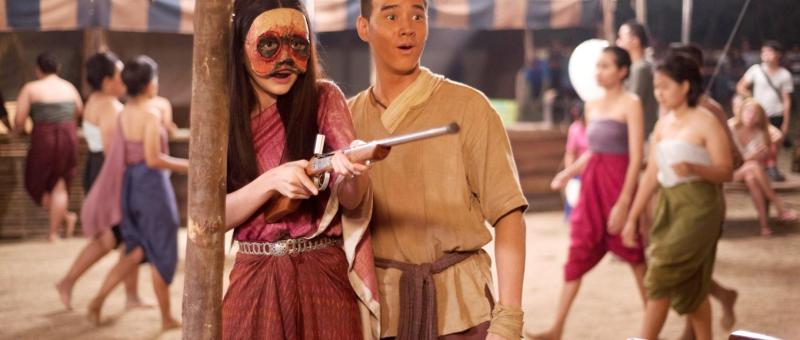
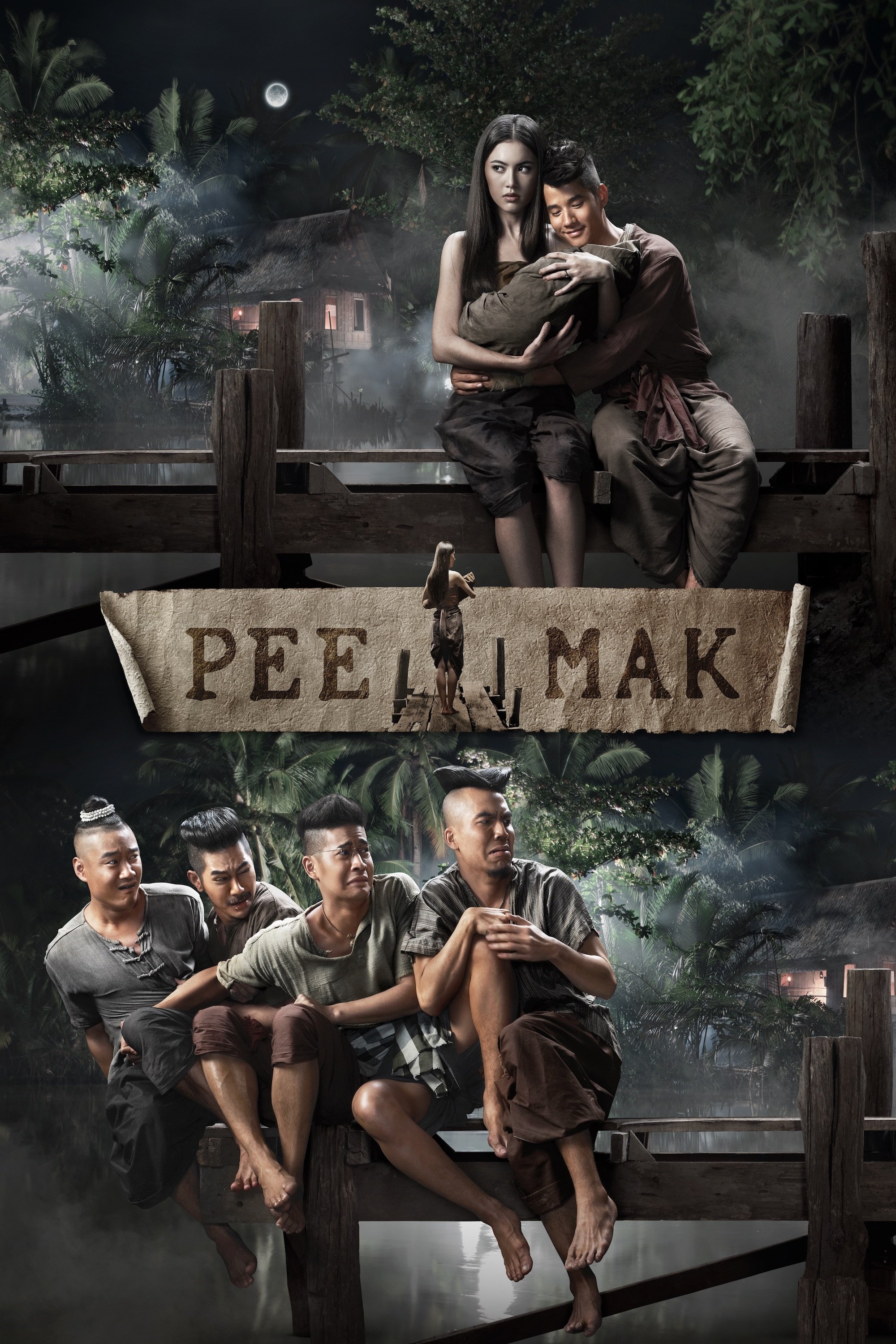
Pee Mak (พี่มาก..พระโขนง, Banjong Pisanthanakun, 2013)

If you suddenly discover your spouse is a member of the undead, do you really have to break up with them or is it alright to go on living with a ghost? The conventional wisdom in Banjong Pisanthanakun’s horror comedy take on the classic folktale Mae Nak Phra Khanong, Pee Mak (พี่มาก..พระโขนง), is that the dead cannot live with the living, but perhaps love really is strong enough to overcome death itself and living without the person who means most to you really might be more frightening than living with an all-powerful supernatural entity.

In any case, much of the comedy revolves around the desperate attempts of Pee Mak’s friendship group to make him realise that wife, Nak (Davika Hoorne), is a ghost. The men had all been away at the war and have now returned but the village seems different and the villagers are all avoiding Pee Mak. Gradually, it dawns on them that Nak actually died due to complications from a miscarriage after going into labour alone at home given Pee Mak’s absence. But Pee Mak himself remains unaware of this fact, or so it seems, and refuses to listen to his friend’s attempts to convince him which are also frustrated by their fear of Nak and the worry that she might curse them if they reveal her secret.

The four friends are each played by the same actors and have the same character names as those in the shorts Banjong Pisanthanakun directed for 4Bia and Phobia 2, and as in those two films there is a degree of confusion about who is and isn’t a ghost. On their return, the men are passed by a ferryman who is returning the bodies of dead soldiers to their families explaining that the graveyards are all full. This of course hints at the destructive costs of the war and haunted quality of the depleted village to which not all men have returned, but also leaves the door open to wondering if the five of them are not already dead themselves and have returned home only in spirit without realising. Pee Mak, after all, sustains a serious injury from which he miraculously recovers driven only love and the intense desire to return home to his wife and the baby he’s never met who must by now have been born. 

Meanwhile, Nak tells Pee Mak that the rumours of her death are greatly exaggerated and mostly put about by a local man, Ping, who had been harassing her while Pee Mak was away at the war and was upset by her rejection. Ping then later also accuses Nak of killing his mother after she drunkenly told Pee Mak about Nak being a ghost, but in general the villagers only avoid Nak until one rather late intervention rather than try to exorcise her spirit. Nevertheless ghost or not, it does not actually appear that Nak is particularly dangerous. She does not drain Pee Mak’s life force nor randomly attack other people and at most only seems to glare intensely at his friends who might just be annoying in far more ordinary ways especially as one of them seems have developed a crush her.

Which is all to say, is it really so wrong for Pee Mak to enjoy a happy family life with his ghost wife who may have developed a set of really useful skills such as super-stretchy arms and the ability to hang upside down? Banjong Pisanthanakun constantly wrong-foots us, suggesting that perhaps everyone’s already dead, or maybe no one is, while eventually coming down on the side of the power of love to overcome death itself. Despite the film’s setting in the distant past, he throws in a constant stream of anachronistic pop culture references that might suggest this is all taking place in some kind of universal time bubble but also lends to the sense of absurdity in what is really a kind of existential farce as the gang attempt to figure out who’s alive and who’s a ghost before eventually realising that it might not really matter. Dead or alive, it seems like life is about just being silly with your friends free from the folly of war, which is surely a message many can firmly get behind.


Trailer (English subtitles)
The Chef, The Actor, The Scoundrel (厨子戏子痞子, Guan Hu, 2013)

“They were described as insane. But others said they were heroes,” according to the opening narration of Guan Hu’s zany wartime comedy, The Chef, The Actor, The Scoundrel (厨子戏子痞子, Chúzi Xìzi Pǐzi). Of course, the truth is that they seem to be both, a band of anonymous avengers desperately trying to end the cholera outbreak in Beijing in 1942 by stealing a vaccine from the Japanese and distributing it to the local population. 

They do this by kidnapping two Japanese soldiers who were involved with Unit 731 working on bioweapons. In a touch of irony, they may have intended to spread the disease intentionally to use to local Chinese population as test subjects, but the Japanese army in China is now so heavily affected they think it might just cost them the war. In any case, the plan goes awry because Ogasawara (Masanobu Otsuka) turns out not to be carrying the vaccine, but a sample of an even deadlier strain against which the existing version won’t work. Meanwhile, the restaurant where the gang are holed up is also surrounded by bandits who think the soldiers were carrying a different sort of treasure. 

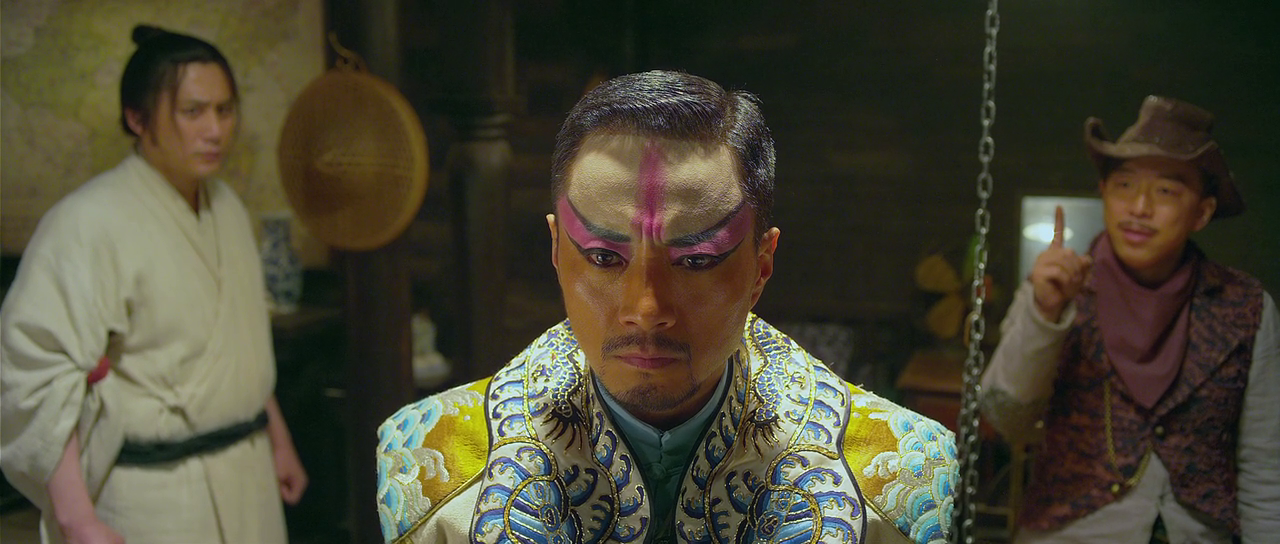
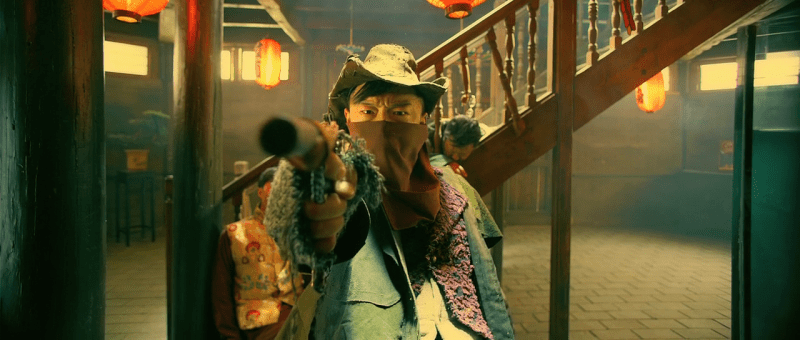
In truth, the gang are scientifically trained special agents with a mission to retrieve the vaccine but having realised that the Japanese can’t be tortured into giving it up, are forced to put on a charade pretending to be a camp sushi chef, his mute wife, a Peking opera performer, and a cowboy. What looks like completely random, bumbling incompetence is actually a finally turned plan designed to get Ogasawara to give up the secret of the vaccine. When Ogasawara’s ogre-like assistant points out they’ve killed far too many people for their captors to let them go, Ogasawara insists they weren’t people, they were test subjects, before explaining that their captors’ biggest weakness is a lack of unity.

This is, of course, ironic, as even if the band are pretending to be at each other’s throats trying to take control of their prey, they are actually working together. Meanwhile, though it may, at times, seem as if Ogasawara is playing them at their own game, it turns out he doesn’t have a game plan either and isn’t really thinking that far ahead. The Japanese just want the code to create the vaccine, and only commit to rescuing Ogasawara when it turns out the recipe he gave them doesn’t work, meaning they need him to come back and work on the project. But the heroes are a little bit ahead of him, realising they might have access to what’s needed to create the vaccine for themselves and spread it throughout the city. 

The final title card dedicates the film to “the movies we loved when we were young,” and Guan certainly does make good use of silent film aesthetics, even in also falling into a more mainstream sensibility and employing may of the same mannerisms as similar blockbuster movies with split screens and fast zooms. The film’s zany humour plays out almost as a kind of reaction to the grim and absurd world all around it in which death lurks all around, along with Japanese Imperial forces and bandits, and nothing is quite as it first seems to be. The Japanese soldiers refer to the Chinese as “Shinajin,” a sort of derogatory term meaning “Chinaman,” while the trio refer to the Japanese as “kimonos” as if to signal their mutual animosity while the dialogue itself is full of silly puns and weird swearing. 

Which is quite something considering the darkness of the premise. Not only are we dealing the atrocities of Unit 731 which is not only responsible for the cholera outbreak, but potential apocalypse for China which is under threat from several angles including the Nationalists and bandits. The sickness they are really trying to cure is their subjugation as they take care to issue the vaccine to ordinary Chinese people without seeking fame or fortune. Nevertheless, the closing titles insist they were based on real people who studied at Yenching University Medical College before the war and then went on to lead quite ordinary lives after this brief moment of heroic insanity as they harness nonsense as a weapon to trick the enemy into betraying themselves before giving up the ghost.


Trailer (Simplified Chinese and English subtitles)

Leaving on the 15th Spring (旅立ちの島唄~十五の春~, Yasuhiro Yoshida, 2013)

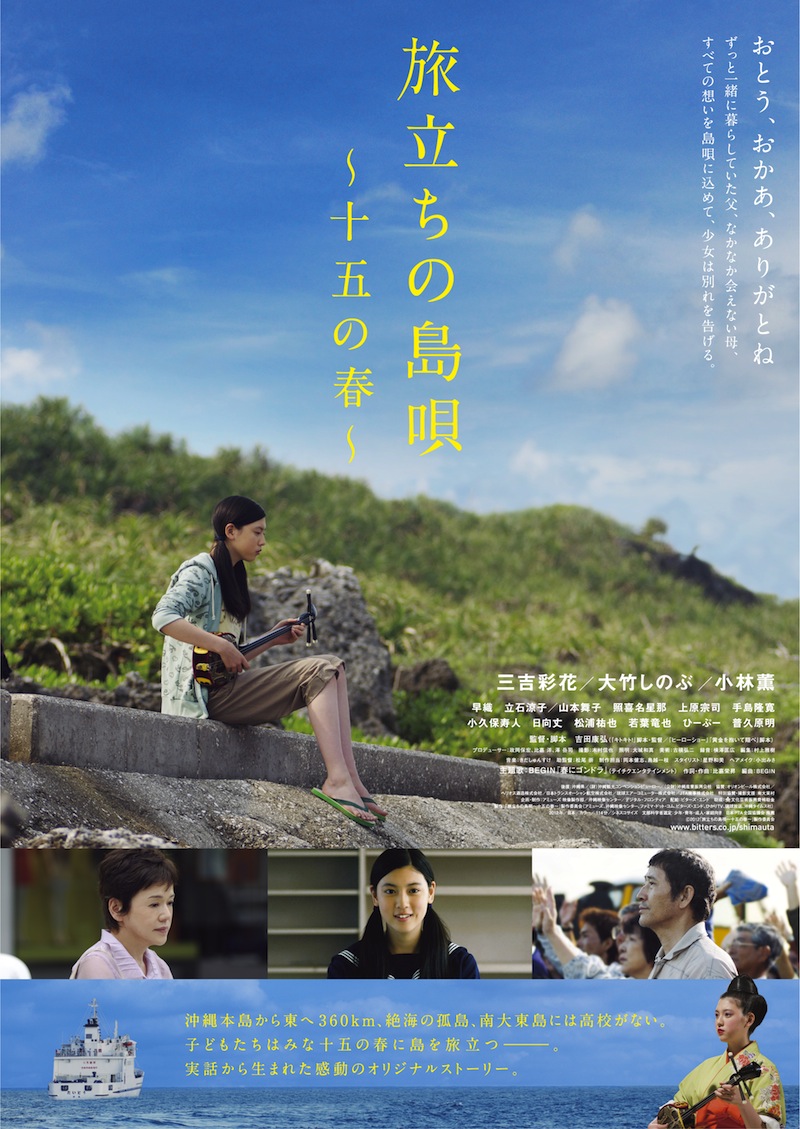
“How many of them will come back?” a man on the shore ominously asks as he watches the young people of his island ship out to pursue their education in the comparatively better equipped capital. Rural depopulation has become a minor theme in recent Japanese cinema, but the situation is arguably all the worse in the outlying islands of Okinawa. As the title of Yasuhiro Yoshida’s Leaving on the 15th Spring (旅立ちの島唄~十五の春~, Tabidachi no Shima Uta: Jugo no Haru) suggests, teens from the small island of Minami Daito (South Daito) must leave at 15 if they want to attend high school because there isn’t one on the island.

That said, there are more kids than you’d expect in young Yuna’s (Ayaka Miyoshi) middle school and it’s more than just a handful who leave the island each spring, many of them choosing to make lives for themselves in the wider world rather than return to their childhood home. On Minami Daito, the main industry is sugarcane but the prospect of Japan joining the TPP trade agreement has many worried that it will soon no longer be viable and with even fewer economic opportunities available many will have no choice other than to abandon the island for good. 

We’re often reminded just how far the island is from the Okinawan capital Naha and how difficult it is to get to. To leave, the kids are placed in a kind of cage and lifted onto a larger boat moored by a small jetty. Even to get to the next island Kita Daito (North Daito) it’s some time on a ferry which might not run if the weather is bad. Distance becomes a persistent theme, not just in Yuna’s impending exit but the scattering of her family. When kids leave for high school, a parent often goes with them as Yuna’s mother Akemi (Shinobu Otake) did when it was time for her sister Mina (Saori) to depart. But Mina is now a grown woman married with a child of her own and Akemi has not been back to the island for two years. This forcible separation continues to disrupt familial bonds as couples necessarily grow apart and children begin to choose their own paths in life which often take them away from their parents. 

It’s this sense of distance which plays on Yuna’s mind, a kind of countdown starting inside her as she witnesses another girl sing the Okinawa folk song “Abayoi” which means “goodbye” in the local dialect and recounts a young person’s sorrow as they must leave their family and childhood home behind on coming of age. Reminded that she’s next in only a year’s time, Yuna meditates on her past and future while reconsidering her relationships. Abandonment often occurs through a simple lapse in contact. Akemi now rarely phones home while Yuna’s nascent first love with a boy from Kita Daito falters when he abruptly stops calling or returning her letters. Eventually she finds out that despite their pledge to attend the same high school on Naha, he has decided to stay and take over his father’s fishing boat because of his dad’s ill health. 

Kenta has realised that his place is Kita Daito and he will remain there the rest of his life while harbouring a degree of resentment that he couldn’t go to high school or pursue his romance with Yuna. He feels their relationship is doomed simply from the fact that they’re from different islands. He won’t leave his, and she likely would not settle on Kita Daito preferring, either a life in the cities or her childhood home. It’s the same for her parents, Akemi deciding that she prefers life in the city and the degree of independence she has there while her father Toshiharu (Kaoru Kobayashi) would not survive off the island. Both of her siblings have already left, Mina returning with her infant daughter apparently on the verge of separating with her husband partly it seems because of the insecurity the separation of her family has left her with, while Yuna’s brother seems to be a harried workaholic with no family life to speak of. 

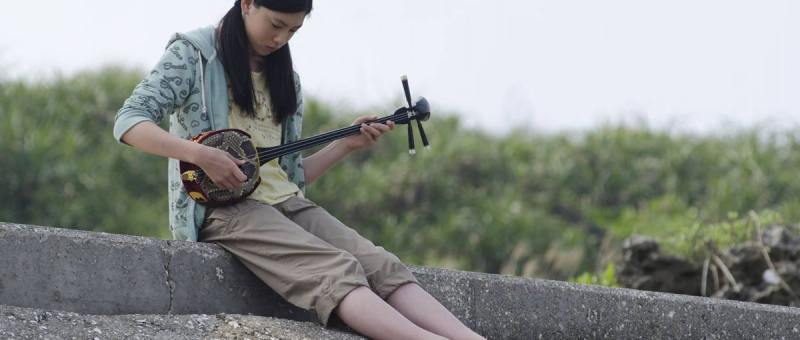
Rather childishly she thinks she can reunite her family and dreams of buying a big house on Naha for them all to live together, adult siblings included, without fully accepting that the relationship between her parents has been gradually worn away leaving them strangers to each other and each desiring different kinds of futures. What she comes to is perhaps an acceptance of the distance in her life, the longing for her island home where she says everyone is one big family, as she finds herself choosing independence. A picturesque vision of Minami Daito and its idyllic landscape along with the traditions of the island including its rich musical culture and Okinawan Sanshin, Yoshida’s gentle drama discovers that “abayoi” is a part of life that can’t be avoided but can be sweet as well as bitter once you’ve learned to accept it.


Trailer (English subtitles)

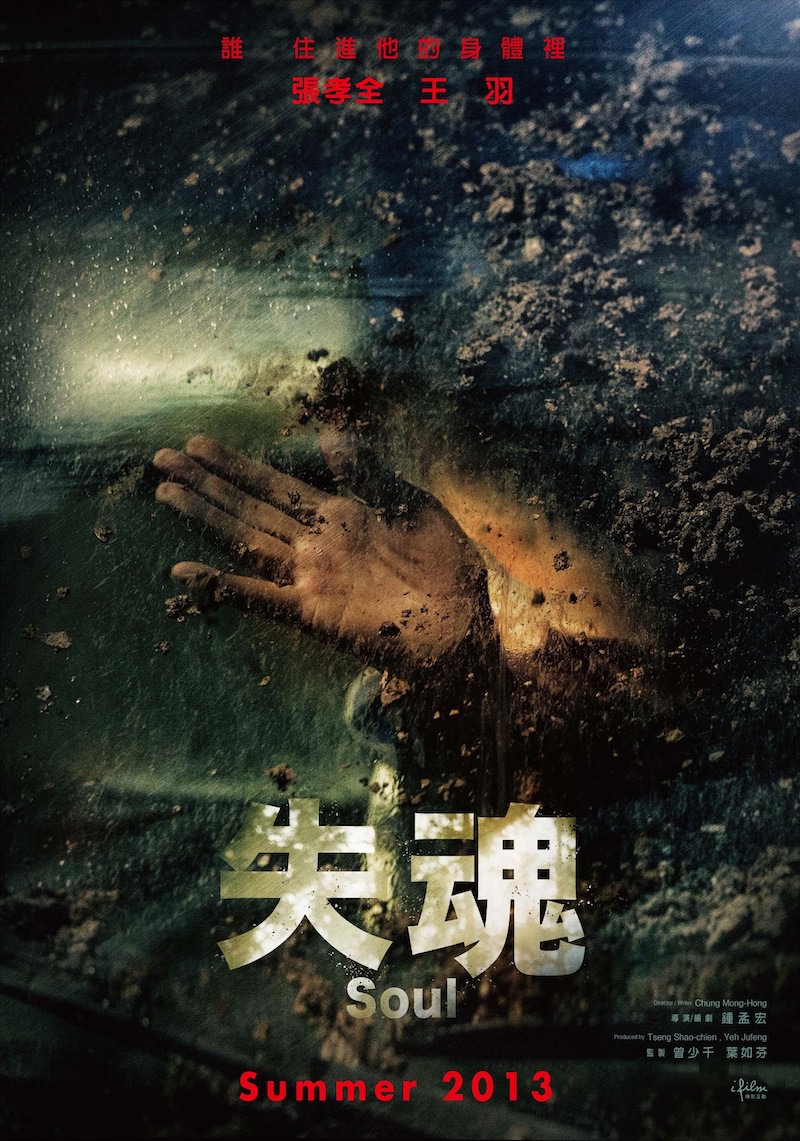
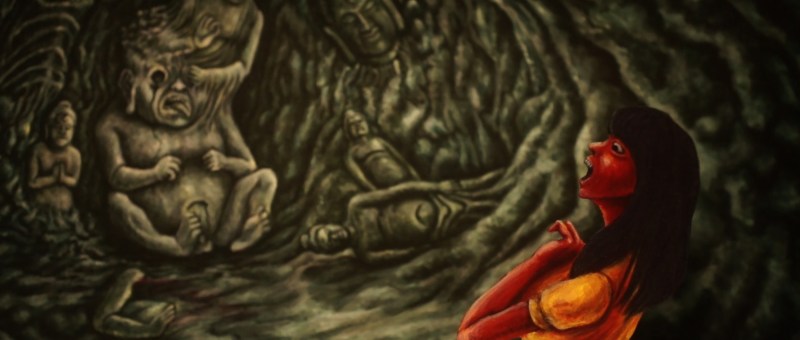
Soul (失魂, Chung Mong-Hong, 2013)

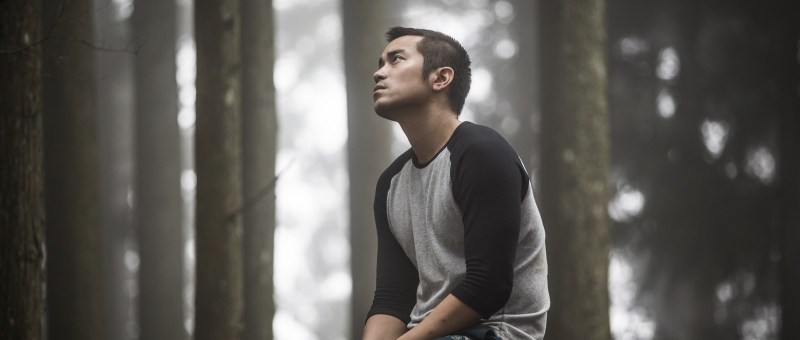
“Sometimes the things you see aren’t what they seem” the stoical father at the centre of Chung Mong-Hong’s supernatural psycho-drama Soul (失魂, Shī hún) later advises, for the moment creating a new, more convenient reality but also hinting at the mutability of memory and perception. Distinctly eerie and beautifully shot amidst the gothic atmosphere of the misty Taiwan mountain forests, Chung’s ethereal drama is at heart a tale of fathers and sons and the griefs and traumas which exist between them. 

When sushi chef Ah-Chuan (Joseph Chang) collapses at work, no one can figure out what’s wrong with him, finally suggesting perhaps it may be depression. His boss instructs three of his colleagues to take him back to his apparently estranged family to recuperate for reasons perhaps not altogether altruistic. In a near catatonic state, Ah-chuan is barely present offering no response to his name and staring vacantly in no particular direction. When he finally does begin talking, it’s to insist he’s no longer Ah-Chuan explaining that this body happened to be vacant and so he’s moved in while Ah-Chuan will apparently be off wandering for some time. Ah-Chuan, however, then abruptly stabs his sister Yun (Chen Shiang-chyi), who had travelled from Taipei to look after him, to death and is discovered covered in blood sitting calmly over her body offering only the justification that she was intending to harm him. 

Wang (Jimmy Wang), Ah-Chuan’s father barely reacts to finding his daughter’s corpse, merely rolling her under a bench and attempting to mop up the blood when a family friend, Wu (Chen Yu-hsun), who happens to be a policeman suddenly comes calling. Wang is either infinitely pragmatic instantly deciding there’s nothing he can do for his daughter so he’ll try his best to save his son, or else near sociopathic appearing to care nothing at all that Yun is dead. Nevertheless, realising that Ah-Chuan may be dangerous he takes him up to his remote cabin near the orchid garden and locks him inside while trying to figure out what or who this presence that has his son’s appearance might or might not be. As he later says, this brief time together is the most he’s spoken to his “son” if that’s who he is in years even if acknowledging that this Ah-Chuan is quite different from the old. Yet if it were not for the obvious fact that others see and interact with him we might wonder if Wang had simply conjured Ah-Chuan, projecting his own latent violence, guilt, and regret onto the figure of his son who is also in a way himself. 

Yet whatever Ah-Chuan now is he finds himself growing closer to the old man, feeling a filial responsibility towards him that he otherwise would not own. He contacts a “messenger” from “across the woods” to help his find Ah-Chuan’s wandering soul to tell him that his dad’s not doing so well, entering a space of dream and memory that reveals the trauma at the heart of their relationship that might in part help explain Wang’s apparent coldness. Just as the two Ah-Chuans begin to blur into each other, so perhaps to father and son, Wang prepared to go to great lengths to protect his only remaining child while, ironically, offering some harsh words to his son-in-law for not better protecting “the only daughter I have”. 

Chung hints at a kind fluidity of consciousness, each episode of “death” or “possession” accompanied by that of another creature, fish gasping and flapping around, a tired bug trying desperately to cling onto a leaf but failing, or a pair of snakes twisting themselves into a knot. Is Ah-Chuan merely experiencing a protracted dissociative episode under the delusion he is “possessed” while his essential selves “wander” the recesses of his consciousness or has someone else, a second soul, taken up residence in a body left vacant by a man who was in a way already “dead”. Wang in fact hints at this, telling the doctor that he had sometimes thought of Ah-Chuan as dead, or at least wondered if he might be seeing as they had long been estranged, suggesting that the Ah-Chuan of his heart and memory was already gone Wang believing himself to have killed something in him through his own violence when he was only a child. 

The two men mirror each other, growing closer yet also further apart as they make their way back towards the truth that might set them, metaphorically at least, free. Often viscerally violent not least in its jagged, abrupt cuts to black that feel almost like dropping out of consciousness or else waking fitfully with brief flickers of other realities, Chung’s eerie, ethereal drama ventures into the metaphysical but in its strangely surreal final scenes returns us to a more concrete “reality” in which the way home is found it seems only in dreams. 


Original trailer (Traditional Chinese / English subtitles)

INGtoogi: The Battle of Internet Trolls (잉투기, Um Tae-hwa, 2013)

A keyboard warrior enters a masculinity crisis after being ambushed in real life and taking a beating from an online rival in Um Tae-hwa’s graduation film, Ingtoogi: The Battle of the Internet Trolls (잉투기, Ingtoogi). Though the title may promise something more like a slacker comedy, Um subtly hints at the loserville of the contemporary Korean society which is, as the hero’s mother suggests, “only for the select few” leaving men like Tae-sik (Uhm Tae-goo), in contrast to the film’s title, losing the will to fight.

20-something and unemployed, Tae-sik still lives at home with his mother and fills his life with online fighting games. Lured to a park on the pretext of selling an online game item, Tae-sik is unexpectedly attacked by fellow gamer ManBoobs and becomes a laughing stock for getting beaten up in the street. Vowing revenge, Tae-sik makes his way to a mixed martial arts gym named Ingtoogi which as the coach explains means “we’re still fighting” and begins training in preparation to publicly call out Man Boobs for a fair fight on safer ground.

But Tae-sik is now traumatised and has become frightened of everything, hallucinating being punched in the face and in fact afraid of getting hit. It’s this sense of fear along with his wounded masculinity that he’s trying to avenge through violence and male dominance, but in order to do so has to resort to carrying around a kitchen knife as rather phallic replacement for his fractured manhood while otherwise trained by an equally disaffected teenage girl herself a former mixed martial arts champion.

Young-ja’s (Ryu Hye-young) high school class is perhaps surprisingly asked to debate capitalism in broadly positive terms only for her best friend to shock her by giving a detailed, text book answer about the loss of individuality later explaining that her nagging mother bribed the teacher to get the topic in advance so she could prepare. Young-ja is an orphan living alone though watched over by her martial arts expert uncle, Wook, but Tae-sik too has a nagging mother who is particularly disappointed in him for embarrassing himself by getting beaten up and going viral online. She wants to emigrate to Costa Rica vowing that it’s too hard to live in Korean society which is only for the elites. Tae-sik has no desire to move and in a pointed criticism states that though he and his mother live in the same space he does not feel as if they “live together” suggesting that the demands of contemporary capitalism and her job as an estate agent have placed a divide between them.

Indeed, when she suggests that Tae-sik learn the trade from her she in fact ends up in a physical altercation with a homeowner that is observed by the entire neighbourhood just standing and watching much as they’d watched Tae-sik getting beaten up online. The film seems keen to present his generation as one already beaten into submission and retreating behind the shield of their computer screens rather than taking risks in real life while those like Man Boobs who is later revealed to have been suffering with poor mental health are perhaps looking for something more “real” offline but have few ways to express themselves outside of violence. Even Man Boobs’ friend who set up the attack and filmed it is revealed to be a failed boy band star whose bid for fame in a capitalist society has crashed and burned leaving him with nothing. 

Yet for all that Tae-sik and his friend Hee-jun (Kwon Yul) who learns to take his knocks faster are fairly skeevy each attempting to ask out the teenage Young-ja despite being in their 20s, Hee-jun following up on a tip off from one of the other “loser” fighters about how to set up a date to take advantage of girl. Far from overcoming his powerlessness, what Tae-sik has to get used to is being beaten and effectively accept his “loserdom” if continuing a futile attempt to fight his dismal circumstances by less than productive means in simply not giving in and grinning through the blood no matter how many knocks he takes. The inane insults of online commenters present themselves as a kind of Greek chorus enshrouding Tae-sik in his self-loathing and powerlessness but do so only as a means of masking their own, ranting against the darkness from the comparative safety of their anonymous online personas. Though underlined by a quiet irony, Um paints a bleak picture of the contemporary city in which masochistic violence has become the only escape from an oppressive society.


INGtoogi: The Battle of Internet Trolls screened as part of this year’s London Korean Film Festival.

Trailer (English subtitles)

Storytellers (うたうひと, Ryusuke Hamaguchi & Ko Sakai, 2013)

Many tend to forget the folktales and fables they were told when young or at least until they themselves have a child yet it’s often through mystical stories that we first begin to learn about the world and our place within it. Third in a series of documentaries by Ryusuke Hamaguchi & Ko Sakai focussing on the Tohoku region in the wake of the 2011 earthquake and tsunami, Storytellers (Utauhito) follows folklore scholar Kazuko Ono of Miyagi Minwa no Kai as she travels the local area visiting friends in order to hear the various stories they remember from their youth. 

Yet as she explains during a trademark Hamaguchi backseat monologue in a car he and co-director Sakai are driving, folktales may have different meanings and interpretations to different people and in different eras in their own particular context. As an example she cites the tale we’ve just heard recited by an elderly woman titled The Monkey’s Bride in which a farmer with three daughters unwisely promises a wife to a monkey who agrees to help him with his rice paddy. The first two daughters refuse, but the third agrees because her father made a promise only to trick the monkey, who has been nothing but kind to her, into drowning himself in a lake. As a child, Kazuko like many disliked the story feeling sorry for the monkey who had acted only with humanity and does not seem to warrant being killed in such an unkind fashion. But then she began to reconsider how her grandmother from whom she first heard it may have read the tale as a woman married off at 16 who constantly tried to run away and only wanted to escape cruel treatment at the home of her in-laws. To her the daughter in the story was brave, doing that which she could not in freeing herself from a forced marriage after being sold to pay her father’s debt. Looking deeper again she began to wonder if the monkey wasn’t also a metaphor for the rich landowners who oppressed peasant famers with only poor quality paddies who were often forced to sell off their daughters in return for financial assistance. 

Other stories meanwhile speak of the ingenuity of the poor, a little girl rewarded after responding to an ad promising vast riches for anyone who manages to bore the story-loving lord, she managing it quickly by making him repeat a lengthy nonsense phrase at regular intervals. A story apparently meant to encourage young couples to find “clever” ways of sorting out marital disputes similarly finds a husband returning from the city selling his wife’s lover whom she hastily shut in a water jar, getting one over on him and her, getting his hands on 10 ryo, and even getting the jar back too. Such stories tell us something about the world in which they took place, female adultery in this case not so much of problem able to be solved with some comedic shenanigans rather than the point of a sword, while we might equally find it an absurd way to deal with marital infidelity. Then again there are also a series of thematically similar stories cautioning against marginalised members of society who create problems in order to gain fame and fortune through solving them such as two bizarre tales of magical instruments which cause people’s bottoms to sing an absurd and annoying song which only the holder of the object can stop allowing them to leverage their new talents for unearned wealth and status. 

Even so it isn’t perhaps the tales that matter so much as their transmission, many of the elderly storytellers recalling memories of their grandmothers from whom they first heard how the shrimp got its curved back or of eagles who tried to fly to the edge of the ocean. Each of the storytelling sessions begins in ritualised fashion, Kazuko and the other party introducing themselves to each other though they have all been friends for years or sometimes decades and already know each other well. As in the story of the girl and the lord, we’re reminded that tales like these expect call and response, an exchange between the storyteller and the listener that transcends the story itself. A now elderly man recounts that he’d forgotten most of the tales his eccentric grandmother had told him before joining the folktale group in his 40s, but also advances that the stories she gave him were intended to foster a sense of wonder in the world along with a confidence and security that would allow him move freely through the darkness. A lesson in oral history in which these ancient tales are shared and retold before reaching new generations is perhaps a sign of hope that something has and will survive in the simple act of speaking and listening even as Kazuko explains that in order to hear the story she must also change herself so she too may keep moving forward . 


Storytellers streams worldwide (excl. Japan) via DAFilms until Feb. 6 as part of Made in Japan, Yamagata 1989 – 2021 (films stream free until Jan. 24)

My Atomic Aunt (波の向こう, Kyoko Miyake, 2013)

“I can’t let TEPCO ruin my life” the heroine of Kyoko Miyake’s personal documentary My Atomic Aunt (波の向こう, Nami no Mukou) eventually asserts, explaining that when you have no more tears to cry then you become defiant. Having lived in London for 10 years prior to filming the documentary, a lack of defiance was something that had initially interested Miyake, wondering if she’d simply been away too long no longer understanding why everyone in her family’s hometown of Namie in Fukushima continued to refer to the Tokyo Electric Power Company in such affectionate terms. Then again, as her aunt Kuniko points out before losing her patience, “anger won’t get us anywhere”.

Returning to Japan soon after the 2011 earthquake and tsunami, Miyake details her own relationship with Namie, rendered uninhabitable after the Fukushima nuclear disaster, during her opening voiceover describing it as a warm and nostalgic place marked by a sense of rural tranquility. Nevertheless through making the documentary she comes to question both herself and the town, wondering why it was that people were so keen to have the plant come when the prevailing wisdom of her own generation was anti-nuclear and wary of duplicitous heavy industry. As her aunt and her friends reveal, however, post-war Namie was a poor village where farmers often had to leave for city jobs over the winter to make ends meet. Some grew envious of other local towns which had become economically prosperous thanks to corporate investment while others remained sceptical. Those who refused to sell their land for the development of another nuclear plant were harassed into submission by those convinced of its benefits, while TEPCO was keen to invite the local community to inspect existing plants to prove that they were safe. 

An awkward and in fact incredibly sexist propaganda video targeted at local wives and mothers demonstrates that safety was still an issue as late as the ‘90s, a company representative ominously claiming that the plant has been designed to withstand a tsunami before adding “we will never betray your trust”. Many residents still want to believe in TEPCO’s promises, sure that they will somehow fix what is broken even while many of them are trapped in temporary housing with no idea when or if they’ll be allowed to return home. Aunt Kuniko tries to stay cheerful, bored with trying to kill time having previously devoted herself entirely to work. Miyake describes her aunt as a feminist pioneer who showed her how to be glamorous and successful while also having a rich family life. Ironically enough, Kuniko ran both a wedding parlour and a funeral home right next to each other with a bakery in-between. She wanted her children to take the businesses over, but her three sons have already moved on, one buying an apartment and starting a business of his own far away without saying anything at all about it to her. 

The tsunami disaster has deepened a generational divide with the young leaving the area to make new lives elsewhere while as one old lady puts it the elderly are left behind with nothing to do but laugh. These people haven’t just lost their homes, they’ve lost their hometown, in a sense orphaned and free floating in a Japan struggling to find space for them as the heartrending echoes of plaintive folksong Furusato make clear. Forced to accept they may never be able to return, Kuniko looks for new premises but only for her funeral home conceding that there’s not much future in the wedding business, with all of the youngsters gone there’s no one left to get married. “There’s no such thing as absolute safety” she laments, regretting having been duped by TEPCO and the dubious promises they sold even as they positioned themselves as the driving force of the post-war economic miracle. The town felt proud by proxy that the energy they generated went into rebuilding the country, but as Miyake admits as long as the lights stay on in Tokyo no one cares about Fukushima or about the people still living in temporary accommodation caught in a never-ending limbo waiting for someone to tell them what they’re supposed to do now that everything they’ve ever worked for or built is lost in an instant. 

While her husband remains somewhat sympathetic to TEPCO, arguing that the problem isn’t nuclear power but safety, Kuniko begins to lose her patience taking part in protest marches against the plant while trying to salvage what she can from her old life. Miyake bookends the film with images of post-Fukushima Namie now an eerie ghost town, pastries still sitting in Kuniko’s bakery the area’s timelessness ironically mirroring Miyake’s description of it in her childhood memories as a kind of time-warp to post-war Japan from bubble-era Tokyo. An elegy for a community erased, Miyake’s quietly angry documentary takes aim at indifferent government and corporate greed, but finds also a stoical sense of endurance as Kuniko waters her abandoned flowers and prepares to start again. 


My Atomic Aunt streams in the US until Dec. 23 as part of Japan Society New York’s Flash Forward series.

The Burning Buddha Man (燃える仏像人間, Ujicha, 2013)

“There are many strange things happening in this world” according to the mysterious young woman who appears in the brief live action sequences bookending Ujicha’s debut feature, The Burning Buddha Man (燃える仏像人間, Moeru Butsuzo Ningen). Who is she? One of the “space people” mentioned in the accompanying voice over which also points out that humans are hard to trust seeing as they don’t even trust each other, or merely a stand in for the omnipotent artist sitting down as she does and looking over her creation her butler dutifully waiting at her side? Who can say, it’s just one of many mysteries at the heart of Ujicha’s beguiling retro sci-fi/horror Buddhist conspiracy thriller animated in his now trademark and equally retro “gekimation” style. 

Taking place in the director’s native Kyoto, the action opens with a strange, alien-like creature breaking into a temple and firing some kind of laser from a phallic device on his belt directly into the head of a colossal Buddha statue. The couple who look after the family-run temple, mindful of their duty to protect their ancestral legacy, are perturbed and politely ask the creature to stop but are later caught in the crossfire when the statue suddenly disappears leaving only their bottom halves behind. Cue the arrival of teenage daughter Beniko (Yuka Iguchi) in her school uniform who is quickly taken in by weird old monk Enju (Minori Terada) who explains that he’s an old friend of her parents and that the theft of the statue is part of a spate of similar heists across the Kyoto area perpetrated by a crazed cult who are apparently intent on “rescuing” neglected Buddha statues from “disrespectful” modern people. Staying with him in his temple, however, Beniko starts to have doubts especially after encountering the strange-looking children who run wild in the grounds Enju claims are “disadvantaged” kids he’s taken in after they were abandoned by their parents because of their odd appearances, not to mention an encounter with Enju’s sculptor grandson Enji (Ryuki Kitaoka) who suddenly frees a small dog apparently trapped inside the uchiguri cavity of an Buddhist statue after being caught in the range of the “Matter Transference Device” used by the thieves to teleport the neglected icons to “safety”. 

A weird tale of spiritual fusion, The Burning Buddha Man’s villains have apparently forgotten all their Buddhist teachings and become “addicted” to melding with statues in order to harness their power and become all powerful beings. Beniko, however, is still pure of heart and is not after revenge for what happened to her parents but to save the wrongdoers by making them “reform”. To do so, however, she’ll have to undergo an apparently reversible transformation herself as well as journeying to another world where, she discovers, her elderly catatonic grandmother (Chisako Hara) has apparently been in training for just such an eventuality for the last couple of decades. “It’s easy just to kill them” Beniko later explains, “but no one can get out from their suffering that way” apparently hoping to undo some of the pain in the world caused by this strange new technology through an act of healing. 

As showcased in the live action intro/extro sequences in which the young woman painstakingly assembles and then disassembles her world, pausing briefly to look admiringly at a figure perhaps representing herself before handing it back to her gloved butler for safekeeping, Burning Buddha Man’s aesthetics consist of a series of beautifully painted backdrops and paper cut out puppets of its strange cast of characters which include a gang of Giger-esque biomechanical former Buddhist monks rendered monstrous by their experiments in spiritual enhancement. Amping up the body horror quotient, real liquid often oozes from their mouths made sickening in its viscosity while blood later fills the screen. Yet for all that there’s a strangely childlike glee in the macabre grimness as the wholesome heroine and her pure-hearted friends push back against the corruptions of hyper-religiosity and spiritual madness hoping to restore rather than destroy but ultimately finding themselves forging a purifying hellscape that ends only in fire (and a peculiar kind of sludge making its way towards the drain of all humanity). Deeply strange yet strangely charming Ujicha’s Buddhist body horror conspiracy thriller is undeniably dark but also imbued with a sense of ironic playfulness in its truly bizarre cosmology.


The Burning Buddha Man is available on blu-ray in the UK courtesy of Third Window Films in a set which also includes Ujicha’s second feature Violence Voyager as well as a selection of shorts.

Original trailer (English subtitles)

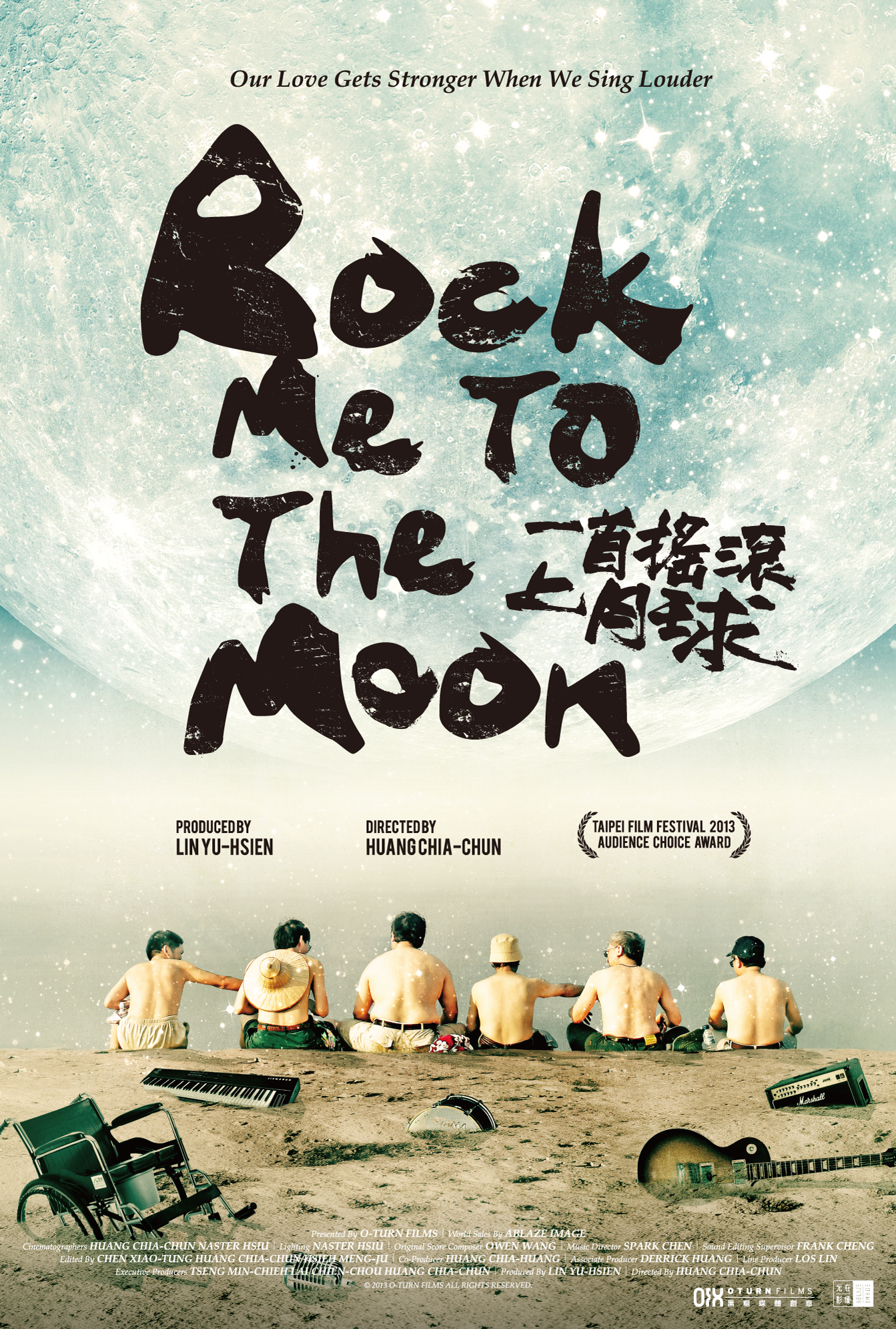
Rock Me to the Moon (一首搖滾上月球, Huang Chia-chun, 2013)

“Finally, I understand to be strong is to be gentle” sings the lead vocalist of Sleepy Dads, a rock band comprised entirely of middle-aged men who are each fathers of children with rare medical conditions. Documentarian Huang Chia-Chun first encountered the men while working as a volunteer with Taiwan Foundation for Rare Disorders where he was struck by their intense love for their children continuing to give all for their families while also obviously facing their own difficulties as they try to balance economic support with the emotional. Charting the Sleepy Dads’ quest to play at a high profile rock festival, Rock Me to the Moon (一首搖滾上月球, Yī Shǒu Yáogǔn Shàng Yuèqiú) is not only an exploration of living with disability but also a quiet re-evaluation of notions of masculinity as the fathers find themselves members of a minority when it comes to their children’s care. 

That was in fact one of the motivations which led to the founding of the band, one of the dads remarking that as they looked around at various support groups it was almost all mothers with very few men, lamenting that unfortunately many fathers either reject their children or abandon their families entirely. A news report later in the film, meanwhile, relates the tragic story of a single-father who was pushed towards suicide because of the difficulties of caring for his daughter alone which left him unable to earn the money to support them both and eventually overburdened with debt. Though one of the Sleepy Dads is a school teacher with a steady job, many of the others are in precarious freelance employment struggling to balance the need to earn money with the physical need to be there for their children each of whom has differing needs especially as some of them have more than one child suffering with longterm illness. 

The band provides a place where the men can come together to relax with others in a similar position, finding mutual support and solidarity while investing themselves in mastering a new skill. Guided by Spark, the lead singer of top rock band Quarterback, who offers them the opportunity to open at one of their concerts, the Sleepy Dads do their best to perfect their skills with the hope of eventually playing at a top festival despite their comparatively advanced age and lack of experience. Training hard to achieve their goal, it’s less the end point that matters than the process as they work through their difficulties together with good humour and determination. 

As another of the fathers puts it, however, Taiwanese men are raised to be brave and strong but he’s also under an intense amount of pressure. Poignantly his wife, preparing to undergo medical treatment herself, expresses that she’d just like her husband to give her a hug but he says he doesn’t know how because he wasn’t brought up to show emotion in that way. She also worries that he sometimes doesn’t see that she’s under a lot of pressure too and prefers to think of her as a kind of superwoman with an innate ability to cope with anything life throws at her. Nevertheless, the Sleepy Dads have fierce love for their children and are never afraid to show it, doing everything they can to care for them while knowing in some cases that their kids may not survive them and so their time together is even more precious. As the song says, they’ve learned that true strength lies in being gentle. 

While one of the mothers laments that she feels isolated even within her own family because her in-laws will not accept the children, asking her not to bring them to a family gathering, the Sleepy Dads have formed an extended family of their own coming together to celebrate one of the dad’s moves into a new home he’s had designed to better meet his family’s needs with all the kids playing together happily. They don’t pretend that their lives are easy, but they share their joys and sorrows equally and work out their frustrations through the medium of song. A warm and empathetic tribute to these selfless men and their infinite love for their children, Rock Me to the Moon is also a celebration of friendship and solidarity not to mention the power of music to overcome all hardships. 


Rock Me to the Moon streams in the US Dec. 11 – 13 as part of Asian Pop-Up Cinema & TACCGC’s @Home with Taiwan Cinema: Love & Hope.

Original trailer (English subtitles)

Snowpiercer (설국열차, Bong Joon-ho, 2013)

“Control the engine, control the world” insists the revolutionary mastermind at the centre of Bong Joon-ho’s first English language feature Snowpiercer (설국열차, Seolgungnyeolcha), quite literally meaning to seize the means of production. Adapted from the French graphic novel Le Transperceneige by Jacques Lob, Benjamin Legrand and Jean-Marc Rochette, Bong’s near future dystopia locates itself in a world both ruined and perhaps saved by human hubris, but salvation is a prize offered only to those who can pay, or at least make themselves “useful” to its mysterious and invisible creator, here an engineer both mechanical and social who controls the engine which moves the world yet insists on an order which is far from divine. 

In the near future, humanity’s attempts to repair the damage it has done through manmade climate change by releasing a manmade gas into the atmosphere have backfired to such a degree that the surface of the Earth has become a frozen wasteland no longer able to support life. The only remaining living creatures survive aboard a high tech, ironically eco-friendly train designed for luxurious cruising which cheerfully connects all the world’s railways as one, looping the globe in international solidarity. As such, the train is a self sustaining eco system, a world entire filled with orchards and aquariums where the rich can enjoy all the pleasures of the Earth, but far in the back, segregated from those whose place on the train is assured, is an underclass of stowaways who are denied such luxuries and are largely controlled through fear and starvation with gelatinous protein bars their only form of sustenance. 

“Know your place” the sinister Minister Mason (Tilda Swinton) insists, explaining that they owe their lives only to the “order” the train provides and that therefore they must each serve it by embracing the role they have been assigned. This last instruction is becoming increasingly hard to bear for those trapped in the back of the train with little to no prospect of improving their lot. There have been rebellions before but all have failed. Curtis (Chris Evans), a reluctant leader, his friend Edgar (Jamie Bell), and their mentor Gilliam (John Hurt) are planning another insurrection, certain that the power of the men who guard them is now illusionary because the weapons they carry have been rendered purely decorative. When a child is taken from the rear for unclear reasons, the plan is put into action with Curtis leading a charge towards the front, encouraged by mysterious messages from a secret collaborator somewhere further up the train, and assisted by a Korean tech expert (Song Kang-ho) responsible for designing the train’s security systems and his psychic daughter Yona (Go Ah-sung). 

Later we discover that failed revolution is another means of maintaining “balance” as synonymous with the order that the mysterious engineer Wilford (Ed Harris) provides. Rebellion keeps the population numbers in the back down and engenders the kind of despair that ensures docility at least for a time. There is something distinctly dust bowl in the train’s design from its art deco aesthetics to its wholesome brand of political indoctrination as neatly dressed children sit around the harmonium and are told of Wilford’s greatness by a prim schoolteacher while taught to fear and hate those from the rear. Curtis and his compatriots aren’t merely fighting for freedom and equality but to regain the humanity they fear the system has stolen from them. Recounting a grim tale of how Gilliam lost his limbs, Curtis laments that he too wanted to sacrifice an arm for his fellow man but he couldn’t do it. He never wanted to lead a revolution and is insecure in his vision. Tempted by Wilford, he is no longer sure if he came here to destroy “order” or merely to own it. 

Wilford’s ’30s-style ultracapitalist fascism justifies itself under the rationale that without “leadership” the people devour each other, which is disingenuous seeing as, as in Parasite, Snowpiercer’s true horror is the insidiousness of the system which forces one oppressed person to oppress another through enforced inequality. Wilford insists on “balance”, on everything having its place, but there can be no balance in a world in which a chosen few enjoy untold riches while the masses starve. The chosen few don’t even seem to be very happy, mindlessly swallowing sushi and burying themselves in hedonistic pleasures to escape the fear and emptiness of their lives. Curtis is presented with a choice, become a part of the system which, quite literally, eats its young, or make the sacrifice he couldn’t make before and become the spanner in the works. Yet the choice is only partly his, the means to reshape the world comes from an unexpected direction and is as dependent on faith as Wilford’s insistence on the divinity of industry, but when the great machine grinds to a halt those who walk free of it may find that faith repaid.


Snowpiercer is available on UK blu-ray courtesy of Lionsgate.

UK Release trailer